The whole room laughed at once. Not the polite kind of laughter, and not the nervous kind either. It was the full, open-mouthed kind that filled a barn, bounced off corrugated metal walls, and made a person feel very small, very fast. The auctioneer had barely finished reading the lot number before people were already turning to one another, nudging elbows and shaking their heads.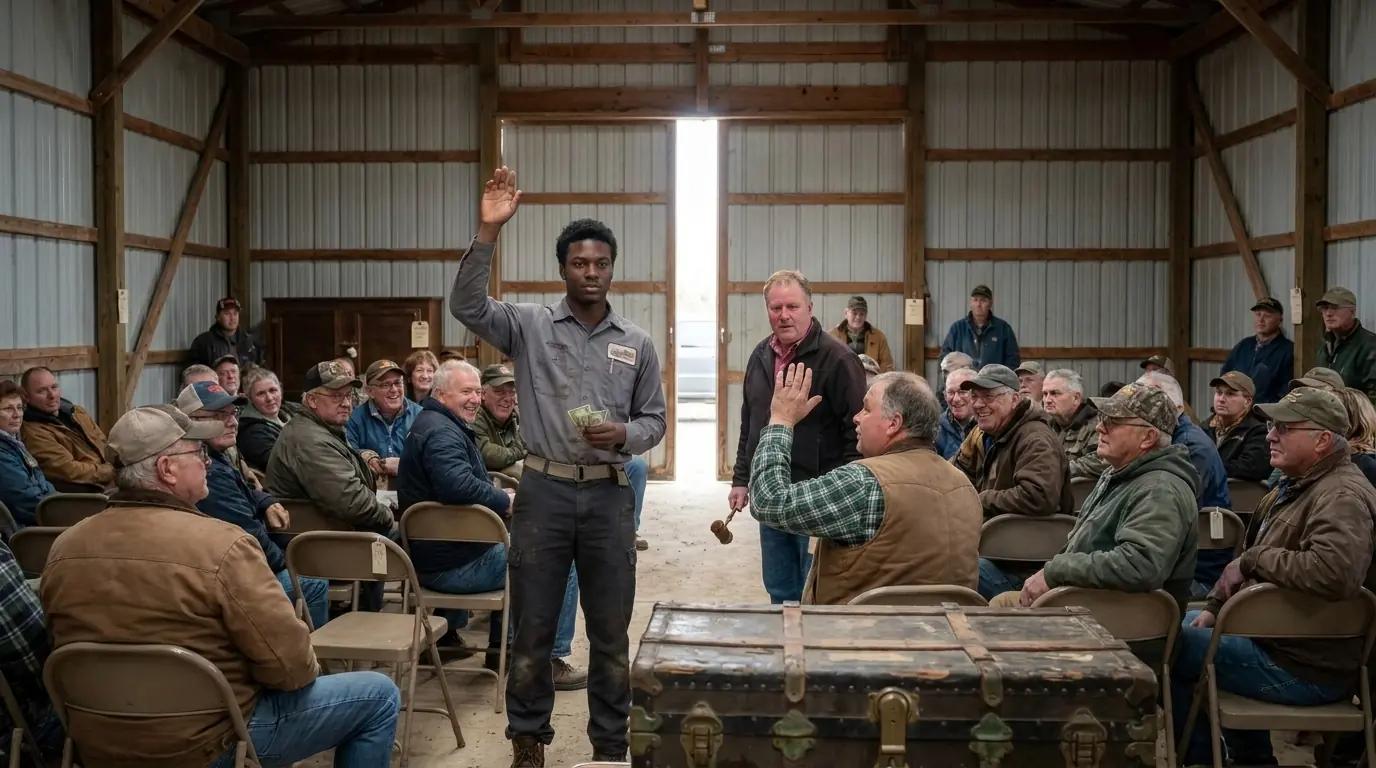
At the center of all of it stood a twenty-year-old named Kofi Mensah Reid, holding fifty dollars in crumpled bills and staring at a water-damaged wooden trunk that had not been opened in nineteen years. He did not flinch. That was the thing nobody who had been there that day would ever quite admit: the young man did not flinch.
The Millhaven County estate auction happened every spring at the old Belmont fairgrounds, just east of town on the highway that cut through the valley before the land flattened into farmland. It was the kind of event people drove forty minutes to attend, not because they needed anything, but because in a town of four thousand people, it was something to do. Farmers came. Retired couples came. Collectors in vests with too many pockets came, and nearly all of them knew one another, which was the part that mattered.
Kofi did not quite belong to that world. He had moved to Millhaven three years earlier with his mother, Adelaide, after his father died. They had come from Hamilton, which people in Millhaven said as though it explained something. Kofi worked mornings at the co-op hardware store on Fletcher Street, and in the evenings, he spent his time in the small garage behind their rented house restoring furniture.
He repaired chairs mostly, sometimes cabinets, and occasionally things people described as hopeless cases. He had a gift for it. Anyone who had seen his work knew that. But Millhaven was the kind of town where who you were mattered more than what you could do, and Kofi had not yet been there long enough to receive credit for either.
The trunk in question was Lot 47. It had come from the estate of Raymond Culver, who had died in February at eighty-one, leaving behind a farmhouse full of things his three adult children wanted nothing to do with. The estate lawyer, a compact man named Gerald Foss, had organized the auction. Most of the lots moved quickly: the John Deere tractor, the chest freezer, and the 1970s dining set that somebody's wife would sand, repaint, and call farmhouse chic.
But Lot 47 sat alone on a folding table near the east wall. A cloth had covered it earlier, but someone had removed it before the auction began. From the moment it was uncovered, people kept their distance.
It was a steamer trunk made of dark wood, with leather straps and brass fittings gone green. Water stains bloomed across the top in rings, the way wood looks after it has been wet, dried, and soaked again over many years. The lid had warped slightly at one corner. The original brass latch had been secured with a separate padlock, an older one with a brass body and steel shackle.
That padlock had not been opened in nineteen years because nobody alive knew the combination. Raymond Culver had taken whatever he knew about it to the frozen ground of Calvary Cemetery on February 4.
The Culver children had tried to get it open. Raymond's daughter, Sandra Culver Marsh, told Gerald Foss that her brother had spent twenty minutes on it with bolt cutters the previous fall before giving up.
"The metal was harder than it looked," she said.
They had considered cutting the trunk itself open, but something about doing that had made them stop. It felt wrong somehow, like opening a letter addressed to someone else. So the trunk remained sealed.
When the auctioneer, a florid man named Terry Galvin, called Lot 47, the mood in the room shifted. It was the particular shift that happens when something nobody wants gets called anyway.
Terry described it efficiently. "Steamer trunk, unknown contents, sold as is. Starting bid, twenty-five dollars."
Silence.
"History of sitting in a barn," someone called from the third row.
The room laughed.
"Twenty-five," Terry repeated.
Kofi raised his hand.
The laughter started quietly. Just a few people at first, the ones sitting close enough to see who had bid. Then it spread as people leaned, turned, and craned their necks.
Kofi stood near the back, close to the east wall and the trunk itself. He wore a gray work shirt with the co-op logo on the chest. He was the youngest person in the room by at least a decade, and he was the only Black person there, a detail everyone noticed first whether they would admit it or not.
"Twenty-five from the young man in the back," Terry said, professionally neutral.
"Thirty," called a heavyset man near the front.
His name was Don Hadley, and he bought things at auction the way some people swat flies: reflexively, just to be doing something.
"Thirty-five," Kofi said.
Don Hadley turned around. He took a long look at Kofi, then at the trunk, then back at Kofi with the expression people use when they are trying to decide whether someone is foolish or whether they are missing something.
"Forty," Hadley said.
"Fifty."
The murmuring began at fifty. People were paying attention now.
"What does he think is in there?" a woman near the middle whispered, not quietly enough.
"Couldn't tell you," the man beside her said. "Boy doesn't know the town. Doesn't know Raymond."
That was the line people repeated later in kitchens, at the diner counter on Main Street, and in the co-op parking lot: Doesn't know Raymond. As though knowing Raymond Culver was a prerequisite for bidding on his belongings. As though there were rules everyone else understood and Kofi Mensah Reid had somehow missed the moment when they were explained.
Don Hadley shrugged and sat back. He was finished.
"Fifty dollars to the young man in the back," Terry Galvin said. "Going once. Going twice."
The gavel came down, and the room laughed again. Harder this time, less politely. It was the laughter of people who believed they understood exactly what had happened: a young outsider had paid fifty dollars for a locked trunk full of nothing, and the experience would serve as a small lesson.
Kofi paid Gerald Foss in cash and arranged to collect the trunk at the end of the auction. He did not make eye contact with anyone on the way out.
He loaded the trunk into the bed of his pickup with help from a teenager Gerald had hired for the day. The trunk weighed more than it should have, considerably more, and that fact stayed in Kofi's mind as he drove home with the windows down and the radio off.
He had not bid on the trunk because he was impulsive. He was not impulsive by nature, and his mother would have been the first to say so. He had bid on it because of his father.
Noel Mensah Reid had been a locksmith. Not a hobby locksmith or an occasional locksmith, but a trained and certified professional. He had been one of those men who could sit across from a lock and understand it the way a doctor understands a patient.
Noel had run a small shop in Hamilton for eleven years. Kofi grew up in the back of it, doing homework on a workbench, listening to his father speak to locks under his breath, and watching his hands move with a precision that seemed to belong to a quieter world than the one outside the shop window.
Noel died from a cardiac event on a Tuesday afternoon in November, seventeen months earlier. He was fifty-three and alone at work when it happened.
Kofi inherited almost nothing material from him. The shop had debts. The equipment was sold to cover them, and the lease was gone within a month. But Kofi inherited his father's eyes, his father's hands, and his father's particular way of looking at a locked thing and knowing, without being able to explain how, whether there was something worth opening it for.
The padlock on Raymond Culver's trunk was a Corbin Bohannan Model 7 from the 1960s, a combination lock with a four-digit dial and an internal mechanism his father had once described as a small and honest piece of engineering. Kofi recognized it the moment he saw it. The recognition felt like a small, warm pressure in the back of his chest, the way a familiar song feels when it returns after years.
His father had worked on three of those locks in Kofi's memory. Once, while sitting on a stool with a disassembled lock spread across a cloth, Noel explained that the model had a manufacturing quirk: a slight resistance in the dial at certain digit positions. If you knew what to listen for, it could tell you which numbers were live.
It would not reveal the combination, Noel had said, but it could narrow the possibilities and give you a place to begin.
"A lock like this talks if you know how to listen," he had told twelve-year-old Kofi while slowly turning the dial with two fingers.
Kofi had never forgotten it.
He drove home with that weight in the truck bed and his father's voice in his memory. By the time he pulled onto the gravel beside the garage, he had already decided to take the rest of the day off.
The garage was small, barely large enough for a vehicle and a workbench, but Kofi had organized it with the careful attention people develop when they grow up without much space. Tools hung on a pegboard in size order. Supplies were labeled. The workbench was clean.
He slid the trunk off the tailgate and onto a furniture dolly, rolled it inside, positioned it beneath the light, and stood looking at it for a long time.
Up close, in good light, it told a different story than it had on the folding table at the fairgrounds. The water damage was old, fifteen or twenty years at least, possibly older. Beneath the staining, the wood was Baltic birch, solidly constructed. The joints were dovetailed by hand. The leather straps and brass fittings were original.
Whoever had packed and closed the trunk had done it with intention. The padlock had been placed on the exterior latch rather than built into the original hardware, which meant someone deliberately added it later to keep the trunk shut.
Kofi crouched in front of the lock and turned the dial slowly, the way his father had shown him. He felt it on the third number: a whisper of resistance, a catch in the mechanism lasting less than a quarter turn.
He noted it, returned to zero, and tried again.
He worked for a long time, but never frantically. He was not a frantic person. He worked methodically, the way his father had worked, talking to the mechanism under his breath and listening for the answers.
He took breaks. He drank tea. He came back. He tried the combinations suggested by the resistance, eliminated possibilities, and refined his approach.
At 11:40 that night, the padlock opened.
He held it in his hand for a moment. Without tension, it seemed lighter. He set it on the bench, placed both hands on the trunk lid, and looked down at it.
Outside, the neighborhood was quiet. A dog barked somewhere a few streets away, and a train sounded faintly along the CN line north of town. Kofi lifted the lid.
The smell reached him first: cedar and something older, papery and dry, the smell of things sealed away from air for a very long time.
The trunk had been packed carefully, not carelessly. On top lay two neatly folded gray wool blankets in a military-surplus style. Beneath them, wrapped in old newspaper, were half a dozen ceramic or glass objects.
He did not disturb them yet. What made him sit back on his heels was the shallow removable tray hidden along the inside edge near the lid.
A letter lay inside. Beneath it was a thick manila envelope sealed with packing tape that had yellowed to amber.
Kofi picked up the letter first. The envelope was unsealed, its flap simply tucked inside. He opened it and unfolded two pages of careful handwriting in blue ink, the handwriting of someone who had learned penmanship in school and still took it seriously.
The letter was dated September 2004. It was addressed to no one in particular.
It began, "If you are reading this, then I have either gone or given up trying to fix it myself, and in either case, I am sorry."
Kofi read it once quickly. Then he read it again, slowly.
Raymond Culver explained that he had been facilities manager at Millhaven County General Hospital from 1987 to 2001. In the summer of 1999, during a routine inventory, he discovered that surgical supply invoices had been falsified. Not in a small or careless way, but systematically over several years, totaling what he estimated at several hundred thousand dollars.
Raymond documented what he found. He brought it to his department head, Patrick Holt, and was told to let it go. Raymond did not let it go.
He took the records to the hospital administrator and was told, more firmly, to stop asking questions. Again, he refused.
In February 2000, Raymond Culver was the one who was removed. The hospital called it a restructuring. Everyone understood what it really was, but nobody said it out loud.
Raymond kept the evidence. Every invoice, comparison figure, and handwritten note was stored in the manila envelope beneath the letter.
He preserved it because he believed in 2000, again in 2001 when he tried to raise the issue through a contact at the provincial health authority, and again in 2004 when he wrote the letter, that someone would eventually care enough to act. He believed the right person would come along.
What Raymond had not anticipated, he wrote near the bottom of the second page, was that he would run out of time. The years had passed as they always do, and the energy required to keep fighting had eventually become more than he possessed.
"I should have done more," the letter said. "I know that. But I couldn't open this box myself anymore. Maybe someone else can."
Kofi understood then that the trunk had been packed in 2004. It had remained in Raymond Culver's barn for nineteen years. Raymond died in February. His children, who did not know what it contained, took one look at the lock and sent it to the estate auction.
And Kofi Mensah Reid, who had grown up behind his father's locksmith shop in Hamilton, who had paid fifty dollars on instinct and been laughed at by a room full of people who did not know him, had opened it on a Tuesday night in a garage on Birch Crescent in Millhaven, Ontario. In his hands was the letter Raymond Culver had sealed away in the hope that it would eventually find the right person.
Kofi sat on the cold concrete floor for a long time. The dog down the street fell silent. The train was gone. It was nearly one in the morning.
He read the letter a third time.
He did not go to the police immediately. He considered it, turning the problem over patiently and methodically.
His concern was simple. A twenty-year-old with fifty dollars' worth of claim to a dead man's trunk, walking into a police station with twenty-five-year-old hospital invoices, did not present a situation that commanded automatic respect. Kofi understood how rooms worked. He had been in enough of them to know that the first judgment people made was whether you belonged there.
He called his mother first.
Adelaide Mensah Reid listened without interrupting, which was her gift. She could listen the way other people pray: fully and without distraction.
When Kofi finished, she remained quiet for a moment.
"Your father would have known what to do," she said.
"I know," Kofi replied.
"So do you."
Next, he called Judith Osei, who had been two years ahead of him at school in Hamilton and now worked as a legal aid paralegal in Guelph. She answered on the fourth ring, which was better than Kofi expected at 1:15 in the morning.
He told her what he had found. Judith listened and asked three sharp, specific questions.
Then she said, "Don't touch the documents more than you have to. Photograph everything before you move it, and call me in the morning. I know someone at the health ministry."
Kofi spent the next two hours doing exactly that. He photographed every page with his phone, positioning the lamp for maximum clarity. He laid each document flat on the workbench, handled it only by the edges, and preserved the order in which it had been packed.
His father always said the way you do a thing tells the thing how seriously you mean it.
By three in the morning, Kofi had sent Judith a complete set of photographs and carefully returned the original documents to the envelope. He locked the garage, went inside, and slept poorly, but he slept.
What followed was neither simple nor fast, because these things rarely are.
The health ministry contact Judith knew was Harriet Boateng, an auditor in the provincial compliance office. After reviewing the photographs, Harriet said she would need to examine the originals before making any definitive statement, but what she saw appeared to be, as she carefully put it, potentially significant.
The originals were examined. Authentication took time. Document experts reviewed the paper, ink, dates, and chain of custody.
Patrick Holt, Raymond Culver's former department head, had retired in 2006 and now lived in Barrie. He was seventy-four. When contacted, he initially said nothing useful.
The hospital administrator from that era had died in 2015. Three people connected to the procurement chain Raymond documented were still alive and living in the province.
Kofi did not attend those meetings or interviews. He was not entitled to. The documents were now evidence in a process that did not technically belong to him, no matter what he had paid for the trunk.
Judith kept him updated, sometimes calling from parking lots after meetings and using the careful language of someone trained not to say too much.
"Progress is being made."
"The right people are paying attention now."
"This isn't going away."
In Millhaven, word about the trunk spread the way news travels in small towns: quickly, imprecisely, and through cracks in the ground. The story circulating was garbled, missing most of the facts and replacing them with assumptions, but its basic shape was clear.
The young man from Hamilton had bought something at the Culver auction that turned out to matter.
Nobody admitted they had been wrong to laugh, but the laughter was very quiet now.
Don Hadley came into the co-op one afternoon while Kofi was logging an inventory order. He stood at the counter and said without quite looking at him, "Heard you made a good buy at the Culver sale."
"I'm not sure yet," Kofi said.
Hadley nodded slowly, as if that answer satisfied him, and left.
Sandra Culver Marsh called Kofi on a Thursday in early June. Her voice was careful, the way voices become when people are feeling something they have not decided how to name.
She said her brother had told her some of what was happening. Their father had never explained why he left the hospital, and the family had assumed it was simply age, time, or the ordinary drift of things.
Sandra said she did not know what to say exactly, but she was glad the trunk had found someone who could open it.
"Your father left it hoping someone would," Kofi said.
Sandra was quiet for a moment.
"He was a stubborn man," she said. "He believed things got righted eventually, even if he didn't live to see it."
She paused.
"I used to think that was naive."
"And now?" Kofi asked.
She did not answer immediately.
"I don't know yet," she said. "Ask me again in a year."
The formal findings were released in October.
A provincial compliance review concluded that systematic procurement fraud had occurred at Millhaven County General Hospital between 1996 and 2001. The total was significantly higher than Raymond Culver had estimated, closer to 1.2 million dollars over the full period.
Three individuals were referred to the appropriate authorities. The hospital's current administration, which had no connection to the events, issued a formal statement acknowledging both the fraud and what Raymond Culver had done in trying to stop it.
The statement mentioned him by name. It said that if his concerns had been properly addressed at the time, years of ongoing loss to a public institution might have been prevented.
Nobody held a party. That was not how these things worked. There was no ceremony, and Raymond Culver received no posthumous award because the systems that issue formal recognition had not been designed with people like him in mind.
But his name was in the public record now, attached to the right story for the first time in twenty-three years.
When Sandra Culver Marsh read the statement, she called her siblings and read it aloud to them over the phone. Afterward, she sat alone at her kitchen table for a long time.
Kofi heard about the findings from Judith, who called on a Friday afternoon. He was in the garage sanding a rocking chair someone had brought him the week before, and he stepped outside so he could hear her properly.
He stood in the gravel with sawdust on his hands while she explained what had happened.
"That's it?" he asked.
"That's it," Judith said. "That's what it looks like. The rest takes more time."
Kofi looked down at his hands, at the sawdust, and at the grain still visible within it if you looked carefully.
"Okay," he said.
"You did a good thing," Judith told him.
Kofi thought of his father, the stool in the Hamilton locksmith shop, the disassembled lock spread across a cloth, and two fingers resting on a dial.
A lock like this talks if you know how to listen.
"My father did," Kofi said.
The trunk still sits in the corner of Kofi's garage. He cleaned it, reconditioned the leather straps, and polished the brass fittings until they looked close to what they once were.
He did not sell it. He was not entirely sure why, except that selling it felt like the wrong thing to do.
Sandra Culver Marsh came to see it in November, on a cold afternoon when the maples on Birch Crescent had gone bare and the sky was the flat white of early winter. She stood in the garage doorway and looked at it for a while.
"It's smaller than I remembered," she said.
"It always is," Kofi replied, "when you finally look at the thing."
She nodded and said little else. She stayed for tea, and they talked about Raymond, not about the hospital or the fraud, but about the man himself.
He had coached minor hockey for twenty years. He made his own jam. He believed stubbornly, right to the end, that the world was capable of getting things right if you gave it enough time.
Sandra left before dark. Kofi stood at the window and watched her taillights disappear around the corner. Then he returned to the rocking chair.
There is something worth saying before this story ends, something the events themselves cannot say because stories do not speak. People do, and someone has to.
A room full of people laughed at a young man for paying fifty dollars on instinct, for trusting something he could not fully explain, and for refusing to become the person the room had already decided he was. They were wrong, but not merely because Kofi turned out to be right about the trunk. That was never the real point.
The point is that nobody in that room asked what he knew that they did not. Nobody considered that the thing they were laughing at might be something they simply could not see.
A man named Raymond Culver spent twenty-three years waiting for the right person to come along. He never lived to learn that someone had.
That is the part that stays with you, if you let it.
Kofi Mensah Reid listened to a lock the way his father taught him. He paid attention to the small, honest resistance that told him where the truth was hiding. He was patient with it. He did not give up when the mechanism was stubborn, the hour was late, or the room full of people had already made up its mind.
His father would have understood exactly what that meant.