November 14, 1983 began with mud.
Not ordinary farm mud.
This was the thick Missouri kind that swallowed boots, buried tires, and turned every field road into something closer to wet concrete than soil.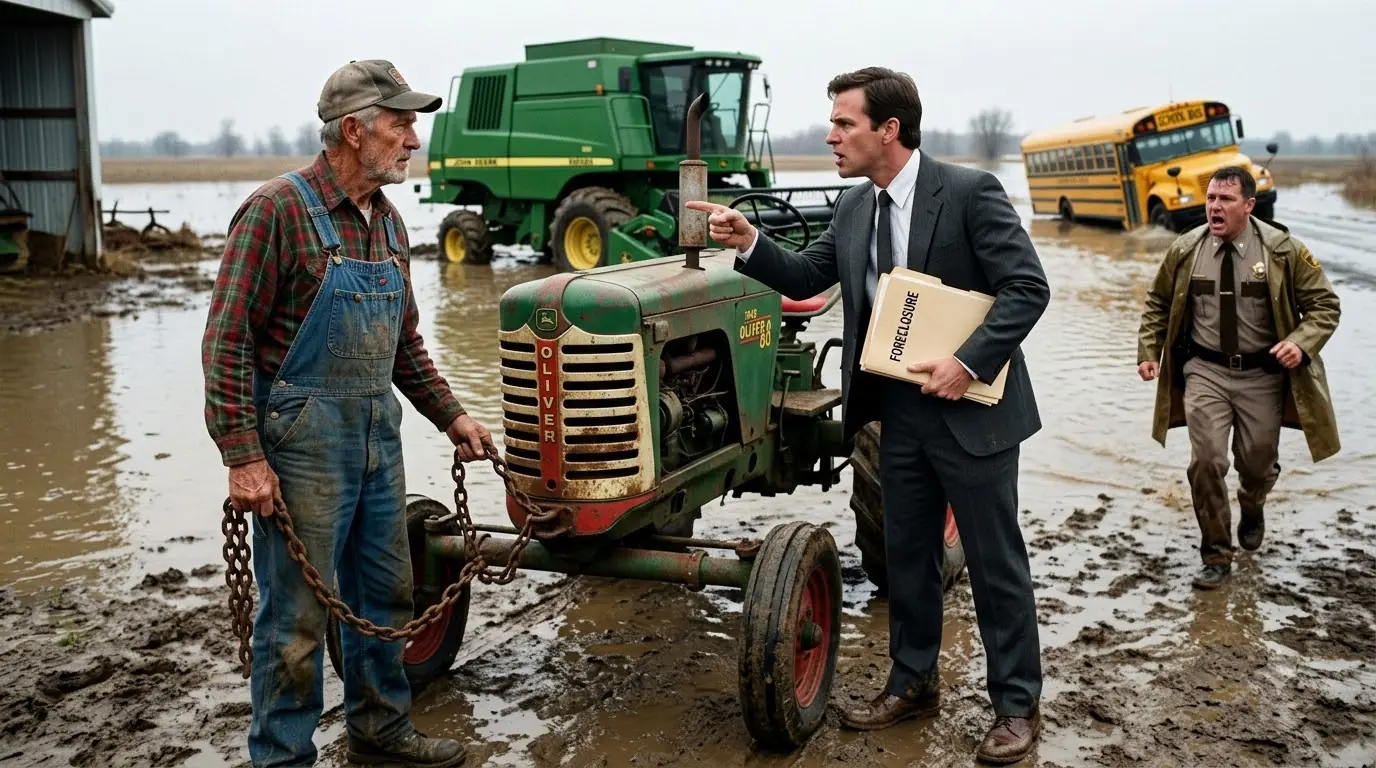
Rain had fallen across Macon County for six straight days.
Creeks had risen over their banks.
Drainage ditches disappeared beneath brown water.
Soybean fields that should have been hardening for late harvest now looked like shallow lakes scattered beneath a low gray sky.
At 8:12 that morning, three vehicles turned onto Whitaker Road.
Two tow trucks.
One county pickup.
Behind them came a dark sedan carrying Daniel Mercer, manager of Prairie State Agricultural Credit.
Daniel was thirty-six years old.
Clean haircut.
Dark charcoal suit.
Expensive watch.
Polished black shoes that had never been designed for a farmyard in November.
On the passenger seat beside him rested a thick foreclosure folder.
Inside were documents capable of transferring 312 acres, three grain silos, a red barn, two storage sheds, and nearly every piece of machinery Harold Whitaker owned to the bank.
Ownership was scheduled to transfer at noon.
Daniel had handled foreclosures before.
He disliked them.
But he did not believe emotion should interfere with mathematics.
Loans were agreements.
Payments had schedules.
Collateral existed for a reason.
To Daniel, the system was harsh only when someone refused to accept that numbers did not care how long a family had lived somewhere.
He parked near the farmhouse.
A tow truck driver named Rick Dawson climbed out behind him and looked toward the old shed.
“What are we hauling first?”
Daniel checked his papers.
“Nothing until noon.”
Rick nodded.
Then he saw the tractor.
A faded green Oliver 88 stood beneath the open side of the shed.
Its paint had oxidized almost gray.
One headlight was cracked.
The hood carried scratches that looked older than Rick.
Mud stained the rear tires.
A weld line crossed one fender.
Rick laughed.
“You want that museum piece too?”
The second driver, Eddie Coleman, walked closer.
“That thing still run?”
Neither noticed Harold standing near the porch.
He was seventy-two.
Lean.
Gray stubble.
Deep lines around his eyes.
Faded cap.
Plaid shirt beneath mud-stained denim overalls.
His hands were thick and scarred from fifty years of wire, steel, hydraulic fluid, and winter cold.
He looked at the men.
Then at the tractor.
Then back toward the flooded fields.
Rick grinned.
“No offense, old-timer, but I think the Smithsonian pays better than salvage.”
Eddie laughed.
Harold did not.
Daniel approached with the folder beneath one arm.
“Mr. Whitaker?”
Harold nodded.
“Daniel Mercer.”
“I know.”
Daniel paused.
They had spoken twice by phone.
Harold had sounded exactly like this.
Calm.
No anger.
No pleading.
That had bothered Daniel more than shouting would have.
“I'm required to provide final notice in person.”
Harold looked at the folder.
“You already sent three.”
“I know.”
“Then this makes four.”
“Yes.”
Daniel opened it.
“Unless the arrears are cured by noon, Prairie State Agricultural Credit will assume ownership under the security agreement.”
Harold stared across the farm.
His father had bought part of that ground after the Depression.
Harold had added acreage slowly.
Twenty acres one year.
Thirty-two another.
Leasing neighboring ground when money was too tight to purchase.
He had planted his first soybean crop there in 1951.
Married Eleanor in 1954.
Raised two children in the farmhouse.
Buried his wife twenty-five years later after cancer consumed nearly everything they had saved.
The hospital bills continued long after she was gone.
Then drought came.
Then interest rates climbed.
Then two bad harvests arrived nearly back to back.
Harold had missed payments.
Not because he stopped working.
Because the farm stopped producing enough money to survive both weather and debt.
Daniel believed he understood all of this.
But understanding a file was not the same as understanding a life.
“Mr. Whitaker,” he said, “I can give you until noon. No more.”
Harold nodded once.
“I heard you.”
Rick glanced at the Oliver again.
“You could've sold that years ago.”
Harold looked toward him.
“For what?”
Rick shrugged.
“Anything.”
Harold walked toward the tractor and placed one hand on its hood.
“My father bought it new.”
Rick smiled.
“That's sentimental.”
“No.”
Harold looked at him.
“That's maintenance.”
Rick frowned.
Harold continued:
“That tractor was built before people forgot hard times come back.”
Nobody laughed immediately.
Daniel studied him.
There was no bitterness in the sentence.
Only certainty.
The silence lasted until another engine appeared on the road.
A mud-covered pickup raced toward the farm.
The driver, Luke Harris, barely stopped before jumping out.
“Harold!”
Harold turned.
Luke was forty-two, soaked from the knees down.
“We buried the Case.”
“Where?”
“South field.”
“How bad?”
“Rear axle almost gone.”
Rick smirked.
“That combine weighs, what, twenty thousand pounds?”
“More.”
Rick looked toward the Oliver.
“Maybe Grandpa's tractor can save it.”
Eddie laughed.
Daniel did not.
He was watching Harold.
The old farmer simply turned and walked toward the shed.
No argument.
No insult.
No defense.
He disappeared into the darkness.
For almost twenty seconds, only rain could be heard.
Then:
Metal clanged.
A toolbox opened.
Something poured into a tank.
Daniel checked his watch.
11:02.
“What's he doing?” Rick asked.
Luke smiled faintly.
“Starting it.”
Rick laughed again.
“That thing hasn't moved since Reagan got elected.”
Luke looked at him.
“You don't know Harold.”
The first ignition crack came from inside the shed.
Violent.
Mechanical.
Then silence.
Rick grinned.
“Called it.”
Another cough.
Longer.
Smoke rolled from beneath the roof.
Then the engine turned again.
Once.
Twice.
And suddenly the Oliver came alive.
The sound was enormous.
Deep.
Uneven.
A six-cylinder mechanical roar that seemed to travel through the ground before reaching the ear.
Blue smoke climbed from the vertical exhaust.
Harold eased the tractor into daylight.
Daniel stared.
He had expected noise.
He had not expected presence.
The Oliver looked primitive beside the modern equipment parked around it.
No enclosed cab.
No electronic displays.
No air conditioning.
No sophisticated hydraulic controls.
Just steel.
Cast iron.
Rubber.
Mechanical linkages.
But every part seemed to move with purpose.
Daniel stepped closer.
“You kept it running?”
Harold stopped.
“No.”
Daniel frowned.
Harold looked at him.
“I kept it ready.”
Luke laughed.
Not mockery.
Relief.
“If it gets my combine out, I'll pay you cash.”
Harold shook his head.
“No.”
Luke blinked.
“What?”
“You help the next farmer stuck worse than you.”
Luke stared.
Then nodded.
“Deal.”
Harold loaded a heavy logging chain onto the rear platform.
Daniel glanced at his watch again.
11:09.
Foreclosure waited.
Yet something made him follow.
The south field lay nearly a mile away.
The Case combine sat at an angle in the mud.
Its rear axle was buried nearly halfway to the frame.
One modern tractor already rested fifty yards away with its tires sunk deep enough that it could no longer help.
Rick examined the situation.
“That Oliver can't pull it.”
Harold climbed down.