“Ma’am, this branch handles serious clients.”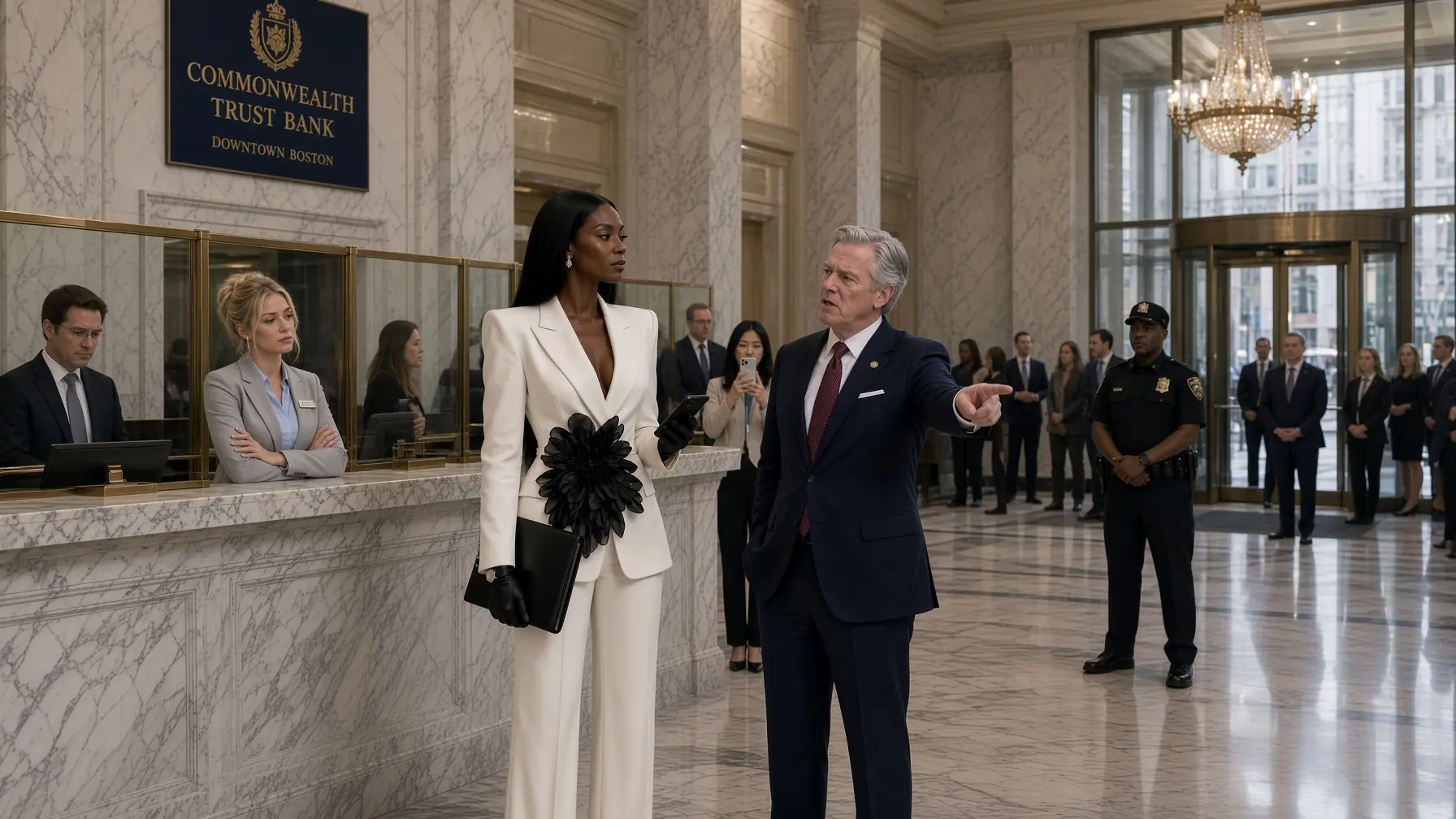
The words landed softly, almost politely, which made them worse.
Dr. Naomi Caldwell stood in the middle of the marble lobby of Commonwealth Trust Bank, holding a leather portfolio in one hand and a phone in the other. She was dressed in a cream blazer, dark trousers, and low black heels, the kind of professional outfit that should have ended any question about whether she belonged in a financial institution. But the receptionist had already decided the story before hearing it.
Naomi looked at the young woman behind the desk.
Her nameplate read Brooke Ellis.
Brooke was twenty-three, with glossy hair, perfect nails, and the distracted confidence of someone who had learned arrogance from management before she learned judgment. Her eyes flicked from Naomi’s blazer to her shoes, then to the old leather portfolio she carried. The portfolio was expensive, but worn at the corners from years of travel, meetings, audits, and boardrooms where people underestimated her until the first slide appeared.
“I’m here to open a corporate account,” Naomi said. “I was told this branch could handle high-volume institutional deposits.”
Brooke barely looked at her screen.
“Do you have an appointment?”
“No. But I was referred by Congressman Adler’s office and by your regional team.”
Brooke’s mouth tightened.
“We don’t take walk-ins for business services.”
Naomi waited.
The sentence itself was not offensive.
The way Brooke said it was.
It carried that familiar tone, the one dressed up as policy but shaped like dismissal. Naomi had heard it in private clubs, corporate lobbies, hotel check-in counters, airport lounges, and academic conferences where people mistook confidence for permission. The words changed from place to place, but the message stayed the same.
Not here.
Not you.
Not without someone else confirming you are allowed.
“I understand procedures,” Naomi said. “But I’m not here for a small business starter account. My firm is transferring operating funds connected to a federal infrastructure consulting contract. I need to speak with a business banking officer.”
Brooke smiled without warmth.
“Maybe one of our neighborhood partner branches would be more appropriate.”
Naomi’s fingers rested quietly on the portfolio clasp.
“More appropriate how?”
Brooke blinked.
The question had arrived too cleanly for comfort.
“You know,” Brooke said, lowering her voice slightly. “A branch that works more with smaller community accounts.”
At 8:48 that morning, the lobby was filling with the usual downtown crowd. Attorneys with briefcases. Retirees waiting for the safe deposit desk. A restaurant owner dropping off cash receipts. A young college student sitting near the wall, recording a casual morning livestream for her followers while sipping iced coffee from a plastic cup.
The student’s name was Lila Tran.
She had 61,000 followers on TikTok, mostly because she filmed small moments around Boston and somehow made city life look more interesting than it felt to the people living it. That morning, she had started her stream while waiting for her mother to finish a wire transfer. She meant to film the lobby ceiling, the old brass teller windows, and the absurd price of coffee across the street.
Instead, her phone captured Brooke Ellis looking at Dr. Naomi Caldwell as if the bank had just been asked to lower its standards.
The comments began slowly.
What’s happening?
Why is the receptionist acting like that?
She looks professional to me.
Naomi did not know she was being recorded yet.
She only knew the old heat in her chest, the heat that came when a person tried to make humiliation sound like customer service. She had spent too many years learning not to answer that heat too quickly. Anger, when people expected it from you, became evidence they thought they had predicted.
So she kept her voice calm.
“I would still like to speak with your manager.”
Brooke’s eyes shifted toward the corner office.
“Mr. Whitmore is busy.”
“With clients?”
“With important clients.”
The phrase was not accidental.
Naomi heard every inch of it.
Across the lobby, a Black security guard near the entrance turned his head slightly.
His name was Andre Miles.
Andre had worked at Commonwealth Trust for eleven years, long enough to know the difference between policy and performance. He had seen Brooke dismiss people before. He had seen the branch manager do worse. He had also learned that speaking up in a private bank lobby could cost a uniformed man his paycheck faster than misconduct cost a manager his job.
But that morning, something about Naomi’s stillness made him pay closer attention.
At 8:52, the door to the corner office opened.
Stephen Whitmore stepped out.
He was fifty-two, silver-haired, narrow-faced, dressed in a navy suit that looked like it had never been worn outside rooms where men expected agreement. He had managed the downtown Boston branch for fourteen years. He spoke in annual reports about service excellence, relationship banking, and client trust.
His branch had also received thirteen discrimination complaints in two years.
None sustained.
Most buried under phrases like miscommunication, inconsistent expectations, and failure to follow appointment protocol.
Whitmore looked at Brooke first.
Then at Naomi.
The change in his expression was brief, but obvious to anyone watching closely.
“This woman wants to open a corporate account without an appointment,” Brooke said. “I explained our policy, but she’s insisting.”
Naomi turned toward Whitmore.
“My name is Dr. Naomi Caldwell. I operate Caldwell Advisory Group. I’m seeking business banking support for a significant federal consulting contract.”
Whitmore’s smile appeared.
It was smooth.
It was polished.
It was completely empty.
“Dr. Caldwell,” he said, making the title sound like a costume. “This establishment serves qualified clientele with verified capital relationships. We handle complex accounts, significant deposits, and private commercial portfolios.”
“I’m aware.”
His eyes moved over her face, her clothes, her portfolio.
“I’m not sure you are.”
The lobby changed.
Small conversations faded.
The restaurant owner at the teller counter turned halfway around.
Lila’s livestream jumped from 80 viewers to 400.
Naomi held his gaze.
“I would like you to review my documentation before making that assessment.”
Whitmore gave a small laugh.
“Documentation can be printed anywhere.”
“So can assumptions.”
Brooke’s mouth opened slightly.
Andre looked down, but only for a moment.
Whitmore’s face hardened.
“Ma’am, I’m trying to save you embarrassment. Our commercial accounts require serious capital backing. We are not a fit for every boutique operation or grant-funded initiative.”
The coded language was clean enough for court if nobody listened carefully.
But everyone in the lobby heard what he meant.
Naomi set her portfolio on the reception counter.
“My firm is not a boutique operation.”
Whitmore leaned closer.
“Then perhaps you should have had your assistant schedule properly.”
“I don’t need an assistant to enter a bank.”
“No,” he said. “But it might help you understand where to go.”
Lila’s comments exploded.
Did he just say that?
This is racism with marble floors.
Someone tag the bank.
Naomi looked toward Brooke’s monitor.
“Did you enter my name?”
Brooke hesitated.
“No.”
“Did you check the referral note?”
“No.”
“Did you ask for the contract documents?”
Brooke’s face flushed.
Whitmore interrupted.
“That is enough. We are not obligated to waste staff time validating every exaggerated claim made at the front desk.”
Naomi’s voice lowered.
“Mr. Whitmore, I am going to give you one final opportunity to handle this professionally.”
The manager smiled again.
That was his mistake.
People who mistake calm for weakness often smile right before the floor disappears.
“Are you threatening me?”
“I’m warning you.”
He turned toward Andre.
“Security, please escort this woman out. We have legitimate clients waiting.”
Andre did not move immediately.
That hesitation mattered.
Whitmore noticed it.
“Mr. Miles,” he said sharply. “Do your job.”
Andre walked forward slowly.
He looked at Naomi, then at the portfolio, then at the phones now visible in the lobby. His own hand moved toward the small recorder clipped near his security radio. It was not official bank equipment. It was his. He had started carrying it after watching too many incidents vanish into polished reports.
“Ma’am,” Andre said gently, “I’m going to ask that we keep this peaceful.”
Naomi nodded.
“I have no intention of disturbing the peace.”
Whitmore scoffed.
“You already have.”
Naomi turned back to him.
“No. I disturbed your expectation.”
At 8:59, Lila’s livestream crossed 3,000 viewers.
People were tagging local reporters.
Someone in the comments had already identified Whitmore from a previous complaint thread.
Another viewer posted: Isn’t this the branch that got sued two years ago?
Naomi reached into her portfolio.
Whitmore stepped back as if she had reached for a weapon.
“Hands where we can see them,” he snapped.
The phrase drew a sharp breath from the crowd.
Naomi paused.
Slowly, she removed a single folder.
No rush.
No drama.
Just paper, bound in a navy clip, with a federal contract summary visible on the front page.
“This is the award letter for Caldwell Advisory Group’s federal advisory contract,” she said. “Fifty-eight million dollars over four years. Your institution was recommended for operating deposits, payroll processing, and reserve management.”
Whitmore did not take it.
His refusal became louder than any insult.
Brooke looked at the figure on the page.
Her eyes widened.
Whitmore noticed and turned on her.
“Do not touch those documents.”
Naomi closed the folder.
“Interesting.”
“What is?”
“You just refused to inspect the documents you said I lacked.”
Whitmore’s voice rose.
“I am not going to be manipulated in my own branch.”
“Your branch?” Naomi asked.
“My branch.”
That was the second mistake.
The first had been assuming.
The second was saying ownership out loud.
At 9:00 exactly, Naomi took out her phone.
Whitmore laughed.
“Calling your lawyer?”
“No.”
She tapped a contact.
Margaret Lane
Regional President
The phone rang once.
“Margaret Lane.”
“Margaret, it’s Naomi Caldwell. I’m at Commonwealth Trust, downtown Boston, and the Whitmore situation is unfolding exactly as your internal complaints suggested.”
The lobby went still.
Whitmore’s face changed.
Not fully.
Just enough.
There were many Margarets in the world, but only one Margaret Lane who could end his career before lunch.
Naomi continued.
“Yes, the branch manager. Yes, he refused to review credentials. Yes, he instructed security to remove me. Yes, multiple customers are recording. One livestream appears to have several thousand viewers.”
Whitmore stepped forward.
“Give me that phone.”
Andre moved before he could reach her.
Not aggressively.
Just enough to stand between the manager and Naomi.
Whitmore froze.
Naomi looked at him with professional calm.
“I would not advise that.”
Brooke whispered, “Mr. Whitmore…”
“Quiet,” he hissed.
Naomi listened to Margaret for a moment, then nodded.
“Yes. Send corporate enforcement. Preserve all lobby footage, teller audio, workstation logs, security radio traffic, and gate timestamps.”
Whitmore’s breathing changed.
“Dr. Caldwell,” he said, forcing the title now, “perhaps there has been a misunderstanding.”
Naomi ended the call.
“No.”
The word was soft.
It still cut clean.
“A misunderstanding happens when information is unclear. I gave you my name, purpose, referral source, contract context, and documentation. You chose not to look.”
The crowd murmured.
Lila’s livestream crossed 8,000 viewers.
Whitmore looked around and seemed to realize for the first time that his lobby had become a courtroom.
“Let’s move into my office,” he said quickly. “We can resolve this privately.”
Naomi’s face remained calm.
“You made this public when you announced that I did not qualify.”
“That was standard procedure.”
“No,” she said. “That was prejudice wearing a tie.”
At 9:09, a black SUV stopped outside the bank.
A man in a dark suit stepped out, carrying a tablet and a thin leather folder. His name was Daniel Mercer, corporate investigations director for Commonwealth Trust. Managers across the region knew his name the way people know storm warnings.
He entered the lobby without looking left or right.
Whitmore moved toward him.
“Daniel, thank God. This customer is creating—”
Mercer walked past him.
Straight to Naomi.
“Dr. Caldwell,” he said. “I apologize on behalf of Commonwealth Trust. President Lane briefed me on the way over.”
That single sentence completed the reversal.
The people in the lobby understood it.
The livestream understood it.
Brooke understood it so clearly she sat down behind the reception desk.
Whitmore stood there with his mouth slightly open, suddenly just a man in a suit who had misread the only person in the room he could not afford to misread.
Daniel opened the folder.
“Mr. Whitmore,” he said, “let me properly introduce Dr. Naomi Caldwell. PhD in economics from Columbia. Former Federal Reserve policy adviser. Board member for three national economic development councils.”
Whitmore swallowed.
Daniel continued.
“As of yesterday morning, Dr. Caldwell is also Commonwealth Trust’s newly appointed Senior Vice President for Client Equity and Compliance across the Northeast region.”
The lobby went silent.
Then the silence broke into whispers.
Lila nearly dropped her phone.
Her livestream comments became unreadable.
Naomi reached into her portfolio again and removed an appointment letter signed by the CEO.
She placed it on the counter, directly beside Brooke’s keyboard.
“This morning was a mystery audit,” she said. “Your branch was selected because of thirteen discrimination complaints, unusually low minority client retention, and repeated employee concerns about exclusionary service culture.”
Whitmore looked down at the letter.
His hand twitched, but he did not touch it.
“What happened here today will be included in my first compliance report to the executive board.”
“Dr. Caldwell,” he said, voice breaking, “I didn’t know.”
Naomi looked at him.
“That is exactly the problem.”
“I mean, I didn’t know your position.”
“You knew I was a customer.”
He had no answer.
Naomi turned toward Brooke.
“You also knew I was a customer.”
Brooke’s eyes filled.
“Yes, ma’am.”
“And you chose to treat me as an inconvenience before checking a single fact.”
Brooke lowered her head.
“Yes.”
That honesty, late as it was, saved her from sounding like Whitmore.
At 9:16, Daniel Mercer began the formal preservation process.
Lobby cameras.
Workstation logs.
Phone recordings.
Security audio.
Customer witness contacts.
The timestamped livestream.
Even the exact moment Brooke failed to enter Naomi’s name into the client system.
Everything was secured.
Andre Miles stepped forward when asked for a statement.
His voice was steady.
“I witnessed Dr. Caldwell request professional service. I witnessed Ms. Ellis dismiss her without checking credentials. I witnessed Mr. Whitmore refuse to review documents, suggest she did not meet branch standards, and order me to remove her without cause.”
Whitmore looked at him with betrayal.
Andre did not look away.
“I’ve seen similar incidents before.”
That sentence changed the room again.
Naomi turned toward him.
“How many?”
Andre exhaled.
“Enough that I started writing them down.”
He reached into the inner pocket of his uniform jacket and pulled out a small black notebook.
Dates.
Times.
Names.
Descriptions.
The quiet archive of a man who had learned that memory needed backup.
Naomi accepted it with both hands.
“Thank you, Mr. Miles.”
Andre nodded.
His eyes shone, but he did not break.
People like him rarely got to be the hero in official reports.
Naomi made a note to change that.
Whitmore tried one more time.
“Dr. Caldwell, I have managed this branch for fourteen years. I have a family. A mortgage. Responsibilities. Surely one bad interaction should not erase an entire career.”
Naomi studied him.
“This was not one bad interaction.”
He opened his mouth.
She lifted the notebook.
“It is one recorded example of a pattern.”
Daniel Mercer’s phone buzzed.
He looked at the screen.
“The emergency executive call is set for 10:30.”
Naomi nodded.
“I’ll be ready.”
Whitmore went pale.
“Emergency call?”
Naomi closed her portfolio.
“Yes. The board needs to decide whether this branch is a banking office or a legal liability.”
At 10:30, Naomi sat in a glass conference room on the thirty-first floor of Commonwealth Trust’s regional headquarters.
Downtown Boston stretched beneath the windows, bright and indifferent. On the table in front of her sat a laptop, Andre’s notebook, the preserved lobby footage, the federal contract summary, and a live social media report showing the video had passed 220,000 views. By then, the phrase Banking While Black had begun trending across New England.
Chairman Richard Ellison joined from New York.
Margaret Lane joined from her office upstairs.
General Counsel Priya Raman joined from Washington.
Three board members appeared on screen from Chicago, Atlanta, and San Francisco.
Nobody made small talk.
Naomi began with the numbers.
“The downtown Boston branch has generated thirteen documented discrimination complaints over twenty-four months, more than four times the regional average. Minority business account conversion is thirty-seven percent below peer branches. High-value Black and Latino clients are redirected to smaller branches at a rate inconsistent with standard service practice.”
She clicked to the next slide.
“This morning, I observed the mechanism behind those numbers.”
The video played.
Brooke’s dismissal.
Whitmore’s refusal.
The phrase qualified clientele.
The security order.
The phone call.
The reveal.
Nobody interrupted.
When the screen went dark, the room felt heavier.
General Counsel Raman spoke first.
“Legal exposure?”
“Significant,” Naomi said. “Possible Section 1981 claim, state civil rights exposure, pattern evidence, reputational harm, and potential regulatory inquiry. The federal contract relationship complicates the optics further.”
A board member named Thomas Greer frowned.
“Are we sure immediate termination is appropriate? Viral videos can distort context.”
Naomi looked at him.
“That is why we are not relying only on the video.”
She opened Andre’s notebook.
“Mr. Miles documented nine incidents in seven months. Three match prior complaints. Two involve customers redirected after requesting commercial accounts. One involves a Black physician told wealth management was not available without an appointment, while a white walk-in was accepted twenty minutes later.”
Greer went quiet.
Naomi continued.
“Whitmore’s personnel file also shows documented resistance to mandatory service equity training. His branch has no minority managers, despite operating in a service area that is fifty-six percent minority. Employee promotion patterns show the same culture his lobby behavior revealed.”
Margaret Lane leaned toward her camera.
“What are your recommendations?”
“Immediate termination of Stephen Whitmore for misconduct and breach of professional conduct obligations. Brooke Ellis remains employed only under probation, retraining, and mentorship if she cooperates fully. Temporary corporate oversight of the branch. Independent audit of all denied business account inquiries. Promotion of Andre Miles to interim operations liaison during the transition.”
One board member raised an eyebrow.
“The security guard?”
Naomi’s gaze did not move.
“The security professional who documented a pattern leadership ignored.”
The room stayed silent.
Then Margaret nodded.
“I support the recommendation.”
One by one, the board agreed.
The vote was nearly unanimous.
Whitmore was terminated by noon.
He cleaned out his office under Daniel Mercer’s supervision, placing fourteen years of plaques, framed certificates, golf photos, and executive retreat souvenirs into a cardboard box. The video had passed half a million views by then. His name was already attached to articles, posts, and clips that would follow every future job application.
No severance.
No performance bonus.
No graceful exit framed as retirement.
Just termination for cause.
Brooke sat in the break room waiting for her own meeting, her face pale and blotched from crying. When Naomi entered, Brooke stood immediately.
“Dr. Caldwell, I’m sorry.”
Naomi sat across from her.
“I believe you are sorry today.”
Brooke lowered her eyes.
“I deserved that.”
“No,” Naomi said. “You needed to hear it.”
Brooke wiped her cheek.
“Am I fired?”
“That depends on what you do with what happened.”
The young woman looked up.
Naomi’s tone stayed firm.
“You followed a discriminatory culture because it was easier than questioning it. That does not make you harmless. It makes you responsible.”
Brooke nodded slowly.
“You will complete bias training. You will work under new supervision. You will be evaluated quarterly. And you will apologize directly to any customer identified in the branch review if they are willing to hear it.”
Brooke whispered, “Yes, ma’am.”
“This is not a second chance because you cried. It is a second chance because transformation requires some people to learn in public and then do better in private.”
Brooke absorbed that.
Good.
Naomi was not interested in easy forgiveness.
She was interested in change.
Andre Miles’s promotion happened that afternoon.
Not to branch manager.
That would have been symbolic and unfair without proper training.
Instead, he became interim customer integrity liaison, reporting directly to regional compliance while the branch was restructured. His salary doubled. His notebook became the basis for the internal review. His first assignment was to help design a reporting system employees could use without fear of retaliation.
When Naomi told him, he stared at the paper for several seconds.
“I was just trying to keep track,” he said.
“That is leadership.”
“I’m not a banker.”
“You understand customers better than the man who ran this branch.”
Andre looked toward the lobby.
For eleven years, he had stood near the door while people in better suits made worse decisions.
Now the door was still his post.
But the meaning had changed.
The branch closed for three business days.
That was expensive.
Necessary things often are.
During the closure, corporate teams reviewed every denied service request, every customer complaint, every account referral, and every staff promotion pattern under Whitmore. Customers who had been dismissed were contacted directly. Some hung up. Some laughed bitterly. Some cried because nobody from a bank had ever called to say, “We should have treated you better.”
One man, a Black contractor named Jerome Bell, had been turned away six months earlier while trying to open payroll accounts for a construction firm.
The same week, a white competitor with a smaller contract had been accepted without appointment.
Jerome returned only because Andre called him personally.
“I remember you,” Andre said. “You came in with the blue folder.”
There was silence on the line.
Then Jerome said, “You remember that?”
“Yes, sir.”
“And now you want me to trust the bank?”
“No,” Andre said. “I want you to let us earn the chance to try.”
Jerome came in the next morning.
Naomi was there to greet him.
Not for show.
For accountability.
Three months later, the branch looked the same from the street.
Same marble columns.
Same brass teller windows.
Same heavy glass doors.
But inside, the culture had changed enough for customers to feel it before anyone announced it. Staff greeted people before judging them. Business inquiries were logged and tracked. Denied services required written reasons. Mystery audits became routine. Customer demographics were reviewed monthly, not to tokenize service but to detect patterns early enough to correct them.
Brooke improved.
Not perfectly.
Real growth rarely performs neatly.
She stumbled, overexplained, got defensive in training once, and cried twice when customers described how banks had humiliated them in the past. But she stayed. She listened. She stopped treating politeness as proof of innocence and discomfort as proof of attack.
Andre became the person staff quietly consulted when something felt wrong.
Not because he had all the answers.
Because he asked the right question.
“Did we verify before we assumed?”
That question became the branch standard.
Six months after the incident, Naomi presented the results to the full board.
Complaints down eighty-two percent.
Minority-owned business account openings up forty-nine percent.
Customer satisfaction up thirty-six percent.
Employee retention improved.
Revenue grew in the exact communities the branch had previously pushed away.
Thomas Greer, the board member who had worried about overreacting, looked at the numbers and cleared his throat.
“It appears the reforms are profitable.”
Naomi looked at him.
“They were ethical before they were profitable.”
He nodded.
Some lessons were late.
Late still mattered.
By the end of the year, Commonwealth Trust expanded the Caldwell Protocol across all Northeast branches.
Denied service documentation.
Real-time discrimination reporting.
Quarterly mystery audits.
Independent complaint review.
Promotion audits.
Customer dignity training tied to manager bonuses.
Every branch manager hated the paperwork at first.
Then the lawsuits dropped.
Customer retention improved.
Revenue grew.
And the executives who once thought dignity was a public relations word began using it in quarterly investor calls because the numbers made morality easier for them to understand.
Naomi had mixed feelings about that.
But she accepted progress even when motives arrived imperfectly.
Lila Tran’s livestream reached 4.8 million views.
She was interviewed by local news, then national outlets, then a documentary team doing a series on public accountability. She told every interviewer the same thing.
“I almost stopped recording because I thought it wasn’t my business. Then I realized that’s how these things stay private.”
Her platform changed after that.
Less coffee content.
More documentation.
More community stories.
More follow-up, which Naomi appreciated because outrage without follow-up often became entertainment.
Stephen Whitmore tried to recover professionally.
For months, he told people he had been caught in a political moment. He claimed the video lacked context. He said corporate needed a scapegoat. He said Dr. Caldwell set him up. He said many things.
The problem was that the footage remained.
So did the complaints.
So did Andre’s notebook.
So did the branch numbers.
Eventually, Whitmore found work at a small financial services office outside Worcester, far below the salary and status he once enjoyed. Naomi heard about it from Daniel Mercer and felt no joy.
Consequences were not meant to entertain her.
They were meant to warn the next person.
One year later, Naomi returned to the downtown branch without announcement.
She wore a navy coat, simple black dress, and the same old leather portfolio. The lobby was busy, but not tense. A young Black woman at the reception desk greeted an older Asian couple. Brooke stood nearby, helping a Latino restaurant owner upload tax documents for a commercial credit review.
Andre, now in a tailored suit instead of a security uniform, walked through the lobby with a tablet in one hand.
He saw Naomi and smiled.
“Dr. Caldwell.”
“Mr. Miles.”
“Walk-in audit?”
“Maybe I just wanted to see the branch.”
“You never just want to see the branch.”
She smiled.
“Fair.”
They stood near the entrance for a moment, watching customers move through the space. No one knew that the woman with the old portfolio had once stood in the same lobby while being told she did not belong. That was fine with Naomi.
The goal was never to be recognized.
The goal was for the next woman not to need recognition.
A young man approached the reception desk wearing work boots, paint on his sleeve, and nervousness in his hands.
“I need to ask about a business account,” he said. “I don’t have an appointment.”
Brooke looked up.
Naomi watched carefully.
“Of course,” Brooke said. “Let me get your name and see who’s available. If no banker is free right away, I’ll schedule the earliest slot and give you the document checklist now so you don’t lose time.”
The young man relaxed.
Naomi looked at Andre.
Andre’s eyes stayed on the desk.
“That,” he said quietly, “would not have happened before.”
“No,” Naomi said. “It would not have.”
Years later, people still told the story like a dramatic reversal.
A Black woman walked into a bank.
The manager dismissed her.
Then he learned she was his new corporate boss.
Then he lost everything.
That version traveled easily because people liked the moment power revealed itself. They liked the manager’s face when the title landed. They liked the livestream, the black SUV, the corporate investigator, the sudden collapse of arrogance.
Naomi understood why.
But she always told the longer version.
The real story was not that Stephen Whitmore insulted the wrong Black woman.
There was no right Black woman to treat that way.
There was no right customer to dismiss based on clothes, race, accent, hair, age, neighborhood, or the size of a portfolio nobody had bothered to open.
The real story was that a branch had built a culture where assumptions moved faster than verification.
Where complaints became paperwork.
Where employees learned that prejudice was acceptable if it sounded professional.
Where a security guard had to keep a secret notebook because the official systems had failed.
That was the part Naomi wanted remembered.
Her title did not create her dignity.
Her contract did not create it.
Her PhD did not create it.
Her appointment letter did not create it.
She had deserved professional service before anyone knew she controlled a regional budget, before Margaret Lane answered the phone, before Daniel Mercer walked through the glass doors, before a livestream made her humiliation useful to the public.
That morning did not prove Naomi Caldwell was worthy.
It proved how many people needed proof before they were willing to act like she was.
On the second anniversary of the incident, Commonwealth Trust opened the Caldwell-Miles Client Equity Center inside the same regional headquarters where the emergency board call had taken place. Naomi insisted Andre’s name be on it because records matter, but witnesses matter too.
At the opening, Brooke spoke briefly.
Her voice trembled, but she did not hide from the truth.
“I was part of what happened that morning,” she said. “I wanted to believe I was just following a manager’s lead. But following bias still spreads bias. I am grateful I was given the chance to change, and I know that chance was more than many customers received here.”
Andre spoke after her.
He did not use big language.
He rarely did.
“I wrote things down because I was tired of watching people leave with their shoulders lower than when they came in,” he said. “I didn’t know a notebook could become evidence. I just knew forgetting helped the wrong people.”
Naomi stood last.
She looked at the room full of executives, bankers, community leaders, former customers, staff members, and students who had studied the incident in business ethics courses.
“Power is not useful because it can punish,” she said. “Power is useful because it can build systems where punishment is needed less often.”
The room stayed quiet.
Good.
She had learned to trust silence when it meant people were thinking.
Afterward, a young Black woman approached her near the back of the room.
She was a college student, finance major, first in her family to attend university. She held a notebook against her chest and spoke with the nervous speed of someone trying not to waste a powerful person’s time.
“Dr. Caldwell,” she said, “I watched the livestream when I was in high school. I wanted to work in banking, but I thought maybe banking didn’t want people like me.”
Naomi looked at her.
“And now?”
The girl smiled.
“Now I want the corner office.”
Naomi smiled back.
“Good. Take the whole floor.”
The girl laughed.
Naomi meant it.
That was how change moved when it worked properly.
Not only through firings and board votes, though those mattered.
Not only through policies and audits, though those mattered too.
It moved through the imagination of someone who watched a door close on one woman and then saw that same woman rebuild the doorway.
The downtown branch kept its marble floors.
Its brass windows.
Its old chandeliers.
Its air of financial importance.
But the meaning of the room changed.
Customers entered with less fear.
Employees asked more questions before making assumptions.
Managers knew the numbers would be checked.
And somewhere inside the compliance system, every denied account still asked the same simple question before the file could close.
What facts were reviewed?
That question became the quiet heart of the reform.
Simple.
Boring.
Powerful.
Because most discrimination does not announce itself with a slur or a shout.
It hides in skipped steps.
In names not entered.
In documents not opened.
In appointments suddenly required.
In policies applied unevenly.
In the phrase “not a fit” delivered to people who were never given the chance to fit.
Naomi Caldwell built her career by catching those moments before institutions could bury them.
That morning at Commonwealth Trust, one manager believed he was protecting the prestige of his branch.
Instead, he exposed the poverty of his imagination.
And in doing so, he gave Naomi everything she needed to change more than his job.
He changed the system around him because she made sure the evidence did not stop at embarrassment.
It became policy.
It became training.
It became promotion.
It became data.
It became a young receptionist learning better, a security guard stepping into leadership, a student livestreamer becoming a witness, and thousands of customers entering banks with one more reason to expect dignity.
People remembered the famous line.
“This establishment serves qualified clientele only.”
Naomi remembered what came after.
A pause.
A breath.
A decision.
Then the quiet answer history always gives to arrogance when someone finally keeps the record.
Qualified was never the question.
Fairness was.