A poor old farmer shocked everyone when he spent $1,200 on 43 starving, bone-thin bison at a liquidation auction. The whole town believed the animals had only a few weeks left to live.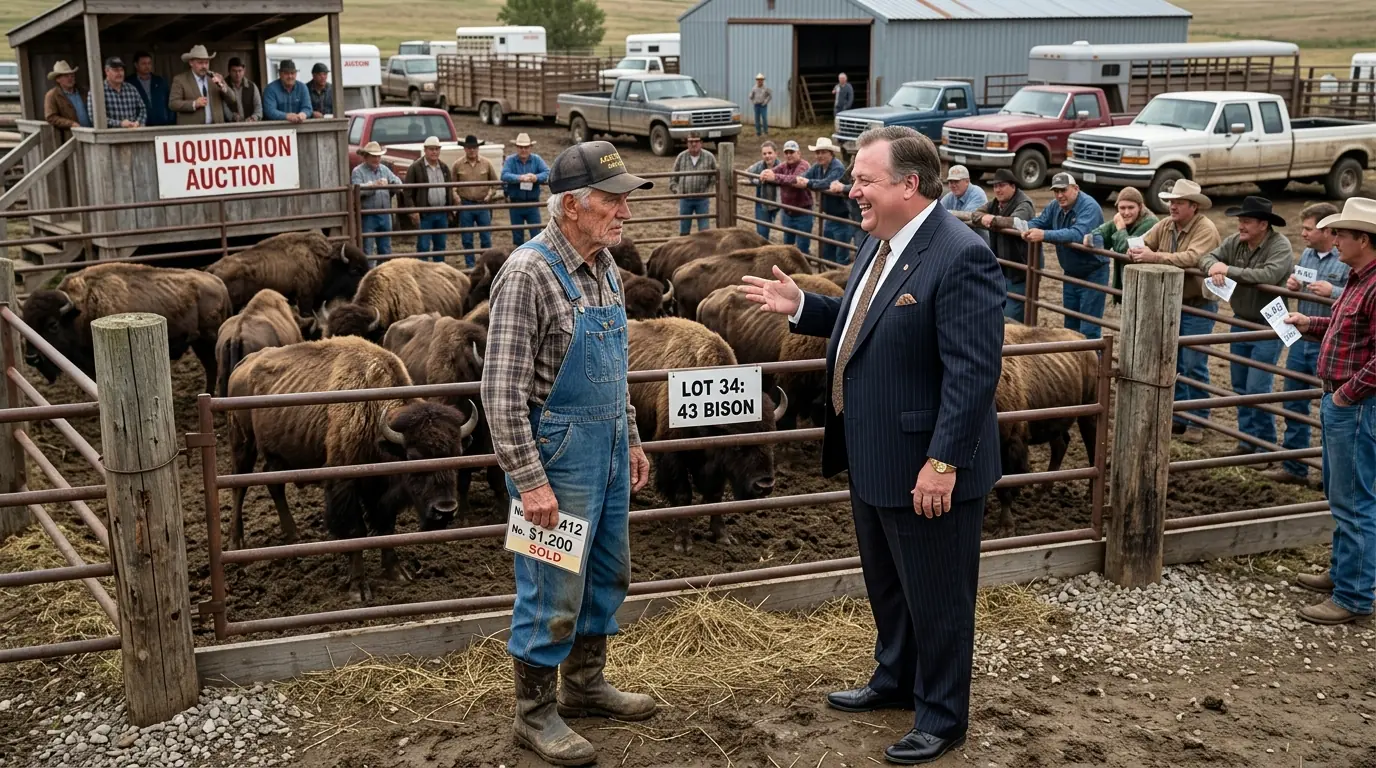
The president of the biggest bank in the area, a heavy-set and arrogant man, laughed at him in front of everyone. He said the old farmer was throwing away the last of his money on animals that were already as good as dead. The bison had belonged to a ranch the bank had seized after the former owner failed to repay a loan. The bank did not care what happened to the animals; it simply wanted them gone so it could sell the land for a new development project. The bank wanted to clear the property as fast as possible, so it put the entire herd up for sale at almost scrap value.
Most buyers saw only ribs sticking through dirty coats and bodies weakened by hunger. But the old farmer watched something else. He studied how the animals stood, how they breathed, and how they reacted to movement around them. After more than 50 years of farming, he believed they were not dying from some terrible disease. They looked starved, dehydrated, and exhausted. If they were given proper food, water, and care, he believed they still had a chance to recover.
Right after the auction, the farmer called an experienced local veterinarian to examine the weakest animals. The vet confirmed that their condition was serious, but most of them could still recover with the right treatment. The old man then asked a friend with a livestock trailer to help move all 43 bison back to his small farm. As the trucks pulled away, the bank president stood there laughing. He shouted that the herd would be dead before the first major snowstorm and that the old farmer would soon lose his farm too, because he would have no money left to keep it.
But the old farmer had not bought the bison out of pity; he believed he had noticed something everyone else had missed. Still, profit meant nothing if he could not keep the animals alive first. He repaired broken fences, built new water troughs, and separated the herd into smaller groups. The stronger bison were allowed into the pasture, while the weakest stayed close to the barn where he could watch them carefully.
He worked from sunrise until dark. With animals this weak, one broken fence, one empty water trough, or one missed feeding could mean the difference between life and death. His savings disappeared faster than he expected. Transportation, feed, medicine, and repairs drained his money day after day.
Just as the herd began to stabilize, winter arrived early. Snow covered the pastures and buried most of the natural grass. The hay inside his barn would last only a limited time. He began counting every bale and calculating exactly how many days of feed he had left. But the snow kept falling, and it became clear that this winter would be the first real test of whether his gamble could survive. Heavy snow damaged the old fences, and for days the road leading to the farm was almost impossible to use. The farmer had to get up in the middle of the night to check the herd and repair weak sections of fencing.
One animal worried him more than the others: an older female that had arrived in terrible condition. During one brutally cold night, he found her lying motionless in the snow. She could barely lift her head and showed almost no response. He called the veterinarian immediately. When the vet arrived, both men understood that the old female might not survive until morning. The veterinarian warned him that the bison might die before the night was over, but the old farmer refused to leave her alone.
He stayed beside her for hours, keeping warm water and food within reach. For most of the night, she barely moved. Then, just before sunrise, she suddenly pushed her front legs against the ground. The first time, she slipped and fell back down. Then she tried again. Slowly, with everything she had left, the bison pushed herself up and finally stood on all four legs. The farmer named her Hope. From that day on, she became a symbol of the entire herd's fight to survive.
As Hope regained her strength, she often became the first animal to lead the others toward patches of grass buried beneath the snow. She used her head and hooves to break through the frozen surface, and the rest of the herd followed. Because of her, the bison were able to reach grass that seemed completely lost under the winter snow. The more the farmer watched Hope, the more convinced he became that this herd had unusual survival instincts.
But just as the bison began to recover, the bank president started putting pressure on the old farmer's finances. He knew the farm still carried a mortgage. Soon, a company connected to the bank suddenly bought up most of the available hay from the biggest suppliers in the area. The local supply dried up almost overnight, and feed prices jumped sharply with 43 hungry bison needing food every day.