The morning Dale Warner arrived with his flatbed truck and a cashier's check for eighty-seven thousand dollars, Margaret Foster was in the north pasture counting stones.
She had been counting them for three weeks.
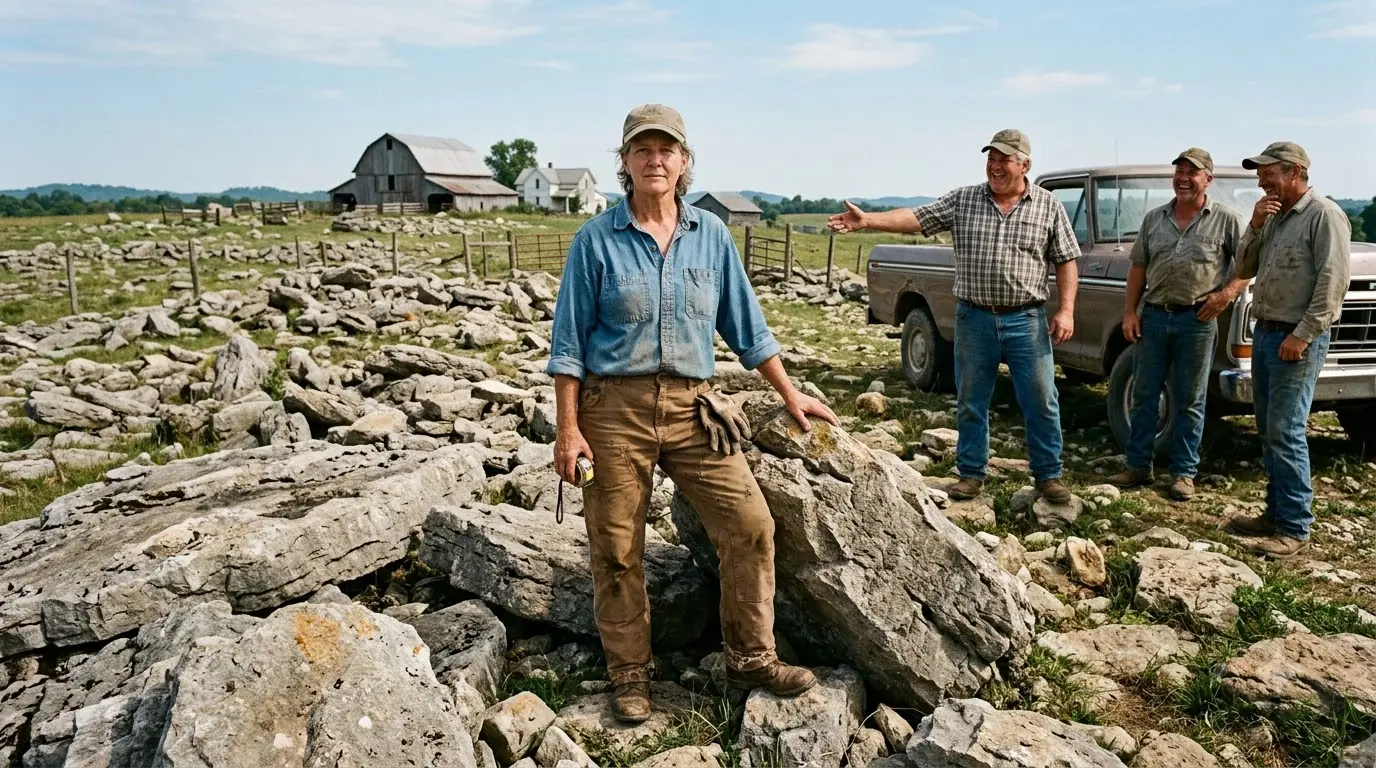
Not every stone.
That would have been impossible.
There were too many.
She had divided the pasture into rough squares using orange survey flags and a hundred-foot measuring tape, then sampled each section the way she had once sampled hay yield and soil condition when her husband, Jim, was alive.
Number of exposed stones.
Approximate dimensions.
Surface condition.
How much limestone broke naturally above grade.
Where the larger outcrops began.
Where the soil thinned to almost nothing.
At sixty-three years old, Margaret had never imagined she would spend a Kentucky summer measuring rocks.
Then again, she had never imagined she would become the sole operator of Foster Farm either.
“Mrs. Foster!”
The voice carried across the field.
Margaret straightened slowly.
Her lower back complained.
She rested both hands on the measuring tape clipped to her belt and looked toward the gravel lane.
A white Ford flatbed had stopped near the old cattle gate.
Dale Warner stepped out.
He wore brown work boots, jeans, a canvas jacket despite the warming morning, and the same battered cap he had worn on every visit since May.
He carried a blue folder in one hand.
In the other was an envelope.
Margaret knew what was inside before he reached her.
Still, she did not let herself believe it.
Not completely.
Hope had become something she handled carefully.
“Morning,” Dale called.
“Morning.”
His boots crunched over loose limestone as he crossed the pasture.
He looked around.
“You're still counting.”
“I’m not finished.”
“You've got forty-two acres.”
“I know how many acres I have.”
Dale smiled.
“I’m beginning to think you intend to inventory Kentucky.”
“Only the portion I own.”
He stopped in front of her.
Then held out the envelope.
“This is what we discussed.”
Margaret looked at it.
Did not take it immediately.
“How much?”
Dale knew she already knew.
“Eighty-seven thousand.”
The number hung between them.
Margaret looked toward the farmhouse in the distance.
White siding.
Green roof.
Smoke stain above the chimney Jim always said he would clean.
Barn beyond it with three patched sections and one section that desperately needed a fourth.
Forty-two acres spreading behind everything.
Rock.
Thin grass.
More rock.
The land everyone had told her to abandon.
She looked back at Dale.
“This clears the bank?”
“You told me the balance was eighty-two.”
“With fees.”
“You'll have room.”
He extended the envelope again.
Margaret took it.
The cashier’s check seemed impossibly light.
A rectangle of paper.
Nothing more.
Yet her fingers trembled.
Dale noticed.
He pretended not to.
He looked toward the outcrop beside them.
“My crew can start Monday.”
Margaret swallowed.
“You're certain.”
“About the stone?”
“Yes.”
Dale laughed softly.
“Margaret, I have now drilled, split, cut, soaked, pressure-tested, and annoyed laboratory technicians with samples from seventeen locations on this farm.”
“That is not yes.”
“It is better than yes.”
He crouched beside a pale gray slab protruding from the ground.
“This property is extraordinary.”
Margaret looked across the pasture.
For most of her life, nobody had used that word about Foster Farm.
Difficult.
Rocky.
Thin.
Poor.
Marginal.
Useless.
Never extraordinary.
Dale stood.
“Every test came back grade A or better.”
He pointed toward the western ridge.
“The stone over there is denser.”
Then toward the lower field.
“More fossil pattern there.”
Another direction.
“Those large weathered pieces near the old tobacco shed will be beautiful in landscape walls.”
He smiled.
“You're sitting on enough premium heritage limestone to keep me busy for years.”
Margaret looked down at the check.
Six months earlier, a banker had told her the exact same stones made the farm worth less than she owed.
That memory had never left.
March had been cold that year.
Not winter cold.
Kentucky early-spring cold.
Wet.
Gray.
The kind that made mud cling to boots and made every fence repair feel twice as unpleasant.
Richard Thornton arrived at Margaret’s house shortly after ten on a Thursday morning.
She had known Richard since high school.
He had known Jim even longer.
They played baseball together.
Went fishing together twice as young men.
Later, Richard entered banking while Jim stayed on his father's farm.
That history was why Margaret agreed to let him come to the kitchen instead of meeting at First Kentucky Savings.
She thought he was coming to discuss refinancing.
He brought printouts.
That should have warned her.
Bankers rarely brought good news in folders.
Margaret poured coffee.
Richard accepted but did not drink.
He spread several pages across the table Jim had built thirty-one years earlier.
Loan balance.
Property valuation.
Soil assessment.
Delinquent payment schedule.
Estimated liquidation.
Margaret looked at the numbers.
She knew them already.
She had been looking at them every night.
Richard folded his hands.
“Margaret, I’m trying to help you see this clearly.”
She disliked that sentence immediately.
Whenever someone said they wanted to help you see clearly, they generally meant they believed you were refusing to see the world their way.
“I'm listening.”
Richard tapped the valuation.
“The updated soil review found roughly eight inches of usable topsoil across much of the northern and eastern ground.”
“I know.”
“Then limestone bedrock.”
“I know what my own ground looks like.”
“Stone-to-soil ratio is extremely high.”
“Yes.”
Richard sighed.
“The land isn't worth what the debt requires.”
Margaret looked toward the window.
Beyond the glass, the north pasture stretched beneath a pale sky.
“You said that last month.”
“I’m saying it more directly now.”
He softened his voice.
“No conventional farmer is going to buy this acreage at a price that clears the loan.”
“Maybe somebody doesn't want conventional.”
“Margaret.”
“What?”
“You've been trying to make this ground pay for thirty years.”
“Jim and I.”
Richard’s face changed.
“I'm sorry.”
“So am I.”
Jim had been gone two years.
Pancreatic cancer.
Six months from diagnosis to funeral.
Margaret still sometimes woke at five expecting to hear him pulling on work boots in the mudroom.
Some mornings, she found herself setting two coffee mugs on the counter.
Then standing there looking at the second one.
Grief behaved strangely around routine.
It did not always arrive as tears.
Sometimes it arrived as an extra coffee cup.
After Jim died, Margaret kept the farm going because continuing felt easier than deciding not to.
They had always run cattle.
Small tobacco acreage years earlier.
Hay.
Some corn where soil allowed it.
But the poorest forty-two acres had never produced much.
Jim called the north pasture “God's rock collection.”
Every spring, he cursed it.
Every summer, he complained the grass browned first there.
Every autumn, he talked about improving it next year.
The next year never changed the limestone.
Then cattle prices weakened.
Equipment repairs accumulated.
Jim’s medical bills drained savings.
Margaret refinanced part of the farm.
Then another note came due.
By the second spring after his death, the bank was losing patience.
Richard pointed to another page.
“The cleanest option is deed-in-lieu.”
Margaret looked at him.
“Say that in normal language.”
“You transfer the property to the bank.”
“All of it?”
“The encumbered acreage.”
“The house.”
“Yes.”
“The barn.”
“Yes.”
“My grandfather's land.”
Richard leaned back.
“You walk away without foreclosure on your record.”
“Where do I go?”
“Jessica has room.”
Margaret stared.
“You called my daughter?”
“No.”
“Then don't tell me what room she has.”
Richard looked uncomfortable.
“I’m trying to protect you.”
“My home is not a spreadsheet problem.”
“It is when the debt exceeds the value.”
“This is where Jim died.”
“I know.”
“This is where my daughter grew up.”
“I know.”
“My grandfather is buried four miles from here because he refused to leave this county his whole life.”
“I know.”
Richard lowered his voice.
“That's history, Margaret.”
She looked at him.
“This is finance.”
There it was.
The line between them.
History on one side.
Finance on the other.
Margaret understood finance.
She was not foolish.
Land sentiment did not make loan payments.
But she also knew bankers sometimes treated current market use as though it represented all possible value.
Richard gathered the printouts.
“Think about it.”
“Until when?”
“October.”
She already knew.
“After that?”
“The bank proceeds.”
“Foreclosure.”
“Yes.”
Richard stood.
“There's no shame in accepting reality.”
Margaret looked toward the pasture.
“Whose reality?”
He did not answer.
After he left, Margaret did something her grandmother had taught her when she was twelve.
She walked the land.
Not because walking solved anything.
Because her grandmother believed you should never make decisions about ground while sitting inside.