Grant Halbrook looked at the check in Darius Holloway's hand and laughed out loud in the middle of the marble lobby. He did not check the routing number, did not glance at the seal pressed into the paper, did not ask a single question that mattered. He tore the check in half in front of dozens of witnesses, slid the pieces across the counter, and said, “Come back when you understand how real money works.” Darius did not raise his voice. He gathered the two torn halves, looked the banker in the eye, and asked, “Are you certain you want to destroy a founding trust instrument?” Seconds later, alarms began to sound.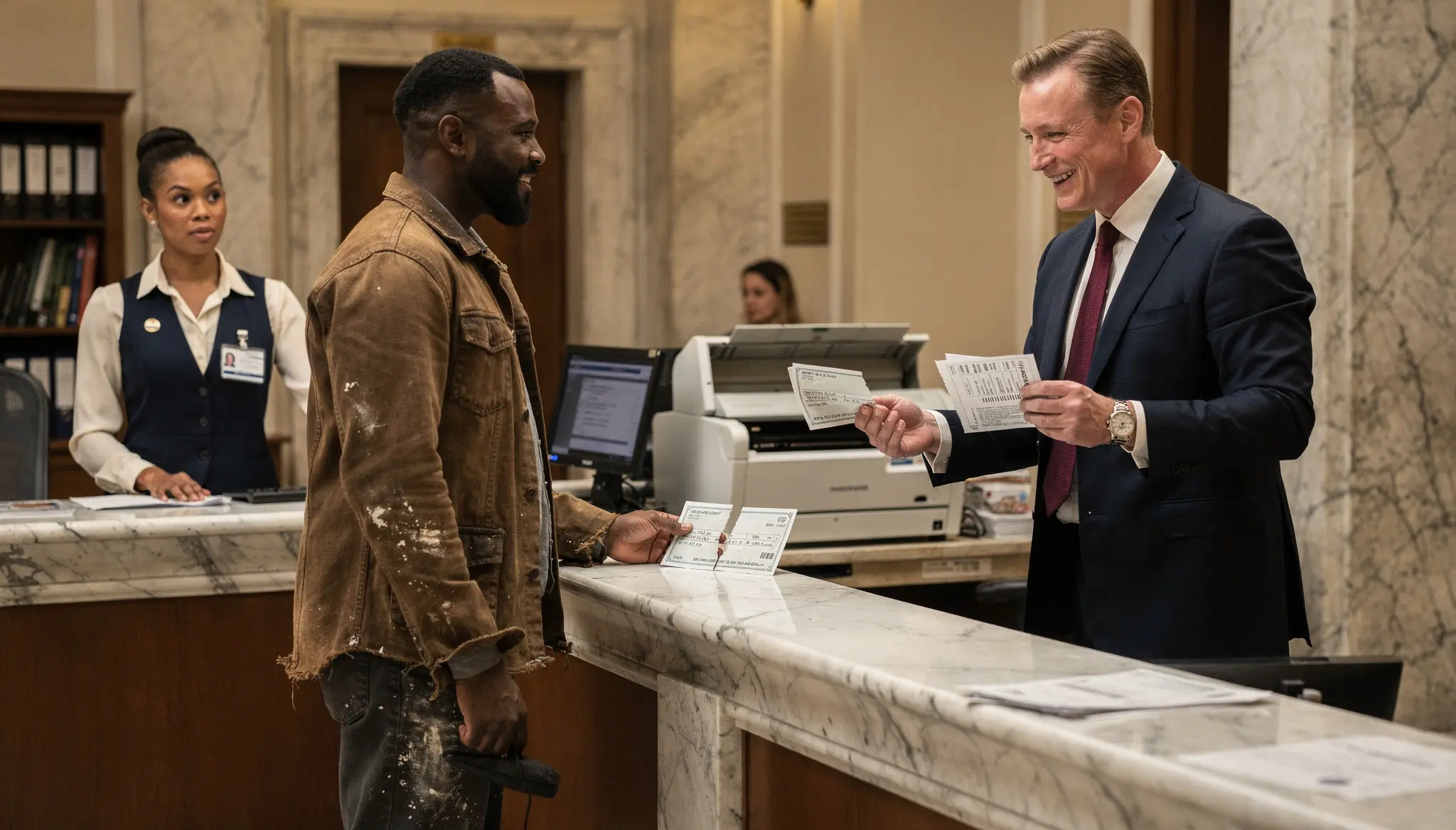
A steel door two floors below the lobby unlocked itself, and on every screen in the building, one name appeared. Darius Holloway. Darius Holloway walked through the polished doors of Whitmore Dominion Bank, still wearing the jacket he had worn on the restoration site. Its cuffs were frayed, and his boots were dusted with plaster from the old ceiling beams of Langston Arcade.
The receptionist looked him over from his collar to his boots and pointed him toward the general teller line, even after he asked politely for the business accounts officer. Two other customers in tailored coats were offered coffee while they waited. Darius was offered nothing but a number on a paper slip and a long bench near the window. He did not mind the wait itself.
He had grown used to rooms that decided who mattered before anyone spoke a single word, and he had learned long ago that patience was often the sharpest tool a quiet man could carry into a loud building. The marble floor beneath his boots still carried faint traces of plaster dust, a reminder of the archway he had left half-finished that morning, its old wooden ribs exposed to the light for the first time in decades. Langston Arcade meant more to him than a job site. His grandfather had walked those same corridors as a young man, long before the building fell into disrepair, back when the shops inside it were full of tailors, pharmacists, and printers who had built entire lives within its walls.
Darius had spent eleven months restoring it beam by beam, and he had no intention of watching it disappear into a stranger's balance sheet over a technicality and a deadline. The lobby around him buzzed with the particular hum of an institution that had forgotten what struggle felt like. Chandeliers overhead, polished brass at every counter, security guards positioned like statues near the doors. None of it intimidated him.
He had seen enough boardrooms in his previous career to know that marble and brass were often just expensive ways of hiding rot underneath. Naomi Pierce took the check first. She noticed the heavy card stock, the raised seal pressed into the corner, and a routing sequence that did not match anything she recognized from current account formats. Her screen flagged the transaction for manager review before she could even finish typing the amount of $1,800,000 into the system.
Grant Halbrook arrived at the counter already skeptical. Instead of reading the account information in front of him, he asked Darius what he did for a living, where the money had come from, and whether he understood the penalties for bank fraud. He asked the questions the way a man asks rhetorical questions, already certain of the answer he wanted to hear. Darius explained calmly and without defensiveness that the funds were meant to pay off the mortgage on Langston Arcade before the foreclosure clock ran out.
Darius had encountered men like Grant before in boardrooms and courtrooms and quiet meetings where important decisions were made behind closed doors. He recognized the particular blend of insecurity and authority that made a man need an audience before he could feel powerful. And he understood that arguing with that kind of performance rarely worked. The only thing that ever worked was patience and proof.
Darius checked the clock mounted above the vault entrance and quietly reminded Grant that the bank had less than one hour before the foreclosure protection on Langston Arcade expired for good. He kept his tone even, refusing to give Grant the reaction the man seemed to be fishing for in front of the growing audience. Grant barely glanced at the signature line before declaring the check fraudulent. Naomi suggested pulling the archival verification file, but Grant cut her off before she could finish the sentence, waving a hand as if her caution were an inconvenience rather than her job.
He had already made up his mind about Darius the moment he saw him standing at the counter, and no amount of protocol was going to change that first impression. Other customers in the lobby had begun to notice the exchange, some pretending not to listen while clearly straining to catch every word. Grant seemed to feed off that attention, his voice growing more theatrical with every sentence, as though the small audience gathering around him only confirmed he was doing something righteous rather than something cruel. He asked Darius in front of the growing line behind him whether he was the maintenance man or the cleaning contractor over at Langston Arcade.
Darius answered that he was the person responsible for protecting it. Grant laughed again and said that responsibility was not the same thing as ownership. A line he clearly thought was clever. Darius produced his identification and a trust authorization document, laying both flat on the counter. Grant did not read either one.
He looked instead at the frayed jacket and the dust on his boots and motioned for a security guard to stand closer to the counter as though Darius were a threat rather than a customer. In front of everyone waiting in line, Grant tore the check cleanly in half. He dropped the two pieces on the counter and announced in a voice pitched for an audience that the bank did not serve people who tried to play millionaire with counterfeit paper. Darius picked up both halves without a trace of anger and without a raised voice.
He asked Naomi quietly whether the scanner had already logged the instrument number before it was destroyed. Naomi, still shaken, nodded and confirmed that it had. Darius looked directly at Grant and asked one final question, giving him a last chance to reconsider. “Are you certain you want to void a certified instrument drawn against the Founders’ Reserve Account No. 01?” he asked.
“No such account exists at this bank,” Grant answered flatly. The moment the words left his mouth, every terminal in the building went dark and then flickered back to life with a red border around the screen. A siren tone rolled through the lobby, low and mechanical, and somewhere below the marble floor, a vault door disengaged with a heavy metallic clank that everyone in the room could feel through their feet. The central monitor above the teller stations displayed a single line that made the whole lobby go silent.
It read that Vault 01 had been activated and that the authorized trustee on record was Darius Isaiah Holloway. Malcolm Sutton, the bank's chief counsel, called down from the main headquarters within minutes of the alert reaching his desk. He instructed the branch in no uncertain terms that no one was to allow Darius to leave until his identity had been formally confirmed through the proper channel. Grant assumed for one relieved moment that Darius was about to be arrested and he straightened his tie and told the guard to hold him at the counter.
Malcolm's voice through the speakerphone corrected him immediately, stating that the person whose system access needed to be restricted was Grant himself, not the customer he had just humiliated. Naomi explained to the branch manager, her hands still trembling slightly, that when she had scanned the check, the system had matched it to an archival code first entered into the ledgers back in 1987. Tearing that instrument, she said, had been logged automatically as interference with a founders' trust asset, and the system did not care who had done the tearing. Darius was led at last into the private client room he had been denied access to less than an hour earlier.
He accepted no coffee and no scripted apology. He simply asked that the bank halt immediately any pending sale of Langston Arcade to outside buyers. Grant tried once more to insist there had been a mistake of identity, suggesting that Darius merely shared a name with someone in an old file. But the system required a fingerprint and a signature match before the inner vault chamber would open, and both came back an exact match within seconds.
Malcolm read the confirmation aloud, and the room went quiet in a different way than before. It was quiet with the particular stillness of people realizing the ground beneath them had shifted. Darius Holloway was by every legal record the bank possessed the lawful successor trustee of the Holloway Civic Trust. Malcolm added one more detail that made Grant's face lose its color entirely.
Vault 01 did not merely hold cash reserves. It held documents that could determine on paper and in law who actually controlled Whitmore Dominion Bank. Vivian Whitmore arrived at the branch with two members of her legal team trailing behind her, moving through the lobby with a particular ease of someone accustomed to every room reorganizing itself around her presence. After hearing Grant's version of events, she did not apologize to Darius.
Instead, she offered a private settlement quietly to keep the incident from becoming public. Darius declined without hesitation. He told her the problem was never really the torn check itself. The problem was that a bank employee had looked at him and decided on sight that a man who looked like him could not possibly own something that mattered.
Vivian argued that the Holloway Civic Trust was, as far as she understood it, an old charitable fund with no real authority over current operations. Darius suggested she open Vault 01 herself before drawing any more conclusions about what did or did not have authority inside her own bank. She pushed back further, telling Darius that even if some old arrangement had once existed, decades of restructuring, mergers, and new charters surely superseded whatever paperwork his grandfather had once signed. It was the kind of argument she had used before in boardrooms, confident and practiced, the sort of statement that usually ended a conversation rather than starting one.
Darius answered that founding trust agreements were typically written with specific protections against exactly that kind of erosion, precisely because the people who wrote them understood how easily promises could be reorganized out of existence. He was not guessing. He had spent years reading documents like it in his previous career, watching companies try to bury old obligations under new corporate structures, and he recognized the shape of the argument before she had even finished making it. Grant, sensing his position collapsing, tried to reframe the confrontation, telling Vivian that Darius had been aggressive and threatening at the counter.
Naomi immediately contradicted him, stating clearly that Darius had never once raised his voice, not even when the check was destroyed in front of him. Grant then attempted to shift blame onto Naomi instead, implying she had scanned an instrument she had no authority to process. Darius recognized exactly what Grant was doing, positioning a junior employee to absorb the consequences meant for him, and he was not willing to let that happen quietly. He requested formally and on the record that every camera recording and every system log from that hour be sealed immediately and preserved.
Vivian bristled visibly at being given instructions inside a building that carried her family's name on the letterhead. Darius reminded her without raising his voice that the right to demand preservation of evidence was written into Article 9 of the original founding agreement between the Whitmore family and Isaiah Holloway. It was not a request. It was a contractual right that predated everyone standing in the room.
Malcolm confirmed after a brief search through the archived legal files that the article was still fully enforceable and binding on the bank today. Vivian's confidence cracked for the first time since walking through the doors. She stepped away and called her father Conrad Whitmore, the bank's chairman emeritus. When she said the name Darius Holloway aloud, there was a long pause on the line before Conrad answered with a single instruction, telling her, “Do not let that man open the black box until I arrive.” While the family patriarch made his way across town, Darius offered to explain calmly and without theatrics a piece of history that the bank had never publicly acknowledged.
He said it not as an accusation but as a simple correction of the record. In 1987, Whitmore Dominion Bank had stood on the edge of collapse after a string of disastrous investment decisions. Larger institutions had refused to step in and rescue it, viewing the risk as too great for the reward. Isaiah Holloway, Darius's grandfather, had organized a coalition of shopkeepers, dock workers, physicians, and Black business owners across the city, asking each of them to place their savings directly into the failing bank.
In exchange for that rescue, the Whitmore family had signed an agreement granting the Holloway Civic Trust voting shares and formal protection over a set of designated community properties, including Langston Arcade. It was not charity. It was a negotiated exchange between equals made in a moment when the bank had nowhere else to turn. Isaiah had not been a wealthy man himself.
He kept a modest office above a hardware store two blocks from the bank, a single desk lamp burning late into the night as he tallied pledges from people who trusted him more than they trusted any banker in a suit. He asked a dock worker for $300 one week and a schoolteacher for $400 the next, building the rescue one signature at a time, refusing to let the effort collapse under its own weight. Word of the collapsing bank had spread through the neighborhood like a fever, and there were plenty of voices telling Isaiah the effort was foolish, that no group of working people could possibly save an institution the size of Whitmore Dominion. He kept a ledger by hand, ink smudged at the edges from long nights, recording every dollar and every promise with the same careful attention he gave to his own family's finances.
When the rescue succeeded and the bank survived that brutal winter, the celebration inside the boardroom lasted only as long as the crisis itself. Within a few years, new executives arrived who had never heard Isaiah's name spoken aloud, and the story of the rescue was quietly reshaped into something simpler. A tale of prudent leadership rather than a debt owed to an entire community. As the years passed and the bank grew into a financial empire spanning multiple states, the role of the people who had saved it quietly disappeared from the official story.
Photographs of Isaiah vanished from the hallway portraits. The name of the trust was buried deep in an archive nobody thought to search anymore, filed under a code so obscure that even senior staff assumed it belonged to a dormant account no longer worth remembering. Vivian did not want to accept that her family's current wealth had been built in part on money supplied by the very communities whose properties the bank was now preparing to seize and sell.
Her face showed the particular discomfort of someone hearing a family story rewritten in real time. Bennett Kingsley joined the conversation by video call, his tone smooth but sharp underneath. He called Darius an opportunist and argued that a nearly 40-year-old agreement could not possibly stand in the way of a transaction worth hundreds of millions of dollars in the present day. Darius did not raise his voice to match Kingsley's irritation.
He simply asked Malcolm to read the anti-dilution clause of the original agreement aloud, word for word, so that no one in the room could later claim confusion about its meaning. The clause confirmed something that made Kingsley's expression tighten. The 18 percent voting stake secured in 1987 remained 18 percent of total voting power today, regardless of how many additional shares the bank had issued in the decades since. It was protected against dilution by design.
Darius also held a formal veto right over the sale of any property specifically designated as protected community assets, and Langston Arcade sat directly on that list. Kingsley's confident tone began to fray at the edges as the implications settled over the call. Darius made his position clear without theatrics. The sale to Kingsley Properties was not merely paused for review.
He intended to demand a full audit of every foreclosure Bennett Kingsley had pushed through the bank over the past ten years, and he expected the bank's cooperation in producing the records. Kingsley moved quickly to fight back, spreading word among board members that Darius was extorting the bank with forged paperwork and pressuring Vivian to convene an emergency board session before the story could spread any further. He wanted the narrative controlled before anyone outside the building had a chance to hear it. Grant, meanwhile, slipped quietly into the security office and attempted to delete the footage of himself tearing the check in front of the lobby.
Naomi noticed unusual activity on the archival server and immediately alerted Malcolm, who flagged the access attempt before any file could be permanently erased. When confronted, Grant insisted he was simply protecting the bank's reputation from an embarrassing misunderstanding. He continued to minimize Darius, arguing that a few old documents did not mean the man understood how a modern financial institution actually operated, as though paperwork and competence were separate things. Darius revealed without pride or bitterness that he had once worked as a forensic auditor before leaving the profession after refusing to bury evidence of wrongdoing for a major corporation.
He then pointed out calmly and precisely the exact three steps Grant had just taken to alter the timestamp data on the security system. Naomi still had the automatic backup log recorded directly from the check-scanning device, untouched by anything Grant had tried to change. The two torn halves Darius had picked up off the counter also carried a microprinted verification code that proved beyond doubt the instrument had been genuine from the start. Vivian began to understand that Grant was not merely prejudiced in his judgment.
He was actively willing to destroy evidence to protect himself, a realization that unsettled her far more than the torn check ever had. A preliminary audit triggered automatically by the vault activation uncovered a disturbing pattern. Several customer loans had been quietly shifted into default status just days before Kingsley Properties submitted lowball offers to purchase the exact same properties.
A coincidence too precise to be accidental. The pattern repeated itself across a dozen separate files, each one following an almost identical script. A small business would fall two or three payments behind. During a slow season, the bank would decline to offer the kind of short extension it had freely granted to larger corporate clients.
And within weeks, Kingsley Properties would appear with a purchase offer priced well under market value. No single file looked suspicious on its own. Together, they told a story that no honest employee could explain away as coincidence. Malcolm pulled the loan officer assignments for each flagged file and noticed the same three names recurring far more often than statistics could justify.
Two of those names belonged to junior staff who had simply followed instructions passed down from above them. The third name belonged to Grant Halbrook, who had personally signed off on the default determinations in nine of the twelve cases under review. The torn check meant to humiliate Darius and end the matter quickly had instead triggered a special audit clause that Kingsley had spent years successfully avoiding. Malcolm soon discovered that Grant had been receiving so-called consulting fees from a shell company directly tied to Bennett Kingsley, a paper trail hidden just carelessly enough to be found by anyone willing to look past the surface paperwork.
The fees were modest at first glance. A few thousand every quarter routed through an account with a name that meant nothing on its own. But the timing lined up precisely with each foreclosure Grant had pushed through. And once Malcolm laid the transactions side by side with the property sales, the pattern became impossible to dismiss as routine consulting work.
Conrad Whitmore arrived at the branch not long after. And unlike his daughter, he knew exactly who Darius was the moment he saw his face. Conrad had met Darius years earlier as a young man standing quietly at his grandfather Isaiah's funeral. In front of both Grant and Vivian, Conrad finally admitted the truth he had carried privately for decades.
Isaiah Holloway had not been an ordinary depositor passing through the bank's doors. He had been the man who stopped Whitmore Dominion Bank from collapsing entirely in a single winter. Conrad quietly asked Darius to resolve the matter discreetly, appealing to him to protect the reputations of both families rather than let the history become public knowledge. He spoke of legacy, of decades, of careful reputation building, of shareholders who would panic at any hint of scandal touching the Whitmore name.
Darius listened without interrupting, letting the older man finish everything he needed to say. When Conrad was done, Darius answered that the Holloway family had nothing left to hide. Only the Whitmore family, he said, had reason to fear what the truth might cost them now, and that fear was not something he intended to help them manage quietly. Conrad seemed to age visibly in the silence that followed, the weight of nearly forty years of unspoken debt, finally settling somewhere he could not negotiate his way out of.
He had spent his career believing that discretion was a form of kindness, and he was only now beginning to understand how much that discretion had cost the people on the other side of it. Together, the group descended to Vault 01, moving through a hallway Darius had never once been permitted to walk before that morning. The system required Darius's own signature before the inner chamber would release its final locking mechanism, confirming once more that the trust had never belonged to anyone else. Inside there was no mountain of cash waiting for them, only a black-lacquered box, several original share certificates, a leather-bound ledger, and the founding agreement itself.
Its ink was faded, but its language remained perfectly legible after nearly forty years. The chamber smelled faintly of old paper and cold steel, undisturbed for so long that a thin layer of dust had settled evenly across every surface inside. Darius ran his fingers along the edge of the ledger before opening it, recognizing his grandfather's handwriting immediately from the careful, slightly slanted script he had seen on birthday cards as a child. Each entry recorded a name, an amount, and a date, page after page, of ordinary people who had trusted a stranger's promise that their money would come back to them eventually.
Vivian stood a few steps back, arms crossed, watching the scene with an expression that had shifted from suspicion to something closer to quiet unease. She had grown up hearing stories about her family's foresight and business acumen during difficult years, and standing in that vault, she was beginning to understand how much of that story had simply left out the people who mattered most. The box also contained a letter written by Conrad's own father to Isaiah Holloway, sealed and never made public. In it, the elder Whitmore admitted plainly that the bank had survived only because of community money, and he promised that the institution would never again be used as a weapon to take property away from the very people who had saved it.
Conrad admitted he had read that letter many years earlier, but had chosen never to bring it forward, fearing what it might mean for the family's carefully maintained public image. Darius felt no satisfaction in the discovery, only a quiet disappointment that a promise once made in good faith had been allowed to gather dust in silence for so long. The documents revealed something that changed the entire shape of the coming battle. Kingsley Properties could not legally complete the purchase of Langston Arcade without a signature from the Holloway Civic Trust, a requirement buried in the original transfer restrictions attached to the deed itself.
Every disclosure filing the bank had submitted for the sale was missing that mandatory signature entirely, a gap that no one on Kingsley's legal team appeared to have noticed—or perhaps one they had simply hoped no one would ever check. Conrad handed Darius a second sealed envelope from the box, its front marked only with a single instruction to be opened, only if the Whitmore family ever broke the founding agreement. The full board convened at bank headquarters two days later, an unusually large gathering summoned on short notice. Bennett Kingsley sat near the center of the table, confident that a room full of wealthy, comfortable people would naturally side with him over an outsider carrying old paperwork. When Darius walked in, still wearing his familiar work jacket, Kingsley made a point of asking security loudly enough for the table to hear why an outside visitor had been allowed into a closed board session at all. Darius placed his original share certificate on the table without a word and let the document answer the question for him.
Malcolm informed the room that Darius was not a guest that day. He represented the second-largest voting block in the entire institution and carried formal veto authority written directly into the bank's founding charter, a fact several board members were clearly hearing for the very first time. Kingsley mocked the very idea that a community trust could carry any real weight in a modern financial institution, calling it a relic better suited to a museum than a boardroom.
Darius opened the second envelope Conrad had given him, revealing a clause allowing the Holloway Civic Trust to nominate an interim chairman if the bank ever knowingly seized protected community assets. Darius did not claim the chairmanship for himself. Instead, he nominated an independent board member with no ties to either family and formally demanded a complete investigation into every transaction the bank had conducted with Kingsley Properties over the previous decade. Kingsley threatened to pull his considerable investment from the bank entirely, warning that the stock price would collapse the moment word reached the open market.
Darius answered evenly that the Holloway Civic Trust had already assembled a coalition of ethical investors ready to provide fresh liquidity the very same day, should Kingsley choose to walk away. The man the room had assumed came in that morning simply begging the bank to accept a check had in fact arrived with enough backing to protect the institution from the very billionaire currently trying to control it. The realization moved visibly across the table chair by chair as board members recalculated who actually held the power in the room. One board member, an older woman who had sat quietly through most of the session, finally spoke up and asked Darius directly why he had never mentioned any of this when he first walked into the branch with his check.
Darius answered simply that he had not come to the bank that morning looking for power. He had come to save a building that mattered to people who had no other way of protecting it themselves. Another member, younger and visibly uncomfortable with how the morning had unfolded, asked whether the coalition of investors Darius mentioned was even real or simply a bluff meant to rattle Kingsley. Malcolm answered on Darius's behalf, sliding a folder of signed commitment letters across the table, each one representing capital, already prepared to move the moment it was needed.
Kingsley studied the folder for a long moment, his composure visibly slipping for the first time since he had entered the room that morning. He had built his reputation on being the person other people feared losing, and for the first time in years, he was staring across a table at someone entirely unmoved by the threat of his departure. Just as the vote seemed within reach, Grant burst into the meeting carrying a folder, insisting he had uncovered proof that Isaiah Holloway had stolen funds from the bank decades earlier. He dropped copied ledger pages onto the table, his voice rising with the desperate energy of a man trying to save the only career he had left.
Kingsley seized on the accusation immediately, demanding that Darius's voting rights be suspended, pending review of the new evidence. For a moment, the room's sympathy seemed to tilt back in his favor, exactly as he had planned. Darius did not panic. Looking closely at the figures on the page, he noticed the dates had been quietly reversed and that the document formatting matched software that did not exist in 1987.
The forgery was careless in exactly the way rushed forgeries usually are. Naomi, watching remotely from the branch, pulled server logs showing that Grant had downloaded the very same file from a company server owned by one of Kingsley's holding entities just hours before walking into the meeting. The timeline left no room for innocent explanation, and she forwarded the logs to Malcolm's tablet before the meeting had even reached its next agenda item. Malcolm studied the forged pages more closely under the light of the boardroom projector, pointing out for the entire table to see that the paper itself carried a manufacturer's watermark that had not existed until many years after the date claimed on the document.
It was the kind of mistake a careless forger makes when they assume no one in the room will bother checking anything beyond the numbers. Malcolm cross-checked the copied pages against the original ledger still resting inside Vault 01. The funds Isaiah had supposedly stolen were, in truth, wages he had personally advanced to bank employees during the exact months the institution could not meet its own payroll obligations, a fact confirmed by matching signatures from tellers who had worked at the branch decades earlier and were still alive to remember it.
One of those retired employees, reached by phone that same afternoon at Malcolm's request, confirmed on a recorded line that Isaiah had personally handed her an envelope of cash one Friday afternoon when the bank itself could not process payroll. She had kept a handwritten thank-you note in a drawer at home for nearly forty years, never imagining anyone would ever ask about it again. Conrad stood up in front of the entire board and confirmed the truth publicly without hesitation. This time he admitted that his own family had allowed Isaiah's reputation to be quietly diminished over the years when in fact the man had single-handedly protected hundreds of jobs during the bank's darkest winter.
Grant was suspended on the spot, his access badge deactivated before he even left the room. Kingsley lost his voting rights over the conflict of interest and the fabricated evidence and the matter was formally referred to financial regulators for further review. Darius had every opportunity sitting in that room to humiliate Grant in front of the entire board the way Grant had once humiliated him in a crowded lobby. Instead, he simply placed the two torn halves of the original check on the table and spoke without raising his voice at all.
“You tore that check because you assumed a name like mine could never belong on an account of that size,” he told Grant. “That single assumption has done more damage to your career than anything I could ever have done in return,” Darius said quietly. The board, still absorbing everything that had just unfolded, asked Darius directly what he intended to do with the authority he now held over the institution. They wondered aloud whether he would shut the bank down, sell his stake for a considerable fortune, or seize the highest position in the building for himself.
Darius chose none of those paths. He stated plainly that an institution once saved by an entire community carried a permanent obligation to serve that same community, not to profit from its slow destruction. He intended to use his authority to repair the bank rather than dismantle it. Using his restored voting power, Darius canceled the pending sale of Langston Arcade entirely and ordered every manipulated loan identified in the audit to be restored to its original fair terms.
He established an independent oversight board with real authority, not a symbolic one designed to look good in a press release, staffed with people who had no financial ties to either the Whitmore family or Kingsley's network of holding companies. He insisted that every customer whose loan had been quietly pushed into default receive a full accounting of what happened to their account along with an offer to renegotiate terms that reflected fair market practice rather than manufactured urgency. Several of those customers, small business owners who had assumed their losses were simply bad luck, learned for the first time that their failures had been engineered from a desk they never knew existed. He required the bank to publicly disclose the full history of the Holloway Civic Trust for the first time in its corporate records, ending decades of quiet omission.
He also insisted that Whitmore Dominion Bank issue a direct public apology to every customer whose account had been unfairly targeted and he directed a portion of the bank's profits into a new fund supporting local businesses. Vivian Whitmore kept her position as chief executive, but only under the condition of a full audit and a genuine institutional reckoning that she could no longer avoid. She acknowledged publicly in her own words that the bank had deliberately buried Isaiah Holloway's role in its own survival for far too long. Conrad asked that Isaiah's portrait finally be hung beside the bank's other founders in the main lobby where it had never once appeared.
Darius agreed on one condition, that the names of every single person who had placed their savings into the bank during that winter of 1987 be recorded permanently as well, not just the one man who had organized them. Langston Arcade was fully restored and reopened its doors to the small businesses that had built their livelihoods inside its walls for generations. A tailor who had feared losing his lease for months hung a new sign above his shop window. That same week, the restoration crew finished the final coat of paint on the ceiling beams.
A pharmacist who had already begun searching for a new location decided to stay, telling a neighbor that the arcade finally felt like it belonged to the people who worked inside it again. Darius did not move into a corner office or trade his work clothes for a tailored suit. He returned instead to the restoration site, his hands dusted with plaster once again, finishing the old archway he had started weeks earlier. He still answered his own phone, still showed up before sunrise with a thermos of coffee, and still measured his days by the progress of a building rather than the size of a boardroom.
Vivian visited the site once, unannounced, standing quietly near the entrance as she watched him work alongside two younger tradesmen he had hired from the neighborhood. She admitted somewhat awkwardly that she had never once set foot inside Langston Arcade before that day, despite having approved its foreclosure from behind a desk many floors above the street. Darius simply handed her a spare pair of gloves and asked if she wanted to help carry a beam. And to her own surprise, she did.
Months later, Darius returned to the branch where it had all begun. Naomi Pierce had since been promoted to branch director, a change that felt earned rather than symbolic. She offered him a replacement check, framed carefully behind glass, as a kind of tribute, but Darius gently declined to accept it. He kept the two torn halves of the original check instead, tucked safely in a drawer at home, a quiet reminder that a person's worth was never measured by the coat on their back or the number printed neatly on a piece of paper.
Every so often when a new client walked into his office wearing work boots and an uncertain expression, he would take the torn pieces out and set them on the desk between them, letting the story speak before he ever said a word himself. Naomi told him once that she still thought about that morning behind the counter the way her hands had trembled, scanning a check that would upend the entire branch before lunch. Darius told her that her instinct to check the archival file even after Grant waved her off had been the only reason any of it worked out the way it did. She had done her job honestly in a room full of people who had stopped doing theirs.
The vault door of Vault 01 closed behind him with its familiar heavy sound, sealing the past back into place until it was needed again. Somewhere above him, construction crews were already restoring the old portrait wall in the main lobby, preparing a space for a face the bank had spent decades trying to forget. Outside, on the small brass plate mounted beside the entrance, the name of the bank no longer stood entirely alone.
Beneath it, in newly engraved letters, a second line had been added for anyone walking past to read, stating simply that the institution was watched over by the Holloway Civic Trust, the people who had saved the bank when no one else in the world was willing to do so.