The first time I saw the man, I was already reaching for the polite voice I used when asking difficult customers to leave.
My name is Denise Walker, and at forty-seven, I had managed StarSprout Kids Salon inside Fairlane Mall in Louisville, Kentucky, long enough to know when a situation was about to become a problem. Our salon was built for birthday curls, glitter braids, first haircuts, pretend spa days, and little girls who wanted butterfly clips in colors their mothers would regret by dinner.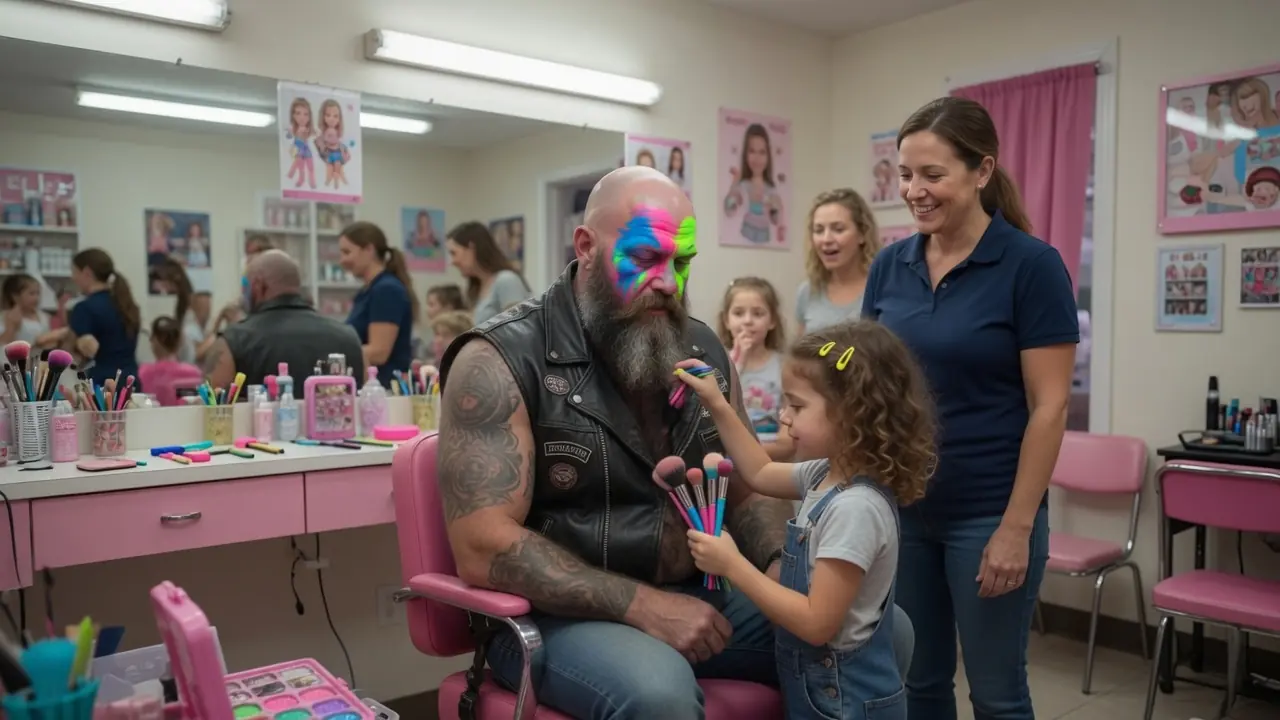
It was not built for a six-foot-five biker who looked like he could lift a vending machine with one arm.
He came through the mall entrance at 10:42 on a Saturday morning, and the whole salon changed before he said a word. He wore a black leather vest over a faded gray T-shirt, heavy boots, and jeans with a chain clipped at the pocket. Tattoos covered both arms, ran across his knuckles, and disappeared up his neck beneath a thick salt-and-pepper beard.
Two mothers moved their children closer to them.
One little boy stopped eating his lollipop.
The biker noticed all of it.
He stopped just inside the doorway, slowly removed his leather vest, folded it across one arm, and kept both hands visible like he was used to making people feel safer around a body they had already judged. Then a little girl stepped out from behind him.
She was seven, maybe small for her age, with tan skin, hazel eyes, and dark curls pulled back with two green butterfly clips. She held a plastic beauty case against her chest with both arms, the kind sold in toy stores with washable colors, tiny brushes, and enough glitter to ruin a carpet for generations.
She looked at me very seriously.
“I need a customer chair,” she said.
I glanced at the biker.
He gave me a small nod.
“This is her appointment,” he said.
His voice was deep, rough, and quiet.
“What kind of appointment?” I asked.
The little girl opened the plastic case and pulled out a folded index card. It had been decorated with stickers and written in careful crooked letters.
CUSTOMER: DADDY
SERVICE: FULL FACE MAKEOVER
ARTIST: LUCY RAY
I looked back at the man.
He looked at the room.
The only empty station was the toddler station, a pink butterfly chair with little wings on the back and a round table covered in cartoon stars. It was made for children who still needed help climbing in.
“That chair won’t hold him,” I said.
The biker studied it.
“Fair concern.”
The little girl’s face fell so quickly it hurt to see.
He saw it too.
Then he crouched beside the chair and pressed both hands against the seat, checking the screws, the legs, the plastic frame, every joint with the seriousness of a mechanic inspecting brakes. He tested it once, then twice.
“What’s your weight limit?” he asked me.
“Honestly? I don’t know.”
“That’s honest.”
He turned to the little girl.
“Lucy, if it cracks, we stop. Deal?”
She nodded, but her eyes were already wet.
He lowered himself slowly.
Carefully.
His knees rose too high, his boots stuck out past the little footrest, and his shoulders nearly swallowed the pink butterfly wings behind him. The chair groaned once in protest, but it held.
The salon went silent.
The little girl took a purple cape from her case and tried to drape it around his shoulders. It barely covered the top half of him. He leaned forward so she could clip it, hands resting flat on his knees.
“What look do you want?” she asked.
He studied the toy palette.
“Artist’s choice.”
She nodded like he had given the correct answer.
That was how it began.
Her first line of blue powder went too high on his right eyelid and stopped too low on the left. She added pink circles to both cheeks, a green streak above one eyebrow, and gold glitter across his nose. The glitter stuck in his beard. A little girl at the next station giggled, then covered her mouth when her mother shot her a look.
The biker did not flinch.
He did not laugh.
He did not correct her.
Every time Lucy’s hand shook, she whispered, “Sorry.”
And every time, he answered, “Keep going.”
After twenty minutes, she was still apologizing.
After forty minutes, the apologies became softer.
After an hour, she leaned in close to fix a crooked silver line near his temple, and her hand steadied for the first time.
A father near the waiting bench lifted his phone.
The biker’s eyes moved to him.
Not angry.
Not threatening.
Just direct.
The father lowered the phone.
I noticed that.
The biker noticed everything.
His name, I later learned, was Roman “Grizzly” Hale.
He rode with a motorcycle club called the Steel Saints, worked nights as a tow-truck driver, and had once spent twelve hours in sleet pulling cars off an icy highway without charging half the people because, as one customer told me later, “He said bad weather was already expensive enough.”
But that morning, none of us knew that.
We only saw the leather, the ink, the size, the silence.
We only saw what we had been trained by fear to see first.
Lucy worked for nearly two hours.
She painted one of his fingernails orange, another purple, then decided his left cheek needed a red star. At one point she asked if she could put glitter on his beard. Roman thought about it.
“Is glitter removable?”
“Mostly.”
“That sounds like a lie.”
“It’s artistic.”
He nodded.
“Proceed.”
By the time she finished, his face looked like a parade had crashed into a biker bar.
Blue eyelids.
Pink cheeks.
Green lines.
Gold glitter.
One orange nail.
One purple nail.
A red star leaning sideways near his beard.
Lucy stepped back, holding her smallest brush like a surgeon completing a difficult operation.
“Done,” she said.
The room waited for his reaction.
Children leaned forward.
Parents watched over their phones and coffee cups.
I stood behind the counter pretending to organize appointment cards while actually watching harder than anyone.
Roman looked into the mirror.
He studied his face.
For a long moment, he said nothing.
Then he nodded once.
“Strong work.”
Lucy stared at him.
“You mean it?”
“Yes.”
“It’s not even.”
“Neither are mountains.”
“That’s not makeup.”
“It’s still good structure.”
She frowned.
“You don’t know makeup.”
“I know when somebody stayed with the job.”
That sentence did something to her.
Her shoulders lowered.
Her chin lifted.
A small smile appeared and disappeared before she could stop it.
I assumed he would ask for wipes before leaving. Any adult would. Especially a man like him, walking through a crowded mall on a Saturday with glitter in his beard and toy powder across his eyelids.
Instead, Roman stood up carefully, returned the pink chair to its proper place, put on his leather vest over the little purple cape until Lucy unclipped it, and walked out of the salon still wearing every color she had put on him.
People stared immediately.
Teenagers pointed near the pretzel stand.
A woman in a perfume kiosk laughed before catching herself.
Two men outside the sports store made a joke loud enough to travel.
Roman kept walking.
Lucy walked beside him holding the plastic case, looking from his painted face to the people watching them. At first, she seemed embarrassed. Then she noticed something that mattered more than the stares.
He was not hiding.
He did not lower his head.
He did not wipe his face with his sleeve.
He walked through Fairlane Mall like a man wearing a work of art made by the most important artist in the world.
I followed at a distance.
Not because I meant to spy.
Because I had left the salon to take deposit slips to the office, and because something about that man and that little girl had already hooked into me.
They stopped near the grocery market at the far end of the mall.
Lucy tugged on his sleeve.
“Daddy?”
He crouched beside her, which still made him taller than some adults.
“Yeah, firefly?”
“Are you embarrassed?”
Roman looked around at the people pretending not to stare.
Then he looked back at her.
“My daughter needed one customer who trusted her hands,” he said. “I’m the best customer she’s got.”
Her mouth trembled.
“But people are laughing.”
“People laugh when they don’t understand what they’re looking at.”
“Do you understand?”
He touched the red star on his cheek with one finger.
“I’m learning.”
That was when an older woman behind them dropped her shopping basket.
Apples rolled across the floor.
Lucy jumped.
Roman stood and instinctively moved between his daughter and the woman.
“Easy,” he said.
The woman stared at Lucy’s green butterfly clips.
Then at the plastic case.
Her face changed so completely that even Roman saw she was not afraid of him.
She was remembering.
“Where did you get those clips?” she asked.
Lucy held the case tighter.
“My mom’s.”
The woman’s eyes filled.
“Was your mother named Elise?”
Roman went still.
Lucy looked up at him.
The woman put one hand over her mouth, then reached carefully into her purse and pulled out an old photograph, the edges softened from years of handling.
“I knew her,” she said. “I trained her. She worked at my makeup counter before she went freelance.”
Roman did not take the photograph at first.
His big hand hovered near it like the paper might explode.
Then he looked down.
The world seemed to stop around him.
The woman in the photo had Lucy’s curls, Lucy’s smile, and the same green clips in her hair. She was younger, bright-eyed, standing behind a makeup counter with brushes in one hand and color smeared across the back of the other. Roman’s painted face changed while he looked at her—not the colors, but the man beneath them.
He looked like someone had opened a locked room inside him.
The woman’s name was June Marlowe.
She had owned a small cosmetics booth downtown years earlier, before malls swallowed half the city’s little businesses. Elise Hale had worked for her at nineteen, back when her hands shook from nerves and she apologized every time a brush touched someone’s skin.
“She was shy at first,” June said. “Talented, but terrified of making mistakes.”
Roman gave a rough laugh that did not sound happy.
“She never told me that part.”
“She probably outgrew it before you met her.”
Lucy whispered, “Mommy’s hands shook too?”
June crouched carefully to Lucy’s level.
“Oh, sweetheart. Everyone’s hands shake when something matters.”
Lucy looked down at the plastic case.
The case, I would later learn, had once belonged to Elise. Not the toy makeup inside it, but the old green handle and cracked clear lid. Elise had kept brushes in it as a teenager. Years later, when Lucy began pretending to do makeup, Elise cleaned it, filled it with washable colors, and gave it to her.
Then came the illness.
Breast cancer first.
Treatment.
Hope.
A clean scan.
Then the return that nobody wanted to name until there was no choice left.
Elise died when Lucy was six.
Fourteen months before the day in our salon.
For most of those fourteen months, Roman did what many grieving parents do when they do not know how to survive and raise a child at the same time. He became practical. Lunches packed. Bills paid. Doctor files boxed away. Clothes sorted only after Lucy stopped asking why her mother’s sweater still smelled like lavender.
He did not talk about makeup because makeup had been Elise’s world.
And Roman could fix engines, tow trucks, patch drywall, cook three meals, braid hair badly, and sit through school assemblies with knees pressed against child-sized chairs.
But he did not know how to step into Elise’s world without feeling like he was stealing from it.
Lucy did.
She opened the case again six months after the funeral.
Not every day.
Just sometimes.
At first, she painted paper faces.
Then dolls.
Then her own hand.
When school career week came around, she wrote MAKEUP ARTIST under her name and brought the case to class.
Roman thought that meant healing.
But grief had only changed clothes.
At career week, Lucy set up three chairs near the craft table.
Her first classmate, a girl named Harper, agreed to sit. Lucy’s blue line went crooked because her fingers shook. Harper looked in the mirror too soon and laughed.
“It looks weird.”
Two other children giggled.
Lucy tried to fix it.
Harper stood up.
The second child asked if Lucy was almost done after three minutes.
The third decided she did not want makeup after all.
By lunch, Lucy folded the cape, closed the case, and pushed her appointment card into the trash.
Roman found it that night.
Torn in half.
CUSTOMER: ANYONE NICE
SERVICE: MAKEOVER
He taped it back together at the kitchen table.
“What happened?” he asked.
“Nothing.”
“Nothing doesn’t tear paper.”
She shrugged.
He waited.
Roman was good at waiting. Men who tow wrecked cars at midnight learn that panic never moves metal faster.
Finally, Lucy said, “They don’t trust my hands.”
That sentence broke him in a way he did not show.
The next night, he sat in the kitchen chair and told her to practice on him.
She lasted nine minutes.
The night after that, eleven.
Then fifteen.
By Saturday, he brought her to StarSprout Kids Salon because he thought a real salon might make the practice feel real enough to heal what school had damaged.
He did not know there was something else inside the case.
June Marlowe did.
She asked Lucy to open the inner pocket.
Lucy hesitated.
Roman frowned.
“What inner pocket?”
Lucy’s fingers moved to the bottom lining of the case and pulled out a folded appointment card, older than the one she had made for him.
The writing on it was neat and slanted.
Elise’s writing.
CUSTOMER: LUCY
SERVICE: FIRST REAL ARTIST DAY
ARTIST: MOMMY & LUCY
Roman stared at it.
He had never seen it.
Lucy held it with both hands.
“She wrote it before the hospital bed came,” she said.
The mall blurred around him.
June wiped her eyes.
“Elise told me she wanted Lucy to have a first real practice day. She said she was going to be the customer, then let Lucy be the artist.”
Roman’s voice came out low.
“Why didn’t I know about this?”
Lucy did not accuse him.
That made it worse.
“You were outside.”
He knew exactly what she meant.
Near the end, Elise had asked Roman to step out during certain moments. Not because she did not love him. Because illness had taken so much dignity already, and she wanted her daughter to remember color, not tubes and pain. Roman obeyed because he thought that was love.
Lucy remembered him standing outside the door.
That evening, Roman sat across from her at their kitchen table with the plastic case between them.
The makeup was still on his face.
He had not washed it off.
Not at the mall.
Not on the ride home.
Not when two men at a stoplight shouted something about circus clowns.
Lucy traced the old appointment card with one finger.
“She didn’t finish,” she said.
“The appointment?”
Lucy nodded.
“She got tired. She closed her eyes. I painted blue and purple, but she didn’t see it in the mirror.”
Roman swallowed.
He had no answer.
For a year, he had thought Lucy missed her mother in the simple way all children miss a dead parent. At bedtime. On birthdays. When other girls came to school with mothers carrying cupcakes and ponytail holders and reminders.
Now he understood that Lucy had been trying to finish a conversation.
Every face she painted was not just practice.
It was another attempt to reach the mirror Elise never held.
Roman called the hospice center the next morning.
The nurse who had cared for Elise was named Maribel Grant. She remembered Lucy immediately. She remembered the toy colors. She remembered Elise laughing softly when the blue went almost to her eyebrow.
“She saw it,” Maribel said.
Roman closed his eyes.
“There was no mirror.”
“There was a window.”
The room had been dark enough that late afternoon light turned the hospital glass reflective. Elise opened her eyes after Lucy turned away to clean a brush. She saw her own face in the window: one blue lid, one purple lid, pink on the cheeks, uneven and bright and made entirely by her daughter’s trembling hands.
“She smiled,” Maribel said.
Roman pressed one fist against his mouth.
“Lucy doesn’t know.”
“I thought she did.”
“No.”
Maribel came by that evening with a photo.
In it, Elise’s reflection showed faintly in the dark hospital window. The colors were crooked. Beautiful. Alive. Her thin hand touched the blue near her eye, and her mouth was curved in a tired smile.
Lucy held the photo for a long time.
“She liked it?”
Maribel knelt beside her.
“She told me not to fix a thing.”
“Why?”
“Because you did it.”
Lucy cried then.
Not loudly.
Not dramatically.
Just the way children cry when their bodies finally understand something their hearts have been carrying too long.
Roman reached for her, then stopped.
“Can I hold you?”
She nodded.
He held her carefully, still wearing faded glitter near his beard from the day before.
The old appointment card lay on the table.
After a while, Lucy picked up a pencil and placed a small checkmark beside Elise’s name.
FINISHED.
The story should have ended there.
It would have been clean.
A father sits still.
A daughter gains courage.
A mother’s last smile is found.
But real life does not close where a story wants it to.
Three days later, the mall video spread online.
It had been recorded by a younger member of the Steel Saints named Cody Pike, who thought Roman walking through Fairlane Mall in toy makeup was harmless and funny and sweet. He posted it first in a private motorcycle group.
Someone shared it publicly.
Then someone clipped it.
Then strangers took over.
By morning, the video had thousands of comments.
Some called Roman father of the year.
Some mocked him.
Some made jokes about his size, his beard, his tattoos, his face.
Some praised Lucy’s “talent,” though most had not asked whether the little girl wanted her work shown to the world.
A toy brand sent a message offering free products if Lucy would do more “biker makeover content.”
Roman read that message twice.
Then drove to the Steel Saints clubhouse.
He walked in still carrying the plastic makeup case.
Cody stood near the pool table, pale before Roman said a word.
“I didn’t mean harm,” Cody said.
Roman set the case on the table.
“That doesn’t answer what you did.”
“I thought people would love it.”
“People loved the part they could use.”
The room went quiet.
Roman did not yell.
That was worse.
“My daughter needed a place where mistakes stayed safe,” he said. “You handed them to strangers.”
Cody looked down.
“I’m sorry.”
“Not to me.”
The club president, a gray-bearded man called Bishop, leaned against the bar.
“Roman, you want him out?”
Several members shifted.
In the old days, disrespect to a brother’s family could cost a man his patch.
Roman looked at the case.
Then shook his head.
“That’s Lucy’s call. Not mine.”
A week later, Cody apologized to Lucy in the back room of StarSprout after hours, with me present, Roman beside her, and a child counselor Roman had found through the hospice center.
Cody did not defend himself.
He did not mention positive comments.
He did not say people meant well.
He looked at Lucy and said, “I showed something that was yours before you said I could.”
Lucy sat with her hands folded over the case.
“Did people laugh at Daddy?”
“Yes.”
“Did he wash it off?”
Cody glanced at Roman.
“No.”
Lucy looked at her father.
That mattered.
The world had laughed, but her customer had not hidden.
She looked back at Cody.
“You can stay in the club,” she said. “But no kids on videos unless they say yes.”
Bishop adopted it as club rule the same night.
Written.
Posted.
No exceptions.
That rule became known as Lucy’s Law.
The makeovers continued, but privately.
After salon hours.
No cameras.
No strangers.
The first Steel Saint to sit after Roman was Bishop, who was almost as big and twice as grumpy. He lowered himself into the toddler chair, looked at Lucy, and said, “No glitter.”
Lucy opened her palette.
“Clients can request. Artists decide.”
Bishop looked at Roman.
Roman shrugged.
“I don’t outrank the artist.”
Bishop left with green glitter across his forehead.
Then came Mateo, who asked for one blue star and somehow got six.
Then Arnie, who claimed red made him look fast.
Then Doc, the club medic, who patiently let Lucy explain why purple was “a calm color with attitude.”
I taught her brush cleaning, skin-safe products, allergies, and how to ask consent before touching anyone’s face.
Her mother had taught permission.
I taught procedure.
Roman paid for every after-hours appointment even when I told him not to. He said professionals did not practice in stolen rooms. Lucy kept a little envelope labeled SALON MONEY and insisted on paying me herself, one wrinkled bill at a time.
Her hands still shook.
Especially with new faces.
But the people who loved her sat still.
They let her wipe away mistakes.
They let her try again.
They let her learn that a crooked line did not mean someone would disappear.
A year later, Lucy returned to career week.
Not with a makeover chair.
Not at first.
She brought paper face charts, clean brushes, washable colors, and a sign Roman helped her make.
PRACTICE STATION
YOU CAN STOP ANYTIME
PLEASE SAY IF YOU DO NOT LIKE SOMETHING
Roman stood at the back of the classroom in a plain blue shirt.
No leather vest.
No biker performance.
No need to become a wall unless she asked him to.
Harper, the girl who had laughed the year before, came first.
The room held its breath in the way only children’s rooms can.
Lucy’s hand shook as she dipped the brush in blue.
The first line went crooked.
Harper looked at the mirror.
Then said, “Can you fix it?”
Lucy nodded.
“I can.”
She wiped it gently and tried again.
No one laughed.
Roman looked at the floor for a moment, blinking hard.
Years passed, as years do.
StarSprout Kids Salon eventually replaced the pink butterfly chair because the old one had a crack along one leg and a history nobody could explain to corporate without sounding ridiculous.
I offered it to Roman as a joke.
He took it seriously.
The chair now sits in his garage beside his black Road King, under a shelf of tools and motorcycle wax. The pink plastic is faded. A trace of green glitter remains stuck near one wing, impossible to remove.
Roman calls it shop equipment.
Nobody corrects him.
Lucy is fourteen now.
Taller, quieter, sharper in the way girls become after surviving their first real grief and learning it does not kill them. She studies cosmetic art through a supervised youth program and volunteers once a month at a family support center connected to the same hospice where Elise spent her final weeks.
She does not tell sick kids that makeup will make them beautiful.
She asks, “How do you want to feel today?”
Sometimes they say brave.
Sometimes invisible.
Sometimes like a dragon.
Sometimes just not bored.
Roman is still her best customer.
His beard is grayer now, and his knees no longer tolerate the butterfly chair for more than ten minutes, so Lucy lets him sit in an adult folding chair. He complains that success has ruined tradition.
She tells him tradition can evolve.
On Elise’s birthday, Lucy opens the old plastic case.
Most of the toy colors are gone now, the trays empty and clean. The green clips rest inside beside the old appointment card, the hospice-window photograph, and one faded salon receipt from the first day Roman sat in that toddler chair.
He sits in the garage while evening light filters through the open door.
Lucy paints one blue line above his right eye.
One purple line above his left.
A small pink mark on each cheek.
Not a recreation exactly.
More like a conversation continued.
Roman looks into the motorcycle mirror.
“Do I look like your mom?”
Lucy studies him seriously.
“No.”
“Good. Beard would complicate the resemblance.”
She smiles.
“You look like you.”
That was what Elise always believed makeup should do.
Not hide.
Not replace.
Reveal.
Lucy offers him a cleansing wipe.
Roman takes it, considers it, then hands it back.
“Need groceries.”
She sighs.
“You’re going out like that again?”
“We’re low on milk.”
“People will stare.”
He puts on his leather vest.
“People always stare.”
The Harley starts with a deep rumble that vibrates the garage floor. Lucy climbs on behind him, helmet secure, the old plastic case tucked safely in the saddlebag. As they ride toward the grocery store, the sky over Louisville turns orange at the edges.
At the first red light, a driver in the next lane looks over and laughs.
Roman does not turn away.
Lucy leans forward and rests her helmet briefly against his back.
She does not need him to fight every stare.
She only needs him not to be ashamed of her colors.
Years earlier, her hands had shaken so badly she thought nobody would ever trust them.
But her father had folded himself into a toddler chair, lowered his tattooed knees beneath a pink table, and given her the one gift grief could not take away.
A willing face.
A patient heart.
A customer who stayed.
And sometimes that is where a dream begins again.
Not with applause.
Not with perfection.
But with one person strong enough to sit still while you learn.