I didn’t mean to follow him.
That’s what I kept telling myself afterward.
But when a man the size of a refrigerator walks into a children’s hospital holding fairy balloons in one hand and a pink gift bag in the other, you don’t just look back down at your phone.
You notice.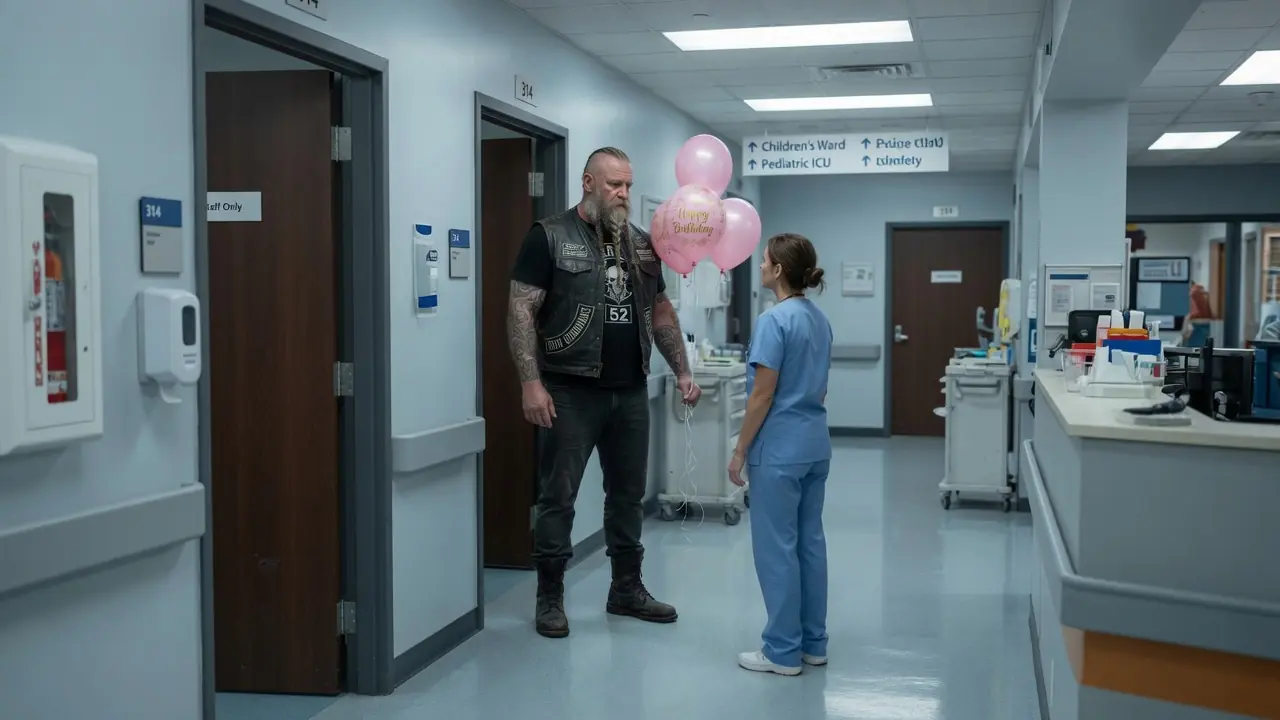
My daughter was sitting at a little plastic table near the lobby aquarium, drawing purple clouds on a hospital coloring sheet while we waited for radiology to correct a paperwork error. I was close enough to keep one eye on her and close enough to hear the leather of the biker’s vest creak every time he took a breath too deep.
The hospital smelled like disinfectant, cafeteria fries, hand sanitizer, and the kind of fear parents try to hide behind paper coffee cups.
The man stood in the middle of the lobby as if he had forgotten why doors existed.
His name, I learned later, was Wade Harlan.
But in that first moment, he was only a giant man with gray in his beard, tattoos down both arms, heavy boots planted on the polished floor, and five pastel balloons floating over his shoulder like they had chosen the wrong escort.
A nurse named Denise Lowell stood beside him.
She was short, red-haired, and calm in the practiced way pediatric nurses become calm after seeing too much pain in small bodies.
“You can take the elevator,” she said gently.
Wade looked at the elevator doors.
His jaw tightened.
“No.”
“Wade.”
“Stairs.”
Denise nodded as if she had known that would be the answer.
That was the first thing that made me look closer.
Here was a man who had clearly ridden a motorcycle through storms, deserts, and whatever kind of trouble leaves scars across your knuckles. But he stood there afraid of an elevator.
Not uncomfortable.
Afraid.
My daughter looked up from her coloring sheet.
“Mom,” she whispered, “why does that big man have fairy balloons?”
“I don’t know, sweetheart.”
But I wanted to.
Wade Harlan had been riding motorcycles since he was sixteen years old, back when he lived out of a duffel bag and slept behind gas stations when money ran thin. His father had left before Wade could remember his voice, and his mother worked graveyard shifts at a roadside motel outside the fictional town of Briar Junction.
Wade found family in a motorcycle club long before he understood the difference between belonging and survival.
The club was called the Iron Willows.
They were not angels, and Wade would have hated anyone who tried to polish them into saints. They drank too much, cursed too freely, and settled arguments faster than most judges would approve.
But if one of their people lost a job, they passed a helmet for rent money.
If a widow needed a roof patched, they showed up with ladders.
If a child needed medicine, nobody asked whether the family could pay it back.
Wade became the kind of man strangers avoided at gas stations.
Then he became the kind of father who learned how to braid doll hair.
Her name was Sophie.
I didn’t know that yet.
Not while he stood at the foot of the stairwell with one hand on the railing and the other gripping those balloon strings so carefully they did not tangle.
I only knew what I could see.
I saw his boot hover over the first step.
I saw his left thumb rub the inside of his leather vest, over and over, like there was something hidden there he needed to touch before he could keep breathing.
I saw two other bikers enter behind him.
One was an older Black man with silver hair under a faded green bandana, a cane hooked over one arm, and a patched vest covered in road dust. The other was younger, white, maybe twenty-five, nervous as a rookie firefighter at his first call, holding a little white gift bag with pink tissue paper sticking out the top.
The older man said, “Brother.”
Wade did not turn.
“Not now, Bishop.”
Bishop came closer.
His voice was low.
“You called us.”
“I called because I thought I could do this.”
“You can.”
Wade let out a hard, humorless breath.
“I’ve been sitting in the parking lot for two hours holding balloons for a kid I’ve never met.”
Bishop looked toward the stairwell, then toward the balloons.
“You know enough.”
The younger biker lifted the gift bag slightly.
Wade looked at it like it might bite him.
“What’s that?”
The kid swallowed.
“Sticker books. Nurse said she likes mermaids and planets. And cats.”
Wade’s face changed at the word planets.
Just a flicker.
His thumb pressed harder against the inside of his vest.
“Planets,” he said quietly.
Denise looked over and caught me watching.
I quickly looked down at my daughter’s coloring page like a guilty teenager.
My daughter had made the clouds purple, the sun green, and the hospital building bright orange.
Wade took one step.
Then another.
The balloons drifted above him, ridiculous and soft against the gray stairwell walls. His boots hit each concrete step with the heavy sound of a man walking toward a memory that still had teeth.
Pediatric oncology was on the fourth floor.
You can feel those floors before you read the signs.
The air changes.
Voices drop.
The beeping machines seem more polite, like even technology knows not to be too loud around children fighting for tomorrow.
There were paper stars taped to doors, handprint turkeys even though Thanksgiving had passed, cartoon animals on IV poles, and names written in marker on construction paper.
A hallway of little brave things.
I had no real reason to be up there except the radiology clerk had sent us to find a nurse who had walked to the fourth floor with our form. That was the excuse I used. My daughter came with me, clutching her orange hospital drawing, and I kept her close.
Wade reached the fourth-floor landing and stopped.
The fairy balloons tapped gently against the ceiling tile.
Somewhere down the hall, a child laughed once, then coughed until a machine beeped faster. A cart squeaked past. A doctor in blue scrubs glanced at Wade, then at Denise, and said nothing.
Room 418 was halfway down the hall.
The door was open.
Inside was a little girl, maybe seven years old, sitting in bed with a crooked paper crown on her bald head. She was tiny, the way sick children become tiny even when their eyes are old. Stickers covered the side rail of her bed, and a handmade sign taped to the wall read HAPPY BIRTHDAY, NORA! in uneven glitter letters.
There were no visitors.
No stack of presents.
No cousins jumping around.
No exhausted parent trying to smile through fear.
Just Nora, one nurse adjusting the tubing near her IV, and a cupcake on a tray with an unlit candle stuck in the frosting.
Wade saw the room.
His face went gray.
Not pale.
Gray.
His hand started shaking around the balloon strings.
Denise stepped into the doorway first.
“Nora, honey, your birthday guest is here.”
The little girl looked past her.
At Wade.
Then smiled with the immediate trust children still have before adults teach them caution.
“Is he the motorcycle man?”
Wade’s mouth opened.
Nothing came out.
The young biker behind him shifted the gift bag from one hand to the other.
Bishop stood still in the hallway.
Nora lifted one hand.
“Hi.”
Wade did not move.
The nurse inside the room smiled gently.
“You can come in.”
He looked at the doorway.
Then at the room number.
I saw something strike him.
Not a thought.
A force.
Then a woman in a charcoal blazer came quickly down the hallway with a tablet in one hand and a badge bouncing against her chest. Hospital administration, from the look of her. The kind of person trained to soften her voice while enforcing hard policies.
“Excuse me,” she said. “What’s happening here?”
Denise turned.
“It’s okay. He’s here for Nora.”
The administrator looked Wade up and down.
The vest.
The boots.
The tattoos.
The skull-and-willow patch.
Then she looked at Bishop and the younger biker behind him.
“Is he family?”
“No,” Denise said.
“Then he needs visitor clearance.”
Wade took one step back.
Immediately.
It was such a small movement, but everyone saw it.
Nora saw it too.
Her smile faltered.
The administrator lowered her voice, but not enough.
“We’ve had concerns about non-family visitors on this floor. Some parents feel uncomfortable.”
Bishop’s jaw tightened.
The young biker looked at the floor.
Wade nodded once.
“Understood.”
He held the balloons toward Denise.
“Give these to her.”
Nora sat up straighter.
“Wait.”
Her voice was thin, but it cut through the hallway better than a shout.
Wade froze.
Nora looked at the administrator, then back at Wade.
“He came for my birthday.”
The administrator’s face softened.
Rules make people stiff even when their hearts try to bend.
“I know, sweetheart. But we have to keep everyone safe.”
Nora looked down at her blanket.
Her chin trembled.
That was the false ending.
I could feel it.
Everyone could.
The scary biker would leave. The hospital would remain orderly. The little girl would get balloons handed to her by a nurse, and everyone would pretend that was almost the same thing.
Wade turned toward the stairwell.
One boot moved.
Then another.
Then the cupcake candle tipped over on Nora’s tray and rolled across the plastic with a tiny click.
Wade stopped like somebody had grabbed the back of his vest.
He whispered something.
I was close enough to hear it.
“Not again.”
Bishop heard it too.
His face changed.
“Wade.”
Wade did not answer.
He turned back toward Room 418.
Not toward the administrator.
Not toward Denise.
Not even toward Nora.
Toward the wall beside the door.
There was an old framed photograph hanging there, one of those donor pictures people pass a thousand times without really seeing. It showed a group of nurses around a little girl in a wheelchair. She wore a pink knit hat and held a stuffed cat. Beside her, kneeling awkwardly in a leather vest, was a younger Wade Harlan.
No gray in his beard.
No deep lines around his mouth.
Same shoulders.
Same huge hands.
The plaque beneath the photo read:
SOPHIE HARLAN FAMILY COMFORT FUND
I read it twice before my mind caught up.
Denise stepped closer to the administrator.
“That’s why we know him.”
The hallway went quiet.
Wade touched the frame with two fingers.
Not dramatically.
Not like a movie.
Just two fingers against glass.
“My daughter died in that room,” he said.
Nobody moved.
“Twelve years ago.”
The administrator’s face drained.
Wade kept looking at the photograph.
“After we buried her, I told myself I’d never come back here. Not because the hospital did anything wrong. Because I couldn’t breathe inside it. I made the kind of promise people make when they’re broken and think grief cares about rules.”
The balloons swayed above his shoulder.
He swallowed.
“Every year on Sophie’s birthday, I ride past this place. I park across the street. I send money. Toys. Gas cards for parents. Blankets. Whatever Denise says the kids need.”
He let out a breath.
“But I don’t come in.”
Denise’s eyes shone, but she held herself together.
Wade finally looked toward Nora’s room.
“Yesterday Denise called and said there was a girl in 418 turning seven. No family coming. Mother gone. No father listed. Foster placement delayed. And she liked fairies, cats, and planets.”
His voice cracked at the last word.
“Sophie liked planets.”
That explained the gift bag.
The young biker held it tighter against his chest.
Wade looked at the administrator.
“I’m not here to scare anybody. I’m not here to make a show. I’m trying to break a promise I should’ve never made.”
Nora had gone very still in her bed.
She looked at the photograph.
Then at Wade.
“Was Sophie your little girl?”
Wade’s throat moved.
“Yeah.”
“Did she have birthdays here too?”
“Four of them.”
“Did people come?”
He nodded.
“Too many. She liked being the boss of a crowd.”
Nora looked at her lonely cupcake.
Then she asked the question that made every adult in that hallway forget how to breathe.
“Are you still a dad if your kid is in heaven?”
Wade closed his eyes.
Bishop looked away.
The young biker wiped his nose with the back of his hand.
Wade walked to the doorway but still did not cross it.
“I don’t know,” he said. “I’ve been trying to answer that for twelve years.”
Nora studied him with the serious face sick children sometimes get too early.
Then she said, “You can come in if you want.”
The administrator stepped aside.
No one told her to.
Wade looked at the threshold.
His boots were half an inch from the room.
I have never seen a man fight a doorway before.
Not another man.
Not a rule.
Not a locked gate.
A doorway.
His leather vest creaked as he breathed in. His hand went again to the inside lining. This time, the vest opened just enough for me to see what his thumb had been touching.
It was not a club patch.
It was a tiny hospital bracelet, laminated and sewn flat into the leather.
SOPHIE HARLAN.
Denise saw me notice it.
“She asked him to keep it close,” she whispered.
Wade stepped into Room 418.
Nothing happened.
No thunder.
No collapse.
No ghost rising from the tile.
Just one man crossing twelve inches of hospital floor.
But everyone in that hallway knew we had watched something brutal and sacred.
Nora looked at the balloons.
“Those are mine?”
Wade nodded.
“Unless you hate fairies.”
“I don’t hate fairies.”
“Good. Because I looked ridiculous buying them.”
She smiled.
The sound Bishop made was almost a laugh.
The young biker stepped in and set the gift bag on the chair.
“There are planet stickers too.”
Nora’s eyes widened.
“For my wall?”
Denise looked at the nurse.
The nurse looked at the administrator.
The administrator sighed.
“We can allow temporary birthday decorations.”
Bishop muttered, “Be still, my grateful heart.”
Wade shot him one look.
Bishop became very interested in the floor.
Then Nora asked, “Are you my birthday person?”
Wade stood beside the bed as if he did not know where to put his hands.
Men like him can rebuild engines, drag wrecked bikes out of ditches, bury friends, and walk into courtrooms without blinking. But put them beside one tiny girl with an IV and a crooked paper crown, and they become helpless.
“I can be,” he said.
She pointed at the chair.
“Birthday people sit.”
Wade sat carefully.
Like the chair belonged to someone else.
Nora picked up the cupcake.
“Can you light it?”
Denise said, “No flame in the room, honey. Hospital rules.”
Nora sighed like the hospital had personally betrayed her.
Wade leaned forward.
“We’ll fake it.”
He held up one scarred index finger like a candle.
Nora stared.
Bishop raised an eyebrow.
Wade made a tiny whooshing sound.
Nora giggled.
Not politely.
Not weakly.
A real giggle that shook her shoulders and made the crown slide over one eye.
Wade smiled for the first time.
Not big.
Not easy.
Just enough.
Then Nora looked at his finger.
“Make a wish.”
Wade shook his head.
“Birthday girl makes the wish.”
“I wish you were not sad.”
The room broke.
Not loudly.
Hospital people do not always break loudly. Bikers usually do not either. They have both learned to fold pain into tasks and coffee cups and jokes that arrive too late.
But something in that room cracked open.
Wade looked down at his raised finger.
His hand was scarred and tattooed, too large for pretend candles, too rough for the paper cup of apple juice beside Nora’s bed. That same hand had probably frightened strangers in parking lots. Now it was trying to be a candle for a girl who had no one else.
His voice came out rough.
“Too late for that, kid.”
Nora thought about it.
“Then I wish you were less sad.”
Wade nodded once.
“That might work.”
The details came back to me later, after Denise told me the parts I had not known.
The balloons were not random.
Sophie had loved fairy balloons because she said they made hospital rooms look less bossy.
The planet stickers were not just a gift.
Sophie had covered every ceiling tile she could reach with stars because she wanted “something better to look at than white squares.”
The hospital bracelet inside Wade’s vest was the last one Sophie wore.
And the elevator?
Sophie had coded in an elevator on the way back from a scan.
They got her back.
For five more months, they got her back.
But Wade Harlan never stepped into a hospital elevator again.
He did not tell Nora that part.
He did not tell her she was brave.
Adults say that too much to sick children, as if children should be grateful for having to be heroic.
Instead, he opened the sticker book, found a page with a cat wearing a space helmet, and asked, “Where does this go?”
Nora pointed at the wall.
“Right above the moon.”
Wade looked at the wall, then at the nurse.
“Is there a moon?”
Nora gave him a patient look.
“We’re making one.”
“Right. Obviously.”
Bishop stood at the door with his arms crossed, pretending not to be emotional.
The young biker carefully peeled stars from a sticker sheet like he was handling evidence.
My daughter tugged my sleeve from the hallway.
“Mom,” she whispered, “is he crying?”
I looked at Wade.
He was not crying.
But his whole face looked like a man standing in rain.
“A little,” I said.
Then came the sound from outside.
Engines.
Not one.
Many.
Low at first, rolling in from the street below like thunder trying to be respectful.
Parents turned toward the windows.
Nurses paused.
Nora lifted her head.
Wade looked at Bishop.
Bishop held up both hands.
“Not me.”
The young biker suddenly looked guilty.
Wade narrowed his eyes.
“Evan.”
The young biker swallowed.
“You called the club.”
“I called two people.”
“I called the rest.”
Wade stood.
“I said no circus.”
Evan held his ground, pale but determined.
“No circus. Birthday line.”
Wade moved to the window.
Down in the circular drive outside Mercy Vale Children’s Hospital, motorcycles rolled in one by one. Not revving. Not showing off. Just arriving. Leather vests. Gray beards. Women riders with long braids. Old men with bad knees. A few pickup trucks too.
They parked in a clean line near the curb.
Then every rider shut off their engine.
Silence settled.
Each person climbed off holding a balloon.
Fairies.
Stars.
Cats.
Planets.
One alligator, for reasons no one could explain.
Wade’s face tightened.
Bishop said quietly, “Family doesn’t always listen when you tell them to stay gone.”
Wade did not answer.
Down below, the Iron Willows stood in the bright afternoon sun, looking up at Room 418.
They did not wave.
They did not shout.
They simply stood there with balloons in their hands.
Present.
Nora crawled carefully onto her knees, weak but determined.
“Are they for me?”
Wade looked at the riders below.
Then at the little girl in the bed.
Then at the hospital bracelet sewn into his vest.
“Yeah,” he said. “Looks like you’ve got a whole bunch of birthday people.”
After that day, Wade came back every Thursday.
Not for long.
Twenty minutes.
Sometimes thirty.
Never with a big speech.
Usually with coffee for the nurses and something small for the kids on the fourth floor. Coloring books. Gas cards. Soft blankets. Stuffed animals. Once, a box of glow-in-the-dark ceiling stars that made the administrator rub her temples for a full minute.
He still took the stairs.
Still paused on the fourth-floor landing.
Still touched the inside of his vest before Room 418.
Nora started calling him Fairy Wade.
He said he hated it.
He absolutely did not hate it.
The Iron Willows built a ritual around Mercy Vale without ever admitting it was a ritual.
Bikers do that.
They will perform the gentlest act you have ever seen and then look personally offended if you name it.
On the first Saturday of every month, a few riders came from fictional towns like Larkspur Bend, Calder Ridge, and Hollow Creek Junction. They parked across the street, killed the engines, and brought in gift cards, blankets, toys, stuffed animals, and grocery vouchers for families who were sleeping in chairs beside hospital beds.
No noise.
No drama.
No readable patches on the pediatric floor.
Just boots on tile.
Leather creaking softly.
Big hands holding small things.
Wade never became cheerful.
That would make this story untrue.
Some grief does not heal.
It learns a new route through the body.
His shoulders stayed heavy. His beard kept more gray than black. He still avoided elevators and sometimes stood outside the hospital for ten full minutes before walking in.
But he walked in.
That mattered.
I saw him again months later at a roadside diner called Junie’s Table, just off the fictional Highway 18 outside Copperfield Flats. My daughter and I had stopped for pancakes after an early appointment, and Wade’s black Road King sat outside beneath a cottonwood tree.
There was a purple planet sticker on one saddlebag.
Nora had put it there.
Wade was sitting with Bishop, eating apple pie, when the waitress asked about it.
He looked through the window at the sticker.
“Kid has terrible taste,” he said.
Bishop grinned.
“You clear-coated it.”
Wade pointed his fork at him.
“Shut up.”
That was Wade’s version of tenderness.
Nora’s treatments got worse before they got better.
That is the truth.
There were nights Wade rode home under cold stars with his jaw clenched so hard his teeth hurt. There were mornings Denise called and he answered before the first ring finished. There were days Nora wanted no balloons, no stickers, no birthday people, and no jokes.
On those days, Wade sat in the chair beside her bed and said nothing.
He had learned something the rest of us spend years avoiding.
Love is not always fixing.
Sometimes love is staying in the chair.
The following August, Nora turned eight.
Room 418 was empty by then.
Not for the reason everyone feared.
She had been moved to outpatient care and placed with a retired librarian named Mrs. Hattie Bloom, who had fostered children for thirty years and knew how to love carefully without making promises too fast.
Nora’s hair had begun growing back in soft dark patches.
She still wore crooked crowns.
She still liked planets, cats, and stickers that were not technically approved by hospital administration.
Her birthday party was held behind Junie’s Table, under the cottonwood tree, with folding chairs, paper plates, too much lemonade, and a cake shaped like a moon.
Wade arrived late.
Of course he did.
The whole parking lot heard the Harley before they saw it, that low V-twin rumble rolling over the asphalt, then cutting off into a silence that made everyone turn.
He climbed off slowly.
Bad knee.
Old back.
Big man getting older.
In one hand, he carried a small gift box.
In the other, a single balloon.
Not fairies this time.
A silver moon.
Nora ran to him with her paper crown bouncing and wrapped both arms around his waist.
Wade froze the way men freeze when they are loved without warning.
Then he rested one scarred hand on the back of her head.
She looked up at him.
“Are you still my birthday person?”
Wade glanced toward the road, toward the long ride back to Hollow Creek Junction, toward a hospital room that had taken his daughter and somehow given him another place to put his love.
“Yeah,” he said.
Just one word.
But Bishop turned away.
Evan, now wearing a full patch on his vest, wiped his eyes and blamed the dust.
Wade tied the silver moon balloon to the back of Nora’s chair. The wind tugged at it, but the string held.
Later, after the cake was cut and the sun fell behind the diner sign, the bikes started leaving one by one.
Wade stayed a moment longer.
He stood near his Road King, one hand inside his vest, fingers resting over Sophie’s bracelet.
Then he looked across the yard.
Nora was laughing under the cottonwood tree, her crown crooked, her moon cake smeared on one cheek, her silver balloon floating above her like a promise that had not left.
Wade started his Harley.
The engine rumbled low.
He rode out onto Highway 18, taillight glowing red in the dusk, a purple planet sticker on his saddlebag, grief behind him and beside him.
Not gone.
Carried.
Years from now, people might tell the story like it was about a scary biker and a sick little girl.
It was not.
Not really.
It was about a man who thought love had ended because his child was gone.
It was about a hospital door he believed he could never cross again.
It was about a lonely girl with a crooked crown who asked the one question nobody had been brave enough to ask him.
Are you still a dad if your kid is in heaven?
And it was about the answer he found, not in words, but in showing up.
With fairy balloons.
With planet stickers.
With coffee for nurses.
With silence on bad days.
With a chair beside a bed.
Sometimes the heart does not heal by forgetting the room where it broke.
Sometimes it heals by walking back in, shaking, carrying balloons for someone else.