“Take that hat off, old man.”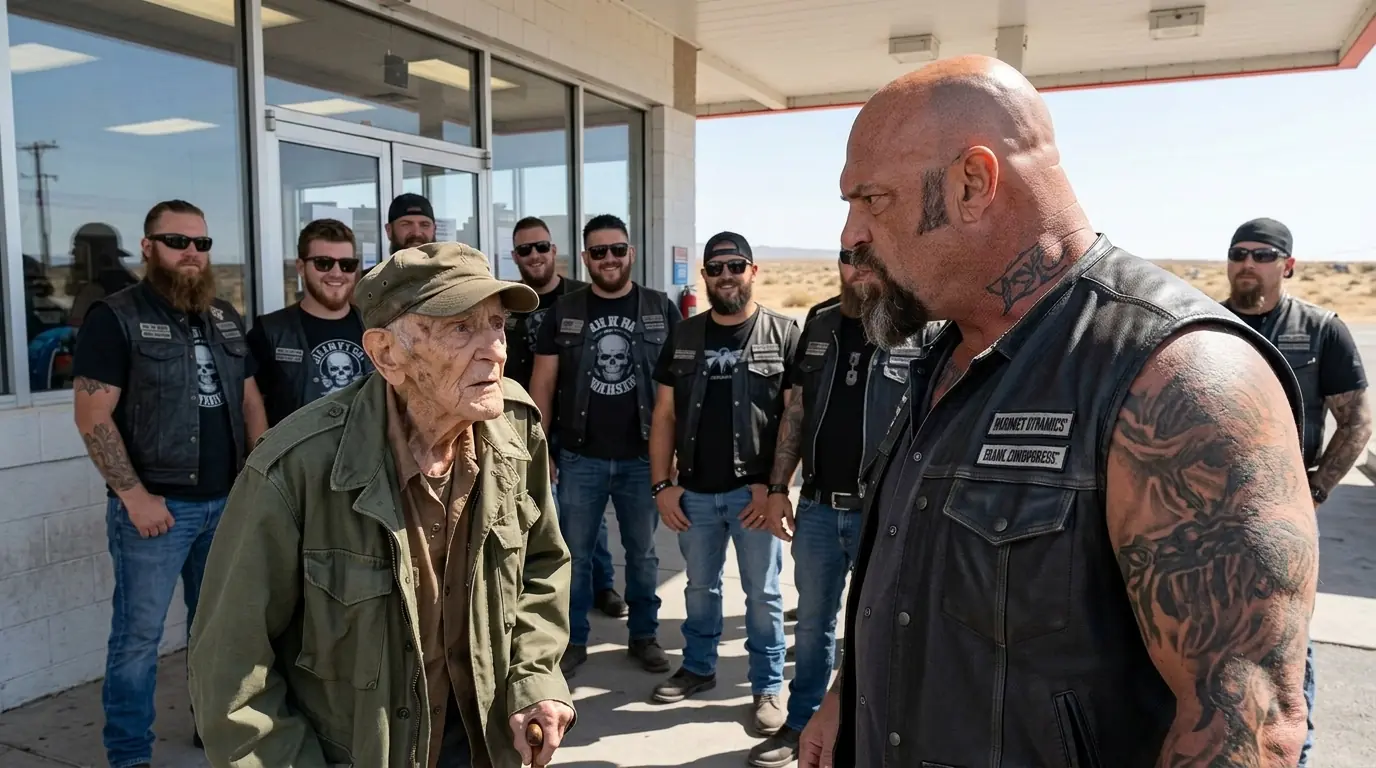
The voice cut across the gas station lot under a hot, white afternoon sun.
Raymond Ellis stopped beside Pump Six with one hand resting on his cane and the other curled around the handle of his old pickup truck. He was seventy-eight years old, lean in the way old soldiers become lean when time takes everything soft and leaves only bone, habit, and memory. Silver hair showed beneath a faded Marine Corps cap, the green cloth worn nearly pale at the edges.
He turned slowly toward the voice.
Five bikers sat near the front of Dalton’s Fuel & Market, their motorcycles lined up like they owned the asphalt. Leather vests, loud engines, beer hidden in paper bags, sunglasses reflecting the fuel pumps back in cold little mirrors. Across their backs was the name Iron Jackals, stitched in red over black.
The largest of them stepped forward.
His name was Mason Crowe.
He was thirty-two, thick through the shoulders, tattooed down both arms, with the loud confidence of a man who had learned that picking on the right people could feel like strength. He pointed at Raymond’s hat with two fingers and smiled for the men behind him.
“I said take it off.”
Raymond looked at him for a long moment.
“Why?”
Mason laughed.
“Because you look ridiculous wearing it.”
The others joined in.
One of them, a narrow-faced man with a chain hooked to his belt, pointed at the faded ribbons pinned above the left pocket of Raymond’s field jacket.
“Those real, Grandpa? Or did you find ’em at a yard sale?”
Raymond did not answer.
He had worn the jacket because the morning had been cool when he left home, and because the jacket still fit if he didn’t button it. The medals had stayed pinned there for years, not for display, not for attention, but because his wife had once told him to stop hiding everything that hurt him. She had been gone nine years now, and he still heard her voice when he put it on.
Mason moved closer.
“You deaf?”
“No,” Raymond said.
“Then take off the hat.”
Raymond’s eyes moved across the five men.
He was not afraid.
Afraid had been a young man’s emotion, sharp and useful, something he had known in jungles, ridgelines, and the sudden silence after incoming fire. What he felt now was weariness. The old kind. The kind that comes when you realize some men grow older without growing into anything.
“I earned this hat,” Raymond said.
Mason’s smile hardened.
“Bet you earned a lot of stories too.”
One of the bikers reached out for the brim.
Raymond caught his wrist.
It was not fast.
It was just exact.
The younger man’s grin vanished when the old Marine’s fingers closed around him. Raymond’s hand trembled slightly, but the grip still knew what to do. For one quiet second, the biker looked into Raymond’s eyes and saw something he had not expected.
Not anger.
Not panic.
A distance.
Like the old man was looking at him from somewhere much worse than a gas station parking lot.
Raymond released him.
“Don’t touch the hat.”
Mason stepped closer, trying to laugh the moment back into his control.
“You threatening us?”
“No.”
Raymond adjusted the brim.
“I’m asking you to act like men.”
The laughter stopped.
Then came back louder.
That was how weak men handled shame. They fed it noise.
The one with the chain kicked Raymond’s cane.
It spun across the concrete, scraping through a thin rainbow slick of oil before striking the base of a trash can. Without the cane, Raymond’s balance broke. His shoulder hit the edge of a newspaper box, and pain flashed through his left hip so hard his breath left him.
The bikers laughed again.
Inside the store, seventeen-year-old Cody Hale stood behind the counter with one hand frozen over the register keys.
He had been working at Dalton’s for six months, long enough to know which customers wanted receipts, which truckers bought coffee at dawn, and which men made the whole store feel smaller when they walked in. The Iron Jackals had arrived twenty minutes earlier and had already insulted a delivery driver, complained about gas prices, and made Cody feel like calling the sheriff.
Now he reached slowly for his phone.
Raymond walked to the cane.
Each step hurt.
The old piece of shrapnel in his hip had been there since 1969. Doctors in a naval hospital had told him it was safer to leave it than cut deeper trying to remove it. Most days, it slept quietly inside him. That afternoon, the pain woke up mean.
He bent down, picked up the cane, and wiped dust from the polished wooden handle.
Raymond did not complain.
He did not ask for help.
He did not even look embarrassed.
That was the part Mason did not like. He had expected the old man to get loud, or scared, or leave. He had expected to feel big. Instead, the old Marine straightened his jacket and walked toward the store like their laughter had not been worth hearing.
That silence changed the lot.
It stopped being entertainment.
It became judgment.
Raymond opened the glass door, and the bell gave a bright, cheerful ring that did not belong to the afternoon.
Cody stood up straighter.
“Afternoon, sir.”
“Pump Six,” Raymond said. “Forty dollars.”
His voice was rough, but steady.
Cody glanced toward the bikers following him inside.
“Are you okay?”
“I’m fine.”
Mason leaned against a rack of chips and laughed under his breath.
“Listen to him. Fine. Like he didn’t almost fall on his face.”
Raymond set his wallet on the counter.
The leather was old and soft, darkened by decades of pockets, sweat, rain, and use. When he opened it, Cody saw a photograph inside. A woman in a yellow dress standing beside an old Chevy truck, smiling like summer itself had belonged to her.
Mason saw it too.
“That your girlfriend from the nursing home?”
Raymond counted the bills.
He did not look up.
The chain-belt biker stepped forward and flicked one finger against the medals pinned to Raymond’s jacket.
The sound was small.
Metal against metal.
But it moved through Raymond like a bullet finding an old scar.
For a moment, the store disappeared.
There was no register.
No fluorescent light.
No cold drink cooler humming against the wall.
There was only wet heat, red mud, smoke hanging low between torn trees, and a radio crackling through bursts of gunfire. Someone was yelling for a corpsman. Someone else was praying. A young radio operator named Eddie Crowe was pressed against a broken ridge with blood running down his sleeve, still calling coordinates because if the line went dead, the men below them would die without ever knowing help was close.
Raymond blinked.
The gas station returned.
The biker’s finger still rested on the medal.
Raymond raised his eyes.
“Remove your hand.”
The young man pulled back without understanding why.
Mason pushed away from the chip rack.
“What are you going to do if he doesn’t?”
Raymond turned toward him.
“I’ve met louder men than you.”
Mason grinned.
“And what happened to them?”
Raymond looked past him, through the window, toward the highway shimmering in the heat.
“They stayed where we left them.”
He did not say it like a threat.
He said it like grief.
That made the words heavier.
Cody watched the five bikers shift, each man suddenly unsure whether the joke had gone somewhere none of them knew how to follow.
Mason removed his sunglasses.
His pride had been damaged in front of his crew, and men like Mason treated pride like a debt that had to be collected immediately.
He stepped close enough for Raymond to smell beer, cigarettes, and cheap aftershave.
“Maybe I should take that hat myself.”
Raymond’s hand tightened around the cane.
“You don’t want to do that.”
“Then stop me.”
Mason reached for the brim.
The bell over the door rang again.
A man stepped into the store from the glare outside.
He was tall, late fifties maybe, wearing a black T-shirt, faded jeans, dusty boots, and dark sunglasses. A pale scar curved from his right temple toward his ear. He did not look around like a customer. He looked around like a man counting risks before anyone else knew there were risks to count.
Five bikers.
One elderly veteran.
One frightened cashier.
A chain on one belt.
A folding knife clipped to another pocket.
One man too close to the old Marine.
The stranger saw all of it in less than two seconds.
Mason lowered his hand.
“This doesn’t involve you.”
The stranger removed his sunglasses.
His eyes moved to Raymond’s cap.
Then to the ribbons.
Then to one faded red-and-yellow strip above the old Marine’s heart.
“That ribbon is real,” he said.
His voice was quiet, but it carried.
Raymond turned.
The stranger nodded toward his chest.
“Third Marine Division.”
Raymond studied him.
“Army?”
“Ranger.”
The stranger held his gaze.
“Seventy-Fifth.”
That was enough.
Men who had never served would have needed more explanation. Men who had served did not. The two of them recognized each other in posture, in stillness, in the way neither was trying to impress the room.
Mason looked from one man to the other.
“So what? You two going to start crying into the flag?”
The stranger faced him.
“No.”
He tucked his sunglasses into his pocket.
“You’re going to apologize.”
The bikers laughed.
But not all of them.
Not loudly.
Mason forced his own laugh higher to cover the gap.
“To him?”
“Yes.”
“And if I don’t?”
The stranger took one step forward.
It was a small step.
That was the problem.
Men who wanted to scare people took big steps, noisy steps, arms spread, chest out. This man only reduced the distance. He did not raise his voice. He did not need to.
“You should.”
Mason looked toward his crew.
There were five of them.
The old man could barely walk.
The stranger was alone.
Numbers should have made Mason feel safe.
They did not.
“Who are you supposed to be?”
“Adrian Keller.”
The name meant nothing to Mason.
It meant something to Cody.
Cody had seen him on television two months earlier during a Veterans Day ceremony at Fort Reynolds. Retired Colonel Adrian Keller. Former Ranger commander. Silver Star recipient. The kind of man local news anchors spoke about with a different voice.
Cody’s mouth opened slightly.
One of Mason’s men leaned close.
“He said Ranger, man.”
Mason ignored him.
“There are five of us, Adrian.”
Keller’s expression did not move.
“I counted.”
Mason reached for the chain hanging from his belt.
Raymond planted his cane against the tile.
“Don’t.”
For the first time, Mason really looked at him.
Not at the age.
Not at the cane.
Not at the faded hat.
At the man.
Raymond was not preparing to fight him.
He was warning him.
That somehow felt worse.
Keller’s eyes returned to the medals.
“Where were you?”
Raymond hesitated.
“Vietnam.”
“Where?”
“Near Da Nang. July of ’69.”
Keller’s face changed.
Just a little.
“What unit?”
Raymond gave him the designation.
Keller stood straighter.
He knew that action.
Many career officers did, though the names of the men involved had been buried under time, politics, and the country’s long discomfort with the war. A small Marine position had held long enough for wounded men to be evacuated through a narrow draw under heavy fire. Nearly half the unit never made it home.
“Staff Sergeant Raymond Ellis,” Keller said.
The store went still.
Raymond lowered his eyes.
“Not staff sergeant anymore.”
“You were that day.”
Mason’s hand fell away from the chain.
Keller continued, voice measured.
“Bronze Star. Purple Heart. Navy Commendation. Held a ridge for three hours after radio contact failed.”
Raymond looked away.
“Men did more than me.”
“My father was one of the men carried off that ridge.”
Raymond’s head lifted.
“Who was your father?”
“Lieutenant Mark Keller.”
Recognition moved across Raymond’s face slowly, like an old photograph developing in water.
“He had a chest wound.”
“Yes.”
“Tall boy. Wouldn’t stop trying to stand up.”
“That sounds like him.”
Raymond swallowed.
“He kept asking for his radio operator.”
Keller nodded.
“My father said a Marine carried him downhill while rounds cut the trees above them. Said the man had a broken watch and kept telling him, ‘Stay awake, Lieutenant. You can sleep when I say.’”
Raymond’s left hand moved without thinking toward his wrist.
The watch had broken that day.
He had thrown it into a drawer when he came home and never worn another one.
“He lived?” Raymond asked.
“He lived to seventy-six,” Keller said. “Had three children. Six grandchildren. He saw me graduate Ranger School. He saw my daughter born. He never forgot you.”
Raymond looked down at the counter.
The store blurred for a moment.
He cleared his throat.
“I’m glad he made it.”
“He made it because you did.”
Keller extended his hand.
Raymond stared at it, then took it.
His fingers trembled now.
Not because of fear.
Because sometimes memory waits fifty years to put its hand on your shoulder.
Outside, a low rumble began on the highway.
At first, it sounded like a storm gathering beyond the trees.
Then it deepened.
Engines.
Many of them.
The windows of Dalton’s Fuel & Market vibrated softly. The bikers turned toward the glass. Cody leaned over the counter to see.
Motorcycles appeared at the far end of the road.
Not five.
Not ten.
Almost twenty.
They rode in two disciplined lines, equal distance between each bike, engines low and steady. Sunlight flashed across chrome, windshields, helmets, and polished black tanks. Their vests bore a silver eagle and the words:
VETERANS HIGHWAY ALLIANCE
SERVED THEN. SERVING STILL.
The motorcycles entered the lot and parked in formation.
Every engine shut down within seconds.
The silence that followed was larger than the noise.
A woman dismounted from the lead bike.
She was in her early fifties, Latina, short dark hair threaded with gray, Navy insignia pinned to her vest. She walked toward the store while the rest remained beside their motorcycles, helmets tucked beneath their arms.
The bell rang again.
She stepped inside, looked once at Keller, then raised her hand in a clean salute.
“Colonel.”
Keller returned it.
“Commander Ortiz.”
She lowered her hand and turned toward Raymond.
For a moment, she only looked at the ribbons.
Then her face changed.
“Staff Sergeant Ellis?”
Raymond frowned slightly.
“Do I know you?”
“No, sir.”
Her voice softened.
“My name is Maribel Ortiz. My uncle was in the evacuation column below your ridge.”
Raymond looked at Keller.
“What is all this?”
Keller stepped aside.
“The Alliance was finishing a charity ride twenty miles south. I was supposed to meet them here.”
Ortiz looked at the Iron Jackals.
Then at Raymond’s cane.
Then at the cap Mason had nearly taken from his head.
“Did someone touch his medals?”
No one answered.
“Did someone knock away his cane?”
Still no answer.
Keller pointed toward Mason.
“He led it.”
Ortiz looked at Mason’s vest.
“Iron Jackals.”
Mason tried to recover something from the wreckage of his pride.
“We were joking.”
“No,” Keller said. “You were choosing someone you thought couldn’t answer.”
Mason’s face tightened.
The biker who had flicked Raymond’s medal looked at the floor.
Ortiz turned to Raymond again.
“Sir, your position held after two officers were down and the landing zone was under fire.”
Raymond shook his head.
“My position didn’t hold. Men held. Names held. Some just didn’t make it into the reports.”
Ortiz went quiet.
That was how old soldiers corrected praise.
Not by rejecting honor.
By widening it.
Mason stared at Raymond’s medals as if seeing them for the first time.
Then something strange moved across his face.
“My grandfather was over there,” he said.
Raymond turned.
“What was his name?”
Mason hesitated.
“Edward Crowe. People called him Eddie.”
The store fell silent.
Raymond’s hand tightened around the cane.
“Radio operator?”
Mason’s eyes lifted quickly.
“You knew him?”
Raymond closed his eyes.
The ridge came back.
Eddie Crowe crouched over a battered radio, one sleeve dark with blood, headphones pressed to his ear, refusing to let the line die. Eddie laughing two nights before because the cook had ruined rice badly enough to make every man miss home. Eddie showing Raymond a photograph of a baby boy he had not yet met.
Raymond opened his eyes.
“He kept the radio alive when the rest of us thought everything had gone quiet.”
Mason’s mouth parted.
“My dad barely knew anything. He just said his father died in Vietnam.”
“He died making sure other men got home.”
Mason looked down.
The arrogance drained out of him so quickly he seemed younger by ten years.
“My father hated the Marines,” Mason said. “Hated the uniforms. Hated anything military. Said it took his father and left his mother with nothing.”
Raymond nodded slowly.
“War doesn’t end when the shooting stops. It walks into kitchens. Bedrooms. Garages. It sits at dinner tables where nobody knows what to say to it.”
Mason’s eyes reddened.
“I didn’t know.”
“No,” Raymond said. “You didn’t.”
Mason looked at the cap he had tried to take.
Then at the cane his friend had kicked.
Then at the old Marine’s medals.
“I’m sorry.”
Raymond did not answer right away.
Mason swallowed.
“I mean it.”
Raymond stepped closer.
Slowly.
The whole store seemed to hold its breath.
When he reached Mason, he looked up at him.
“Sorry is a door,” Raymond said. “Not a house.”
Mason frowned.
“You have to walk through it,” Raymond said. “And then you have to live different on the other side.”
Ortiz removed her riding gloves.
“This Sunday, we’re holding a service at the county veterans center. Eddie Crowe’s name is on the wall. So is Lieutenant Keller’s. So are eight men from that ridge.”
Mason looked at her.
“My family never knew there was a wall.”
“Now you do.”
Keller looked at the other Iron Jackals.
“You come too.”
The bikers stood awkwardly between the chips and the beer cooler.
They had walked into the store believing mockery made them hard.
Now they stood surrounded by men and women who had known war and still understood respect.
One by one, they removed their sunglasses.
Then their caps.
The chain-belt biker walked to Raymond with the cane in both hands, though Raymond already had it.
“I’m sorry,” he said.
Raymond studied him.
Then nodded once.
Outside, the Veterans Highway Alliance lined up beside their motorcycles.
Ortiz opened the door and stepped out first. Keller followed. Raymond came after them with his cane tapping against the concrete. Mason and the Iron Jackals trailed behind, quieter than they had been all day.
The veterans stood in formation.
No one had ordered them to.
They simply knew.
When Raymond reached the front of the store, every veteran raised a hand in salute.
Different ages.
Different wars.
Different uniforms long ago folded into closets, boxes, and memories.
Some stood straight.
Some leaned on bikes.
One man saluted with two missing fingers.
A woman near the end had tears on her face and made no effort to hide them.
Raymond stopped.
For a moment, he looked almost startled.
Then his back straightened.
His cane stilled.
His right hand rose slowly to the brim of his faded Marine cap.
The salute was for him.
But not only him.
It was for Eddie Crowe at the radio.
For Mark Keller bleeding on the evacuation trail.
For the men who never got old enough to stand at a gas station beneath a hot afternoon sun.
For the families who carried silence because no one had ever given them the full story.
Raymond lowered his hand.
“Thank you,” he said.
The words nearly broke apart before they left him.
Keller stood beside him.
“My father wanted to find you for years.”
Raymond kept his eyes on the line of veterans.
“I spent years hoping nobody would.”
“Why?”
“Because every thank-you comes with ghosts.”
Keller nodded.
“They come anyway.”
Raymond looked toward Mason.
The younger man had removed his vest and held it folded in one hand.
For the first time, he looked ashamed without trying to turn shame into anger.
That mattered.
The memorial service took place the following Sunday.
Mason arrived without his Iron Jackals vest.
He wore a plain white shirt, clean jeans, and boots that had been polished badly but sincerely. In his hand was a small photograph his father had finally taken from a locked drawer. Eddie Crowe was twenty-two in the picture, standing beside a radio crate with a cigarette tucked behind one ear and a grin too wide for the war waiting ahead of him.
Mason held the photograph like it might vanish if he loosened his grip.
Raymond stood beside him at the veterans center wall.
Eddie Crowe’s name was there.
So was Mark Keller’s unit.
So were names Mason had never heard but would never forget again.
“My dad never came here,” Mason said.
“Some men can’t walk toward the wound,” Raymond replied. “They spend their whole lives walking around it.”
“Did my grandfather suffer?”
Raymond looked at him.
Mason braced for the answer.
“Yes,” Raymond said.
Mason’s eyes closed.
“But he was not alone.”
That was the part that undid him.
Not the death.
The presence.
Mason bowed his head and cried quietly, one hand pressed against the wall beneath Eddie Crowe’s name. No one mocked him. No one told him to toughen up. The veterans around him understood that grief arriving late is still grief.
Raymond told him the pieces he could bear to give.
Eddie hated canned peaches.
Eddie wrote letters to a woman named Ruth every Thursday.
Eddie called every mosquito in Vietnam by a different curse word.
Eddie stayed at the radio long after any sensible man would have abandoned it because the wounded below needed coordinates, and Eddie believed voices mattered when men were dying in the dark.
“He wasn’t fearless,” Raymond said.
Mason looked up.
“I thought men like him had to be.”
“No,” Raymond said. “Fearless men are usually fools. Brave men are scared and keep working.”
Mason wiped his face.
“My father said the war made our family hard.”
“It probably did.”
“How do you fix that?”
Raymond looked at Eddie’s name.
“You stop passing the hardness on like an inheritance.”
The Iron Jackals changed after that.
Not overnight.
Real change rarely arrives clean enough for a movie ending.
Two men left the group immediately, saying they had not signed up for “veteran charity nonsense.” Mason let them go. The ones who stayed helped repair the veterans center roof before winter. They drove older vets to doctor appointments. They cleaned neglected headstones at the county cemetery. They stopped drinking before rides, and eventually stopped bringing paper bags to gas stations altogether.
Mason removed the Iron Jackals patch from his vest.
For a while, the back stayed blank.
Then he sewed on a small patch with Eddie Crowe’s unit number and one word beneath it.
Remember.
He did not wear it proudly at first.
He wore it carefully.
There is a difference.
Dalton’s Fuel & Market changed too.
Cody asked the owner if they could put up a small veterans board near the entrance. The owner agreed, mostly because the story had brought more customers through the door than any discount ever had. What began as one photo turned into a wall.
Families brought pictures.
Marines, soldiers, sailors, airmen, nurses, mechanics, radio operators, truck drivers, medics, cooks.
Some in color.
Some black and white.
Some faded so badly the faces looked like they were already halfway back into memory.
At the center was a photograph taken the day of the incident.
Raymond stood with his cane.
Keller stood on one side.
Commander Ortiz stood on the other.
Mason stood several feet away, head lowered, vest in his hands.
Beneath it, a small bronze plaque read:
HONOR IS WHAT WE CARRY FOR THOSE WHO CANNOT.
People began stopping at Dalton’s for more than fuel.
Truckers left coins beneath photos.
Schoolchildren came in with teachers and asked why some names had stars beside them. Veterans who had not spoken about their service in decades began bringing old photographs in envelopes, shoeboxes, and trembling hands.
Cody cleaned the glass every morning.
He learned the names.
That mattered.
Raymond visited once a week.
He bought black coffee, always paid full price, and sat on the bench near the wall. Some days people recognized him and came over to shake his hand. He accepted it, but never seemed comfortable with praise. Other days, he sat quietly and looked at Eddie Crowe’s photograph as if the young radio operator might start speaking if given enough patience.
One afternoon, Mason found him there.
No sunglasses.
No vest.
Just a work shirt, jeans, and a small metal pin in his hand.
“My father gave me this,” Mason said.
Raymond looked down.
It was a radio operator’s insignia, tarnished but intact.
“Eddie’s?”
Mason nodded.
“He said he should have given it to me years ago, but he didn’t know how to explain it.”
Raymond studied the pin.
“Do you want it on the wall?”
“I thought so.”
“And now?”
Mason looked at the photographs.
“I don’t know.”
Raymond closed Mason’s fingers around the insignia.
“The wall holds memory,” he said. “That holds responsibility.”
Mason looked at him.
“What am I supposed to do with that?”
“Carry it.”
Raymond tapped the younger man’s fist gently with his cane.
“When you start feeling like the man you were that day, remember who held a radio while men were bleeding and afraid. Remember what your name came from before anger got ahold of it.”
Mason’s jaw tightened.
“I was cruel to you.”
“Yes.”
“I kicked a man when he was old.”
“You tried.”
Mason almost smiled, then didn’t.
“I don’t know if I can become a better man.”
Raymond looked toward the highway.
“You don’t become one all at once. You become one in the next thing you do.”
Commander Ortiz arrived a few minutes later carrying three coffees.
She handed one to Raymond, one to Mason, and kept one for herself.
“We’re holding another service next month,” she said. “Raymond, we want you to speak.”
Raymond shook his head.
“I’ve said enough.”
“No,” Ortiz said. “You’ve carried enough. Saying is different.”
He did not answer.
She sat beside him.
Keller could not attend that afternoon, but a framed letter from him hung beside the memorial wall.
Some battles never end. They only change shape. Honor survives when one generation teaches the next what must not be forgotten.
People stopped to read it every day.
That evening, Raymond, Mason, and Ortiz sat outside the gas station as the sun turned the highway gold.
Motorcycles passed in the distance.
Not loud.
Just steady.
Mason held Eddie’s radio pin in his palm.
“I spent most of my life thinking my grandfather was just a name that made my dad sad.”
Raymond rested both hands on his cane.
“That’s how a lot of men get remembered at first.”
“What changes it?”
“Somebody asks.”
Mason looked at him.
“And somebody answers?”
Raymond nodded.
“If they can.”
The wind moved through the parking lot.
A dry leaf crossed the concrete near the place where Raymond’s cane had been kicked away weeks earlier. Mason watched it slide past his boot. He looked ashamed again, but the shame no longer seemed useless.
It had become something to build from.
A father lifted his little boy near the memorial wall so the child could see the photographs. The boy pointed at Eddie Crowe and asked something too soft to hear. His father leaned close and began reading the name out loud.
Raymond smiled faintly.
“They aren’t gone,” he said.
Mason turned.
Raymond looked at the faces behind the glass.
“Not while somebody says their names.”
For a long while, nobody spoke.
That was all right.
Some silences are empty.
Some are full.
Months later, Mason would say that afternoon at the gas station saved his life, though not in the dramatic way people expected. No one dragged him from a burning car. No one pulled him from a river. No one put a hand on his shoulder and told him he was forgiven.
An old Marine simply refused to hate him cheaply.
A retired Ranger told him the truth without dressing it up.
A group of veterans showed him what strength looked like when it did not need an audience.
And his own grandfather, dead more than fifty years, finally became more than a family wound.
He became a responsibility.
Raymond never liked the phrase “wrong man.”
People in town used it often.
Those bikers picked on the wrong old man.
Raymond always corrected them.
“There is no right old man for that,” he would say.
No right veteran to mock.
No right cane to kick.
No right medal to touch with dirty laughter.
No right grief to turn into entertainment because the person carrying it looks too weak to answer.
That was the lesson people slowly learned at Dalton’s Fuel & Market.
Courage did not always roar.
Sometimes it appeared as an old man bending down to retrieve his cane without surrendering his dignity.
Sometimes it walked through a glass door wearing dusty boots.
Sometimes it arrived on twenty motorcycles and shut every engine off at once.
And sometimes, if a man was lucky enough to recognize the moment before it passed, courage began as an apology he would spend the rest of his life trying to deserve.