Caleb Whitmore set the folder down on the billionaire's reception desk and a woman in a $4,000 suit picked it up and dropped it in the trash can without reading a single page. He didn't shout. He didn't beg. He just looked at Victoria Arlington and said, "That copy was yours. There are four more and one of them is already in a bank vault."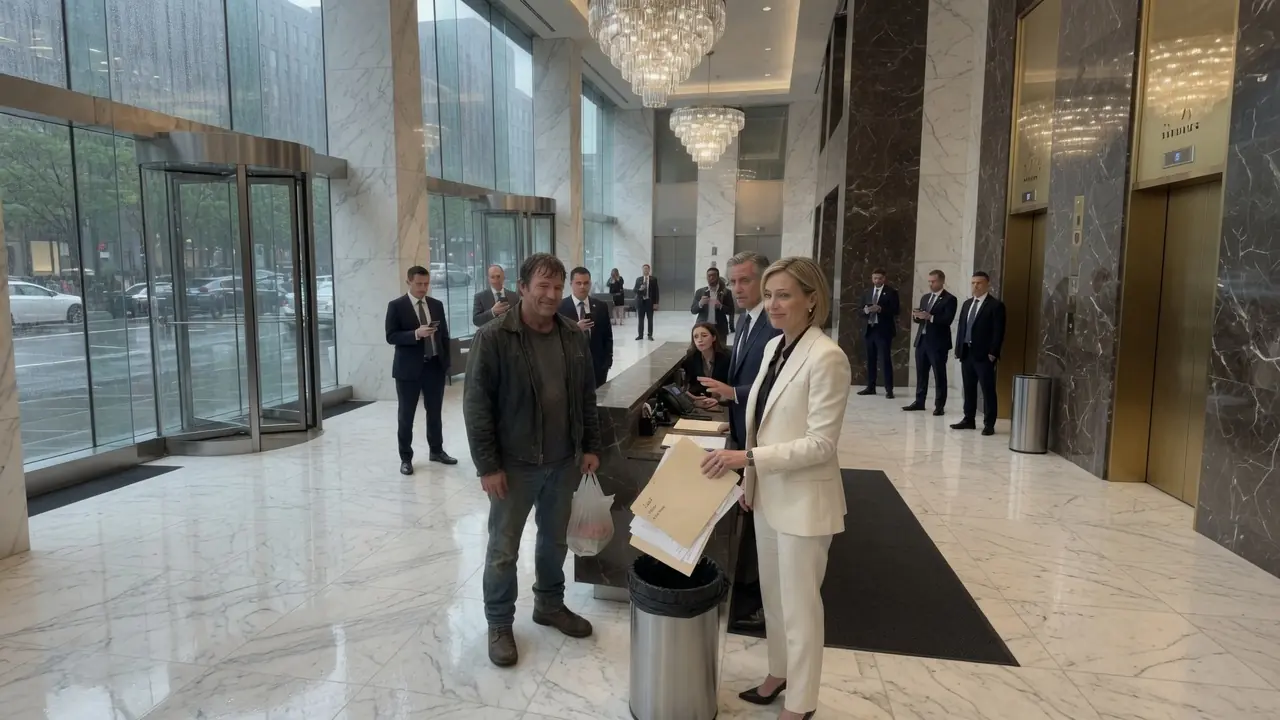
She laughed and called the police. Ninety minutes later, a single father in a faded work jacket stood in handcuffs while she smiled for the cameras and asked for one phone call. That call froze $150 million. The rain came in off of the water that morning the way it always did in Grey Haven, sideways cold and without apology. Caleb Whitmore had been awake since 4:00.
Not because of an alarm, because at 4:00 in the morning, the house was quiet enough to think, and he'd needed to think about what he was going to do at 9:00. He'd sat at the kitchen table with a cup of coffee gone cold in front of him, the folder squared up on the placemat like a plate he couldn't bring himself to eat. Sarah's handwriting was on the tab. Two years gone and her handwriting was still on the tab. He hadn't been able to make himself replace it.
At 6:15, his daughter came down the stairs in her school uniform with her hair still wet. "You're wearing the jacket," Lily said. "I'm wearing the jacket." "Dad." She stopped at the bottom step.
She was 14, and she had her mother's talent for putting a whole argument into a single syllable. They're going to look at you like you're nothing. Probably. So, wear the other one. The one from Uncle Ray's funeral.
Caleb turned the coffee cup a half turn on the table. Your mother bought me this jacket. I know. She bought it the year we opened the center. She said a man ought to walk into a room dressed like what he actually is.
He looked up at her. I'm a machinist, sweetheart. I'm not going to walk in there pretending I'm one of them. They'd smell it in about four seconds and it would make everything I say sound like a lie. Lily crossed the kitchen and stood next to his chair.
She put her hand on the folder, just laid it there flat the way you'd touch a headstone. Is this the one? She asked. This is the one. And if they say no.
Caleb was quiet a moment. Outside the gutter over the porch was running like a faucet. "Then they say no," he said. And then we find out what kind of people they are. She kissed the top of his head, which she'd started doing about a year ago, and which still undid him every single time.
And she went to catch her bus. He put the folder in a plastic grocery bag because it was raining and because he owned exactly one briefcase and it had a broken clasp. And because a man who's been poor long enough stops being embarrassed about staying dry. The lobby of Arlington Global Group was three stories of white marble and glass, and it had been built to make people feel small. It worked.
Caleb noticed it working on himself the second the revolving door spat him out. There was a security guard by the elevators who clocked him at forty feet. There was a woman at the reception desk with a headset and a smile she put on like a wristwatch. There were maybe 30 people crossing that floor. Suits, heels, ID badges on lanyards, coffee cups from the place downstairs that charged $7.
And Caleb watched every one of them do the same small thing when their eyes passed over him. They looked, then they looked away fast. Then they walked a little quicker. He'd worn work boots into a lot of rooms in his life. He knew that walk.
He shook the rain off the plastic bag, wiped his boots twice on the mat, even though nobody in that building had wiped their feet in a decade, and went to the desk. "Morning," he said. "Good morning." The receptionist's eyes did the elevator thing down, up, and back to her screen. "Are you here for deliveries?
Deliveries is around on Kesler." "No, ma'am. I'm here to see Victoria Arlington. The typing stopped. I'm sorry.
Victoria Arlington, Caleb said, or whoever's authorized to receive filings on the harbor project. That would be fine, too. I don't need her specifically. I need somebody with the authority to stamp a document as received. The receptionist smiled with about half her face.
Do you have an appointment? No, ma'am. Then I'm afraid. I called eleven times, Caleb said. Not sharp, just even the way you'd read a serial number off a part.
Over nine days, I left my name and my number and the reason each time. Nobody called back. I sent two certified letters. One came back refused and the other one got signed for by somebody named M. Okafor.
And I've got the green card in this bag if you want to see it. He tapped the plastic. I don't have an appointment because I couldn't get one. That's not the same thing as not trying. She stared at him.
The smile was gone now, and what was underneath it wasn't cruelty. It was just tiredness. She'd had this conversation before. Not with him. With others.
Sir, I really can't. I know you can't. He put both hands on the counter, palms down so she could see they were empty and so she could see that they were scarred across the knuckles, one fingernail permanently black from a press break in 2011. So, let me ask you for something you can do. Is there a mail room, a compliance office, a legal intake desk, anywhere in this building where a piece of paper can be handed to a human being who will write down the date and time they got it.
Legal intake is on 22, but it's badge access only. Can you call them? She hesitated. Her eyes flicked past his shoulder to the guard Caleb guessed and then back. "What's in the folder?"
She asked quietly. "Documents that say if your company signs a contract on Friday, they're going to be signing it on top of a fraud." The receptionist's hand stopped halfway to her phone. That's a joke, right? No, ma'am.
Sir, my name's Caleb Whitmore. My wife's name was Sarah Whitmore. She spent four years of her life getting the Grey Haven Harbor Community Agreement written and signed by every party that mattered, including the predecessor company to this one. She died before she could see whether it held. He kept his voice down.
He wasn't performing. That was the thing that would come back to him later that at every single point right up until the end, he had not raised his voice one time. It's not holding. And I've got the paperwork that proves somebody in this building knows it isn't holding. I'm not asking anyone to agree with me.
I'm asking one person to receive it. That's all. Stamp it, log it, throw it in a drawer, just make it exist. She looked at him for a long 3 seconds. Then she picked up the phone.
Rebecca, hi. It's Dana in the lobby. I have a gentleman here with a document for the harbor project. No, no appointment. I know.
I know. But he's saying her voice dropped. He's saying it's a compliance matter. Okay. Okay.
Yeah. She hung up. Someone's coming down. Thank you, Caleb said. Truly.
Don't thank me yet, Dana said. And it was the first honest thing anybody in that building said to him all day. The man who came down was named Nathan Caldwell. And Caleb knew who he was before he introduced himself because Caleb had spent nine days reading. And Nathan Caldwell's signature was on page 41.
Caldwell was maybe 50 silver at the temples, and he had the specific walk of a man who has never once in his adult life been told to wait. He came across that marble floor with two people trailing him, and he was already talking before he was in range. Mr. Whitmore. Nathan Caldwell, general counsel.
I understand there's some confusion. No confusion. Caleb offered his hand. Caldwell looked at it. Then he shook it.
One pump and Caleb watched him glance at his own palm afterward. A flick quick almost nothing. Almost. I've got seven documents here, Caleb said, opening the bag. Six are copies.
The seventh is, let me save us both some time. Caldwell put up a hand, and the hand had a watch on it worth more than Caleb's truck. I know exactly what this is. This is the evergreen material. Caleb stopped.
Something moved behind his ribs. Not fear exactly, recognition. The way you feel when you're driving at night and you see the deer's eyes before you see the deer. "You know what it is," he said slowly. I know it's an old novelty clause in a dead community agreement that has no operative force whatsoever, Caldwell said briskly.
It was drafted in 2016 by a well-meaning nonprofit and it was superseded by the 2021 master development framework which I personally negotiated. Whatever your late wife believed she was building Mr. Whitmore and I'm sorry for your loss sincerely. It doesn't exist anymore. Legally, it's a ghost.
That's interesting. "It's not interesting," Caleb said. It's just true. No, I mean it's interesting that you called it evergreen. Caleb looked up at him.
I didn't say the word evergreen. I said seven documents. You said evergreen. The lobby noise kept going. Somebody's heels clicked past.
An elevator chimed. Caldwell's face did not change at all, which was in its own way an answer. Everyone in this building knows about the harbor litigation. "There isn't any harbor litigation," Caleb said. That's the whole problem.
Nobody sued anybody. There's nothing on a docket anywhere. So how does everybody in this building know about a clause in an agreement that's supposedly a ghost? For maybe two full seconds, nobody said anything. Then Caldwell laughed.
It was a good laugh. Caleb would give him that. It was warm and rueful and it had a little bit of you got me in it and it was completely manufactured and about six people in earshot relaxed when they heard it. You're sharp. Caldwell said genuinely.
Have you considered law school? I considered a lot of things. Then my wife got sick. That landed. Caleb saw it land.
Caldwell's jaw moved once. Mr. Whitmore quieter now. Almost decent. Let me tell you how this actually goes.
And I'm telling you this as a courtesy because I've done this a long time and I don't enjoy watching people hurt themselves. You hand me that folder. I take it upstairs. It goes into a review queue. The review queue is administered by outside counsel.
Outside council takes 90 to 120 days. The contract executes Friday. Do you understand what I'm describing to you? You're describing a filing cabinet with a lock on it. I'm describing a process.
Same thing if you built the process. Caleb pulled the folder out of the bag and held it. Not offering it, just holding it. So, don't put it in the queue. Log it.
There's a difference. And you know the difference better than I do. I'm asking for a date stamp and a receipt number. Six seconds of somebody's life. That's the entire ask.
And why would I do that? Because if it's a ghost like you say, a date stamp cost you nothing. Caleb tilted his head. The fact that you're standing in a lobby arguing with a machinist about six seconds is the loudest thing anybody said to me all week. Caldwell's eyes changed.
Not angry, worse. Calculating. Caleb had seen that exact look on a foreman's face once right before the man decided that the cheapest fix was to fire somebody. Nathan. The voice came from behind him from the elevators, and Caleb watched the entire lobby reorganize itself around it.
Heads turning spines, straightening two people, actually stepping backward without seeming to know they'd done it. Victoria Arlington had arrived. She was smaller than he expected. That was the first thing. The second thing was that she moved through that lobby like weather.
She didn't hurry and she didn't slow down and people simply weren't in her way anymore by the time she got there. Victoria Caldwell said and there was a warning in it. I've got this. You've got a crowd is what you've got. She stopped six feet from Caleb and looked at him.
Actually looked top to bottom and unlike everyone else in the building, she didn't pretend not to. Who is this Caleb Whitmore? Ma'am, I didn't ask you. I know, Caleb said. I answered anyway.
Seemed faster. Something in her eyes sharpened. Not warmth, interest. The way a person looks at a machine that's making a noise it shouldn't make. Caleb Whitmore, she repeated.
And what are you, Caleb Whitmore? Ma'am, it's not a difficult question. Everyone who walks into my lobby is something. Vendors are vendors. Journalists are journalists.
Activists are activists. I can usually smell those that use a particular soap. What are you? I'm a father, Caleb said. Victoria blinked.
But I'm here because I'm a father and because I was a husband and neither of those is on a business card. Victoria studied him for a long moment. Then she laughed. She It wasn't Caldwell's laugh. Caldwell's laugh had been a tool.
Hers was real, and that was the thing that made the whole lobby go cold. She was genuinely actually delighted. "Oh, that's good," she said. "That's very good. Did you write that in the car?
Be honest. I wrote it at 4 this morning at my kitchen table, ma'am, along with about nine other things I'm not going to say. Because they're rude. Because they're true, Caleb said, and I'd like this to go well. Victoria's smile stayed exactly where it was, but something behind it moved a quarter inch.
Nathan, she said without looking away from Caleb. What does he want? He wants a date stamp on the evergreen file. Huh. She nodded slowly.
How much? Caleb frowned. I'm sorry. How much? She said it patiently the way you'd repeat a word to a foreigner.
This is the part where you tell me a number. Everybody has a number, Mr. Whitmore. The number is never really about money. It's about the story people need to tell themselves afterward.
So, some people say 100,000 and mean I want to be respected. Some people say 2 million and mean I want to hurt you. Some people can't say a number out loud at all and those people are the most expensive because what they want is to be begged. Caleb stared at her. Which are you?
Victoria asked pleasantly. None of them. Everyone's one of them. Then I guess I'm the first, Caleb said. Because I don't want your money.
I don't want a dollar of it. I wouldn't take it if you put it in a wheelbarrow and rolled it out here right now. Victoria's smile widened. Nathan, he's lying. I'm not.
Everyone lies about this. It's the most predictable lie there is. She stepped closer. Five foot four. She was in his space now and she did it deliberately and Caleb noticed that he didn't move and he noticed that she noticed.
Let me tell you why. I know you're lying, Mr. Whitmore. You drove here. That's a truck outside, isn't it?
Something with 180,000 mi on it. 212. 212. She said it like a prize. You have a child.
You said father singular. No wife mentioned no we. So, she's gone or she left. And given the way you're holding that folder like a rosary, I'm going to guess gone. You have a mortgage you're behind on, or you were behind on it recently enough that the feeling hasn't worn off, and you're standing in a marble lobby in a jacket with a frayed collar telling a woman with $4 billion that you don't want money.
She tilted her head. Caleb, come on. The lobby was silent. Caleb was aware of every person in it. He was aware of Dana at the desk not typing.
He was aware of the guard by the elevator standing with his hands behind his back. He was aware that his own heart was going hard enough that he could feel it in his throat. And he was aware mostly that Victoria Arlington had just described his entire life in eleven seconds and gotten every single fact right and the whole thing completely wrong. You're good at that, he said. I know.
No, I mean it. That was impressive. You got the truck. You got the mortgage. You got Sarah.
His voice didn't shake. That surprised him a little. You missed one thing, did I? Yeah. Caleb held up the folder.
You figured out everything I've lost. You didn't ask what I kept. Victoria's eyes flickered. That's a lovely line, she said. It's not a line, ma'am.
It's an inventory. Yeah. She took a step back. Just one. And Caleb, who had spent 16 years reading machines by the sound they made, heard it.
"All right," Victoria said. "I'll play." "What did you keep her word?" Caleb said, "That's it. That's the whole list."
In 2016, my wife sat in a room for 11 months with your predecessors and the Port Authority and the city and four neighborhood associations, and she got them all to sign one page that said, "Before anybody redeveloped the working harbor, an independent review would confirm the displacement numbers were honest, not favorable. Honest." That's all she ever asked for. She wasn't trying to stop the project. She wanted the people who'd get moved to be counted, and they were counted.
No, ma'am, they weren't. Caleb opened the folder. Your exhibit C says 140 households in the affected zone. The actual number is 96. Caldwell said that's a methodology difference.
It's a definition difference, Caleb said. And it was the first time all morning that anything like heat came into his voice. You redefined affected zone to exclude anybody on a month-to-month lease. That's 766 people who fell off a spreadsheet because somebody changed a footnote. Those people are real.
I know about 40 of them by name. Ray Bellamy's 81 and he's lived on Dunore Street since Nixon. And according to your exhibit C, he doesn't exist. Mr. Whitmore.
And here's the part I want you to actually hear. Caleb turned a page and held it up. Somebody in this company ran the real numbers in March internally. I've got the summary and the tab labels and a cover memo. And the memo says, and I'm reading it, ma'am, per counsel, do not circulate outside the working group pending strategy.
That's not a methodology difference. That's two sets of books. The silence in the lobby went from awkward to something else entirely. Victoria didn't look at the page. That was what Caleb noticed.
She never looked at the page, not once that whole morning. Where did you get that? She said it wasn't a question. Doesn't matter. It matters a great deal.
No, ma'am, it doesn't. And here's why. Caleb closed the folder. Because you didn't ask if it was true. You asked where I got it.
A person who thought the memo was fake would have said that's a forgery about a second and a half ago. You went straight to the leak. That's the answer to my question. Somewhere behind Victoria, one of Caldwell's assistants shifted her weight, and the sound of it was enormous. Victoria Arlington looked at Caleb Whitmore for a long, long moment, and then she smiled again, and this time there was nothing warm in it at all.
Nathan, she said, "Take the folder, Victoria. Take the folder." Caldwell reached out. Caleb handed it over. He handed it over without one second of hesitation and that he'd think later was what broke the spell because everyone in that lobby had been braced for him to clutch it to argue to make them take it from him.
He just gave it up like a man passing a wrench. Caldwell looked at the folder in his hands like it had been worn from someone else's pocket. Now what? Victoria said. Now you log it.
Caleb said Datetime receiving party. You give me a receipt with a number on it, then I leave and I don't come back and you never see me again. And if I don't, then at 5:00 Friday, copies go to the state financial regulator, the city planning commission, the four institutional investors named in your Q2 disclosure, and the bank underwriting the expansion facility. He said it the way he'd read a Torque spec. No drama in it whatsoever.
Not because I want to hurt you, because the whole point of what my wife built was that somebody outside this room gets to see the numbers. If you won't be that somebody, they will. That's a threat. That's a deadline, Caleb said. You made it.
I just showed up for it. Victoria stood very still. Then she turned and she walked six steps to the reception desk and she took the folder out of Nathan Caldwell's hands on the way. And Caleb understood what was about to happen. Approximately half a second before it did, she dropped it in the trash can.
It made a sound. That was the thing. It made a real physical thump. And in the silence of that lobby, it was the loudest noise Caleb had heard in two years. Somebody gasped.
He didn't see who. Victoria turned around, brushing her hands off against each other once, twice, unhurried. "Loged," she said. Caleb didn't move. He looked at the trash can.
He looked at her. And then, and this was the thing that would end up on every screen in America, though nobody knew it yet. Caleb Whitmore smiled. It wasn't a big smile. It was small and tired, and it didn't reach his eyes.
And it was the smile of a man who has just watched somebody confirm the worst thing he suspected about them, and now doesn't have to wonder anymore. "Okay," he said quietly. Okay, Victoria repeated. Yes, ma'am. Okay.
He picked up the empty plastic bag off the counter, folded it in half, and put it in his jacket pocket because he'd been raised not to leave trash behind, even in a room where somebody had just thrown his wife's life's work away. That copy was yours. There are four more. One's with a lawyer, one's with a person I'm not going to name. One's in a safe deposit box at First Coastal and one's in a sealed envelope with a courier who's been given instructions.
Bluff, Caldwell said. Might be. Caleb nodded agreeably. That's the fun part. You've got about 52 hours to decide.
Get him out of my building. Victoria said. Yes, ma'am. The guard his badge said. Reynosa came forward and put a hand on Caleb's arm.
And Caleb held both hands up open at shoulder height and said, "I'm going. I'm not going to be a problem for you, brother." "Sorry, man," Reynosa said under his breath. "Not your fault. You're just working."
They were eight steps from the revolving door. "Eight steps. That was how close it came to being a completely different story." And then Victoria Arlington said, "Actually, no." Caleb stopped.
He turned around slowly and Victoria was standing in the middle of her lobby with her arms folded and her head tilted and an expression on her face that Caleb would spend the rest of his life trying to describe accurately to people and never quite manage. She wasn't angry. She was bored. And she just thought of something that might be entertaining. He came into a private building without an appointment.
She said he was told to leave. He refused. He made threats against this company in front of what 30 witnesses. She looked around mildly. Somebody call the police.
The lobby didn't move. I'm sorry, she said. Did I stutter? Dana, call the police. Dana's hand was shaking.
Caleb could see it from twenty feet. Ma'am, he wasn't Dana. Dana picked up the phone. Caldwell crossed to Victoria. Fast, low, urgent.
Victoria, Victoria, listen to me. Don't do this. Whatever's in that folder, we handle it upstairs. We handle it quietly. This is exactly Nathan.
This is exactly the wrong Nathan. She said it softly and he stopped like he'd hit a wall. You've been telling me for nine days that that clause is a ghost. Were you lying? No.
Then there's nothing in that trash can but paper, Victoria said. And this man is trespassing and I would like him removed by people with handcuffs because the last four of these I settled quietly and the number keeps going up. Every one of them talks to the next one. They tell each other I pay. Her voice never rose.
That was the terrible part. So this one doesn't get money. This one gets to be an example. Caleb stood there in his wet boots and listened to a woman decide to arrest him for sport. "Ma'am," he said.
She looked over. "You don't have to do this." "I know," Victoria said. "That's what makes it worth doing." The squad car took 11 minutes.
Caleb spent them standing exactly where he was, hands out of his pockets, feet apart, not moving, because he had learned a long time ago from a man named Curtis Pratt at the shop that when the police are coming for you and you are the only person in the room who looks like you, do the entire game is don't give them a story. Some of the office people drifted back to work. Most didn't. He counted phones four, then seven, then 11, held down low against thighs, angled up recording. He didn't know it yet, but two of those videos were already uploading.
Victoria didn't leave. She stayed. She stood by the desk with one hand on the marble and twice she checked her watch and once she took a call and said, "No, push it to 11. I'm dealing with something." And looked directly at him when she said something.
Caldwell paced. He paced and he made a call and came back and he had stopped looking at Caleb entirely, which told Caleb everything he needed to know about what Nathan Caldwell believed. When the two officers came through the door, Caleb spoke first, calm and loud enough for everyone. Officers, my name is Caleb Whitmore. I'm not armed.
I don't have anything in my pockets except a phone, a wallet, and a folded up grocery bag. I'm going to keep my hands where you can see them. The older cop's eyebrows went up about a millimeter. The younger one, tall, maybe 30 name tag Reeves looked at Caleb for a second longer than he needed to. "Who called?"
Reeves asked. "I did?" Victoria said. "And you are?" Victoria Arlington.
This is my building. Ma'am, what's the complaint? Criminal trespass. He was asked to leave and refused. "That's not accurate," Caleb said.
Sir, I know I'm not supposed to talk. I'm going to talk one time and then I'll be quiet and you can hold everything I say against me. Caleb kept his hands up. I came in at 9:04. I was invited to stay by the woman at that desk who called upstairs on my behalf.
Their general counsel came down and talked to me for 11 minutes. I was asked to leave at approximately 9:31 and I turned around and started walking to the door and I was eight steps from it when Ms. Arlington told the guard to stop me and called you. There's 30 people in this lobby who saw it and there's a camera on that pillar and a camera over the door and probably four more I can't see. I'm not asking you to believe me, officer.
I'm asking you to pull the video. Reeves turned and looked at the pillar. Victoria said, "The cameras are on a 30-day loop and their company property." And officer Daniel Reeves, 29 years old, four years on the job. Nobody in particular, a man whose name Caleb Whitmore did not know and would not forget, said, "Ma'am, why would you volunteer that?"
The lobby got very quiet. "Excuse me, I didn't ask about your cameras," Reeves said. "I hadn't gotten there yet." Victoria's expression didn't change, but she didn't answer either. The older officer, Kolchak, put a hand on his partner's shoulder, easy, and turned to Caleb.
Sir, were you asked to leave? Yes, sir. Did you leave? I was leaving. I got stopped.
But when you were asked, you didn't go out the door immediately. No, sir. I took about four seconds to put a plastic bag in my pocket. Kolchak sighed. It was the sigh of a man 41 months from a pension who has just realized exactly what kind of morning this is going to be.
Sir, turn around, please. Yes, sir. Put your hands behind your back. Yes, sir. Caleb turned around.
He found himself facing the trash can. He looked at it while a police officer he had no quarrel with put steel on his wrists in front of 30 strangers. And he thought clearly the way you think about a bolt pattern. Sarah, I tried it the polite way. I want the record to show I tried it the polite way.
The cuffs clicked and behind him, Victoria Arlington laughed, not loud. That was the detail that finished her. Every reporter who covered it later got that wrong. They all wrote that she laughed loudly. They all wrote cackled and none of it was true.
It was a small laugh, almost affectionate. The laugh of a woman watching a dog fail to get onto a couch. You see, she said to nobody, to everybody, to the whole marble room. This is what always kills me. Men like this walk in here absolutely certain they matter.
She said it lightly. She said it the way you'd comment on Rain. They're not bad men. That's the tragedy. They just have no idea how small they are.
Reeves's jaw tightened. Kolchak said, "Ma'am, I'd ask you not to address the arrestee. I'm not addressing him." Victoria said, "I'm addressing you. You're going to write a report and somebody's going to read it and I want the tone to be right."
Reeves turned Caleb toward the door, hand on his elbow, and Caleb went, "Two steps, three." Then Caleb stopped and turned his head and said over his shoulder in a voice that carried across every inch of that marble. "Ma'am, one question." Victoria looked up. "When you were figuring me out just now," Caleb said.
"The truck, the mortgage, my wife. That was fast. That was really fast." He nodded slowly. "How many of us have you done that to?"
She didn't answer. That's what I thought. Caleb said, "See, that's the problem with getting good at reading people. You stop reading them all the way to the end." And then he let them walk him out into the rain.
The booking room at Grey Haven Central smelled like burnt coffee and floor wax. They took his belt. They took the plastic bag. They took his wallet and counted the money out loud, $16, and put it in a manila envelope. And the desk sergeant asked him twice if he understood the charges and Caleb said yes sir both times.
Reeves stood by the wall the whole time. Didn't have to. Did anyway. You need a lawyer? Reeves asked when the sergeant stepped away.
I've got one. You've got one? Yes, sir. Reeves looked at the boots, at the jacket, at the $16 in the envelope. Mr.
Whitmore, he said carefully. What exactly is in that folder? Caleb met his eyes. Officer, he said, if I tell you, you're going to have a very hard week. I've had hard weeks.
Not like this one. Caleb almost smiled. Do me one favor instead. When you write your report, write down that the cameras came up before you asked. Just that one sentence.
Don't editorialize. Don't take my side. Don't take hers. Just put the sentence in. Reeves was quiet for a second.
Why? Because in about 9 months, somebody's going to read that report in a room with a court reporter in it, Caleb said. And that one sentence is going to matter more than anything either of us says today. Reeves stared at him. Then he said, "You get one phone call."
"I know," Caleb said. "I only need one." He walked to the wall phone and he stood there with his hand on the receiver for a second and he thought about Sarah in the hospital bed in the last week when she couldn't talk much anymore and how she'd written a name on the back of a pharmacy receipt and pressed it into his hand and squeezed it hard enough to hurt. If they ever break it, she'd said not before. It's a bomb, Caleb.
It's a real bomb. He'd carried that receipt in his wallet for two years and never dialed it once. Caleb picked up the phone and he dialed. The phone rang four times. Caleb had counted on two.
He'd thought about it for two years and in every version he'd imagined the woman picked up on two. And by the fourth ring, the whole thing had started to feel like exactly what Nathan Caldwell had said. It was a ghost, a piece of paper, a dead woman's hopeful arithmetic. Then there was a click and a voice said, "Ellery." Caleb closed his eyes.
"Margaret," he said. The silence on the other end went on so long that he checked the receiver to see if the call had dropped. "Say that again," she said. "Margaret, it's Caleb." "Caleb who?"
"You know who?" There was a sound like a chair moving, like a woman standing up very fast in a room where standing up fast was not something people did. Caleb Whitmore, she said. Yes, ma'am. It's been two years.
Two years and 4 months. You didn't come to the memorial dedication? No, ma'am. I didn't. I sent you nine letters.
11. Caleb said, "I've got all of them." Margaret Ellery breathed out. He could hear her hand cover the phone, hear her say something muffled to somebody else in the room. Give me a minute.
Closed the door. And then she was back, and her voice had changed. It had gone flat and careful. The way people talk when they've stopped being surprised and started being afraid. Where are you calling from?
Grey Haven Central. That's a She stopped. That's a police station. Yes, ma'am. Caleb, I'm all right.
Are you arrested? Yes, ma'am. For what? Criminal trespass. Where?
Arlington Global. The lobby. Margaret Ellery said a word. Caleb had never once heard her say in the four years he'd known her. And then she said, "Don't say anything else.
Don't say one more word on that line. I'm going to give you a number." Margaret, it's a firm on Blackwell they owe me. They'll have somebody down there in Margaret. She stopped.
Caleb turned his shoulder toward the wall. Eleven feet away. Officer Daniel Reeves was doing a very poor job of pretending to read something on a clipboard. I didn't call you for a lawyer, Caleb said. Then why in God's name did you call me?
He'd rehearsed this, too. He'd rehearsed it in the truck at 4 in the morning and in the shower and standing at the workbench with a part in his hand and the lathe running down. And every time it had felt enormous, like a thing you'd need a speech for. It turned out to be four words. Activate the evergreen clause, he said.
The line went completely silent, not quiet, silent, the specific dead nothing of a person who has stopped breathing. Margaret, I'm here. Did you hear me? I heard you. Her voice had gone somewhere strange.
Caleb, do you understand what you just said? Yes, ma'am. No, I don't think you do. I think you heard Sarah say it once when she was on morphine and you've been carrying it around like a rabbit's foot. So, let me be very clear with you about what that sentence is.
He heard her sit back down. That is not a complaint. That is not a letter to the editor. That is a founder initiated compliance freeze under a registered community benefits instrument. And if I execute it, it goes to the trustee at First Coastal.
And First Coastal is the administrative agent on Arlington's expansion facility. And the second it lands, they are obligated, not encouraged, obligated to put a hold on $150 million of drawn and undrawn credit pending independent verification. I know. It doesn't ask permission. It doesn't go to a judge.
It's a contractual trip wire and it cannot be quietly unpulled. Do you know why? Because Sarah made it that way. Because Sarah made it that way. Margaret said, "Because Sarah sat in my office in 2016 and said, "Margaret, they'll settle it.
They always settle it. One person gets a check and everybody else gets bulldozed. Build me something that can't be bought, and I told her she was insane, and I built it anyway because she wouldn't leave." Margaret's voice cracked on the last word and came back harder. And if I pull it and you're wrong, if what you've got is a hunch and a bad feeling and some numbers a guy at a bar told you, then Arlington Global sues the review board and the board is me and a retired hydrologist and a woman who teaches at the community college and they will take everything from all three of us and they will be right too.
I know that, too. So, I'm going to ask you one time, and Caleb, I want you to think before you answer because I've known you for a decade, and you have never once in your life exaggerated anything." She d. "What have you got?" Caleb pressed the receiver harder against his ear.
"I've got the March deck," he said. The sound Margaret Ellery made was not a word. "The internal one," Caleb said. "The real numbers. 96 households broken out by street, by lease type, by age of head of household.
And I've got the cover memo attached to it that says, "Do not circulate outside the working group pending strategy per counsel." Per counsel. That's the phrase signed initial NC. Margaret said, "Oh my god, there's more." Exhibit C in the public filing says 140.
Same fiscal quarter, same author line. They ran it twice, Margaret. They ran it honest and then they ran it again with the footnote changed and they filed the second one. How do you have this? Same answer I gave Caldwell.
It doesn't matter. It matters to me because if it's stolen, it's not stolen. Caleb glanced at Reeves, who had given up on the clipboard entirely. It was mailed to a residential address by a person who had lawful access to it and who is protected under the whistleblower provisions of the same instrument you drafted, which and I read this eleven times to make sure says any employee of a covered developer may transmit compliance relevant material directly to the review board without breach. Section 4, subsection C.
You wrote it. There was a very long I did write that, Margaret said slowly. Nobody's ever used it. Somebody used it nine days ago. Who?
I don't know. Caleb said. There was no name in the envelope. There was no note. Just the deck, the memo, and a Post-it that said she's going to sign it Friday.
Margaret Ellery was quiet for a moment. You've had this for nine days, she said. And you spent nine days calling their front desk eleven times, Caleb. I sent two certified letters. Why?
And there it was. The question he'd known was coming since 4 that morning, and he found that his throat had closed up around the answer, and he had to swallow twice before it came out. Because Sarah told me not to use it unless they broke it, Caleb said. Those were her words, not before. She wasn't trying to catch anybody, Margaret.
She wanted them to do the right thing on their own. She'd have been happy if they'd just stamped the folder in Reddit and fixed the number. That's all she ever wanted. His voice went rough. So, I gave them nine days to be decent.
I gave them every chance I had. I stood in that lobby this morning and I asked one woman for six seconds of a stamp and she took my wife's work and she put it in a garbage can in front of 30 people. And then she had me put in handcuffs for the entertainment value. Reeves looked at the floor. So they broke it.
Caleb said, "That's my answer. They broke it and I'm not asking you. I'm telling you because the clause says a verified founder doesn't have to ask." Margaret said very quietly. "Caleb, what?
You're not a founder?" The booking room hummed. What? Caleb said you're not a founder. Sarah was a founder.
Ray Bellamy is a founder. Teresa Nunez was a founder and she died in 2019 and we never replaced her. You were married to a founder. Margaret's voice was strangled. The verification protocol requires two living founders in agreement on the record.
It's in the same section three paragraphs down. I put it there because you you Caleb, you personally sat in that meeting in 2016 and said, and I quote, "What if somebody down the road pulls this thing out of spite?" And Sarah looked at you and said, "Then it takes two of us." And she wrote it on a napkin. I have the napkin.
Caleb stood in a police station with $16 in an envelope and his belt in a bin. And he felt the entire architecture of two years come apart in his hands. Two, he said, "Two. There's two of you left. There's one of us left."
Margaret said, "I'm not a founder either. I'm counsel to the board. I'm the one who executes it." Ray Bellamy is the only living signatory on that instrument. And Caleb Honey Ray Bellamy is 81 years old and I haven't been able to reach him in 11 months because his phone's been shut off since last summer.
Caleb put his forehead against the wall. You're telling me? He said that the only man who can stop this is the man on Dunore Street who they erased off the spreadsheet. Margaret didn't answer for a second. Then she said in a voice he'd never heard from her.
Oh, that's Caleb. That's not a coincidence. No, ma'am, it isn't. They cut him out of the count because if he's not in the affected zone, he's not an affected party. And if he's not an affected party, his signature is a nullity.
Caleb said they didn't erase 766 people by accident. They erased them to get to one. Sweet Jesus. How long do you need to do? What?
To execute once you've got him. Margaret was already moving. He could hear a drawer, paper, a keyboard. 40 minutes. It has to be a live voice.
It has to be recorded. He has to state his name and his signatory number and affirm the predicate. And Caleb, I have to see the document. I can't freeze $150 million on your description of a Post-it. I need the deck in my hands.
There's a copy in a safe deposit box at First Coastal, which is closed until it's 10:40 in the morning, Margaret. All right. Right. She laughed one shaky note. God, I've been up since 3.
Okay. Who has the key? It's a joint box, Caleb said. It's in my name and one other. Who's?
Caleb looked at the wall. Lily's, he said. The line was silent. Your daughter, Margaret said, she's 14. She's a signatory on the box because Sarah put her on it in the hospital and I fought her about it for 2 days and she wouldn't let it go.
She said, "Caleb, if they come for you, they'll come for you and they won't think to look at a kid." Caleb's eyes burned. I thought she was being paranoid. I told her she was scaring our daughter for no reason. Caleb, she was making a plan.
He said she was dying and she was making a plan. And I sat there and told her to rest. Caleb, listen to me. Margaret's voice came through the receiver like a hand on his shoulder. You have 4 minutes on a jail phone.
Feel that later. Feel all of it later. I'll sit with you and we'll feel it together. I promise. Right now, I need you to tell me exactly what you want and I need you to be a machinist about it.
Caleb breathed in through his nose, held it, let it out. Dunore Street, he said. Raises the yellow house third from the corner. There's a boat trailer in the yard with no boat on it. He doesn't answer the door for people he doesn't know.
He's got a bad hip and it takes him 90 seconds to get there. And if you knock twice and leave, he'll think you were a bill collector. Knock and wait. Tell him you're Sarah's Margaret. He'll know.
I'm 40 minutes out. I know. Who's closer? Caleb didn't want to say it. He stood there and he did not want to say it.
And he thought about a 14-year-old girl in a school uniform kissing the top of his head. And he thought about what Sarah would say. And what Sarah would say was, "She's mine, too, Caleb. And you don't get to decide. She's small.
My daughter's at Grey Haven East." He said, "Dunore's four stops on the six bus. She's got the box key on her house ring and she has since she was 12 and she doesn't know why. Margaret said, "Caleb, I can't ask a child to you're not asking her." Caleb said, "I am."
He hung up before he could change his mind and then he stood there with his hand on the receiver for four seconds and then he turned around and Officer Daniel Reeves was standing directly behind him. "You get one call," Reeves said. I know that was one call. Yes, sir. Reeves looked at him for a long moment.
Behind him at the desk, Sergeant Kolchak had a phone to his ear and was saying, "Uh-huh. Uh-huh." In the tone of a man being told something he did not like. "Mr. Whitmore," Reeves said.
"Is there anything in that folder that would make a police officer look stupid for arresting you?" "Yes, sir." "How stupid?" "National," Caleb said. Reeves shut his eyes briefly.
You want to know the funny part? Caleb said, "You didn't do anything wrong. You showed up. You took a complaint. You followed the process.
That's the whole trap, officer. That's how it works. Nobody in that lobby did anything wrong except one woman, and she only had to do one thing, and everybody else just did their jobs." He shrugged with his shoulders because his wrists were still tight. That's what my wife spent four years trying to explain to people.
It doesn't take villains. It takes a footnote and 40 polite people. Kolchak hung up the phone. Reeves, he said. Get over here.
Reeves went. Caleb watched them talk with their heads bent for maybe 30 seconds and he watched Reeves's spine change and then Kolchak came over and stood in front of him with his thumbs in his belt. Mr. Whitmore, Arlington Global's counsel just called my captain. Yes, sir.
Not the desk, not me. My captain at the district 9 minutes after you got booked. Yes, sir. Now, you want to know what he asked for? Kolchak's face was doing something complicated.
He didn't ask us to hold you. He asked us to release you right now. Charges withdrawn. No paperwork, no arraignment. Walk him out the back.
Caleb went very still. That's Caldwell, he said. That's a name I did not say. He's not doing me a kindness. No.
Kolchak agreed. He is not. If I'm never arraigned, there's no arrest record. If there's no arrest record, there's no incident report in the system and there's no video subpoena. And in about 6 months, when somebody asks, "Did Arlington Global have a man arrested for delivering a compliance document?"
The honest answer from the police department is we have no record of that. Caleb looked up. He's not letting me go, Sergeant. He's making this morning stop existing. Kolchak worked his jaw.
That's a hell of an accusation. It's not an accusation. It's the smartest thing he's done all day. Caleb almost admired it. He fished it out of the trash, didn't he?
The folder. Soon as she walked out of that lobby, he went back and he fished it out of the can and he read it and he read it standing up and now he's making phone calls. Nobody said anything. Kolchak took a long breath through his nose. Reeves, he said without turning around.
Where's your report? Half done, Sarge. Finish it on paper now. Then log it and timestamp it and put a copy in the box. Colch's eyes never left Caleb's face.
And son, write down everything. Everything you saw, everything you heard in the order you heard it. Don't clean it up. Reeves said, "Yes, Sergeant." Sergeant Caleb said, "Don't.
I just want to say, Mr. Whitmore, I got 41 months to a pension and a wife who wants to see Arizona." Kolchak said, "And I am not doing you a favor. I'm doing my job, which is the only thing I've got that nobody in a nice suit gets to touch. Now sit down and shut up before I remember I like you.
Caleb sat down. He sat down and he looked at the clock on the wall and he did the math. Lily got out of third period at 10:55. Four stops on the six. 90 seconds for an 81-year-old man with a bad hip to get to a door.
The clock said 10:44. 52 hours. He told Victoria Arlington he'd been wrong about that, too. 22 floors above the lobby. Nathan Caldwell was standing at the head of a conference table with the March deck spread out in front of him in 11 separate stacks and his hands were not steady.
Close the door, he said. Emily Carter closed the door. She was 26 years old. She had been Victoria Arlington's executive assistant for 19 months, which was a company record. And she had learned in her first week that the correct posture in this room was to be a piece of furniture that could take dictation.
Emily Caldwell didn't look up. How long have you been on the harbor working group distribution? Since March, sir. March. He laughed once with nothing in it.
Of course, March. Sir, do you know what this is? Emily looked at the table. She looked at it for slightly too long and she knew she'd looked at it for too long and she watched Nathan Caldwell notice her look at it for too long and something happened in the room that neither of them ever acknowledged out loud for the rest of their lives. It's the impact modeling, she said.
It's the March impact modeling. Yes, sir. The one that says 96. Yes, sir. Emily Caldwell straightened up.
How did a machinist get an internally distributed watermark-free copy of a document that exists on 11 laptops in this building? Emily Carter's heart was going so hard she was certain he could hear it. "I don't know, sir," she said. And Nathan Caldwell looked at her, really looked for about 2 seconds, and Emily made herself look back. And what she saw in his face was not suspicion.
It was calculation. He was deciding whether he wanted to know. "No," he said slowly. Neither do I. He turned back to the table.
Get Victoria out of the 11:00, he said. Sir, that's the I know what it is. It's the underwriters from First Coastal. They flew in from I know what it is, Emily. His voice cracked across the room and Emily flinched and Caldwell caught himself and put both hands flat on the table and breathed.
I'm sorry. I apologize. Get her out of it. Tell her it's a Chinese wall issue. Tell her anything.
I need 11 minutes with her before she's in a room with that bank. Emily said, "Yes, sir." And went to the door and then stopped. "Mr. Caldwell, what?
The man in the lobby?" She had her hand on the knob and she did not turn around. "Is he right?" Nathan Caldwell was quiet for four full seconds. "Emily," he said.
"Go get her." Victoria Arlington was on the 24th floor with a phone against her ear and her back to the window. And when Emily came in, she held up one finger without breaking stride. No, Peter. I'm not going to do that because if I do that, then every municipality on the eastern seaboard learns that Arlington reopens closed terms when somebody sends a strongly worded letter and then I'm not a developer.
I'm a vending machine. Because Friday, Peter, because it's been Friday for 6 weeks. Okay, good. Yes. Love to Anne.
She hung up and turned around and Emily said, Mr. Caldwell needs 11 minutes. He can have four, he said. 11. Emily.
Victoria smiled at her. And it was the smile she used on people she liked, which was rarer and much more dangerous. Nathan has said, "I need 11 minutes to me approximately 600 times, and it has never once been about something that required 11 minutes. It's a ritual. It's how he clears his throat."
She picked up a folder from the desk. "Is this about the man in the lobby?" "I think so, ma'am." "Was he pretty upset?" Emily hesitated.
"Ma'am, Nathan, was he pretty upset?" Victoria was still smiling. He always gets. There's a thing his mouth does. Did his mouth do the thing?
Yes, ma'am. Emily said. His hands were shaking. The smile stopped. Victoria Arlington put the folder down.
Say that again, she said. His hands were shaking, ma'am. He had papers all over the big table and he'd taken his jacket off and he yelled at me. And he's never yelled at me. Not once.
And then he apologized for yelling at me and that scared me worse. Victoria was very still. Emily, she said, "In 19 months, have you ever volunteered an observation to me?" "No, ma'am." "Why now?"
Emily Carter thought about the lobby. She had been standing on the mezzanine. She had been up there with a coffee she'd gone down to get for a woman who could afford to buy the entire coffee shop, and she had watched a man in a wet work jacket hold his hands up at shoulder height and say, "I'm not going to be a problem for you, brother." And she had watched her employer laugh. And she had felt something in her chest that she had been carefully not feeling for 19 months finally come all the way loose.
"Because I think you should take the 11 minutes, ma'am," she said. Victoria took the 11 minutes. It took Caldwell 90 seconds. "It's real," he said. Victoria stood in the doorway of the conference room and looked at the table and did not come in.
"Which part?" "All of it. The deck's real. The memo's real. The initials are mine.
The distribution list is 11 people, and I can name all 11. And the delta between March and the public exhibit C is not a methodology adjustment. It is a deliberate redefinition executed in April at the direction of this office. He was talking fast and flat. And he had the specific voice of a man reading his own autopsy, which I signed off on, which I told you was defensible.
Which, Victoria, it is defensible. That's the thing. It's genuinely arguable under the framework. I'd win that argument in front of a hearing officer eight times out of 10. Then we're fine.
But not with that memo attached to it. Caldwell picked up a single sheet and held it out. And his hand was shaking again. And Victoria saw it and something went across her face that Emily Carter, watching from the hall, would remember for a very long time. She was frightened.
For about a third of a second, Victoria Arlington was frightened. And then it was gone and replaced by something much worse, which was resolve. Per counsel, do not circulate outside the working group. Pending strategy, Caldwell read. Do you know what that sentence is in front of a jury?
It's not a document, Victoria. It's a confession with a footer on it. Every regulator in this state reads that sentence and they don't hear prudent counsel guidance. They hear a man in a nice office telling 10 people to hide the real number until we figure out how to spend it. Then we say it means the other thing.
There is no other thing. There is always another thing, Nathan. That's what I pay you $800,000 a year for. He knows about Bellamy. The room stopped.
Victoria's head turned. What? The old man. Caldwell was breathing hard. In the lobby, he named him Ray Bellamy Dunore Street.
He said it out loud in front of 30 people. And I stood there and I let it go past me because I was busy being clever. And I have been sitting up here for 90 minutes trying to figure out why my stomach dropped when he said it. And I finally went and looked. He turned a page around.
Raymond A. Bellamy, signatory 3 on the 2016 instrument. Victoria said, "So, so he's a founder Victoria. So is half of Dunore Street." No, no, that's the whole point.
That's the Victoria. That instrument has four named signatories and three of them are dead. Nunez in 2019. Whitmore in he stopped. Sarah Whitmore two years ago.
The silence in that conference room went on a long time. Whitmore. Victoria said. Yes. The man in my lobby is named Whitmore.
Yes. Victoria Arlington stood absolutely motionless. Nathan, she said, and her voice was perfectly level. Did I have the widower of a founding signatory of the Community Benefits Instrument arrested in my own lobby on camera in front of 30 employees for the crime of handing me a document? Caldwell said, "Yes."
"Did you know that when you came down?" I knew the name was on a list of names. I did not put it together in the 11 minutes I had in an elevator. "No, you are the general counsel of this. You threw it in a garbage can, Victoria."
Nobody had ever said anything like that to her in that building. Caldwell heard himself say it and did not take it back. I have spent nine days telling you that clause is a ghost, he said quietly. And I believed it. I still believe it 90%.
But the 10% is that it's a live trip wire with a founder verification protocol. And there is exactly one living founder left and he is an 81-year-old man on Dunore Street whose name we removed from the affected party's schedule in April. He set the page down very gently. And the widower knows it. He said it in your lobby and you had him arrested and gave him a phone call.
Victoria's eyes moved. Emily Carter in the hall watched a billionaire do arithmetic. How long has he been in custody? Victoria said. Caldwell looked at his watch.
Two hours and 6 minutes. Get him out. I already did. Caldwell's laugh was awful. I called the district commander at 10:15.
I told them to drop it and walk him out the back and lose the paperwork. Good. It's not good. Caldwell said. They said no.
Victoria blinked. They said no. A sergeant named Kolchak processed him on paper, wrote it up longhand, timestamped it, and put it in the box. It's in the system, Victoria. It's been in the system since 10:09.
He rubbed his face with both hands. And the arresting officer's supplemental narrative has a sentence in it that I am going to be reading in a deposition for the rest of my natural life. What sentence? At approximately 0938, prior to any inquiry regarding video, Ms. Arlington stated that the lobby cameras operate on a 30-day loop and our company property.
Victoria did not move. "Get me the bank," she said. "Victoria, get me the bank, Nathan, right now. I want Sandoval on the phone, and I want to close Friday's paper today, this afternoon, in this building before any of this can." Emily Carter's phone buzzed in her hand.
Then Caldwell's rang. Then the desk phone in the conference room lit up. And then the one in the hall. And then Victoria's own phone, the one with four people's numbers in it, began to vibrate on the table face up. And the name on the screen was Randall Sandoval, First Coastal.
Nobody picked anything up for about 2 seconds. Well, Victoria said, "That was fast." She answered it. Randall, I was just She stopped. Emily Carter had never heard silence like the one that came out of Victoria Arlington.
Then she had heard her be quiet. She had heard her be cold. She had never heard her be interrupted and simply stay stopped for eleven seconds with a phone against her ear and her eyes fixed on the middle distance and absolutely nothing on her face at all. Say that again, Victoria said. When?
Randall, that's not No. No. Listen to me. That instrument was superseded in 2021. I have counsel standing eight feet from me who negotiated it personally.
Caldwell had gone the color of paper. Then unplace it. Victoria's voice finally moved just slightly. Randall. Randall.
I have been banking with you for 19 years. I sat at your daughter's wedding. Then who can? That's not an answer. That's a hallway.
She listened and Emily watched her turn slowly and look out the window at the harbor. And the harbor was gray and flat and full of rain. Who executed it? Victoria said. Read me the name.
She said. Not the counsel, the founder whose voice is on the verification. The pause was longer this time, and then Victoria Arlington closed her eyes. "Raymond Bellamy," she said. She hung up without saying goodbye.
For a moment, nobody in that room did anything. Then Caldwell said, "How much?" "All of it. $150 million," Victoria said. "Drawn and undrawn, with a compliance hold effective at 11:19 this morning, pending independent verification of the displacement schedule by the review board."
She set the phone down on the table with tremendous care the way you'd set down something that might go off. They can't release it. There's no mechanism. There's no appeal. There's no override.
There's no relationship. There's no Randall. It just sits there until three people, none of us have ever met, read the real number and say a sentence out loud. Caldwell sat down. He sat down in a conference chair like a man whose legs had simply been switched off and he laughed and it was a terrible sound.
Two hours, he said. Nathan, you had him arrested at 9:40 and it was over by 11:19. Two hours. He looked up at her and there were tears in his eyes and he wasn't crying about the money. Do you understand that if you had let him walk out that door, if you just let him go, he'd have gone home.
He'd have gone home and waited until Friday like he said, and we would have had 52 hours to fix this quietly, and I could have fixed it, Victoria. I could have fixed almost all of it. Then why didn't he go home? Because you arrested him, Caldwell said. Because you took him to a building with a telephone in it and a police officer standing next to it and you gave a man who'd been sitting on a live grenade for two years the one thing he needed which was what permission.
Caldwell said his wife told him not to pull it unless they broke it and you broke it in front of 30 witnesses. Victoria Arlington stood at the window of her own building and did not turn around. How do you know that? She said, "Because he told the whole lobby and none of us were listening," Caldwell said. He said, "I don't want your money.
I wouldn't take it in a wheelbarrow and you laughed and I stood there and I laughed with you." He put his face in his hands. He wasn't negotiating Victoria. He said he was giving us a chance. Out in the hall, Emily Carter looked down at her phone.
The video had 600,000 views. The thumbnail was a still frame of a woman in a $4,000 suit mid-laugh, her head tilted back and in the foreground, slightly out of focus, a man in a faded work jacket with his hands behind his back and his eyes on a garbage can. The caption said she called the cops on him for filing paperwork. Emily read the number of views again. Then she looked up through the glass at the woman she had admired for 19 months at the sharpest person she had ever met, standing perfectly still at a window with $150 million frozen behind her and no idea yet that any of it had been filmed.
And Emily Carter did the arithmetic of her own life. Nine days ago, she had gone to a coffee shop on Kesler Street at 6:00 in the morning and paid cash. She had used a plain envelope. No note, no name, just a Post-it in handwriting she'd deliberately made ugly that said she's going to sign it Friday. Emily put her phone in her pocket.
She smoothed her skirt and she went to see whether Victoria needed anything. At 10:44, Lily Whitmore's phone buzzed in her blazer pocket in the middle of third period biology, and she made the decision that would define the rest of her life in about four seconds. The number wasn't in her contacts. She'd been raised not to answer numbers that weren't in her contacts, but she'd also been raised by a woman who once told her in a hospital bed, "When it's real, you'll know and you won't have time to check with anybody." And Lily had spent two years wondering what that meant.
She raised her hand. Bathroom. She was in the hallway before Mr. Devo finished nodding. Hello, Lily.
Lily, this is Margaret Ellery. I don't know if you remember your mom's Margaret. There was a small sound on the other end. Yes, Margaret said. That's exactly right.
Honey, your dad. Where is he? Lily was already walking. Where's my dad? He's fine.
He's safe. He's at Grey Haven Central and he is completely fine. Nobody's hurt but Lily. Listen to me. I need to ask you something and I need you to understand that you can say no.
Do you hear me? Your father was very specific. You can say no and nobody will ever be mad at you. Not him, not me. Not, "What do you need?"
Margaret d. "You sound just like her," she said. "What do you need, ma'am?" So Margaret told her. She told her fast and clean, the way you'd tell an adult, because there wasn't time to tell it any other way.
And Lily Whitmore stood in a school hallway with a laminated bathroom pass in her hand and listened to a lawyer explain that her house key ring had been a weapon since she was 12. "The silver one," Lily said. "The flat one that doesn't open anything." "That's the one. I asked her about it."
Lily's voice went strange. "In the hospital, I asked her what it was for, and she said it was for later." "Yeah," Margaret said quietly. That would be her. Lily looked at the clock over the trophy case.
The six bus is in 6 minutes, she said. If I miss it, the next one's 25 after. Lily, I need you to hear the other half. If you do this, you're going to a bank and then to a stranger's house, and there is a chance I want to be honest with you. There's a real chance that other people are trying to get there, too.
"Are they going to hurt him, Ray?" No. Nobody's going to hurt anybody. They're going to talk to him. Margaret's voice hardened.
That's the whole danger, sweetheart. They're going to be extremely nice to him. Lily started to run. She hit the front doors of Grey Haven East at 10:49 with a security aid, yelling behind her about a signout sheet, and she made the six with 40 seconds to spare, and she sat in the back with her hand around a flat silver key and her heart going like a bird in a box. At the branch on Fifth, the teller looked at a 14-year-old in a school uniform for a long moment.
Sweetheart, is your mom with you? No, ma'am. Well, honey, I can't. My name is Lily Whitmore. I'm a signatory on box 1174.
It's a joint box, and I'm listed on the card with my father, Caleb Whitmore, and my mother, Sarah Whitmore, who's deceased. I have the key and I have my school ID and I have my birth certificate on my phone because my dad made me photograph it when I was 12 and I never knew why. She put the key on the counter. Please pull the card. I'll wait, but please pull it now.
The teller pulled the card. She read it twice. Then she looked up and something in her face changed and she said, "Come with me, hun." Box 1174 held a manila envelope and inside the envelope was 91 pages. And Lily Whitmore stood in a vault at 11:02 in the morning and read the words, "Do not circulate outside the working group pending strategy and understood with total clarity exactly why her father had been wearing that jacket."
She took a picture of every page. It took her 4 minutes. Her hands shook on the first 11 and then stopped shaking entirely. She sent them to the number Margaret had called from and then she called it and Margaret picked up on half a ring. I've got it, Lily said.
You've got it. Check your phone. Lily, how far are you from Dunore? 11 minutes. I'm 4.
Lily, ma'am, I'm 4 minutes away. And you're 11. And you said people are trying to get there and be nice to him. Lily was already walking out through the lobby. So, I'm going to go knock on the door and wait 90 seconds and tell him I'm Sarah's daughter, and then you're going to show up 7 minutes later and do the legal part.
That's the whole plan. It's not complicated. Margaret said, "Your mother would be, don't." Lily's voice cracked one clean break and then it was gone. Don't do that right now.
I'll fall apart if you do that right now. Okay. Okay. Lily hung up. Ray Bellamy's yellow house was third from the corner.
And there was a boat trailer in the yard with no boat on it, and there was also in the driveway a black car with the engine running. Lily stopped on the sidewalk. There was a man standing on Ray Bellamy's porch, gray suit, umbrella, a leather folio under his arm. He was talking through the screen door in the pleasant carrying voice of a man who had said the same paragraph 40 times that year. And Lily caught the tail of it as she came up the walk.
"And it's a courtesy visit, Mr. Bellamy. That's all it is. Nobody's asking you to sign anything today." "Then why'd you bring a pen?"
Lily almost laughed out loud. The man turned. He had a good face. That was the thing she'd tell her father later. He had a really good face, kind eyes, the whole thing.
"Hi there," he said. "You lost?" "No, sir. This is a private residence." Yes, sir.
I know. Lily walked up the steps and stood next to him and looked through the screen at the shape of an old man in a recliner eleven feet away. Mr. Bellamy. My name's Lily Whitmore.
I'm Sarah's daughter. The house went completely silent. Then there was the sound of a footrest coming down. Mr. Bellamy, the man in the suit said, and his voice had changed maybe 2%.
Sir, "I want to be careful here because this young lady is a minor, and she's clearly been sent by somebody. I'd hate for anyone to take advantage of—" "Son, how long you've been standing on my porch? Ray Bellamy said, "About 10 minutes, sir." About 10 minutes. And in 10 minutes, you never once said the word harbor.
The old man's voice was thin, and it whistled a little at the edges, and it did not sound like a man who could be handled. That girl's been here 15 seconds and I already know what she wants. Come in, honey. Not you. Mr.
Bellamy. "Not you," Ray said. You can stand out there in the rain and think about your pen. Lily opened the screen door. Ray Bellamy was 81 and he had his hands folded on a cane and he was looking at her with an expression she'd only seen on one other face in her life at a funeral on a woman who'd worked with her mother for 11 months in 2016.
Lord, he said, you've got her mouth. That's what people say. Sit down, sir. I don't have time to sit down, girl. I'm 81 years old and I've got a bad hip and a man from a corporation on my porch.
Sit down. Lily sat down now. Ray Bellamy said, "Your daddy in trouble. He's in jail." Ray closed his eyes.
"They arrest him this morning." "How did you?" "Cuz a fella like that came around Tuesday and another one Thursday. And that one out there's the third," Ry said. "And every one of them wanted to be my friend.
And I got no phone and no family left. And I ain't stupid." He opened his eyes. They've been counting me for months, sweetheart. I just couldn't figure out what for.
You're the last one. Lily said last what? Signatory. The instrument my mom built. There were four and three of them are dead and it takes two living founders to pull the trigger.
And my dad isn't one. He only married one. She was talking too fast and she made herself stop. It's you and my mom and my mom's gone. So, it's you and my mom's word and a lawyer 11 minutes out who says she can make that work if you'll say your name into a phone.
Ray Bellamy looked at her for a long moment. That's why they cut me off the list, he said. Yes, sir. 700 and some people wiped out of a spreadsheet because of an old man on Dunore Street. 96 is the real number.
140 is what they filed. Lily held up her phone. I've got the pages, both versions, and the memo. Ray Bellamy started to laugh. It went on a while.
It turned into a cough and then back into a laugh. And when it was done, he wiped his eyes with the heel of his hand and said, "Sarah told me, 2016," she said. Ry, "They'll never come at us head-on. They'll come at us with a footnote." I told her she read too many books.
Outside a car door shut, then another one. Lily looked through the screen and there were two more men on the walk now and the one with the good face was talking to them with his hand over his mouth. "Mr. Bellamy," she said quietly. "How long does it take you to get to the door?"
"9 seconds." "Don't get up." At 11:11, Margaret Ellery's car came up Dunore Street doing 40 in a 25. And stopped at an angle across the driveway blocking the black sedan in which she later swore was an accident and which nobody who knew her ever believed. She got out with a recorder in one hand and her phone in the other.
Gentlemen, ma'am, this is a private. I know exactly what this is. Margaret walked past all three of them without slowing down. My name is Margaret Ellery. I'm counsel to the Grey Haven Harbor Community Review Board.
You are standing on the property of a named signatory to the instrument that board administers and you are employed by a covered developer. And I want each of you to understand that section 9 of that instrument makes contact with a signatory during a pending compliance predicate a reportable event. She was on the porch now. So please stay. Stay right there and keep talking to me.
I would love for this conversation to be in my report. The man with the good face said, "There's no pending predicate." Margaret smiled at him. "There will be in 6 minutes," she said, and went inside. "The verification took four."
Margaret set the recorder on Ray Bellamy's coffee table between a dish of butterscotch candies and a picture of a woman who'd been dead 19 years. And she said, "Sir, I need you to state your full legal name." Raymond Arthur Bellamy and your signatory number under the 2016 Grey Haven Harbor Community Benefits Instrument. Three. How do you know that?
Cuz Sarah Whitmore told me to memorize it. And I never forgot a damn thing that woman told me in my life. Margaret's hand shook for exactly one second and then went still. Mr. Bellamy, I'm going to show you two documents on this phone.
Take your time. He took his time. He put his glasses on and he read exhibit C. And then he read the March deck. And then he read them both again.
And Lily Whitmore watched an 81-year-old man find his own name on page 31 of one document and not on page 11 of the other. Well, Ray said, "There I am." Sir, March, I'm here. April, I ain't. He handed the phone back.
61 years I lived in this house, buried my wife out of this house, and a man in an office made me disappear with a footnote, and the reason he did it was so I couldn't say no. He looked up. Ask me your question, counselor. Margaret said, "Do you, as a verified living founder, affirm that evidence of material misrepresentation in the displacement schedule has been presented to you, and do you direct the review board to activate the evergreen clause?" I do.
Say it as a sentence, sir, for the record. Ray Bellamy sat up as straight as his hip would let him. I'm Ray Bellamy, he said. Signatory three, and I'm looking at two sets of books with my own eyes, and I say, "Freeze it. Freeze all of it.
Not for me. I'm 81. They can bulldoze me with the house. He nodded at Lily. For that girl's mother who sat in that chair you're in and asked me to be the one who didn't die.
Margaret stopped the recorder. At 11:19, a compliance officer at First Coastal named Denise Oval received an authenticated transmission from a registered community benefits trustee. Read it twice, said, "Oh, hell." And did the only thing the manual permitted her to do. She placed the hold and $150 million stopped moving.
Caleb Whitmore walked out of Grey Haven Central at 12:41 with his belt in his hand and $16 in his pocket and no idea that any of it had happened. Kolchak walked him to the door personally, which Caleb understood was not affection. Charges are dropped, Kolchak said. By them by the DA at 11:51 on the recommendation of nobody I'm going to name. Kolchak handed him the manila envelope.
Arraignment's off. But you were booked, son. You were printed and photographed, and there's a paper report in the box and a supplemental narrative with your name on it. And that don't go away because somebody made a phone call that exists now forever. Caleb looked at him.
Sergeant, he said, did you do that on purpose? I did my job on purpose. Kolchak said, "Get out of my station." Reeves was waiting by the truck, out of uniform jacket, just the shirt hands in his pockets, standing in the rain like a man who'd been standing there a while. Officer, Mr.
Whitmore. Reeves nodded at the truck. 212 on the odometer. 213 now. Yeah.
Reeves didn't smile. I put the sentence in. I know you did. How do you know? Because your sergeant's in a bad mood, Caleb said.
And a man doesn't get in a bad mood over a report he's proud of. He gets in a bad mood over one he knows is going to cost him. Reeves looked away down the street at nothing. My dad ran a body shop for 31 years, he said. Off Kesler.
He lost it in 2009. I know the building. Yeah. Reeves nodded slowly. "Yeah, I figured you did."
He put out his hand. Caleb shook it. "Whatever's coming," Reeves said. "I'd like it on the record that a police officer told you good luck." Caleb got in the truck.
He put the key in. He sat there for a second with both hands on the wheel because his hands had started shaking about 90 seconds after the cuffs came off and hadn't stopped since and he'd been carefully not letting anybody see it. His phone had been in the envelope turned off for 3 hours. He turned it on. It buzzed for 11 straight seconds.
206 messages. 41 missed calls. Nine voicemails. Numbers he didn't know. Numbers with area codes he didn't know.
A text from Curtis Pratt at the shop that just said, "Caleb, what did you do?" A text from a number labeled Margaret E that said, "Call me the second you're out." A text from his daughter sent at 11:23 that said, "I've got him, Dad." He said yes. He said yes for mom.
And then at the top, most recent from an unknown local number 6 minutes old. Mr. Whitmore, this is Victoria Arlington. I'd like 15 minutes of your time. Name the place.
Caleb read it four times. Then he called Margaret. "Where's my daughter?" He said. "She's sitting in Ray Bellamy's front room eating butterscotch candy and she is completely fine and she is the single most terrifying human being I have ever met in my life."
Caleb put his hand over his eyes. "Caleb, I'm here. It's done." Margaret said. "At 11:19, First Coastal placed the hold—all of it, drawn and undrawn."
It's frozen and it's going to stay frozen until the board verifies the schedule. And Caleb, I've got the March deck. I've got the memo. I've got a recorded verification from a living founder. And I've got three Arlington employees who came to an 81-year-old man's door in the middle of a pending predicate, which is a reportable event, which means I get to put their names in a document that goes to the state.
Caleb didn't say anything. Say something. She texted me, Caleb said. Margaret stopped. Who texted you?
Arlington personally from her own phone. He looked at the screen. 15 minutes. Name the place. No, Margaret.
No, absolutely not. Caleb, I'm your friend, but right now I'm also counseledled to a board that just froze $150 million. And if you sit down alone in a room with the CEO of the covered developer 40 minutes after the predicate lands, you hand her exactly one thing. You hand her the ability to say, "This was a shakedown from the start." Margaret's voice was iron.
That's what she's buying. She's not buying 15 minutes. She's buying a photograph of the two of you at a table. You think she's that fast, Caleb? She was that fast at 9:30 in the morning with no information.
She's had two hours now. He sat in his truck in the rain. "Then it's a good thing," he said slowly, "that I'm not going to be alone." The place he named was a booth at the Anchor Diner on 4th at 3:00 because it was Sarah's diner and because the coffee was a dollar 10 and because Caleb Whitmore had decided somewhere around 1:00 in the afternoon that if this woman wanted to look at him, she was going to do it under fluorescent lights in a room full of people who ate with their hands. He got there at 2:40.
Margaret was already in the booth with a legal pad. Lily slid in next to him at 2:51 and didn't ask permission. And Caleb looked at her and opened his mouth and she said, "Don't." Lily, you're going to say I shouldn't be here. You're 14.
I opened the box. Lily said I sat in his house. I'm the one who said her name. She looked straight ahead at the door. You don't get to bring me all the way to the end of it and then send me to the car.
Caleb looked at Margaret. Margaret shrugged. I told you. Terrifying. Victoria Arlington came in at 3:00 exactly.
She came alone, which surprised all three of them. No Caldwell, no car idling out front that anybody could see. She was wearing the same suit and she had a phone in her hand and she stopped just inside the door and looked around a diner she had never in her life had a reason to enter. Then she found the booth and walked over and stood at the end of it. Mr.
Whitmore, Miss Arlington. She looked at Margaret. "Counsel." "Margaret Ellery." "I know who you are."
Victoria looked at Lily last and longest, and something moved behind her face. And you're the daughter? Yes, ma'am. You're the one who got to Bellamy. Lily said nothing.
Sit down or don't, Caleb said. But if you sit down, my lawyer's recording and I'm telling you that upfront because you didn't tell me about your cameras. Victoria sat down. She put her phone face down on the table. I want to say something, she said, and I'd like to say it before anybody starts negotiating because I've been in a car for 20 minutes trying to find a version of this where I come out looking like a person and there isn't one.
She folded her hands. This morning was the worst professional decision of my life. And it wasn't a decision. That's what I keep. Mr.
Whitmore, I want you to understand something. I didn't calculate anything. I wasn't protecting a deal. I was bored. You were standing in my lobby being decent at me, and it made me feel something I don't like feeling, and so I made it stop the fastest way I know how.
Nobody said anything. That's not an apology, Victoria said. I'm not going to insult you with one. It's a fact and I'd like it in your lawyer's recording. Margaret's pen had stopped moving.
Okay. Caleb said, "What do you want?" 48 hours. No. Margaret said, "Councel, I'm not asking you to unfreeze anything.
I can't ask that there's no mechanism. I've spent 3 hours learning that in extremely humiliating detail." Victoria's eyes didn't leave Caleb's. Here's what I'm asking. In 48 hours, my board meets.
When they meet, they will be looking at $150 million in suspension. And a video with the last number I saw was 4 million views of me laughing while a man gets handcuffed for handing me paper. They will remove me. That's not a fear. That's arithmetic.
I've done it to other people. Then why do you need 48 hours? Because I want to be the one who tells them. Victoria said. Caleb sat back.
That's it, he said. That's the whole ask. That's the whole ask. You could have said that in a text. I could have.
Victoria's jaw moved. I wanted to see if you'd look at me. Lily said, "Why would he do that for you?" Everybody turned. Sweetheart, no.
I want to know. Lily was very pale and very steady. You threw my mom in a garbage can. That folder, that's four years of her life. That's the year she was pregnant with me.
That's her handwriting on the tab. And you dropped it in a trash can to be funny. Her voice didn't rise. It got quieter, which was worse. So why would he give you anything?
Victoria Arlington looked at a 14-year-old girl and for the second time that day had absolutely nothing to say. He wouldn't, Caleb said. Victoria turned. You're not going to get it, Caleb said. Not because I want you humiliated.
I don't. I've got no appetite for it at all and that's going to disappoint about 4 million people. But there it is. He leaned forward, forearms on the table, hands flat. You don't get 48 hours because 48 hours is managing it, and managing it is the whole disease.
That's what April was. Somebody ran the honest number in March and then somebody managed it and 96 people became 140 because a manager wanted to control the sequence of who found out what. That's not ma'am. You asked me this morning what I was and I told you I was a father and you thought it was a line. Caleb's voice was steady and low.
Here's what it means. It means for two years I've been telling a kid that if you tell the truth in the right order to the right people, it works. And this morning she watched it not work. She watched me do everything right. Every letter, every phone call, every please and thank you.
And she watched a woman laugh at me and put me in handcuffs. So no, you don't get to control the sequence. Not one more time. Not for one more hour. Your board finds out the way everybody else finds out.
The diner clattered around them. Victoria Arlington sat very still and then she nodded once. All right, she said. She picked up her phone. Mr.
Whitmore, before I go, I'm going to give you something, and I want you to understand why I'm giving it to you, which is not decency. It's because you're going to find it in about 6 weeks anyway, and I'd rather you found it from me." She turned the phone around and slid it across the table. That's the distribution list. March deck, 11 names.
Caleb didn't touch it. Somebody on that list mailed you a document. Victoria said, "Nathan's already started looking. He'll find them by Tuesday. He's very good.
It's the only thing he has left." And when he does, he's going to say, "It was theft." And he's going to say, "A disgruntled employee stole proprietary work product." And that becomes the story. Not the 96, not the memo, the thief.
She tapped the table once. Unless the person who did it comes forward first on their own and is protected under section 4, Margaret said slowly. You want us to find them? I want them to be unfindable as a villain. Victoria said, "It's the only card I have left that's worth anything, and I'd rather spend it than have Nathan spend it for me."
Caleb looked at the phone, 11 names on a screen. He read them, and then his eyes stopped on number nine, and he sat there for a second. And then he looked up at Victoria Arlington and saw that she was watching him and that she already knew and that she had known since approximately 11:40 that morning and that she'd driven to a diner on 4th Street to hand it to him instead of to her own general counsel. Huh? Caleb said quietly.
Yes, Victoria said. Does she know you know? No. Are you going to fire her? Victoria Arlington stood up and buttoned her jacket.
Mr. Mr. Whitmore, she said, "In 48 hours, I'm not going to be able to fire anyone." She put $2 on the table for a coffee she never ordered, and she walked out into the rain. Nobody at the table said anything for about eleven seconds.
Then Margaret Ellery put down her pen, and the sound it made against the formica was enormous. "Caleb, I know, Caleb, whose name is it?" He turned the phone around and slid it across the table and Margaret read the list and Caleb watched her get to number nine and stop. "Oh," Margaret said. "Yeah, she's the assistant."
"Yeah, she's 26." Margaret pressed her fingers against her eyes. She's 26 years old and she's on the distribution list because somebody needed a warm body to format slides and that's why she had it and that's why nobody thought about her. And that is exactly why she's the one who did it. Lily said, "Who is she?"
"Her name's Emily Carter." Caleb said, "She works for Arlington. She was standing on the mezzanine this morning with a cup of coffee in her hand." "How do you know that?" "Because I counted the phones," Caleb said.
11 people filming and one person not. He picked up his coffee and found it had gone cold. He put it down. Dad. Lily's voice had changed.
Is she going to be okay? And Caleb Whitmore sat in his wife's diner and understood that this was the actual question. Not the money, not the harbor, not the video that 4 million strangers had watched with their thumbs hovering. This a 26-year-old girl who'd walked into a coffee shop at 6:00 in the morning and paid cash and made her own handwriting ugly on purpose because she'd been that scared and had done it anyway. That depends on the next two hours, Caleb said.
Margaret was already writing. Section 4, subsection C. Any employee of a covered developer may transmit compliance relevant material directly to the review board without breach of any confidentiality obligation, and no covered developer shall take any adverse employment action on the basis of such transmission. She looked up the problems the word directly. She didn't send it to the board.
She sent it to your house. Caleb went still. Say that again. She sent it to you, Caleb. To a residential address.
You're not the board. You're not counsel to the board. You're not a founder. Margaret's jaw was tight. If Caldwell gets there first, he doesn't argue the whistleblower provision.
He argues she never invoked it. He says she stole proprietary work product and mailed it anonymously to a private individual who then used it as leverage. And Caleb, the ugly part is that a hearing officer might buy it because the anonymity is what kills her. Whistleblowers don't hide. Thieves hide.
She hid because she was terrified. I know that. You know that. It's not a legal argument. Lily said, "So fix it."
Margaret turned. Sweetheart, no. I'm serious. Lily's hands were flat on the table. She sent it to the wrong address.
So, make it the right address. Can't you can't the board ratify it? Like retroactively? People do that. My civics teacher said, "Cities do that all the time when somebody signs something wrong."
Margaret opened her mouth. Then she closed it. Then she said, "Oh, you absolute little monster. What? Nunc pro tunc Margaret was writing so fast the pen was tearing the paper.
It's Latin it means now for then it's how you fix a defective filing after the fact the board can accept a late cured transmission and deem it received as of the original date if the substance was compliance relevant and the delay didn't prejudice anybody which it obviously didn't because we froze the money anyway. She stopped. But but what Caleb said, but she has to invoke it herself. Margaret looked up. She has to say the words.
She has to name herself as the transmitting employee in writing to the board. And she has to do it before Caldwell names her first because the second he names her, she's not a whistleblower coming forward. She's a suspect who got caught. Caleb was already sliding out of the booth. Dad.
Margaret, how long to draft it? 20 minutes. It's four paragraphs. Caleb, it's not the drafting. It's the signing.
How do we get it to her? Margaret stared at him. That's the part I don't have. She admitted. She's on the 24th floor of a building you were arrested in this morning.
You can't call the switchboard. Every call in that building goes through a log, and the log is the first thing Caldwell pulled. You can't email her. That's their server. You can't text her because we don't have her number.
And if we had it, we shouldn't use it because it's a company phone. Then somebody walks in and hands it to her. Caleb said, "You will be arrested at the door." Actually arrested this time with a real trespass warning on the record from this morning. And Caleb, the second you set foot in that lobby, everything changes.
Every single thing changes. Right now, you're a machinist who got handcuffed for filing paperwork. 12 hours from now, you're a man who came back. Caleb stood there in the aisle of the Anchor Diner. "Then I don't go," he said.
"I don't go and Margaret doesn't go and Ray Bellamy sure as hell doesn't go." "So, who goes?" Lily Whitmore stood up. "No," Caleb said. "Dad, absolutely not.
No, I let you go to the bank because there wasn't time and I have been sick about it for 4 hours. I'm the only one who can walk in there." You're 14. That's why, Lily said, and her voice went up for the first time all day. And two truckers at the counter turned around.
Dad, look at me. Look at what I'm wearing. I'm a kid in a school uniform. They will not put a hand on me. They can't.
There are 11 million people watching that video. And if a security guard touches a 14-year-old in that lobby, the company is finished by dinner, and they know it. Lily and she'll come down. Lily's eyes were wet and absolutely fixed. That's the part you're not doing the math on.
If some lawyer shows up, Emily Carter hides. If I show up the kid from the video, the guy's daughter, she comes down. She has to. She's been sitting up there for 5 hours with the worst thing she's ever done in her whole life, sitting on top of her chest. And if somebody tells her that Caleb Whitmore's daughter is standing in the lobby asking for her by name, Lily's chin came up.
She'll run down the stairs. The diner clattered. Caleb looked at his daughter and saw with a clarity that felt like a hand closing around his heart. Sarah Whitmore at 24 standing in the doorway of a machine shop, telling him she had a plan. Margaret, he said, draft it.
Margaret drafted it in 17 minutes on a legal pad and had it typed on her phone and sent to a print shop three doors down. And while she typed, Caleb sat in the booth and made himself breathe. There's a condition, he said. To what? To her doing it.
He nodded at Lily, who was standing by the door, jittering. She goes to the desk, not past it. Not to an elevator, not to a stairwell, not into an office. The desk. She says one sentence to a woman named Dana and then she stands there.
Who's Dana? The receptionist. Caleb's mouth moved a little. She's the only person in that building who tried to help me and she got about 9 seconds of grief for it and she's had 5 hours to think about how that felt. Lily doesn't ask her to break a rule.
Lily just gives her the chance to be a person twice in one day. Margaret looked at him for a second. You know, she said, "Sarah used to say you were the good one." Sarah lied about a lot of things. 22 floors up, Nathan Caldwell had a whiteboard.
He had gotten the whiteboard from the training room himself, physically wheeled it down the hall himself because he had reached the stage of the day where he did not want another human being in a room with him, unless he had asked for them by name. On it he had written 11 names in black marker and next to seven of them he had drawn a line through and next to two he had written question marks and next to one he had written a single word march. His phone rang Caldwell sir it's Reyes in facilities. You asked about the badge logs go. So the Kesler street door that's the loading side.
Nobody on your list badge there in the window you gave me but I got a hit on something else. Paper rustled. Print jobs. You wanted print jobs on the harbor deck between March 14th and March 21st and there's nothing. Zero.
Nobody printed it. Caldwell closed his eyes. Of course not, he said, because you can't. It's watermark locked. Every print carries the user ID in the header.
That's the entire point of he stopped. Sir, he said watermark-free. Sir, I said it this morning. I said, "How did a machinist get a watermark-free copy of a document that exists on 11 laptops in this building?" Caldwell was standing.
Now, you can't print it clean. You can't email it out. The DLP catches attachments. You can't take it on a thumb drive. The ports are locked.
So, how do you get 91 clean pages out of this building? Reyes said, "You'd have to photograph the screen, sir, and then and then print the photographs somewhere else." Caldwell said. Somewhere with a copy machine and a cash register. Reyes, how many copy shops are within four blocks of this building?
I don't, sir. Maybe three. Find out which one has cameras. He hung up and looked at the whiteboard and at the one word. And he thought about a girl standing in a doorway saying, "Is he right?"
And Nathan Caldwell, 51 years old, $800,000 a year, 22 years at the same firm before that. A man who had genuinely sincerely believed for most of his adult life that he was one of the good ones because he had never once told a client to lie. He had only ever told them what a court was likely to permit. Sat down on the edge of the conference table and put his head in his hands. He was going to find her.
He was going to find her by Tuesday and he was going to write a memo about theft and it was going to work and the harbor project might even survive it and 96 people would still get moved and he would still be general counsel. He knew all of that. He sat there for a very long time. Then he picked up the phone and said, "Get me the coffee shop on Kesler." Lily Whitmore walked through the revolving door of Arlington Global Group at 4:38 in the afternoon.
She had four sheets of paper in a plastic grocery bag because when she'd asked Margaret for a folder, Margaret had said there wasn't time, and Caleb had reached into his jacket and pulled out the bag he'd folded in half that morning and handed it to her without saying anything at all. She stopped six feet inside the door. The lobby was exactly the way her father had described it, which was somehow the worst part because he described it in about nine words, and every one of them had been right. She walked to the desk. The receptionist looked up with a smile she put on like a wristwatch.
And then the smile came off her face in one piece. "Oh," Dana said. "Hi," Lily said. "Are you Dana?" "Yes."
"My name's Lily Whitmore." Dana's hand went to her mouth. "My dad was here this morning," Lily said. "He told me you tried. He said you called upstairs for him when you didn't have to."
And he said, "You got yelled at for it." And he wanted me to tell you that he noticed. He said his exact words. He said, "You were the only person in the building who told him the truth all day." Dana's eyes were bright and she was blinking hard and Lily watched a woman decide something.
What do you need, honey? I need Emily Carter. Dana's face went blank. That's sweetheart. That's Ms.
Arlington's assistant. Yes, ma'am. I can't just I know. Lily put both hands on the counter, palms down the way her father had without knowing she was doing it. I'm not going to go past this desk.
I'm not going to touch an elevator. I'm going to stand right here in this exact spot for as long as it takes. And if security wants to walk me out, I'll walk out. I won't make anybody carry me. She swallowed.
But there's about 11 million people who watched what happened here this morning. And I think you and I both know what it looks like if a man in a uniform puts a hand on a 14-year-old in this lobby today. So, I'm not threatening you. I'm just I'm telling you the situation so you know I'm not asking you to be brave for free. Dana stared at her.
You're really her kid, she said. I'm really his kid. Dana picked up the phone. Her hand was shaking and Lily saw it. And Lily said very quietly, "Ma'am, you don't have to say why."
"What? Just say there's someone in the lobby for her." "That's true, right? That's all the way true. You're not lying to anybody and you're not helping me.
You're just you're doing your job." Lily's mouth wobbled and steadied. That's what my dad said this morning. He said, "It doesn't take villains. It takes a footnote and 40 polite people.
I think it probably works the other way, too. Dana looked at her for two full seconds. Then she dialed four digits and said, "Emily, hi, Han. It's Dana in the lobby." There's someone here for you.
No. I Dana's eyes came up and met Lily's. It's not on the calendar. Emily, Dana said, "I think you should come down." Emily Carter came out of the stairwell, not the elevator.
The stairs, 24 flights of them, and when she came through the fire door into the lobby, she was out of breath, and one shoe was in her hand, and she stopped dead about 30 ft away. She looked at Lily. Lily looked at her, and Emily Carter, who had held it together for nine days and 5 hours, made a sound that she was horrified by and could not stop. "Hi," Lily said. You're Lily Whitmore?
Yeah. Emily put her hand over her mouth. Is he okay? She said, "Is your dad? Please, I need you to tell me.
Is he okay?" They said he was released, but there's a thing on the news that says he's okay. Lily's voice was gentle in a way that surprised her. He's fine. He's sitting in a diner on Fourth Street with $16 and a cold coffee, and he's fine.
Emily started to cry. She cried the way people cry when they've been holding a plank for nine days. Silently, catastrophically, without any change in her face at all. Just water coming down and her hand pressed over her mouth and her whole body shaking. I didn't know she'd arrest him, she said.
I didn't I thought he'd mail it. I thought he'd mail it to the state and it would be a letter. It would be a letter and a lawyer and it would take a year. That's what these things do. They take a year.
He tried to give it back to you. Lily's throat was closing. Nine days. He called eleven times. He sent two letters.
He didn't want to blow it up. He wanted somebody to read it. I know. He stood right there this morning and asked for a stamp. I know, Emily said.
I was on the mezzanine. They stood there. Why'd you do it? Lily asked. Emily wiped her face with the heel of her hand.
Because I formatted it, she said. What? That's it. That's the whole answer, and it's so stupid. She laughed wetly.
I formatted the deck. In March, I did the slides. I did the charts. I made the bar graphs. I picked the blue.
And then in April, they sent me a revised version and asked me to make it match. And I sat there at 11:00 at night with two files open side by side and the only thing that changed was a footnote and a number. Her voice broke and I was going to do it. I was going to reformat it and go home and get a sandwich. And I got up to get water.
And when I came back, I looked at the screen and I thought, "Those aren't slides. That's 766 houses. And I have to make them the right shade of blue. Lily was crying now, too, and didn't notice. So, I got out my phone, Emily said, and I took 91 pictures of my own screen like a criminal.
And then I sat on it for a month because I was scared because I have a lease and a car payment and a dad in Ohio with a hip. And I told myself somebody else would do it, somebody with a title, somebody who could afford to. Nobody did. Nobody did. Emily agreed.
And then Friday came up on the calendar. She looked down at her one shoe. I'm going to lose everything. She said matter-of-factly. You know that, right?
Mr. Caldwell's got a whiteboard. There's 11 names on it. He's going to figure it out by Monday and he's going to say I stole it. And he'll be right.
That's the thing. Technically, he's right. I photographed proprietary work product and mailed it to a stranger. I've been sitting up there all day trying to decide whether to walk into his office and just say it. Don't, Lily said.
I have to. No, listen. Lily held up the grocery bag with both hands like it was something breakable. That's why I'm here. Emily looked at the bag.
What is that? It's four paragraphs, Lily said. Margaret Ellery's phone rang at 4:52 and she picked it up on half a ring. Ms. Ellery, the voice was young and wrecked and trying very hard.
My name is Emily Carter. I'm employed by Arlington Global Group. I'm on the March distribution list for the Harbor Impact Modeling. I'm Is this line recorded? Margaret's hand closed around the edge of the table.
It is now, she said. Ms. Carter, before you say one more word, I am counseledled to the review board, not to you, and I need you to understand. I read it, all four paragraphs. She made me read it twice out loud in the lobby, which was, "She's kind of terrifying, ma'am.
I've been saying that all day. I understand you're not my lawyer. I understand this is a voluntary invocation. I understand it can't be withdrawn." A shaky breath.
Ms. Ellery. On March 19th, I transmitted compliance relevant material to Caleb Whitmore's residential address because I believed I still believe that a covered developer was preparing to execute on a materially false displacement schedule. I did it anonymously because I was afraid. I'm invoking section 4 subsection C and I'm asking the board to accept the transmission nunc pro tunc as of the original date.
Margaret was writing so fast her handwriting had stopped being handwriting. Ms. Carter, I have to ask you one question and I need you to think before you answer. Did anyone offer you anything? Money, employment, consideration of any kind from Mr.
Whitmore, from me, from the board, from any journalist? No, ma'am. Did anyone threaten you? No, ma'am. Are you doing this of your own free will?
There was a Ma'am, Emily said, I've got a 14-year-old girl standing here in a school uniform holding a grocery bag, and she hasn't said anything for like 40 seconds, and honestly, it's the worst thing I've ever experienced. Margaret laughed and it came out as something else. That's a yes, Emily said. That's a yes, ma'am. At 4:58, Nathan Caldwell's phone rang.
Sir, it's Reyes, the place on Kesler Bayside Print. They've got cameras. They hold 30 days. And the manager says he'll pull it if we send someone with a letterhead. "March 19th, 6:00 a.m., you said."
Caldwell looked at the whiteboard, at the one word. At nine names crossed out and one with a question mark and one with March written next to it in his own handwriting. He thought about a girl with her hand on a doorknob. He thought about $800,000 a year and a partnership he'd left in 2004 and a daughter in law school in Boston who had asked him at Thanksgiving what exactly it was that he actually did and how he had made a joke instead of answering and how she had laughed and how they had both known. Sir, Reyes said, "Do you want the tape?"
Nathan Caldwell said yes. He hung up. Then he stood up and he picked up the eraser and he stood in front of that whiteboard for a long, long moment. And then he put the eraser down without using it because Nathan Caldwell was not a good man. He was a careful one and a careful man does not destroy evidence at 4:58 in the afternoon on the day a compliance hold lands.
He walked out and left the door open and the names up, which is how at 5:04 a paralegal named Denise walked past and looked in and stopped. The board of Arlington Global Group met on Thursday at 9:00 in the morning, 46 hours after a woman dropped a folder in a garbage can. Victoria Arlington did not ask for 48 hours. She got about 90 seconds. Victoria.
The chair was a man named Howerin 73, who had been on the board since it had been three people and a lease. Before we begin, I want to say that I've known you 19 years. Bill, let me get through it. He didn't look up from the table. 19 years.
And in 19 years, I have never once seen you make a decision you couldn't defend. I've seen you make hard ones, cold ones. I sat in this room in 2018 when you cut 400 people and you did it in one afternoon and you did it right. You told them yourself. You stood up in that cafeteria and you took it in the face for 6 hours.
He finally looked up. So, I need to understand something because I've watched the video 40 times and I can't. Bill, the video is Why' you laugh? Victoria Arlington opened her mouth and nothing came out. That's what nobody can get past.
Howerin said, "Not the hold. The hold's $150 million, and it's a catastrophe, and we'll survive it. We've survived worse. It's not the fraud, either." Nathan says, "The April redefinition is arguable, and Nathan's usually right about what's arguable."
He leaned forward. "It's four seconds of tape. It's you laughing while a man in handcuffs looks at a garbage can. 22 million people have watched it. My granddaughter sent it to me.
She didn't know I knew you. She sent it to me with a little face on it. Nobody in the room moved. So, I'll ask it one more time and then we'll vote. Howerin said, "Why'd you laugh?"
Victoria looked at 11 people around a table. And she thought about a diner on Fourth Street and a 14-year-old girl saying, "You threw my mom in a garbage can and the thing she had said in a car for 20 minutes trying to find a version where she came out looking like a person." Because he wasn't afraid of me," she said. The room was silent. "That's it," Victoria said.
"That's the whole answer. He stood in my lobby in a wet jacket and he wasn't afraid of me. And I have spent 31 years building a building where that doesn't happen. And when it happened, I didn't experience it as a problem." She put her hands flat on the table.
I experienced it as an insult and I made it stop. And it took me about four seconds. And I didn't think about it any harder than you think about swatting a fly. And Bill, that's the part I want on the record. Not that I did something monstrous.
That I did something small. It was the smallest thing I did all day. Howerin was very still. 96 households. Victoria said, "I never read the number.
I want that on the record, too. Nathan brought me the March deck, and I never read it because I don't read decks. I read summaries. And the summary said 140. And I said, "Fine."
She laughed one note at nothing. Somebody's going to write that I orchestrated a fraud. I didn't. I built a machine where a 26-year-old girl with a laptop was the only person in the building who ever actually looked at it. That's worse.
I'd like somebody in this room to understand that. That's worse. Nathan Caldwell at the far end of the table closed his eyes. All in favor, Howerin said quietly. It was unanimous.
It took 4 minutes. She kept the title. That was the thing that got written up wrong everywhere afterward. Every outlet ran with ousted and it wasn't true. Victoria Arlington remained the largest single shareholder of Arlington Global Group and she remained on the board and she kept an office and a car and her name stayed on the building because her name was the building.
She just wasn't allowed to decide anything ever again. Howerin walked her to the elevator himself. Victoria, don't. It's going to be all right. Bill, in about 4 hours, a company that bears my name is going to issue a statement expressing regret, she said.
And then in about 6 months, some very good lawyer is going to stand in a hearing room and explain to three people who volunteer their Tuesdays that 140 was a defensible methodology and they're going to lose and the harbor is going to get built anyway, Bill in 9 years by somebody else with the honest number. The elevator opened. So no, it's not going to be all right. It's just going to be correct, which is a thing I never in my life had to distinguish before this week. She got in the elevator.
Victoria Howerin said, she looked up. The girl, he said, the assistant, the one who mailed it. Emily legal saying we can still take her. Nathan says the whistleblower provision is arguable both ways and if we get out in front of it, Bill Victoria put her hand on the door. The name of the assistant who mailed it is Emily Carter and she is the only employee this company had who was doing her actual job.
And if you touch her, I will personally spend $100 million making sure everyone in America knows your granddaughter's name. She smiled and it was almost warm. I'm not allowed to decide anything anymore, but I'm still the largest shareholder and I still have $4 billion and I've just discovered I've got an enormous amount of free time. She let the door close. Emily Carter was in her apartment with two suitcases open on the bed when the call came.
She'd been packing for 11 hours, not because she had anywhere to go. She just started packing at midnight because her hands needed to do something. And by noon, she had folded and unfolded the same four sweaters so many times that she'd started laughing at herself and then crying and then laughing again. She looked at the screen. Arlington Global HR.
She sat down on the bed. She let it ring three times and then she thought about a man holding his hands up at shoulder height, saying, I'm not going to be a problem for you, brother. And she picked it up. This is Emily Carter. Ms.
Carter. This is Renata Diaz, SVP of people. Do you have a moment? Yes, ma'am. I want to be extremely clear with you about why I'm calling because I understand this is a frightening call to receive.
Paper rustled. At 9:41 this morning, the board received a written invocation under section 4 subsection C of the Grey Haven Harbor Community Benefits Instrument filed by counsel to the review board on your behalf and dated March 19th. Nunc pro tunc at 9:52, this company's general counsel filed a memorandum with the board. Emily closed her eyes. Here it was.
Ms. Carter, I'm here. The memorandum states that in Mr. Caldwell's professional legal opinion, the transmitting employee acted within the express protections of section 4, that the anonymity of the transmission does not defeat those protections that the company's contrary position would be, and I'm reading his words, litigable, but indefensible, and that any adverse action taken against you would constitute a reportable event under the same instrument." Emily stopped breathing.
He wrote that. He wrote that at 9:52 this morning, Diaz said, and then he resigned at 9:54. The apartment was very quiet, Ms. Carter. Your employment is not in jeopardy.
Your access is being restored this afternoon. You'll be reassigned out of the executive suite for obvious reasons. There's no executive suite anymore functionally. And I'd like to talk to you next week about the compliance office because it's about to become the most important department in this company and it currently has four people in it and none of them can format a slide. Also, off the record, and I'll deny it: My sister lives on Dunore.
Emily made a sound. Ma'am, she said, can I ask you something? Yes. Why'd he do it Caldwell? He had me.
He had a whiteboard. Renatada Diaz was quiet for a second. I asked him that this morning. She said in the hallway. He was carrying a box.
What did he say? He said, "She was the only one who asked me if he was right." At 6:15 that evening, Caleb Whitmore came out from under a truck at Hollis Fabrication with grease to his elbows because Curtis Pratt had said, "You're going to sit in your house and rot do the brakes." And his phone was buzzing on the bench where he'd left it and it had been buzzing for 2 days. He wiped his hands and looked.
41 voicemails, producers, two publishers, a man from a streaming service, a woman from a network who had called nine times, and one text from a number he hadn't saved. She's safe. Caldwell filed for her and quit. Va Caleb read it three times. Then a second text came through.
I'm told you refused an interview with 60 Minutes twice. And then 30 seconds later, they're going to offer you money next. A great deal of it. I'd like to be there when you say no. If only so I can watch someone do it.
Caleb stood there in the shop with the lift humming and Curtis banging something in the next bay. He typed Anchor Diner. Saturday 3:00. He looked at it. Then he deleted it and typed, "Bring your own coffee money."
He hit send. She brought her own coffee money. That was the first thing Caleb noticed on Saturday. Victoria Arlington came into the Anchor Diner at 3:00 with a $5 bill in her hand, held out slightly like a woman who had been told the rules and intended to follow them exactly. "It's $1.10," Caleb said.
"I'm aware. I looked it up." She sat down across from him. I'd like the change. You would, Mr.
Whitmore. I have $4 billion and no job. The change is all I've got left. That's mine. Caleb almost laughed.
He caught himself doing it and let it happen anyway because he'd spent two days deciding whether he was allowed to and had concluded that Sarah would have. Mara brought the coffee without being asked. Victoria looked at the cup for a second thick white ceramic chipped at the lip and picked it up and drank it black. They offered you $200,000, she said. $250,000 as of yesterday for an interview.
For an interview and a book and something called life rights, which I had to have explained to me twice, and I still don't understand it. Caleb turned his own cup a half turn on the table. Apparently, there's a version of this where a man plays me. Who? They wouldn't say.
They said a major name. That means they don't have one. Victoria set the cup down. And you said no. I said no.
Why? And Caleb Whitmore looked at the woman who had put him in handcuffs for entertainment on a rainy Tuesday morning and gave her the truth because at this point it was the only currency either of them had left. Because the second I take it, it becomes a story about me. He said, "It becomes a movie about a pluckucky machinist and a wicked billionaire, and everybody watches it and feels great and cries at the end, and then they go to bed." He shook his head slowly, and 96 households are still on a spreadsheet.
"Ma'am, nobody's going to make a movie about a footnote, but the footnote is the whole thing. The footnote is the only thing that ever mattered." Victoria was quiet. You know what the review board actually is? Caleb said, "It's Margaret and a retired hydrologist named Bill Okoye and a woman named Anita who teaches statistics at the community college on Tuesday nights.
Three people, volunteers. They meet in a church basement because the church doesn't charge." He tapped the table once. That's what stopped you, not me. Not a phone call.
Three volunteers and a piece of paper. My wife spent four years getting 11 people to sign. That's not entirely. It's entirely true and you know it's entirely true. Victoria looked out the window at 4th Street.
Yes. She said it's entirely true. They sat there. Can I ask you something? Caleb said.
You've earned it. Why'd you come to the diner that first day? You'd already lost. The hold was on the video was out. You knew about Emily.
You could have stayed in your building and let your lawyers handle it and you'd have been better off. He leaned back. You drove down here and sat in a booth and handed me the one thing that could hurt you worst. And I've been trying for 2 days to figure out what the play was. There wasn't one.
Ma'am, Mr. Whitmore. Victoria's hands were flat on the for mica. I've made approximately 9,000 decisions in my career and every single one of them had a play. That's what I am.
I'm a woman who sees the board four moves out. She looked up. Tuesday morning, I looked at a man in a wet jacket and I didn't see one single move. Not one. And I've thought about it every hour since.
And I finally understand why. Why? Because you weren't playing. She said, "You'd already decided who you were going to be before you walked in the door. There was nothing to read, and I've spent 31 years reading people, and it turns out that if a person simply isn't lying, I'm Her mouth moved.
I'm blind. I'm completely blind. It's the only thing I can't see." Caleb didn't say anything for a moment. "That's the saddest thing anybody's ever said to me in this diner," he said.
And my wife died four blocks from here. Victoria's eyes came up sharply and then unbelievably she laughed a real one small and helpless. The first thing in the entire week that either of them had done by accident. That's very cruel, she said. Yes, ma'am.
I deserved it. Yes, ma'am. The hearing came 14 months later in a room with folding chairs. It took nine days. Anita from the community college walked three volunteers and two lawyers and a state hearing officer through the difference between 140 and 96 using a whiteboard at a pace so slow that one of Arlington's outside attorneys was later heard to describe it as the worst nine days of my professional life.
She did not raise her voice once. She just kept asking the same question, "What changed between March and April?" Besides the footnote until the answer stopped being a paragraph and started being a shrug. The finding ran to 211 pages. The part everybody quoted was one sentence on page 9.
The record does not support a conclusion that the schedule was in error. The record supports a conclusion that the schedule was accurate in March and was made inaccurate in April. The Harbor Project was not killed. Caleb had never asked for that, and he told anyone who'd listened, the four or five people who eventually asked him that killing it, had never been the point. It was suspended Rebid and restarted three years later under an agreement that ran to 400 pages and required an independent count every 18 months in public with names.
96 households were counted. 640 of them stayed. The rest got relocation terms that were in the flat estimation of a woman who taught statistics on Tuesday nights. "The first honest number this city has produced in my lifetime." Ray Bellamy stayed in the yellow house.
He lived four more years. He made it to 90 on Dunore Street third from the corner boat trailer in the yard with no boat on it. And at the end there was a nurse who came twice a day and a 14-year-old, eighteen by then, who came on Sundays with butterscotch candy. And he complained about the candy every single time. They changed it, he'd say.
It ain't the same. It's the same "Girl." I've been eating this candy since Eisenhower. He died on a Tuesday in his own chair in his own house in the affected zone counted. Emily Carter runs the compliance office now.
It has 31 people in it. She is 32 years old and she has framed on the wall behind her desk not a diploma and not an award, but a plain manila envelope with no return address and a Post-it note stuck to the front in handwriting somebody made ugly on purpose. New hires ask about it constantly. She tells them the same thing every time. That's the first thing I ever did that scared me, she says.
Everything I've done since has been easier. That's not a comfort. That's a warning. The first one's the only one that costs anything. And if you wait for it to get cheaper, you'll wait forever.
Nathan Caldwell teaches now second-year seminar on regulatory compliance at a state law school, two hours inland, $41,000 a year. And he tells the story every fall on the first day. And he tells it accurately, which is to say he tells it with himself in it. I never told a client to lie, he says. Not once in 29 years.
I want you to write that down because you're going to say it too someday and I want you to notice how good it feels. He lets it sit. Here's what I did instead. I told them what a court would probably permit. That's all.
That's the whole job. And a man handed me a folder in a lobby and I told him about a review queue and everything I said was true. And I was the most dishonest person in that building. Someone always asks about the whiteboard. I had 11 names on it.
He says, "I found her by Friday. I could have had her by Monday." And then he says the thing they all remember. She asked me if he was right. That's all.
She stood in a doorway and asked me a yes or no question. And I said, "Go get her instead of answering." And I had to live in that hallway for 2 days before I could say the word out loud. Officer Daniel Reeves made detective in 2029. He keeps a copy of one supplemental narrative in a drawer, and once, at a retirement party half a beer in, he told a rookie that the most important thing he ever did in his career was write down a sentence about a camera before anybody asked him about a camera.
The rookie didn't get it. "You will," Reeves said. Kolchak got Arizona. Victoria Arlington never came back. She stayed on the board for 11 months and then sold down to 9% and stopped answering the building's calls.
She did not write a book. She turned down every interview which nobody expected and which was reported approximately once and then forgotten because there's no story in a billionaire who doesn't talk. What she did was fund things quietly at first, and then, after a reporter dug it up in year three, she declined to comment—quietly, on purpose. She funded independent review boards, 14 of them in 11 states, in cities where the shipyards were going and the towers were coming. Church basement, folding chairs, retired hydrologists.
She never once put her name on any of them. She and Caleb had coffee at the Anchor Diner four times a year for the rest of her life. She always brought a five. He never let her pay. The vocational center reopened on a Saturday in October.
They kept the name. There had been a push to rename it for Sarah for the harbor for the whole thing. And Caleb said no and kept saying no because his wife had named it the Grey Haven Works in 2015 for the reason that it was a place where people went to work and putting a dead woman's name over the door would make it a memorial. And Sarah Whitmore had never once in her life wanted a memorial. She'd wanted a shop.
So it's a shop. Two lathes, a Bridgeport, a welding bay, and a 16-station bench room. And on Tuesdays and Thursdays, Caleb Whitmore stands in front of 11 people who are between things laid off out starting over 61 years old and terrified, and teaches them to read a caliper. He never became famous. That's not modesty.
It's arithmetic. The video hit 31 million views and then it hit the wall every video hits. And by spring, the internet had moved on to a man who caught a shark from a jet ski. And the name Caleb Whitmore stopped meaning anything to anybody who didn't live within four blocks of a harbor, which was exactly what he wanted, and which he had said out loud in a diner in front of a lawyer with a recorder running on the first day. Lily Whitmore went to law school.
Of course, she did. She graduated in the top of her class and turned down a firm on Blackwell that offered her a number with a comma in it that made Margaret Ellery physically sit down. And she went to work instead for a nonprofit that drafts community benefits instruments, which is a job that 11 people in America have and which pays $62,000 a year. Margaret asked her why once. Because somebody has to build the trip wires, Lily said.
And then because she was Sarah's daughter and Caleb's daughter both. And because I want the next one to only take one founder, she fixed it, too. It's in the model instrument now, the one that's been adopted in nine states. Section 4, paragraph 2, a single clause allowing a surviving spouse of a deceased signatory to verify in the founder's stead. The drafting notes call it the Whitmore provision.
Nobody knows why except about six people. There's a photograph on the wall at the Grey Haven Works over the coffee machine where everybody has to look at it. It's not the video still. It's not the handcuffs. It's not Victoria Arlington mid-laugh with her head tilted back which ran on 400 websites and two magazine covers and which Caleb has never watched all the way through.
Not once, not in 20 years. It's a phone. Just that, a grainy shot somebody took with a bad camera in a police station in 2026. A wall-mounted telephone beige scuffed with a cord that hangs down and a hand on the receiver, and you can't see the man's face at all. Underneath it in Sharpie, in a 14-year-old's handwriting, is the only caption it has ever needed.
He asked first. That's the part people get wrong every time they tell it. They tell it as a revenge story. They tell it as a take down the poor man who ruined the rich woman the phone call that burned an empire down. And they love it and they cheer at the part with the trash can.
But Caleb Whitmore called eleven times. He sent two certified letters. He drove across a city in the rain with a folder in a grocery bag. He stood in a marble lobby with his hands flat on a counter and asked one human being for six seconds of a date stamp. And he asked politely, and he asked when he didn't have to, and he asked when he already had a bomb in his wallet with a phone number on it that his dying wife had pressed into his hand.
He gave them nine days to be decent. They laughed, and that is the whole lesson, the entire thing, the only piece of it worth carrying out of that diner and into your own life. A man with the truth on his side doesn't have to shout, doesn't have to hurry, and doesn't have to hate anybody. He only has to refuse one single time to be told that he doesn't count. Caleb Whitmore refused and $150 million stopped moving.