The car sat in the corner of the auction hall like something nobody had bothered to throw away yet. Dust covered the hood in a thin gray film. The paint had blistered and peeled along the fenders, and the handwritten lot tag dangling from the side mirror read: $5,000 to $8,000, no reserve. Nobody stood near it. Nobody even glanced at it.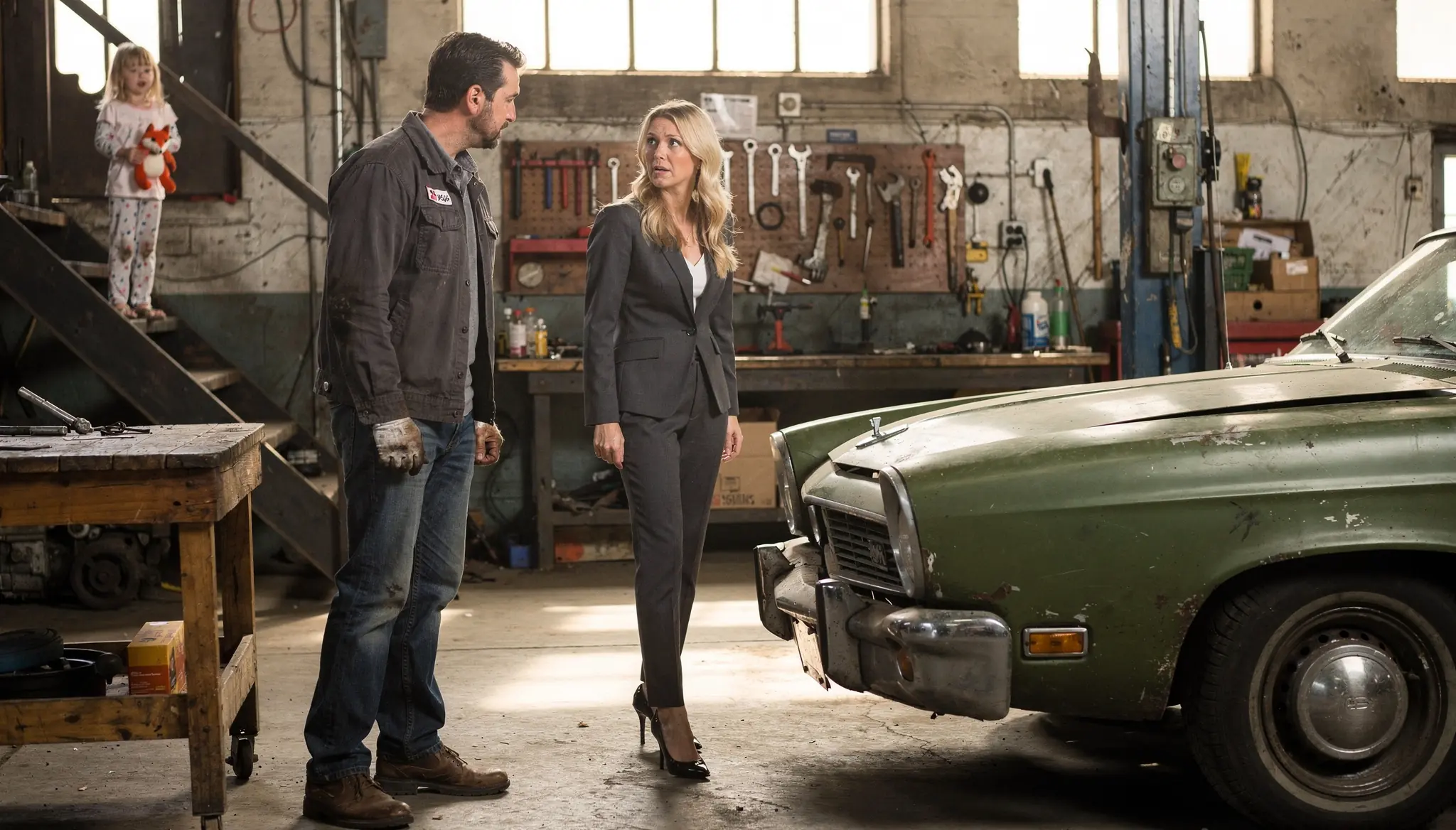
Then Giselle Hartwell, CEO of Hartwell Prestige Auctions and one of the most powerful names in high-end estate sales in New York, walked past it. She looked down at the man crouching beside it with a small flashlight in his hand and said four words that everyone within earshot heard clearly. “Scrap metal. No value.”
The man in the worn work jacket did not stand up. He did not argue. He simply kept looking at the undercarriage with the calm, unhurried attention of someone who already knew something the room did not. What did Lucas Grant see in that car that an entire auction house full of experts had missed? The answer was worth more than eight million dollars, and it began with a lesson his father had taught him a long time ago.
Lucas Grant loaded the last of his tools into the passenger footwell of his pickup at 6:45 on a Tuesday morning. He checked the side mirror out of habit and pulled away from the narrow Brooklyn street where his repair shop occupied the ground floor of a converted warehouse. The sky was that particular shade of pale gray that came before the city fully woke, and traffic on the bridge was still light enough for him to see the East River clearly below. Mia sat in the seat beside him. She was six years old, and her red fox stuffed animal, which she called Rusty, was tucked firmly beneath one arm. She had her mother’s habit of waking completely alert, with no groggy transition, just eyes open and questions already waiting.
“What’s your favorite car in the whole world?” she asked, adjusting Rusty’s ear with the focused seriousness of someone arranging something important. Lucas thought for a moment. He always took Mia’s questions seriously because she could tell when an answer had been rushed.
“A car nobody has looked at the right way yet,” he said. She nodded as though that made complete sense, settled back in her seat, and watched the bridge cables pass overhead. Lucas kept his eyes on the road. Three years earlier, he had been a chassis engineer with a small but respected Formula Heritage racing team. It was a position he had earned not through connections, but through the kind of obsessive mechanical knowledge that made other engineers uncomfortable at dinner because every conversation eventually became about tolerances, welds, suspension geometry, or forgotten manufacturing details.
His father, Raymond Grant, had spent forty years documenting the history of American racing manufacturers. Raymond’s particular obsession had been Callaway Racing, a short-lived Detroit company that had produced some of the most technically sophisticated factory prototype cars of the early 1960s before a warehouse fire in 1965 reportedly destroyed most of what the company had built. Raymond had spoken about the GTR-0 the way other fathers spoke about legendary fish they had almost caught. “The only factory prototype,” he would say. “The first one off the line. Gone, probably, but not certainly.”
Lucas had grown up with that story the way other children grew up with fairy tales. Mia’s mother, Claire, had died in a traffic accident when Mia was three. Lucas left the racing team six months later, not because he could not handle the work, but because a paddock in Monaco and a six-year-old in Brooklyn were not compatible in the way that mattered most. He opened the repair shop, learned how to pack school lunches, and kept his father’s research binders on a shelf above his workbench.
That morning, he was driving to the Upper East Side for a preview at a Hartwell Prestige estate sale, the kind of event where old money’s furniture and forgotten collections were cataloged and sold. He was not there for the Patek Philippe watches or the Impressionist paintings. He was there for anything mechanical, anything overlooked, anything hidden in the back of the catalog that the main bidders would ignore. He parked the truck two blocks from the venue and signed Mia into the complimentary children’s room near the main entrance. It was a small space with beanbag chairs and a television playing cartoons. He kissed the top of her head, left Rusty in her arms, and walked through the tall front doors with his flashlight in his jacket pocket and his father’s voice somewhere behind his eyes.
The main hall was high-ceilinged and already crowded with preview guests, all moving with the particular confidence of people accustomed to rooms where expensive things were displayed. Lucas stayed near the edges, reading the lot tags methodically. He paused at a set of vintage tire-changing equipment and a crated collection of dashboard gauges from the 1950s. Then he turned a corner near the back wall and stopped.
The car had been pushed against the wall between two storage racks of framed artwork. A rolling equipment cart partly blocked it, positioned as though whoever had placed it there had been actively trying to keep it out of the way. The dull olive-green paint was not original, not by decades. The bodywork was wrong for any production model Lucas recognized, modified or partly stripped, with altered fender lines.
But beneath all of that, visible only if someone knew precisely where to look, the roofline had proportions that were unusual in a very specific way. Lucas crouched and turned on his flashlight. He was still angled beneath the driver’s side door when footsteps stopped nearby. He looked up.
“This lot has no real value,” she said, her voice carrying cleanly through the high-ceilinged room. “It is here as a courtesy to the estate family. We did not want to refuse them.” She paused, letting the silence settle, then added with a small precision that landed exactly where she intended it to land.
“I’m not sure this preview is the right fit for certain budget ranges.” A few nearby guests glanced over. One or two nearly smiled. Lucas did not stand immediately. He looked at the car for another two seconds, the flashlight still in his hand, then rose and met Giselle’s eyes without any particular expression.
“Thank you for letting me know,” he said. She moved on. Lucas turned back to the car and examined the firewall through the gap behind the fender. Diana Walsh lingered for a moment, not obviously, just a beat longer than necessary. When Lucas glanced toward her, she looked away first.
A heavyset man in a black suit appeared briefly at the edge of the hall, a Rolex on his wrist and the easy movement of someone who had spent so much time in rooms like this that he had stopped noticing them. He was Jason Cole, a mid-level collector and dealer who had been buying and reselling specialty automotive lots for two decades. Jason gave Lot 47 the quick, practiced glance of someone sorting through a bin for something worth saving. He found nothing that interested him and moved on.
Through the doorway to the children’s room, Lucas could see Mia standing at the threshold with Rusty under her arm. She was looking toward him. He gave her a small nod, and she disappeared inside again. Lucas pocketed his flashlight and walked to the registration desk.
The bidding room filled to about sixty percent capacity for the main session. It thinned considerably after the marquee lots, a collection of estate jewelry and two significant paintings, cleared during the first forty minutes. Lot 47 was called near the end, after the remaining crowd had broken into smaller clusters of people checking phones and finishing coffee. The auctioneer, a Hartwell staff member filling in for the final stretch, announced it in the same brisk, neutral tone used for everything else.
“Lot 47, automotive item. Estimated at five thousand to eight thousand dollars. Sold as is, no warranty, no reserve. Bidding opens at three thousand.”
Three thousand became five thousand within thirty seconds, which surprised no one. Then the room went quiet again, the way rooms went quiet when nobody particularly wanted something. Lucas raised his paddle at eight thousand. Jason Cole, positioned in a far corner with his arms crossed, noticed the bid and looked across the room for the first time with genuine attention. He raised his own paddle.
“Nine thousand.” Lucas answered at eleven thousand. Jason studied him across the room: the work jacket, the careful posture, the way he watched the car rather than the auctioneer. Then Jason set his paddle on the armrest.
Not worth it, his expression said. Whatever this was, it was not worth a bidding war. The gavel came down. Diana Walsh handled the paperwork at a side table. She slid the bill of sale across the counter without making it obvious that she was watching Lucas’s face.
“What did you see in it?” she asked quietly enough that the question would not carry. Lucas signed his name. “I’m not certain yet,” he said, “but I think I’ll know by the end of the week.”
Mia waited near the main entrance with a volunteer, Rusty perched on her shoulder, while the loading crew attached a crane hook to the car’s chassis. “It’s really dirty,” she said when Lucas lifted her so she could see better. “It has been waiting a long time,” he replied. He buckled her into the truck, glanced in the rearview mirror at the car secured on the flatbed behind them, and drove back across the bridge toward Brooklyn.
He worked alone in the shop that first night after Mia fell asleep. The overhead LED bars turned the space a clean white, and Lucas moved around the car in a slow, outside-in pattern, using the same approach his father had always used: begin with the body, then work toward whatever the body was hiding. The welds on the inner structure were the first clue. They were not amateur work, and they were not the product of automated manufacturing. They were hand-applied spot welds with a distinctive spacing pattern that dated to a specific era and a specific level of fabrication: professional race-team construction from the early 1960s.
Lucas photographed everything with his phone, composing each frame carefully enough that the resolution would hold under magnification. He worked without music, which was his habit whenever something required the kind of concentration sound interrupted. He opened the hood. The engine block sat in the bay with the quiet authority of something designed to do one thing extremely well. Lucas angled the flashlight toward the left face of the block, the inner surface most people ignored because it faced the firewall and required someone to nearly place his head inside the engine bay to see it.
The casting mark was there in raised numerals. 03-1963. March 1963. Lucas did not make a sound. He held the light steady and read the mark three times.
His father had described that mark in an audio recording Lucas had transferred to his phone years earlier and listened to so often that he could recite it from memory. “If you ever find a block cast in March of ’63 with the CGT prefix on the chassis, look for the chassis plate immediately. Don’t stop for anything.” Lucas withdrew his head from the engine bay and stood straight. For a moment, he simply breathed.
The chassis plate in the standard location had been removed. The mounting holes remained, darkened with age, the thread pattern intact but empty. That was not unusual for a car that had passed through many hands over sixty years. What mattered was the secondary location.
Factory race cars from that era almost always had a backup identification point, a stamp applied by the build team somewhere inconvenient enough that casual disassembly would miss it. Lucas removed the glove compartment housing. Four screws. Ten minutes. Then he reached into the recess behind it with a handheld lamp.
The stamp had been cut directly into the frame rail. CGTR001. Lucas sat on the shop floor with his back against the rear wheel and remained there for a while. CGTR001: the chassis number of the Callaway GTR-0, the only one ever built, the car the historical record claimed had burned in the Callaway Racing warehouse fire on November 14, 1965.
He rose, returned to the firewall, and checked the third clue. Behind the engine bay, pressed between two layers of the firewall structure, a hand-welded reinforcement bar ran diagonally across the upper section. The weld angle was not perfectly symmetrical. It was not meant to be. The roughly seventy-three-degree angle was the deliberate signature of a craftsman who worked by feel rather than by jig.
That habit had been documented in a single technical history paper published thirty years earlier by the National Automotive History Institute. The paper described the technique as belonging exclusively to one man: chief fabricator Arthur J. Webb, who had hand-welded every Callaway factory prototype from 1962 through 1965. Mia appeared in the shop doorway at three in the morning, her hair uncombed, Rusty hanging from one hand, her bare feet on the concrete step.
“Are you okay?” she asked. “I’m fine,” Lucas said. “Go back to sleep.”
She looked at him, then at the car, with the evaluating stare children used when they suspected adults were underreporting. “Did you find what you were looking for?” Lucas looked at the car for a long moment. “I think I might have,” he said.
She padded back upstairs. Lucas reached for his phone and dialed a number he had not used in two years. Dr. Samuel Webb was seventy-two, retired from the directorship of the National Automotive History Institute, and the only living authority on Callaway Racing’s factory operations. He was also Arthur J. Webb’s son.
Lucas had met him twice. The first time was as a child, when Raymond brought him to a conference in Detroit. The second was years later, when Lucas still worked with the racing team and Dr. Webb came to authenticate a set of period documents.
When Lucas called at eight the next morning, he did not explain the full situation. He simply read three pieces of information from his notes. “March 1963. CGTR001. Firewall bar at approximately seventy-three degrees.”
The silence on the other end lasted long enough that Lucas checked whether the call had dropped. Then Dr. Webb spoke in a voice that had become very quiet and very careful. “Send me photographs. Every photograph you have. Right now.”
Lucas sent forty-seven images. Two hours later, Dr. Webb called back on video. A colleague sat beside him, a German academic named Dr. Hoffmann, one of the few surviving researchers who had worked directly with original Callaway factory records during the 1990s.
Dr. Hoffmann examined the photographs one by one without speaking for nearly twenty minutes. When he finally did speak, it was in accented but precise English. His first words were directed not to Lucas, but to the image of the firewall bar on the screen.
“The weld,” he said. “Seventy-three degrees. This is Arthur’s technique.” Dr. Webb translated the weight of that statement, though it needed no translation.
“My father welded this car.” A different kind of silence settled over the call, the silence that came when something long believed impossible turned out to have been merely unlikely. Dr. Webb looked directly at Lucas through the screen.
“If the engine is original, unmolested, and unreplaced, and if the chassis stamp is what you say it is, then what you have is the GTR-0. The only one. There is no second car. The fire destroyed the records and components, but not the vehicle.”
Lucas asked the question that needed to be asked. “Estimated value?” Dr. Webb was quiet for a moment.
“We need formal authentication before anyone states a final number. But speaking conservatively, based on the current market for factory prototype racing cars of this significance, I would say seven to nine million dollars is a careful estimate. It could go higher.” Lucas ended the call, placed the phone face down on the workbench, and stood at the shop window looking toward the narrow street.
Across the sidewalk, Mia was in the small fenced yard beside the shop, walking Rusty along the top rail with intense concentration and narrating a story to herself too quietly for Lucas to hear. He watched her for a long time. Then he turned back to the shop and began preparing the car for a more thorough inspection. The black SUV appeared outside the shop at nine in the morning on the fifth day. Lucas saw it from the second-floor window while making coffee. The engine idled behind tinted glass with the particular stillness of a vehicle waiting for its driver to do something rather than go somewhere.
Jason Cole came through the front door without knocking, which did not surprise Lucas because men like Jason rarely knocked on the doors of repair shops. A young attorney followed him, carrying a briefcase and wearing the slightly rigid expression of someone who had been told the meeting would be short. Jason looked around the shop at the tools hanging on pegboard, the hydraulic lift, and the parts-supplier calendar on the wall. His expression managed to be simultaneously unimpressed and calculating.
“You bought a car at the Hartwell session two days ago,” he said. “I bought a car,” Lucas confirmed. “Everything was processed correctly. I have the paperwork.”
Jason smiled with one side of his mouth. “I’m not here about the paperwork. I want to buy it from you.” The attorney placed an open folder on Lucas’s workbench. The contract had already been prepared. A number appeared in bold at the top.
$200,000. Same-day wire transfer. Lucas did not look at the folder. “No,” he said.
Jason paused like a man unaccustomed to hearing that word offered first and alone. “You paid eleven thousand dollars.” “Eleven thousand five hundred.” “I’m offering two hundred thousand. That is a reasonable offer.”
“No,” Lucas repeated in exactly the same tone. Jason’s expression shifted into something more deliberate. The social smile disappeared, replaced by the face he presumably wore in negotiations he expected to win. “The estate family has attorneys reviewing the original sale. There may be a question about whether an item of exceptional undisclosed value was properly represented in the inventory.”
The attorney shifted his weight slightly. The movement told Lucas that the argument possessed some technical merit and several significant gaps. “The lot was sold as is, without warranty or representation of value,” Lucas said. “Hartwell Prestige made no claim about the car in either direction. I reviewed the terms before bidding. The purchase is legally complete.”
The attorney’s slight shift became a slight stillness, which was even more informative. Jason studied Lucas with the recalibrating attention of someone who had expected a shorter conversation. Mia appeared in the interior doorway connecting the shop to the stairwell. Rusty was tucked beneath one arm, and she watched the unfamiliar men with the frank curiosity of a six-year-old who had not yet learned to pretend she was not looking.
Jason glanced at her, then back at Lucas. When he looked at Lucas again, something new had entered his expression, another calculation, a different kind of leverage being considered. Lucas did not look toward Mia. “Three hundred thousand,” Jason said. “Final offer.”
Lucas turned his head toward the doorway. “Mia, go upstairs, please.” When the sound of her footsteps faded, Lucas looked directly at Jason Cole. “You should get in your car and leave before I call my attorney.”
Jason left. At the door, he paused and looked back once, not to speak, but to stare at the car on the lift. It remained dusty and battered beneath its dull olive-green paint, and to any eye except the right one, it still appeared entirely worthless. Jason’s expression was not that of a man who had given up.
Lucas watched the SUV pull away, picked up his phone, and called Dr. Webb. “We need to move faster,” he said. Dr. Samuel Webb drove down from Boston the next morning in an old Volvo. He arrived at the Brooklyn shop at ten with a leather document case tucked beneath one arm and a thirty-five-millimeter film camera in a canvas bag over his shoulder.
He parked at the curb, walked through the open roll-up door, and stopped just inside. From fifteen feet away, he looked at the car as still as someone who had waited a very long time for something and was not yet certain it was what he had hoped to find. He set down his bags and approached slowly, the way a person approached something fragile, not because the car itself was fragile, but because the moment was. Dr. Webb crouched beside the engine bay. When he pressed his palm against the diagonal weld bar on the firewall, his voice was low and unsteady.
“This is my father’s weld.” He was not speaking to Lucas. He was speaking to the metal, or perhaps to a version of that shop floor that had existed more than sixty years earlier. The authentication took three hours.
Dr. Webb worked with the methodical patience of someone who had spent fifty years preparing for that exact examination. He photographed everything on film because he did not trust digital images as the sole record of something this significant. He cross-referenced every finding against documents carried in the leather case: original Callaway factory blueprints, Arthur Webb’s handwritten build notes, and a fragmentary set of supplier invoices from 1962 and 1963.
The chassis stamp matched. The engine casting date matched. The weld geometry matched. Then Dr. Webb discovered something Lucas had missed because finding it required knowing precisely where to look and why it might be there.
Tucked inside a narrow recess along the inner dashboard rail and clipped to the frame steel with a small metal fastener was a cylinder made from thin plastic housing. It looked like the kind of improvised preservation case a careful man might construct from materials available in a factory tool room. Inside the cylinder, rolled around a short wooden dowel, was a single sheet of paper. It was a factory build sheet dated March 31, 1963.
Chassis designation: CGTR001. Engine designation: 8003. At the bottom was a sign-off line. A. J. Webb, Senior Fabricator.
The handwriting was compact and leaned to the left, the writing of someone who had spent thirty years recording production notes in the margins of blueprints. Dr. Webb held the paper in both hands without speaking for a long time. When he finally looked up, his eyes were red.
“He hid it here,” he said. “He knew the car would not be burned. He hid the proof.” Lucas stood in the shop doorway with his hands in his pockets. Late-afternoon light entered at an angle across the floor. Mia had come downstairs and stood beside him, her small hand wrapped around two of his fingers. She watched the older man at the workbench with the gravity of a child who understood that something important was happening even if she could not yet name it.
By five o’clock, Dr. Webb had signed and notarized a formal authentication certificate. The document stated, in precise and unambiguous language, that the vehicle bearing chassis number CGTR001, an engine casting dated March 1963, and a factory build sheet signed by Arthur J. Webb was the Callaway GTR-0 factory prototype, the only surviving example.
It also stated that the car’s estimated fair-market value in the current collector automobile market was between $7.5 million and $9 million, with the potential for a higher auction result because of the vehicle’s unique historical importance. Dr. Webb shook Lucas’s hand at the front door and held it for a moment before releasing it. “How did you find it?” he asked.
Lucas glanced down at Mia, who leaned against the doorframe with Rusty balanced on top of her head. “My father taught me how to look,” Lucas said. Dr. Webb nodded, climbed into his Volvo, and drove north into the early evening.
Lucas went back inside and called the main office of Hartwell Prestige Auctions. His call was transferred twice before reaching Giselle Hartwell directly, which was unusual for an unsolicited call. She answered with the practiced efficiency of someone managing a dense schedule. Lucas said what needed to be said without preamble.
He owned the Callaway GTR-0. It had been formally authenticated by Dr. Samuel Webb, and he wanted to sell it through Hartwell Prestige in a dedicated single-lot auction. A silence followed, longer and differently shaped than the normal pause of someone retrieving information. It was the silence of a person rearranging an entire mental picture.
“Lot 47?” Giselle asked. “Yes.” Another silence.
“I will need to see the authentication documents.” “Dr. Webb is available for a direct call if you need him.” Lucas heard something being set carefully on a hard surface.
“We will schedule a special session,” Giselle said. “Friday. We will handle all preparation on our end.” Her voice retained its professional precision, but it had shed something else, the controlled authority that had been present in their previous exchange, the vocal equivalent of speaking to someone from a height.
“Thank you,” Lucas said, and ended the call. That evening, Mia sat on a high stool beside his workbench while he repaired a 1968 muscle car that had nothing remarkable about it except that it needed to run and its owner needed it back the following week. “Are you selling the dirty car?” she asked.
“Yes,” Lucas said without looking up from the carburetor he was rebuilding. “Why? You just got it.” Lucas set down the float and thought about how to make his answer both true and small enough for a six-year-old to carry.
“Because some things do not belong in only one person’s shop,” he said. Mia considered that while turning Rusty in her hands. “Like a library book?” Lucas looked at her.
“Exactly like a library book.” She seemed satisfied. She watched him work until her eyes began closing. Then he carried her upstairs without waking her, pulled the blanket over her, and returned downstairs to finish rebuilding the carburetor.
Hartwell Prestige sent the press release at eight on Friday morning. SPECIAL SINGLE-LOT SESSION: 1963 CALLAWAY GTR-0, SOLE SURVIVING FACTORY PROTOTYPE, AUTHENTICATED BY DR. SAMUEL WEBB. By ten, three international automotive-history publications had picked up the announcement. Twelve international bidders registered for remote access. The main bidding room at the Hartwell venue held more people by 11:30 than it normally saw during its flagship spring sale.
Lucas drove across the bridge in the same pickup with Mia beside him in a navy dress and Rusty on her lap. He wore a white button-down shirt and dark trousers. No suit, no tie, nothing that would have made him unrecognizable to anyone who had seen him three days earlier in a work jacket, crouching beside a car nobody wanted. He parked, took Mia’s hand, and entered through the main doors.
People looked at him now, not because of what he wore, but because his name appeared at the top of the press release. Several collectors and dealers in the lobby wore the particular alert expression of people who had recently been forced to recalibrate an assumption. Diana Walsh met Lucas and Mia at the main entrance with two access cards. She looked at Mia with genuine warmth and crouched slightly to meet her at eye level.
“What’s your name?” she asked. “Mia,” the girl replied. “And this is Rusty.”
Diana smiled the kind of smile that belonged to a person rather than a professional role. She led them into the sellers’ waiting area, a quiet room off the main hall with upholstered chairs and a window overlooking the street. Jason Cole was already in the bidding room when Lucas walked through before the session began. He sat in the second row with his arms folded and his jaw set in the expression of a man who had decided he might still salvage something from a situation that had moved substantially against him.
He had registered to bid. Lucas noticed and said nothing. Dr. Webb sat in the front row with his leather document case on the seat beside him. The car had been brought into the room on a low platform, carefully cleaned but not restored. Every original surface remained intact and honest. Dr. Webb watched it with the patient attention of someone sitting with a very old friend.
Giselle Hartwell stepped to the podium, and the room quieted. She introduced the lot using the precise historical language provided in the authentication documents, reading from notes she had clearly prepared with care. Then she opened bidding at two million dollars. Two million became four million in the first fifteen seconds as three international telephone bidders entered simultaneously. Four million became $5.8 million before thirty seconds had passed.
Jason Cole raised his paddle at six million. A Japanese collector on a remote screen offered $6.5 million. Jason answered at seven. The remote bidder went to $7.8 million.
Jason raised his paddle again. “Eight million.” The remote screens went quiet. Giselle looked over the room, her voice steady.
“Eight million going once.” No movement came from the screens. Lucas stood at the side of the room near a wall, one hand resting on Mia’s shoulder. She did not understand the numbers. They were too large and abstract, beyond the scale of anything in her daily life. But she watched her father’s face with the acuity children developed when they learned to pay close attention to the adults they depended on.
“Eight million going twice.” The room held its breath. The gavel came down. “Sold. Eight million two hundred thousand dollars.”
The room released its breath in applause, murmured conversation, and the soft percussion of phones being lifted. Jason Cole stood, buttoned his jacket without looking at anyone, and left through a side door with the unhurried gait of someone carefully managing a defeat in public. Dr. Webb did not stand. He remained in the front row, looking at the car on the platform with his hands folded in his lap and his eyes bright with tears.
Lucas looked down at Mia. She looked back at him. She did not ask about the number. She tightened one arm around Rusty and placed her other hand in Lucas’s.
Diana Walsh took Mia to a small lounge near the side corridor, where a tablet had been loaded with cartoons. Mia went willingly and settled Rusty on the armrest before the door was halfway closed. Giselle Hartwell found Lucas in the hallway outside the main room. It was not the imposing corridor near the front entrance, but a quieter passage leading to the administrative offices, where the ceiling was lower, the lighting softer, and there was nothing for either of them to perform for.
She came alone, with no clipboard, assistant, or practiced public composure. She stood across from Lucas with the posture of someone making a deliberate effort at something. When she said his name, she did so without the inflection of someone holding an advantage. “Lucas Grant.”
He waited. “What did you see in that car?” she asked. It was not the rhetorical version of the question. It was the real one.
Lucas considered her for a moment. “The firewall reinforcement bar,” he said. “The weld angle. Seventy-three degrees. It was the signature of a specific fabricator.”
“You saw that when you were crouching beside it Tuesday morning?” “I saw it in the preview photographs sent to registered attendees the week before. I was already suspicious when I entered the hall. I needed to confirm it in person.”
She was quiet. Lucas watched something move through her expression, not the managed shift of a person changing a professional position, but the involuntary rearrangement of someone processing the exact weight of what she had done. “I said what I said in front of a lot of people,” she said. It was not an apology yet. It was a precisely offered statement.
“You did,” Lucas replied. She held his gaze. “Your daughter was there.” “Mia has seen a lot of things,” Lucas said. His tone was neither forgiving nor hard. It was simply honest, the way very few people were when they had something to forgive and chose not to turn it into theater. “She knows that being right does not mean people will believe you immediately. She is learning. That is all right.”
Giselle kept looking at him. “Your father. What did he do?” “He died four years ago. He was an engineer. He spent most of his life looking at things other people had stopped examining.”
“And you?” Lucas glanced toward the lounge where Mia waited. “I love my daughter,” he said simply. “The cars are how I take care of that the right way.”
Giselle stood in the particular stillness of someone who had heard something requiring no response and knew it. “I will send a formal letter of apology on Monday,” she said. “That is not necessary.” Lucas did not sound cold, nor was it performed generosity. It was merely the statement of a man who had decided Tuesday morning, crouching in a dusty hall, that he had no use for anyone else’s opinion of what he could see.
“But if you want to send it, that is your decision.” He gave her a small, neutral nod and turned to collect his daughter. Two weeks passed. Lucas did not move the shop, buy a new truck, or order a new sign for the front of the building. He opened a trust account for Mia at the credit union three blocks away. A significant portion of the money was placed into a structure that would give her choices when she was old enough to need them, with no conditions attached.
He kept the remainder in a business account and planned to expand the shop by one bay. The addition would allow him to hire a second mechanic and stop working every Saturday alone. Nothing on the outside of the building changed. The same parts-supplier calendar remained on the wall. The same coffee maker with the cracked handle sat on the same shelf.
Dr. Webb visited one last time before returning to Boston. He arrived in the Volvo with a flat package under his arm. Inside was an old black-and-white photograph taken on a factory floor in 1963. Two men stood beside a car unmistakably identifiable as the GTR-0 in its original racing configuration, the bodywork intact and perfect.
One of the men was Arthur Webb, younger than Lucas had ever imagined him, squinting slightly beneath the factory lights. Dr. Webb had written on the back in the same compact, left-leaning cursive as his father. “To the man who found what my father left behind.”
Lucas hung the photograph above his workbench between a wiring diagram for a 1972 coupe and a picture of Raymond standing beside a race car in a Detroit paddock sometime during the early 1990s. On a Thursday afternoon two weeks after the sale, Lucas lay beneath the unremarkable 1968 muscle car whose owner only needed it running. Mia climbed onto the high stool and began arranging Rusty on top of the tool chest with architectural precision. “What are you doing today?” she asked, as she always did, as though the answer would determine something important.
“Looking at a car,” Lucas said from beneath the chassis. “Is it a good one?” “I don’t know yet. I’m still looking.”
She considered that. “Like the dirty one?” “Like the dirty one,” he agreed. Mia nodded, satisfied, and returned to arranging Rusty.
That evening, as Lucas locked the shop, his phone buzzed on the workbench. The message came from an unfamiliar number, but the initials at the end identified the sender clearly. “I want to apologize for what I said that morning. Not because of what the car turned out to be, but because I judged before I looked. I know now what that cost and what it could have cost. G.H.”
Lucas read it once, then again. He typed a reply. “Thank you for writing this. L.G.”
He placed the phone on the bench, turned off the overhead lights, and stood for a moment in the darkness before heading upstairs. Through the single window above the workbench, a streetlight cast a long rectangle across the floor. The 1968 muscle car sat within it on the lift. Nothing special. Nothing hidden. Just a car that needed work.
Lucas looked at it anyway. Habit. The habit his father had given him. The habit of looking at ordinary things long enough and carefully enough that ordinary sometimes became something else entirely.
There were things people walked past because they saw no obvious reason to stop. There were things that sat in the back of rooms, tagged, priced, and ignored, waiting for the one person who knew where to look and why. Most of those things never met that person. And that person, quiet, unhurried, wrong by the world’s first accounting and right by every accounting that followed, almost never announced himself.
He simply crouched in the back of a hall with a small flashlight, looked beneath a car everyone else had dismissed, and saw what nobody else had taken the time to find. Not because he was lucky. Because someone, a long time ago, had taught him how to look.