The snap happened so close to Camille Dawson’s face that the violinist nearest the champagne wall missed half a note. One sharp click of Sloane Pembroke’s fingers cut through the ballroom, followed by a voice polished by private schools, family money, and the assumption that obedience usually arrived when she demanded it. “Another glass, please, and this time don’t make me wait until the photographers get here.” A handful of guests laughed before they had even decided whether the remark was funny.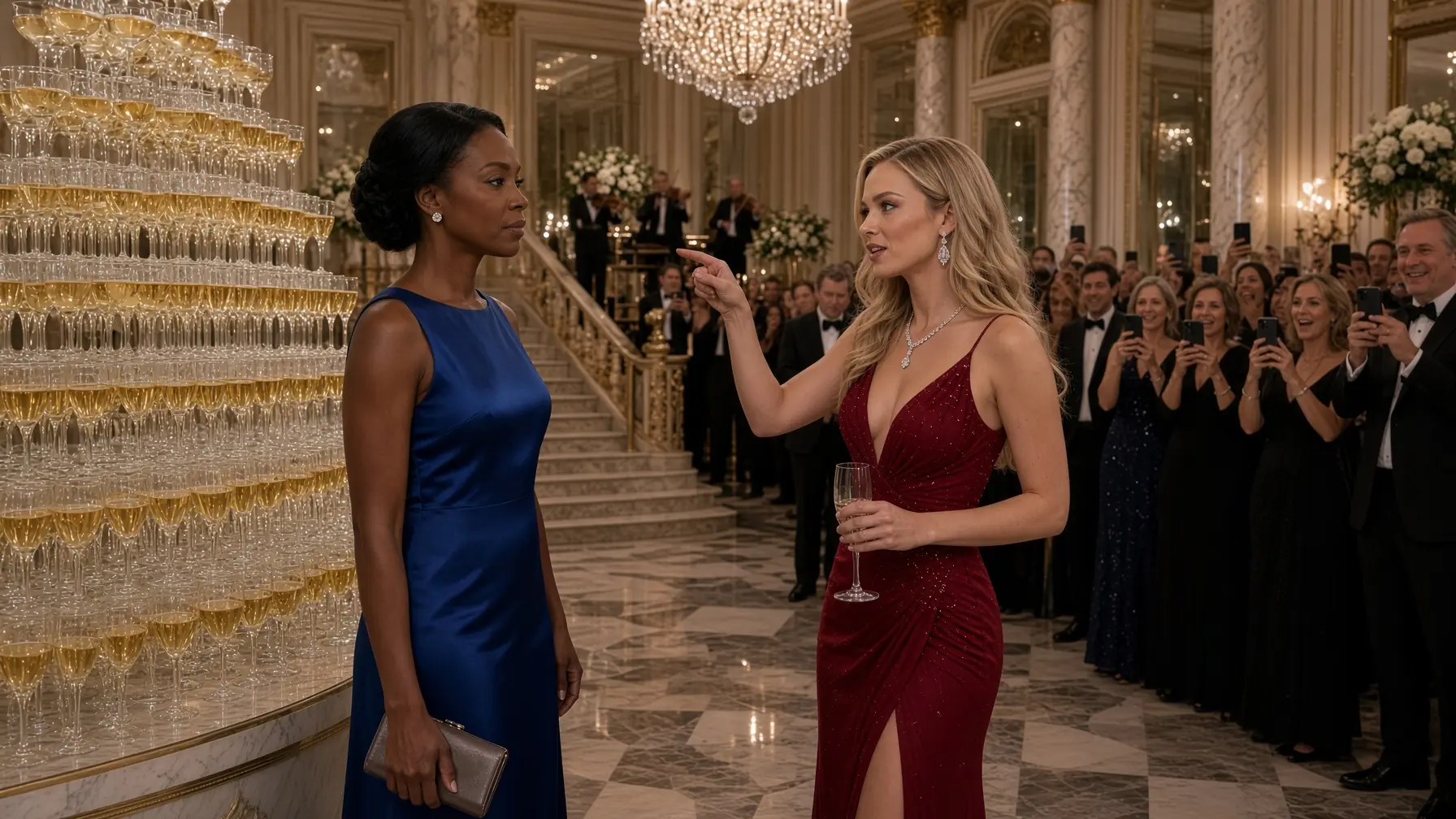
Camille did not move. She stood beside a silver tower of crystal flutes wearing an ivory column dress with almost no jewelry, a pearl-gray clutch resting against one hip, and her dark hair pinned neatly behind her head. Nothing about her clothes screamed wealth, which was exactly how she preferred it when walking into rooms where people revealed themselves more honestly around strangers they considered unimportant. Her expression remained calm enough that Sloane mistook restraint for uncertainty.
Around them, the ballroom of the Pembroke Grand shimmered beneath chandeliers the size of small cars. Hedge-fund managers, private-equity partners, hotel executives, diplomats, luxury developers, and bankers from three continents filled the room with the soft hum of people discussing numbers larger than most families would see in several lifetimes. Tonight was supposed to be the night Pembroke International announced the expansion that would carry a century-old American hotel dynasty into twenty-one new global markets. The champagne wall, string quartet, press riser, projection screens, and midnight announcement had all been designed to make success look inevitable.
Sloane lifted her empty flute again. At thirty-one, she was the only daughter of Pembroke International chairman Richard Pembroke and had spent her life moving through rooms where the family name usually arrived before she did. She wore a white designer gown, diamonds along her throat, and a bracelet that flashed whenever she gestured. “I’m not asking for a miracle,” she told Camille. “Just pour the drink.”
Camille looked at the flute, then at Sloane. “I don’t work here.” Her voice was low, smooth, and completely free of embarrassment. For one second, the laughter around them thinned. Then Sloane looked Camille up and down as if the correction itself had been offensive.
“No, apparently not,” Sloane said, smiling toward the people watching. “But you’re standing where the staff stands.” A woman in emerald silk near the flower columns covered her mouth, though delight showed clearly in her eyes. A junior banker standing two rows behind Camille lifted his phone higher, and the red recording dot reflected faintly in the crystal wall. Camille noticed all of it without turning her head.
Sloane stepped closer and pressed the bottom of her champagne flute lightly against Camille’s clutch. “My father built this hotel for people who understand standards,” she said. “Tonight decides whether Pembroke International becomes a truly global company or spends the next twenty years pretending old American money still impresses anyone.” The rim of the glass left a wet circle on the leather. Camille let it remain there.
The nearest guests expected a response. They wanted outrage, humiliation, maybe a raised voice that would allow everyone to pretend the conflict had become mutual. Camille offered none of that. Instead, she looked past Sloane toward the stage, where Pembroke’s chief financial officer, Evan Mercer, had checked his watch four times in less than two minutes.
Evan was waiting for a decision almost nobody else in the room understood. The expansion required a syndicated credit facility worth several billion dollars, and the banking consortium had delayed final approval until the last possible moment because questions remained about Pembroke’s overseas liabilities. The press conference was scheduled for midnight, but without that financing there would be no announcement worth making. Richard Pembroke had built the evening around the assumption that the money would arrive.
Sloane turned toward the crowd and raised her empty glass like a prop. “This,” she announced brightly, “is why we usually train temporary staff before investor events.” Laughter traveled farther this time because the billionaire’s daughter had told the room what was safe to find amusing. Camille watched men who would describe themselves as sophisticated laugh at a woman they had not bothered to identify.
Then she opened her clutch. There was no lipstick, compact, or nervous little invitation card inside. A slim black phone rested beside a folded legal document tied with a dark navy ribbon. Camille touched the screen once, placed the phone back inside, and closed the clutch.
Across the ballroom, Evan Mercer’s phone vibrated. He ignored it because Richard Pembroke was speaking to him about the timing of the midnight announcement, then the device vibrated again. A third vibration came almost immediately after the second. Evan finally looked down.
The color left his face. He read the message twice, lifted the phone toward his ear, and listened for perhaps three seconds. His eyes traveled slowly across the room until they found Camille beside the champagne. The expression he wore was not recognition alone; it was the expression of a man watching the floor disappear beneath an entire corporation.
Richard noticed. “Evan?” he said sharply, his smile still fixed for the nearby guests. “What happened?” Evan did not answer him immediately, which was the first thing that made Richard truly nervous. Instead, the CFO walked directly across the marble floor toward his daughter.
Sloane was still smiling when Evan reached her. He leaned close enough that only she should have heard him, but the room had become so quiet that several people caught every word. “She froze the credit facility.” Sloane’s hand opened.
The champagne flute slipped from her fingers and shattered across the marble. Glass scattered around her heels while champagne spread in a thin gold puddle beneath the chandeliers. Every phone that had been recording Camille remained raised. Thirteen minutes after Sloane snapped her fingers, the woman she had mistaken for staff had just stopped several billion dollars from reaching Pembroke International.
Sloane stared at Evan. “She did what?” Her voice had shrunk. Evan swallowed and repeated the sentence more formally this time. “Northstar Sovereign Capital suspended approval of the entire lending package, effective immediately.”
Richard Pembroke pushed through the guests. He was sixty-two, silver-haired, perfectly tailored, and famous in business magazines for smiling even when reporters asked questions that would make other executives sweat. That smile vanished when he reached Evan. “You’re telling me one woman just froze twelve banks?”
Camille stepped away from the champagne wall. The movement was only a single pace, but the guests around her parted as if they had suddenly learned the floor belonged to somebody else. Sloane looked at her with a new expression, no longer contempt exactly, but disbelief struggling to become fear. “Who are you?”
Camille glanced at the broken flute. “That question would have been useful thirteen minutes ago.” Several investors exchanged looks. Richard’s eyes narrowed because unlike his daughter, he recognized the surname on the documents crossing his finance department all week.
“Ms. Dawson,” he said carefully. Camille looked at him. “Mr. Pembroke.” The fact that Richard knew her name hit Sloane harder than the shattered glass.
Richard forced his old smile back into place. “This is a private family event.” Camille shook her head. “It is a financing event being disguised as a family celebration.” Evan looked down because there was no safe argument against that. Several bankers stopped pretending not to listen.
Richard lowered his voice. “Whatever happened between you and my daughter can be resolved privately.” Camille’s expression did not change. “Your daughter did not freeze your financing.” Sloane looked almost relieved until Camille continued.
“Pembroke International froze its own financing when it failed to resolve questions involving undisclosed litigation, hidden guarantees, and three overseas properties whose debt exposure does not match what your lenders received.” Silence moved across the ballroom differently now. Not socially awkward silence, but financial silence, the kind that arrives when people with capital hear the first crack beneath a polished floor.
Richard looked toward Evan. “What is she talking about?” Evan’s face told him he already knew enough. Camille continued before the CFO could answer. “London, Lisbon, and Doha all carry contingent liabilities your disclosure package treats as resolved, even though two remain active and the third was transferred into a subsidiary created nine weeks ago.”
Sloane laughed once. The sound was sharp and brittle. “This is ridiculous.” Camille did not even look at her.
Richard stepped closer. “Ms. Dawson, you’re making a very serious accusation.” Camille nodded. “That is why I sent your finance team eleven written questions before tonight.” Evan closed his eyes briefly.
The chairman turned toward him. “Eleven?” Evan answered quietly. “Yes.” Richard’s jaw tightened.
Camille watched the room reorganize itself around uncertainty. A Zurich banker had already stepped aside to make a call, while a representative from Dubai leaned toward counsel and began whispering. Money rarely fled dramatically. It moved quietly toward elevators while everyone else was still pretending the party had not ended.
Sloane finally stepped between Camille and her father. “So this is revenge because I embarrassed you?” Camille looked at her for the first time in several minutes. “No.” The simplicity of the answer unsettled her.
“If I wanted revenge for what you said, I would leave,” Camille continued. “Your father’s financing problem existed before you noticed me.” Richard’s shoulders stiffened. “Then why are you here?”
Camille’s eyes moved toward the grand staircase, the gold railings, and the marble arches that framed the entrance hall beyond the ballroom. For the first time that evening, something personal entered her expression. “Because my mother once stood in this building and was treated exactly the way your daughter just treated me.”
Richard went still.
Sloane noticed. “Dad?” He did not answer her.
Twenty-six years earlier, Camille Dawson had been nine years old when she followed her mother through the front doors of the Pembroke Meridian Hotel. Her mother, Lorraine Dawson, wore a navy suit she had pressed twice that morning and carried architectural drawings in a leather tube nearly as tall as Camille herself. Lorraine had spent eleven months leading the structural redesign that saved the hotel from a renovation failure the Pembrokes desperately wanted kept out of newspapers. She had been the lead architect, not an assistant, consultant, or decorative name placed on a diversity brochure.
Camille remembered the lobby more clearly than most childhood vacations. She remembered the smell of fresh flowers, the polished floor, the gold trim, and the way her mother squeezed her hand before walking toward a presentation that could have changed both their lives. Richard Pembroke, twenty years younger and already running development for the family business, passed them near the elevators. Without looking twice, he placed an empty coffee cup in Lorraine’s hand.
“Service entrance is around back,” he said.
Lorraine froze. Hot coffee spilled across her fingers, and Camille remembered the tiny twitch in her mother’s face as she fought not to react in front of her daughter. “Mr. Pembroke,” Lorraine said, “I’m presenting the Meridian restoration this morning.”
Richard looked her over. Then he smiled. “Then I suppose somebody should tell security.”
The presentation happened anyway. Lorraine walked into the boardroom, explained the structural redesign, answered every question, and left believing professionalism had survived humiliation. Three weeks later, Pembroke International announced the restored hotel using almost every major element from Lorraine’s plans. Another architectural firm received public credit.
Lorraine sued. The case lasted years. She did not lose because the work was not hers.
She lost because Pembroke had money for delay, specialists, discovery battles, experts, and legal bills that could exhaust a small architecture practice without touching a hotel empire. By the time the case ended, Lorraine’s firm was gone. She kept the original blueprints beneath her bed until the day she died.
Camille was thirty-five when Lorraine passed away. Cancer took her quickly, but the professional wound had been with her for far longer. Even near the end, Lorraine refused to call herself a victim. “Don’t spend your life making them regret what they did,” she told Camille. “Spend it making sure they can’t do it to somebody else.”
Camille took that advice literally. She studied finance first because money seemed to decide which truths received oxygen, then went to law school because contracts were where powerful people hid their version of memory. She built a career in distressed credit, acquisition finance, and restructuring, learning how companies looked strongest right before debt exposed what marble could not hide. At forty-one, she became managing director of Northstar Sovereign Capital.
Northstar did not make headlines the way private-equity brands did. It preferred quiet transactions, institutional debt, sovereign money, pension capital, and situations where one signature decided whether a billion-dollar deal remained alive. Pembroke International’s expansion required Northstar’s approval because Northstar had organized the lending consortium. Richard Pembroke needed Camille Dawson’s name on the final authorization.
Now the woman his daughter had ordered to pour champagne was the only person in Manhattan who could give him what midnight required.
Richard’s face changed as the memory returned. “Lorraine Dawson.” His voice was almost a whisper.
Camille nodded.
Sloane looked between them. “Who is that?”
Camille’s expression cooled again. “The woman whose work is holding up half the room you’re standing in.”
Richard looked toward the arches. For the first time, fear appeared behind his eyes.
Sloane laughed dismissively. “If this is some twenty-five-year-old grudge, send us an invoice.” Several people visibly winced. Camille studied her with something closer to sadness than anger.
“An invoice?” she repeated.
“My father has lawyers. You’re a lender. People settle disputes.”
Richard turned toward his daughter. “Stop talking.”
Sloane stared at him.
Camille opened her clutch and removed the document tied with the dark navy ribbon. She untied it carefully and unfolded the first page. Evan Mercer took one look and whispered, “Jesus.”
Richard turned. “What?”
Camille held the packet at her side. “Original authorship documentation for the Meridian restoration, internal development correspondence, draft settlement terms your counsel prepared but never presented to Lorraine, and a signed memorandum from your former development director confirming that her drawings were incorporated after the attribution change.” The ballroom became silent again.
Richard gave a dry laugh. “Those documents are decades old.” Camille nodded. “Age does not turn fraud into tradition.” Sloane looked toward her father.
“Dad?”
Richard did not answer.
That was enough.
A Zurich banker stepped farther away from the family. Two members of the Pembroke board stopped whispering and simply stared. One camera near the entrance had originally been positioned for press photographs, but its operator quietly turned it toward Camille.
Richard lowered his voice. “What exactly do you want?” He expected a number because men like Richard found numbers comforting. Numbers could be negotiated, financed, reclassified, or hidden inside a settlement. Camille disappointed him.
“Correction.”
Richard frowned.
“My mother’s name restored to the Meridian restoration record and every publication that reused the false attribution.” Camille folded one finger. “Public acknowledgment of what happened.” Another.
“A permanent scholarship and fellowship program for women architects from communities historically excluded from major commercial commissions.” Another. “Full lender disclosure of the liabilities your company has been trying to move around.”
Richard stared at her.
Sloane looked disgusted. “You want to humiliate us.”
Camille shook her head. “Humiliation is what happens when you make someone small for your amusement.” Her eyes settled on Sloane.
“Disclosure is what happens when facts become inconvenient.”
Before Richard could answer, Evan’s phone rang again. Not vibrated, but rang with the private tone reserved for key financing contacts. He looked toward Camille before answering.
She shook her head slightly.
Whatever this was, it was not hers.
Evan listened.
Then whispered, “No.”
Richard grabbed his arm. “What now?”
Evan lowered the phone. “Singapore withdrew.”
The room erupted into overlapping whispers.
Richard’s face changed. “They can’t withdraw.” Evan looked sick. “They just did.”
“We had verbal commitment.”
“They’re citing compromised collateral and unverified asset exposure.”
Camille’s eyes narrowed.
She had frozen the credit line.
She had not contacted Singapore.
Someone else was moving.
The ballroom doors opened.
An elderly woman entered wearing a black evening suit, low heels, and carrying a slender ebony cane. Two attorneys walked behind her, but neither attempted to move ahead of her. She was eighty-one years old and crossed the ballroom with the slow confidence of someone who had never needed speed to make people move.
Sloane turned pale.
“Grandmother?”
Richard closed his eyes.
The woman was Margaret Pembroke, widow of the late founder and matriarch of the family whose name appeared over hotels from Boston to San Francisco. She had avoided most public events for years, which meant half the room had never seen her outside old photographs. Yet Richard immediately stood straighter.
“Mother.”
Margaret ignored him.
She walked past Sloane.
Past Evan.
Stopped beside Camille.
Then looked toward the ballroom.
“Lorraine Dawson saved this hotel in 1998.”
Richard’s face hardened.
“Mother, no.”
Margaret continued as though he had not spoken. “There was a structural failure developing behind the east façade during renovation, and your mother found it before anyone was injured.” She looked directly at Camille.
“She redesigned this building.”
Camille stared at her.
Margaret’s eyes softened.
“And my son allowed another firm to take the credit.”
For the first time that evening, Camille’s control slipped.
Only slightly.
A tremor in her fingers.
Margaret held out a thick folder.
“Your mother sent these to me.”
Camille looked at it but did not take it immediately. “When?”
“Before the lawsuit ended.”
“Why?”
“Because she knew I believed her.”
Camille’s breath shortened.
Richard stepped forward. “This is not the place.”
Margaret turned toward him.
“No.”
Her voice remained quiet.
“The lobby was the place when you handed her a coffee cup.”
The sentence landed harder than shouting.