“You should remember what room you’re standing in.”
The private dining hall on the 45th floor of Sterling Crown Tower had been built to make people lower their voices without being asked. Glass walls looked out over Chicago, where the city glittered beneath the night like a tray of diamonds spilled across black velvet. Marble counters shone beneath crystal chandeliers, silverware sat exactly one inch from the edge of each plate, and folded linen napkins rose beside wine glasses like little white birds.
That evening, the room held twenty-four of the most powerful people in the city.
Developers.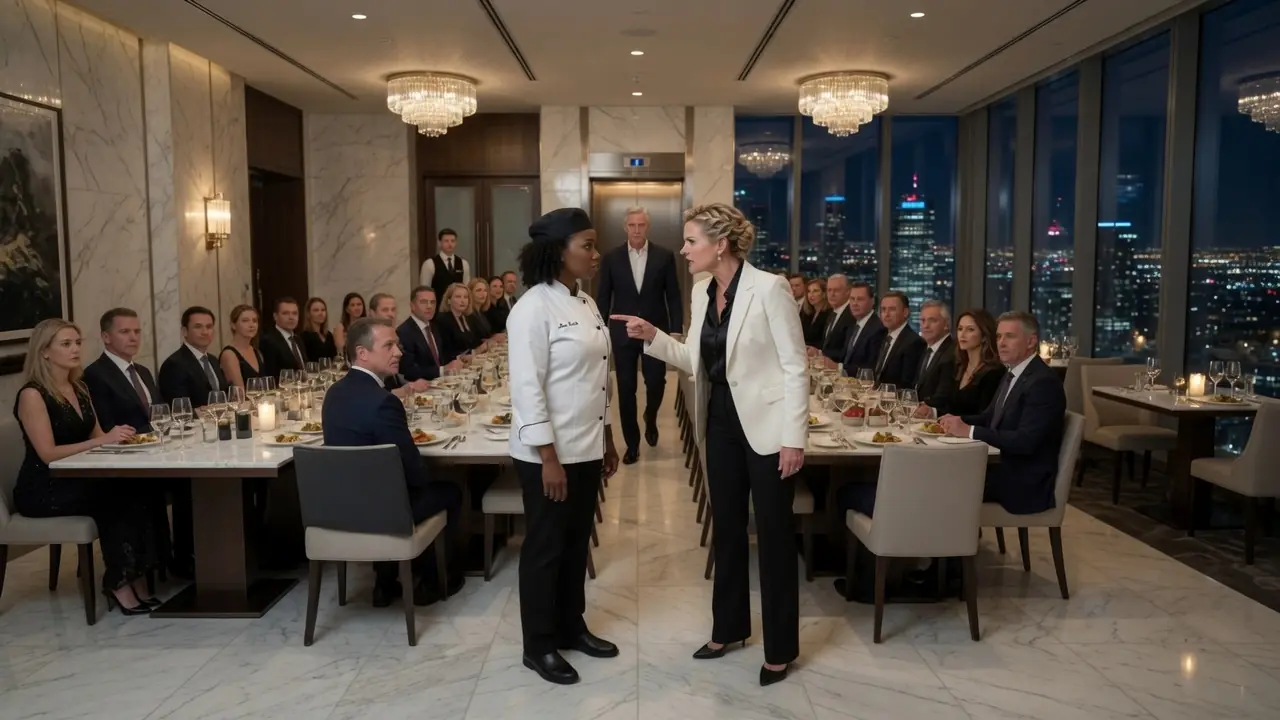
Bankers.
Hospitality executives.
Political donors.
People whose phone calls could change zoning laws, move markets, delay investigations, or turn a forgotten neighborhood into a billion-dollar project before the people living there understood they had become numbers on a presentation slide.
At the center of the gathering was Julian Sterling, the man who owned the tower, the restaurant group, half the city’s luxury hotels, and enough private influence to make even confident people choose their words carefully around him.
But before Julian entered the room, before the guests stood to greet him, before the night revealed what kind of mistake pride can make when it goes unchallenged, a woman stood behind the service doors with a spoon in one hand and a calmness no insult could manufacture.
Her name was Lena Brooks.
She was thirty-four years old, Black, quiet, and precise in a way that made her kitchen feel less like a workplace and more like an operating room. Her white chef’s coat was pressed clean. Her dark curls were tucked beneath a black cap. Her eyes moved from pan to plate to garnish with the controlled attention of someone who knew exactly what perfection required and had no interest in begging anyone to notice.
Lena did not cook loudly.
She did not shout across the line, slam pans for drama, or turn the kitchen into theater for people who believed artistry needed a temper. She moved with purpose. A pinch of smoked salt here. A sauce adjusted half a degree darker. A fillet rested not by timer alone, but by instinct, by smell, by the way heat left the flesh and settled into readiness.
She had learned food before she learned ambition.
Her first classroom had been her aunt’s kitchen in Savannah, Georgia, where the screen door rattled in summer heat and every Sunday meal carried the weight of memory. Her aunt, Josephine, believed cooking was not service if it was done with love. It was language. It was history. It was the difference between feeding a body and reminding a person they were still human.
Lena learned young.
By thirteen, she could make biscuits without measuring.
By seventeen, she could debone fish faster than grown line cooks.
By twenty-three, she had worked in two Michelin-starred restaurants, trained in Lyon under a French chef who believed compliments weakened discipline, and spent a year traveling through West Africa learning spice traditions from women who laughed at European men calling themselves masters of flavor.
Lena’s food did not try to impress people.
It stopped them.
Critics had written about her dishes as if they were trying to describe weather, grief, homecoming, and prayer all at once. One reviewer wrote that eating her food felt like “remembering something your family never told you but your bones already knew.” Lena read the review once, folded the paper, and placed it in a drawer beneath old recipe cards from her aunt.
She did not need to stare at praise.
She needed the next dish to be right.
Her connection to Julian Sterling had begun six years earlier, on a winter night when his personal chef quit without warning and three emergency replacements failed before dessert. Julian was known to be nearly impossible to cook for. Not because he was loud, wasteful, or cruel. Worse than that, he was exact.
He noticed everything.
The wrong texture in a sauce.
A herb added too early.
A plate that arrived twenty seconds past its best life.
Men who could buy anything often pretended to have taste. Julian actually had it, and that made him more difficult than most. He did not eat to flatter chefs. He ate as if excellence were a contract and every plate had either honored it or broken it.
Lena had been hired for one private dinner.
Nothing more.
She sent out the first course, and it came back untouched except for one bite. She sent out the second, and it did not return. By the third course, a slow-braised oxtail with black garlic jus and Carolina gold rice crisped at the edges, Julian had left his table, walked to the kitchen door, and knocked.
He did not burst in.
He knocked.
Lena remembered that.
When she opened the door, he stood there in a dark suit with no expression.
“You made this?” he asked.
“I did.”
He looked at her for a long moment.
Then he said, “You are the first person in five years who has cooked like you were not afraid of me.”
Lena did not smile.
“That is because I was cooking for the food.”
The next morning, Julian’s assistant called with a contract.
Since then, Lena had cooked every private dinner in Julian’s residence, every closed-door negotiation, every family anniversary, and every meal he ate before making decisions that turned into headlines. She was not on the public payroll. She did not appear in brochures. Guests rarely knew her name.
Julian did.
That was enough for her.
He never entered her kitchen without permission. He never commented unless asked. He never questioned her suppliers, her methods, or her timing. Once, he told her a dish needed acid. She tasted it again, realized he was right, added preserved lemon, and respected him more because he never mentioned it afterward.
Tonight was supposed to be unusual but manageable.
The executive chef for the tower’s formal dining events, a man named Adrian Cole, had been called away after his wife went into emergency surgery. The dinner was already scheduled. Twenty-four guests confirmed. Six courses planned. Wine paired. Contracts surrounding a massive riverfront hotel project waiting quietly beneath every handshake.
Lena listened, looked at the menu, asked three questions, and agreed.
She was not being asked to rescue a dinner.
She was being asked to maintain a standard under pressure.
That was not new.
By six o’clock, she had taken command of the tower kitchen so quietly that the staff almost forgot it was command. She reorganized the stations, reassigned prep, tasted every sauce, corrected the pastry team’s timing, and calmed a junior cook who had nearly ruined the mushroom consommé by trying too hard to impress her. The kitchen settled around her like a machine finding its rhythm.
The dining room did not know.
The guests did not ask.
People like them rarely wondered who made perfection possible.
Outside, a black town car arrived at the tower entrance at 7:18.
The driver stepped out, hurried to the rear door, and opened it for a woman who emerged as if the sidewalk were a stage and she had paid for the lighting. She wore a pearl-white blazer over a silk blouse, tailored black trousers, and diamond earrings large enough to seem less like jewelry than punctuation. Her hair was pulled into a severe twist that sharpened an already sharp face.
Her name was Celeste Harrow.
She was forty-two years old, founder and chief executive of Harrow Urban Properties, one of the most aggressive real estate development firms in the Midwest. She had built her fortune through skill, instinct, and a talent for turning other people’s hesitation into her advantage. She was not stupid. She was not decorative. She was brilliant in the cold way a blade is brilliant.
But somewhere along the climb, Celeste had mistaken wealth for proof of human superiority.
She did not think of herself as cruel.
Cruelty, in her mind, required emotion, and Celeste preferred efficiency. She simply believed people had ranks. Some led. Some followed. Some served. The ones who served were useful when invisible and irritating when they reminded her they had faces.
Drivers.
Servers.
Housekeepers.
Assistants.
Kitchen staff.
She did not hate them.
That would have required seeing them clearly.
She entered Sterling Crown Tower expecting the evening to confirm her position. Julian Sterling had invited her because Harrow Urban Properties controlled parcels essential to the riverfront development. She believed the deal needed her. She believed Julian knew it. She believed every person in that room would understand that by dessert.
The private dining hall impressed even her, though she refused to show it.
A young server stepped forward to take her coat.
Celeste let the garment slide from her shoulders without looking back, trusting the girl to catch it before it touched the floor. Then she entered the room, greeting investors and executives with a smile calibrated to suggest warmth without surrendering power.
She knew how rooms worked.
Who to approach first.
Who to ignore until they felt the omission.
Who to flatter just enough.
Who to make wait.
She moved through the room like a woman rearranging furniture only she could see.
The trouble began near the service corridor.
A young server named Andre Wells, twenty-one years old and three weeks into the job, stepped around a guest at the exact moment another chair shifted behind him. The tray in his hand tilted. He saved most of it, but a few drops of sparkling water landed near Celeste’s heel.
Not on her shoe.
Near it.
Andre’s face drained of color.
“I’m so sorry, ma’am,” he said quickly. “Let me—”
Celeste turned on him before he could finish.
Her voice was not loud.
It did not need to be.
“Are you trained at all?”
The conversations closest to them thinned.
Andre stood very still.
“Yes, ma’am. I apologize.”
“If you cannot carry water across a room, I’m not sure why anyone trusted you near glass.”
A few guests glanced over.
Andre swallowed. “It won’t happen again.”
“It shouldn’t have happened once.”
Lena heard the shift from the kitchen entrance.
Good kitchens listen to rooms. Not just orders and bells, but tone, silence, tension. Lena could tell from thirty feet away when embarrassment had become public and someone was trying to turn a mistake into a lesson in hierarchy.
She stepped out calmly.
Andre looked like he wanted to disappear.
Lena placed herself gently between him and Celeste without making the movement seem defensive.
“My apologies for the disruption,” Lena said. “We will make sure the service continues smoothly.”
Celeste looked at her for the first time.
Her eyes moved from Lena’s face to the chef’s coat, to the name embroidered in small black thread near the pocket. Lena Brooks. Executive Culinary Consultant. The title meant nothing to Celeste because she had already decided the category.
Kitchen.
Staff.
Below.
Something in Lena’s stillness seemed to irritate her.
“You should train your people better.”
“I understand your concern.”
“No,” Celeste said. “I doubt that you do.”
Andre flinched slightly.
Lena did not.
She inclined her head, not as submission, but as closure, then turned back toward the kitchen.
As she walked away, Celeste spoke softly enough to pretend it had not been meant as an announcement and loudly enough that the people nearby heard every word.
“That is where people like her belong. Behind a door.”
The woman beside Celeste looked down into her wine glass.
Andre heard it.
So did three guests.
So did Lena.
No one spoke.
That was often how harm entered expensive rooms.
Not through thunder.
Through silence.
The first five courses were flawless.
Lena’s menu moved like a story told by someone who trusted the listener. The amuse-bouche was a chilled peach and cucumber spoon with black pepper oil and a paper-thin shard of country ham. Then came a crab bisque so smooth it seemed less poured than whispered. A salad followed, built from roasted carrots, citrus, pistachio, and whipped goat cheese, bright enough to wake the palate without exhausting it.
Compliments traveled back through the service corridor.
One guest called the bisque extraordinary.
Another asked whether the chef had trained in Paris.
A hospitality executive said the third course was better than anything currently being served in her flagship restaurant.
Lena heard each comment, nodded once, and returned to work.
Praise was useful only if it did not distract from the next plate.
The main course was the dish she cared about most.
Herb-crusted lamb with a white bean purée, charred spring onion, and a dark jus reduced slowly with roasted bones, fig, black garlic, and a trace of smoked clove. It was southern memory filtered through European discipline and the quiet heat of spice traditions older than any tower in the city. She had tasted the jus nine times. Adjusted salt twice. Rested the lamb exactly long enough for the juices to settle without losing warmth.
She plated every serving herself.
The twenty-fourth plate received the same attention as the first.
When the trays left the kitchen, Lena exhaled slowly.
Now the food would speak.
The dining room received the course with a silence that would have made most chefs smile. Conversations slowed. Forks moved carefully. People who had spent years eating expensive food suddenly gave their plates the full respect of attention.
Then Celeste Harrow set down her fork.
The sound was small, but deliberate.
Silver against porcelain.
A little verdict.
She pressed her napkin to her lips and looked around the table as if preparing witnesses.
“This is oversalted.”
The man across from her, a hotelier named Grant Ellis, paused with his fork still in hand.
“I don’t think so,” he said. “Actually, I think it’s exceptional.”
Celeste ignored him.
“It is oversalted,” she repeated. “And heavy. Very heavy for lamb.”
The woman beside her took another bite and frowned, not in displeasure but confusion.
“I think mine is beautiful.”
Celeste’s eyes hardened.
She pushed the plate forward half an inch.
A server approached immediately.
Celeste did not wait for the question.
“I want whoever is responsible for this dish brought out here.”
The server’s expression tightened. “I can relay any feedback to the kitchen.”
“No,” Celeste said. “I said I want them here.”
The server glanced toward the service corridor.
A few moments later, Lena walked out.
She moved with the same calm stride she had used all evening. Not hurried. Not defensive. Not eager to explain. She stopped beside Celeste’s table and gave a polite nod.
“I understand there is a concern with the main course.”
Celeste leaned back slightly, as if pleased the room had returned to the proper arrangement.
“There are several concerns.”
Lena waited.
Celeste began with the salt. Then the sauce. Then the plating. Then the texture. With each sentence, her voice grew sharper, fuller, more theatrical. She was no longer reviewing food. She was performing status.
The surrounding tables quieted.
Celeste seemed to draw energy from that.
“The dish lacks restraint,” she said. “It tastes like someone trying to prove sophistication instead of possessing it.”
Lena’s face did not change.
“I’m sorry the dish is not to your preference,” she said. “I would be happy to prepare an alternative.”
Celeste blinked.
That was not the answer she wanted.
She wanted apology.
Submission.
A visible crack.
“I don’t want another dish,” Celeste said. “I want someone to admit that this kitchen is serving food beneath the standard of this room.”
Lena held her gaze.
“The other guests appear satisfied.”
The sentence was not rude.
That made it worse.
Celeste stood.
Her chair scraped softly against the floor. A few people shifted, but nobody spoke. Her finger lifted toward Lena’s chest, trembling slightly with a rage that had mistaken itself for authority.
“You do not get to tell me what other guests think.”
“I did not tell you what they think,” Lena said. “I observed what they ate.”
Grant Ellis looked down to hide the smallest hint of a smile.
Celeste saw it.
Humiliation, even imagined, can make proud people dangerous.
She stepped closer.
“You people always think composure makes you equal.”
The room froze.
Lena’s eyes sharpened, but her body remained still.
“Are you certain,” she asked quietly, “that is the sentence you want to stand by?”
Celeste laughed once, short and cold.
Then her hand moved.
It was not a large motion.
It was worse than that.
Short.
Sharp.
Casual in the way it assumed consequence would not follow.
The slap cracked across Lena’s face and echoed off the glass, marble, crystal, and silver. Her head turned slightly with the force of it. A server gasped. Someone dropped a fork. Andre, standing near the service corridor, went completely pale.
For one suspended second, nothing in the room moved.
Then Lena turned her face back.
She did not touch her cheek.
She did not step away.
The mark was already rising red across her skin, but her expression remained so steady that the room seemed more shaken by her stillness than by the slap itself.
Celeste stood breathing faster now.
Maybe she expected Lena to cry.
Maybe she expected shouting.
Maybe she expected staff to rush in, remove the problem, restore the evening, and leave Celeste with the victorious silence she was used to receiving.
Instead, Lena looked at her and said, “Are you finished?”
Celeste’s lips parted.
The question unsettled her more than anger would have.
Then she recovered and lifted her chin.
“You should remember where you stand.”
Nobody spoke.
Twenty-four powerful people sat motionless in a room designed to make them feel untouchable, and not one of them moved.
Lena looked at them.
Not accusingly.
Worse.
Clearly.
Then she set the serving tray she had been holding onto the side station with careful precision.
“I know exactly where I stand,” she said.
Celeste turned toward the nearest floor supervisor. “Get the manager. Now. And have this woman removed.”
The supervisor, a man named Nolan Price who had run Sterling private events for twelve years, did not move toward Lena.
He touched his earpiece.
That was the first sign the room had misunderstood the evening.
Celeste did not notice.
She sat again as if the matter had been decided. The guests around her began performing normalcy with the desperate skill of wealthy people trying to pretend that violence had not happened six feet from their wine glasses. Conversations resumed in low, brittle fragments. Forks moved without appetite.
Lena remained where she was.
Not confronting.
Not retreating.
Present.
Heavy with a dignity nobody in that room had given her and therefore nobody in that room could remove.
Then the private elevator opened.
Julian Sterling entered without announcement.
He did not make entrances like a showman. His presence arrived the way weather arrives before a storm, first as pressure, then as certainty. He was fifty-six, lean, silver-haired, and dressed in a dark suit without a tie. His face carried the calm of a man who had not needed to raise his voice in twenty years because the world had learned to move when he spoke softly.
The room registered him within seconds.
Guests stood.
Several moved toward him with practiced smiles and extended hands.
Julian greeted them with efficient politeness, but his eyes had already moved past the greetings. He read rooms the way others read contracts. He saw the unnatural stillness near the center table. He saw Nolan by the service station, one finger still near his earpiece. He saw Andre standing too rigidly by the wall.
Then he saw Lena.
She stood six feet from Celeste Harrow, posture controlled, face turned slightly toward him.
Across her left cheek was the unmistakable red mark of a hand.
Julian stopped walking.
The room stopped with him.
He looked first at Lena.
Then at Celeste.
Then at the guests seated around them.
His voice, when it came, was quiet.
“Who struck her?”
Nobody answered.
The silence stretched.
A few guests looked down at their plates. Someone swallowed. A young server near the wine station looked as if he wanted to speak but feared the entire room more than the truth.
Nolan stepped forward.
No drama.
No embellishment.
He described the complaint about the lamb. He described the escalation. He described Celeste Harrow standing and striking Lena Brooks across the face in front of the room.
When he finished, Julian looked at Lena.
She met his eyes and gave one small nod.
That was enough.
Julian turned toward Celeste.
She had begun forming her defense before he even spoke. She had met him twice before at industry events. She believed they understood one another. People at their level, she thought, did not let service incidents interrupt major business. They contained them.
She took a breath.
“Julian, I apologize for the disturbance, but she—”
“No.”
One word.
Flat.
Complete.
Celeste blinked.
Julian did not raise his voice. That made the moment colder.
“Do not finish that sentence.”
The room went completely still.
Celeste’s face tightened. “I was merely trying to address unacceptable service. She is only—”
He stepped closer.
“Do not say only.”
The word hit harder than a shout.
For the first time that evening, Celeste seemed uncertain.
Julian turned slightly, not away from her, but toward the room.
“Since there appears to be confusion,” he said, “let me correct it.”
His voice carried to every table.
“Lena Brooks has been my private chef and culinary director for six years. She has prepared every private meal in my residence, every confidential dinner, every diplomatic gathering, every family memorial, and every negotiation meal important enough that I trusted no one else to touch it.”
The guests listened without moving.
“She has cooked for two former heads of state, a royal family, three Nobel laureates, and more executives in this room than most of you realize. She has been offered positions in Paris, Copenhagen, and New York. She declined them because she chooses her own work. Not because she lacks options.”
Celeste’s face changed.
Confidence first.
Then confusion.
Then denial losing ground.
Julian continued.
“Tonight, she agreed as a personal favor to me to take command of this dinner after an emergency pulled my executive chef away. Every course you praised tonight exists because of her skill, her discipline, and her generosity.”
He looked directly at Celeste.
“And you struck her.”
No one breathed loudly.
Julian’s face had gone cold in a way that seemed to lower the temperature of the room.
“In all the years I have hosted dinners in this tower, I have never permitted a guest to abuse my staff. I will not begin tonight because the person responsible arrived wearing diamonds.”
Celeste opened her mouth.
Nothing came out.
The room around her had already begun to move away socially before anyone moved physically. The people seated beside her leaned back in their chairs. Grant Ellis looked at the table, his expression controlled but not sympathetic. Two investors who had come to discuss the riverfront project with Celeste no longer looked in her direction.
Then the fragments began surfacing.
A hospitality CEO quietly mentioned an incident at a charity gala where Celeste had reduced a valet to tears over a delayed car.
A banker remembered a board meeting where she humiliated her assistant for a calendar mistake.
Someone else whispered about a restaurant video that had circulated for two days before disappearing, showing Celeste berating a waiter until he shook.
Another guest confirmed it.
Then another.
The slap had not created her reputation.
It had made people brave enough to name it.
Julian listened.
His chief counsel, who had been seated near the far window, stood and moved toward him. A short conversation followed. Quiet. Precise. Devastating. Documents were not yet on the table, but decisions were already forming.
Celeste watched the room change.
Not dramatically.
No one shouted.
No one called her names.
That was worse.
They simply began withdrawing the thing she valued most.
Association.
A real estate partner checked his phone, then excused himself to make a call.
A hotel investor shifted seats during the next course and did not return.
Two men who had arrived prepared to join Celeste’s riverfront development proposal moved toward Julian and began a separate conversation near the windows.
By the time dessert was served, a dark chocolate and espresso composition that would have been the most memorable part of any other evening, Celeste Harrow’s professional world had already begun to fracture.
Julian stood at the end of the meal.
He thanked the room for attending.
Then he announced, in the same measured tone he used for quarterly decisions, that Sterling Group was suspending all active negotiations with Harrow Urban Properties pending review.
No gasp followed.
Only silence.
The kind that meant everyone understood the sentence had teeth.
Within twenty minutes, two other firms represented in the room had quietly communicated similar pauses. By morning, the market would hear rumors. By afternoon, analysts would ask questions. Within forty-eight hours, Harrow Urban Properties would lose more than confidence.
It would lose momentum.
Celeste tried to speak to Julian privately before leaving.
His assistant intercepted her with polished finality.
“Mr. Sterling is unavailable.”
“He will want to hear my explanation.”
“He has heard enough for tonight.”
Celeste stood in the corridor outside the dining room with her coat over one arm and understood, for perhaps the first time in years, that a room could close around her. Not loudly. Not violently. Just completely.
She turned then and saw Lena near the service entrance, overseeing the end of dinner with the same calm she had shown all evening.
Celeste approached slowly.
Her walk had changed.
The proprietary stride was gone. The floor did not seem to belong to her anymore. She stopped a few feet from Lena and said her name.
“Ms. Brooks.”
Lena turned.
Celeste swallowed.
“I owe you an apology.”
Lena waited.
“What I did was wrong,” Celeste said. “I was angry, and I behaved inexcusably. I hope you can accept that I am sorry.”
The words were correct.
Their weight was uncertain.
Lena looked at her for a long moment.
She was not cruel.
She was not eager to punish.
She was simply honest.
“I hear what you’re saying,” Lena said. “But I have been in enough rooms to know the difference between someone sorry for what they did and someone sorry for what it cost them.”
Celeste’s face tightened.
Lena continued, voice quiet.
“I don’t know which one you are yet.”
Around them, staff moved softly through the corridor, pretending not to listen and hearing everything.
“What happened tonight was not only the slap,” Lena said. “It was the comment before it. The way you spoke to Andre. The way you looked at me before you knew my name. The way you believed the room would protect you because you thought my work made me smaller than you.”
Celeste lowered her eyes.
Lena did not soften the truth to make it easier.
“I learned very young what it feels like to walk into a room and be decided about before speaking. I worked years to let my craft answer for me. I do not owe immediate forgiveness because consequence made you reflective.”
Celeste stood still.
For the first time that night, she did not look angry.
She looked exposed to something she did not know how to organize.
“I understand,” she said.
Lena looked at her.
“No,” she replied gently. “You are beginning to.”
Celeste nodded once.
Then she left.
The room offered her the blank courtesy of strangers. No one stopped her. No one reached out. A few people gave small neutral nods, the kind offered to someone familiar but no longer trusted close.
She collected her coat from the same young server she had ignored when she arrived.
This time, she looked at the girl’s face.
That was something.
Not enough.
But something.
Then she disappeared into the elevator and descended into the city, where consequences were already waiting below.
After she left, the dining room settled into a different quiet.
Julian stood near the head of the room and addressed his guests briefly. He did not apologize for the discomfort. He did not pretend the evening could return to elegance by ignoring what had happened. He thanked them for attending, then said the food had been extraordinary.
Then he turned to Nolan.
“Please bring Chef Brooks out.”
A pause moved through the room.
Then Lena appeared from the service corridor.
She had changed nothing. Same chef’s coat. Same calm expression. Same mark still faintly visible on her cheek.
For a moment, she looked at the room.
And the room looked back.
Then Grant Ellis stood.
A second later, someone else followed.
Then another.
Then the entire dining room rose.
The applause began unevenly, then gathered strength. It was not polite applause. Not the tidy recognition given at charity events when donors want to be seen clapping for the correct thing. It was fuller than that. Warmer. Almost ashamed of itself for arriving late.
Twenty-four powerful people stood for the woman they had watched be struck and had not defended in time.
Lena accepted the applause with a small nod.
She did not bask in it.
She did not perform gratitude for recognition that should not have required violence to arrive.
But she allowed it to exist.
Several guests approached afterward with quiet words. One offered a restaurant partnership. Another asked if she would consider a private consulting contract. A global hospitality executive leaned close and said something that made Lena’s expression shift for one brief second toward joy before returning to composure.
Julian approached last.
“I am sorry,” he said.
Lena looked at him. “You did not strike me.”
“No,” he said. “But it happened in my room.”
She respected him more for saying that.
“It did.”
He nodded. “It will not happen again.”
“No,” Lena said. “It won’t.”
Nothing more was needed.
She returned through the service doors.
Back in the kitchen, the applause became muffled, a warm vibration moving through the walls. Lena stood at the central prep station, washed her hands, and began the end-of-service work. Inventory checked. Knives cleaned. Surfaces wiped. Leftovers labeled. Equipment inspected.
The staff moved around her quietly.
Andre stood near the sink, still shaken.
Lena noticed.
She always noticed.
“Andre,” she said.
He looked up quickly. “Yes, Chef?”
“You handled yourself well tonight.”
His face changed.
He seemed almost unable to accept the sentence.
“I froze.”
“No,” Lena said. “You stayed composed while someone tried to shame you. That is not freezing. That is survival with manners.”
His eyes reddened.
She placed a clean towel beside him.
“Do not let anyone convince you that their cruelty is your failure.”
Andre nodded.
A young line cook named Talia, barely twenty, stood nearby wiping down a tray that was already clean. She had watched everything from the service corridor with wide, unblinking eyes.
After a long silence, she asked, “Chef, are you okay?”
Lena looked at her.
“Yes.”
Then she added, “And when your turn comes, you will be too.”
Talia did not fully understand.
But she understood enough to keep the words.
The kitchen settled into its final quiet.
Running water.
Soft steel.
The last burner hissing cold.
The ordinary music of work completed well.
Lena thought about Celeste Harrow as she cleaned.
Not the slap first.
The look afterward.
That final expression in the corridor, when a woman who had spent years inside her own assumptions seemed, for one small moment, to be standing outside them and looking back. Lena had seen that look before. Sometimes it became change. Sometimes it hardened into resentment.
She had no power over which one Celeste would choose.
Nor did she want it.
Lena had said what was true.
Clearly.
Without cruelty.
Without false forgiveness.
That was her part.
The rest belonged to Celeste.
She thought about Julian’s face when he saw her cheek. The way he had asked one question and made the room account for itself. She thought about the guests who had watched in silence and then stood to applaud later. She did not hate them for being late, but she would not pretend lateness had no meaning.
Silence had weight.
So did applause.
She knew the difference.
Near midnight, Lena hung her chef’s coat on the hook inside the staff room. She would take it home and wash it herself, as always. She changed into a plain dark jacket, picked up her bag, and stood alone for a moment in the empty kitchen.
The room no longer held the heat of service.
It had become itself again.
Counters.
Steel.
Knives.
Bowls.
Pans.
Tools that meant nothing in careless hands and everything in skilled ones.
She looked at the kitchen the way a person looks at a place they love without needing anyone else to understand why.
Then she walked out.
The service corridor was quiet now. The private elevator carried her down alone. When the doors opened into the lobby, the night air beyond the glass looked cool and clean.
Lena stepped outside and did not call a car immediately.
She stood on the sidewalk beneath the lit windows of Sterling Crown Tower and let the city move around her. Somewhere above, the chandeliers were dimming. Guests were collecting coats. Contracts were shifting. Reputations were breaking. New opportunities were being whispered into phones.
Down here, she was simply Lena Brooks.
Thirty-four years old.
A chef.
A woman who had woken that morning, gone to work, taken command of a kitchen, served one of the best meals of her life, been struck by someone who confused status with worth, and walked out carrying no shame that belonged to her.
The mark on her cheek would fade by morning.
The meaning would not.
But Lena did not need the wound to remain in order to remember what was true.
Dignity is not grown in chandeliers.
It is not hidden in bank accounts, guarded by guest lists, or granted by powerful men after a room finally learns your name.
It is built in ordinary hours.
In the repetition of craft.
In the choice to do the work well even when no one sees it.
In the refusal to let another person’s blindness become the measure of your value.
That night, high above the city, a room full of powerful people finally saw Lena Brooks clearly.
But she had not become worthy when they stood.
She had been worthy in the kitchen.
She had been worthy before the slap.
She had been worthy before Julian spoke.
She had been worthy when Celeste looked at her and saw only a category instead of a person.
Recognition arrived late.
Dignity had been there the whole time.
Lena turned her collar against the cool night air and began walking down the sidewalk, away from the tower, away from the applause, away from the room that had needed a public reckoning to see what had always been standing in front of it.
She did not look back.
She had a kitchen to return to tomorrow.
And her work, like her worth, had never depended on who was watching.