They called the horse Widowmaker because no man had stayed on his back longer than twelve seconds.
The name had begun as a joke among the grooms at Thornfield Hall, then hardened into superstition after Lord Avery broke his wrist, Captain Fenton cracked two ribs, and the Duke’s own riding master was found in the mud with blood in his mouth and no memory of how he had landed there. By the time the black stallion was locked in the far stall of the north stable, half the county believed the animal was cursed.
Lady Marian Wycliffe believed no such thing.
Curses were what lazy people invented when they did not wish to understand the shape of damage.
She stood outside the stall at dawn with straw on her hem, rain in her hair, and a bucket of oats balanced against one hip. The horse watched her from the shadows. He was magnificent in the way storms were magnificent, all black muscle, white-rimmed eyes, and violence waiting for a reason.
“Good morning, Atlas,” she said softly.
The stallion’s ears snapped forward.
No one at Thornfield called him Atlas anymore. The name had been abandoned after the accident, replaced by the crueler one men used when fear made them theatrical.
Marian used his true name because she had known him before the fear.
That was the first secret.
The second was that she was not Marian Reed, the quiet stable maid hired three weeks ago by an exhausted head groom who had too many horses and too few hands willing to go near the Duke’s monster.
She was Lady Marian Wycliffe, daughter of the late Earl of Rowmere, sister to the man who had supposedly died beneath Atlas’s hooves two years earlier.
And she had come to Thornfield Hall to prove that Duke Elias Thorn had murdered neither her brother nor his own reputation.
The world believed the story because the world liked simple endings. Lord Julian Wycliffe had been thrown from Atlas during a private ride with the Duke. His neck had broken on the lower hunting path. Duke Elias Thorn had returned to the house carrying blood on his sleeve and silence in his mouth. Atlas had been found loose in the western field, wild-eyed and shaking.
No witnesses.
No explanation.
Only a dead heir, a ruined horse, and a Duke who refused to defend himself.
Marian had been seventeen then. Young enough to be sent from the room when men spoke of death, but old enough to understand when truth had been folded away beneath convenience. Her family had accepted the official account. Julian had been reckless. The Duke had been unfortunate. The horse had been dangerous.
But Marian knew her brother.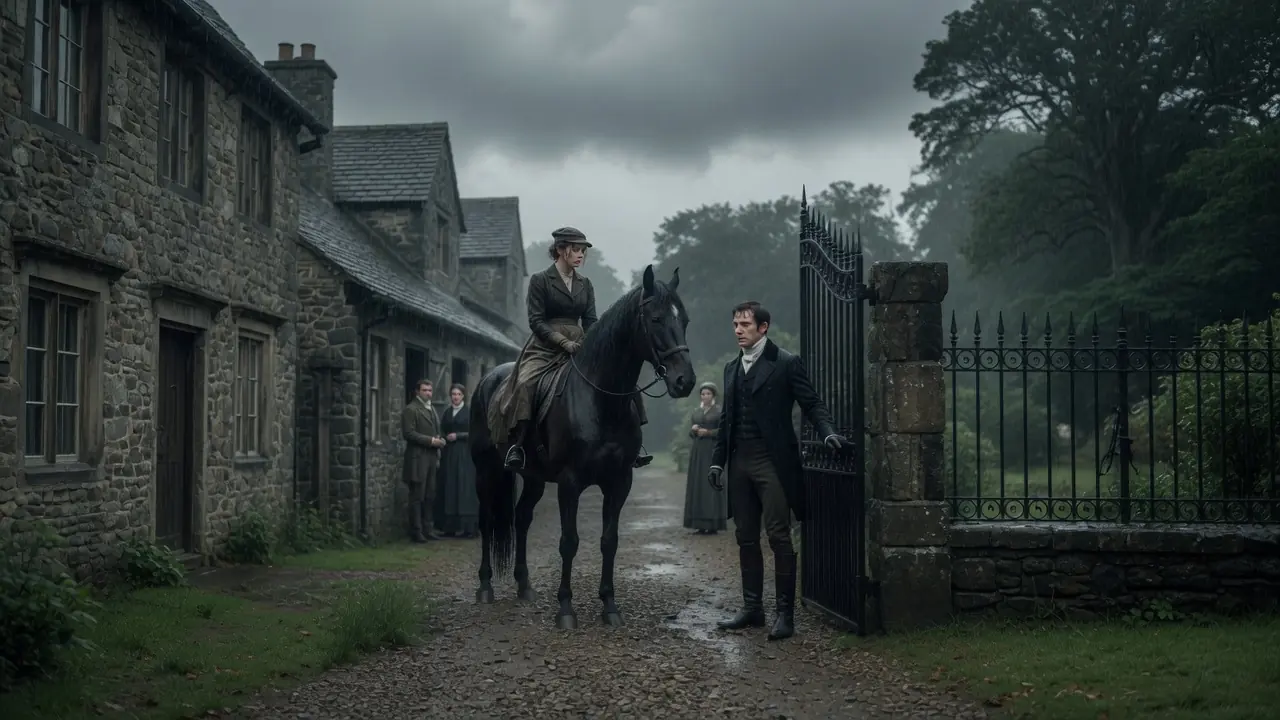
Julian had been many things, proud, charming, selfish when it suited him, but he had never been careless on horseback. He had trained Atlas himself from a yearling. He would no more have mishandled that horse than he would have struck a child.
So Marian had waited.
She waited through mourning, through her mother’s decline, through her uncle’s sudden control of Rowmere’s affairs. She learned ledgers because Julian had once joked that the only way to catch a gentleman lying was to follow his money. She learned stable work from an old groom loyal enough to remember her before she became inconvenient. She cut her hair, darkened her brows, traded silk for rough wool, and arrived at Thornfield with a false reference and hands already callused from practice.
In three weeks, she had learned several things.
The Duke of Thornfield was not mad. He was not cruel. He was cold in the way men became cold when every warm thing they touched was later used as evidence against them.
He rose before dawn. He rode alone. He spoke little. He carried the estate in the clenched line of his shoulders and never looked toward Atlas’s stall unless forced to pass it.
And Atlas was not vicious.
He was afraid.
Marian knew fear when she saw it. She had seen it in mirrors after Julian died. She saw it now in the stallion’s flared nostrils, in the way he backed from raised hands, in the way his body trembled whenever a man approached from his left side.
Something had happened to him on that path.
Something no one had bothered to ask the horse to remember.
“Easy,” Marian whispered, setting the oats down just inside the stall. “No one is asking anything of you.”
Atlas snorted.
She sat on the floor outside the stall door and took out the small leather notebook hidden in her bodice. Inside were names, dates, payments, and fragments of old testimony. One entry had been circled three times.
Mr. Silas Vane, former steward at Thornfield Hall. Dismissed one month after Julian’s death. Rehired six months later by Marian’s uncle at Rowmere.
That was not coincidence.
Marian did not believe in curses, and she trusted coincidence even less.
“You are very calm for a woman sitting outside a killer’s stall.”
The voice came from behind her.
Marian closed the notebook before turning.
Duke Elias Thorn stood in the stable doorway, tall, broad-shouldered, severe in a dark riding coat still damp from morning mist. He was thirty-one, though sorrow had carved older shadows beneath his eyes. His hair was black, his face angular, and his mouth looked as though it had forgotten how to soften.
The grooms feared his silences more than other men’s shouting.
Marian rose carefully. “He is not a killer, Your Grace.”
The Duke’s gaze moved from her face to the stallion beyond her shoulder. Atlas had not retreated. That was unusual. Everyone knew it.
“You have been here three weeks,” he said. “You know less than you think.”
“I know enough to see when a horse has been blamed because men find guilt inconvenient.”
His eyes returned to her.
The stable seemed to hold its breath.
No servant spoke to the Duke that way. Certainly not a stable maid with wet hems and hay in her hair.
“You are bold,” he said.
“Of what?”
“Men mistaking fear for guilt.”
Something flickered across his face.
Gone too quickly for most people.
Not for Marian.
He looked toward Atlas again. “Can you handle him?”
“Yes.”
“Can you ride him?”
The question was a challenge.
Or a warning.
Perhaps both.
Marian thought of Julian’s laugh, Julian’s hand on Atlas’s neck, Julian telling her, “He listens if you do not lie to him.”
“Yes,” she said.
The Duke’s jaw tightened. “Then prove it.”
One of the grooms made a strangled sound.
Marian looked at the Duke. “When?”
“Now.”
Rain whispered over the stable roof.
Atlas shifted in the stall, hearing something in the silence even the humans did not.
The Duke stepped closer. “If you can ride him across the south paddock without being thrown, you keep your position. If you cannot, you leave Thornfield before nightfall with double wages and a reference.”
Marian understood what he was doing.
He was not trying to dismiss her.
He was trying to protect her from a horse he still believed carried death in his bones.
That made him more dangerous to her purpose, not less.
Because it was much easier to hate a cruel man than to unravel a wounded one.
“I will ride him,” she said. “But not in the south paddock.”
His eyes narrowed. “No?”
“No. On the lower hunting path.”
The color left his face.
Every groom in the stable went still.
The lower hunting path had not been used in two years.
“That path is closed,” the Duke said.
“Then open it.”
“You do not know what you are asking.”
“I know exactly what I am asking.”
He crossed the space between them in three long strides. Marian had to tilt her head back to keep his face in view, but she refused to step away.
“Do you have a death wish?” he asked quietly.
“No.”
“Then why?”
Because my brother died there.
Because you were the last man to see him alive.
Because the horse remembers something you will not say.
Instead, she answered, “Because fear does not end in a paddock.”
The Duke stared at her for a long moment.
Then he said, “Saddle him.”
By noon, half of Thornfield Hall had gathered near the lower gate.
No one had been invited.
Everyone came.
Servants lined the back steps. Grooms clustered near the stable yard. The housekeeper stood beneath a black umbrella beside the cook, who claimed loudly that she had only come because if the girl broke her neck, someone ought to say a prayer.
The Duke stood alone near the iron gate leading to the lower hunting path.
Marian led Atlas from the stable herself.
The stallion moved like a shadow made flesh, every muscle alive beneath his black coat. He wore no heavy bit, no harsh rein, no studded strap. Marian had chosen the lightest bridle in the tack room and a plain saddle from the old hunting collection.
The head groom looked as if he might faint from disapproval.
The Duke said nothing.
His eyes did not leave Atlas.
Or Marian.
She mounted from the block with a fluid motion that made several grooms murmur. Atlas sidestepped once, tossing his head. Marian leaned forward and spoke into his mane.
“Not yet,” she whispered. “We are only remembering.”
The horse stilled.
The Duke heard the whisper, though not the words.
He opened the gate.
Beyond it, the lower path ran through wet grass, past the old beech trees, and down toward the ravine where Julian Wycliffe had died. The earth there held memory badly. Even from the saddle, Marian felt it.
Atlas felt it too.
His body changed beneath her.
The tension ran from his neck through his back like a drawn wire. His left ear flicked. His breathing sharpened. He did not bolt, but he wanted to.
Marian loosened the reins.
The Duke’s voice came from beside the gate. “Hold him tighter.”
“No.”
“He will run.”
“Only if I tell him there is something to flee.”
“That horse—”
“Trusts no hand that starts by expecting war,” she said without looking back.
For a moment, only the rain answered.
Then the Duke stepped aside.
Marian guided Atlas forward.
They walked at first.
One step. Then another. The crowd behind them disappeared behind the curve of the path. Soon there was only the rain, the trees, the horse beneath her, and the Duke walking several paces behind on foot.
She had not expected him to follow.
She should have.
Men like Elias Thorn did not abandon danger simply because they feared it.
Halfway down the path, Atlas stopped.
Not abruptly. Not violently.
He froze.
His head lifted. His ears fixed on the trees near the ravine. His whole body trembled.
Marian’s breath slowed.
“There,” she said softly.
The Duke had stopped behind them.
“This is where he threw Julian,” he said.
“No,” Marian answered.
The Duke’s gaze sharpened. “What did you say?”
“This is not where a horse throws a rider.”
She dismounted before he could stop her.
Atlas jerked, then steadied when her hand touched his neck. Marian knelt in the mud and pushed aside wet leaves at the path’s edge. She had studied old accident accounts for months. She knew the reported location. But she also knew no one had inspected it properly after the first day.
There, beneath the leaves, was the old iron ring set into a half-buried post.
A hunting barrier once used to hang temporary rope across the path.
Marian’s heart began to pound.
The Duke came closer. “What is that?”
“A place to fix a rope.”
His face went still.
She looked up at him. “Your Grace, did Atlas throw my brother, or did someone stretch a rope across this path at chest height?”
For the first time since she had met him, Duke Elias Thorn looked truly shaken.
He crouched beside her in the mud, ignoring the ruin of his coat, and ran his hand over the iron ring. His fingers came away rusted orange.
“There was no rope when I found him,” he said.
“Someone removed it.”
“I would have seen—”
“You found a dying man and a terrified horse. You saw what grief allowed you to see.”
His eyes snapped to hers.
The rain moved over his face like something colder.
“What do you know of grief?”
Too much, she almost said.
Instead, Atlas screamed.
The sound tore through the trees.
Marian spun.
A man stood farther up the path, half hidden beneath the branches, a pistol in his hand.
Silas Vane.
Former steward of Thornfield.
Current steward of Rowmere.
The man from her notebook.
The Duke moved first, but Marian was closer to the horse. Atlas reared, wild with remembered terror. Marian caught the reins, not pulling, only anchoring herself in his line of sight.
“Atlas,” she said sharply. “Look at me.”
The stallion’s hooves struck the mud.
The pistol lifted.
Vane shouted, “Step away from the horse!”
The Duke straightened slowly. “Vane.”
The former steward laughed once. “Still alive, Your Grace. Unlike others.”
Marian’s blood chilled.
The Duke’s voice was very quiet. “You killed Julian Wycliffe.”
“I corrected a problem.”
Marian stopped breathing.
Vane’s eyes moved to her. “And now the little sister comes dressed as a servant, thinking herself clever.”
The world narrowed.
The Duke turned his head slightly toward her.
Sister.
The word had landed.
Her disguise was gone.
His face revealed nothing, but she saw the fracture in his eyes.
“You knew?” he asked.
Marian could not answer.
Vane smiled. “She came to prove you guilty. Charming, is it not?”
The pistol remained steady.
“Why?” the Duke asked.
Vane’s jaw tightened. “Because Lord Julian found the first ledger. Because he knew your late father and Lord Rowmere had hidden money in horse purchases for years. Because he was going to expose it. Because dead men do not speak, and frightened horses make excellent murderers.”
Marian’s hand tightened on Atlas’s rein.
The plot broke open in pieces around her.
Her father. The Duke’s father. False horse purchases. Hidden money. Julian had not died in a riding accident. He had died because he discovered corruption buried beneath bloodlines and breeding records.
Vane’s eyes slid toward her. “Your uncle sends his regards, Lady Marian.”
So her uncle knew.
No.
Her uncle had ordered it.
The pistol shifted toward the Duke.
Atlas moved before Marian could.
Not backward.
Forward.
The stallion lunged with a scream of rage and memory, knocking Marian aside with his shoulder but not trampling her. Vane fired. The shot cracked through the trees. Bark burst from the beech above the Duke’s head.
Then Atlas struck Vane full in the chest.
The man fell hard into the mud, the pistol skidding away.
The Duke had him pinned a heartbeat later.
By the time the grooms reached them, summoned by the shot, Silas Vane was bleeding from the mouth and cursing the horse he had once turned into a scapegoat.
Atlas stood over him, trembling.
Marian rose slowly from the mud.
The Duke looked at her.
Not at Vane.
Not at the pistol.
At her.
“Lady Marian Wycliffe,” he said.
She swallowed. “Yes.”
“You came here under false pretenses.”
“Yes.”
“To investigate me.”
“Yes.”
“To prove I murdered your brother.”
Her voice broke despite her best efforts. “Yes.”
The rain fell between them.
His face hardened in a way that made her chest ache.
“And now?”
She looked at Atlas, at the iron ring, at Vane dragged upright by the grooms, at the ravine where her brother had died and the truth had waited two years beneath leaves.
“Now,” she said, “I believe I owe you an apology.”
“No,” he said.
The word struck like a door closing.
“You owe me the truth.”
Thornfield did not sleep that night.
Silas Vane was locked in the old gamekeeper’s room with two footmen outside the door and a magistrate summoned from the village. Atlas was returned to the north stable, where he stood exhausted but calm while Marian washed mud from his legs with shaking hands.
The Duke did not come to the stable.
Not that night.
Nor the next morning.
By noon, the whole house knew she was Lady Marian Wycliffe.
By supper, they knew she had entered service under a false name.
By evening, the servants had divided themselves into factions: those who thought her brave, those who thought her mad, and Mrs. Bell the housekeeper, who thought both opinions inadequate and brought Marian tea without comment.
Vane confessed before dawn on the second day.
Not out of guilt.
Men like him did not waste energy on guilt.
He confessed because the ledgers found in his traveling case connected him to Marian’s uncle, to old payments from the Duke’s late father, and to the forged sale of three racehorses that never existed.
Julian had discovered the scheme.
Julian had planned to tell the Duke.
Vane had stretched the rope across the lower path and frightened Atlas toward it with a pistol shot. Julian had struck the rope, fallen backward, and broken his neck. The Duke, arriving minutes later, had found only the aftermath.
Vane removed the rope.
Atlas received the blame.
The Duke received the suspicion.
Marian read the confession in the library with both hands wrapped around the paper.
The Duke stood by the window.
He had not looked at her once since entering the room.
“I am sorry,” she said.
“Yes.”
The single word hurt more than anger.
She folded the confession carefully. “I should have told you who I was.”
“Yes.”
“I thought you were hiding something.”
“I was.”
She looked up.
His face remained turned toward the glass.
“I was hiding shame,” he said. “Not guilt. There is a difference.”
Marian’s throat tightened.
“I saw your brother die,” he continued. “I reached him while he still breathed. He tried to speak, but there was blood in his mouth. I thought he was trying to say my name. For two years, I believed he died looking at me as if I had failed him.”
She stood.
“Elias.”
He turned then.
The use of his name changed something in the room, but not enough.
“You came here and made me hope I had been wrong about that horse,” he said. “You made me believe there might be truth beneath what everyone had decided. And all the while, you were deciding whether I was a murderer.”
“I was trying to find my brother’s killer.”
“And if it had been me?”
Her answer came quietly. “Then I would have ruined you.”
He nodded once.
As if that confirmed something he had already known.
“You should return to Rowmere,” he said.
“My uncle ordered my brother’s death.”
“Then do not return to Rowmere. Go to London. Go to your aunt. Go anywhere that is not here.”
The words were controlled.
That made them worse.
Marian looked at him across the library, at the man she had misjudged, at the Duke who had lived under suspicion because the truth would have required someone to listen to a horse everyone had decided was mad.
“I do not want to leave.”
His jaw tightened.
“No,” he said. “But you came here built of lies. I have had enough of those in this house.”
She left the library without another word.
But she did not leave Thornfield.
Not yet.
Three days later, Marian found the final ledger.
It was hidden in Atlas’s old tack trunk, beneath a false bottom Julian himself had built years before. She knew because his initials were carved into the underside. J.W., crooked and impatient.
Inside were copies of every forged purchase, every false horse sale, every transfer between Thornfield and Rowmere. Julian had been gathering evidence before he died.
At the bottom of the trunk was a letter addressed to Marian.
My little hawk,
If you are reading this, I have either become dramatic or dead. I hope for dramatic.
If something happens to me, do not trust Uncle Bertram. Do not trust Vane. Do not blame the Duke unless you have proof. He is difficult and proud and colder than a church floor, but he is not dishonorable.
Atlas knows me better than most men do. If they say he turned on me, they are lying.
Follow the money.
And if you must be reckless, be accurate.
Julian
Marian sat in the straw beside the trunk and wept until Atlas lowered his great black head and breathed against her shoulder.
The Duke found her there at dusk.
He saw the letter in her hand.
He did not ask permission before reading it.
Perhaps he should have.
Perhaps grief had its own laws.
When he finished, his hand trembled once.
Only once.
“He knew,” Elias said.
“Yes.”
“He knew I would not harm him.”
“Yes.”
The Duke closed his eyes.
Marian wiped her face with the heel of her hand. “I did not know.”
“No.”
“But I should have wondered why he trusted you.”
His eyes opened.
“He was my friend,” Elias said.
The words were quiet, stripped bare.
“And I never told anyone because admitting the friendship made losing him worse.”
Marian looked up at him.
There, in the stable that had once held only fear, she finally saw the whole shape of him. Not the cold Duke. Not the suspected murderer. Not the man society had made from rumor and silence.
A man who had lost his friend, his horse, his honor, and had been too proud or too wounded to ask anyone to believe him.
“I believe you,” she said.
He looked at her for a long moment.
Then he sat down in the straw beside her.
Not gracefully.
Not like a duke.
Like a tired man whose legs had finally decided the floor was enough.
Atlas breathed over them both.
For several minutes, neither spoke.
Then Elias said, “Your brother had terrible handwriting.”
Marian laughed through what remained of her tears.
“It was a family affliction.”
“No. Yours is worse.”
She turned to him, offended. “You have read my notes?”
“You left them in the tack room while pretending to be a servant.”
“I was investigating.”
“You were misspelling half the county.”
She laughed again, and this time he nearly smiled.
That was how forgiveness began.
Not with declarations.
With straw on silk, grief in the open, and a horse who had carried the truth longer than either of them.
The scandal that followed was enormous.
Lord Bertram Wycliffe attempted to deny everything until Vane produced the letters Bertram had written in his own hand. The magistrate seized Rowmere’s accounts. The racing club whispered. Parliament muttered. Society discovered, with great delight, that murder, forged horse sales, and a disguised lady in service were far more interesting than any ordinary season.
Marian’s name was spoken in drawing rooms for weeks.
Some called her brave.
Some called her improper.
Several elderly ladies called her both and seemed to enjoy the contradiction.
The Duke of Thornfield said nothing publicly until one dinner at Lord Harbury’s, when a gentleman with more wine than wisdom remarked that Lady Marian had behaved “rather like a stable creature herself.”
Elias set down his glass.
The table went quiet.
“Lady Marian uncovered a murder, exposed a financial fraud, and restored my estate’s honor,” he said. “If that is what you mean by stable creature, I recommend more ladies take to the stables.”
No one mentioned it again.
Marian heard about the remark three days later from Mrs. Bell, who had heard it from the underbutler, who had received it from a footman who was not supposed to have been near Lord Harbury’s dining room but had excellent ears.
She found Elias in the paddock with Atlas.
The horse stood beside him calmly now, his head lowered while the Duke ran a brush along his neck.
“You defended me,” Marian said.
He did not turn. “You required no defense.”
“Then what were you doing?”
“Correcting language.”
She smiled.
Atlas nudged Elias’s shoulder, impatient with the pause.
The Duke resumed brushing.
“He trusts you now,” Marian said.
“No,” Elias answered. “He tolerates me because you do.”
“That is not entirely untrue.”
He looked over at her then.
The wind moved through the pasture grass. Summer had come bright and green over Thornfield, softening the edges of everything grief had sharpened.
“You could return to Rowmere,” he said. “It is yours now. Your uncle will not hold it.”
“I know.”
“You could go to London.”
“Yes.”
“You could marry some very respectable man who has never been accused of murder by three counties.”
“That sounds dull.”
“Respectability often is.”
She walked closer, stopping beside Atlas.
The stallion lowered his head toward her, and she touched the white star between his eyes.
“I do not want Rowmere yet,” she said. “I do not want London. And I have had enough respectable lies to last my life.”
Elias’s hand stilled on the brush.
“What do you want?”
She looked at him.
It should have frightened her, saying it plainly. But after everything, fear seemed like an old dress that no longer fit.
“I want to stay.”
His face changed.
Not much.
With him, everything meaningful happened in narrow margins.
“As what?” he asked.
She lifted her chin. “That depends on whether you are asking as a duke, a friend of my brother, or a man who has been brushing the same patch of horse for five minutes because he is nervous.”
Atlas snorted.
Elias looked down at the horse, then back at her.
“I am not nervous.”
“No. Of course not.”
“I am considering.”
“Very slowly.”
His mouth curved.
A real smile this time, small and devastating.
“Stay,” he said. “As yourself. No false name. No servant’s cap. No lies. And if, in time, you find you can tolerate Thornfield, Atlas, and a man who still has difficulty speaking before he feels too much—”
“I can.”
He stopped.
Marian stepped closer.
“I can tolerate all three.”
His gaze searched hers. “That is not an answer made from pity?”
“No.”
“Or guilt?”
“No.”
“Or your brother’s memory?”
Her voice softened. “Julian led me here. He does not decide whether I remain.”
Elias looked at her for a long moment.
Then he held out his hand.
He did not take hers.
He waited.
Marian placed her hand in his.
Atlas shifted beside them, calm as a witness.
One year later, the lower hunting path opened again.
Not for a race.
Not for a challenge.
For a ride.
The county gathered because the county could not resist spectacle, and because no one had forgotten Widowmaker, the cursed stallion who was now once again called Atlas by everyone with sense and corrected by everyone without it.
Marian rode him.
Elias rode beside her on a gray mare with more patience than beauty. They approached the old path together beneath a bright September sky. The iron rings had been removed from the posts. The ravine fence had been rebuilt. The place of death had become, if not innocent, then honest.
At the bend where Julian had fallen, Marian slowed.
Elias slowed with her.
For a moment, neither spoke.
Then Marian leaned forward and touched Atlas’s neck.
“Ready?” Elias asked.
She looked at him.
Then at the open path.
“Yes.”
They rode forward.
Not fast at first.
Then faster.
Atlas gathered beneath her, powerful and sure. The gray mare matched him stride for stride. At the low stone wall beyond the beech trees, Marian felt the old thrill rise, not fear, not grief, but the fierce joy of a body and a horse agreeing on flight.
Atlas jumped.
The gray followed.
For one suspended second, they were all in the air together.
Then they landed cleanly on the other side.
Behind them, people cheered.
Marian barely heard them.
She was laughing.
Elias was looking at her as if the world had rearranged itself into something he had not known he was allowed to have.
Later, at Thornfield Hall, when the guests had gone and the horses were cooled and fed, Marian found the Duke in Atlas’s stall.
He was standing with one hand on the horse’s neck, quiet in the golden evening light.
“You are hiding,” she said.
“I am reflecting.”
“On your victory?”
“On your recklessness.”
She stepped into the stall. “You married it.”
“Not yet.”
Marian froze.
Elias turned.
There was no audience. No county watching. No scandal to correct. No murder to solve. Only straw, lamplight, the warm breathing of a horse, and a man who had finally learned that truth spoken plainly could heal what silence had made monstrous.
He took a small velvet box from his coat.
Marian stared at it.
“Elias.”
“I loved your brother,” he said quietly. “I grieved him badly. I buried the truth because I could not bear looking at the hole it left. Then you arrived in my stable under a false name, insulted my judgment, saved my horse, exposed a murderer, and made the house feel inhabited again.”
“That is a very unusual proposal.”
“I have not yet begun.”
“Then begin properly.”
His mouth curved.
He opened the box.
Inside was a ring of plain gold set with a dark sapphire the exact color of storm clouds over the moor.
“Lady Marian Wycliffe,” he said, “will you remain at Thornfield as my wife, my equal, and the only person alive whom Atlas obeys more readily than me?”
Atlas snorted again.
Marian looked from the ring to the horse to the man she had once come to ruin.
Then she smiled.
“Yes,” she said. “But I will not promise to make either of you easy to manage.”
Elias slid the ring onto her finger.
“I would not know what to do with easy.”
They were married in October, beneath a sky clear enough that the whole county called it a blessing and Mrs. Bell called it overdue.
Atlas stood in the paddock beyond the chapel wall, black coat shining, ears forward, as if he understood ceremony perfectly and disapproved of how long humans took to reach obvious conclusions.
During the vows, Marian thought of Julian.
Not with the sharp pain that had once lived beneath every breath, but with the warmth of something completed. Her brother had not been given justice quickly. But he had been given justice. And the horse blamed for his death had carried her to the truth.
When Elias placed the ring on her hand, he paused only once.
A half second.
A small navigation before feeling became speech.
Marian saw it.
She loved him more for it.
At the wedding breakfast, an elderly aunt asked whether it was true that the Duchess had once worked in the Duke’s stable.
Marian smiled over her teacup.
“Yes,” she said. “And very well, too.”
Elias, seated beside her, reached beneath the table and took her hand.
Not to rescue her.
Not to quiet her.
Only to be there.
Outside, Atlas ran along the fence line, mane flying, no longer cursed, no longer caged, no longer carrying the story men had forced upon him.
And Thornfield Hall, which had spent two years holding its breath around grief, opened its doors to the sound of laughter, hooves, and a woman who had come disguised as a servant to find a murderer and stayed as the Duchess who taught them all the difference between control and trust.
Some love stories begin with a dance.
Some begin with a letter.
This one began with a black stallion everyone feared, a false stable maid with mud on her skirts, and a Duke who finally learned that the truth does not always speak in words.
Sometimes it waits in the eyes of a horse.
Sometimes it runs.
And sometimes, if one is brave enough to loosen the reins, it carries you home.