The outdoor courts behind Pacific Ridge High were where boys became legends, liars, or targets.
Every afternoon, the California sun burned down over the blacktop, shining through rows of tall palm trees beyond the chain-link fence. The basketball hoops rattled in the breeze, old white boundary lines faded under years of sneakers, and the air smelled like warm asphalt, grass, sweat, and cafeteria fries drifting from the building across the field.
During fifth-period PE, the courts belonged to Coach Reynolds and thirty-seven restless students who would rather be anywhere else.
But on that Tuesday in 1993, the court belonged to Brad Keller.
At least, Brad thought it did.
Brad was seventeen, blond, broad-shouldered, and built like every high school sports poster wanted a boy to look. He wore a dark green sleeveless shirt, white athletic shorts, high socks, and a white wrist wrap he claimed was from an old basketball injury, though most students knew he wore it because it made him look tougher. He moved with a swagger that said he expected everyone to step aside before he even reached them.
Most people did.
Brad was captain of the summer league team, starter on varsity basketball, and the kind of guy teachers called “competitive” when they did not want to admit he was mean. He laughed loudly, shoved too hard during games, and made every mistake someone else’s fault. When he won, he wanted applause. When he lost, he wanted revenge.
And lately, his favorite person to punish was Noah Ellis.
Noah was the opposite of Brad in almost every way. He was quieter, leaner, and less interested in being watched. He wore a gray sleeveless shirt, dark gym shorts, and old sneakers his mother had bought from a discount store before school started. His hair fell across his forehead, and he often looked like he was thinking about something far away from whatever room he stood in.
At Pacific Ridge, quiet boys were usually ignored.
But Noah had made one mistake.
He was good at basketball.
Not loud-good. Not showoff-good. Not the kind of good that slapped the backboard and yelled after every layup. Noah played like someone who had learned alone on cracked driveways and empty park courts. He moved without wasting steps. He passed before defenders saw the opening. He shot with a soft, clean release that made the net whisper.
That bothered Brad more than anything.
Because Brad could handle weaker boys.
He could handle awkward boys.
He could handle boys who missed shots and lowered their heads.
What Brad could not handle was a quiet boy who made him look slow.
The problem started two weeks earlier, when Coach Reynolds split the PE class into teams for a short tournament. Brad expected to dominate. His team had two varsity athletes, one baseball player, and a freshman tall enough to block shots by accident. Noah’s team had Tommy Price, who hated running, Eddie Morales, who played better defense than offense, and a shy sophomore named Peter who apologized every time he touched the ball.
Brad laughed when he saw the matchups.
“This is going to be ugly,” he said.
It was ugly.
Just not the way Brad expected.
Noah did not try to beat Brad with strength. He beat him with patience. Every time Brad lunged for a steal, Noah changed direction. Every time Brad crowded him, Noah passed around him. Every time Brad tried to force him left, Noah spun right and finished at the rim before Brad could recover.
By the end of class, Noah’s team won by two points.
Nobody said much at first.
Then Eddie shouted, “Game!”
The whole court reacted. A few students laughed in surprise. Tommy jumped around like they had won the NBA Finals. Peter clapped with both hands over his head.
Noah only picked up the ball and handed it to Coach Reynolds.
That made Brad angrier.
If Noah had celebrated, Brad could have called him cocky. If Noah had talked trash, Brad could have shoved him and blamed the moment. But Noah only walked away like winning was something that happened quietly.
From that day on, Brad watched him.
In the locker room, Brad called him “park bench Jordan.” In the hallway, he bounced imaginary basketballs when Noah passed. At lunch, he asked if Noah had learned to play from “old men at the public court.” His friends laughed every time.
Noah said nothing.
That was how he survived most things at Pacific Ridge. He did not feed the fire. He did not challenge boys who needed crowds. He kept his head down, helped his mother after school at the small grocery store she managed, and practiced basketball at night under the yellow lights of Bellamy Park, where nobody cared what shoes he wore.
But silence had a cost.
By Tuesday, Brad’s jokes had turned into shoves.
A shoulder check near the gym doors.
A hard pass thrown at Noah’s chest during warmups.
A trip disguised as an accident while the class jogged laps.
Noah absorbed each one, jaw tight, eyes steady.
Coach Reynolds noticed some of it, but not enough. Brad was good at timing his cruelty between whistles, behind groups, inside moments that looked harmless from far away.
That afternoon, Coach divided the class for half-court games. The sun was bright, the blacktop hot, and the palm trees beyond the fence swayed slowly under a clear blue sky. Students groaned as they stretched, complained about the heat, and argued over teams.
Brad immediately pointed at Noah.
“I want him,” he said.
Coach Reynolds narrowed his eyes. “This is PE, Keller. Not the state championship.”
Brad smiled. “Just making it fair, Coach.”
Noah said nothing.
Eddie Morales, standing beside him, muttered, “Fair means he gets to foul you every possession.”
Noah glanced at him. “I know.”
“Then say something.”
Noah looked across the court at Brad, who was spinning the ball on one finger while his friends laughed around him.
“Not yet,” Noah said.
Eddie frowned. “What does that mean?”
Noah did not answer.
The game began.
Brad guarded Noah from the first possession. He stood too close, chest forward, arms wide, smiling like every bump was part of the sport. Noah caught the ball near the right wing and immediately felt Brad’s forearm press into his ribs.
“Come on, quiet boy,” Brad said. “Show me that driveway magic.”
Noah bounced the ball once. “Play defense.”
Brad’s smile twitched. “I am.”
“No,” Noah said. “You’re posing.”
Eddie made a choking sound from the corner, trying not to laugh.
Brad’s eyes hardened.
Noah drove left. Brad slid with him and gave him a hard bump with his shoulder. Noah kept his balance, crossed the ball low, and stepped back. Brad lunged forward. Noah rose into a jump shot.
The ball arced cleanly.
Swish.
A few students shouted.
Eddie clapped once. “That’s one!”
Noah backpedaled calmly.
Brad caught the ball as it fell through the net and stared at it like the basketball had betrayed him.
The next possession, Brad demanded the ball. He drove straight at Noah, trying to overpower him. Noah stayed low, took one step back, then stripped the ball clean from Brad’s right hand. The ball bounced toward midcourt.
Students reacted loudly.
Noah chased it down, turned, and passed to Eddie for an easy layup.
Brad stood frozen near the free throw line.
Then he laughed, but the laugh sounded wrong.
“Lucky,” he said.
Noah jogged past him. “Then stop letting it happen.”
The court went quiet for half a second.
Brad’s friends, Tyler and Mark, stopped smiling.
Brad stared at Noah’s back, and everyone nearby could feel the change in the air. The game was no longer about PE. It was about Brad’s pride, and Brad’s pride had become dangerous.
On the next play, Noah brought the ball up slowly. Brad waited near the top of the key, bouncing on his toes. His blond hair was damp with sweat. His jaw was clenched. His eyes did not look playful anymore.
Noah crossed half court.
Brad stepped in.
Hard.
His shoulder slammed into Noah’s chest. Noah stumbled but kept the dribble. Coach Reynolds blew his whistle.
“Foul, Keller!”
Brad lifted both hands. “I barely touched him!”
Coach pointed at him. “Watch it.”
Noah picked up the ball and walked back to the check line. Brad came close, voice low enough that only Noah heard.
“You’re making this worse for yourself.”
Noah looked at him. “No. You are.”
Brad smiled without warmth. “You think because you made a couple shots, people care?”
Noah held the ball at his hip. “I don’t need them to care.”
That answer bothered Brad more than any insult could have.
Because Brad needed people to care.
He needed Tyler to laugh. He needed Mark to back him up. He needed girls watching from the tennis fence. He needed the class to know when he won.
Noah needed none of that.
He only needed the ball and enough space to move.
The game continued, but Brad stopped pretending to play clean. He slapped Noah’s arm on drives. He bumped him after passes. He stepped on his heel once and muttered, “My bad,” with a smile that said it was not bad at all.
Noah stayed calm.
But inside, something was changing.
He thought about all the times he had walked away. All the times he had let Brad’s words fall to the floor without picking them up. All the times he had told himself that ignoring disrespect meant he was stronger than it.
Maybe sometimes that was true.
But sometimes silence only taught the wrong person that he could keep going.
The score reached nine to nine.
Game to eleven.
Eddie checked the ball to Noah. The court had almost completely stopped around them. Other PE games faded into the background. Students from the far hoop drifted closer. A few girls from tennis paused near the fence to watch.
Brad noticed the audience and smiled again.
This was what he wanted.
A stage.
Noah dribbled once, then twice.
Brad leaned close. “You’re not scoring.”
Noah looked at the basket. “Then stop me.”
Brad lunged.
Noah crossed right, spun left, and slipped past him. The move was clean, fast, almost too smooth for the old blacktop court. Brad reached back and grabbed Noah’s arm.
The ball rolled loose.
Noah stopped.
The whistle blew.
Coach Reynolds shouted, “Keller!”
But Brad did not let go immediately. His fingers were locked around Noah’s upper arm, his body half-turned, his face twisted with anger.
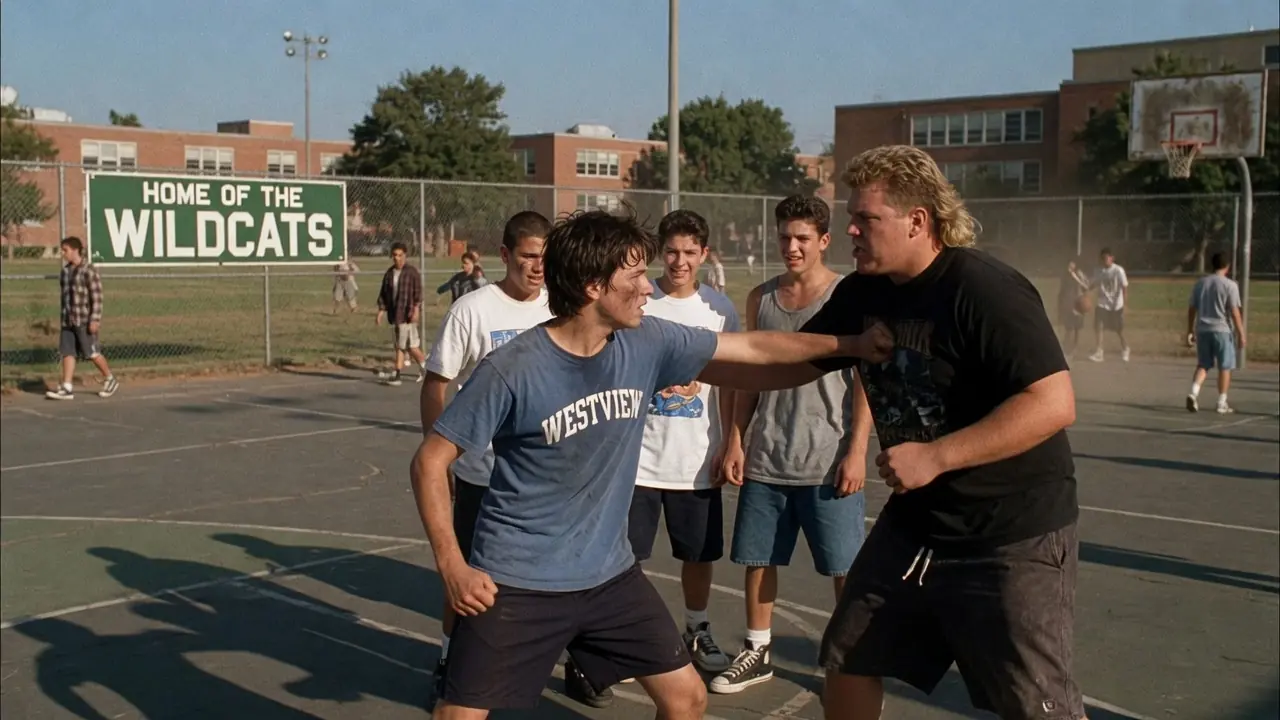
“You think you’re better than me?” Brad snapped.
Noah looked down at Brad’s hand.
Then he looked at Brad.
“Let go.”
Brad stepped closer, still gripping his arm. “Answer me.”
The whole court had gone silent now.
Noah’s voice stayed low. “Let go.”
Brad shoved him backward by the arm.
That was the line.
Noah had learned basketball from his older brother Marcus before Marcus left for the Marines. Marcus had taught him shooting, footwork, and something more important than both.
“Balance wins,” Marcus used to say. “In basketball. In fights. In life. The guy who loses balance first loses control.”
Brad had just lost control.
Noah moved.
He turned his shoulder inward, breaking Brad’s grip with one sharp twist. Brad reached again, but Noah stepped aside, caught Brad’s wrist, and guided his momentum past him. Brad stumbled forward, tried to plant his foot, and found Noah’s leg already blocking his path.
It was not a punch.
It was not wild.
It was balance.
Brad hit the blacktop hard on one knee and one hand, then rolled onto his side near the free throw line.
The entire court froze.
The basketball bounced once beside them.
Then rolled away.
Brad Keller, the boy who had shoved, mocked, grabbed, and ruled the court with his mouth, was down on the asphalt in front of everyone.
Noah stood over him, breathing hard but controlled.
His fists were not raised.
His face was not angry in the way people expected.
He simply said, “Don’t grab me again.”
Brad pushed himself up, face red with shock and humiliation. “You tripped me!”
Noah looked at him. “You grabbed me.”
Coach Reynolds arrived between them, whistle still in his mouth, eyes sharp. “Enough!”
Brad pointed at Noah. “He threw me down!”
Eddie spoke immediately. “After you fouled him like five times.”
A girl by the fence shouted, “He grabbed his arm first!”
Another student added, “We all saw it!”
Brad looked around, expecting his friends to save him.
Tyler looked away.
Mark stared at the basketball rolling near the sideline.
For the first time, Brad’s audience did not know how to laugh for him.
Coach Reynolds looked at Brad. “Sit out.”
Brad’s mouth opened. “Coach—”
“Now.”
The word cut across the court.
Brad stood slowly, brushing dust from his shorts, trying to look angry instead of embarrassed. He walked toward the sideline, but every step felt smaller than the one before.
Noah bent down and picked up the ball.
Coach looked at him. “You okay?”
Noah nodded. “Yeah.”
“You sure?”
“I’m sure.”
Coach studied him for a second, then turned to the class. “Game continues. Next foul like that, whoever does it is done for the week.”
Noah walked back to the check line.
Eddie came close and whispered, “That was insane.”
Noah bounced the ball once. “It was balance.”
“What?”
“Nothing.”
The game resumed without Brad. Tyler took his place, but his defense had no bite. The court felt different now. The fear that had made everyone move around Brad had cracked open.
Noah scored the final point on a clean pull-up jumper from the elbow.
Game.
Eleven to nine.
Noah’s team won.
Noah did not celebrate. He handed the ball to Coach Reynolds and walked toward the water fountain near the fence. Eddie followed him, grinning like he had just witnessed history.
“You know everyone’s going to talk about this all week,” Eddie said.
Noah bent to drink from the fountain. The water was warm, but he did not care.
“Let them,” he said.
From the sideline, Brad watched with his arms crossed, jaw tight. His knee was scraped, and his pride was worse. He looked like he wanted to say something, but Coach Reynolds stood close enough to stop him.
The bell rang ten minutes later.
Students headed toward the locker rooms, buzzing with the story already growing in size. Some said Noah had dropped Brad with one move. Some said Brad had tried to punch him, which was not true. Some said Noah had secretly trained in martial arts, which was also not true.
Noah ignored all of it.
In the locker room, he changed quietly and shoved his gym clothes into his bag. He expected Brad to corner him near the lockers. He expected Tyler and Mark to block the aisle. He expected the usual second act after a public embarrassment.
Instead, Brad stayed on the far side of the room, silent.
That silence felt louder than his jokes.
After school, Noah walked toward the bike rack. The late afternoon sun stretched long shadows across the parking lot. He unlocked his old bike and was about to leave when someone called his name.
It was Coach Reynolds.
“Noah.”
Noah turned. “Yes, Coach?”
Coach walked over slowly, hands in the pockets of his windbreaker. “I want to talk about what happened today.”
Noah’s stomach tightened. “I didn’t start it.”
“I know.”
That surprised him.
Coach looked toward the courts. “I should have stopped it earlier. Keller’s been pushing too far. I saw some of it. Not all. Enough that I should have stepped in before it reached that point.”
Noah said nothing.
Coach sighed. “You defended yourself and stopped. That matters. But next time, tell me sooner.”
Noah looked down at his bike handle. “I didn’t think it would matter.”
Coach’s face tightened, not with anger, but with regret. “That’s on us, then.”
Noah looked up.
Coach nodded once. “I mean it. If students think adults won’t do anything until someone hits the ground, we’ve already failed.”
Noah did not know what to say to that. Adults rarely admitted failure in front of students.
Coach continued, “Brad is sitting out the rest of the week. If he touches you again, he’s out of PE basketball completely and I’m sending it to the office.”
Noah nodded. “Okay.”
“And Noah?”
“Yeah?”
Coach’s voice softened slightly. “You’re a good player.”
Noah looked away, uncomfortable. “Thanks.”
“I’m serious. You ever think about trying out?”
“For basketball?”
“No, for chess club,” Coach said dryly.
Noah almost smiled.
Coach pointed toward the gym. “Tryouts are next month for summer league. You should show up.”
Noah shook his head. “Brad’s on the team.”
Coach’s expression hardened. “That court does not belong to Brad.”
The words stayed with Noah all the way home.
That court does not belong to Brad.
Noah thought about the blacktop, the faded lines, the palm trees, the ball rolling away after Brad hit the ground. He had spent so long treating certain spaces like they belonged to louder people. The cafeteria. The locker room. The courts. The center of attention.
Maybe they only owned those places because everyone else kept stepping back.
The next day, Brad did not speak to him.
Neither did Tyler or Mark.
But everyone else did.
Eddie slapped him on the shoulder in the hallway and called him “balance king” until Noah threatened to never pass him the ball again. A sophomore asked how he made Brad fall. A girl from the tennis team said, “Nice shot yesterday,” though Noah was not sure whether she meant the jumper or the takedown.
At lunch, Noah sat outside under the shade near the bike racks, where he usually ate alone. Eddie appeared with his tray. Then Peter from PE. Then two other students who had watched the game. They sat near him like it was no big deal, but Noah understood that it was.
People were choosing not to leave him alone with the story.
Brad returned to PE on Friday, but he was different. Not better, exactly. Not kind. But careful. He stayed away from Noah during warmups. He passed the ball when he should. He argued with Coach once, then stopped when Coach gave him a look.
Near the end of class, the ball rolled to Noah at the sideline. Brad stood a few feet away.
For a second, neither moved.
Then Brad said, low enough that only Noah could hear, “You embarrassed me.”
Noah picked up the ball. “You embarrassed yourself.”
Brad’s jaw tightened.
Noah expected a shove, a threat, something ugly.
Instead, Brad looked toward the court and exhaled through his nose. “I shouldn’t have grabbed you.”
Noah studied him.
It was not a full apology. It was not enough to erase weeks of shoves and jokes. But it was the first honest sentence Brad had ever given him.
“No,” Noah said. “You shouldn’t have.”
Brad nodded once, like the words hurt to swallow. Then he walked away.
Noah did not forgive him that day.
But he also did not feel afraid.
A month later, Noah showed up for summer league tryouts.
Brad was there, of course. So were half the boys who thought the team already belonged to them. Noah almost turned around when he saw the cluster of varsity jackets near the bleachers.
Then Coach Reynolds spotted him.
“Ellis,” he called. “You’re up next.”
Noah stepped onto the court.
The sun was lower than it had been that Tuesday, throwing long golden lines across the blacktop. The palm trees moved in the breeze. The ball felt familiar in his hands.
Brad stood near the free throw line, watching.
This time, he said nothing.
The drill began. Noah caught the pass, took one dribble, changed direction, and finished cleanly at the rim. On defense, he stayed low and forced his man into a bad shot. During scrimmage, he passed, cut, stole the ball twice, and hit a jumper from the corner.
He did not play to prove Brad wrong.
He played because he belonged on the court.
At the end of tryouts, Coach Reynolds read the list.
Noah made the team.
Eddie shouted so loudly from the fence that Coach told him to leave or sign up as the mascot.
Brad did not clap.
But he did nod once.
Noah nodded back.
Not friendship.
Not forgiveness.
Just recognition.
By the end of the semester, the story of Brad falling on the blacktop had become part of Pacific Ridge legend. Some students exaggerated it. Some turned Noah into a secret fighter. Some claimed they had known all along that Brad was going to lose his balance one day.
Noah knew the truth.
He had been scared.
His hands had shaken afterward.
His heart had pounded so hard he could barely hear.
But courage was not the absence of fear. Courage was the moment he stopped letting fear choose his place for him.
On the last day of school, Noah walked past the outdoor courts after final period. The blacktop was empty, the hoops still, the palm trees casting long shadows across the faded white lines. He stopped at the free throw line and looked at the place where Brad had fallen.
He did not smile because someone had hit the ground.
He smiled because he had stayed standing.
Eddie came up behind him, spinning a basketball on one finger badly. “You coming to the park later?”
Noah turned. “Yeah.”
“Good. We need you. Brad’s playing too.”
Noah raised an eyebrow. “That supposed to scare me?”
Eddie grinned. “Not anymore.”
Noah took the ball from him and bounced it once.
The sound echoed across the empty court.
For years, he had thought quiet meant staying out of the way. But that spring taught him something different. Quiet could be control. Quiet could be patience. Quiet could be the breath before the move that changed everything.
Brad Keller had grabbed him because he thought the court belonged to the loudest player.
Noah Ellis proved it belonged to whoever had the balance to stand their ground.