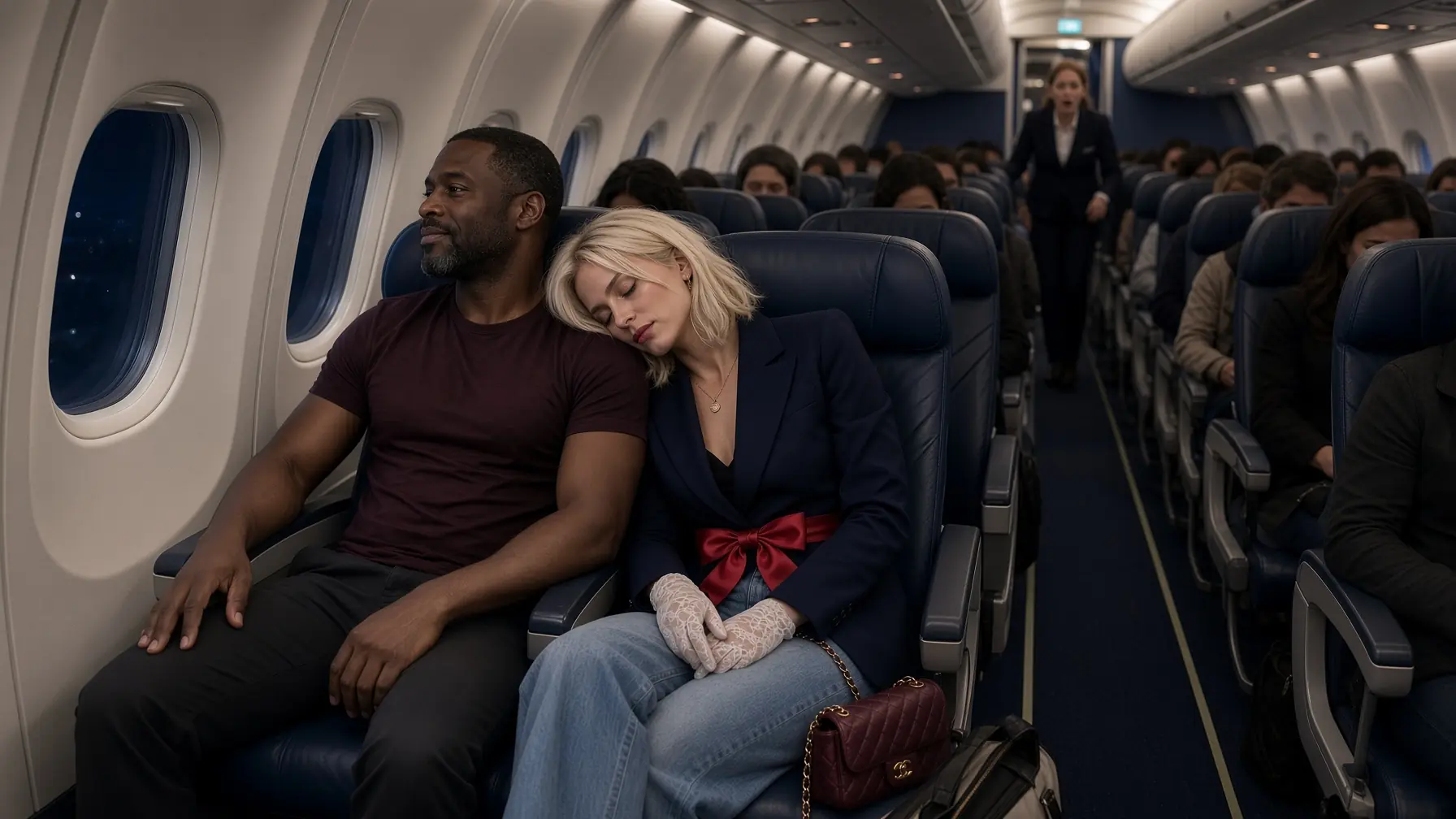
At 1:17 in the morning, Marcus Reed was asleep with his forehead pressed against the cold window of Flight 602 when the captain’s voice came over the speakers. It wasn’t the usual smooth announcement about turbulence or seat belts. The voice sounded controlled, but there was something underneath it that Marcus recognized immediately. Fear.
“Ladies and gentlemen, if there is anyone aboard with advanced military aviation experience, particularly tactical or fighter aircraft, please alert a member of the cabin crew immediately.”
The cabin went completely still. A few people looked around as if they expected some decorated pilot in uniform to rise from first class, but nobody moved. Marcus opened his eyes slowly and stared at the darkness beyond the window, where the Atlantic stretched unseen beneath them. For almost four years, he had done everything possible to bury the part of his life that understood exactly what that announcement meant.
Three hours earlier, Marcus had boarded North Atlantic Airways Flight 602 at JFK carrying one backpack, a laptop case, and the exhausted expression of a man who had been living on airport coffee for two days. He was thirty-nine, tall and lean, with close-cropped black hair beginning to gray at the temples. To the other passengers, he looked like another tired businessman headed to London. Nobody would have guessed that there had once been a fighter jet with his name painted beneath the canopy.
Marcus had spent the previous two days in Manhattan completing a security systems contract for the technology firm where he now worked. His office was technically in Seattle, but clients still wanted people sitting across conference tables instead of glowing from laptop screens. That meant a handful of cross-country and international trips each year, something Marcus tolerated only because the salary allowed him to raise his eight-year-old daughter, Zoe, without constantly worrying about money. Every time he traveled, he counted the hours until he could get home.
Zoe was staying with their neighbor, Elaine Warren, a retired elementary school teacher who treated the little girl like a granddaughter. Marcus had called just before boarding and listened while Zoe explained an entire school project about the solar system without pausing to breathe. Before hanging up, she had asked the same question she always asked whenever he traveled. “You’re coming home Sunday, right, Dad?”
“Sunday morning,” Marcus had promised.
“You swear?”
“I swear.”
That word had meant more between them than Zoe understood. Four years earlier, Marcus had stood in their kitchen wearing a flight suit while his daughter, then only four, wrapped both arms around his leg and begged him not to leave again. Zoe’s mother had died from complications following an illness the year before, and deployments had suddenly stopped feeling like sacrifices Marcus was entitled to make. He left the Air Force less than six months later.
Before civilian life, Major Marcus Reed had flown F-15E Strike Eagles for eleven years. His squadron had operated from bases in the United States, Europe, and the Middle East, sometimes returning with damaged aircraft and sometimes returning without everyone who had taken off that morning. He had accumulated thousands of flight hours and enough emergency training to make instinct outrun fear. His callsign had been Bishop, partly because he was quiet and partly because someone once joked that Marcus started praying only after everyone else had run out of ideas.
He rarely talked about any of it now. His coworkers knew he had served, but most assumed he had worked somewhere behind a desk. Zoe knew her father had once been a pilot, yet Marcus had never described combat missions or the nights when alarms dragged him from sleep. He wanted her to think of him as the father who packed lunches, fixed bicycles, and forgot where he left his keys.
That was the life he had chosen.
So when the captain asked for military pilots, Marcus remained seated.
A woman across the aisle whispered to her husband. Somewhere behind Marcus, a baby began crying as nervous conversations moved through the cabin. The young college student beside him removed his headphones and looked around. “That’s probably not normal, right?”
“No,” Marcus said.
The student glanced at him. “You sound pretty sure.”
Marcus didn’t answer.
The announcement came again two minutes later, this time from a flight attendant. She asked anyone with military aviation experience to identify themselves immediately and emphasized that the crew was dealing with a serious technical emergency. Several passengers stopped whispering after that. Marcus could hear seat belts clicking as people instinctively tightened them.
His mind went directly to Zoe.
He pictured her asleep beneath the purple blanket covered with tiny white stars, one foot probably hanging over the edge of the mattress. He imagined Elaine waking her the next morning with news no child should ever hear. For years Marcus had told himself leaving military aviation was the decision that guaranteed he would always come home.
Now doing nothing might be what prevented it.
A flight attendant began walking slowly down the aisle. Her name tag read Sarah Callahan, and although her face remained professionally calm, Marcus noticed the way she kept glancing toward the front of the aircraft. She stopped occasionally to reassure passengers, but her eyes were searching. By the time she reached row eleven, Marcus had already made his decision.
He unfastened his belt and stood.
Sarah stopped immediately.
“I might be able to help.”
Half the surrounding passengers turned toward him.
Sarah studied his jeans, faded gray sweatshirt, and running shoes. “What kind of experience do you have?”
“United States Air Force. F-15E pilot. Eleven years.”
Her eyes sharpened. “Current?”
“Separated four years ago.”
“Commercial certification?”
Marcus shook his head. “Not current.”
Sarah hesitated. “Do you have military identification?”
“No.”
The answer clearly did not help.
“I left the service,” Marcus explained. “I don’t carry flight credentials around anymore.”
A businessman two rows behind them muttered something about letting random passengers into the cockpit. Marcus heard it but ignored him. Sarah lowered her voice.
“Sir, I need you to understand why I’m asking. We cannot bring someone forward based only on a claim.”
“I understand.”
“What unit?”
“Fourth Fighter Wing, Seymour Johnson. Before that, training at Mountain Home.”
“How many hours?”
“A little over twenty-three hundred in tactical aircraft.”
Sarah still looked uncertain.
Then an older man in row twelve leaned into the aisle.
“Ask him something specific.”
Sarah turned.
The man stood carefully. He was perhaps sixty-five, with silver hair, wire-rimmed glasses, and shoulders that still carried traces of military posture. “Colonel Andrew Whitmore, retired Air Force maintenance command,” he said. “If he spent eleven years in an Eagle, we can figure that out pretty quickly.”
Marcus almost smiled.
Whitmore looked directly at him. “Complete electrical failure during instrument conditions. First priorities?”
Marcus answered without hesitation.
“Maintain aircraft control, establish backup instruments, preserve battery power, verify generators and emergency power, then determine whether recovery is possible before the situation deteriorates.”
Whitmore nodded slightly.
“Hydraulic degradation?”
“Reduce unnecessary control movement, identify which system is failing, preserve remaining pressure, configure early if possible, and avoid aggressive maneuvering.”
Whitmore asked three more questions.
Marcus answered all three.
Finally the retired colonel looked toward Sarah.
“He’s real.”
That was enough.
“Come with me.”
As Marcus followed her forward, people stared openly. He heard someone whisper that the man in the sweatshirt was apparently a fighter pilot. Another passenger began filming with his phone before Sarah sharply told him to put it away.
At the cockpit door, she stopped Marcus.
“I need one thing from you.”
“What?”
“If the first officer tells you to back away, you back away.”
Marcus nodded.
“Understood.”
The door opened.
Marcus knew something was terribly wrong before he had taken two steps inside.
The captain was reclined awkwardly in the left seat while a middle-aged woman wearing medical gloves checked his pupils. Sweat soaked through the captain’s white shirt, and one side of his face appeared noticeably slack. In the right seat, First Officer Liam Foster held the controls with both hands.
Foster could not have been older than twenty-nine.
His breathing was too fast.
The doctor looked at Marcus. “Dr. Rebecca Shaw. Captain had what appears to be an acute stroke about fifteen minutes ago. He’s conscious intermittently but unable to speak clearly or control his right side.”
Marcus nodded and looked at the instrument panel.
Several warnings were illuminated.
“What happened to the airplane?”
Foster glanced back. “Who are you?”
“Former Air Force.”
“He flew Strike Eagles,” Sarah added. “The retired colonel in twelve confirmed enough of his background for me.”
Foster stared at Marcus for one uncomfortable second.
Then another warning tone sounded.
Whatever skepticism remained had to wait.
“We lost primary hydraulic pressure shortly after the captain collapsed,” Foster said. “Secondary system started dropping four minutes later. Autopilot disconnected during the first failure, and I’ve been hand-flying since.”
Marcus leaned closer to the displays.
The jet was banking several degrees right.
Foster corrected it.
The response came late.
Marcus felt the aircraft’s slight wandering motion beneath his feet. “Controls getting heavy?”
“Worse every minute.”
“How long until London?”
“Almost three hours.”
Marcus looked at him.
“We’re not going to London.”
Foster exhaled. “I know.”
“What’s closest?”
“Shannon.”
“How far?”
“About two hundred twenty nautical miles.”
Marcus looked at the hydraulic indications again.
Even Shannon suddenly felt far away.
“What type rating do you have?” Foster asked.
“None on this aircraft.”
Foster’s expression tightened.
Marcus understood why.
Flying a fighter did not magically make someone qualified to command a wide-body passenger jet. The systems were different, the control characteristics were different, the approach speeds were different, and Marcus had no intention of pretending otherwise. What he did understand better than almost anyone aboard was how aircraft behaved after systems stopped behaving the way designers intended.
“I’m not here to replace you,” Marcus said. “You know this airplane. I know damaged airplanes. We work together.”
Foster looked at him for several seconds.
Then he nodded.
“Okay.”
That single word changed everything.
Foster contacted Shannon while Marcus examined the information available. The hydraulic pressure was deteriorating steadily, but not yet catastrophically. They still had flight controls, although each movement required more effort and delivered less response.
“What are they giving us?” Marcus asked.
“Runway two-four. Winds twelve knots, mostly down the runway. Weather’s clear.”
“Emergency equipment?”
“Already rolling.”
Marcus nodded.
“Then that’s where we’re going.”
Sarah remained near the cockpit door.
“Should I tell the passengers what’s happening?”
“Yes,” Marcus said. “Enough truth that they stop inventing something worse.”
She gave him a questioning look.
“Tell them the captain became ill, we’ve diverted to Ireland, and they need to remain seated. Don’t mention how much hydraulic pressure we have left.”
“How much do we have?”
Marcus looked at Foster.
Foster swallowed.
“Thirty-one percent on one system. Twenty-seven on the other.”
Sarah understood immediately.
She disappeared into the cabin.
Marcus sat in the cockpit jump seat and began working through the problem with Foster. They reduced unnecessary control movements and planned the descent early so the aircraft would not require dramatic configuration changes near the runway. Every adjustment became a negotiation with the airplane.
For several minutes, things remained stable.
Then they hit turbulence.
The aircraft dropped sharply.
Foster reacted instinctively, pulling back.
“Easy,” Marcus said.
Another jolt struck the plane.
Foster pulled harder.
Marcus put a hand on his forearm. “Don’t chase it.”
“We’re losing altitude.”
“It’s turbulence, not a departure. If you keep correcting every bump, you’ll burn through what’s left of the hydraulics.”
Foster forced himself to relax.
The aircraft shuddered again, then settled.
Marcus nodded. “There you go.”
Foster released a long breath.
“I’ve flown this route forty times.”
“Tonight isn’t the route you’re flying.”
Foster looked at him.
Marcus pointed toward the instruments.
“You’re flying the airplane that exists right now. Forget the one you wish you had.”
That sentence seemed to steady him.
In the cabin, Sarah was fighting a different emergency.
Fear.
Passengers had begun calling family members through the aircraft’s internet connection. Rumors were spreading faster than the crew could control them. Someone claimed both engines had failed, another insisted they were turning toward Iceland, and a third passenger said the captain was dead.
A man near the center of the cabin stood and demanded answers.
Sarah ordered him to sit down.
He refused.
“I paid four thousand dollars for this ticket,” he shouted. “I deserve to know who is flying this plane.”
Colonel Whitmore unbuckled his belt.
“Sit down.”
The passenger turned. “Stay out of this.”
Whitmore rose slowly.
“I spent thirty-two years around military aviation. The man they took forward knows exactly what he’s talking about.”
“You don’t know that.”
“I know enough.”
The passenger gestured angrily toward the cockpit. “He’s not even an airline pilot.”
A woman across the aisle began crying again.
That was when Dr. Shaw emerged from the cockpit.
“The captain suffered a medical emergency,” she said loudly enough for several rows to hear. “The first officer remains in command of this aircraft. The former military pilot is assisting him because the aircraft has a technical problem.”
People became quiet.
Then someone asked the question everyone was thinking.
“Are we going to crash?”
Dr. Shaw paused.
She could have lied.
Instead, she said, “The best thing every one of us can do right now is give the people flying this airplane the calmest cabin possible.”
It wasn’t reassuring.
But it was honest.
Passengers sat down.
Back inside the cockpit, the hydraulic pressure had dropped below twenty percent.
Shannon was still seventy miles away.
Marcus did the calculation twice.
Both times gave him an answer he hated.
“We need to increase the descent rate.”
Foster looked over.
“That’ll require more control input.”
“I know.”
“And if the pressure collapses?”
“Then I’d rather be five thousand feet above Ireland than twenty thousand feet above the Atlantic.”
Foster looked toward the dark windscreen.
Then he nodded.
They began descending faster.
Marcus monitored airspeed while Foster handled the controls. The massive passenger jet was nothing like the Strike Eagle Marcus had once thrown through combat turns, but the language of damaged flight was familiar. Every vibration meant something.
Every hesitation meant something.
Every second they remained airborne was another second the hydraulic system could fail.
At forty miles, the pressure fell to twelve percent.
At thirty miles, nine.
Sarah returned.
“We’re preparing the cabin.”
“Good.”