Fall 1971. A dark field stretches beneath a gray Wisconsin sky.
Six acres of Vernon County loam buried under 40 tons of crooked carrots no cannery would touch. Wind cuts down from the ridge sharp enough to bite through canvas.
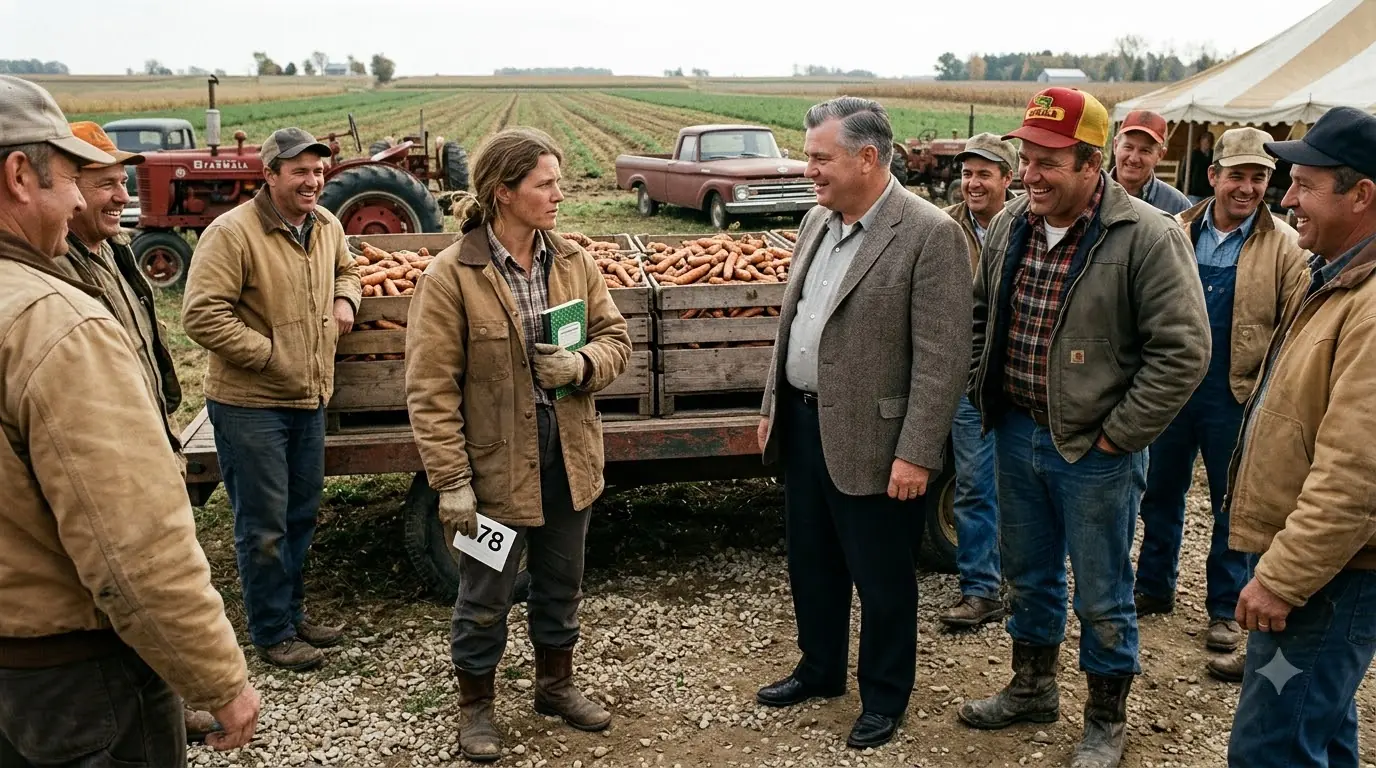
The camera pulls back. A weathered auction tent rises at the field's edge. Forty people huddle around a flatbed platform, breath visible in the cold light. A low murmur passes through the crowd when a number gets called out.
$60. Not a single hand comes up against it. Close now. A gloved hand lifts a bidder's card.
A woman in an oversized canvas coat, hair pulled back with baling twine. 31 years old. A widow. Nobody in that tent knows she has been running the arithmetic for three months.
At the back, a man in a wool sport coat stands still, eyes narrowing. A green Buick Electra idles on the shoulder beyond the fence. The gavel comes down inside the auction tent.
The Holdridge place sat in the flat yellow light of an October afternoon that couldn't decide whether to hold on to summer or let it go. Vernon County, Wisconsin, 1971. The kind of day when the wind came off the ridge with just enough edge to remind a person that winter was already loading its wagon somewhere north of Eau Claire. There were maybe 40 people standing on the trampled grass between the machine shed in the equipment row.
Most of them men in Carhartt jackets and seed-corn caps. A few women in wool coats holding coffee that had gone lukewarm two lots ago. The auctioneer's platform was a flatbed trailer with a hand-lettered sign nailed to the tongue. Krauss Auction Service.
Wendell Krauss himself stood on the flatbed with a wireless microphone that squealed when he turned his head too fast. Marabel Thorson stood near the back edge of the crowd, close enough to the rear tire of a parked Massey Ferguson that she could rest one gloved hand on the tread when the bidding got slow. She was 31 years old. She wore a canvas barn coat that had belonged to her father, the cuffs turned twice because his arms had been longer than hers.
Her hair was the color of unfinished oak, pulled back at the nape with a piece of baling twine because she'd forgotten to grab a proper tie before she left the house. In the inside pocket of the coat against her ribs was a green composition notebook with a soft spine and a rubber band around it. Everyone in the crowd knew who she was. Not one of them was watching her.
Wendell Krauss worked through the tractor first, then the hay rake, then the disc harrow with the bent tooth on the third gang. He worked through a lot of hand tools that went for pocket change and a chest freezer that went to the Rasmuson boys for $11 because they wanted the compressor for a walk-in cooler they were building behind their father's meat market. The sun moved a full hand's width across the sky between the tractor and the last real piece of equipment. By the time Wendell got to Lot 47, the crowd had thinned to about half of what it had been at the start, and the people who remained were the kind who came to farm auctions, because farm auctions were where the county did its arithmetic in public.
Wendell held up a piece of paper and cleared his throat into the microphone. The static cut sideways across his voice for a second before it settled. His words came out flat, the way a man talks when he's decided in advance to move something quickly and not dwell on what he's asking people to bid on. The lot was this: 47 wooden produce crates, most warped some with slat gaps a person could push a fist through.
One hand-cranked root washer, single drum, 40 inches long with a 4-inch crack running along the weld seam and brush rollers worn down to the steel cores. And the standing right to haul away whatever carrots remained in the back six acres of the Holdridge Place, which the crowd already knew about because everyone in Vernon County had heard the story by mid-August. The Vernon County cannery had rejected the entire Holdridge Fall Harvest.
Too crooked, too forked, too knobby to run through the commercial peeler without jamming the blade guides every 40 seconds. Forty tons of carrots sitting in six acres of black loam, and the Holdridges couldn't sell them for the cost of pulling them out of the ground. Wendell opened at $10. Nobody moved.
He came down to five. A man near the front laughed under his breath. The kind of laugh that carried because it was meant to carry. Marabel raised her gloved hand.
$60. The number landed in the tent like a stone dropped into a horse trough. Not loud, just wrong size for the container. Wendell looked at her from the flatbed with an expression that hovered between confusion and mild concern.
The way a man looks at a friend who has just misread the menu at a diner. He asked once low whether she meant six. She shook her head. 60.
Wendell paused a beat longer than he needed to. He looked around the tent to see if anybody wanted to argue with her. Nobody did. The man near the front who had laughed under his breath was now looking at his boots.
Wendell brought the gavel down and said her name into the microphone and the sound of Marabel Thorson going home with the Holdridge lot moved through the crowd like weather. She didn't stay for the closeout. She walked to her truck, which was a 1963 Ford F-100 with a dented left rear panel and 140,000 miles on the odometer. And she was pulling her checkbook out of the glove box when her brother-in-law, Harlon Thorson, found her.
Harlon was 35, a soft-spoken man with hands that had never once been clean in the 22 years Marabel had known him. He farmed 160 acres two miles east of her place and had a wife and three children and a habit of showing up whenever Marabel appeared to need a second pair of hands without ever quite saying that was why he was there. He stood beside the truck with his hands in his coat pockets and looked at her for a long moment before he spoke. He wanted to know what she was planning to do with 40 tons of carrots that a commercial cannery had already told her she couldn't sell.
Marabel closed the checkbook and put it on the dashboard. She wasn't planning to sell them to the cannery. Harlon waited. That was fine, he said.
But what was she planning to do with them? She was planning to feed them to horses. Harlon looked at her, then at the 6 acres visible beyond the machine shed, then at the F-100 with its dented panel in its tired suspension. He didn't laugh.