“You’re replaceable.”
Three words on a screen shattered seven years of Marcus Reed’s life before his coffee even had time to cool.
The email arrived at 9:14 on Friday morning.
Around him, the fourth floor of Pinnacle Technologies continued operating as if nothing had happened.
Keyboards clicked.
Printers hummed.
A product meeting began behind the glass wall of Conference Room Four.
Someone near the breakroom laughed.
The espresso machine hissed.
The ordinary machinery of corporate life kept moving, indifferent to the fact that one employee had just been told seven years of sacrifice could be summarized as operational redundancy.
Marcus stood beside his desk holding a paper coffee cup in one hand and his phone in the other.
The message had come from Victoria Harmon, founder and chief executive officer of Pinnacle Technologies.
It was not addressed only to Marcus.
That almost made it worse.
The subject line read:
ORGANIZATIONAL EFFICIENCY AND ACCOUNTABILITY
The message was written in the sterile language companies preferred when making decisions that would hurt actual people.
Pinnacle was restructuring.
Duplicative functions would be consolidated.
Management layers would be reduced.
Individual expertise could no longer be allowed to become “organizational dependency.”
Then came the sentence.
In a resilient organization, all roles—including yours—must be replaceable.
Marcus read it three times.
On the fourth, he stopped at the same word.
Replaceable.
His coffee became heavier in his hand.
For seven years, Marcus had been Principal Resilience Architect at Pinnacle.
The title sounded vague to anyone outside technology.
Inside the company, it meant Marcus was usually the person called when something had gone wrong badly enough that ordinary troubleshooting stopped working.
A corrupted authentication cluster in London.
Marcus.
A failed certificate rollover that locked enterprise customers out of encrypted archives.
Marcus.
A cloud-region outage during a holiday weekend.
Marcus.
A data-center migration nobody wanted to schedule because it touched infrastructure older than half the engineering department.
Marcus.
He did not write most of Pinnacle’s software.
He did not own every system.
He was not some magical engineer who alone understood a billion-dollar company.
Marcus would have laughed at anyone who described him that way.
What he possessed was institutional memory.
Seven years of it.
He remembered why strange exceptions existed.
Which recovery assumptions were no longer true.
What had survived three acquisitions but never been redesigned because there was always something more urgent.
He knew the difference between documentation describing how a system was supposed to behave and the scars explaining how it actually behaved.
And for the last eighteen months, Marcus had repeatedly warned leadership that Pinnacle’s disaster-recovery environment had become dangerously dependent on legacy infrastructure inherited from an acquisition.
He had written reports.
Opened risk tickets.
Requested budget.
Built migration plans.
Presented to vice presidents.
The answer was always some variation of the same thing.
Next quarter.
After the product launch.
When revenue stabilizes.
Once the merger integration is complete.
There was always a reason to postpone expensive work that produced no new feature customers could see.
Marcus looked at the framed photograph beside his monitor.
Ava.
Six years old.
One missing front tooth.
Pink sweater.
Her hair exploding into curls because she had refused to let him brush it properly that morning.
The photograph had been taken at a school carnival.
Ava was holding a stuffed shark larger than her torso and smiling as though her father had personally arranged for happiness to exist.
That photograph hurt more than Victoria’s email.
Because Marcus could already hear tonight’s question.
“Did work go okay, Daddy?”
For years he had told Ava the missed dinners mattered.
The emergency calls mattered.
The weekends when his laptop sat beside pancakes mattered.
“Daddy helps keep people’s information safe.”
That was how he explained his job.
Simple enough for a child.
He had never told her that the harder part was keeping executives from gambling with risks customers could not see.
Marcus placed the coffee on his desk.
His phone rang.
Human Resources.
Linda Foss.
He let it ring twice before answering.
“Marcus.”
Linda’s voice was soft.
Too soft.
That careful tone people used when they wanted kindness to disguise an outcome they had no intention of changing.
“Hi, Linda.”
“I’m sorry to call like this.”
There it was.
“Okay.”
“Your position is one of those affected by today’s restructuring.”
Marcus looked toward the email still open on his monitor.
“How many?”
“Twenty-eight positions across engineering and operations.”
“Who made the list?”
A pause.
“I’m not able to discuss individual selection criteria.”
“Was there a technical review?”
“Marcus—”
“That’s not a difficult question.”
Another pause.
“No formal technical-dependency review that I’m aware of.”
Marcus closed his eyes.
Of course.
Finance identified salary bands.
Management identified “duplicative” functions.
PowerPoint identified efficiency.
Nobody asked what happened when one of those boxes disappeared.
Linda continued.
“You’ll receive twelve weeks of severance and extended medical coverage.”
Marcus almost smiled.
Seven years.
Twelve weeks.
“Security will meet you at your desk.”
His eyes opened.
“Security?”
“It’s standard procedure for employees with privileged systems access.”
Yesterday Marcus had been trusted with production architecture supporting banks, hospitals, retailers, and government contractors.
Today he required an escort.
“I understand.”
“I really am sorry.”
Marcus looked at Ava’s photograph.
“I know.”
He ended the call.
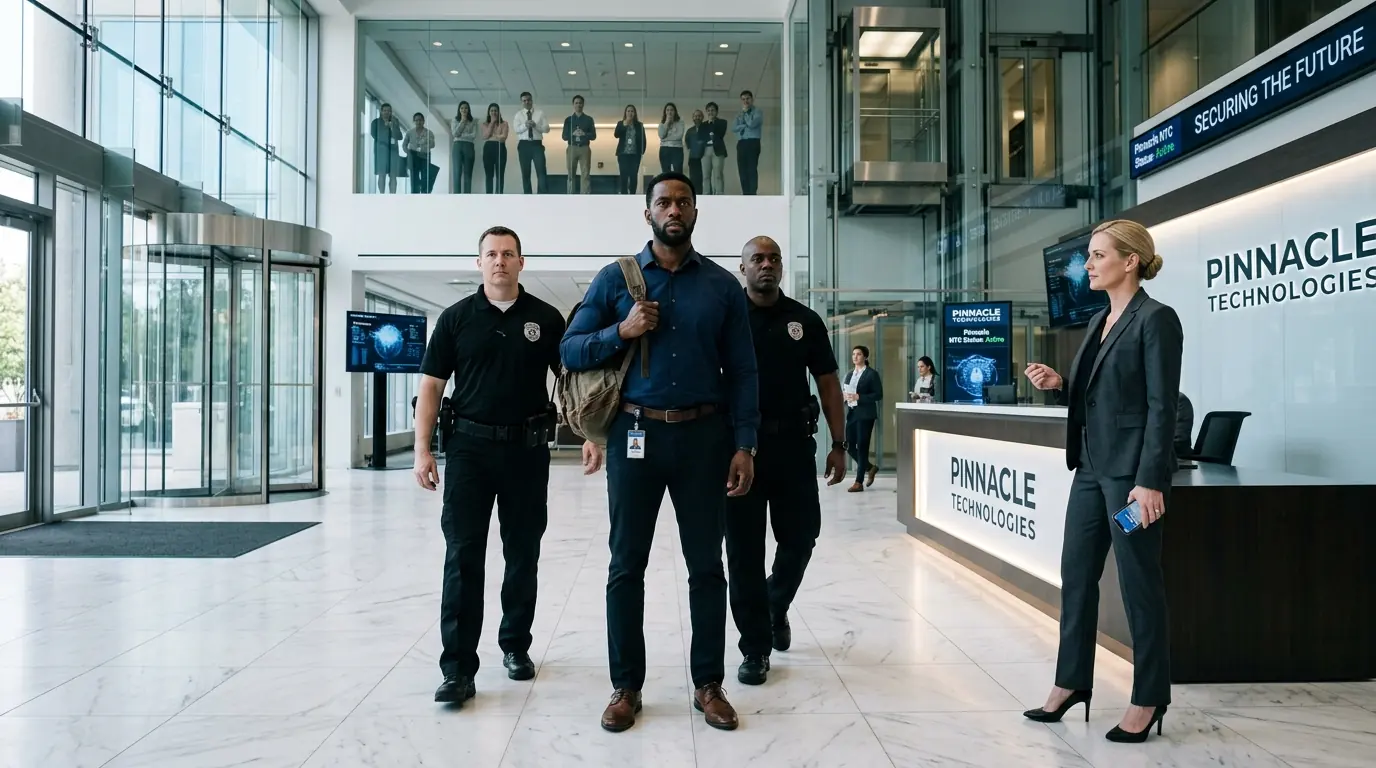
Two guards appeared five minutes later.
Neither looked comfortable.
Marcus knew both by name.
Carl and Dennis.
He had helped Carl reset access to his daughter’s stolen laptop account three years earlier.
Dennis once brought Marcus coffee during a twenty-hour outage.
Now they stood beside his desk as though there needed to be witnesses while he packed.
Around the floor, heads rose.
Then dropped.
Corporate survival had its own body language.
People looked away from layoffs because acknowledging the person being removed forced them to imagine their own chair empty.
Marcus packed slowly.
Laptop left behind.
Security token left behind.
Company phone.
Access card.
A notebook containing nothing sensitive, only grocery lists mixed with meeting reminders.
Ava’s photograph went into his backpack.
So did the small ceramic mug she had painted for Father’s Day.
Blue paint.
Crooked yellow letters:
DAD FIXES EVERYTHING
That nearly broke him.
He zipped the bag.
“Ready,” Carl said quietly.
Marcus nodded.
He walked between the guards.
Past the infrastructure team he had trained.
Past junior engineers whose midnight calls he had answered without asking whether they had checked documentation first.
Past directors who had put his name into escalation plans but apparently not into restructuring discussions.
One engineer, Priya Shah, stood when he passed.
“Marcus?”
He stopped.
Her face was pale.
“What happened?”
“Restructuring.”
“They fired you?”
Carl shifted uncomfortably.
Marcus smiled faintly.
“Looks that way.”
Priya looked toward the glass offices.
“But the resilience migration—”
Marcus gave her the smallest shake of his head.
Not here.
Not now.
She understood.
Her expression changed from confusion to fear.
Marcus kept walking.
The elevator ride to the lobby lasted thirty-eight seconds.
It felt longer.