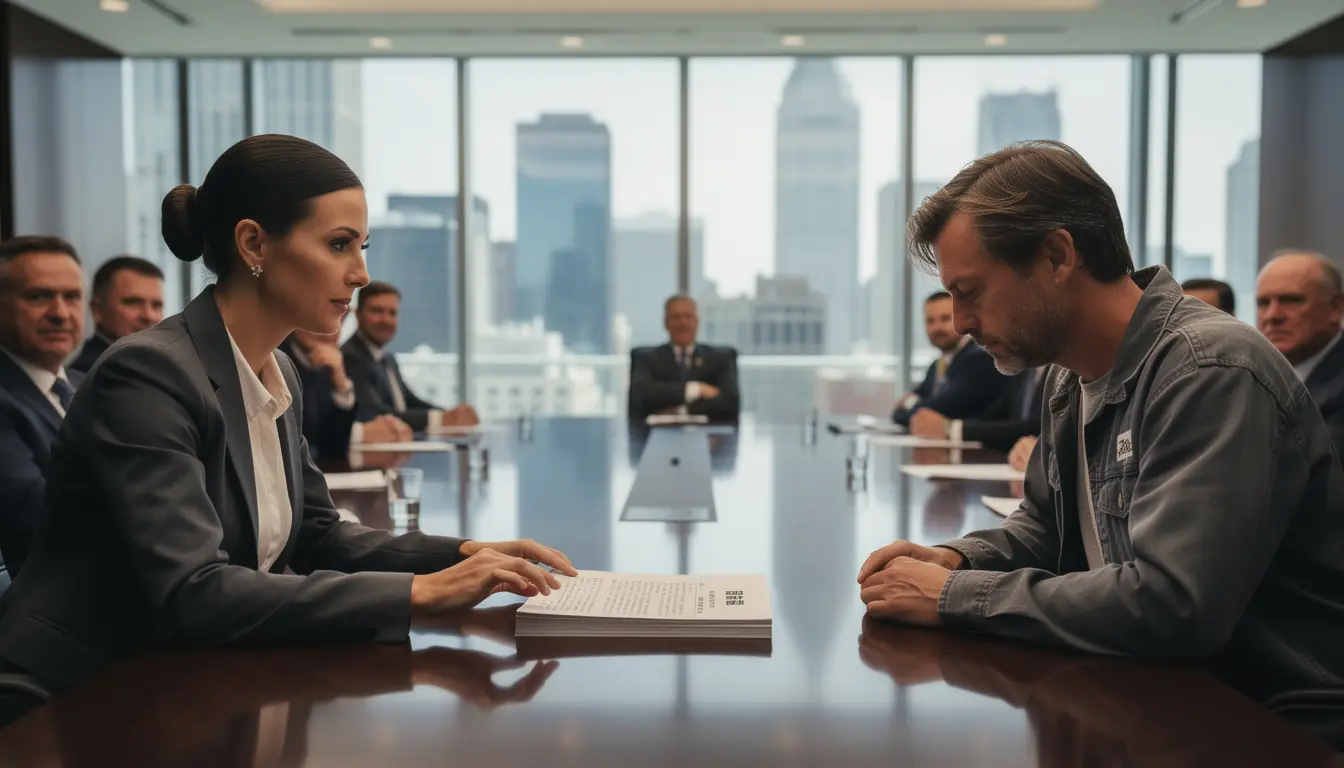
CEO Victoria Ashbourne pushed the Japanese contract across the polished table. Several executives laughed. Nolan, the warehouse coordinator she had summoned to carry equipment, looked down at the document. He had not touched a contract like this in years."Page 17," he said quietly. "Who approved this translation?"Victoria's smile vanished. "Our legal department. Is that a problem?"Nolan turned the page toward her. "That depends. Did you intend to give them the right to take everything?"Nobody laughed this time—and Nolan had not finished reading.Nolan Whitaker arrived at Ashbourne Dynamics at ten minutes past six in the morning, which was the only hour of the day that belonged to him. The glass tower in downtown Chicago was still dark on its upper floors. Down in the receiving bay, the fluorescent lights hummed over pallets of crated equipment, and the night guard lifted two fingers from his crossword in greeting. Nolan lifted two fingers back. That was the whole conversation, and it was the best one he would have until lunch.He was 39 years old, with tired eyes and a gray work jacket that had been washed so many times the logo on the chest had faded to a ghost. His pickup truck, a decade-old Ford with a dent in the tailgate, sat in the far corner of the employee lot where it always sat. He had dropped his daughter Maya at school 40 minutes earlier, and he would collect her at 3:00, and everything in between was arranged around those two promises.The shipment that morning was demonstration equipment: six crates of precision calibration units meant to impress a delegation from Japan. Kuramoto Precision Industries was coming to sign. Everyone in the building knew it: the company had been buzzing about the deal for months—a $180 million partnership that would double Ashbourne's manufacturing capacity—and the rumor was that the board had given Victoria Ashbourne until Thursday morning to close it or lose it.He walked the line of crates with a pen in his teeth, matching stenciled codes against printed ones, the way he did with every delivery. The fourth crate stopped him. The stencil on the wood read KRT. The manifest said KRV.One letter. Most people would have called it a typo and moved on.Nolan crouched, ran a thumb over the stencil, and checked the serial plate inside the lid. The hardware was correct; it was the calibration set loaded onto the units that carried the newer designation. Somewhere between the factory and the manifest, a paperwork system had been told that old data and new data were the same thing.He pulled a battered notebook from his back pocket—the one with the cracked spine and the rubber band around it—and wrote the date, the crate number, and both codes. Then he filed the discrepancy through the proper channel, a form that went to the logistics queue, because that was what the procedure said to do."What is that?"The voice belonged to Dana Pierce, the executive assistant to the chief executive, who had materialized at the loading dock in heels that did not belong near forklifts."Code mismatch on crate four. It should be flagged before it goes upstairs."