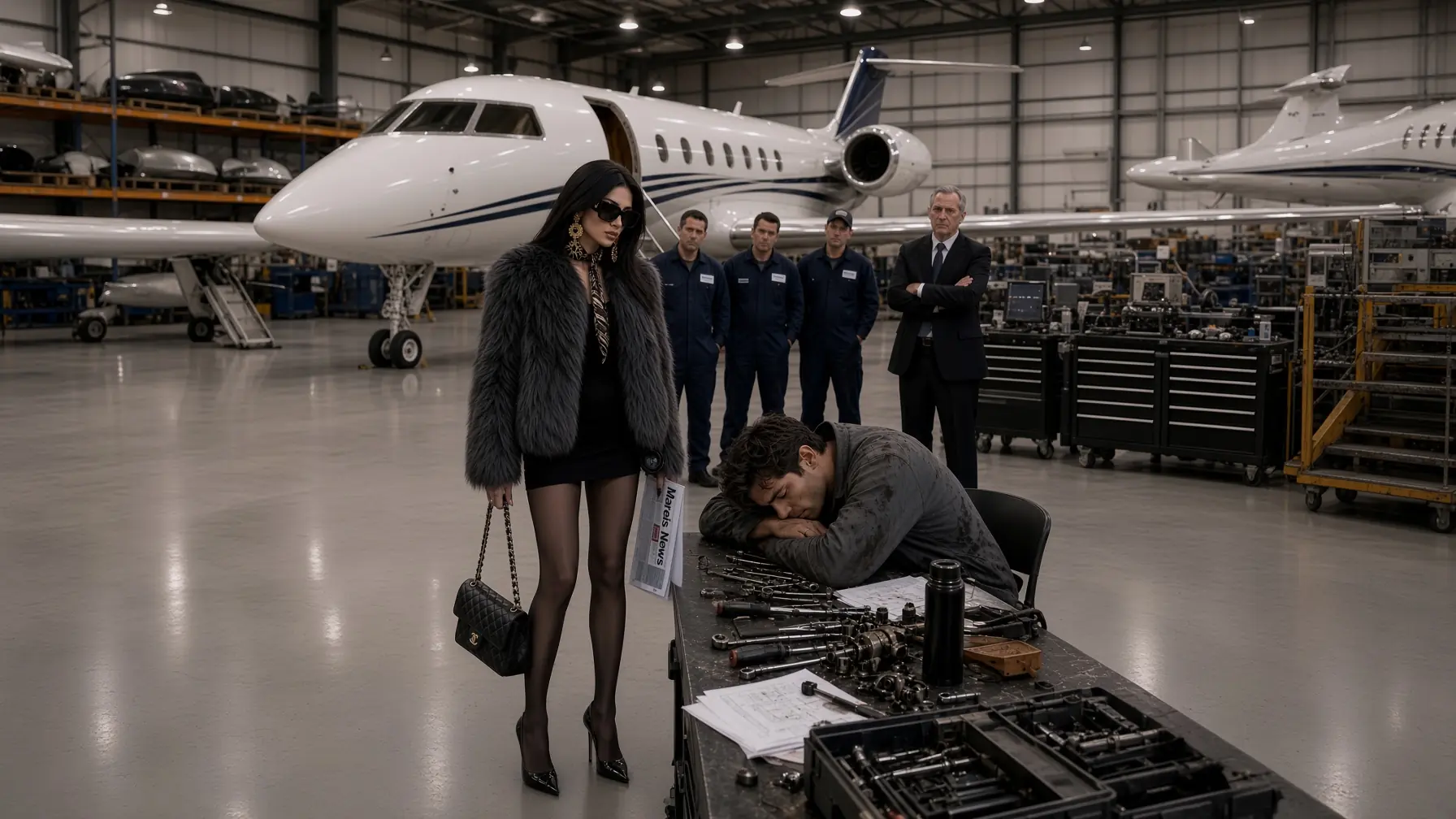
At 7:03 in the morning, Madeline Ashcroft walked into the hangar and stopped cold at what she saw. Lucas Hayes, a veteran maintenance engineer who had spent 18 years inside these walls, was asleep on the bare concrete floor, only a few feet from a private jet worth more than $200 million. She did not ask a single question. In front of the entire morning crew, she fired him on the spot. Certain that what she was looking at was carelessness, plain and simple, the kind of failure her company could not afford to tolerate.
It took less than 3 hours for an emergency technical report to land on her desk. The man she had just thrown out of the building in front of dozens of witnesses was the same man who had stayed awake through the night to stop that very aircraft from failing catastrophically mid-flight. And by the time she understood what she had done, it was already far too late to take the words back. It was 2:00 in the morning when the trouble started. The kind of hour when most of the city had already gone quiet, except for the low hum of hangar lights that never fully switched off.
Six engineers stood clustered around a hydraulic diagnostic panel that refused to make sense, its numbers drifting in ways none of the standard manuals could explain. Pressure kept dropping in small increments, then recovering, then dropping again. And every attempt to isolate the cause led back to the same dead end. The scheduled test flight was less than 7 hours away, and nobody in that circle of tired faces wanted to be the one who called it off. Lucas came in without announcement, the way he always did.
His jacket still smelling faintly of the cold outside air. He did not raise his voice, and he did not ask who was supposedly in charge of the problem. He walked straight to the panel, studied the readout for a long, silent moment, and asked one quiet question that cut through all the noise the others had been making for the last hour. "Who checked the return pressure line? " Nobody answered right away. A few of the younger technicians exchanged glances, and eventually one of them admitted, almost sheepishly, that they had checked everything except that single connection.
Lucas nodded once, set his coffee down on a nearby cart without another word, and got to work as though the conversation had already ended in his mind. Anyone who had spent real time around that hangar could tell a version of the same story about him. 18 years of Ashcroft Aviation, most of them spent in corners of the building no visiting executive had ever bothered to see. He was the name people quietly passed along whenever nothing else was working. The one who accepted the ugliest overnight shifts without a word of complaint, the one who never once walked upstairs to ask for recognition he had clearly earned many times over.
He avoided the company's internal politics entirely, treating the executive floors above like a country he had no interest in visiting. No passport, no desire to go. A younger engineer named Ryan Cole, barely 2 years into the job, once asked him plainly why he never pushed for a promotion after everything he had done for the place. Lucas had only shrugged, wiping grease from his knuckles with a faded rag he kept folded in his back pocket. "A title doesn't fix a hydraulic line," he had said.
"It just gives you a nicer chair to sit in while it fails. " Madelyn was cut from an entirely different piece of cloth. At 35 years old, she was the youngest chief executive in the company's history, a woman who had climbed to the top through relentless discipline and an unwillingness to ever be caught unprepared in a room full of investors. She ran her meetings the same way she ran her own mornings, with precision timed down to the minute and very little patience for excuses she considered avoidable. She believed, and she said it often enough that the phrase had almost become company folklore, that a business the size of Ashcroft Aviation could not afford exceptions of any kind. A great company does not get to have exceptions, she told her board more than once.
And every time she said it, she meant every word of it completely. While she slept soundly in her downtown apartment that night, entirely unaware of what was unfolding across the city. Lucas remained on his knees beside the aircraft. Hands stained with hydraulic fluid, chasing a fault line that refused to let him walk away, refusing to let the sun come up on a problem still unsolved. Around 4:00 in the morning, Ryan brought him a fresh cup of coffee and asked, half joking, whether Lucas ever actually slept at home like a normal person.
Lucas allowed himself the faintest smile, the first anyone had seen from him that night, and admitted that home had started to feel like a place he only visited between shifts, rather than somewhere he truly lived. Ryan didn't push further, sensing there was more behind the answer than Lucas was willing to share with someone still new enough to the company not to understand it fully yet. The two of them worked in comfortable silence after that, passing tools back and forth without needing to ask. The kind of rhythm that only develops between people who have spent real hours together under hard conditions. By 5:30, the worst of the diagnostic work was finished, and Lucas sat back against the support strut just to rest his eyes for what he intended to be only a few minutes.
He never meant to fall fully asleep. Exhaustion, in the end, does not ask permission before it takes what it needs from a person. Morning arrived the way it always does after a night that refuses to end quietly. Gray light spreading slowly across the tarmac outside the hangar doors. Madeline arrived earlier than usual, dressed sharply for a meeting with investors that would shape the direction of an entire fiscal quarter.
Her thoughts already three steps ahead of her own footsteps. She cut through the hangar floor on her way toward the executive elevator, the shortest route to her office. And that decision was what put her directly in Lucas's path. Lucas was asleep on the concrete, curled against a support strut with a wrench still loose in one hand. His body folded into the kind of exhausted stillness that comes only after hours without rest.