Mason Reed was only 18 minutes late because he stopped on an Ohio highway to help an elderly woman whose tire had blown out while every other car drove past without slowing down. CEO Vanessa Blackthorn did not ask for his explanation. Before every department manager in the building, she collected his badge and announced that Mason Reed lacked the discipline required to lead. He packed his things quietly and walked toward the exit not knowing the woman he had just helped was already stepping through the front gate.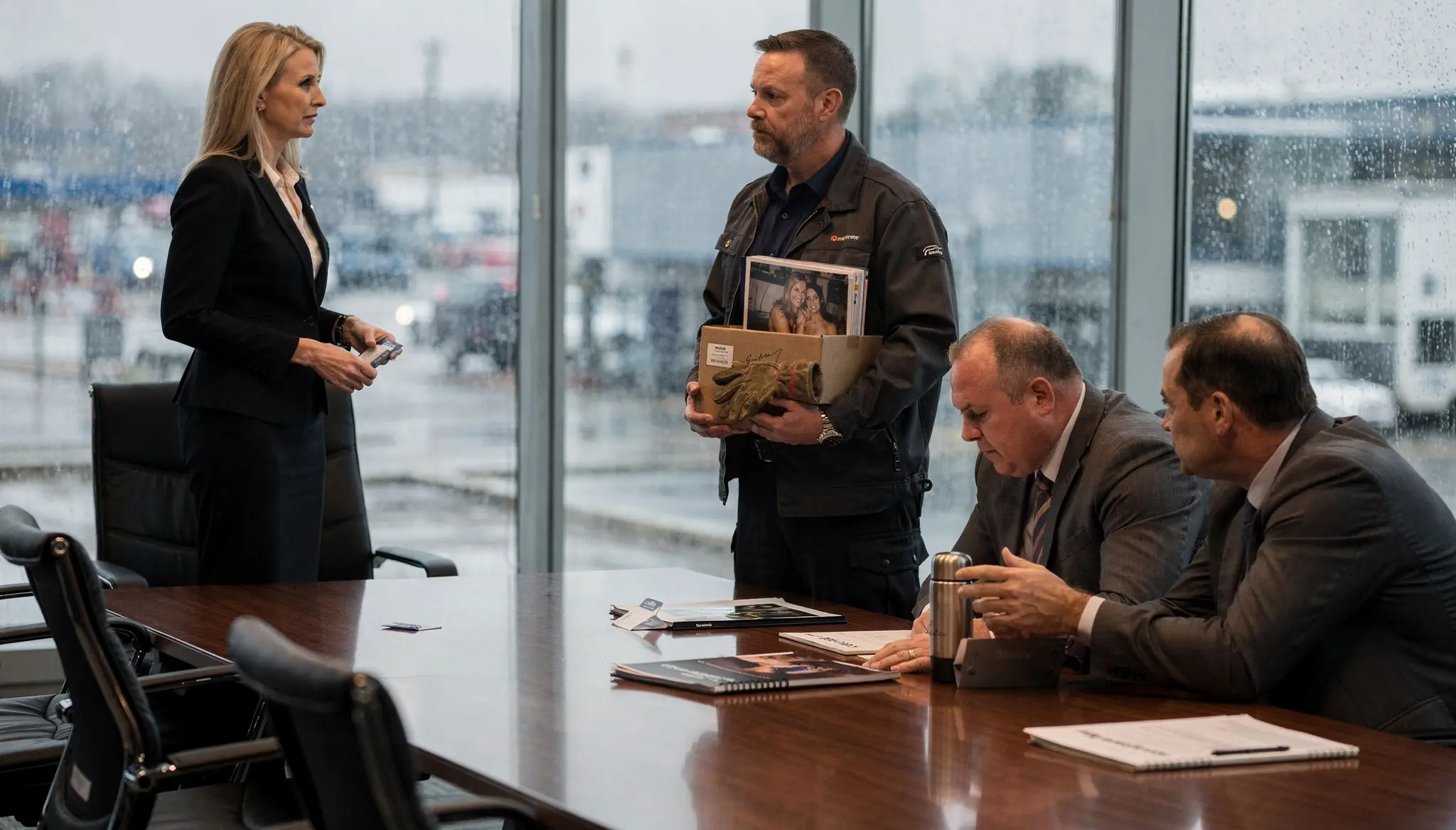
She placed her umbrella on the boardroom table, looked at the CEO and said, "You just fired the only person in this building I trust. He is your new director." The morning had begun the way most of Mason's mornings did, with the particular discipline that single fathers learn not from ambition but from necessity. It came from the knowledge that if they did not hold the structure together, no one else would do it for them. He had been up before 6:00, made breakfast for his daughter Brooke, and reviewed the production summary on his tablet while she ate, noting the three units Delaney had flagged in her quality report with the careful language she used when she was trying not to alarm anyone before the data was solid.
Brooke watched him across the table, 18 years old and sharp enough to read the tension in his posture even when he kept his voice easy, and she asked whether the big shipment was going to happen on schedule. He told her he did not know yet, which was the only honest answer he had. And they finished breakfast without discussing it further because both of them understood that some problems were not solved at kitchen tables. He kissed her on the top of her head on the way out, told her he would be home before 9:00, and walked to his truck feeling the weight of a day that had already decided it would be difficult.
Wellingham Emergency Systems produced the kind of equipment most people never thought about until a hospital lost power during a surgery, until a disaster shelter needed to keep vaccines refrigerated through a 3-day storm, until a data center supporting medical records went dark, and someone needed a backup source that actually worked. Mason had been with the company for 11 years, had started on the assembly floor, and had worked his way to shift supervisor, and then to operations lead in a trajectory that had nothing to do with politics and everything to do with the fact that he understood machines and the people running them with equal clarity. The previous operations director, Frank Hollis, had spent his last 2 years pushing Mason's name for the role that would open when he retired, writing formal letters of recommendation that Mason knew nothing about, and arguing in executive meetings that the company's institutional knowledge was walking around in a hard hat on the production floor.
Frank had left after one argument too many with Vanessa Blackthorn about what the word standard was supposed to mean, and the director's chair had sat empty for nearly 2 months while Mason quietly absorbed its responsibilities without carrying its title, coordinating three production lines, managing new hire training, and working through the backlog of quality exceptions that had accumulated under the pressure of the Sentinel X delivery deadline. Wellingham had won a contract to deliver 420 portable emergency power modules to Carrington National Health, a hospital network across seven states, and the contract was worth $180 million, a number large enough to appear in strategic communications and small enough to be destroyed entirely if the units failed in the field at the wrong moment. He spotted the car from a distance, a dark Lincoln with its hazard lights pulsing orange against the gray of the early morning, pulled to the side of a two-lane road where the shoulder was barely wide enough to stand safely.
She was 70-something, well-dressed in a coat that had seen better decades, and she accepted his suggestion that she stand farther from the lane without argument, which told him she was sensible. The spare was beneath the trunk floor under a covering that had not been lifted in years. The jack was where it was supposed to be, and the work itself took 12 minutes, during which she asked him his name, where he worked, and listened with the focused attention of someone filing information rather than making conversation. He told her his name was Mason and that he worked at the Wellingham plant.
He also told her she should have the other tires inspected because the front passenger side was showing wear that would become a problem inside of 2 months. And she thanked him with a gravity slightly out of proportion to the service. He refused the folded bills she offered and drove away having made what would turn out to be the most consequential decision of his professional life without knowing that was what it was. He was 18 minutes late when he walked through the Wellingham gate and saw through the glass wall of the conference room that Vanessa Blackthorn was standing at the head of the table in the manner she reserved for moments she intended to use as lessons.
The meeting was supposed to be about confirming the final delivery schedule for the Sentinel X shipment and reviewing the quality certification paperwork that would accompany the 420 units when the trucks left on Friday. Vanessa had called it for 7:30 and when Mason pushed open the glass door at 7:48 the CEO turned from the whiteboard and let the silence do the work of an accusation before she said a word. He explained that he had stopped to help someone on the highway and that he wanted to address the quality flagging on three units before anything else because Delaney's thermal readings were not something that could be signed past without a second look. Vanessa said the company could not function on the basis of heartwarming roadside stories and the way she said it closed the door on any technical discussion as firmly as if she had locked it.
She placed a manila folder on the table and slid it toward him with the precision of someone who had been waiting for an opportunity to use it. The file contained two occasions when Mason had left early to handle emergencies involving Brooke, both approved in writing by his previous supervisor, a detail the current documentation had somehow failed to carry forward. It contained a record of the single instance in which he had refused to approve a line speed increase because the new operator in position four had not yet completed her certification on that station, characterized by Russell Voss, the production manager, as resistance to operational directives. It contained three email threads in which Mason had written formal objections to delivery dates he believed could not be met without compromising the inspection process, described in the file as insubordination, and a reference to a quality report that remained unsigned only because the report contained data he had not yet been able to reconcile with what the factory floor was actually producing.
When Mason pointed out that every item either had an approved exception or was directly connected to a safety concern raised through proper channels, Russell said that Mason had a way of always finding reasons why the rules did not apply to him. And several people at the table looked at the surface in front of them rather than at Mason, which told him everything he needed to know about how much of this had been discussed before he walked in the door. Vanessa extended her hand, palm up, and waited for his badge. He placed it in her hand with the same deliberateness she had used to slide the folder, and she announced to the room that his employment was terminated effective immediately, that Russell Voss would sign the outgoing shipment documentation, and that the meeting could proceed.
Mason asked the human resources representative seated against the wall to ensure that a complete copy of his personnel file was preserved without modification, a request phrased so calmly and specifically that the HR manager wrote it down before she had consciously decided to. And then he walked to his locker and began collecting the things that were his. He did not hurry, and he did not slam anything. And the people on the floor who watched him pass did so with a particular grief that workers feel when the person who kept things honest is quietly removed and everyone pretends not to notice.
He was halfway to the exit when the dark Lincoln pulled through the front gate. Margaret Wellingham had not been inside her own factory in 14 months. Long enough that the receptionist did not immediately recognize the founder of the company she was being paid to serve and asked whether she had an appointment. Elaine Porter, the company's general counsel, appeared from the corridor at the same moment and recognized Margaret immediately with a visible recalibration that moved across her face like a weather system.
Because Elaine understood in the space of 1 second that every decision made in the last 48 hours was now subject to review by someone with the authority and legal standing to overturn any of them. Margaret told the receptionist that she was there for a board session scheduled the previous week, that she did not need an escort, and that she would like someone to find Mason Reed before he reached the parking lot. Vanessa met her in the corridor with the controlled composure of a CEO who had been blindsided but was not going to show it and explained that the morning had involved a minor personnel matter now resolved. Margaret asked her to clarify what resolved meant.
Vanessa said an employee had been terminated for a documented pattern of behavioral issues, most recently a failure to appear at a critical meeting, and that the company's operations were stronger for the decision. Margaret said she had met the employee in question approximately 45 minutes earlier on a rural highway where he had stopped in the rain to change your tire while every other vehicle drove past, and that she would like to understand how a man who behaved that way on his own time had managed to accumulate a disciplinary file substantial enough to justify termination. Vanessa said that personal conduct and professional conduct were not the same thing, and that kindness was not a management credential. Margaret agreed, and then she opened her leather portfolio.
It contained a quality performance analysis showing the defect rate on Mason's lines had dropped 31% in the 8 months since he had taken on the director's responsibilities without the director's title, stamped with dates that predated any current disputes. It contained a letter from Edmund Carrington's procurement office commending Mason specifically for his transparent communication during testing, and noting that his willingness to raise concerns had been a material factor in Carrington's decision to proceed with the contract. It contained Frank Hollis's formal letter of recommendation written 14 months earlier and submitted through proper channels, which no one in the room could explain why had not been acted upon. It contained a summary of the operations director vacancy now open 63 days alongside the duties Mason had been performing in the interim, which mapped almost exactly to a full director's job description.
And it contained three flagged safety communications, each signed by Mason, each raising concerns about the Sentinel X thermal data, each marked in the system as received and not responded to. Margaret said a board vote could be completed in 12 minutes, and she was prepared to move immediately. The vote to suspend Mason's termination and appoint him acting operations director for 30 days past with three members supporting and one abstaining. Elaine recorded the resolution with the methodical neutrality of someone who had spent a career making sure that consequential decisions left clean trails.
Mason was called back from the parking lot by a junior HR coordinator who had to run to catch him before he reached his truck, and he returned to the building with the composed expression of a man who was not sure yet whether this was a reprieve or a complication, and was prepared for either. Margaret told him the position was his for 30 days, that the board expected results, and that the first result they needed was an honest answer about whether 420 units of emergency medical equipment were safe to deliver to hospitals across seven states. Mason said he needed to freeze the shipment before he could answer that. Margaret said to do what he needed to do.
And then she looked at Vanessand said that Mason would be the new director and that the company should allow him to do the work it had spent months trying to prevent him from doing. Mason did not take the director's office on his first day in the role, did not move his things into the glass-walled room overlooking the production floor and did not change anything about the way he walked through the building or talked to the people on the lines. What he did was stop the three trucks loading in bay four with 12 minutes to spare before their departure window, which cost the logistic coordinator an extremely difficult phone call to the freight broker, and then he called a meeting in the largest break room where there were no managers standing against the walls and no one senior to any individual worker except Mason himself. He told the workers he was not going to ask them to trust him immediately, that he understood why some might be reluctant to say anything given what they had watched happen that morning, but that he needed people to tell him what they had seen in the last four months that they had not been able to put into a report because someone above them had indicated the report would not go anywhere useful.
Three people spoke in the first 10 minutes and then more followed. And by the end of the session, he had a handwritten list of nine specific observations that had never appeared in any official quality documentation. Russell Voss began his campaign against Mason's authority within hours of the board vote, withholding complete component inventory records on the grounds of a system migration that the IT department quietly told Mason did not apply to the specific files he was requesting, reassigning two workers who had spoken at Mason's floor meeting to different shifts, and sending a message through the informal network that Mason had gotten the position by cultivating a relationship with an elderly board member, and that his safety concerns were a cover for personal ambition.
Carter Winslow circulated an analysis of the daily carrying cost of the delayed shipment that was structured to make a person feel personally responsible for a large number. And Vanessa supported each of these moves through channels careful enough that nothing could be directly attributed to her. Mason worked through all of it with the patience of someone who understands that the fastest way to solve a problem is to look at it clearly before doing anything about it. Delaney Brooks brought him the three modified test reports on his second day in the role.
The originals printed from an archive she had maintained privately after watching the official versions change in ways that did not reflect what she had actually recorded. The difference between the two documents was not a matter of interpretation. One document showed a unit reaching a thermal threshold that required automatic shutdown. The other showed the same unit operating within normal parameters.
The difference between the two readings was 27° and 27° was the distance between a system that would protect a hospital and a system that might, under the right conditions, become the problem it was supposed to solve. The failure mode Delaney had identified was not the kind that announced itself immediately, which was the most dangerous kind. The Sentinel X units operated without issue in standard testing conditions, which was precisely why the substitution of thermal relay component had passed through initial certification without triggering any alarm loud enough to stop the line. The relay in question came from a supplier called Crown Ridge Components, added to the approved vendor list 8 months earlier through an expedited process that bypassed the standard evaluation period, and the unit price for the Crown Ridge relay was 18% lower than the relay it replaced.
Under standard operating conditions, the relay functioned correctly, but the conditions in which it would fail were the conditions that existed inside a hospital during an extended power outage, which was the specific scenario the Sentinel X had been designed to address. When the unit ran continuously for more than 8 hours under a full electrical load, when the ambient temperature was elevated because the building's HVAC was also on backup power, when two battery banks were charging simultaneously, and the ventilation fan was running at reduced speed to conserve power, the relay would take too long to interrupt the circuit. The thermal buildup in the relay housing would exceed design tolerance. And in a small percentage of cases involving poor airflow and sustained load, the outcome would be categorized in any honest incident report as a fire risk.
Mason found the supplier substitution approval buried in a procurement record that was not difficult to locate once he knew what he was looking for. The approval chain showed Russell Voss's digital signature on the vendor authorization and Carter Winslow's approval on the payment processing, and a notation indicating that full recertification testing would be completed before the component entered production. The recertification testing had not been completed. There was a document in the system that said it had been with a date and a signature, and when Mason showed the document to Delaney, she said the signature was not one she recognized and that the testing protocol it referenced described a procedure that could not have been conducted on the equipment available at the Columbus facility.
Mason sent Vanessa formal written notification requesting an independent laboratory to conduct a 12-hour sustained load test on a unit selected randomly from sealed production inventory. Her response arrived in 3 hours and contained a clause stating that if the independent test found no deficiency, Mason would be expected to resign immediately and the company would proceed with delivery. He read the clause twice, signed it, and notified Edmund Carrington's office that the test was proceeding. Russell Voss understood what the independent test would find and he acted on that understanding the previous evening during a shift that was not recorded in the official shift log.
Delaney had spent the night reviewing the component inventory records, cross-referencing serial numbers against the units in the staging area set up for the laboratory technicians, and she found the discrepancy before the test began. The serial numbers on the relays inside the staged units did not match the production records for those units, which meant someone had opened the units and replaced components. Mason did not cancel the test. He walked to the sealed production inventory in the warehouse, selected a unit at random from a pallet that had not been opened since it was logged in, and did so in front of Elaine Porter, a board representative, two laboratory technicians, a union steward, and a procurement liaison from Edmund Carrington's office who had arrived unannounced the previous afternoon and had not left the building since.
Russell objected loudly that opening a sealed customer unit without authorization was a contractual violation, and Elaine told him that under the board resolution granting Mason temporary operational authority, the inspection was within scope and that she had the paperwork if he wanted to review it. The sealed unit was opened in front of everyone present, and the relay inside matched the Crown Ridge Component Series production record. The test ran for 12 hours. At the 9-hour mark, thermal monitoring equipment recorded a temperature reading that crossed the design threshold.
Mason shut the system down in a controlled manner before any hardware damage occurred, and everyone in the room stood in the silence that falls when something abstract becomes concrete and can no longer be argued away. Vanessa issued a statement saying the result indicated an isolated unit defect and that Mason had selected this particular unit deliberately to create the appearance of a systemic problem. Edmund Carrington's procurement liaison sent a single message to the Carrington legal team, and within the hour the entire shipment was frozen pending an independent forensic review. The laboratory's report came back 3 days later with a detail that moved the situation from a quality failure into something more serious.
The safety certification mark carried by the Crown Ridge relay was not legitimate, and the testing that would have authorized its use had never been conducted by the authority whose mark it bore. Elaine's investigation into Crown Ridge Components took 4 days and produced a picture that was straightforward once the records were assembled and read in sequence. The company had been incorporated 22 months earlier, operated from a shared office address, had no manufacturing capacity of its own, subcontracted its production to a facility with no history of supplying medical equipment, and had appeared on Wellingham's approved vendor list because Russell Voss had added it through an emergency qualification process that could be initiated by a single director-level employee without full procurement committee review. The invoices showed that Wellingham had paid 18% less than it had paid the previous supplier, but still more than the actual cost of the components Crown Ridge had purchased from its subcontractor.
The gap between those two numbers had traveled through a consulting company occupying the same shared office space as Crown Ridge. The consulting company's principal was Carter Winslow, Russell Voss's brother-in-law. Winslow had reviewed and approved every payment without raising a question. Mason sat with this information for one evening and then called the floor meeting.
He had been planning since his second day in the role, this time including every shift supervisor and line lead, walking through what he had found without editorializing and without attributing blame to anyone in that room. He told them what would happen next. Every unit in inventory would be inspected. Every Crown Ridge relay would be replaced with the certified component from the original supplier.
The timeline for delivery would be extended. The customer had been notified and agreed to the revised schedule pending the full forensic review, and no one in that room would be asked to sign anything that did not accurately reflect what they had actually done or seen. A woman at the back, one of the assemblers who had worked on the Sentinel X line for two years, raised her hand and asked whether Mason could guarantee that speaking honestly during the review process would not cost any of them their jobs. He said he could not guarantee what other people would decide, but he could guarantee that no one on his watch would face discipline for telling the truth, and he put that in writing before the meeting ended.
The story Vanessa began circulating about Mason was constructed with enough apparent specificity to be credible at first glance. She suggested that his decision to stop on the highway had been a performance, rather than an impulse, that a man who truly lacked the time to arrive at a critical meeting on schedule would not also have time to complete a full tire change for a stranger, that he lacked the formal executive education the director's role traditionally required, and that his safety concerns, which had paralyzed a $180 million contract, could be understood as the actions of someone who wanted to make himself indispensable, rather than someone trying to protect hospital patients. A still image extracted from warehouse camera footage appeared in a local business publication showing Mason entering the component storage areat 10:47 in the evening before the independent test, and Russell told anyone who would listen that the image raised serious questions about whether the defective unit had been defective before Mason selected it.
Mason said nothing publicly and waited because he knew something Russell did not, which was that Delaney had asked the security office for complete footage from that evening, rather than a single extracted frame, and the complete footage showed Mason entering the areat 10:47, checking a document against a serial number on a box, and leaving at 10:53 without touching anything, and also showed Russell Voss entering the same areat 11:38 with two other individuals and remaining for 41 minutes. Brooke saw the image in the publication and called her father during her lunch break. And when he answered, she heard in his voice the particular flatness that meant he was managing something he had not told her about. She asked him directly whether he was thinking about stepping back from the role, and he said the thought had occurred to him because he did not want her to watch him become someone who fought every attack and lost the part of himself that had made the fighting worth starting.
She told him that he had stood on a cold highway and changed a tire for a stranger who could not help herself, and if he walked away now from 420 units of faulty equipment going to hospitals, he would have helped one person and abandoned hundreds of others simply because someone had said unkind things about him. The complete warehouse footage was submitted to Elaine's office the following morning. The data trail from the deleted access logs arrived next, confirming that the records showing Russell's warehouse visit had been removed using administrative credentials registered to an account in Vanessa Blackthorn's office at 2:14 in the morning on the day after the independent test. Margaret came to Mason's temporary office on a Thursday afternoon and sat down across from him without preamble, and he told her that he needed to say something she might not want to hear, and that he was going to say it because she deserved honesty more than deference.
He said that the story of the tire change was a good story, and that her willingness to act on what she observed had made it possible for the truth about the Sentinel X to come out. But that a story about one good act was not the same as a system that prevented bad acts. And that the factory had reached the point it had reached because the people with the authority to maintain standards had been absent long enough for a different set of standards to fill the space they had left. He said this without anger and without accusation.
And she listened with the stillness of someone who had known this was coming and had been deciding whether to receive it honestly. She told him she was aware of how long she had been away, and that she had constructed several adequate explanations for herself over the years, all of which had the quality of being technically accurate and substantively false. She had read the financial reports, attended the quarterly calls, convinced herself that growth metrics were a reliable proxy for organizational health, and had been wrong about that in a way that was not a simple mistake, but a choice. She had stopped visiting the floor because it felt intrusive, stopped reading the internal quality filings because the summaries she received were always optimistic, and hired Vanessa Blackthorn because the board wanted someone who would produce results quickly, while Margaret told herself that results were what mattered.
The anonymous report from Delaney had reached her through a channel she monitored irregularly, and she had been on her way to the factory to ask questions about it when the tire blew out. And the fact that the first person she encountered on that errand was Mason Reed had not been a test she had designed, but it had told her something she needed to know about what Vanessa had spent months trying to remove from the building. She said his appointment would be evaluated on the basis of his decisions and not on the basis of her goodwill, and that she intended to return to the board as a more active presence, not to override him, but to ensure that the people above him were doing their jobs as rigorously as she expected him to do his. Carter Winslow's cooperation agreement had already produced the document that mattered most, a direct email from Vanessa instructing him to process the Crown Ridge payments without routing them through standard vendor review because she needed the cost savings reflected in the quarterly report before the board's financial review, and to ensure that any quality concerns were handled after the delivery revenue was recognized.
The board convened at 8:00 with Edmund Carrington participating remotely, his face on a screen at the end of the table, his expression carrying the quality of attention that belongs to someone deciding whether a relationship is salvageable. Vanessa presented her case with the composure and precision of someone who had prepared extensively, arguing that Mason had disrupted a critical delivery timeline on the basis of incomplete data, that the board had made a sentiment-driven appointment that bypassed normal succession protocols, and that the result had been the potential loss of the company's largest contract and significant damage to its market reputation. She was a good enough presenter that two board members shifted in their chairs in a way that indicated they were weighing her words. Mason put thermal data on the table, the original and the modified version side by side, and let the gap between them do most of his speaking for the first 10 minutes.
He showed the relay serial numbers from the production records alongside the serial numbers from the stage test units, showed the complete warehouse footage, and showed the timeline of the vendor substitution alongside the timeline of the recertification documentation that described testing that had not occurred. He showed the Crown Ridge corporate records, the shared office address, the subcontracted manufacturing, the consulting company, the flow of money from Wellingham's procurement budget to an account associated with Russell Voss's brother-in-law. He also presented Carter Winslow's account of the directive he had received. And then he put down the documents and told the board what he intended to do about the 420 units.
Quarantine every unit containing the Crown Ridge component, contract with the original relay supplier for certified replacements, rebuild the testing protocol from documented procedures rather than modified records, conduct full recertification under third-party supervision, and deliver the units to Carrington National Health on a revised schedule that Edmund Carrington had already agreed to in principle. Carter confirmed from his seat that Vanessa had asked him to ensure the cost of the relay substitution appeared as a savings in the quarterly report, and that quality concerns were to be handled after delivery revenue was recognized. Russell acknowledged under Elaine's direct questioning that he had altered the test data, saying he had done so under pressure from communications he had received from the executive suite. Vanessa denied issuing a direct order to falsify any technical document and maintained that her communications had been about timeline and cost management.
It was a position the email record made difficult to sustain. Edmund Carrington spoke once, briefly, from the screen at the end of the table, and said that Carrington National Health would continue its commercial relationship with Wellingham if and only if the individual presenting the remediation plan was the individual responsible for executing it, and that his legal team was in the process of formalizing this as a contractual requirement. Margaret asked for a motion, and the room moved quickly after that. The board removed Vanessa Blackthorn from the chief executive position for cause, enumerating in the resolution her concealment of a known safety risk, her interference with quality documentation, her failure to disclose a conflict of interest in the vendor approval process, and her retaliation against an employee who had raised legitimate safety concerns through proper channels.
Russell Voss was terminated, and the financial documentation relating to the Crown Ridge transactions was referred to the company's external auditors with a recommendation that they determine whether referral to law enforcement was appropriate. Carter Winslow resigned and entered into a cooperation agreement with the audit team. The acting director appointment was converted to a permanent appointment, effective immediately, with a compensation package that reflected the responsibility Mason had been carrying without recognition for the better part of a year. After the session ended, Mason read the board resolution in Elaine's office.
He sat in the chair across from her desk with the document held in both hands, quiet for longer than its length required. When he handed it back, he said he had conditions for accepting the role on a permanent basis. No manager at any level would have the unilateral authority to modify or delete a quality assurance report once it had been submitted and any modification would require a joint signature from the quality director and the general counsel. Workers on the production floor would have the explicit and protected right to halt a production line when they observed a condition they believed presented a safety risk and the exercise of that right would be reviewed rather than punished.
All vendor approvals above a threshold Mason specified would require a full procurement committee review with no emergency bypass available to a single director level employee. Safety related communications from any level of the organization would be routed automatically to a board level safety committee rather than exclusively to the executive team. And the company's performance evaluation criteria would be revised to include quality and safety metrics with equal weight to delivery speed and cost efficiency so that the incentive structure that had made Russell's decisions possible would not simply find a new vehicle in the next product cycle. Elaine wrote all five conditions down and said she would have the policy language drafted by the following week.
Edmund Carrington, when informed of the conditions, said they were exactly what he would have asked for. A year passed in the rhythm of shift changes and line adjustments and the particular satisfaction of a process that runs the way it was designed to run. The Sentinel X units deployed across the Carrington network without a single field incident. That result was remarkable not because it was exceptional, but because it was what had been promised and what should always have been delivered. Mason still walked the production floor every morning before going to his office.
Still knew the names of the workers on all three lines and the names of their children. Still understood the machines well enough that a sound slightly wrong in pitch told him something before any sensor did. He had not become a different kind of person in the director's role. He had become more fully the person he had already been.
With the authority to act on what he observed, rather than to report it upward and hope. Brooke appeared at the factory on a Friday afternoon in late August, the week before she left for her first year of university, carrying two cups of coffee and wearing the expression of someone trying not to show how much the approaching departure already cost her. She handed him a flat package wrapped in brown paper and inside was a watch, a simple one with a clean face and a leather band, and she said it was so he would have no excuse for being late to anything important. He held it in his hands for a moment and told her that a watch could tell him what time it was, but could not tell him what the right thing to do was.
He said that when a car was stopped on the shoulder and a person stood beside it without help, the watch would have no opinion on what he should do, regardless of what time it showed. She told him he was insufferable and that she loved him and he told her the same and he meant both equally. Margaret returned to the factory that same month for the ceremony that Mason had resisted calling a ceremony during which a framed statement was mounted on the wall near the main entrance visible to anyone arriving for a shift or a meeting or a delivery. It said in plain letters, without flourish, "No deadline outweighs a life that needs help."
The policy attached to the statement was specific and unromantic. Workers who stopped to render aid in a genuine emergency were required to notify their supervisor as soon as safely possible to provide an account of the situation when they returned and to accept that their time would be recorded accurately rather than fabricated in either direction. The company would not treat the exercise of basic human decency as a disciplinary event but it would also not treat it as a blank authorization for any absence and the distinction between those two things was the honest middle where Mason had always believed good organizations were supposed to live. Margaret asked him standing in front of the mounted statement with a cup of coffee going cold in her hand whether he thought he had gotten the director's role because he had changed a tire.
He looked at the statement on the wall and then back at her. He said no, the tire change had simply made her look at the factory clearly enough to see what the company had been trying not to see for the better part of two years, and that what she had seen was not a good deed, but a culture visible once a person stopped accepting reports as substitutes for observation. He left the factory that evening at 5:43, drove the familiar route back toward the neighborhood, and somewhere on the eastern side of the city, on a street where the shoulder was wide enough to park safely, a sedan sat with its hazard lights on, and a figure stood beside it in the early September dusk. Mason checked his mirrors, moved to the right lane, and brought his truck to a stop a measured distance behind the other vehicle, and he got out with the same unhurried intention he had brought to every problem worth solving for as long as he could remember.
No one watching from the cars that passed could have known what the man walking toward that stopped vehicle had risked the last time he had made this choice, and what it had cost him, and what it had ultimately returned, and none of that was why he stopped. He stopped because a person was standing beside a stopped car without help, and because that simple fact had never required anything more from him than the willingness to see it clearly.