In front of hundreds of investors, Victoria Ashbourne ripped the badge from Evan Roark's neck, erased his name from the launch screen, and announced that the single father would never work in aviation again. His crime was asking for 30 minutes to check a strange vibration reading. Security searched his bag like he was a criminal and marched him off the tarmac while cameras rolled. Victoria ordered the prototype started anyway.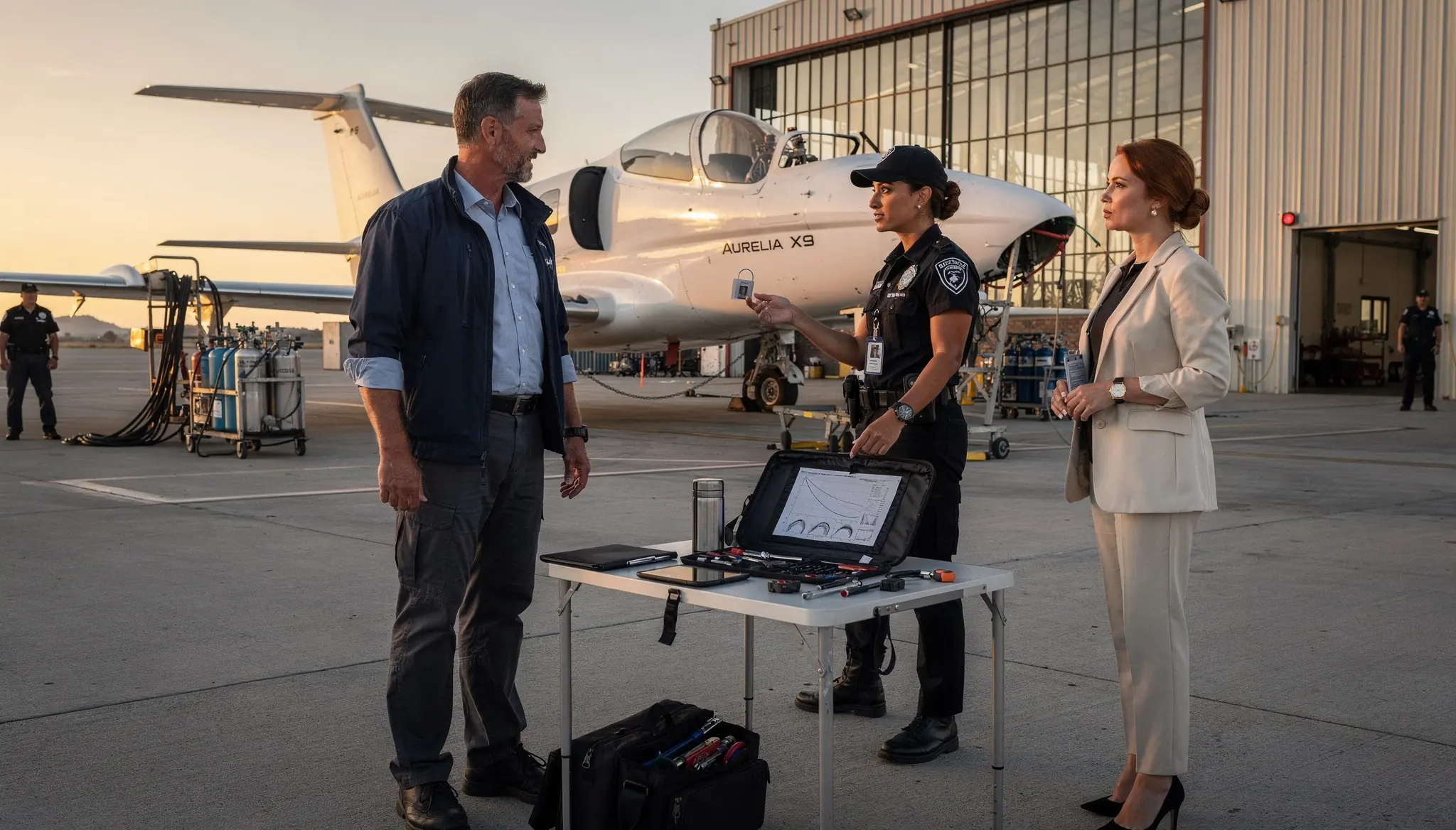
But the lead test pilot, a man who trusted no one lightly, pulled off his helmet, climbed down from the cockpit, and said one sentence that stopped the entire launch cold. What he said next would unravel a conspiracy no one saw coming. Evan Roark arrived at the testing hangar before sunrise, the way he had for 11 years, carrying a thermos of black coffee and a folder of numbers that mattered more to him than sleep. The hangar lights buzzed on in long rows, illuminating the sleek white body of the Aurelia X9, a $600 million hybrid prototype that Ashbourne Aeronautics had spent four years building toward this single morning.
Evan was 43 years old, a single father who raised his daughter Paige on his own since her mother passed, and he had built his life around two things: showing up for her and never letting a machine fly with a lie hidden inside it. He walked the perimeter of the aircraft slowly, running his palm along the cool metal skin, checking connection points that other engineers had already signed off on twice. The hangar smelled of cold metal and jet fuel, a smell Evan had come to associate more with peace than danger because it meant the machines were still sleeping and had not yet been asked to lie to anyone. He liked this hour precisely because it belonged to no one else.
No investors demanding milestones. No board members hungry for headlines. Only the quiet hum of diagnostic equipment and the soft whir of cooling fans along the wing. Somewhere behind him, a maintenance crew murmured over a coffee cart.
Their voices were low and unhurried, and they were unaware that the numbers scrolling across Evan's screen were about to change the shape of everyone's morning. At 4:00 in the morning, during the final engine run, a spike appeared on his monitor that made him set down his coffee. The left wing actuator showed a vibration pattern lasting less than 4 seconds, but it crossed a threshold his own design specifications had drawn. Years earlier, Evan had established that threshold to catch exactly this kind of hidden failure before it became a catastrophe in the sky.
He replayed the data twice, then a third time, hoping he was wrong. He was not wrong. A vibration that small on the ground could become a locked control surface at altitude. It was the kind of failure that turned routine flights into funerals.
But when Evan pulled up the official inspection report to attach to his delay request, he noticed the file had been modified after midnight, hours after his own last entry, and the account that made the change carried access privileges higher than his own. He stared at the timestamp for a long moment, feeling the floor of his certainty shift beneath him. Whoever touched that file had done it quietly, deliberately, and with full knowledge that no one below a certain rank would ever think to check. Victoria summoned Evan to the VIP staging area, close enough to the gathered investors that he could hear champagne glasses clinking behind a thin curtain of fabric.
She asked him in a voice sharpened by months of promises made to the board whether he understood how many contracts a single minute of delay could cost the company. Evan explained as plainly as he could that the actuator might behave normally on the ground and still seize once the aircraft climbed and the load shifted across the wing, and that 30 minutes was all he needed to confirm or rule it out. She looked at him the way people look at an obstacle rather than a person, and told him his caution had always read to her as a lack of ambition. Behind the thin curtain separating them from the gallery, Evan could hear the clink of glassware and the low murmur of investors rehearsing their own excitement, unaware that the woman standing in front of him had just decided a business relationship mattered more than a mechanical warning.
Victoria's tone carried the particular chill of someone who had learned from childhood dinners in a house full of portraits that hesitation was the one flaw her family never forgave. Evan noticed her hands were steady, her posture perfect, and yet something in her eyes flickered whenever the word delay left his mouth, as though the very sound of it threatened something deeper than a schedule. Then she said something that had nothing to do with actuators or airframes. She mentioned, almost casually, that Evan often left the office at the same hour every evening to pick up his daughter, framing it as proof that he was never fully committed to the company that paid him.
Conrad continued playing peacemaker, quietly urging Evan to sign a temporary approval and promising a full inspection once the demonstration flight concluded successfully. Evan refused to put his signature beside anything he had not personally verified, no matter how gently the request was dressed up. Moments later, a young engineer named Lena Cross sent Evan a message from across the hangar floor, her hands visibly trembling as she typed. She told him her electronic signature appeared on the very inspection report that had been altered after midnight, even though she had never reviewed or approved that data.
Evan read the message twice, then looked up at the Aurelia X9 gleaming under the hangar lights, and understood for the first time that this was not a technical oversight. Someone had built a deliberate cover, layer by layer, and he was standing directly in front of it. Evan folded the message into the pocket of his jacket as though it were something fragile, then walked toward a quiet corner of the hangar where the noise of technicians and the distant hum of the crowd could not reach him. He thought of Paige asleep at home with the babysitter who covered these early mornings and felt a familiar tightening in his chest, the same feeling he got whenever the safety of a stranger and the safety of his own daughter's future seemed to depend on the same decision.
He had built his entire career on the belief that a signature meant something. That his name attached to a report was a promise nobody else was allowed to forge and now that promise had apparently been stolen without his knowledge. He pulled up the maintenance photographs from the actuator housing and compared them frame by frame against the original engineering blueprints stored in his own archive. The connector housing on the wing did not match the specification at all.
The paperwork called it premium grade aviation hardware, but the shape of the terminal pins belonged to a cheaper component line typically used in unmanned drone assemblies. Evan asked to open the wing panel for direct inspection before the demonstration proceeded any further. Conrad warned that removing an access panel this close to launch would spook the assembled press and unravel months of carefully built investor confidence. Conrad still framed himself as Evan's protector in the conversation, urging him repeatedly to stay flexible for the sake of thousands of employees whose jobs depended on a smooth launch.
Victoria had built her entire public identity around the promise that Ashbourne Aeronautics moved faster and more boldly than any competitor twice its size. It was a promise she repeated in interviews so often that it had stopped feeling like strategy and started feeling like a personal creed. Every delay in her mind was not merely a scheduling inconvenience, but a small crack in the myth she had spent years constructing around her own leadership. Victoria, listening from a few steps away, began to interpret Evan's persistence as an engineer inflating a minor discrepancy to make himself feel indispensable.
She told him coldly that any engineer in the building could be replaced by morning if it came to that. Evan asked to speak directly with Reese Dalton, the lead test pilot, before the aircraft powered up, but Conrad quietly intercepted the call and told Victoria that Evan was trying to turn the flight crew against leadership. Victoria's patience finished collapsing at that report. She ordered Evan's name struck from the list of engineers scheduled to be recognized during the launch ceremony.
It was a small cruelty meant to remind him of his place. Evan, undeterred, kept digging through procurement records until he found a component replacement order signed 3 weeks earlier, but the approving signature had been carefully scrubbed from the visible field. Whoever authorized that swap had gone to considerable trouble to make sure their name would never surface in a routine audit. Evan walked out onto the staging area and, in full view of the cameras streaming the event live, formally requested that the launch sequence be halted until the wing panel could be inspected.
Conrad leaned close to Victoria and murmured that backing down now, in front of every investor who mattered, would signal to the board that she no longer controlled her own company. Victoria felt the weight of every eye in the gallery pressing against her, and she chose her image over her engineer. She did not simply terminate him. She had security strip the badge from around his neck in front of the cameras, search his bag as though he were a common thief, order his name permanently erased from the Aurelia X9 project files, and declare aloud that every design contribution he had ever made now belonged entirely to the Ashbourne family.
She promised to circulate a warning letter that would keep him from ever working for a major aerospace company again. She then had him escorted out through the service entrance reserved for deliveries and waste removal. Conrad offered a token protest, just loud enough to be heard, then quietly told Evan he would try to smooth things over once the demonstration flight was safely finished. The gallery had gone unnaturally quiet, the kind of silence that follows a slap rather than an announcement, and Evan could feel hundreds of eyes measuring him the way people measure a stranger accused of something shameful.
A young technician near the fuel line lowered her clipboard and looked away, unable to watch a man being dismantled in public for asking the same question she herself had been too afraid to raise. Somewhere in that crowd, a reporter's camera zoomed in tightly on Evan's face, hunting for the flicker of anger or humiliation that would make the footage more compelling by evening. He gave them nothing. No trembling jaw, no raised voice, only a stillness that unsettled Victoria far more than an outburst ever could have, because stillness could not be edited into a satisfying villain scene.
Evan did not beg, and he did not raise his voice. Before security pulled him through the service door, he set a folder on the seat beside Reese Dalton's flight console, the same warnings he had tried to deliver all morning and said only that line 47 deserved to be read before anyone touched the throttle. Reese, a disciplined 46-year-old pilot who had flown beside Evan for over a decade and once trusted him with his own life during a dangerous test years earlier, opened the folder without a word. Reese read the data slowly, his jaw tightening with every line, then closed the folder, removed his helmet, and climbed down from the cockpit in full view of the cameras.
He told the gathered press, in a voice that carried across the entire staging area, that Evan Roark had never confirmed this aircraft was safe to fly and that he personally refused to take it into the sky under those conditions. Reese's voice did not rise or shake as he spoke. It carried the flat, unhurried certainty of a man who had spent two decades reading instruments that never lied to him, unlike the people now standing around him in expensive suits. He remembered, though he did not say it aloud, the afternoon years earlier when Evan had grounded a different aircraft over a reading everyone else dismissed as noise.
It was a decision that likely saved Reese's life during a violent wind shear only minutes later. He still remembered the exact color of the sky that afternoon years earlier, a bruised purple gathering over the runway, and the calm certainty in Evan's voice when he ordered the flight scrubbed against the objections of three other executives standing right there beside him. That single decision had never made headlines, had never earned Evan so much as a mention in an internal newsletter, yet it had kept a young pilot's family whole for another decade. He was not simply defending a colleague.
He was repaying a debt that had never left him, one flight at a time, for as long as it took. Two backup pilots standing nearby, watching the entire exchange unfold, quietly stepped away from the preparation area without waiting to be asked twice. Victoria threatened to end Reese's contract and his career on the spot, but he answered that a chief executive could take away his job, though she had no authority to order him to gamble with his life. Conrad scrambled to call in replacement pilots, but every single one who read Evan's warning declined the assignment before the conversation even finished.
The live broadcast, meant to showcase a triumphant launch, had instead become a public unraveling with phone calls already reaching the board of directors from investors demanding answers. Audrey Sloan, the company's 44-year-old legal and insurance counsel, stepped forward to explain a detail that changed everything in the room. Evan's signature as safety integration director was not a courtesy formality. It was a binding condition written directly into the $600 million insurance policy covering the aircraft.
Audrey spoke carefully, choosing each word the way a surgeon chooses an instrument, aware that everything she said would be scrutinized later by regulators, lawyers, and reporters alike. She reminded the room that insurance policies of this size were never written casually, and that the underwriters had specifically demanded a single accountable signatory, precisely because $600 million could not rest on the word of whoever happened to be convenient that week. Replacing him would require a new engineer to study the entire technical history and receive federal aviation certification, a process that typically took 60 to 90 days. That meant Victoria had just fired the only person capable of legally clearing that day's flight.
Conrad, still wearing the mask of loyalty, suggested quietly bringing Evan back on a temporary basis, but Victoria refused, unwilling to bow in front of the same man she had just humiliated on camera. Federal regulators monitoring the broadcast formally requested that the actuator be removed and examined in front of all interested parties before any further attempt to fly the aircraft. The demonstration that was supposed to cement Victoria's legacy had instead frozen into an open investigation with cameras still rolling. Evan was invited back the following day, not as an employee, but as an independent consultant whose findings would be recorded and witnessed.
He insisted that every step of the inspection be filmed and observed by an outside party, refusing to let anything happen behind closed doors again. When the wing panel finally opened, the actuator inside carried a serial number that had clearly been filed down and re-etched, a detail no honest maintenance record would ever produce. Technicians placed the component into a load simulator designed to mimic in-flight stress conditions while everyone in the room watched the readout in silence. For the first 42 seconds, the actuator performed exactly as specified, and Victoria allowed herself a flicker of relief, certain that Evan had simply been overcautious.
The simulator hummed steadily through those first 42 seconds, a low mechanical breathing that filled the silent room while every engineer present held perfectly still, watching the readout climb through pressure ranges that mimicked a real climb into open sky. Victoria's shoulders had begun to loosen, her lips parting slightly with the beginning of a relieved breath, when the numbers on the screen jerked sideways without warning. At the 43rd second, the actuator locked completely, freezing mid-motion exactly the way Evan had warned it would once real altitude and load pressure came into play. Reese, standing at the back of the room with his arms crossed, confirmed quietly that a failure like this, occurring after takeoff, could have stripped control of the left wing during climb, the most dangerous phase of any flight.
Victoria finally understood, in a way that made her stomach turn, that Evan had not delayed her launch out of stubbornness. He had prevented a catastrophe from unfolding in front of the entire world. Conrad immediately demanded a formal investigation into procurement, positioning himself as the one honest executive determined to root out whoever was truly responsible. He continued building the image of a fair and diligent leader hunting for the real culprit, even offering to personally shield Evan from any lingering blame.
But deeper analysis of the actuator's control software revealed something far worse than a sub-standard part slipped into the supply chain. The onboard firmware had been specifically modified so the aircraft's own diagnostic system would never flag the incompatible hardware installed inside its wing. A security log pulled from the central server showed that the very last person to access that firmware, hours before the launch, had done so using Evan Roark's personal security credentials. Evan felt the shift in the room the way sailors feel a change in wind before the storm itself arrives.
It was a subtle turning of shoulders and averted glances that told him exactly how quickly loyalty could be rewritten by a single printed page. Only minutes earlier, engineers had approached him quietly to say thank you for catching what could have been a public tragedy, and now those same engineers stood a careful distance away. Unwilling to be seen standing too close to a man suddenly wrapped in suspicion. The room, which had begun to soften toward Evan only minutes earlier, went cold and suspicious all over again.
Conrad seized the opening immediately, presenting a printed log that appeared to show Evan altering flight control configurations overnight. Accessing vibration data at unusual hours, generating the warning report only hours before the launch, and copying confidential files onto an external device sometime during the previous week. Victoria, desperate for a narrative that did not implicate her own decisions, decided Evan had staged the entire crisis out of resentment for being stripped from the launch materials. The backup copy Evan had stored on the insurance server months earlier, meant to protect exactly this kind of situation, returned an authentication error that made it useless as evidence in the moment.
Audrey admitted the discrepancy was troubling, but insufficient on its own to prove who had actually altered the data behind the scenes. Even a few engineers who had quietly respected Evan for years began to doubt him under the weight of Conrad's carefully arranged paperwork. Conrad performed disappointment beautifully, telling the board he had tried to protect Evan personally, but could no longer ignore what the evidence appeared to show. He recommended, with practiced reluctance, that Evan be formally handed over to internal investigators pending a full inquiry into sabotage.
Reese still refused to fly the aircraft, but even he could not explain why Evan's access credentials kept surfacing throughout the compromised system. Security confiscated Evan's laptop, revoked every remaining access badge tied to his name, and escorted him out of the testing center for the second time in two days. Victoria stood before the cameras once more, this time declaring publicly that the flight had been sabotaged by a disgruntled former employee, turning Evan from a whistleblower into the very villain of the story overnight. As Evan reached the parking lot, feeling the ground shift beneath him for the second time, Lena Cross caught up to him near his truck and pressed a small brass key into his palm.
She told him quietly that data could be edited, rewritten, and buried by anyone with the right access, but the physical part sitting inside the quarantine storage locker could not lie about where it came from. The parking lot lights buzzed overhead, casting a pale orange glow across the rows of parked cars, and for a moment neither of them spoke, listening to the distant sound of the hangar doors grinding shut for the night. Lena's eyes kept flicking toward the security cameras mounted near the entrance, and Evan understood without asking that she had already weighed the cost of what she was about to hand him against the safety of her own job. He told her quietly that she did not have to do this, that there were other ways forward, but she only shook her head and pressed the key more firmly into his palm, as though the decision had already been made days ago.
Evan closed his fingers around the key, and for the first time in 2 days, felt something other than exhaustion pulling him forward. Inside the quarantine locker sat the original, genuine actuator that had once been installed on the Aurelia X9 before someone quietly swapped it out during a late-night maintenance shift 3 weeks earlier. Lena explained that she had discovered the part removed during an overnight rotation and, following protocol rather than the direct order she received to dispose of it, tagged it for isolated storage instead of destruction. The locker itself sat in a forgotten corner of the facility behind rows of decommissioned test equipment nobody bothered to catalog anymore.
It was exactly the kind of place where a careful person might hide something they were not yet ready to explain. Lena had told no one, not even her closest colleagues, carrying the weight of that secret through months of ordinary meetings and casual hallway conversations with the very man she suspected of orchestrating the fraud. Every time Conrad had smiled at her in a briefing, she said later, she had felt the cold press of the actuator's housing against the back of her mind. It was a silent countdown she prayed she would never have to use.
She had kept it hidden ever since, waiting for a moment when the truth would matter more than her own safety inside the company. The component still carried its original manufacturer seal, the correct Aurelia X9 project code stamped into the housing, a timestamp recording exactly when it had been removed from the wing, and paint transfer for marks that matched precisely with the interior of the wing cavity. Tucked beneath the housing was a paper shipping slip, the kind of document nobody thought to digitize or delete, showing a signature confirming delivery of the replacement part. Evan turned the slip over in his hands twice, half expecting the name printed across the top to rearrange itself into something less damning, but the ink held firm under the fluorescent light of the storage room.
Every legitimate vendor Ashbourne Aeronautics used passed through a lengthy verification process logged in triplicate, yet this single shipment had bypassed every one of those checkpoints as though it had never needed to answer to anyone at all. The slip revealed the replacement component had never passed through official procurement channels at all. It had been shipped directly from a company called Whitmore Advanced Systems. Conrad had always claimed no personal connection to any outside vendor, but the business registration attached to that name listed his own younger brother as the sole owner.
Lena admitted, her voice barely above a whisper, that Conrad had copied Evan's security credentials during a routine computer maintenance visit months earlier, keeping them ready for exactly this kind of emergency. Every warm gesture Conrad had made toward Evan since that first morning in the hangar had never been kindness at all. It had been a way to stay close enough to measure how much Evan already knew and steer the investigation wherever Conrad needed it to go. Evan sat with that realization for a long moment inside his parked truck, the brass key still warm in his palm, understanding that the one person who had appeared to stand beside him from the very beginning had actually been building the trap the entire time.
The discrepancy between the cost of genuine aviation grade components and the cheaper substitutes traced back through several shell transactions to a private investment fund that Conrad quietly controlled behind a series of borrowed names. Evan thought back over every conversation he had shared with Conrad across the past 3 years. Every lunch, every quiet word of encouragement offered in a hallway, and felt each memory curdle into something entirely different in hindsight. He remembered Conrad once telling him that good engineers were the backbone no executive should ever take for granted.
It was a sentiment that had felt sincere at the time and now sounded like a script rehearsed for an audience of one. It was not a single desperate decision. It was a pattern stretched across months, engineered patiently by someone who understood exactly how much trust a title like Chief Operating Officer could buy. Evan, Lena, and Audrey brought the genuine actuator, the shipping slip, and the vendor registration directly before the full board of directors the following morning.
The boardroom that morning felt smaller than usual. Its long mahogany table crowded not just with directors, but with the quiet weight of everything about to be said aloud for the first time. Sunlight cut through the tall windows in sharp bands, falling directly across the genuine actuator sitting at the center of the table like an exhibit in a trial nobody had scheduled, but everyone now had to attend. Conrad could not deny the physical origin of the swapped component once the documents were laid across the table in front of him, so he pivoted instead toward blaming Victoria's relentless pressure for creating the conditions that made the fraud possible.
He produced a stack of emails showing Victoria repeatedly demanding the launch proceed on schedule, regardless of what engineering concerns reached her desk. The full shape of Conrad's plan finally came into focus as board members read through months of internal communications and financial records laid side by side. He had used substandard components to quietly divert millions of dollars for himself, pressured the Aurelia X9 toward an unmovable deadline, and stood to collect a $25 million bonus the moment the aircraft completed its first public flight successfully. If the fraud were ever discovered, his plan was to let Evan absorb the blame entirely.
And if the crisis somehow grew beyond containment, he intended to use Victoria's own aggressive emails to remove her from the company and step into the chief executive role himself as the calm, responsible savior. Victoria realized, sitting silently at the head of the table, that Conrad had not merely defrauded the company financially. He had studied her pride and turned it into the perfect weapon against her own leadership. Evan refused to let her position herself as a total victim in the story, even as the true architect of the fraud sat exposed before them.
He presented sworn statements from several engineers who described being humiliated, threatened, or quietly pushed out after raising honest concerns about delays over the previous 2 years. He told the room plainly that Conrad had built the fraud brick by brick, but Victoria had built the silence that let it stand undetected for so long. A boardroom culture where no one dared say a dangerous word out loud. The board members exchanged uneasy glances, understanding that punishing Conrad alone would leave the deeper rot untouched inside the company's leadership.
By the end of that long morning, the board faced a decision that would determine the fate of both executives, not just the one caught holding physical proof of his crime. Conrad's access to every company system was revoked before the meeting even adjourned, and he was formally handed over to the federal investigators facing charges of fraud, embezzlement, and endangering a certified flight test. Two federal agents waited near the elevator bank, patient and unremarkable in gray suits, exactly the kind of ordinary presence that made the entire scene feel more unsettling than any dramatic arrest could have. Conrad straightened his jacket before he walked toward them, still performing composure out of habit, even though every person in the room now understood exactly what that composure had always concealed.
He lost his power in the very room where he had spent years quietly manipulating people into trusting him. There was no dramatic chase and no final confrontation, only documents that closed every door in front of him one by one. Victoria initially believed that exposing the true mastermind behind the sabotage would be enough to secure her own position as chief executive going forward. The board reached a different conclusion after reviewing everything laid before them.
They found that Victoria bore direct responsibility for the leadership culture that allowed a scheme like Conrad's to flourish undetected for so long. She had humiliated employees who tried to raise safety concerns, prioritized public image over verified data, taught her staff that delivering bad news carried real personal risk, dismissed her own safety director before any investigation had even begun, and publicly branded an innocent man a saboteur without sufficient proof. Victoria was suspended from her role as chief executive for a minimum of 1 year. Her name quietly removed from every remaining launch campaign, and full operational authority transferred to an interim leadership team overseen directly by the board.
Before leaving the room, she walked over and offered Evan's badge back to him. It was the same one stripped from his neck in front of hundreds of cameras only days earlier. He looked at it for a long moment and did not take it from her outstretched hand. Evan told her quietly that the badge represented a company that had once forced honest people into silence, and that he would only consider wearing it again once that company had genuinely changed, rather than simply survived a scandal.
Victoria absorbed the words without argument, understanding for the first time what it actually cost the people beneath her every time she chose comfort over truth. Later that same week, the board formally offered Evan the position of interim chief executive of Ashbourne Aeronautics, a gesture meant to restore public confidence as quickly as possible. Evan declined the offer without hesitation, telling the board that accepting the chief executive role immediately after Victoria and Conrad's downfall would only convince employees he had engineered the entire crisis to seize power for himself. He agreed instead to lead an independent recertification committee separate from executive influence entirely, but only if the board accepted five conditions he had thought through carefully during his two days away from the company.
He laid the conditions out one at a time, his voice steady and unhurried, watching the faces of board members who had spent the last week learning, sometimes for the first time, how easily their own company had nearly destroyed itself from the inside. Every engineer would hold the authority to halt any test they believed was unsafe without needing permission from someone above them. No employee would ever face punishment for reporting a genuine safety risk, regardless of how inconvenient the timing might be for leadership. Pilots would retain the right to refuse a flight without losing their contracts or their livelihoods over that decision.
All critical technical data would be backed up on servers entirely outside the reach of executive control, so no single person could quietly rewrite history again. And the names of the engineers who had actually built the Aurelia X9, not just the executives who stood beside it for photographs, would be permanently restored to the official project record. Victoria requested a private conversation with Evan a few days later, arriving without an assistant or a prepared statement for the first time since he had known her. She apologized specifically for mocking his role as a single father, admitting she had used his devotion to his daughter as a weapon in a moment when she desperately wanted to feel powerful.
She sat across from him in a small conference room with no assistants waiting outside the door, her hands folded tightly in her lap, looking less like the woman who had once commanded a stage full of investors and more like someone finally facing a mirror she had avoided for years. Evan noticed the absence of performance in her voice for the first time since he had known her. No polished phrasing, no careful pause for effect, only plain words delivered without an audience to impress. Evan listened without offering forgiveness immediately, and he did not seek revenge either, choosing instead a quieter kind of accountability that asked more of her than any apology could.
He told her that her regret would only carry real weight once the next engineer who raised an uncomfortable warning did not need to save a $600 million aircraft just to be taken seriously. Victoria nodded and accepted a position within the compliance division rather than any executive role, giving up her private office, her personal assistant, and every privilege her family name had once guaranteed her without question. She arrived at those briefings early now, carrying her own coffee in a paper cup instead of having it delivered, and sat near the back where she could listen more than she spoke. The junior staff around her were cautious at first, unsure how to treat a woman whose name still hung on the building's front entrance.
But over time their conversations grew easier, less guarded, as she proved through small daily choices that she was not simply waiting for her old office to be returned to her. She began attending the same early morning briefings as junior staff, learning for the first time what it felt like to be the person in the room without power. Six months passed, and the Aurelia X9 was rebuilt component by component under full outside supervision. Every part was traceable to a verified, legitimate source.
The morning of the new test flight arrived cool and overcast, the kind of gray sky that photographed poorly for a press release, but felt honest to everyone standing beneath it. There were no publicists arranging camera angles this time, no rehearsed applause lines waiting to be delivered the moment the wheels left the ground, no red carpet or champagne cart wheeled out for photographs. Instead, a simple screen mounted near the hangar entrance displayed the names of every engineer, technician, and mechanic who had touched the aircraft during its long and painful reconstruction. Evan's name appeared first on that list until he personally asked the communications team to move it down, insisting he belonged among the group rather than above it.
Victoria stood quietly with the maintenance crew that morning, far from any reserved area, and told the assembled press plainly that Evan had been fired for doing his job correctly while everyone around him chose comfort instead. Reese Dalton climbed into the cockpit but did not immediately reach for the ignition sequence, pausing instead to look down at Evan standing on the tarmac below him. He asked, in front of everyone gathered, whether Evan intended to sign off this time before the engines ever turned over. Evan reviewed the final inspection report one more time, looked across the row of engineers and technicians who had rebuilt this aircraft with their own hands, and signed his name clearly at the bottom of the page.
Reese smiled for the first time in months and told him that now, finally, he was ready to fly. The engines spooled up with a low, steady roar that rattled softly through the chests of everyone standing along the fence line, a sound the ground crew had heard hundreds of times before, but never quite like this. Evan watched the landing gear lift clear of the tarmac and felt his own breath catch. This time, it was not from fear, but from something closer to relief that had been building quietly for six long months.
The Aurelia X9 lifted off the runway smoothly and climbed into a clear morning sky while the entire ground crew watched in silence rather than celebration. It was the kind of silence that comes from people who understand exactly what could have gone wrong. Paige waited a short distance away beside her father's worn pickup truck, patient the way children learn to be when a parent's work finally matters more than the noise around it. Evan left the hangar before reporters could surround him, choosing his daughter's company over another round of cameras and questions.
When a reporter later asked Reese what had truly changed between the two flights, he answered simply that the aircraft had only needed a handful of new parts while the company itself had needed to be rebuilt from the ground up. Evan watched the Aurelia X9 shrink into the pale blue distance and then turned toward home carrying no desire for a corner office or his name printed across a stage banner. Walking hand in hand with his daughter toward the truck, he thought that some victories never needed an audience to be real. The quiet ones were often the only kind worth having at all. Paige asked him if the airplane was going to be famous now and he told her that he hoped, more than anything, it would simply be forgotten, remembered only as an aircraft that worked exactly the way it was supposed to. He only wanted to know that everyone who boarded that aircraft, now and in every flight that followed, would have the chance to come home again.