The faded blue suit Nolan Reed wore cost $20, but the smirk on CEO Vivian Ashford’s face was worth even less. In front of the entire board, she asked whether he had come to apply for a job or to beg for one. Nolan said nothing. He simply set his worn leather case on the table and waited for the most powerful man in the company to walk through the door. When chairman Conrad Ashford entered and saw him, the color drained from his face in an instant. He rose to his feet, bowed his head to the single father who had just been mocked, and said the words that would change everything. “Boss,” he said, “you have finally come home.”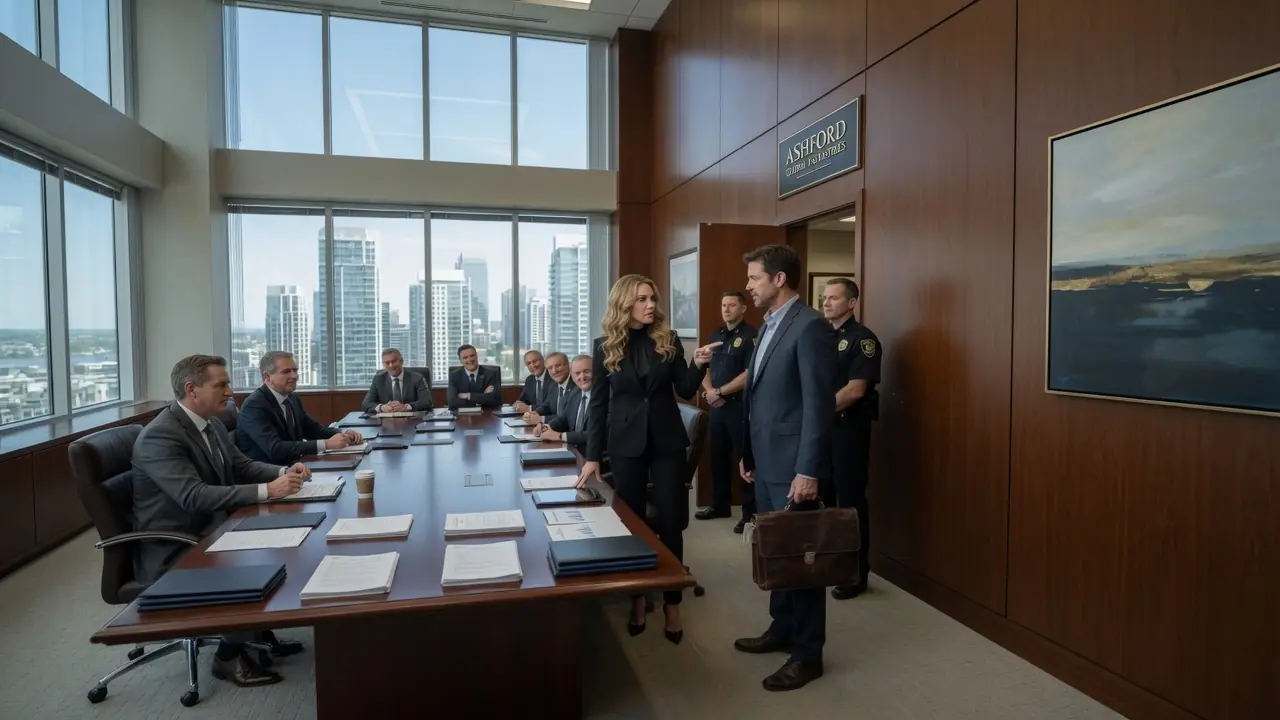
Nolan Reed arrived at the headquarters of Ashford Global Industries on the morning of the most consequential meeting in the company’s history. He wore a navy suit that hung a half-size too large across his shoulders, purchased three years earlier from a second-hand shop for $20. The fabric had thinned at the elbows, and one button near the cuff had been resewn with thread that did not quite match. He carried nothing but a scuffed leather case and a folded letter bearing the seal of the Northbridge Stewardship Trust. The receptionist scanned her list twice and found no trace of his name among the scheduled guests. The head of security studied him for a long moment and guessed, not unkindly, that he had come either to interview for a maintenance position or to drop off paperwork for someone upstairs. Nolan did not correct him. He simply asked that the sealed letter be delivered directly to chairman Conrad Ashford, and then he found a chair near the window and sat down to wait.
While he waited, he watched. Long-tenured employees moved boxes out of offices on the fourth floor, their faces tight with the particular exhaustion of people trying not to cry in public. A floor manager passing through the lobby mentioned to a colleague that the technology division, the very heart of the company, was being sold off to a firm called Blackwell Crown Capital, and that thousands of positions could disappear within the month. Nolan listened without comment, though something behind his calm eyes sharpened. His phone buzzed once. A short message from his daughter Tessa asked whether the meeting was going to be all right. He typed back only that he would be home in time for dinner, and then he set the phone face down on his knee.
Vivian’s assistant crossed the lobby a moment later, glanced at the second-hand suit, and assumed without asking that he represented some minor vendor waiting to deliver an invoice. The lobby smelled of fresh floor polish and the particular anxious energy of a building bracing for bad news that had not yet been told officially. Nolan noticed a security guard near the elevator speaking in hushed tones to a colleague about severance packages, and he noticed too the way both men straightened their shoulders whenever an executive passed as if bracing themselves against something they could not name. He had walked away from rooms like this eleven years earlier and had never once missed the particular tension that gathered in them before a storm. Sitting there now in a jacket two sizes too large and shoes resoled twice over, he felt no urge to announce himself. He had learned long ago that the people who needed to know who he was would find out soon enough, and the people who did not would only complicate what needed to be done.
An older janitor pushing a cart of cleaning supplies paused near his chair and asked kindly whether he needed directions to the employment office on the second floor. Nolan thanked him and said he was exactly where he needed to be. The small kindness in the man’s voice, offered freely to someone he assumed had nothing, stayed with Nolan longer than anything the executives upstairs would say to him that morning. When Nolan was finally escorted upstairs, no one in the building understood that the quiet man in the outdated suit held the single signature capable of halting everything happening inside it. On the conference table sat a thick stack of transaction documents, the sale agreement for the technology division, waiting for one final signature to make it binding. Nolan glanced at the page long enough to recognize Vivian Ashford’s name already printed beneath the line where her signature would soon be added, and he understood that he had arrived with almost no time left to spare.
Vivian pointed to the loose stitching near his wrist and remarked that the suit itself could not have cost more than $20. Nolan simply confirmed that her guess was correct. The admission, rather than embarrassing him, seemed only to convince the room further that he carried no real authority, and a ripple of quiet amusement passed down the table, board members exchanging glances that said, without words, that the morning’s business could proceed without further delay. Everett leaned back in his chair, arms folded, savoring the moment the way a man savors a meal he did not have to cook himself. He suggested, in a tone dressed up as helpfulness, that perhaps Northbridge simply trusted Ashford Global enough to send whoever happened to be available that morning, and the comment drew a fresh round of laughter that Vivian did nothing to discourage. Nolan sat through all of it without a shift in his expression, his hands folded loosely on the table, watching the room the way a man watches weather roll in from a distance, aware of exactly how much time remained before it arrived.
Vivian instructed security to escort him out before her father arrived for the signing. Nolan rose without resistance, but before he reached the door, he turned back and asked her a single question, whether she typically evaluated every major decision as quickly as she had just evaluated him. She answered that a successful chief executive recognized value the moment she saw it, and at that exact moment the door to the boardroom opened. A junior board member, still new enough to the company to feel uncomfortable with the mockery, later admitted privately that something about the stranger’s composure had unsettled him even before anyone knew his name. He had noticed the way Nolan’s eyes moved across the documents on the table, quick and precise, the way a man reads something he understands far better than the people who wrote it. At the time he said nothing, unwilling to risk the same ridicule Vivian had just directed at their unexpected visitor, and he would spend the following weeks quietly regretting his silence.
Conrad Ashford did not walk toward the chairman’s seat at the head of the table. He walked directly to Nolan, stood at attention as though reporting to a superior officer, and addressed him as the boss in front of the entire assembled board. The room fell into a silence so complete that the hum of the air conditioning became audible. Vivian assumed for a moment that her father had simply mistaken this stranger for someone else. And she reminded him gently that the man was only a representative sent by the trust. Conrad corrected her. Nolan was not a representative. He was the founder and sole steward of the Northbridge Stewardship Trust, the entity holding the block of class A shares that carried final voting authority over every strategic decision at Ashford Global, including any sale of the company’s core technology. When the company stood on the edge of bankruptcy, it was Nolan who had folded his own firm’s technology, capital, and intellectual property into the rescue plan that saved thousands of jobs. Conrad had remained the public chairman ever since, but the final word on any sale, any dismissal of leadership, or any dissolution of the company had always belonged to the man now standing quietly in a $20 suit.
Vivian felt the floor shift beneath her. The stranger she had just humiliated could with a single signature remove her from the company within the hour. Everett’s expression changed so quickly that Nolan noted it and filed it away without comment along with the particular way the chief financial officer’s eyes darted toward the exit rather than toward his employer. Vivian meanwhile felt the eyes of every board member in the room turn toward her, waiting to see how she would recover from the mistake she had just made in front of the one person capable of ending her career with a single phone call. She straightened her shoulders and forced her voice steady, determined not to let the humiliation show even as her mind raced backward through every dismissive word she had spoken only minutes earlier. Nolan did not move toward the chairman’s seat either. He opened his worn case, placed the sale agreement in front of Vivian, and informed the room that the Northbridge Trust would not be approving the transaction. When Vivian argued that any further delay risked pushing the company into default, Nolan issued three instructions instead of an argument. The sale would be frozen for 72 hours. No further employees would be dismissed under any pretext, and an emergency audit of the company’s full financial records would begin immediately.
For a long moment nobody in the room moved. One board member, a woman named Dorothy Holloway who had served on the committee for nearly two decades, quietly closed the folder in front of her as though sensing that whatever paperwork it contained no longer mattered. Vivian looked from her father to the stranger and back again, searching for some sign that this was an elaborate misunderstanding that could still be corrected with an apology and a joke. No such sign came. Conrad remained standing at attention, his eyes fixed somewhere past Nolan’s shoulder, unwilling or unable to meet his daughter’s gaze in that particular moment. Vivian braced herself for the dismissal she believed was coming, but Nolan chose to keep her in place. He told her plainly that he did not know whether she was complicit in what he suspected, a victim of manipulation by people closer to her than she realized, or simply a chief executive too proud to look closely enough at the numbers beneath her own signature. Then he told her something that emptied the last of the color from her face. The company was not nearly as short on cash as Everett’s reports claimed. Hundreds of millions of dollars had been quietly routed out through project codes that did not correspond to any real work being performed.
Vivian demanded that her father explain how a man she had never once heard of could hold power greater than her own. Conrad’s account unfolded slowly, each sentence costing him visibly more than the last. Eleven years earlier, Ashford Global had lost most of its major clients following a string of disastrous investment decisions, and the banks refused to extend further credit. Conrad had been weeks away from selling the company for a fraction of its worth simply to avoid total collapse. Nolan, then the young founder of Reed Vector Systems, possessed a coordination technology capable of cutting the company’s operating costs without eliminating the jobs of the thousands of workers who depended on it. Rather than acquiring Ashford Global and stripping it for parts as most investors in his position would have done, Nolan structured a rescue that kept Conrad in the chairman’s seat and folded his own company’s assets into the recovery. In exchange, he received the controlling voting shares now held inside the Northbridge Trust.
Conrad recalled in a voice thinner than usual the exact afternoon Nolan had first walked into his office with nothing more than a laptop and a proposal the banks had already rejected twice. He remembered thinking at the time that the young engineer in front of him seemed far too calm for a man offering to stake his own company’s future on someone else’s failure. Nolan had asked for almost nothing in return beyond the voting shares now held in trust, refusing even the seat on the board that most investors would have demanded as a matter of course. Conrad had never fully understood why until years later, when he realized that Nolan had never wanted the spotlight in the first place, only the certainty that no one would ever again be allowed to gut the company for a quarterly profit at the expense of the people who kept its machines running. Not long afterward, Nolan’s wife died, and he withdrew almost entirely from the business world to raise his young daughter alone. He handed the daily operations to Conrad, but retained a single standing provision, the right to return and intervene personally if the company was ever sold, if its workforce was sacrificed for short-term profit, or if its core technology fell into the hands of a competitor. Vivian felt something close to betrayal settle in her chest, the realization that she had spent years believing she ran a company that in the most fundamental legal sense had never truly belonged to her at all.
Nolan acknowledged that the secrecy had been a mistake, but he reminded her gently that ownership was not the most urgent matter on the table. Everett had presented the board with figures showing the company needed $600 million within days to avoid defaulting on its loan covenants. Nolan had already found one subsidiary with no employees and no verifiable operations that had received more than $180 million in consulting fees over three years. That subsidiary, according to the filings Mara Quinn had pulled overnight, maintained financial ties to Blackwell Crown Capital. Mara arrived early the next morning with a printed stack of financial statements marked in red ink, each flagged entry representing a payment that seemed to exist only on paper. She explained, in the careful language of someone accustomed to delivering bad news to powerful people, that the subsidiary in question had been registered less than two years earlier, listed no physical address beyond a shared mailbox service downtown, and had never filed a single employment record with the state. Vivian read through the pages twice, her jaw tightening with each new discrepancy, unable to reconcile the numbers in front of her with the confident financial briefings Everett had delivered to the board every quarter for years.
Nolan asked Vivian to work alongside him rather than against him, and she agreed, reluctantly, driven less by trust than by a fierce need to prove she was not merely a puppet dancing on Everett Kincaid’s strings. Within hours, Mara Quinn discovered something that turned her reluctant cooperation into genuine alarm. Vivian’s digital signature had been used to guarantee a loan she insisted she had never seen, let alone approved, and the timestamp on the document placed it three weeks before she had even been briefed on the company’s cash position. Rather than investigating from the comfort of the executive suite, Nolan brought Vivian down to the main production floor, where the technology division scheduled for sale still hummed with activity. Vivian arrived surrounded by managers and dressed in the kind of tailored clothing that announced her presence before she spoke a word. Nolan, still in his $20 suit, drew no such attention, though a few of the older engineers glanced at his name on an old design document and began to whisper among themselves. One veteran engineer quietly told Vivian that the entire architecture of the plant had been built from blueprints Nolan had designed more than a decade earlier, and that he had never collected a cent in royalties, choosing instead to funnel that money into a fund meant to protect jobs during downturns. Vivian began to understand that the man she had dismissed as unworthy of a seat at the table could easily have lived as a billionaire, yet had chosen a smaller, quieter life far from the spotlight of power.
She walked the length of the production floor slowly, past machines that hummed with a rhythm she had never bothered to learn, past workers who nodded politely without recognizing her face the way they might have recognized a supervisor who actually spent time among them. A woman operating one of the calibration stations mentioned, almost in passing, that her son had been born the same year the plant had nearly closed, and that she still kept a photograph of the old rescue announcement taped inside her locker as a reminder of what almost never happened. Vivian said nothing in response, but she found herself standing a little longer at that particular station than she had planned, turning the woman’s words over in her mind long after she had walked on. Nolan noticed that the plant servers were transmitting technical data to an outside location every night after the building emptied. The receiving address belonged to an intermediary firm that traced back, layer by layer, to Blackwell Crown Capital. Vivian, still clinging to her original justification, insisted the company genuinely needed the money and that Blackwell remained the only viable buyer willing to move quickly enough to save it. Nolan led her to a group of employees who had already received termination notices, none of whom could say for certain whether the chief executive herself had approved the layoffs or whether someone else had acted using her authority. Vivian discovered, with a sickening jolt, that Everett had used her delegated signing authority to finalize dismissals before the board had ever voted on the matter. She began to understand, for the first time, that her own distance from the people who worked beneath her had created exactly the kind of opening someone like Everett needed to act in her name without her knowledge.
Nolan offered her no comfort in that moment. He told her, evenly, that real authority did not permit a leader to blame subordinates once the consequences of their decisions came due. Later that evening, Everett called Vivian privately and insisted that Nolan was fabricating the entire crisis in order to seize the company away from the Ashford family once and for all. His voice carried an urgency she had rarely heard from him before, and he reminded her, more than once, how many years he had spent protecting her interests against board members who doubted a chief executive so young could handle a company this size. Vivian listened without agreeing, aware for the first time of how carefully rehearsed his reassurances sounded, as though he had delivered some version of this same speech many times before to smooth over problems she had never been allowed to see. Gideon Blackwell invited Vivian to meet him privately at a hotel suite overlooking the financial district. He claimed Nolan intended to remove both her and her father from any meaningful role in the company, leaving the Ashford name attached to nothing more than a building lobby. Blackwell offered her a tempting arrangement, promising that if she completed the sale as originally planned, he would help her buy back controlling shares within a decade and guarantee her position as chief executive for the full length of that time.
Blackwell poured two glasses of an expensive scotch, neither of them intended to finish, and reminded her gently that she had built her reputation on being the youngest chief executive the company had ever appointed, a fact the financial press had celebrated for years as proof that Ashford Global belonged to a new generation. He suggested that surrendering now to a man in a second-hand suit who had spent a decade hiding from responsibility would undo every headline she had ever earned. The words were designed to wound precisely where she was most vulnerable, and Blackwell delivered them with the practiced ease of a man who had talked dozens of executives into decisions that ultimately served only him. Vivian wavered. She had spent her entire career trying to escape her father’s shadow, and the thought of bowing to a stranger in a $20 suit felt like a defeat she could not stomach. Meanwhile, Nolan and Mara traced the company’s outgoing funds deeper into Blackwell’s network and confirmed what Nolan had already begun to suspect. Everett had deliberately falsified the company’s cash reserves, manufacturing a crisis severe enough to force a rushed undervalued sale of the technology division. Blackwell’s true objective was never simply acquisition. Once he controlled the company’s core patents, he intended to trigger a separate debt covenant, seize the remainder of Ashford Global at a fraction of its worth, and dismiss most of its workforce within the year.
Mara traced a pattern stretching back nearly three years, a slow accumulation of small, easily overlooked transactions that individually meant little, but together painted the picture of a company being hollowed out from the inside on a careful schedule. She noted that whoever had built the scheme had been patient, disciplined, and clearly familiar with exactly how much scrutiny the company’s internal audits typically applied, which told both her and Nolan that Everett had not acted entirely alone. Conrad admitted quietly and with visible shame that he had long suspected Everett of wrongdoing, but had never dared investigate openly, afraid that Vivian would see it as her father undermining her authority yet again. Nolan did not soften his assessment of Conrad’s failure. He told the older man plainly that placing family harmony above a chairman’s basic duty had been its own kind of betrayal, one that had left the door open for exactly this kind of exploitation. Vivian returned from her meeting with Blackwell saying nothing about what had been offered to her. And though Nolan noticed the omission immediately, he chose to hand her an incomplete draft of the financial report anyway, watching to see what she would do with it. He told her he needed to know before anything else whether she intended to protect her title or to protect the people who had helped her earn it in the first place.
That night, alone in her office long after the rest of the floor had emptied, Vivian poured herself a drink she never touched and stared at the city lights through the window, turning over every promise Blackwell had made and weighing them against the quiet, unglamorous integrity Nolan had shown her since the moment he first sat down in that boardroom chair. She read through the leaked portions of Blackwell’s private strategy memo and found her own name listed under the heading transitional chief executive with a projected removal date only six months into the new ownership structure. She called Nolan before midnight and told him she had found a way to make both Everett and Blackwell expose themselves. An uneasy partnership formed between them, still shadowed by distrust but sharpened now by a shared target. The plan called for Nolan to appear willing to accept the sale, provided Blackwell completed the wire transfer that same day, forcing Everett to route his promised commission through the same intermediary account Mara had already flagged. Vivian summoned Everett to her office and told him, with practiced coldness, that Nolan had agreed to step aside and that she herself had grown tired of her father’s endless interference in matters that were rightfully hers to decide. She kept her tone flat and controlled, letting just enough resentment slip into her voice to sound believable. And she watched Everett’s shoulders relax as he settled deeper into the chair across from her desk, visibly pleased with how easily the conversation seemed to be going.
He complimented her judgment, told her that he had always believed she was too sharp to let a stranger in a thrift store suit dictate the future of a company her family had built. And for a moment Vivian had to look down at her hands to keep her expression from betraying how much the flattery now turned her stomach. Everett believed her completely, certain that pride alone still governed every decision she made. And in his confidence, he revealed far more than he intended. He admitted almost casually to copying her digital signature and altering months of financial disclosures to manufacture the appearance of a liquidity crisis. Mara recorded the exchange through the company’s standard internal compliance procedure, careful to ensure every word would hold up under scrutiny later. Still wary, Everett demanded proof of loyalty and asked Vivian to sign an order formally suspending Nolan from all executive areas of the building. He watched her closely as she reached for the pen, studying her expression for any flicker of hesitation the way a man studies a poker opponent he no longer fully trusts. And Vivian forced herself to keep her hand steady even as her pulse quickened beneath her composed exterior. She signed it in front of him without hesitation. Only after he left the room did she reveal that she had quietly altered a single clause beforehand, rendering the entire document legally void the moment it was filed. And Nolan, for the first time since arriving, allowed himself to admit that he had underestimated exactly how sharp her instincts could be when she chose to use them. The uneasy alliance between them shifted in that quiet moment from confrontation toward something closer to guarded respect, built entirely on the conversations they had shared and the risks each had taken to protect the other, with nothing more assumed or implied between them.
Everett soon discovered a compliance monitoring device connected to the company’s servers and in a panic, he wiped what data he could reach before calling Blackwell to accelerate their contingency plan. Within the hour, Blackwell announced that the $600 million debt covenant had come due immediately, leaving Ashford Global only a matter of hours before it would face a hostile takeover. An emergency session of the board was called and Blackwell arrived with a team of attorneys demanding the immediate transfer of the company’s core patents under the terms of the accelerated debt agreement. Everett stood before the assembled board and publicly accused Nolan of hiding his true ownership for years in order to manipulate the company from the shadows. And for a moment, several board members appeared genuinely swayed by the accusation. He spoke with the same polished confidence he had used in countless quarterly briefings, gesturing toward Nolan’s worn suit as though it were evidence in itself, arguing that a man who had spent a decade hiding his identity could hardly be trusted now to act in anyone’s interest but his own. Dorothy Holloway, watching from across the table, noted quietly that Everett’s outrage seemed remarkably well rehearsed for a man supposedly caught off guard by the day’s events. Though she kept her assumption to herself for the moment.
Conrad was forced at last to confess the deepest failure of his career. Years earlier, desperate to conceal a significant financial loss and protect the Ashford family name, he had signed a private agreement granting Blackwell limited rights to review the company’s intellectual property if certain cash reserve thresholds were ever breached. Everett had spent the following years quietly engineering exactly that breach, patiently building the very crisis now threatening to destroy everything Conrad had spent decades protecting. Conrad’s voice broke slightly as he described the night he had signed that private agreement alone in his study long after the household had gone to sleep, telling himself it was a formality he would never actually need to honor. He admitted he had chosen silence over disclosure a second time as well, years later, when he first suspected Everett of manipulating the numbers, because raising the alarm would have meant admitting to his own daughter that the empire she believed she had built rested on a foundation he had never fully secured. The confession cost him visibly, each sentence dragging something out of him that had clearly been buried for a very long time, and by the end he could no longer look at Vivian directly. Nolan watched the exchange without interrupting, understanding better than anyone in the room how easily fear could calcify into silence, and how that silence, left unchecked for years, eventually became indistinguishable from complicity. He had seen it before in other companies, in other boardrooms, good men convincing themselves that protecting a family name was the same thing as protecting the people who depended on that family’s decision.
Vivian absorbed the full weight of her father’s confession, and understood, perhaps for the first time, that both of them had placed the Ashford family’s public image above the harder work of transparency and accountability. Blackwell, sensing victory within reach, sneered at Nolan’s outdated suit and remarked that authority meant little once the money had already run out. Nolan answered with a calm, almost gentle question, asking whether Blackwell had ever actually read the original rescue agreement from eleven years earlier in full. He opened his worn leather case and produced the original document bearing the signatures of Conrad Ashford, the participating banks, and the Northbridge Stewardship Trust itself, and calmly explained what it actually contained. The Northbridge Trust had purchased the original rescue loan outright more than a decade earlier, and while later parties retained the right to collect interest payments, no subsequent transfer of the company’s strategic assets could occur without a signature from the Trust itself. Everett had falsified the digital copies circulating through the company’s internal systems, but he had never gained access to the original paper agreement locked away for eleven years inside Nolan’s private records. Mara laid out the full evidence before the board, the falsified reserves, the stolen technical data, and the commission Everett had arranged to collect the moment the sale closed.
Vivian stood before the assembled directors and admitted, without excuse, that her own arrogance and her distance from the people working beneath her had allowed this entire scheme to take root and grow undisturbed for months. She did not ask to keep her position. Instead, she offered her resignation outright, telling the board that stepping down might be the only way to begin restoring the trust the company had lost. Nolan did not rush to defend her. He told her instead that if she wanted any path back to leadership, she would have to face every employee affected by these decisions in person and account for what had happened under her watch, without shielding herself behind anyone else’s failures. Blackwell attempted one final threat of litigation, but Nolan announced that the Northbridge Trust would be pursuing a formal investigation into fraud, corporate espionage, and the falsification of company records, and the room understood immediately that the threat carried real weight behind it. Everett was suspended on the spot and turned over to financial investigators, with no dramatic confrontation, only the quiet procedural collapse of a man who had spent years building a scheme that unraveled in a single afternoon. He gathered his belongings from his office under the watchful eye of two compliance officers, and the employees who passed him in the hallway offered none of the deference they had once shown him automatically, their silence saying more than any accusation could have. By the time he reached the parking garage, the news had already spread through every floor of the building, carried less by any announcement than by the simple unmistakable absence of a man who had once seemed untouchable.
Blackwell left the boardroom without another word, once it became clear the acquisition he had engineered for months now had no legal foundation left to stand on. Conrad rose from his seat, faced Nolan directly, and once again offered him the chairmanship, calling him boss for a second time in front of the same board that had witnessed his return. Nolan declined the title. He told the room that a company did not need one more person to fear. It needed leaders its people could actually trust, and that trust could not be legislated into existence with a single signature or a single title. Then he turned to Vivian to deliver the decision that would determine whether her career at Ashford Global continued at all. Nolan chose not to remove her. Instead, he placed her on a one-year probationary term as chief executive under the direct oversight of a newly reconstituted board bound by conditions that left no room for interpretation. Every pending termination would be reversed immediately. The falsified financial reports would be corrected and published in full. A worker representation council would be established with real authority over future restructuring decisions. Vivian herself would spend regular time on the production floors rather than exclusively in the executive suites above them. And Conrad would step down from the chairmanship entirely, accepting personal accountability for the agreement he had once signed in secret. Vivian accepted every condition without negotiation.
Weeks later, she stood before the entire workforce and delivered an apology with no qualifications attached to it, refusing to shift blame onto either Everett or her father, acknowledging instead that her own pride had blinded her to what was happening beneath her own signature. Nolan turned down the grand chairman’s office offered to him, accepting only a temporary advisory role, choosing once again to protect the quieter life he had built as a father raising a daughter largely on his own. He kept his visits to the building brief and infrequent, arriving early before most of the staff reached their desks and leaving well before the evening meetings that had once defined his entire life. Conrad, freed at last from the chairmanship he had clung to out of guilt as much as duty, spent his mornings walking the production floor without an agenda, learning the names of workers he had overseen for years but never truly known. And more than one of them later admitted, with quiet surprise, that they had spoken to him more in those few weeks than in the entire decade before. Dorothy Holloway was appointed to lead the reconstituted board, and under her steady oversight, the company began publishing quarterly transparency reports that listed, in plain language, exactly how funds were allocated across every division. Reporters who had once written glowing profiles of Vivian’s meteoric rise now wrote instead about her willingness to admit failure publicly. A story that, to her own surprise, seemed to earn her more genuine respect than any of her earlier successes ever had. She kept a framed copy of one such article on her desk, not out of vanity, but as a reminder of the version of herself she never wanted to become again.
In the months that followed, the Worker Representation Council held its first formal meeting in a conference room that had once been reserved exclusively for senior executives, and Vivian attended not at the head of the table, but seated among the rest, taking notes like everyone else in the room. She learned the names of people whose termination notices she had unknowingly signed months earlier, and she made a point, however small, of remembering them. One of them, a machinist named Harold Truitt, who had worked at the company for nearly twenty years before his abrupt dismissal, was quietly reinstated with full back pay. And when Vivian shook his hand personally on his first day back, he told her he had never expected an apology, only a job, and that receiving both at once had caught him entirely off guard. The falsified reports were corrected line by line and published in full, drawing exactly the kind of press scrutiny Everett had once engineered his entire scheme to avoid, though by then the company had nothing left to hide. Tessa appeared only briefly in the final scene, arriving to pick up her father at the end of a long day. And in that small, ordinary moment, Vivian finally understood something she had missed from the very beginning. Nolan had not walked away from power because he failed at it. He had walked away because he chose, deliberately and without regret, to remain present in the life of the one person who needed him most.
Before he left the building for the last time that year, Vivian handed him a small box. Inside was not an expensive replacement suit, but a single button carefully re-sewn to match the $20 jacket he had worn since the morning he first walked through the company’s doors. She told him she had once believed the price of a man’s clothing revealed the whole of his worth. Nolan answered quietly that a suit only told people how much money a man had spent that morning. The way he treated the person wearing it told them everything else. Conrad stepped forward once more, ready to call him boss a third time, but Nolan raised a hand and stopped him, turning instead toward the employees who had gathered on their own without instruction to applaud as the crisis finally came to its end. He told them simply that they were not standing today because of a boss at all. They were standing because for once the company above them had chosen to do the right thing. Vivian stepped down from the small platform at the front of the room and stood level with the workers around her instead of above them, while Nolan walked out into the afternoon light in the same $20 suit he had worn on the day he arrived, unchanged in appearance, though no one in that building would ever again mistake him for a man without value.