“Are there any fighter pilots on board?” The captain's desperate voice cracked through the intercom as alarms screamed and the plane bucked violently. Victoria Hail, CEO of a billion-dollar empire, gripped her armrest with white knuckles, her earlier mockery of the shabby single father across the aisle now echoing in her ears like a curse. She had called him airport trash just 20 minutes ago. Now that same man was rising from his seat with a calmness that defied the chaos.
Who was he? And why did his eyes hold the steady certainty of someone who had faced death before and won? The businessman in seat 4A had been snoring for the past 40 minutes, his mouth hanging open like a broken mailbox. Lucas Grant noticed these things, the small details that most people missed.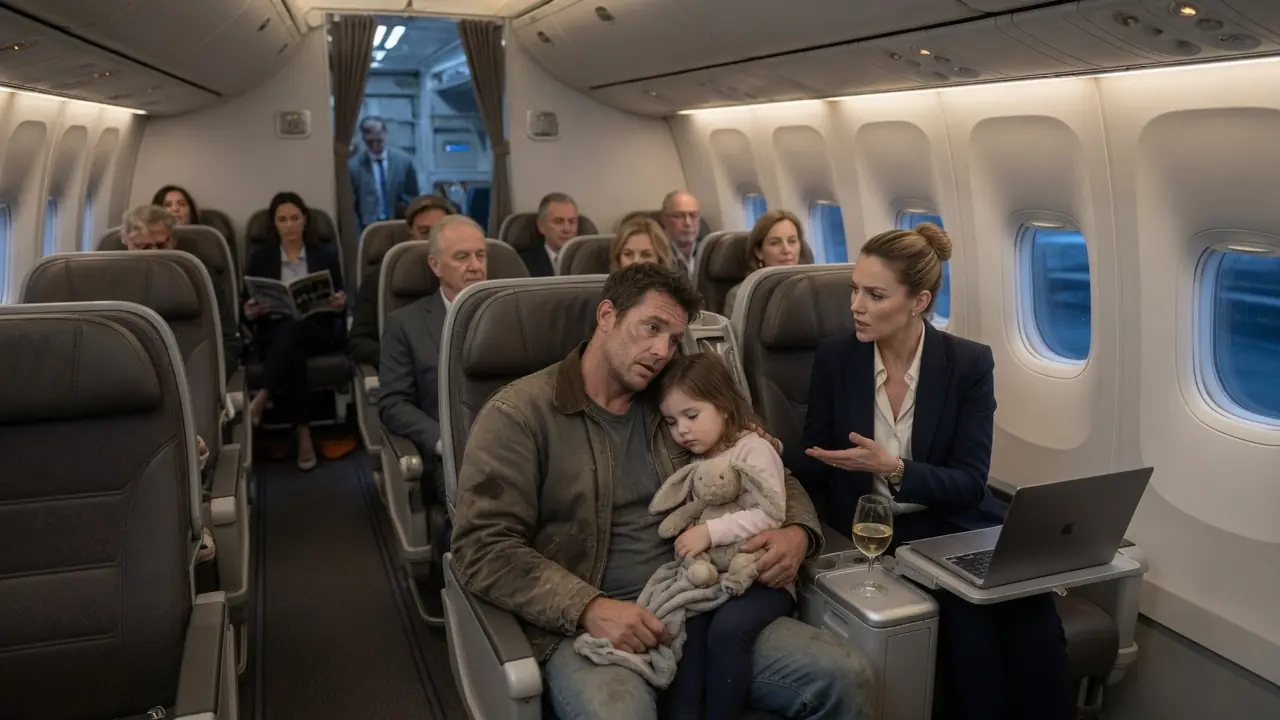
It was a habit from another life, one he had deliberately left behind but could never quite shake. He shifted in his seat, careful not to wake Maya, who slept against his shoulder, her tiny hand still clutching the stuffed rabbit she had named Mr. Whiskers. Flight 2847 from New York JFK to London Heathrow had boarded without incident. The Boeing 777 was a workhorse, reliable and steady, though Lucas knew better than most that reliability meant nothing when fate decided to intervene.
He had learned that lesson at 32,000 feet over the Hindu Kush a lifetime ago. “Excuse me.” The voice was sharp, cutting through the ambient hum of the aircraft like a scalpel. “Could you control your child?” Lucas looked up. The woman across the aisle was staring at him with unconcealed disdain.
She was young, early 30s, he guessed, with the kind of aggressive beauty that came from expensive maintenance and good genetics. Her navy blazer probably cost more than Lucas made in a month at the maintenance hangar. Her hair was pulled back in a severe bun that somehow made her look both powerful and brittle. Maya hadn't made a sound.
She was asleep. I am sorry. Lucas kept his voice neutral. your daughter.
Victoria Hail, though Lucas did not know her name yet, gestured vaguely. “She was kicking my seat earlier, and frankly, I do not understand why children are allowed in business class. Some of us paid full price for these seats. Lucas glanced at Maya, then back at the woman.
She's been asleep for 20 minutes, and she's 4 years old. She was not kicking your seat. “Well, she was certainly making noise during boarding.” Victoria turned back to her laptop, dismissing him. I am just saying some of us have important work to do.
The flight attendant, a kind-faced woman named Sarah, who had helped Lucas settle Maya earlier, appeared from the galley. “Is everything all right here?” “Fine,” Lucas said quietly. “Everything's fine.” Victoria made a small sound of disapproval, but said nothing more. Sarah gave Lucas a sympathetic smile and moved on.
Lucas exhaled slowly, reminding himself that Maya was what mattered. Not this woman's judgment, not her assumptions, just Maya. He pulled out his phone, scrolling through the photos he had taken at the airport. Maya grinning in front of the departure board.
Maya pressing her nose against the window, watching planes taxi. Maya had never been on a plane before. For her, this was magic. For Lucas, it was complicated.
“Did you seriously get business class tickets working at the airport?” Victoria's voice again, quieter this time, but no less cutting. She was not looking at him, addressing her laptop screen as if she were talking to herself. But the words were clearly meant for him. Lucas had learned to recognize his type immediately.
His worn Carhartt jacket, the fraying backpack, the permanent grease stain on his left sleeve from yesterday's shift, all of it screamed blue collar to someone like her. She had constructed an entire narrative about him without knowing a single true thing. “Actually,” Lucas said carefully, “I used points.” H Victoria's expression suggested she did not believe him. Airport employee benefits must be better than I thought.
She had half-guessed right. Lucas did work at the airport, JFK's Hangar 7 specifically, in the maintenance division. He had been there for 3 years, ever since the medical discharge, the divorce, the slow rebuild of a life that had once meant something different. “Something like that,” he replied, choosing not to elaborate.
“Well,” Victoria finally looked at him directly, her eyes scanning him with the clinical efficiency of someone conducting an inventory. ““I hope you appreciate it. Some of us actually earned these seats.”” The implication hung in the air like exhaust fumes. Lucas felt the familiar tightness in his chest.
Not anger exactly, but something older and wearier. The assumption that manual labor meant lesser value, that his hands scarred and calloused from years of working on aircraft made him less worthy of space in the world. He could have told her, could have explained that he had earned his place in this cabin and every other skybound space a thousand times over. could have described the first time he had soloed an F-16, the way the Earth had fallen away, and he had understood, truly understood, what it meant to be human and tiny and infinite all at once.
Could have listed the commendations, the missions, the saves. But he had promised himself he would not do that anymore. Would not use the past as a shield. That life was gone, and anyway, people like Victoria Hail would not care.
They had already decided who he was. Maya earned them,“Lucas said instead, his voice soft.”She's been through a lot this year. She deserves something special.“Victoria's expression flickered, something almost like curiosity crossing her face before the professional mask settled back into place.”Right,“she said, returning to her laptop.”Well, try to keep her quiet.“Sarah returned with drinks. Lucas accepted water for himself and apple juice for Maya, who was starting to stir.
The little girl's eyes fluttered open, and she smiled up at her father with the kind of unconditional trust that still broke his heart daily.”“Are we flying yet, Daddy?”“”We are, sweetheart. We're way up in the sky.“”“Can we see the clouds?”“Lucas raised the window shade. Outside the Atlantic stretched endlessly, moonlight painting silver paths across the water. Maya gasped, pressing her hands against the plastic pane.”It is so beautiful.““It is,” Lucas agreed, watching her face instead of the view.
It really is. Across the aisle, Victoria glanced over despite herself. For just a moment, her expression softened. Then she caught herself and looked away, jaw tightening.
The flight settled into its rhythm. Other passengers dozed or worked or watched movies on their seatback screens. Lucas helped Maya color in the activity book Sarah had provided, patiently identifying different types of aircraft in the pictures. a 737, an A320, a Dreamliner.
Maya repeated the names carefully, treating each one like a precious secret.”“You know a lot about planes,”“Victoria said suddenly. She had been watching them, Lucas realized, listening.”“I work around them,”“Lucas replied.”Not a lie, just not the whole truth.““As a mechanic?” “Something like that.””That is nice.“The word was inflected with the particular condescension reserved for jobs people considered beneath them. I am sure it is very hands-on. Lucas did not respond.
Maya was showing him her drawing, a lopsided airplane with a purple fuselage and smile windows. He praised it enthusiastically, making her giggle. “I run Hail Dynamics, Victoria continued, apparently deciding this man was worth educating about her importance. We're a tech consulting firm, Fortune 500 clients.
I just closed a deal worth $42 million. “Congratulations,” Lucas said, meaning it. Success was success, even when it came wrapped in arrogance. It is exhausting, honestly.
The travel, the pressure, everyone wanting something from you. She sipped her wine, a California Chardonnay that Lucas knew cost $18 a glass. He had seen the menu. I barely have time to sleep, let alone, well, other things.
She gestured vaguely toward Maya, the implication clear. Children were inconvenient, incompatible with real achievement. Lucas felt Maya lean against him, already drowsy again.”Everyone makes choices,“he said quietly.”Exactly.“Victoria seemed to think he was agreeing with her.”I chose my career. I chose to be excellent.
Some people choose other paths. The dismissal in those words, other paths, felt like a physical thing. Lucas had heard variations of this speech before, from his ex-wife's lawyer during the custody hearing, from former colleagues who' traded their flight suits for corner offices, from people who measured worth in titles and bank accounts. He had chosen Maya.
When everything had fallen apart, the discharge, the medical bills, the divorce, he had chosen his daughter. He had taken the maintenance job because it was stable, because it let him be present, because showing up mattered more than status. ““Must be nice,” Victoria continued, her tone suggesting it was anything but. Having such simple priorities: clock in, clock out.
“No real responsibility.” Lucas looked at her then really looked. Beneath the polish and the performance, he saw something familiar. Fear. The kind that came from building an identity so fragile it required constant reinforcement through comparison.
She needed him to be small so she could feel large. “Everyone is responsible for something,” he said. Just not always the same things. Victoria's phone buzzed.
She glanced at it and scowled. Unbelievable. My assistant booked me the wrong hotel. I specifically said the Savoy.
and she she stopped, seeming to remember her audience. Well, you would not understand. Service industry problems. Lucas almost laughed.
Almost told her he had stayed at the Savoy once, courtesy of a grateful ambassador whose daughter he had helped evacuate from a hot zone. Almost described the view from the room, the weight of the metal ceremony afterward, the way his wife had looked at him across the ballroom like he was a stranger in dress blues. But he did not. Instead, he helped Maya settle back against his shoulder, stroking her hair until her breathing evened out.
These were the moments that mattered. Not Victoria's opinion. Not the ghost of his former life. Just this.
His daughter safe, warm, sleeping peacefully at 37,000 feet. The cabin lights dimmed for the night service. Passengers reclined their seats, pulled out blankets, adjusted eye masks. The flight attendants moved quietly through the aisles, collecting glasses and offering final beverages.
Sarah paused beside Lucas. “You are doing great with her,” she whispered, nodding at Maya. “It is not easy traveling alone with a little one.” “Thank you,” Lucas said genuinely grateful. “My daughter's about the same age.
I know how it is.” Sarah smiled, then moved on. “Victoria,” Lucas noticed, had been listening. When she caught him looking, she turned away quickly, something almost like shame flickering across her face before she masked it. The turbulence started small, just little bumps, the kind that make drinks ripple, but do not really concern anyone.
Lucas felt it in his body before his mind registered it. The subtle shift in air pressure, the change in the engine's pitch, old instincts, impossible to kill. Maya stirred slightly. Lucas pulled the blanket higher around her shoulders.
Then the plane dropped. Not much, maybe 50 feet, but enough to make oxygen masks swing and passengers gasp. Enough to wake Maya, who looked up at her father with wide, frightened eyes. Daddy, it is okay, baby.
Just bumpy air. Remember what I told you? The plane is strong. We're safe.
His voice was calm, practiced. The same tone he had used to talk down rookie pilots having their first combat panic. to reassure civilians during evacuations to convince himself during the long nights after the crash that he had fly again. The seat belt sign dinged on.
The captain's voice came through the speakers, professionally unconcerned. Folks, we have got some rough air ahead. Please return to your seats and make sure your seat belts are fastened. Flight attendants, take your seats.
Victoria gripped her armrest. Her laptop slid slightly on the tray table and she caught it quickly, closing it with shaking hands. Another drop. harder this time.
Someone behind them yelped. A carry-on bag tumbled from an overhead compartment, landing with a thud. Ladies and gentlemen, the captain again. We're experiencing some unexpected turbulence.
We're working on finding smoother air. Please remain seated with your seat belts fastened. The plane shook. Really shook.
Like something huge had grabbed them and would not let go. Maya whimpered and Lucas wrapped his arms around her. “Listen to me, sweetheart. Feel my breathing.
Slow and steady. You do it with me. In and out. In and out.
Maya tried, her small chest rising and fall ing in imitation of his. Lucas kept his focus entirely on her, but his peripheral awareness tracked everything else. The flight attendant strapping into their jump seats, their faces professional, but tense. The businessman in 4A, now very much awake and very much terrified.
The woman three rows back praying in Spanish and Victoria knuckles white against the leather armrest, her carefully constructed composure crumbling with each violent shake. “Is this normal?” Her question was directed at no one, at everyone. It is just weather, Lucas said evenly. “The plane can handle much worse than this.” “How do you know?” The sharp edge was gone from her voice, replaced by something raw and honest.
Fear had a way of stripping away pretense. “I just do now.” The turbulence intensified. Not the gentle roller coaster bumps of normal rough air, but something meaner, more sustained. The cabin groaned.
Overhead lights flickered. Several people were crying now, making no effort to hide it. Lucas's mind, trained by thousands of hours in the cockpit, automatically began processing information. The angle of the cabin within normal parameters.
The sound of the engines strained but functional. The interval between drops, irregular, suggesting clear air turbulence rather than storm cells. Daddy, I am scared. Maya's voice was very small.
I know, baby. I have got you. I have always got you. He meant it in a way that transcended this moment.
Meant it in every dimension of their lives. The doctor's appointments for her asthma. The parent teacher conferences where he was the only father in a room full of mothers. The night she woke crying for a mom who had chosen a new husband over her own daughter.
Lucas had always been there, would always be there, gravity and biology and love pulling him to her like physics. The plane dropped again, stomach lurching and sudden. Maya screamed and Lucas held her tighter, murmuring reassurances he was not sure he believed. Then from the cockpit, a sound that changed everything.
Alarms. Not the soft chime of the seat belt sign or the ding of a call button, but real alarms, urgent, insistent, designed to cut through panic and demand immediate attention. Lucas recognized them instantly. Every pilot did.
They were the sounds that preceded emergency checklists, difficult decisions, and occasionally disaster. The captain's voice returned, and this time there was no professional unconcern. This is Captain Morrison. We have a situation.
We have a medical emergency in the cockpit, the captain continued. “If there are any doctors on board, please identify yourselves to the flight attendants immediately.” Sarah appeared from the galley, moving quickly down the aisle. Two passengers raised their hands, a woman near the front, a man near the back. Sarah collected them both, directing them forward.
Lucas watched this unfold with increasing dread. Medical emergency in the cockpit meant crew incapacitation, and if it was serious enough to require passenger doctors. The plane shook again, harder than before. Not turbulence this time.
Evasive maneuvering. The captain was hand-flying, banking sharply to avoid something. Lucas felt it in his bones. The muscle memory of combat flying, of threading aircraft through impossible spaces at impossible speeds.
““We are going to die,” Victoria was staring straight ahead, her face bloodless. “Oh my god, we're going to die. “We are not going to die,”” Lucas said firmly. “You do not know that.
You are just a” She stopped, seeming to remember his daughter. “You do not know that,” she finished quietly. ““I do know that,”” Lucas said. and something in his tone made her look at him sharply.
Time stretched. Lucas tracked it through the interval between heartbeats, through the rhythm of his breathing, through the counting he had learned in survival training. 3 minutes since the alarm started, 5 minutes since the doctors went forward, 7 minutes of increasing turbulence and no update from the cockpit. Maya had gone very still against him, the kind of quiet that children achieve only in genuine terror.
Lucas whispered to her constantly fragments of songs, pieces of stories, promises about tomorrow and next week and next year. Anything to keep her anchored to the future, to the idea that there would be one. Then the intercom crackled. Everyone fell silent.
This is Captain Morrison. His voice was strained now. Professional veneer cracking. I need everyone to listen very carefully.
My co-pilot has collapsed. He's being attended to by the medical personnel on board, but I am flying alone. We're experiencing severe clear air turbulence, and I am having difficulty managing the aircraft solo in these conditions. The silence in the cabin was absolute, as if everyone had stopped breathing at once.
I need to know, the captain paused. When he spoke again, Lucas heard something he had never thought he had hear from a commercial airline captain. Desperation. Are there any pilots on board?
Any flight experience at all? I need someone in this cockpit who can help me fly this plane. Nothing. Nobody moved.
Lucas closed his eyes. The moment stretched like taffy, pulling thin and impossible. He had promised himself. After the discharge, after the crash, after the long months of physical therapy, and longer months of watching his marriage dissolve, he had promised himself he was done.
Done with flying. Done with the sky. done with being the person who stepped up when everything went to hell. He had chosen a different life, a quieter life.
A life where he showed up for Maya's school plays instead of combat briefings, where he changed oil instead of changing the world, where he was present instead of exceptional. Daddy. Maya's voice was a whisper. What is wrong?
And Lucas knew with a certainty that felt like fall ing that he did not have a choice. Not really. Not when Maya was on this plane. Not when 287 people were depending on the competence of a single exhausted captain flying blind through turbulence that would challenge even a fresh crew.
Not when he was the only person in this cabin who had ever hand flown a crippled aircraft through hostile weather and brought it home. He unbuckled his seat belt. Victoria stared at him. “What are you doing?” Lucas did not answer.
He was moving on instinct now. The old training taking over. He knelt beside Maya, taking her face gently in his hands. ““Baby, I need you to be very brave for me, okay?
I need to go help the captain fly the plane.” “But you fix planes, Daddy. You do not fly them.” Her voice wavered. ““I used to fly them, sweetheart, a long time ago. And right now, the captain needs someone who knows how.” He pulled Mr. Whiskers from the seat pocket, tucking the rabbit into her arms.
“Sarah is going to come sit with you. You are going to hold Mr. Whiskers tight and be the bravest girl in the whole sky. Can you do that for me? Maya nodded, tears streaming down her face.
But she nodded. Lucas stood. The entire cabin was watching him now. This shabby airport worker in the worn jacket walking toward the cockpit like he belonged there.”Sir,“Sarah appeared at his elbow.”“Sir, you need to return to your seat.”“”I am a pilot,“Lucas said quietly.”Fighter pilot, 12 years active duty.
I can help. Sarah's eyes widened. She glanced toward the cockpit, then back at Lucas. Decision made.
She nodded sharply. Go. I will watch your daughter. Lucas started moving forward.
Each step feeling like crossing a border from one country to another. Behind him, he heard Victoria's voice, shock stripping away the condescension. “Wait, what? He is a pilot?
He is a fighter pilot?” But Lucas did not stop. Did not turn around. did not acknowledge the question. He was already shifting into a different version of himself.
The one he had tried to leave behind but had never truly escaped. The one who had been trained for exactly this kind of impossible situation. The one who did not fail. The cockpit door was locked, secured according to post-9/11 protocol.
Lucas knocked firm but not panicked. “Captain Morrison, my name is Lucas Grant, former U. S. Air Force F-16 pilot, 12 years service.
I can help you fly this aircraft. A pause. Then the lock clicked. The door opened and Lucas stepped into the controlled chaos of the cockpit.
Captain Morrison was in his 50s, sweat pouring down his face as he fought the yoke. The co-pilot was slumped in his seat, unconscious, being attended to by one of the passenger doctors. Alarms were screaming. Terrain warning.
Over speed warning. Master caution. The instrument panel looked like a Christmas tree of red and amber lights. “Jesus Christ,” Morrison gasped.
“Please tell me you can actually fly.” Lucas slid into the empty jump seat, his eyes immediately scanning the instruments, processing information at a speed that surprised even him. Airspeed 340 knots and fluctuating. Altitude 35,000 feet and descending. heading erratic weather radar showing massive cells ahead, no clear path through.
“I can fly,” Lucas said, his voice steady and calm despite everything. “Tell me what you need.” Captain Morrison looked at him. Really looked. And something in Lucas's eyes must have convinced him because he nodded sharply.
Take the controls. I need both hands for the radio and navigation. Can you hold her steady while I coordinate with air traffic control? Lucas did not hesitate.
He reached for the co-pilot's yoke, his hands finding their positions with the kind of muscle memory that never truly fades. The moment his fingers wrapped around the controls, something shifted inside him. Not a return to who he had been, but a recognition that this part of him had never really left. ““I have the aircraft,”” Lucas said, using the formal language of cockpit handoffs.
“You have the aircraft,” Morrison confirmed. And just like that, Lucas Grant, maintenance worker, single father, man who had walked away from the sky, was flying again. The plane bucked beneath them like something alive and angry. Lucas felt the turbulence through his hands, through the seat, through the marrow of his bones.
This was worse than the approach to Bagram, worse than the sandstorm over Fallujah. This was Mother Nature at her most violent and he was sitting in the cockpit of a civilian aircraft that had never been designed for this kind of abuse. “Mayday, mayday, mayday,” Morrison was saying into the radio. “This is United 2847 Heavy.
We have a medical emergency, pilot incapacitation, and severe turbulence. Requesting priority vectors and immediate descent to smoother air.” The response crackled back. Professional but urgent. Lucas tuned it out, focusing entirely on the aircraft.
He could feel her, the way she wanted to roll left, the way the nose kept pitching up, the way the engines were straining. He made minute adjustments, fighting to keep them level, burning through years of training in seconds. “How bad is he?” Lucas asked, nodding toward the unconscious co-pilot. “Possible stroke,” the doctor said.
She was young, Indian, her hands steady despite the chaos. We need to land soon. Working on it, Morrison said tersely. He was pulling up weather data, navigation charts, calculating options.
Gander is closest, but we had have to descend through this mess. Shannon would be smoother, but adds 90 minutes. We can make Gander, Lucas said. He did not explain how he knew.
Did not mention the dozens of emergency approaches he had made to forward operating bases in worse conditions with less fuel and more enemy fire. He just knew. Morrison looked at him again longer this time. Air Force, you said.
Yes, sir. Combat? Yes, sir. Then I am trusting you to get us through this alive.
Morrison's voice cracked slightly. I have been flying for 30 years, and I have never felt anything like this. It is like the air wants to kill us. Lucas understood that feeling.
He had felt it before, the sense that the universe had decided you were finished and was just working out the details. The trick was not accepting it. The trick was fighting until you won or until there was nothing left to fight with. ““We are not dying today”,” Lucas said, and he meant it with every fiber of his being.
Behind him, through the open cockpit door, he could hear the murmur of frightened passengers, the crying, the praying. He thought of Maya, small and terrified, clutching her rabbit. He thought of Victoria, her earlier cruelty now seeming small and distant. He thought of all the people on this plane who had boarded, thinking about their destinations, their meetings, their families, never imagining their lives would depend on the skills of a washed-up fighter pilot who had come to terms with never being special again.
The turbulence intensified. A massive updraft hit them, slamming the plane upward like a toy. Lucas pushed forward on the yoke, fighting to maintain altitude discipline. Too high and they had burn extra fuel.
too low and they had be closer to the terrain that was somewhere below them in the darkness. “Jesus!” Morrison shouted as they dropped again. “Did you feel that? We're being thrown around like I feel it,” Lucas said calmly.
“Keep working the radio. I have got the aircraft.” And he did. Despite everything, the screaming alarms, the violent movements, the fear trying to claw its way into his chest, Lucas had the aircraft. His hands were steady.
His breathing was controlled. His mind was clear. This was what he had been trained for. Not this exactly.
He had never flown a 777 before. Had never sat in a commercial cockpit, but the essence of it, the high-stakes decision-making, the physical skill, the absolute refusal to accept defeat. United 2847 gander control. We're clearing all traffic.
Your priority. Descend to flight level 250. Vector's coming. Morrison read back the clearance, then looked at Lucas.
You ready for this? Lucas thought about all the people behind him, about Maya, about the promise he had made to himself to always come home to her, about the second chance he had been given when the crash hadn't killed him. ““Let us bring her down,”” he said. And as he eased the yoke forward, beginning the descent through the worst weather he had seen in 15 years of flying, Lucas Grant accepted something he had been running from for 3 years.
You could not escape who you were. You could only choose what to do with it. The night was about to get much worse before it got better. But for the first time since the discharge, since the divorce, since the morning he had woken up in a hospital bed and learned his flying days were over, Lucas felt like himself.
Completely, terrifyingly, undeniably himself. And somewhere in the cabin behind him, as word spread through the frightened passengers that a fighter pilot had taken the controls, Victoria Hail sat frozen in her seat, staring at the space where Lucas had been sitting, finally beginning to understand the magnitude of her error. The descent through 35,000 feet felt like fall ing through concrete. Every thousand feet brought new turbulence, new challenges, new reasons for Lucas's training to override his fear.
His hands moved across the controls with practice precision, making constant micro adjustments that kept the massive aircraft from tearing itself apart. “Airspeed's climbing,” Morrison said, his voice tight. “Watch the overspeed.” Lucas was already pulling back the throttles, feeling the engines respond. “The 777 was nothing like an F-16.
It was heavier, slower to respond, less forgiving of mistakes. But the principles remained the same. Respect the machine. Understand the physics.
Do not fight the aircraft. Work with it. 33,000. Lucas called out, reading the altimeter.
Rate of descent 2,000 feet per minute. That is too fast. Morrison's hands hovered over his own controls, ready to intervene. You need to shallow it out.
Not yet. Host Lucas kept his eyes on the instruments. We need to get below this weather layer. The violence is worse between 32 and 28,000.
If we descend too slowly, we'll get beaten to death. Morrison stared at him. How could you possibly know that experience? Lucas said simply.
He did not elaborate. Did not mention the intelligence briefings about atmospheric conditions over hostile territory. the countless hours studying weather patterns because knowing them could mean the difference between completing a mission and becoming a statistic. The plane shuddered violently behind them through the open cockpit door.
Lucas heard screams. He forced himself not to think about Maya, about whether Sarah was keeping her calm, about whether his daughter would remember this night as the time her father saved her or the time he was not there when she needed him most. United 2847 Gander Control. We're showing you at 330 descending.
Confirm you are still in control of the aircraft. Morrison grabbed the radio. Affirmative, Gander. We have an experienced military pilot assisting.
Continuing descent is planned. Copy that. 2847. Be advised, we're getting reports of severe turbulence from multiple aircraft in your vicinity.
Recommend descent to flight level 200 for smoother conditions. 20. Roger. Morrison said.
He looked at Lucas. That is 20,000 feet. You comfortable taking us that low? Lucas did the math instantly.
They were currently at 33,000, a descent of 13,000 feet through the worst turbulence he had ever experienced in a civilian aircraft. With 287 souls on board depending on him not to make a single critical mistake. I am comfortable, he said, and was surprised to find it was true. The doctor working on the co-pilot looked up.
We need to land soon. His condition is deteriorating. I have done what I can, but he needs a hospital. How long?
Lucas asked. 30 minutes. Maybe 45 if we're lucky. Lucas glanced at Morrison.
What is our ETA to Gander? At current rate of descent and approach speed. Morrison's fingers danced across the flight management computer. 38 minutes to touchdown.
Then we do not have a choice, Lucas said. We push through. Morrison nodded slowly, then reached over and squeezed Lucas's shoulder. It was a gesture of trust that carried more weight than words.
This stranger, this man who had been dismissed as airport maintenance just an hour ago, now held all their lives in his hands.”“Take us down,”“Morrison said. Lucas began the descent in earnest. The turbulence at 30,000 feet was unlike anything he had prepared for. The 777 pitched and yawed, the wings flexing in ways that would have been terrifying if Lucas hadn't understood the engineering tolerance built into modern aircraft.
Boeing had designed these planes to withstand forces far beyond what any sane pilot would subject them to. But sane pilots did not often find themselves flying through atmospheric blenders at night over the North Atlantic. 29,000 Lucas called out. The violence was intensifying just as he had predicted.
The aircraft was being hammered by vertical wind shear. Massive updrafts followed immediately by downdrafts. Invisible forces that could snap a plane in half if you fought them wrong. Lucas did not fight.
He rode the turbulence like a surfer reading a wave, making constant small corrections rather than large dramatic inputs. It was exhausting work. Every muscle in his arms and shoulders burning from the sustained tension of keeping the yoke steady. How are you doing that?
Morrison was watching Lucas's hands with something approaching awe. You are barely moving the controls, but we're staying level. Small corrections, Lucas explained, his voice remaining calm despite the chaos. If you overcorrect in turbulence, you are working against yourself.
The aircraft wants to find equilibrium. Let it do most of the work. It was a technique he had learned the hard way on a night mission over Syria when his flight leader had panicked in heavy weather and nearly crashed, trying to muscle his plane through it. Lucas had watched, learned, and vowed never to make the same mistake.
That flight leader had been grounded the next day. Lucas had been promoted 6 months later.”27,000,“he announced, coming up on the worst of it. He was not wrong. The plane suddenly dropped like an elevator with cut cables.
200 feet in less than 3 seconds. Alarm shrieked. Morrison shouted something that might have been a prayer or a curse. The doctor braced herself against the bulkhead, her medical bag spilling instruments across the cockpit floor.
Lucas pulled back on the yoke, not fighting the drop, but managing their recovery. The plane's nose came up. The engines roared, and they arrested the descent at 26,700 feet.”“Holy hell,”“Morrison breathed.”We just fell.“”I know.“Lucas's voice was still steady, but his heart was hammering against his ribs. That kind of drop in a fighter jet was Tuesday in a commercial airliner full of civilians.
It was the stuff of nightmares. Everyone okay back there? Morrison keyed the intercom. Folks, we're experiencing severe turbulence as we work to descend to smoother air.
Please remain seated with your seat belts fastened. We're doing everything we can to make this as smooth as possible. It was a lie. Of course, there was nothing smooth about this, but it was a necessary lie, the kind that kept panic from spreading like wildfire through the cabin.
Lucas continued the descent. 26,000 25 24 each thousand feet felt earned, paid for in sweat and concentration, and the kind of sustained mental effort that left no room for doubt or fear or anything except the immediate present moment. United 2847 Gander, we're showing weather clearing below flight level 220. You should find calmer conditions shortly.
Copy, Gander, Morrison replied. That is the best news I have heard all night. At 23,000 feet, the turbulence began to ease. Not disappear.
They were still being jostled, but the violent shaking gave way to something more manageable. Lucas felt the change in the aircraft's handling. The way the controls became less resistant, more responsive. “It is working,” Morrison said, relief flooding his voice.
We're getting below it. Lucas allowed himself the smallest of smiles. “Not out of it yet. Keep monitoring the weather radar.
I do not want to run into any embedded cells on approach. On it, they descended through 22,000 feet into air that felt almost peaceful by comparison. The alarm stopped screaming. The master caution lights dimmed.
The 777 steadied, responding to Lucas's inputs with the docile predictability of a well-trained horse. “20,000 feet level,” Lucas announced. How's our fuel state? Morrison checked the gauges.
Adequate for gander with reserves. We burned extra fighting through that weather, but we're not critical. Good. Lucas's shoulders were beginning to ache from the sustained tension, but he did not dare relax yet.
They were through the worst of the turbulence, but they still had to land at night at an unfamiliar airport with a partially incapacitated crew in a cabin full of traumatized passengers. The doctor had stabilized the co-pilot as much as possible, but the man remained unconscious, his breathing shallow, and labored. Every few minutes, she checked his vitals and made notes on a piece of paper torn from the flight manual.”“Will he make it?”“Lucas asked quietly. The doctor met his eyes.
She was young, probably early 30s, but her gaze carried the weight of someone who had seen too much too soon. If we land in the next 30 minutes, yes. If we do not, she did not finish the sentence. Lucas nodded.
30 minutes. He could do 30 minutes. He had done much harder things in much less time. Gander Control United 2847.
We're level at 20,000. Requesting vectors for the approach. United 2847. Gander, fly heading 045.
Descend and maintain 15,000. Expect the ILS approach to runway 21. Weather at Gander winds 230 at 15, visibility 10 mi, scattered clouds at 5,000, altimeter 3012. Morrison read back the clearance while Lucas turned the aircraft to the new heading.
The 777 responded smoothly, banking into the turn with none of the earlier violence. For the first time since taking the controls, Lucas felt like he was actually flying rather than just surviving. You have done this before, Morrison said. It was not a question.
“Done what?” Emergency approach. Wounded aircraft. Everything going to hell. Morrison was watching him with open curiosity.
Now, where'd you serve? Lucas kept his eyes on the instruments. Middle East, mostly, some Africa. Combat missions?
Some. How many? Lucas was quiet for a moment. “Enough.” Morrison seemed to understand that was all he had get.
Well, whatever the Air Force taught you, it is saving our lives right now. I have been flying since I was 17. Civilian, cargo, commercial, and I have never seen anyone handle an aircraft like you are handling this one. You would have managed, Lucas said.
Maybe, but I am damn glad I did not have to try. Morrison paused. What are you doing working in airport maintenance? Someone with your skills should be flying.
It was the question Lucas had been dreading. The one that required explanations he did not want to give. That opened doors to a past he had spent 3 years trying to close. It is complicated, he said finally.
“I bet.” They flew in silence for a few minutes, descending through 15,000 feet. The air was calm now, almost serene. Stars were visible through gaps in the clouds, diamond bright against the darkness. Below them, the Atlantic stretched away into nothingness.
Black water under black sky, the edge of the world. Lucas thought about Maya, about whether she was still crying or whether Sarah had managed to calm her down, about what he had say to her when this was over. About how to explain that sometimes the safe choice was actually the dangerous one. That hiding from who you were did not make you safer.
It just made you unprepared when the universe came calling. 10,000 feet. Morrison announced,”Gander is 40 mi ahead, twelve o'clock.“Lucas could see the lights now. A small constellation of civilization in the wilderness of Newfoundland.
Gander International Airport built during World War II as a refueling stop for transatlantic flights. Now mostly quiet except for the occasional diverted aircraft. Tonight it was their salvation. United 2847 Gander Tower.
You are cleared for the ILS approach runway 21 contact tower on 118.3. Morrison switched frequencies and a new voice crackled through. United 2847 Gander Tower, we have emergency equipment standing by. Winds 240 at 12, runway 21 cleared to land.
Cleared to land, runway 21, United 2847, Morrison responded. He looked at Lucas. You want to take us all the way in? Lucas hesitated.
Landing was different from straight and level flight. It required precise speed control, exact glide slope tracking, perfect timing. One mistake and they had either overshoot the runway or touch down too hard and risk structural damage to the landing gear. But Morrison was asking because he trusted Lucas to do it.
And more than that, Lucas trusted himself to do it. I have got the landing, Lucas said. You have got the landing, Morrison confirmed. Lucas began configuring the aircraft for approach.
flaps to 15°, gear down, airspeed slowing to 160 knots. The 737 settled into approach configuration, and Lucas felt the familiar rhythm of a landing approach settling into his bones. Height over threshold, glide slope indication, localizer centered, sink rate controlled.”1,000 feet above touchdown,“Morrison called out, reading from the radar altimeter. Lucas fine-tuned his descent rate.
The runway was visible now. A ribbon of light stretched across the darkness. His hands moved smoothly across the controls, making tiny corrections, keeping them perfectly aligned with the center line. 500 feet.
The lights were rushing up to meet them. Lucas could see the threshold markers, the touchdown zone lights, the precision approach path indicator showing three whites and one red. Perfect glide path. 200 feet.
He began the flare, pulling back gently on the yoke, raising the nose, bleeding off airspeed. The main wheels kissed the runway with barely a bump. Lucas deployed the thrust reversers and applied brakes, feeling the massive aircraft slow, slow, slow until they were taxiing at walking speed. United 2847.
Nice landing. Exit at taxiway Delta and contact ground on 121.9. Morrison was staring at Lucas with undisguised amazement. “That was..” He shook his head.
“That was perfect. Greaser landing. I have been flying 77s for 8 years, and I could not have done better myself. Lucas did not respond.
He was too busy trying to process what had just happened, trying to reconcile the man he had been for the last hour with the man he had been pretending to be for the last 3 years. Emergency vehicles were racing alongside them. Fire trucks, ambulances, their lights painting the night in reds and blues. Lucas taxied to the designated parking area and set the brakes.
Parking checklist complete, Morrison said. “We are down. We are safe. Thanks to you.” Lucas unbuckled his harness, his hands shaking now that the adrenaline was draining away.
“Thanks to both of us.” Do not sell yourself short. Morrison extended his hand. Captain Tom Morrison and I owe you my life. Lucas shook his hand.
Lucas Grant and you do not owe me anything. The doctor was already preparing the co-pilot for transport. Paramedics crowded into the cockpit, professional and efficient, loading the unconscious man onto a stretcher. Within minutes, he was gone, wheeled across the tarmac toward a waiting ambulance.”“He will make it,”“the doctor said to Morrison.”Thanks to you getting us down when you did.““Thank Lucas,” Morrison said.
He did the flying. The doctor turned to Lucas, really seeing him for the first time. Your military was Lucas said,”Well, whoever you are, you just saved a lot of lives.“She smiled tiredly.”I am Dr. Priya Sharma, and I am very glad you happen to be on this flight.“”So am I,“Lucas said and meant it. The cabin door opened.
Sarah appeared, her face streaked with tears. Lucas. Oh, thank goodness. Maya will not stop crying for you.
She's been so brave, but she needs her father. Lucas was moving before Sarah finished speaking, pushing past the emergency personnel through the galley into the cabin where passengers were still strapped into their seats. Some crying, some praying, some just sitting in shocked silence. Maya saw him and screamed,”“Daddy!”“He ran to her, scooping her into his arms, and she wrapped herself around him like a small, desperate monkey.
Her face was wet with tears, her whole body shaking. I have got you, baby. I have got you. We're safe now.
We're on the ground. “I was so scared. You were gone and the plane was shaking. And I thought I thought, shh, I know, but I told you I would come back, did not I?
I always come back to you. Lucas held his daughter, rocking her gently, and became aware that every eye in the cabin was on him. Passengers were staring with expressions ranging from gratitude to awe to confusion. He had walked toward the cockpit as a nobody.
He was returning as the man who had saved them all. Across the aisle, Victoria Hail sat frozen, her perfect composure shattered. Her mascara had run, leaving dark tracks down her cheeks. Her hands were gripping the armrest so tightly her knuckles had gone white.
She was staring at Lucas like she had seen a ghost.”You.“Her voice was barely a whisper.”You are a fighter pilot. A real fighter pilot.“Lucas did not answer. He was too focused on Maya, on calming her trembling, on being present in this moment that mattered more than Victoria's shock or anyone else's reaction. Ladies and gentlemen, Captain Morrison's voice came over the intercom.
We have landed safely in Gander, Newfoundland. I want to thank you for your patience and courage during that difficult flight. I also want to introduce you to the man who made our safe landing possible. In our darkest moment, when I thought we might not make it, a passenger came forward.
His name is Lucas Grant. He's a former U. S. Air Force fighter pilot and he spent the last 40 minutes helping me fly this aircraft through conditions I never want to see again.
Without his skill and his bravery, we would not be here right now. Mr. Grant, wherever you are, thank you from all of us. Thank you. The cabin erupted in applause.
Passengers were standing now, turning to look for Lucas, some reaching out to touch his shoulder, to shake his hand. The businessman from 4A was openly weeping. An elderly woman clutched at his sleeve, whispering blessings. Lucas wanted to disappear.
This attention, this recognition, it was everything he had been avoiding. But Maya was in his arms, safe and warm, and that made everything else bearable. Sarah appeared at his side. They're going to the plane soon.
Emergency buses are here to take everyone to the terminal, but Morrison wants to speak with you before you go. Lucas nodded. He looked down at Maya. Can you be brave just a little bit longer, sweetheart?
just until we get inside. Maya nodded against his chest, still clinging to him. The deplaning process was organized chaos. Passengers gathered their belongings, helping each other, moving slowly down the aisles.
Many stopped to thank Lucas personally, their gratitude genuine and overwhelming. He accepted it awkwardly, unused to being the center of attention, uncomfortable with praise. Victoria approached last. She stood in the aisle, blocking his path, her eyes red-rimmed and uncertain.
“I need to apologize,” she said. What I said before about you, about your daughter. I was She faltered, searching for words. I was wrong about everything.
Lucas could have been cruel. Could have thrown her earlier words back at her. Could have made her feel as small as she had made him feel. But he was too tired for cruelty.
And anyway, Maya was listening. “Apology accepted”,” he said simply. “No.” Victoria shook her head. “You do not understand.
I need to Can we talk later after you have settled your daughter?” “Maybe,” Lucas said. “Right now, I just need to take care of Maya.” Victoria nodded, stepping aside to let them pass. But as Lucas moved by her, she spoke again so quietly he almost did not hear. ““My father was military.
He used to talk about men like you. I never understood what he meant until tonight. Lucas paused, looking back at her. “What did he used to say?” That the real heroes are the ones who do not want to be heroes, who just do what needs to be done and then go home.
Victoria's voice cracked. He had have been proud to fly with someone like you. There was something in her tone, a weight behind the words that suggested a story Lucas did not know yet. But before he could respond, Maya tugged at his sleeve.”Daddy, I am cold.“”Okay, baby.
Let's get you inside where it is warm.“The terminal at Gander was small but efficient. Airport staff had mobilized quickly, setting up a crisis response area with blankets, hot drinks, and phone banks for passengers to call loved ones. The airline had sent representatives who were working to arrange hotels and onward travel. Lucas found a quiet corner and sat down with Maya in his lap.
She had finally stopped crying, but she refused to let go of him. Sarah brought them hot chocolate and cookies, which Maya accepted, but did not eat.”“How is she?”“Sarah asked quietly.”“Scared, but she will be okay.”“Lucas stroked Maya's hair.”“Kids are resilient.”“”“So are parents,”“Sarah smiled.”What you did up there? I have been flying for 12 years, and I have never seen anything like it.“”You were incredible. “I was doing my job.”“That is not your job anymore, though, is it?
You work in maintenance. Lucas was quiet for a moment. “Yeah, I do.” But you flew fighters. Why did you stop?
It was an innocent question asked with genuine curiosity, but it cut deeper than Sarah could know. Lucas thought about how to answer, how much to share with this kind stranger who had cared for his daughter while he had been trying to save their lives.”I had an accident,“he said finally. medical discharge. And by the time I was cleared to fly again, I had other priorities.
He glanced down at Maya. Better priorities. Sarah seemed to understand that was all she had get. Well, for what it is worth, I am glad you were on our flight tonight, and I am glad you are the kind of father who puts his daughter first.
Before Lucas could respond, Captain Morrison appeared, still in his uniform, looking exhausted but relieved. Lucas, can we talk privately for a minute? Lucas looked at Sarah, who nodded. I will stay with Maya.
Lucas gently transferred his daughter to Sarah's lap, ignoring her small sound of protest. I will be right back, sweetheart. I promise. He followed Morrison to a quieter section of the terminal near the windows overlooking the dark tarmac.
Emergency vehicles were still clustered around the 777, their lights reflecting off the aircraft's silver skin. I have been on the phone with the airline's operations center. Morrison said they want to fly a fresh crew up from New York to take the aircraft onward to London tomorrow, but more importantly, they want to talk to you. Talk to me about what?
About hiring you as a pilot. Morrison's expression was serious. Lucas, what you did tonight, that was not just competent flying. That was exceptional flying.
The kind of flying that saves lives. The airline needs pilots with your skills. Lucas shook his head. I appreciate the offer, but do not say no yet.
Just think about it. Morrison pulled out a business card and pressed it into Lucas's hand. I know you have got reasons for doing what you are doing. I do not need to know what they are, but I want you to know that there is a place for you in the sky if you want it.
You prove that tonight. Lucas looked down at the card. It had Morrison's contact information and scrolled on the back a phone number for the airline's recruitment department. I have a daughter to think about, Lucas said.
I know. I saw her. She's beautiful. Morrison smiled gently.
I also have kids, three of them. And I managed to be both a pilot and a father. It is not easy, but it is possible. It is different when you are the only parent.
Is it? Or is that just what you tell yourself to justify hiding? The words hit Lucas like a physical blow. Morrison's expression softened immediately.
I am sorry. That was out of line. I just He sighed. I watched you in that cockpit, Lucas.
I saw the way you came alive when you took those controls. That is not something you fake. That is not a skill set. It is an identity.
And I think maybe you have been running from that identity when you should have been integrating it into your life. Lucas wanted to argue, wanted to defend his choices, wanted to explain that he had made peace with being ordinary. But standing here in this airport terminal with the adrenaline still fading and his hands still remembering the feel of the yoke, he was not sure that was true anymore. Just think about it, Morrison said again.
No pressure, but you have got my number if you want to talk. They shook hands and Morrison walked away, leaving Lucas alone with his thoughts and a business card that suddenly felt like it weighed 1,000 lb. He returned to find Maya asleep in Sarah's arms, exhausted from fear and relief. Sarah helped him transfer her gently, and Lucas cradled his daughter against his chest, breathing in the familiar scent of her strawberry shampoo.”“Everything okay?”“Sarah asked.”Yeah,“Lucas said.
“Everything is okay.” But it was not. Not really, because something had shifted tonight. Some carefully constructed wall had developed cracks, and Lucas was not sure he could repair them even if he wanted to. The airline put them up in a hotel near the airport, a clean, modest place that reminded Lucas of a hundred other transit hotels he had stayed in during his military years.
Maya woke briefly when he carried her to the room, asked if they were safe, and fell back asleep the moment he told her yes. Lucas laid her in the bed and sat in the chair by the window, watching the sky lighten toward dawn. His body ached, his shoulders throbbed. His hands trembled with residual adrenaline, but his mind was clear for the first time in years.
He thought about Victoria's apology, about the judgment that had preceded it, about how easy it was to make assumptions about people based on surface appearances. He thought about Morrison's offer, about the possibility of returning to a life he had convinced himself was over. He thought about Maya, about what kind of example he was setting, about whether playing it safe was actually the same thing as being wise. Most of all, he thought about those 40 minutes in the cockpit when everything else had fallen away, and he had been nothing but a pilot doing what pilots do, fighting the sky and winning.
His phone buzzed. A text from an unknown number. This is Victoria Hail. Sarah gave me your number.
I hope that is okay. I meant what I said about wanting to talk. When you are ready. No pressure.
Just thank you for tonight. And I am sorry for being the person I was. Lucas stared at the message for a long moment. Then he typed back,”“Apology already accepted.
Get some rest. It is been a long night for all of us.“The reply came almost immediately. My father would have liked you. He had have said you were the real deal.
Lucas frowned at his phone. There was something there. Some story he did not understand yet. Some connection he could not quite grasp.
But he was too exhausted to pursue it now. He set the phone aside and watched the sun rise over Newfoundland, painting the sky in shades of gold and pink. In the bed, Maya stirred and murmured something in her sleep. Lucas moved to her side, pulling the blanket higher around her shoulders.
Tomorrow, they had continue to London. Tomorrow, he had have to decide what to do about Morrison's offer. Tomorrow, he had have to figure out how to explain to a 4-year-old why her father had disappeared into a cockpit and come back different. But tonight, this morning, he was just Lucas Grant, single father, sitting vigil over his sleeping daughter, grateful beyond measure that they had both survived to see another sunrise.
The sky outside the window was brilliant now, vast and infinite and full of possibility. Lucas looked at it for a long time, remembering what it felt like to live up there, to belong to that endless blue. Then he closed the curtains, climbed into bed beside Maya, and let himself sleep finally after the longest night of his life. Lucas woke to find Maya sitting cross-legged on the bed beside him, staring at his face with an intensity that would have been unsettling if it were not so familiar.
Sunlight streamed through the gaps in the curtains, suggesting it was late morning, maybe even early afternoon.”“You were snoring,”“Maya announced solemnly.”“Was I?”“Lucas's voice came out rough, his throat raw from hours of shouting over engine noise and alarms. “Really loud, like a bear.” She paused, her small face suddenly serious.”“Daddy, were you scared on the airplane?”“Lucas sat up slowly. every muscle in his body protesting. He had forgotten how physically demanding flying could be, especially under extreme conditions.
His shoulders felt like someone had been hitting them with hammers.”Yes,“he said, deciding on honesty.”I was scared.“”“But you went anyway.”“”“I did.”“”“Why?”“Lucas pulled Maya into his lap, looking into eyes that were so much like her mothers, it sometimes hurt. Because being scared and being brave are not opposites, sweetheart. Brave means doing the thing that scares you when it needs to be done. Maya considered this with the gravity of someone three times her age.”“Was I brave?”“”“You were the bravest person on that whole plane,”“Lucas said, and meant it.”You trusted me even when everything was scary.
That takes courage.“She leaned against his chest, seemingly satisfied with this answer. They sat like that for several minutes, Lucas breathing in the strawberry scent of her hair, feeling the steady rhythm of her heartbeat against his ribs. This was what mattered. Not the flying, not the recognition, not Morrison's job offer, just this small person who trusted him completely.
A knock at the door interrupted the moment. Lucas glanced at the clock. 1:15 in the afternoon. They had slept for almost 8 hours.
Mr. Grant, a woman's voice, professional and unfamiliar. I am Jennifer Chen from United Airlines. Captain Morrison asked me to check on you and your daughter. Lucas opened the door to find a petite Asian woman in a crisp airline uniform holding a tablet and wearing an expression of barely contained awe.
Mr. Grant, I cannot tell you what an honor this is. She extended her hand. The whole company is talking about what you did last night. You are a hero.
I am not a hero, Lucas said automatically. I just helped land a plane. “You saved 287 lives. Jennifer's smile was warm but persistent.
That makes you a hero whether you like it or not. May I come in?” I have some information about your onward travel, and there are a few people who had like to speak with you. Lucas stepped aside, and Jennifer entered with the efficient professionalism of someone who had dealt with unusual situations before. She smiled at Maya, who was watching from the bed with frank curiosity.
You must be Maya. I heard you were very brave last night. Maya nodded seriously. “My daddy flew the airplane.” “He certainly did.” Jennifer turned back to Lucas.
We have arranged a fresh aircraft to take you to London this evening. Different plane, different crew, completely checked and certified. We understand if you would prefer alternative transportation, but the flight is fine, Lucas said. He was not going to let fear dictate their choices.
And anyway, he needed Maya to see that planes were still safe, that last night had been an aberration. Excellent. Your departure is scheduled for 6:00 p.m., which gives you a few hours to rest and have a proper meal. Jennifer consulted her tablet.
There is also the matter of compensation. The airline would like to offer you complimentary first class tickets for life, a cash settlement for your distress, and we're prepared to discuss employment opportunities if you are interested. Lucas shook his head. I do not need compensation.
I did what anyone would have done.” With respect, Mr. Grant, not anyone could have done what you did. Most people do not have 12 years of fighter pilot experience. Jennifer's expression turned serious. Captain Morrison filed a detailed report.
He stated explicitly that without your intervention, he believes the aircraft would have been lost. The airline takes that very seriously. I appreciate that, but there is something else. Jennifer's voice dropped slightly.
One of the passengers has been asking to see you. She's been quite insistent. A Miss Victoria Hail. Lucas felt something tighten in his chest.
He had almost forgotten about Victoria in the chaos of landing and getting Maya settled. Almost forgotten the way she had looked at him in the cabin, the shock and shame in her eyes. She's here in the hotel. She booked a room on the same floor.
She asked me to give you this. Jennifer handed him a folded note. No pressure, obviously. If you would prefer not to see her, I can convey that message.
Lucas unfolded the note. Victoria's handwriting was precise, almost architectural. I know I have no right to ask for your time, but there is something I need to tell you. Something about my father.
Room 412. Anytime you are willing. Who is that lady? Maya asked, reading over his shoulder.
“Someone from the plane,” Lucas said. Someone who We did not start off on the best terms. Jennifer was watching him carefully. Ms. Hail mentioned she had been unkind to you before the incident.
She seemed genuinely distressed about it. Lucas folded the note and slipped it into his pocket. Tell her I will stop by before dinner after I have spent some time with Maya. Jennifer nodded and made a note on her tablet.
Perfect. I will let her know. Is there anything else you need? Room service, perhaps?
It is all complimentary, obviously. We're fine, thank you. After Jennifer left, Lucas ordered lunch through room service, grilled cheese for Maya, a burger for himself, and they spent the afternoon doing normal things. Maya colored in her activity book.
They watched cartoons on the hotel TV. Lucas helped her practice writing her name, praising each wobbly letter. It was aggressively ordinary, deliberately mundane, an antidote to the terror of the previous night. But as 4:00 approached, Lucas found himself thinking about Victoria's note, about the mention of her father, about the weight in her voice when she had said,”“My father was military.
“Maya, I need to go talk to someone for a little while. Can you stay here and watch your movie? I will leave the door open and I will be right down the hall. Maya looked up from her coloring book, concern flickering across her face.
You will come back. I will come back in 20 minutes. I promise. Okay.
She returned to her coloring, but Lucas could see the tension in her small shoulders. Last night had shaken her trust in a fundamental way. He had have to rebuild it carefully, one kept promise at a time. Room 412 was six doors down.
Lucas stood outside for a moment, gathering himself, then knocked. Victoria opened the door almost immediately. She had changed clothes since last night, now wearing jeans and a simple sweater instead of her business attire. And without makeup, she looked younger, more vulnerable.
Her eyes were red rimmed, suggesting she had been crying recently. “Thank you for coming,” she said quietly. I was not sure you would. “You said it was about your father.” “It is.
Please come in.” The room was identical to Lucas's, but Victoria had made it her own. Laptop open on the desk, paper scattered across the bed, a framed photograph sitting on the nightstand. Lucas recognized the professional staging of someone who traveled constantly, who had learned to create temporary homes in anonymous spaces. Can I get you anything?
Water, coffee. Victoria's hands fluttered nervously, betraying the polished executive facade. I am fine. What did you want to tell me?
Victoria picked up the framed photograph from the nightstand and held it for a moment before handing it to Lucas. It showed a man in military dress uniform. Air Force, Lucas noted, standing with a much younger Victoria. The man was grinning, his arm around his daughter's shoulders, both of them squinting into bright sunshine.
“Colonel James Hail,”“Victoria said softly.”“My father. He died 6 years ago.“Lucas studied the photograph more closely. Something about the man's face was familiar, though he could not place it. I am sorry for your loss.
He was a pilot like you, flew rescue missions, mostly helicopters. Victoria's voice was steady but strained. He spent 25 years in the Air Force and every single day he talked about the privilege of serving, about the responsibility of the uniform, about the men and women who put themselves in harm's way so others could be safe. She paused, taking the photograph back and staring at it.
I worshiped him when I was young, thought he was invincible. Then I got older and decided he was foolish. All that sacrifice for what? A military pension and a flag at his funeral.
I went into business, made money, built something that actually mattered. Or so I told myself. Lucas was beginning to understand where this was going, but he stayed silent, letting her work through it. Last night, when you stood up in that cabin, when you walked toward the cockpit, Victoria's voice cracked.
I saw my father in you. The same certainty, the same quiet competence, the same willingness to step into the fire when everyone else was frozen. She set the photograph down carefully and turned to face Lucas directly. And I realized I would spent the entire flight treating you exactly the way I would learned to treat people like my father, with contempt, with condescension.
Because if I convinced myself that service and sacrifice were for suckers, then maybe I would not have to feel guilty about choosing money over meaning. You do not need to do this, Lucas said gently. You already apologized. No, you do not understand.
Victoria's eyes were bright with unshed tears. I need to tell you the rest about why my father would have recognized you. She walked to the window, staring out at the Newfoundland landscape, rocky and sparse, beautiful in its bleakness. In 2016, my father was part of a rescue operation in Syria.
American contractors trapped behind enemy lines. Heavy fire. Impossible extraction conditions. Three helicopters went in.
Only two came out. Lucas felt ice forming in his stomach. 2016, Syria. He knew this story.
He had lived this story. My father's helicopter was hit by an RPG, went down hard in hostile territory. The mission commander wanted to abort, said it was too dangerous to attempt a second extraction, that they had already lost one bird, and could not risk losing more. Victoria's voice was shaking now, but there was an F-16 pilot overhead providing air support.
He refused to leave, spent 40 minutes suppressing enemy positions, calling in coordinates, creating a corridor for the rescue team, burned through his fuel reserves, put himself directly in the line of fire, took damage to his aircraft. She turned to look at Lucas, and he saw recognition dawning in her eyes. That pilot managed to keep my father and his crew alive until the rescue team could extract them. But his aircraft was too damaged to make it back to base.
He had to eject over the Mediterranean. The ejection went wrong. Spinal compression, shattered vertebrae, months of recovery, medical discharge. The room was very quiet.
Lucas could hear his own heartbeat. Could feel the old pain radiating through his lower back where the injuries had never fully healed. The pilot's name, Victoria continued, her voice barely a whisper now, was Captain Lucas Grant. Lucas said nothing.
What was there to say? He remembered that mission with crystall ine clarity, the radio chatter, the smoke, the desperate calculation of how long he could keep providing cover before his fuel ran critical. He remembered the ejection, the violent snap as the seat fired, the sensation of his spine compressing beyond its tolerance. He remembered waking up in a hospital bed and learning he had never fly fighters again.”My father talked about you,“Victoria said,”for years.
He tried to find you, to thank you, but you disappeared after the discharge. He died thinking he had never get the chance to tell you what your sacrifice meant to him.“”It was not a sacrifice,“Lucas said, his voice rough.”It was the job.” “It was a sacrifice.”“And Victoria's composure finally broke. Tears spilled down her cheeks. You gave up everything for strangers, for people you would never met.
My father was one of six men you saved that day, and because of you, he got to walk his daughter down the aisle at her wedding 2 years later. He got to meet his grandson before he died. He got two more years of life. She crossed the room and took both of Lucas's hands in hers.
And last night I sat in that cabin mocking you, judging you, treating you like you were beneath me when the truth is I am not worthy to breathe the same air as someone like you. Lucas gently extracted his hands. You are being too hard on yourself. Am I?
I built a career on ruthlessness, on stepping on people I deemed less important, on measuring worth in dollars instead of character. Victoria wiped her eyes roughly. My father would have been ashamed of the person I became. And last night, watching you save all our lives without hesitation, without expecting anything in return, I finally understood what he had been trying to teach me all those years.
She walked back to the nightstand and picked up something Lucas hadn't noticed before. A challenge coin, military issue, with the Air Force Pararescue emblem on one side. He wanted you to have this. Made me promise that if I ever found you, I would give it to you.
He called it his most valuable possession. Victoria held out the coin. Lucas took it, feeling the weight of it in his palm. These coins were given only to people who had earned them through extraordinary service.
For Colonel Hail to have considered this his most valuable possession meant something profound. I cannot accept this, Lucas said. “You have to. I promised him.” Victoria's voice was firm now, steadier.
And I am asking you for something else. Let me make this right. Not the words I said. I know I cannot undo those, but the attitude that created them.
The whole toxic culture I have built around success and status. I do not understand. Victoria returned to the bed, gathering up the papers scattered there. These are preliminary plans for a new initiative at my company.
After last night, after watching you, after finally understanding what my father tried to teach me, I have decided to change everything. She handed the papers to Lucas. He scanned them quickly. Proposals for veteran hiring programs, mentorship initiatives, partnerships with military transition services.
I want to create opportunities for people like you, Victoria explained. People who've served their country and then struggled to find their place in civilian life. People who have incredible skills but do not fit the traditional corporate mold. People I would have dismissed a week ago.
Lucas looked up from the papers. “This is ambitious.” It is necessary and it is the least I can do. Victoria met his eyes. I also want to offer you a position, not out of guilt, but because you are exactly the kind of person we need.
Someone who leads by example. Someone who makes the hard choices. Someone who understands that real leadership is not about authority. It is about service.
“I work in aircraft maintenance,” Lucas said carefully. You were a decorated fighter pilot who saved six lives in Syria and 287 lives last night. You are working in maintenance because circumstances forced you there, not because it is where you belong. Victoria's voice was passionate now, animated.
I am offering you a leadership position, flexible schedule, family-friendly policies, a chance to mentor veterans transitioning to civilian careers. And before you say no, consider this. Would not Maya benefit from seeing her father do work that fulfills him? The question hit harder than Victoria probably intended.
Lucas thought about Morrison's card still in his pocket. About the airline recruitment number, about the choice that was slowly taking shape, whether he wanted it to or not. “I need to think about it,” he said finally. Of course.
Take all the time you need. Victoria's expression softened. I am not trying to buy your forgiveness or assuage my guilt. I am trying to become the person my father believed I could be.
And you have shown me what that looks like. Lucas handed the papers back to her but kept the challenge coin. “Your father sounds like he was a good man.” He was the best man I ever knew until last night when I met you. Victoria smiled sadly.
He used to say the measure of a person is not what they do when people are watching. It is what they do when nobody would blame them for walking away. You could have stayed in your seat last night. Nobody would have judged you, but you stood up anyway.
“I had no choice. My daughter was on that plane.” “Everyone has a choice. You chose courage. You chose service.
You chose to be exactly who you have always been, regardless of the cost. Victoria extended her hand. Thank you, Lucas, for my father's life, for my life, for showing me that there is more to success than a corner office and a stock portfolio. Lucas shook her hand, then checked his watch.
I need to get back to Maya. I have been gone too long. Of course, I am sorry for keeping you. Victoria walked him to the door, then paused.
“One more thing,” there is going to be media attention. The story is already breaking online. The airline tried to keep it quiet, but passengers have been posting on social media. By tomorrow, everyone will know what happened.
Lucas's stomach sank. Media attention was the last thing he wanted. I do not want to talk to reporters. I figured I have already had my lawyers draft a statement on your behalf if you want.
It confirms the basic facts, but declines interviews and requests privacy. All you would have to do is approve it. “Why would you do that?” Because I understand now that not everyone wants a spotlight. Some people just want to do good work and go home to their families.
Victoria smiled. Like my father, like you. Lucas accepted the offer gratefully, and Victoria promised to email him the statement within the hour. He returned to his room to find Maya exactly where he had left her, coloring carefully within the lines of a cartoon airplane.”“You came back,”“she said, not looking up.”“I told you I would.”““I know, but I was still scared.” Lucas sat beside her on the bed, pulling her close.
Being scared is okay, Maya. It just means you care about something, and the people who love you will always come back if they can. “Always.” “Always.” They spent the remaining hours before their flight in comfortable silence. Maya colored while Lucas sat with his laptop reading the emails that had accumulated overnight.
There were messages from his supervisor at the hangar, from former military colleagues who had somehow heard about the incident, from Morrison, from Jennifer Chen, from people he did not even know offering congratulations and gratitude. He read Victoria's drafted statement, professionally written, emphasizing the crew's skill while downplaying his own role, and approved it with minor changes. Then he opened a blank email and stared at it for a long time before typing a message to Morrison. “Thank you for the offer.
I am interested in talking more. Not sure what is possible with my situation, but willing to explore options. Lucas. He hit send before he could second-guess himself.
The fresh aircraft was a 787 Dreamliner, newer and quieter than the 777 from the previous night. The crew greeted Lucas and Maya like visiting royalty, upgrading them to first class without being asked, ensuring Maya had every comfort imaginable. The captain came back personally to introduce herself. Mr. Grant, I am Captain Lisa Rodriguez.
I just wanted to say it is an honor to have you on board. What you did last night is something every pilot hopes they had have the courage to do. I appreciate that, Lucas said, uncomfortable with the praise. I also wanted you to know we have filed a detailed flight plan.
We have got perfect weather all the way to London, and this aircraft just came out of maintenance inspection. You and your daughter are going to have the smoothest flight of your lives. She was right. The flight to London was almost surreal peaceful.
Maya fell asleep before they even reached cruising altitude. Exhausted from the previous night's trauma. Lucas sat awake, staring out the window at the Atlantic sliding by beneath them, thinking about the choice that was no longer theoretical, but actual. He could go back to maintenance, could return to the safe, anonymous life he had built, could continue being the father who was always there, always present, never exceptional.
Or he could step back into the sky, could reclaim the part of himself he had buried, could show Maya that it was possible to be both brave and present, both exceptional and available. His phone buzzed with an incoming text. Morrison, glad to hear it. The airlines serious about this.
They need captains with your background. Schedule can be flexible, mostly domestic routes, regular hours, home every night or every other night. Not like military deployments. Think about it and let me know.
Another text. This one from Victoria. Safe flight and thank you again. My father would have loved knowing I finally met you.
Please consider my offer. Not for me, but for all the veterans who need someone to believe in them the way you believed in those six men in Syria. Lucas looked down at Maya, sleeping peacefully in the reclined seat. She deserved a father who was whole, who was not running from himself, who showed her through example that fear was something you acknowledged and then moved through, not something you let dictate your life.
When they landed at Heathrow 8 hours later, Lucas carried his sleeping daughter through customs and immigration, barely aware of the stairs and whispers from other passengers who had read the news stories. Maya woke up in the taxi to their hotel, blinking in the gray London morning. Are we here, Daddy? We're here, sweetheart.
Is it safe? Lucas looked at his daughter. Really looked at her, seeing not just the four-year-old who needed protection, but the person she was becoming, who would learn about courage and fear from watching him. Nowhere is completely safe, Maya.
But we're together, and that is what matters. And when things get scary, we do not run away. We remember who we are and what we can do, and we face it. Maya considered this seriously, like you did on the airplane.
Like I did on the airplane. Will you have to do it again? Lucas thought about Morrison's offer, about Victoria's proposal, about the challenge coin heavy in his pocket. Maybe, he said honestly.
Would that be okay with you? Maya was quiet for a moment, then nodded. If it helps people like you helped us, then yes, Lucas said, making the decision in that moment, I might do it again. The taxi pulled up to their hotel, a boutique place in Kensington, far nicer than anything Lucas would have normally afforded, but provided by the airline as part of their apology package.
As he unloaded their bags, his phone rang. Unknown number. Mr. Grant, this is Colonel Sarah Mitchell from the Air Force Personnel Center. I hope I am not calling at a bad time.
Lucas felt his heart rate spike. Colonel, no, it is fine. What can I do for you? I have been reviewing your service record in light of recent events.
I understand you received a medical discharge in 2016 following an ejection injury. Correct. That is correct. And I also understand you successfully flew a commercial aircraft through severe weather last night, demonstrating full control and no apparent physical limitations.
Lucas could see where this was heading. I was adequately recovered. Yes, Mr. Grant. The Air Force made a mistake.
Your discharge was based on medical evaluations that in retrospect appear to have been overly conservative. With the right documentation and current physical evaluation, there is a strong possibility we could reverse that discharge and restore you to active duty status if that is something you would be interested in. Lucas looked at Maya, who was watching him with wide, curious eyes. Active duty, back in uniform, back in fighters.
everything he had lost being offered back to him like it had never been taken away. I appreciate the call, Colonel, but I have a daughter now. Circumstances have changed. We have family programs, Mr. Grant.
Single parents serve successfully all the time. I am not asking you to decide right now. I am just saying the doors open if you want to walk through it. I will think about it.
That is all I ask. You have my number. Call anytime. After she hung up, Lucas stood on the London sidewalk, bags at his feet, daughter at his side, and felt the weight of possibility pressing down on him like atmospheric pressure.
Three offers, three different paths back to the sky. Morrison and the airlines, Victoria and corporate leadership, Colonel Mitchell and the Air Force, each one representing a different version of the future, a different way of integrating who he had been with, who he had become. Daddy. Maya tugged at his sleeve.
Can we go inside? I am hungry. Lucas smiled and picked up their bags. Of course, sweetheart.
Let's get you fed. As they walked into the hotel, Lucas realized something fundamental had shifted. He had spent 3 years convinced that he had left the sky behind, that the crash and the discharge had ended that chapter of his life permanently. But last night had proven what he had secretly known all along.
You could not separate yourself from your essential nature any more than you could separate water from being wet. The question now was not whether to return to flying. It was how to do it in a way that honored both the pilot he had been and the father he had become. And for the first time since the discharge, Lucas believed that might actually be possible.
The London rain started on their third day, a steady drizzle that turned the city into something from a story book. Maya pressed her nose against the hotel window, watching double-decker buses navigate the wet streets below, and Lucas sat at the desk with three business cards spread in front of him, like tarot cards predicting possible futures. Morrison's card with the airline recruitment number. Victoria's business card with a handwritten note on the back.
Call me when you are ready to change lives. Colonel Mitchell's official Air Force contact information, embossed and formal. three paths, three versions of who Lucas Grant could become. His phone had been ringing constantly since the story broke.
News outlets from around the world wanted interviews. The airline had called twice more with increasingly generous offers. His former squadron commander had sent a long email expressing pride and offering to be a reference for whatever Lucas decided to pursue. Even his ex-wife had called, which Lucas had let go to voicemail, not ready for that particular conversation.
Daddy, can we go to the Tower of London today? Maya asked, turning from the window. The lady at the desk said they have ravens that protect the kingdom. Lucas smiled.
We can go wherever you want, sweetheart. That is why we're here. Except they both knew that was not quite true. They were in London because the airline had given them a week stay as part of their compensation package, but also because Lucas needed distance from New York to think clearly about what came next.
The physical space between him and his old life was helping him see it with new perspective. Maya went back to watching the rain while Lucas pulled out his laptop and opened the email from Victoria that had arrived an hour earlier. Attached was a detailed proposal for what she was calling the Hail Veterans Initiative, a comprehensive program that would recruit, train, and mentor former military personnel into corporate leadership positions. The budget was substantial.
The vision was bold, and at the bottom, she had written,”You would be perfect as the program director. Name your terms. I am serious about this.“Lucas read through the proposal carefully. It was good work, thoughtful, wellressearched, addressing real gaps in how corporations approached veteran hiring.
Victoria had clearly spent the last 3 days doing nothing but developing this plan, and the passion in her writing was evident. She was trying to honor her father's memory by becoming the person he had raised her to be. Before Lucas could respond, his phone rang. Morrison's name on the screen.
Lucas, I hope I am not interrupting your vacation. Not at all. Maya and I were just planning our day. Good.
Good. Listen, I wanted to give you an update. The airlines board met yesterday and they've authorized me to make you a formal offer. It is generous, very generous.
Captain position, full benefits, signing bonus, and most importantly, a schedule built around single parent needs. You would fly primarily domestic routes with regular rotations home, no more than three nights away at a time, guaranteed weekends off twice a month. Lucas felt his pulse quicken. That is That is more than I expected.
You saved nearly 300 lives, Lucas, and you did it with a skill level that most of our captains could not match. The airline recognizes value when they see it. Morrison paused. I also spoke with the chief pilot.
He's willing to work with you on recurrent training, getting you up to speed on the 777 and 787. You would start on domestic routes, build your hours, and transition to international if you wanted, but the focus would be stability, predictability, being there for your daughter. Can I ask you something? Lucas said,”Why does this matter so much to you?
You barely know me.“Morrison was quiet for a moment. I watched my marriage fall apart because I was never home. Chose flying over being present. By the time I figured out what mattered, my kids were grown and my wife was gone.
I rebuilt eventually, remarried, have a good life now, but I lost years I cannot get back. His voice was heavy with old regret. You are at a crossroads, Lucas. You can choose the sky and your daughter.
It does not have to be one or the other. I am trying to make sure you do not make the mistakes “I did.” Lucas felt the weight of that honesty. I appreciate it. Really, I just need to be sure I am making the right choice for Maya.
Of course, no pressure. The offer stands as long as you need it to. Morrison cleared his throat. But I will say this.
Your daughter watched you step up when it mattered most. She saw you be brave. That is a powerful lesson. Imagine what she had learned from watching you build a life that honors both your gifts and your responsibilities.
After they hung up, Lucas sat staring at the rain streaked window, thinking about Morrison's words. Maya had indeed watched him step up, had seen him walk toward danger rather than away from it. What message would it send if he now retreated back into the safe anonymity of the maintenance hangar? Daddy, you look sad.
Maya had abandoned the window and was standing beside his chair, her small hand on his arm. Not sad, sweetheart. Just thinking about big decisions, about flying. Lucas looked at his daughter in surprise.
How did you know? Sarah told me the nice lady from the airplane. Maya climbed into his lap, fitting herself against his chest the way she had done since she was an infant. She said you used to fly fighter jets and save people.
She said you were a hero. Sarah talks too much, Lucas said, but without heat. Are you going to fly again? Would that be okay with you if Daddy had to travel sometimes for work?
Maya was quiet for a long moment, her fingers playing with the buttons on Lucas's shirt. Would you come back? Always. Every single time.
Then it is okay. She looked up at him with eyes that were far too wise for 4 years old. Mommy left and did not come back, but you always come back. The casual reference to her mother hit Lucas like a physical blow.
They did not talk about it often. The divorce, the custody battle, the way his ex-wife had chosen her new husband over shared custody. essentially abandoning Maya, except for occasional supervised visits. Lucas had tried to shield Maya from the worst of it.
But kids were perceptive. They understood more than adults gave them credit for. I will always come back to you, Lucas said fiercely. No matter what job I have, no matter where I go, you are my first priority.
Always. I know. Maya snuggled closer. Can we still go see the Ravens?
Lucas laughed, the tension breaking. Yes, let's go see the Ravens. They spent the afternoon at the Tower of London, watching the legendary birds strut across the grounds while a Beefeater guide told stories about kings and queens and executions. Maya was enthralled, asking questions with her characteristic intensity, and Lucas found himself relaxing for the first time since the emergency landing.
His phone buzzed with a text from Victoria. I am in London. Long story. Can we meet?
I have something to show you. Lucas stared at the message in surprise. Victoria was in London. He texted back at Tower of London with Maya.
Done around 4. The response came immediately. Perfect. Meet me at the Ivy.
5:00 p.m. I will buy you both dinner. Maya likes fish and chips, right? Lucas smiled despite himself. Victoria had done her homework.
He texted confirmation and returned his attention to Maya, who was trying to convince him to buy her a toy raven from the gift shop. The Ivy was everything Lucas expected from a high-end London restaurant. Elegant without being stuffy, crowded with well-dressed patrons who probably did not give second glances to grease maintenance workers. But when Lucas and Maya arrived, Victoria was already there, looking considerably different from the polished executive he had first encountered on the plane.
She wore jeans and a sweater, her hair down instead of pulled back. Minimal makeup. She looked younger, more approachable, and when she saw Maya, her face lit up with genuine warmth. You must be Maya.
I have heard so much about you. Maya studied Victoria with the frank appraisal of childhood. You are the mean lady from the airplane. Victoria's face flushed, but to her credit, she did not flinch.
I was mean, was not I? I said some really unkind things to your dad. I am sorry about that. Did you apologize to him?
I did several times. Maya considered this. Did he forgive you? He did.
Then I guess it is okay. Maya turned to Lucas. Can I get fish and chips? The adults laughed, the tension breaking, and they settled into a booth.
Victoria had brought a portfolio case which she sat on the seat beside her, but she did not open it immediately. Instead, she focused on making Maya comfortable, asking about the Tower of London, about the Ravens, about what else Maya wanted to see in the city. Lucas watched this interaction with growing respect. Victoria was genuinely trying, making an effort to connect with his daughter, not as a prop or an obligation, but as a person worth knowing.
It was a far cry from the woman who had sneered at children in business class. After Maya was settled with her dinner and a coloring book the restaurant provided, Victoria finally turned to Lucas. I need to show you something. It is part of why I flew out here.
She opened the portfolio and pulled out a newspaper clipping yellowed with age protected in a plastic sleeve. The headline read,”Six rescued in daring Syria operation.“Below it was a photo of a younger Colonel James Hail standing with his helicopter crew, all of them looking exhausted but alive. This ran in the Air Force Times 2 weeks after the rescue, Victoria explained. My father kept it framed in his office.
Lucas took the clipping and scanned the article. It described the mission in clinical detail. The ambush, the helicopter going down, the F-16 pilot who had refused to leave, the eventual successful extraction. There was a quote from Colonel Hail.
I owe my life to Captain Grant. He put himself in the line of fire without hesitation, burned through his fuel to keep us alive, and paid for it with his career. That is the definition of a hero. I never knew he said that, Lucas said quietly.
There is more. Victoria pulled out another document, a photocopy of what looked like a military commendation. My father recommended you for the Silver Star. Did you know that?
Lucas shook his head. He had received a commendation for the Syria mission, but nothing that significant. It was denied because the mission was classified, but my father fought for it, wrote letters, filed appeals, made calls. He wanted people to know what you would done.
Victoria's voice was thick with emotion. He talked about you until the day he died. Called you the finest pilot he had ever seen. Said if he ever got the chance to meet you, he had tell you that you were the reason he got to see me get married.
The reason he got to meet his grandson, the reason he had two more years of life. Lucas felt his throat tighten. He had never thought about the ripple effects of that mission, about the lives that had continued because of his choices. He had been focused on what he had lost, his career, his physical capability, eventually his marriage.
He had never considered what others had gained.”Why are you showing me this?“he asked.”Because I want you to understand what you mean. Not just to me, but to everyone whose life you touched. Victoria pulled out more documents, letters from the other crew members who had been rescued, all expressing gratitude, all mentioning Lucas by name. These men wrote to my father over the years.
Every single one of them mentioned you. Two of them named their kids Lucas. One of them became a helicopter pilot instructor and tells your story to every class he teaches. She spread the letters across the table, a paper testament to impact Lucas had never known existed.
You think you are just a maintenance worker, just a single dad trying to get by. But you are so much more than that, Lucas. You are someone who changes lives just by being who you are. Maya looked up from her coloring.
Are those letters about my daddy? They are, Victoria said. They're from people whose lives your daddy saved. Maya studied the letters with interest.
My daddy's a hero. He really is. Lucas felt overwhelmed by the weight of it all. the letters, the commendation he had never received, the gratitude of men he barely remembered.
I was just doing my job. That is what heroes always say, Victoria replied. But here's the thing. You have a chance to keep doing that job.
Not the exact same way, but in ways that still matter. Morrison told me about the airline offer. Colonel Mitchell told me about the Air Force reinstatement possibility. And you know about my proposal.
You talk to Morrison and Colonel Mitchell? I called them. I wanted to understand what options you had, what the landscape looked like. Victoria smiled at his expression.
I know, I know I am being pushy. It is what I do. But I am also trying to help, and I think I found something that might work. She pulled out the final document from her portfolio, a detailed organizational chart and program outline.
What if you did not have to choose? What if you could do all of it in a way that kept you grounded and present for Maya? Lucas looked at the chart, trying to make sense of it. Victoria leaned forward, her energy infectious.
Here's what I am proposing. You become the director of the Hail Veterans Initiative, working for my company. That is your primary role, recruiting, mentoring, building the program. It is a 4 day a week position, flexible hours, work from home options.
But she held up a hand as Lucas started to speak. You also maintain a part-time captain position with the airline. One or two flights a month, domestic routes only, keeping your skills current, and you serve as a consultant to the Air Force on veteran transition programs. That is three jobs, Lucas said.
It is one mission with three approaches. You would be helping veterans transition to civilian life through direct service, through corporate opportunity, and through staying connected to the military community. You would be flying enough to stay sharp, but not so much that you are absent from Maya's life. And you would be building something that outlasts you, a legacy program that helps people for years to come.
Lucas stared at the organizational chart. It was ambitious, maybe too ambitious, but it was also exactly the kind of integrated solution he had been unable to imagine for himself. Not choosing between identities, but weaving them together into something new. This is a lot, he said finally.
It is, but you are capable of a lot. Victoria's expression softened. Look, I know I have no right to push you like this. I was horrible to you.
I judged you. I treated you like you were beneath me. But that is exactly why I need you to say yes. Because if you do, it means I really can change.
It means people really can become better than they were. Maya had been listening quietly now. She spoke up. Daddy, what does that chart mean?
Lucas looked at his daughter. It means a lot of people want Daddy to do important work. Would you still have time for me? It was the question that mattered most.
Lucas looked at Victoria's proposal again at the specific provisions she had built in. Flexible scheduling, work from home capabilities, maximum travel limits. She designed the entire thing around the central constraint of single parenthood. “Yes,” he said to Maya.
I would still have time for you. I would make sure of it. Then you should do it, Maya said with the simple confidence of childhood. You should help people.
That is what heroes do. Victoria's eyes were suspiciously bright. “She's wise, your daughter.” “She gets it from her mother,” Lucas said automatically, then caught himself. “That was not quite true anymore, if it ever had been.” Maya's wisdom came from having to grow up faster than she should have.
From learning to read the adults around her for signs of stability or abandonment. They finished dinner talking through the practical details. Victoria had thought of everything. Compensation packages, benefits, child care support, even a provisional timeline for getting started.
She had put as much energy into this proposal as she probably put into her multi-million dollar business deals. And Lucas found himself moved by the dedication. “I need to think about it,” he said as they were leaving the restaurant. This is a big decision.
Take all the time you need, Victoria said. Well, maybe not all the time. I would like an answer by the end of the month. Lucas laughed.
2 weeks? That is not a lot of time. It is enough time to know what you want. Victoria knelt down to Maya's level.
Thank you for sharing your daddy with me tonight, and thank you for forgiving me for being mean. Maya studied her seriously. You are nicer now. I am trying to be.
Your daddy's teaching me how. After Victoria left in a taxi, Lucas and Maya walked back to their hotel through the London evening. The rain had stopped, leaving the streets glistening under street lights. “Maya held his hand, swinging their arms between them.” “Do you like that lady now?” Maya asked.
“I think I am starting to,” Lucas admitted. “She made some mistakes, but she's trying to fix them.” “Like when I spilled juice on the carpet and helped you clean it up.” “Exactly like that, Daddy.” Maya's voice turned serious. If you take those jobs, will you be happy? Lucas stopped walking and knelt down to meet Maya's eyes.
What makes you ask that? You have been sad for a long time since Mommy left. I want you to be happy again. The observation cut through Lucas like a blade.
He had thought he had been hiding it, maintaining a cheerful facade for Maya's sake. But of course, she had noticed. Children always noticed. I want to be happy, too, sweetheart.
and I think maybe doing work that matters might help with that. Then you should do it. Maya hugged him fiercely and I will help you. I will be really good when you have to work.
Lucas held his daughter, this small person who had somehow become his anchor and his compass, and felt something shift inside him. He had been thinking about this decision as choosing between competing goods, flying versus parenting, service versus stability. But maybe it was not about choosing. Maybe it was about integration, about finding a way to be fully himself while also being fully present for Maya.
They spent the next week exploring London. Lucas took Maya to museums and parks, to the British Library in Buckingham Palace, to afternoon tea at Fortnum & Mason, where she tried clotted cream and declared it weird but good. They rode the London Eye and took a boat down the Thames and fed ducks in Hyde Park. And every evening after Maya fell asleep, Lucas sat with his laptop and worked through the implications of Victoria's proposal.
He called Morrison and discussed how the airline component would work. He called Colonel Mitchell and talked about the Air Force consulting role. He even called his former squadron commander who enthusiastically endorsed the whole plan and offered to help with military connections. Slowly over the course of those seven days, Lucas came to understand that this was not really about the jobs themselves.
It was about reclaiming his identity, about stepping out of the shadow of the crash and the discharge and the divorce and becoming someone who could hold multiple truths at once. Pilot and father, hero and human, exceptional and ordinary. On their last night in London, Lucas sat at the hotel desk with a blank email open addressed to Victoria. He drafted and deleted three different versions trying to find the right words.
Finally, he settled on simplicity. I am in. Let's talk details when I am back in New York. And thank you for seeing who I could be, even when I could not see it myself.
Lucas, he hit send before he could second-guess himself. Then opened a new email to Morrison. Yes to the captain position. Let's work out the training schedule.
I want to be ready to fly by the end of next month. Another email to Colonel Mitchell. I would be honored to consult on veteran transition programs. “Tell me what you need.” And finally, because it felt necessary, an email to his ex-wife.
I know we haven't spoken much since the custody agreement, but I wanted you to know that I am making some career changes. I will still have Maya on our regular schedule, but I wanted to give you a heads up that things are shifting. I am going back to flying, among other things. I hope you are well, Lucas.
He sent them all before he could overthink it, then closed the laptop and went to stand by the window. London spread out below him. Millions of lives intersecting in the darkness, each one carrying its own weight of decisions and consequences and possibilities. His phone buzzed almost immediately.
Victoria, I just did a literal happy dance in my hotel room. Thank you for trusting me. This is going to be amazing. Then Morrison, outstanding news.
Welcome aboard, Captain Grant. I will send the paperwork tomorrow. Colonel Mitchell. Excellent.
I will brief the transition team. They're going to be thrilled to have you involved. And finally, unexpectedly, his ex-wife. That is wonderful news, Lucas.
You should never have stopped flying. You were always meant for the sky. I am sorry I did not understand that when it mattered. I am glad you are finding your way back.
Lucas stared at that last message for a long time, feeling the complicated mix of anger and forgiveness and regret that always came with thoughts of his ex-wife. She had hurt him badly, had abandoned Maya in all but the legal sense. But she had also been right about one thing. He had been meant for the sky.
He was just learning now that he could belong to the sky and to the earth at the same time, to the cockpit and to the bedtime stories, to the missions and to the small daily moments that made up a life worth living. Maya called out from the bedroom, half asleep. Daddy, right here, sweetheart. Love you.
Love you too, Maya, more than all the stars in the sky. Lucas returned to the bedroom and climbed into bed beside his daughter, pulling her close. Outside, London continued its nocturnal dance, indifferent to the small revolution happening in this hotel room where a man was slowly becoming whole again. Tomorrow, they had fly home to New York.
Tomorrow, the real work would begin. Training for the airline, building the veterans program, navigating the complex logistics of a life split between sky and ground. Tomorrow there would be challenges and setbacks and moments of doubt. But tonight, Lucas Grant, father, pilot, hero, human, simply held his daughter and let himself feel something he hadn't felt in 3 years.
Hope for a future that honored both who he had been and who he was becoming. The sky would wait. It had waited this long. And when he returned to it, he had return as a better version of himself.
Not running from responsibility, but integrating it. Not choosing between loves, but learning to hold them all at once. That was the real victory, Lucas realized as sleep began to claim him. Not the emergency landing, not the lives saved, not even the job offers and second chances.
The real victory was learning that you could put yourself back together differently than you had been broken. that you could build a life that made room for all of who you were. As consciousness faded, Lucas's last thought was of Colonel Hail, a man he had never met, but whose legacy had somehow led to this moment. The colonel would have approved, Lucas thought, would have understood that true service was not about sacrifice.
It was about showing up as your fullest self. Whatever form that took. And tomorrow, Lucas would begin showing up again, not as the man he had been or the man he had tried to become, but as someone entirely new, shaped by failure and saved by love, grounded by fatherhood and freed by flight, humble enough to accept help and brave enough to soar. The story was not over.
It was just beginning. The flight home from London was everything the outbound journey hadn't been. Smooth, uneventful, almost boring in its predictability. Maya slept most of the way, her head resting against Lucas's shoulder while he sat awake thinking about the enormous changes waiting for them in New York.
He had sent the emails, made the commitments, set wheels in motion that could not easily be stopped. There was no going back now to the quiet anonymity of Hangar 7, to the safe predictability of changing oil and checking hydraulics while pretending he had never known the sky. When they landed at JFK, Lucas felt the strange sensation of coming home to a place that no longer quite fit. The airport looked the same.
Same crowds, same noise, same controlled chaos. But he was seeing it through different eyes. Now, this was not just where he worked. It was where he had be flying from soon.
Where he had walk through as a captain rather than maintenance crew, where his whole relationship to the space would transform. His supervisor from the hangar was waiting at baggage claim which surprised Lucas until he saw the expression on the older man's face. Pride mixed with something like sadness. Grant Tom Rivera had worked at JFK for 30 years.
Had hired Lucas 3 years ago without asking too many questions about why a former fighter pilot was applying for wrench work. Heard you have been busy. Lucas shifted Maya to his other hip. She was getting too big to carry like this, but she was tired and clingy after the long flight.
Word travels fast. You saved almost 300 people, then turned down every interview request. That made the news almost as much as the rescue itself. Rivera smiled.
Always knew you were overqualified for the hangar. Figured you had your reasons for being there. “I did.” I still do. But you are leaving anyway.
It was not a question. Lucas nodded. Got some opportunities I cannot pass up. I am sorry for the short notice.
Rivera waved that away. Do not apologize for stepping into your future, but I need to know. Are you coming back at all? Even part-time, because if not, I need to start the hiring process.
I would like to stay on per diem if that is possible. Maybe one shift a week. Keep my hand in the practical side. Lucas meant it.
The maintenance work had taught him things about aircraft that he had never learned as a pilot had given him an appreciation for the mechanics that made flight possible. He did not want to lose that connection entirely. Per diem works. Hell, having a captain rated pilot in the hangar will be useful for training purposes.
Rivera extended his hand. Congratulations, Lucas. Truly, you deserve this. They shook hands, and Lucas felt the weight of another transition settling into place.
He was letting go of the life he had built in pieces, the safe harbor he had constructed from the wreckage of his former self. It was terrifying and exhilarating in equal measure. The next two weeks passed in a blur of activity. Lucas enrolled in the airline's training program, spending 12-hour days in simulators and classrooms, relearning systems he had never studied, adapting fighter pilot instincts to commercial aviation procedures.
The transition was harder than he had expected. Commercial flying required patience and standardization, where military flying had rewarded improvisation and aggression, but his instructors were impressed by how quickly he adapted. Captain Morrison checked in regularly, offering advice and encouragement, sometimes bringing his own family to dinner at Lucas's small apartment so Maya could play with Morrison's grandchildren. It was Morrison who helped Lucas understand that the real challenge was not the flying itself, but the mental shift from tactical to procedural thinking.
In a fighter, you are trained to push limits, Morrison explained one evening while Maya and the other children watched a movie in the next room. In commercial aviation, you are trained to respect them. Absolutely. Both approaches are valid, but they require different mindsets.
I keep wanting to solve problems creatively, Lucas admitted. My instructor yesterday got frustrated because I kept suggesting alternative approaches to a systems failure instead of just following the checklist. That impulse saved us over the Atlantic, Morrison said. But in routine operations, the checklist saves more lives than creativity ever will.
You need to know when to use which approach. It was good advice, and Lucas worked hard to internalize it. He studied checklists until he could recite them in his sleep. Practiced standard procedures until they became muscle memory.
Forced himself to slow down and be methodical even when his instincts screamed for faster action. Meanwhile, Victoria was moving forward with the Hail Veterans Initiative at a pace that left Lucas slightly breathless. She had rented office space in Manhattan, hired a small staff, and begun reaching out to military transition programs across the country. She called Lucas daily with updates, questions, ideas, gradually pulling him deeper into the planning process, even before his official start date.
“I found our first cohort,” she announced one afternoon, her voice crackling with excitement through Lucas's phone. “12 veterans, all recently separated, all struggling to translate their military experience into civilian opportunities. Can you meet with them next week? I want them to hear your story.” Lucas hesitated.
I am not sure I am the right person to you are exactly the right person. You have lived it. You know what it is like to go from being exceptional at something meaningful to feeling lost and undervalued. Victoria's tone softened.
Please, Lucas, they need to see that there is a path forward. He agreed partly because Victoria was right and partly because he was learning that sometimes the most important service was simply showing up and being honest about the struggle. The meeting took place in Victoria's new office, a bright space overlooking Central Park that felt a world away from the maintenance hangar. The 12 veterans were a diverse group, different branches, different specialties, different ages, but they all wore the same expression Lucas recognized from his own mirror 3 years ago.
Uncertainty masking barely controlled fear about whether they still had value in a world that did not understand what they had done or who they had been. Lucas stood in front of them, feeling awkward and exposed, and decided to just tell the truth. 3 years ago, I ejected from a damaged F-16 over the Mediterranean. The ejection compressed my spine, ended my flying career, and eventually ended my marriage.
I spent 6 months in physical therapy, learning to walk without pain. Then another 6 months applying for jobs I was overqualified for and getting rejected because I did not have the right civilian credentials. He paused, seeing recognition in their eyes. I ended up in aircraft maintenance.
Good work, honest work, but not what I would trained for, not what I would built my identity around, and I told myself that was fine, that I would made peace with it, that being a good father was enough. He glanced at Victoria, who was watching him with an expression of quiet encouragement. But I was lying to myself. I hadn't made peace with it.
I would just given up. There is a difference. Lucas leaned against the desk, keeping his posture casual. Two weeks ago, I was on a flight when the co-pilot collapsed.
The captain asked if there were any pilots on board, and I almost did not stand up. Almost let fear and shame keep me in my seat. But I thought about my daughter, about what lesson I would be teaching her if I stayed silent when I had something to offer. He told them about the emergency landing, about the 40 minutes of flying through conditions that terrified him, about bringing the plane down safely and then having to figure out what came next.
He told them about Morrison's offer and Victoria's proposal and Colonel Mitchell's call. About the impossible choice that had seemed like choosing between identities. Here's what I learned. Lucas said, “You do not have to choose between who you were and who you are becoming.
You can integrate both. You can honor your service by finding ways to keep serving that fit your current life. It will not look the same as it did in uniform, but it can matter just as much. A woman in the front row raised her hand.
She was maybe 30 with the rigid posture of someone who had spent years in military bearing. But how do you convince civilian employers that military experience matters? I was a logistics officer, managed supply chains for entire forward operating bases. But every interviewer just sees military and assumes I cannot adapt.
Victoria stepped forward. That is exactly what this program is designed to address. We're not just placing veterans in jobs. We're educating corporate leaders about the value you bring.
Leadership under pressure. Adaptability. Mission focus. These are not just military skills.
They're exactly what companies need. The conversation continued for another hour with Lucas and Victoria tag teaming questions, sharing insights, gradually watching the defensive postures of the veterans begin to relax. By the end, several of them were smiling. A few were asking about specific opportunities, and all of them looked less defeated than when they had arrived.
After they left, Victoria collapsed into her desk chair with a satisfied grin. “That was perfect. Was you were perfect. Did you see their faces when you talked about integrating identities instead of choosing?
I was just being honest, Lucas said. Exactly. That is why it worked. Victoria pulled up a document on her computer.
I want to do more of these sessions, maybe monthly with different cohorts. You would be the keynote speaker each time, sharing your journey. Then we bring in corporate partners who've successfully hired veterans. Make it a regular thing.
Lucas considered this. Monthly speaking engagements on top of airline training and eventual flying duties and the Air Force consulting work seemed like a lot. But looking at Victoria's eager expression, remembering the hope that had kindled in those 12 veterans eyes, he found himself nodding. Monthly works.
But we need to be strategic about scheduling. Once I start flying regular routes, my availability will be limited. Already thought of that. I am coordinating with Morrison to make sure your flight schedule and program commitments do not conflict.
Victoria's organizational skills were formidable. Speaking of which, how's the training going? Good. Hard, but good.
I should be fully certified within 3 weeks. And Maya, how's she handling all the changes? It was a thoughtful question, the kind Victoria would have asked two weeks ago. Lucas appreciated the growth it represented.
She's adapting. Her school counselor says she's been more talkative in class, more confident. I think seeing me step up on the plane gave her permission to take up more space herself. Lucas smiled.
Though she did ask me yesterday if becoming a pilot again meant I was going to get a new family like mommy did. Victoria's expression clouded. What did you tell her? That our family is her and me and nothing will change that.
that I might be adding responsibilities but never replacing her. Lucas's voice was firm. She seemed satisfied with that answer, but I am watching closely. If this transition starts affecting her negatively, I will adjust.
That is good parenting, Victoria said quietly. My father used to say the same thing, that if the job ever started hurting the family, the job had to change, not the family. Sounds like he was a wise man. He was.
Victoria was quiet for a moment, then seemed to shake off the melancholy. I have something for you. Been waiting for the right moment. She opened her desk drawer and pulled out a framed photograph, the same one from her hotel room in Gander, showing Colonel Hail with his arm around young Victoria, but this one was different.
It had been professionally matted and framed, and beneath the original photo, Victoria had added text, “Colonel James Hail,” 1956 to 2018. Saved by Captain Lucas Grant, Syria 2016. A hero who recognized heroes. Lucas stared at the frame, his throat tight.
Victoria, I cannot. You can, and you will. It belongs with you. She stood and walked around the desk, pressing the frame into his hands.
My father would want you to have it. He had want you to remember that what you did mattered, that it rippled forward in ways you could not see. Lucas looked down at the colonel's face, at the pride evident in his expression as he stood with his daughter. This man had lived two more years because Lucas had refused to abandon his position over Syria, had walked his daughter down the aisle, had met his grandson, had died knowing his sacrifice had been worth it.
Thank you, Lucas managed. I will treasure this. I know you will. Victoria returned to her chair, all business again.
Now, let's talk about your official start date. I am thinking 3 weeks from Monday, which should give you time to finish airline certification and catch your breath. The next 3 weeks were perhaps the most intense of Lucas's life. He completed his airline training with scores high enough that his instructors started asking him to help teach some of the classes.
He began his consulting work with the Air Force, reviewing their transition programs and making recommendations based on his own experience. He attended his first board meeting at Victoria's company, sitting in a room full of executives who treated him with a respect he was still learning to accept. And through it all, he made sure to be present for Maya. He attended her school spring concert where she sang off key, but with tremendous enthusiasm.
He helped with homework, made dinners, maintained the bedtime routine of stories and songs, and whispered confidences. He taught her that transformation did not mean abandonment, that growth did not require leaving behind what mattered most. His ex-wife called one evening, which was unusual enough that Lucas's first thought was that something was wrong.”“Everything okay?”“he answered.”Everything's fine. I just“She paused and Lucas could hear something vulnerable in her voice.”I saw the news coverage about the emergency landing, and I have been thinking about what you said in your email about going back to flying.
Okay, Lucas said carefully. He was making dinner while Maya did homework at the kitchen table, and he wedged the phone between his shoulder and ear while stirring pasta. I was wrong, Lucas, about so many things. I was wrong to make you choose between flying and family.
I was wrong to leave when things got hard. I was wrong to assume you could not be both a pilot and a present father. She was crying now, soft and muffled. Watching the interviews with the passengers you saved, hearing them talk about the calm single dad who became a hero, I realized I gave up on someone extraordinary because I was too scared to do the work of staying.
Lucas felt a complicated mix of emotions. Vindication, sadness, anger, pity. I appreciate you saying that. I know I do not have the right to ask, but could we try again?
Not romantically. I know that is over, but could we try co-parenting the way we should have from the start? I want to be in Maya's life properly. I want her to know both her parents.
Lucas looked at Maya, bent over her math worksheet, tongue sticking out in concentration. She deserved to have her mother present if her mother was genuinely ready to step up. We can try, he said, but it has to be consistent. Maya's been hurt enough by people leaving.
If you are going to be in, you have to be all in. I understand. I will prove it to you to both of you. They talked for another 20 minutes, working out details of expanded visitation, discussing Maya's needs and preferences, carefully rebuilding a bridge that had been burned 3 years ago.
It was not forgiveness exactly. That would take time, if it came at all, but it was a start. After hanging up, Lucas finished making dinner and sat down with Maya. “Who is that, Daddy?” she asked, though her tone suggested she already knew.
“Your mom?” She wants to spend more time with you if you would like that. Maya was quiet for a long moment, pushing penne around her plate. Will you still be my main parent? Always.
Nothing will change that. Then okay, I guess I can see mommy more. She looked up at Lucas with eyes that were far too old for her age. Do you think she'll stay this time?
I do not know, sweetheart. But if she does not, we'll be okay. We always are. Maya nodded and returned to her dinner, seemingly satisfied.
Lucas marveled at her resilience, at the strength she had developed through adversity. Whatever else he had failed at in his life, he had succeeded at raising a daughter who knew her own worth. Lucas's first official flight as a commercial airline captain was scheduled for a Tuesday morning, a routine domestic run from JFK to Atlanta and back. The kind of milkrun route that senior pilots often scorned, but that Lucas found perfect for his needs.
It would get him home the same day, would let him ease into the rhythm of commercial flying without the pressure of international operations. Morrison met him in the crew room before the flight, wearing his captain's uniform and a huge grin. How you feeling? Terrified, Lucas admitted.
I have flown combat missions, but the thought of being responsible for 200 passengers on a routine flight is somehow scarier. That is because you understand the weight of it. the responsibility. Morrison clapped him on the shoulder.
You are going to do great, and I will be in operations if you need anything. The pre-flight procedures were comfortingly familiar. The walkaround inspection, the systems checks, the crew briefing. Lucas's first officer was a woman named Rebecca Chen, 15 years his senior in commercial flying, but gracious about the experience gap.
I heard about the emergency landing, she said as they settled into their seats. Impressive flying. I had a good captain guiding me, Lucas deflected. Morrison says you were a natural.
Says you handled that 777 like you had been flying them for years. Rebecca smiled. I am glad to have you in the left seat. Feel free to ask questions if anything's unfamiliar.
Commercial procedures can be quirky. The flight itself was perfectly routine, which was exactly what Lucas needed. They pushed back on time, taxied smoothly, took off into clear skies. The 737 handled differently from the larger 777 he had flown over the Atlantic, more responsive and nimble, and Lucas found himself enjoying the tactile feedback of the controls.
Somewhere over Virginia, Rebecca looked over at him and smiled. You are grinning. Am I like a kid on Christmas morning? When's the last time you flew for work?
3 years ago for fun? Never really. Military flying is not exactly recreational. Well, welcome back to the sky, Captain Grant.
It suits you. Lucas realized she was right. The grin was not going anywhere. He was home in a way he hadn't been since the ejection, since the crash, since everything had fallen apart.
And this time, he was bringing his whole self to it. Not just the pilot, but the father. Not just the operator, but the mentor. Not just the man who had been broken, but the man who had learned to rebuild differently.
They landed in Atlanta precisely on schedule. The passengers deplaned with the casual indifference of people for whom routine flights were unremarkable, which was exactly as it should be. No emergencies, no drama, just professional competence delivering people safely to their destinations. The return flight was equally uneventful.
And when they landed back at JFK that evening, Lucas felt a sense of completion he hadn't experienced in years. He had flown professionally, maintained standards, brought everyone home safe. He had done the job he had trained for, the job he loved, the job he had thought was lost forever. Morrison was waiting at the gate.
How was it? Perfect, Lucas said simply. Good, because I have got another route for you next week and the week after that and the week after that. Morrison's eyes twinkled.
“Welcome to the grind, Captain. Hope you are ready.” Lucas drove home through evening traffic, arriving at his apartment just as Maya's school bus dropped her off. She ran to him, backpack bouncing, face lit with excitement. “Did you fly today, Daddy?
Did you? Was it amazing?” Lucas scooped her up, spinning her around despite his tired shoulders. “I did fly, and it was amazing, and I am home now, just like I promised. Will you fly again tomorrow?
Not tomorrow. Tomorrow I am all yours. But next week, yes. Maya seemed satisfied with this answer.
They went inside and settled into their evening routine. Homework, dinner, bath time, stories, the familiar rhythms of single parenthood that Lucas had come to treasure. Now enriched by the knowledge that he did not have to choose between this and the sky. Over the following months, Lucas settled into his new life with increasing confidence.
He flew two or three times a month, building hours and experience, gradually taking on more challenging routes. He led monthly sessions for Victoria's veteran cohorts, watching program participants successfully transition into corporate careers that valued their military experience. He consulted with the Air Force on transition programs, helping to redesign curriculum based on lessons learned from his own journey. and he parented Maya, maintaining the bedtime stories and school conferences and weekend adventures that made up the fabric of their relationship.
She was thriving now, more confident and outgoing. Her earlier anxiety about abandonment gradually fading as Lucas consistently proved he could be both present and exceptional. Victoria's company grew the veterans program beyond anyone's initial expectations. Within 6 months, they had placed 43 veterans in leadership positions across a dozen companies.
Within a year, other corporations were calling to learn about the model, wanting to replicate it in their own organizations. Victoria handled the growth with the same fierce competence she had once directed toward dismissing people like Lucas, except now she was using that energy to open doors instead of closing them.”We're making a difference,“she told Lucas one afternoon as they reviewed program metrics. real measurable difference. These veterans are succeeding, staying in their positions, getting promoted.
The companies are seeing value. It is working. Your father would be proud,” Lucas said. “So would yours,” Victoria replied, which surprised Lucas until he realized she was right.
His own father, a career teacher who taught Lucas that true success was measured in positive impact rather than personal glory, would indeed have been proud of what his son was building. The Air Force consulting work led to an unexpected opportunity. Colonel Mitchell called one evening with a proposal that initially seemed impossible. The Air Force is launching a new program for pilots who were medically discharged but have since recovered.
We're calling it the return to flight initiative. Her voice carried barely contained excitement. You would be perfect as a test case, Lucas. We could bring you back to active duty.
probably not in fighters given your injury history, but certainly in transport or training roles. Lucas felt the old pull of military service, the call to return to the identity he had built over 12 years of uniform service. But he also thought about Maya, about the stability they had built, about the life he had carefully constructed that honored all of who he was. I appreciate the offer, Colonel, truly, but I think I am where I need to be.
I am serving, just differently now. I understand, but the offer stands if you ever change your mind. Mitchell paused. You know, Grant, you are having more impact as a civilian than most officers have in their entire careers.
The transition program recommendations you made, we're implementing them across all branches. The veteran success stories from Hail's program. We're using them as case studies in separation counseling. You are changing the system from the outside.
After they hung up, Lucas sat for a while thinking about impact and legacy, about how sometimes the most important service happened away from the spotlight in the quiet accumulation of small victories that added up to systemic change. A year after the emergency landing, the airline held a ceremony honoring Lucas and Morrison for their actions that night. Lucas reluctantly agreed to attend only because Morrison insisted and because the airline was also recognizing the flight attendants and ground crew who had supported the emergency response. The ceremony was held at the airline's headquarters with executives and media present.
Lucas wore his captain's uniform, still feeling slightly uncomfortable with the authority it represented, and stood on the stage while a senior vice president described the events of that night. Captain Grant's actions exemplified the very best of aviation professionalism. The executive was saying his skill, his composure under pressure, and his willingness to step forward when needed saved 287 lives. We are honored to have him as part of our team.
They presented Lucas with a framed commendation and a crystal award that he immediately knew would end up in Maya's room because she had think it was prettier than anything he had want on display. But what mattered was not the award. It was seeing the faces of the people he had saved. The airline had invited several passengers from that flight to attend, and during the reception afterward, they approached Lucas one by one to thank him.
a businessman who had been sleeping during the crisis, an elderly couple traveling to visit grandchildren, a young mother with an infant, each of them carrying their own lives forward because Lucas had chosen to stand up when the captain asked, and Victoria standing off to the side in an elegant suit, watching with pride evident in her expression. She had brought her mother to the ceremony, introducing her to Lucas with obvious emotion. Mom, this is Lucas Grant, the pilot I told you about, the one who saved dad in Syria. Victoria's mother took Lucas's hands in both of hers, tears streaming down her face.
Thank you. Thank you for giving me two more years with my husband. Thank you for making sure he got to walk Victoria down the aisle. Thank you for being exactly who you are.
Lucas felt his own eyes stinging. He was worth saving, ma'am. They all were. As the reception wound down, Lucas slipped outside for some air.
He found Morrison already there smoking a cigar despite repeated warnings from his doctor. Those will kill you, Lucas observed. So will a lot of things. Might as well enjoy something.
Morrison offered the cigar, and Lucas waved it away. Hell of a year you have had. Hell of a year we have had, Lucas corrected. None of this happens without you trusting me in that cockpit.
Uh-huh. I trusted you because you were trustworthy. Big difference. Morrison studied the glowing tip of his cigar.
You know what the best part of all this is? Watching you become comfortable with who you are. When I first met you, you were hiding, ashamed of what you would lost, convinced you had nothing left to offer. Now look at you.
Captain, program director, consultant, mentor. You are not hiding anymore. I had good teachers, Lucas said quietly. Nah, you had people who recognized what was already there and gave you permission to let it out.
Morrison stubbed out his cigar. The question is, what is next? You have rebuilt your life. You have reclaimed your identity.
What do you do with it now? It was a good question, one Lucas had been thinking about increasingly. The immediate crisis of his transition was over. He had stability, purpose, meaningful work.
But Morrison was right. There was a next chapter waiting to be written. I think, Lucas said slowly, working it out as he spoke. I want to expand what we're doing.
Victoria's program is working for corporate transitions, but there are veterans struggling in ways that corporate jobs will not fix. Mental health issues, addiction, homelessness. I want to create something that addresses those harder cases. Morrison nodded thoughtfully.
That is ambitious, also expensive. I know, but I have been saving the money from the airline settlement, and I think I could raise more if I was willing to actually tell my story publicly. Lucas had been avoiding media attention, declining interview requests, keeping his head down. But maybe that was another form of hiding.
You would do speaking tours, press interviews. If it meant helping veterans who are in the dark places I have been, yes, I would do whatever it took. Morrison smiled. There he is.
There is the fighter pilot who would not abandon his position over Syria. Welcome back, Captain Grant. We have been waiting for you. Lucas returned to the ceremony to find Maya had arrived with Sarah, the flight attendant who had watched her during the emergency.
Maya had insisted on coming to see her father receive his award, and she was wearing her best dress and a serious expression that suggested she understood this was important. She ran to Lucas, and he caught her up in a hug. How's my brave girl? Your award is really shiny, Daddy.
Can I keep it in my room? Lucas laughed. I was hoping you would say that. Victoria approached, smiling at the scene.
She's wonderful, Lucas. You have done an incredible job with her. She did most of the work herself, Lucas said. I just tried not to mess it up too badly.
That is what good parents say. Victoria knelt down to Maya's level. Your daddy's a hero, you know that? Maya nodded seriously.
I know, but he's just my daddy mostly. The hero part only happens sometimes. That is exactly right, Victoria agreed, standing back up. The hero part only happens sometimes.
The rest of the time, he's just a person doing his best, just like all of us. As the ceremony concluded, and people began to leave, Lucas stood holding Maya's hand and looking around at the community he had built. Morrison and the airline colleagues who had welcomed him back to flying. Victoria and the veterans whose lives were changing through the program they had created.
Sarah and the flight crew who had trusted him in crisis. The passengers who had been saved and now had futures to live. This was what success looked like, Lucas realized. Not the awards or the recognition, not the dramatic moments of heroism, but the quiet accumulation of positive relationships and meaningful work.
the integration of all the parts of himself into something whole and functional and good. “Ready to go home?” he asked Maya. “Ready?” she confirmed. They drove home through New York evening traffic.
Maya chattering about her day while Lucas listened with half his attention on her words and half on the mental planning of what came next. the expanded veterans program, the speaking engagements, the continued flying and mentoring and building of a life that honored service without requiring sacrifice. At a stoplight, Lucas glanced in the rearview mirror and caught his own reflection. The man looking back was not the broken pilot from 3 years ago or the scared maintenance worker hiding from his past.
It was someone new, someone who had learned that strength came not from avoiding failure, but from integrating it. Not from hiding scars, but from understanding what they taught. That night, after Maya was asleep, Lucas sat down and wrote an email to a major veterans organization he had been considering approaching. He outlined his vision for an expanded program addressing mental health and transition challenges, drew on his own experience in Victoria's corporate model, proposed a partnership that could scale nationally.
He hit send, then opened his laptop and began working on a different kind of document, a memoir of sorts, telling the story of the Syria mission and the ejection and the long fall from exceptional to ordinary and the slow climb back to integration. Not for ego or recognition, but because other veterans needed to know that the dark places were not permanent, that identity could be rebuilt. That service could continue in forms you never anticipated. The words came slowly at first, then faster as he found his rhythm.
He wrote about the crash and the pain and the shame. He wrote about Maya and choosing fatherhood over status. He wrote about the maintenance hangar and learning humility. He wrote about the emergency landing and the moment of choosing courage over fear.
And he wrote about what came after. The hard work of integration, the slow building of a life that made room for all of who he was. The discovery that you did not have to choose between excellence and presence, between service and family, between who you had been and who you were becoming. As dawn began to lighten the sky outside his window, Lucas finally stopped typing and read back through what he had written.
It was raw and honest and probably needed significant editing, but it was true. And truth, he had learned, was the foundation everything else was built on. His phone buzzed with a response to the veterans organization email. They were interested, wanted to meet, asked if he could present his proposal to their board next month.
Lucas smiled and typed back a confirmation, then closed his laptop, and went to check on Maya. She was sleeping peacefully, Mr. Whiskers clutched in one hand, her face relaxed in the complete trust that only children could achieve. Lucas adjusted her blankets and stood watching her for a moment, overwhelmed by gratitude for this small person who had given him a reason to keep fighting when everything else had fallen apart. “Thank you,” he whispered, though Maya could not hear him.
“For being my anchor, for being my purpose, for teaching me that the most important thing I could be was your father.” He returned to the living room and stood at the window, watching the sunrise paint the New York skyline in shades of gold and pink. Somewhere out there, planes were taking off from JFK, carrying passengers toward their destinations. Somewhere, veterans were struggling with the transition from military to civilian life, wondering if they still had value. Somewhere, single parents were making impossible choices between dreams and responsibilities.
And Lucas Grant, fighter pilot, airline captain, program director, consultant, mentor, father, was ready to help them all find their own paths forward using the hard-won wisdom of someone who had fallen and learned to fly again. The sky was waiting, vast and infinite and full of possibility. But so was the ground, rich with the small daily moments that made up a life worth living. Lucas had learned he did not have to choose between them.
He could belong to both. could be exceptional and ordinary, heroic and human, servant and served. As the sun cleared the horizon and New York City woke to a new day, Lucas made himself coffee and opened his laptop again. There was work to do, programs to build, veterans to help, flights to fly, stories to tell.
There was Maya to raise and a future to construct, piece by careful piece. But for now, in this quiet morning moment before the day's demands began, Lucas Grant simply stood in his small apartment and let himself feel something he had been missing for 3 years. Wholeness. Not perfection.
He had never be perfect, and that was fine. Not the absence of scars. The scars were part of who he was now, markers of survival and growth, but wholeness, integration, the sense that all the pieces of himself finally fit together into something coherent and good and worth being.
The journey was not over. There would be challenges ahead, setbacks and struggles and moments of doubt. But Lucas knew now that he could handle them. He had faced the worst and survived.
He had been broken and rebuilt himself differently. He had fallen from the sky and learned to rise again. And most importantly, he had learned that true altitude was not measured in feet above sea level, but in the distance you had traveled from who you had been to who you had become, in the lives you had touched along the way, in the integrity with which you integrated all the parts of yourself into something whole. As Maya stirred in the next room, calling out sleepily for her father, Lucas set down his coffee and went to her.
This was where he belonged. In the small moments and the large ones, in the cockpit and in the bedroom, in the sky and on the ground. Exceptional when needed, but present always. Hero sometimes, but father first and forever.
The story of Lucas Grant, whom the CEO had mocked and fate had called, had reached its resolution, not in dramatic rescue, but in quiet integration, not in choosing between lives, but in weaving them together. Not in being perfect, but in being whole. And that Lucas realized as he scooped up his daughter and she wrapped her arms around his neck was the only ending that mattered.