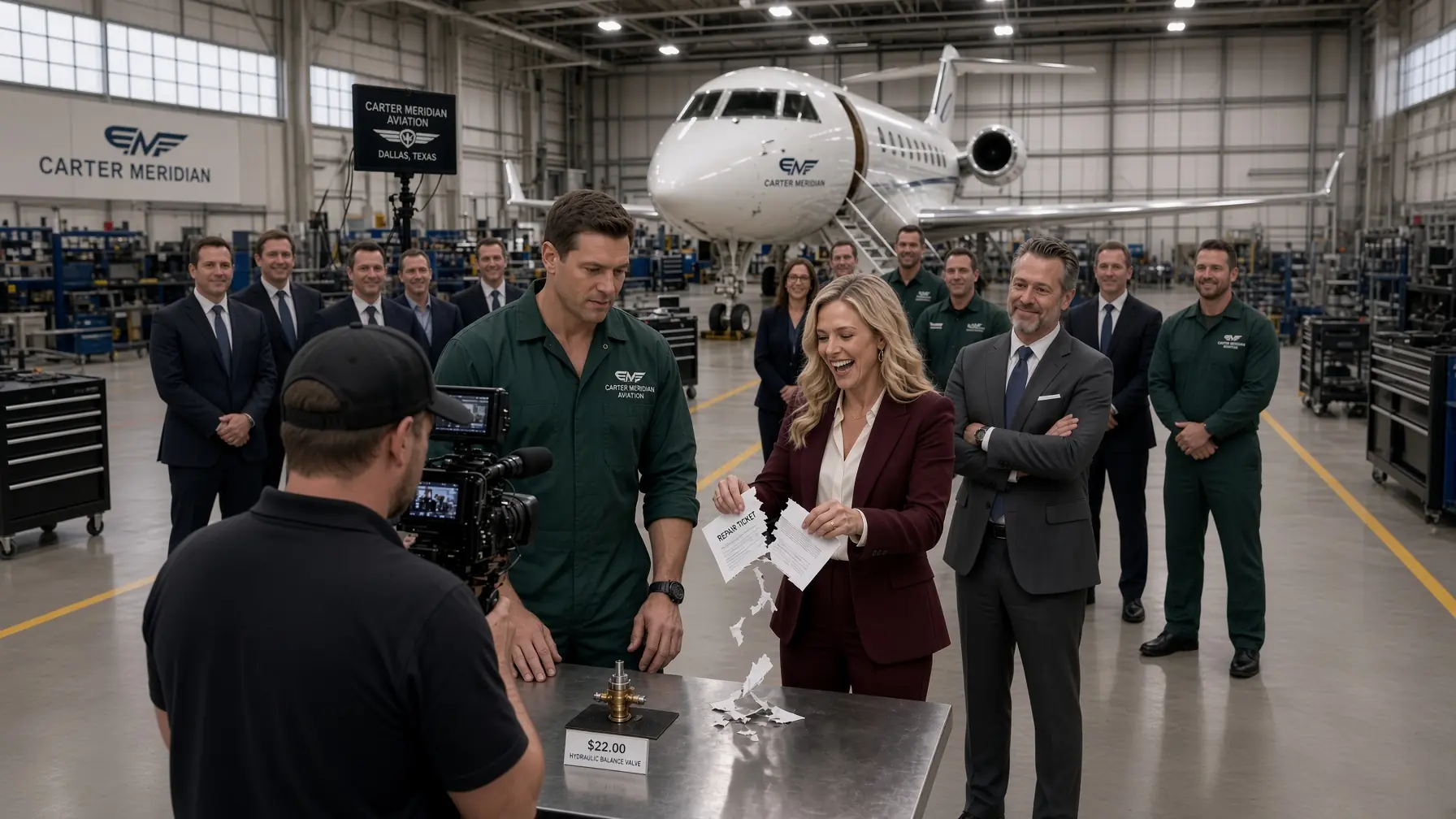
Inside a hangar crowded with shareholders, CEO Amelia Carter laughed when Jackson Wyatt, a single father in faded maintenance coveralls, said he could save the private jet with a $22 hydraulic valve. She tore the repair ticket apart in front of everyone, fired him on the spot, and called it a cheap trick from a mechanic. Jackson said nothing. He set the small valve on the table and walked away without looking back. Three weeks later, the entire fleet sat grounded, contracts collapsed overnight, and Amelia arrived at his front door carrying $22 begging him to return.
Carter Meridian Aviation stood at the edge of a Dallas runway, its glass offices catching the late morning sun while its executives prepared to close a defense transport contract worth hundreds of millions of dollars. The demonstration flight had been staged inside the main hangar, arranged for the board, a cluster of investors, and a delegation from the client company who had flown in specifically to watch the jet perform. The aircraft at the center of it all was the CM-9, the flagship of the fleet and the company's proudest asset. Minutes before the scheduled taxi, a warning light flared across the cockpit display flagging a hydraulic pressure fault in the landing gear control system. The maintenance crew replaced a sensor, inspected the lines, and restarted the flight computer twice, yet the warning kept returning.
Connor Hayes, the operations director, moved through the hangar with the calm of a man who disliked delays more than he disliked mistakes. He proposed grounding the flight and replacing the entire control assembly, a repair that would cost nearly $180,000 and require parts that would not arrive for at least 5 days. A delay of that length threatened to cost Carter Meridian the contract entirely. Jackson Wyatt worked quietly near the maintenance bay, unnoticed by the gathering crowd of decision makers. He did not join the argument swirling around him, and instead crouched beside the forward landing gear and studied a thin trace of fluid pooling beneath the housing, watching how it gathered rather than how it dripped.
He noticed something the others had missed. The pressure was not falling in the steady continuous pattern of a cracked line. It fluctuated only once the system reached a particular temperature threshold, a detail that pointed towards something smaller and stranger than a structural failure. Jackson asked to review the maintenance history, but Connor refused, reminding him that a contract technician had no clearance for that kind of access. Lucas Bennett, the veteran captain assigned to the flight, knew Jackson's background well enough to trust his instincts.
Quietly, without asking permission, he handed Jackson a printout of the flight data logs. Within minutes, Jackson traced the fault to a single balance valve, likely jammed by a rubber seal cut to the wrong dimension for the housing it sat inside. The replacement valve cost $22. Jackson proposed swapping the valve, running a pressure test, and only then deciding whether the larger assembly needed to come apart at all. Connor mocked the suggestion openly, calling it beneath the moment.
Before he could dismiss Jackson entirely, Amelia Carter stepped into the hangar and demanded to know exactly what was happening. Jackson stood there holding the small valve in his palm, facing the young CEO and the entire assembled board. Connor introduced Jackson to the room in the most diminishing way he could manage, describing him as a temporary technician who wanted to fix a $60 million jet with a part that cost less than a dinner out. The description drew a ripple of laughter from several investors who had no context for what they were watching. Amelia felt the weight of the board pressing on her from every direction.
She had inherited the company during a period of rapid expansion, and she lived with a constant fear that any misstep would confirm what certain board members already suspected, that she was too young and too inexperienced to run an aviation company of this size. Letting an unranked technician override her senior engineers in front of a defense client felt, to her, like handing over control she could not afford to lose. Jackson explained the situation plainly. The valve was not fully destroyed. Its internal seal had swollen after prolonged contact with hydraulic fluid that did not match the required specification.
If the valve were replaced and the short section of line cleaned properly, the system should stabilize without further intervention. He added a warning that reached beyond the single aircraft. If substandard fluid had been used on the CM-9, other jets in the fleet could be carrying the same hidden risk. Connor cut him off before Amelia could respond, declaring that Jackson was speculating without evidence. He handed her a report certifying that every fluid and part in inventory met required standards.
Wanting to project decisiveness in front of the investors, Amelia looked down at the $22 repair ticket and laughed. She asked Jackson if he genuinely intended to stake the company's reputation on something bought off a parts store shelf. Jackson answered calmly that the price of a component said nothing about the accuracy of a diagnosis. The response landed as a challenge, and Amelia refused to let it stand unanswered. She tore the repair ticket in half, ordered Connor to replace the entire control assembly, and ended Jackson's contract on the spot.
Lucas started to speak up in Jackson's defense, but Jackson raised a hand to stop him. He placed the new valve on the tool table, gathered his equipment, and walked out of the hangar without another word. Before he reached the door, he turned back toward Amelia and told her that a new control assembly would not fix the actual cause of the failure. Then he added a final warning. No aircraft in the fleet should fly again until every drop of hydraulic fluid had been tested.
Connor scoffed openly at the suggestion. Amelia said nothing in return, though something about the steadiness in Jackson's voice left her unsettled long after he had gone. Once the hangar had emptied, Connor quietly lifted the $22 valve from the tool table and dropped it into a scrap bin. Before anyone could log the request, he deleted the fluid inspection order from the maintenance system entirely. Carter Meridian spent nearly $180,000 replacing the control assembly on the CM-9.
Within 2 days, the aircraft passed every ground inspection and was declared fully operational once again. Connor used the result to prove that Jackson had been wrong. Amelia tried to push away the flicker of guilt she felt over how she had ended his contract in front of everyone. During a test flight, Lucas noticed the hydraulic pressure fluctuating again as the aircraft descended. The warning cleared within seconds, so Connor dismissed it as a minor software glitch, nothing worth reporting.