Camille Ashford stepped down from the black SUV at the Norfolk dry dock, cashmere coat catching the wind, heels striking steel. Ahead, under the blue glare of a welding arc cutting the dawn fog, a man in scorched safety gear knelt against the hull of the Sterling Meridian, sparks fountaining around his shoulders. Her voice cut over the hiss of the torch. Stop. I don’t pay welders to touch my ship without supervision. Step back.
Hollis Vance shut off the torch, lifted his hood, and stepped back exactly three paces. Camille turned away. She did not see him rest his glove against the new bead laid over an old one he had welded 12 years before. The morning shift at Tidewater Marine Works began before the sun.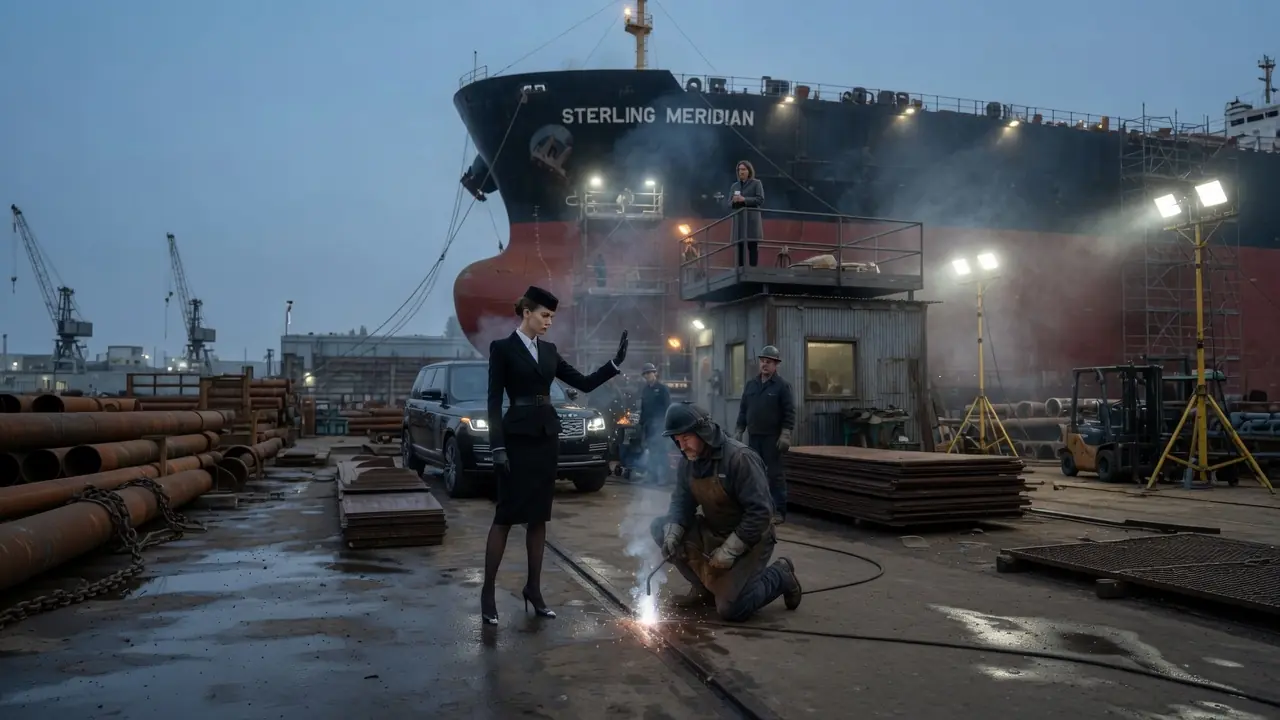
Hollis collected his updated schedule from the dispatch window. Three weeks aboard the Sterling Meridian, graveyard rotation, hull and engine bay work. The foreman, a leathery man named Pete Calder, slid the paper across the counter without looking up. Ashford people are tight on the calendar, he said.
Keep your head down. Don’t talk to the brass. Hollis nodded and folded the paper into his chest pocket. He drove the rust-streaked pickup home along the Elizabeth River as the sky turned the color of brushed steel.
The house was small, two bedrooms and a kitchen that opened onto a porch he had built with his own hands. Wren was already up, sitting at the kitchen table in pajamas, a pencil moving over the pages of a battered sketchbook. She did not look up when he came in. She was deep in the lines.
He set his lunch pail down and came around to look over her shoulder. The drawing was a ship, three-quarter view, the bow lifting out of the page. The proportions were almost right. The rudder placement was exactly right.
He swallowed and did not speak. Daddy, are you fixing a big boat tomorrow? Yeah, a very big one. Is it bigger than the orange one in the harbor?
Bigger than three of those lined up. She smiled at the page and kept drawing. Across the river, on the top floor of the Ashford Maritime Tower, Camille was already in a glass conference room. Garrett Tully sat at the far end of the table with two project binders open in front of him.
His tie was loosened by exactly the amount that suggested he had been there since before her. 19 days, he said, the Singapore consortium is firm. If the Meridian doesn’t leave on the 18th of next month, we lose the $300 million charter and the renewal clause. The refinancing covenant breaks the day after.
Camille did not need the numbers. She had been carrying them in her head for six weeks. What do you need? Cost relief on labor.
I want to swap the in-house engineering crew on the hull repairs for contract welders out of Tidewater. Half the burden rate. We make the calendar. Quality? Tidewater’s certified.
They worked the original build. I’ve already vetted the roster. She read the top sheet of the binder for under a minute, then signed where his finger was waiting. Tully closed the binder before the ink had time to dry.
Two hours later, she was on the dry dock floor in flat-soled boots, walking the length of the hull with the project manager half a step behind her. She turned a corner around the bow scaffolding and saw the same man from the dawn shift bent over a joint at the engine bay. Torch-lit, sparks falling onto a sheet of fire blanket. Who authorized you to work on the engine bay?
Hollis killed the torch and stood. He pulled a folded work order from his chest pocket and held it out without comment. Mr. Tully’s work order. Section nine, paragraph two.
She read it. She handed it back. She walked on without another word. From the office balcony two stories up, Delia Marsh watched the exchange.
Her coffee cup trembled in both hands. She had not seen Hollis Vance in nine years. She had thought, in some private corner of her mind, that she might go a tenth without seeing him again. She set the cup down and pressed her palm flat against the railing until the shaking stopped.
The yard men knew to slow down when they saw the small blue bicycle weaving between the equipment sheds. She found him sitting on an overturned crate by the bow scaffolding, hood pushed back, gloves off. He took the sandwich and made room for her on the crate. She climbed up, opened her sketchbook in her lap, and went back to a drawing she had started the night before.
He ate slowly. He watched her hand move across the paper. Camille was walking the upper gantry with a clipboard when she saw them. A child should not have been on the dry dock floor.
She started toward the access ladder to send a foreman down. And then she paused at the rail because the angle gave her a clear view of the sketchbook. The drawing was a wheelhouse cutaway. The proportions of the chart table relative to the helm were correct.
The rake of the windshield was correct. The bridge wings were drawn with the small chamfer that distinguished a deep-water container ship from a coaster. No 9-year-old drew bridge wings with chamfers. She came down the ladder and crossed the deck.
Hollis saw her coming and started to stand. She waved him back without thinking about it. That’s a beautiful drawing, she said to Wren. Did your dad teach you this? Wren nodded.
He used to draw ships before Mommy went to heaven. Camille did not react. She did not look at Hollis. She thanked the child and walked back across the deck toward the office tower at a measured pace.
And only when the elevator doors closed behind her did her breathing change. In her office, she pulled a contractor personnel file, Hollis Vance, date of hire on current contract six weeks earlier. Prior employment field, blank. References, Tidewater Marine Works.
She closed the folder and opened the company’s legacy design archive instead, a system she had logged into perhaps four times since taking the chair. She searched the Sterling Meridian project files and pulled the original general arrangement plan. The drawing dated to 1four years before. In the title block in the lower right corner, under principal naval architect, was a signature she had walked past for four years without ever looking at properly, H. Vance.
She sat very still. Then she pressed the intercom and asked Delia to come in. Delia closed the door behind her and stood with her hands folded in front of her. Delia, the contractor on the Meridian. Hollis Vance.
Is that the same Vance? It’s a common name in shipbuilding, Ms. Ashford. Delia’s eyes did not lift from the carpet. That night Camille drove herself back to the yard at 11.
She did not announce herself. She stood at the edge of the dry dock under the orange sodium lights and watched the man at the bow weld alone, the blue arc flaring and dying in the dark. His shadow steady on the steel. He moved along the seam the way a pianist moves along a familiar phrase.
He stopped where the bead curved into a difficult angle and adjusted his stance without looking. He had welded this exact seam before. The body remembered. She did not approach.
She watched for 20 minutes. Then she got back in her car and drove home along the empty river road with the radio off. The crack was hairline. It ran along the longitudinal seam of the number three bunker tank, less than two inches, almost invisible under the existing paint.
Hollis found it on the third night of his rotation because he ran his glove along the bead by habit and felt the catch. He stopped. He went back over the same six inches. He felt it again. He wiped the area with solvent and put a magnifier on it.
The crack was not from impact. The bead itself was sound. The base metal beside it had thinned and was beginning to fail. The plate was off-spec.
Lower grade steel had been substituted somewhere in the supply chain and not recently. The corrosion pattern said at least a year. He photographed it, wrote out a discrepancy report by hand on a yellow form, and walked it to the foreman’s shack before dawn. Pete called her, read it twice, and rubbed his face, and called Holly.
Tully called back within 20 minutes. Pete listened, hung up, and looked at Hollis across the desk. He says, Patch it. Don’t escalate. He says we don’t have time.
I’m not signing the completion tag on that bunker. Hollis, I’m not signing it. Pete looked at him for a long moment. Then he shrugged and pushed the form back across the desk. Your name. Your call.
Tully came down to the dry dock himself at 11:00 that morning in a suit that did not belong on a deck. Two foremen and four welders were in earshot, and he made sure of it. You are a contract welder, Mr. Vance. You are not a structural engineer.
You are not the owner of this vessel. You sign the damn tag or you are off the job by lunchtime, and you will not work another Tidewater contract on the Eastern Seaboard. Do we understand each other? Hollis took off his welding gloves slowly and set them on top of his helmet.
I understand you fine. He did not sign. By 2:00, Delia had walked the photographs and the unsigned discrepancy report up to Camille’s office without being asked. Camille read the report twice.
Then she picked up the phone. Send Mr. Vance to my office. Now. Not to the conference room. To my office.
Hollis came up in his work clothes, boots scuffed, a thin line of carbon on the side of his jaw. He stopped just inside the door and waited. Sit down, Mr. Vance. He sat. Why are you refusing to sign?
He did not raise his voice. He did not lean forward. He spoke the way a man speaks when he has thought about the answer for a long time Because if that hull cracks at sea, 300 people die including the crew I’ve worked alongside for 20 years. She looked at him then, really looked.
The scars across the backs of his hands, the frayed cuff of his coat, the way he spoke about the ship, the way a man speaks about a house he built and then sold. I’ll review the report myself. He nodded. He stood. He left. She sat with the report open on her desk for a long time after the door closed. Below the signature on the discrepancy form, she pulled out the original general arrangement plan from the day before and laid the two pages side by side.
The signatures matched. The slope of the H, the loop of the V, the small dot under the E where the pen had rested. The same hand had written both 12 years apart. She drove herself to his house the next evening.
The address in the contractor file down a gravel road off Route 17 through pine scrub to a small wooden house set back from the Elizabeth River with a porch light burning yellow against the dusk. Wren opened the door. Her face went through three expressions in two seconds and settled on a delighted grin. You’re the lady from the shipyard. I am.
Daddy’s making soup. Do you want some? Hollis appeared behind his daughter, dishtowel over one shoulder, expression unreadable. He looked at Camille for a long moment then stepped aside. Come in.
The house was warmer than she had expected. Books on shelves built into the wall, a wood stove in the corner, a long pine table that had been sanded smooth by years of elbows. Wren set her a place without being asked. The soup was lentil with carrots and bay leaf.
The bread was from the bakery on Main Street. Wren did most of the talking about her school, about her teacher who had a parrot, about the drawing she was finishing of a ship called the Mariner’s Dream that she had invented. She put the sketchbook in Camille’s lap between courses and turned the pages for her. Camille had expected childish things.
She found instead a progression. Early pages were rough, fat-lined, the proportions of a six-year-old. Later pages, the ones from the last two years, had cross-sections, deck plans, mooring arrangements. One drawing showed a tugboat with the wheelhouse correctly offset to port for a starboard side tow.
Another showed a small ferry with watertight bulkheads marked in red pencil. You taught her well. Hollis was clearing the soup bowls. She picked it up on her own.
That’s not true. He almost smiled. He did not answer. He brought a wooden bowl of pears from the counter and set it down between them.
Wren took a pear and bit into it without bothering with a knife. Camille turned another page of the sketchbook. The drawing on it was a fishing boat in a quartering sea, the bow lifting against a wave drawn with three quick lines. The waterline was right.
The trim was right. The captain at the wheel was a stick figure with a beard. Who’s the captain? That’s Grandpa Ed.
He died before I was born. Daddy says he had a boat like this in Maine. Hollis was rinsing a pot at the sink. He did not turn around.
After Wren had been put to bed, the two adults sat at the table with the last of the coffee. The fire in the wood stove had burned down to embers. The kitchen smelled of bay leaf and pine. Camille turned her cup in her hands twice before she spoke.
Why are you welding contract jobs, Mr. Vance? He looked past her toward the window, where the river was a flat black band under a quarter moon. Because my hands still know how to do it, and because I don’t owe anyone an explanation for the life I chose. She nodded once.
She did not push. She finished her coffee. She thanked him for the meal. He walked her to her car under a sky thick with stars.
At the door of the car, she paused. She’s a remarkable child. She is. You’re doing right by her. He looked at her for a moment under the porch light.
He did not answer that one, either. He closed the car door once she was inside. She drove home along the river road with the window cracked open. Halfway back, she pulled over onto the shoulder, killed the engine, and sat for a full minute listening to the cicadas.
The smell of pine resin came in through the window. Somewhere out across the water, a barge sounded its low horn. Then she made a call. Delia, tomorrow morning, bring me everything you have on Vance and Holloway Shipbuilding.
Every file, every signature, every personnel record from the acquisition forward, and bring it to my office, not to the file room. Delia arrived at 7:00 the next morning with a banker’s box and a face the color of paper. She set the box on Camille’s desk and closed the door and turned the lock. I worked under your father, Ms. Ashford, from the year he founded the holding company.
I was in the room when he bought Vance and Holloway. Camille waited. Hollis Vance was the principal designer. He and his father-in-law, a man named Ed Holloway, ran the firm. They designed four classes of container ship between them.
Hollis did the work. Ed did the business. When Ed died, Hollis kept building. When his wife, Margaret, was diagnosed, he kept building.
When she passed, he sold the firm to your father 6 months later and signed a non-compete and walked away from a $$40 million earnout he never collected on. He did not want to argue. He just wanted to be done. Camille opened the box.
The top folder was a patent registration. United States Patent Office. Double hull crack arrest system assigned to Vance and Holloway. Inventor H. Vance. Dated nine years before the Sterling Meridian was launched.
The next folder was the bid package for the Meridian itself. The third was the construction log. Hollis’s name appeared on every approval signature for the structural sections. She turned the last page and looked up.
The bunker tank seam. Whose decision was the steel substitution? Delia’s hands went still in her lap. Mr. Tully signed the purchase order for the upgrade refit last winter.
The plate came from a Houston supplier the firm had never used before. The bid was 22% below the next lowest. I flagged it in writing. Mr. Tully told me he had it under control.
He copied me out of the chain the following week. Camille picked up the phone. This is Camille Ashford. I need an emergency independent structural audit of the Sterling Meridian. Full hull. By tonight.
I want the firm out of Newport News. Not the one we usually use. And I do not want Mr. Tully copied on any communication. Bill it to my personal account if you have to.
She hung up. Delia was still standing. Thank you, Delia. Delia nodded and left.
Tully caught Delia in the hallway by the elevators. He did not raise his voice. He did not have to. Whatever she’s planning, you stop it.
Or you are done in this industry. Do you understand me, Delia? Delia nodded. She walked to her desk. She sat down.
Her hands were shaking so badly she had to fold them into her lap to make them stop. That night, Camille drove to the dry dock again. She did not come as the chief executive. She came in jeans and a wool jacket and she walked across the deck plates alone until she found him at the bow, kneeling at the same seam.
He killed the torch and lifted his hood and waited. I know who you are. And why didn’t you tell me? Because it wouldn’t have changed how you treated me on day one.
She did not argue with him. She had no ground to stand on. She turned and walked back across the deck toward her car. And the sound of her footsteps on the steel plates was the only sound in the yard.
The independent audit report landed on Camille’s desk at 6:00 in the morning 2 days later. She read it standing up. She did not sit down for the rest of the morning. She read it twice through and then a third time with a yellow highlighter.
And by the time she was done, the executive summary was the color of egg yolk. 11 points of concern along the hull, all in the longitudinal seams of the bunker and ballast tanks, all in zones where the steel had been substituted during the previous winter’s refit. Probability of structural failure under loaded transoceanic conditions, 61% within the first two voyages. The auditors had used the word catastrophic exactly once in the executive summary.
They had also used the phrase irresponsible substitution of structural grade plate in the technical findings. She called an emergency board meeting for noon. She had nine directors on her board. Five of them were old allies of her father.
Four were her own appointments. Tully had cultivated three of the five old guards for the better part of a decade. He had played golf with two of them on Sundays for as long as anyone in the building had been employed there. He came in prepared.
He had a counter report from a marine surveyor on retainer that called the audit alarmist. He had a timeline that showed the Singapore charter collapsing if the Meridian was pulled. He had a quiet, weary tone that suggested Camille was overreacting under the pressure of her first crisis. He spoke to the room without ever looking at her directly.
He used the word emotional twice in the first 3 minutes. The vote went five to four against pulling the ship. One director abstained. Camille had her hand on the gavel and her voice in her throat when the conference room door opened.
Delia walked in. She was not on the meeting list. She carried a manila folder. She closed the door behind her with both hands and stood for a moment with her back to it.
Her face was composed. Her knuckles were white. She crossed to the table and set the folder on the table in front of Camille. Inside were printed emails, two years of them, between Tully and the Houston steel supplier.
There was a separate agreement attached. The supplier had paid Tully a personal commission of 9% on the contract value, routed through an LLC registered to Tully’s brother-in-law in Nevada. I should have spoken up the day Mr. Vance left, Delia said. Her voice did not shake.
I won’t make that mistake twice. Tully stood up. This is fabricated. The director, who had abstained, pulled the top email toward himself.
He had been the chief financial officer under Camille’s father for 15 years. He knew Tully’s digital signature better than anyone in the room. He looked up at Tully and did not look away. He slid the second email out from under the first and read it without expression.
And then he set it down very deliberately on top of the first. The vote was retaken. The five became one. Tully was suspended pending investigation by the close of business.
Camille did not look at Tully. She looked at Delia, and she nodded once, and Delia nodded back. And that was the only thank you that needed to pass between them. Camille asked the board to stay seated.
She made one phone call from the head of the table. Hollis arrived 20 minutes later in his work clothes. He stopped inside the door and did not sit down. Mr. Vance, she said.
The directors turned to look at him. Can you lead the repair as designer, not as contractor, with full structural authority, full budget, and the in-house engineering team reporting to you? He looked at her for a long moment. Only if Wren can visit the shipyard whenever she wants.
A few of the directors blinked. Camille did not. Done. Hollis took the title of lead structural authority on a single page of paper that Camille drafted herself and signed in front of the board. He did not ask for an office.
He did not ask for a salary number. He asked for the union welders he had worked with on the original build, the ones still in Norfolk. Camille got him every name on his list by the end of the day. The repair began the next morning at 5:00.
Hollis worked the longest hours of any man on the deck. He slept 4 hours a night on a cot in the foreman’s shack. He ate standing up. He stripped the off-spec plate himself in three of the 11 flagged zones because he did not trust the cutters to recognize the metallurgical signs at the edges.
The yard fell into a rhythm around him that the older welders remembered from the original build. Tully was suspended but not silent. From his house in Virginia Beach, he made calls. Within 36 hours, the Singapore consortium had received an anonymous packet of documents suggesting that the Sterling Meridian had suffered an undisclosed structural casualty and that any repair would be cosmetic.
The general counsel of the consortium called Camille personally at 11:00 at night and said the charter was under formal review. Camille flew to Singapore in the morning. 36 hours, one stop, no assistant. She sat across a tea conference table from three men who had been buying ships from Americans for longer than she had been alive.
She put the independent audit report in front of them. She put Hollis’s repair plan in front of them. She put her own personal financial guarantee in front of them drawn against the trust her father had left her. Wait for the post-repair inspection, she said.
If the ship fails any class society standard, the loss is mine personally, not the company’s. Mine. The senior man across the table looked at her for a long moment. Then he closed the folder and slid it back across the table to her and said they would wait. She slept on the flight home for the first time in a week.
While she was in the air, Hollis worked. Wren came to the yard most afternoons with a sandwich for him and her sketchbook for herself. The administrative office let her use a desk in the corner with a glass of pencils and a stack of clean paper. She drew tugboats and crew boats and a small wooden sailing dinghy with two seats.
The welders walked past her on their way out for shift change and tipped their hard hats to her like she was a foreman. One evening she fell asleep at the desk with her cheek on her sketchbook. Hollis carried her out to the truck wrapped in his work jacket. The yard was empty.
The floodlights painted the deck plates white. A taxi pulled up to the gate as he was reaching for the door handle. Camille stepped out of the back seat with her overcoat folded over her arm and her hair pulled back from the long flight. She crossed the lot to the truck.
She did not say anything. She reached past him and gently tugged the jacket up under Wren’s chin so the wind would not get to her neck. Wren did not wake. Singapore agreed. Camille said quietly.
They’ll wait until your inspection clears it. Thank you for trusting the work. I’m trusting the man. A small silence.
He closed the truck door without taking his eyes off her and got in on the driver’s side. She watched the tail lights until they turned out of the yard. By the morning of the 17th day the repair was complete. The independent inspectors came aboard at 8:00.
They were on the ship for nine hours. The yard worked in something close to silence. The report came down at 5:15. All 11 flagged seams passed.
Hull integrity tested 23% above the original specification. The auditors used the phrase exemplary structural craftsmanship in the second paragraph. The senior auditor shook Hollis’s hand on the deck. The Sterling Meridian sailed on the morning of the 19th day.
The dry dock was packed by sunrise. Workers, families, suppliers, three local news vans, the harbormaster, the bishop of the Seafarers Mission in his black coat. The wind off the harbor was cold and steady and smelled of salt and diesel. Children in puffy jackets sat on their father’s shoulders.
The yard band, four men with brass instruments and one woman with a drum, played a slow march from the loading deck. Above the bow, the company flag and the American flag snapped together in the wind. Camille stood on a temporary platform at the bow with the directors in a tight row behind her. She wore a navy coat without a logo on it.
Her hair was loose at her shoulders for the first time anyone on the deck could remember. Delia stood at the foot of the platform with a clipboard and an earpiece, quietly running the ceremony. She found Hollis in the crowd. He was standing toward the back in his work jacket with Wren on his shoulders.
Wren had her sketchbook tucked under one arm and a small American flag in the other hand. He nodded to her once across the deck. Camille had written remarks. She set them down on the lectern unread and spoke without them.
This ship sails today because of one man whose name should have been on every page of its design, Hollis Vance, the architect, not the welder. The crowd turned. Hollis kept his eyes on Camille and gave her a small nod and did not move from where he was standing. Wren waved with her whole arm.
One of the older union welders near the front began to clap, and then the clapping spread across the deck in a wave that did not stop until the senior captain of the Meridian sounded the first short blast of the ship’s horn. The Sterling Meridian was untied at 9:30. The tugs took her out under a clear winter sky. The deck hands cast off the last spring line by hand.
By 11:00 she was a gray shape on the horizon. By 12:00 she was gone. Camille found Hollis at the edge of the parking lot afterward. Wren had gone with another welder’s family to look at a fire truck.
Come back, Camille said, not as a contractor, as chief design officer. You own the design division outright. Equity, authority, your name on every drawing that leaves the building. He looked out toward the water for a long time before he answered.
I left that life for a reason, Ms. Ashford. I’m not the man who needs an office anymore. She did not press. She did not perform disappointment.
She asked the next question honestly, Then what do you want? To finish my coffee tomorrow morning without anyone asking me to be someone I’m not. She laughed. It was a real laugh, short and surprised, the first one she had made in weeks. He noticed it.
He did not say anything about it. The wind moved her hair across her face and she did not push it back. That’s a fair price, she said. Wren came running back across the lot with a sticker of a Dalmatian on her cheek and pretzel salt on her chin.
She caught Camille by the hand without asking permission. Will you have dinner with us again? Hollis did not intervene. Camille looked at him over the top of Wren’s head.
He gave her the smallest shrug, the kind that meant up to you. Two weeks passed. The grand jury indicted Garrett Tully on charges of wire fraud, breach of fiduciary duty, and witness intimidation. The Houston steel supplier was named as an unindicted co-conspirator.
The trade press had a field day. Camille gave one statement to the Norfolk Pilot and refused all other interviews. The statement was four sentences long and ended with a thank you to the welders who had refused to sign a tag they did not believe in. Delia was promoted to chief compliance officer with a board seat.
She accepted on the condition that the company endow a fund for the families of any crewman who reported a structural concern in good faith and was retaliated against. Camille signed it the same afternoon. The fund was capitalized at $$12 million by the end of the quarter. In the same week, without telling anyone in advance, Camille filed papers to create a scholarship foundation under the corporate umbrella, the Vance Foundation.
Full tuition and stipend for high school graduates entering naval architecture or marine engineering programs at any American university. Preference given to applicants from working shipyard families. The initial endowment came from Camille’s personal trust and a matched contribution from the company. The Norfolk Pilot ran the story on a Tuesday morning.
Hollis read it at his kitchen table over his second cup of coffee. Wren leaned over his arm and saw the headline. Daddy, that’s your name. He smiled. He folded the paper in half.
He did not pick up the phone. That Saturday afternoon, Camille drove herself out to the wooden house on the river. She had a box of colored pencils for Wren and a bottle of red wine for the kitchen. She did not call ahead.
Wren opened the door and made a sound that was not quite a word. Hollis appeared behind her with a dish towel over his shoulder, exactly as he had the first time, and he looked at Camille like a man who had been expecting her without having admitted it. The dinner that night was the second the three of them had eaten together. There were no questions about the past.
Wren told a long story about a frog she and her friend Lily had found by the school steps and named Mr. Buttons before letting him go in the rain barrel out back. Hollis sliced bread. Camille poured water into the child’s glass first, the way Wren had taught her to without ever saying so. The wine stayed in its bottle on the counter.
No one mentioned it and no one opened it. After Wren had gone to bed, Camille and Hollis sat on the porch out back with the river running soundless below them. The night was cold but not bitter. He had brought out two wool blankets without asking and laid one across the back of her chair.
Five minutes passed in which neither of them spoke. A heron called once from the reeds and then was quiet. Finally, he said, You didn’t have to name the foundation after me. I didn’t do it for you.
I did it for the next welder I might walk past without seeing. He turned his head and looked at her. She did not look back. She was looking at the river.
Six months later, the Sterling Meridian had completed three trans-Pacific runs without incident. The class society had moved the entire Ashford fleet to a higher inspection tier on the strength of the post-repair audit. Three new commercial contracts had been signed. The refinancing covenant was no longer the only thing in Camille’s calendar.
She did not come to the dry dock in cashmere anymore. She wore canvas jackets in the winter and a long-billed cap in the summer. She knew the names of more than 30 men and women on the yard floor. She still ran the meetings.
She ran them differently. The first hour of every Monday was set aside for any worker in any role to bring a structural concern directly to her without going through their foreman. The first month, no one came. The second month, three did.
By the sixth month, the slot was booked out two weeks in advance. Hollis still took the occasional welding contract. He did not need the money. He liked the weight of the rod in his hand and the small focused world inside the welding hood.
The Vance Foundation had funded its first nine students at the start of the academic year. Two of them had written him letters. He had answered both by hand. On a Saturday afternoon in early October, Camille drove out to the house with a roll of paper under her arm.
Wren was in the front yard with a half-finished birdhouse on a sawhorse. She waved her hammer over her head in greeting and went back to her work. Hollis was at the kitchen table fixing a hinge. Camille unrolled the paper on the empty side of the table.
It was a site plan. Five acres on the river just east of his property. A small boatyard sketched out in pencil. Sheds for traditional wooden hull construction.
A railway down to the water. A workshop. An office that was barely bigger than a closet. I bought the land next door, she said. If someone wanted to build something there, I wouldn’t object.
He looked at the drawing for a long time. He ran his thumb along the line of the railway where the cradle would meet the water. Wren came in to see what they were looking at. She climbed onto a chair and put her chin on her father’s shoulder.
Daddy, will you build a boat for me? Maybe a small one. With your help. Camille rolled up the paper and stood to leave.
She had her car keys in her hand. He walked her to the front door. On the porch step, with the river light coming in low and gold behind her, he said the thing he had not said before. Camille. She stopped. Stay for dinner.
Wren made cookies. She nodded. She turned around. She walked back into the house. The last image is the three of them at the kitchen table.
Wren holding up a misshapen oatmeal cookie like a trophy. Hollis pouring coffee from the chipped enamel pot. Camille laughing, head tipped back. The laugh of a woman who has forgotten for a moment that she is the chief executive of anything.
The camera pulls back through the kitchen window. The light inside the wooden house is warm against the early dusk. Down the river, far out past the bend, the running lights of another container ship blink red and green as it slips out of the Norfolk channel toward open sea. Neither of them had been looking for what they found.
But the river had been there all along, quiet and patient, waiting for both of them to stop running.