Daniel arrived twenty minutes early, the way people do when life has taught them that being late costs more than time. He stepped into the towering glass lobby carrying an old laptop bag with worn corners and a jacket that had clearly seen better years. His clothes were clean but simple, and nothing about him announced success. People noticed him, but only briefly. The receptionist glanced up and offered the kind of polite smile reserved for delivery drivers and contractors.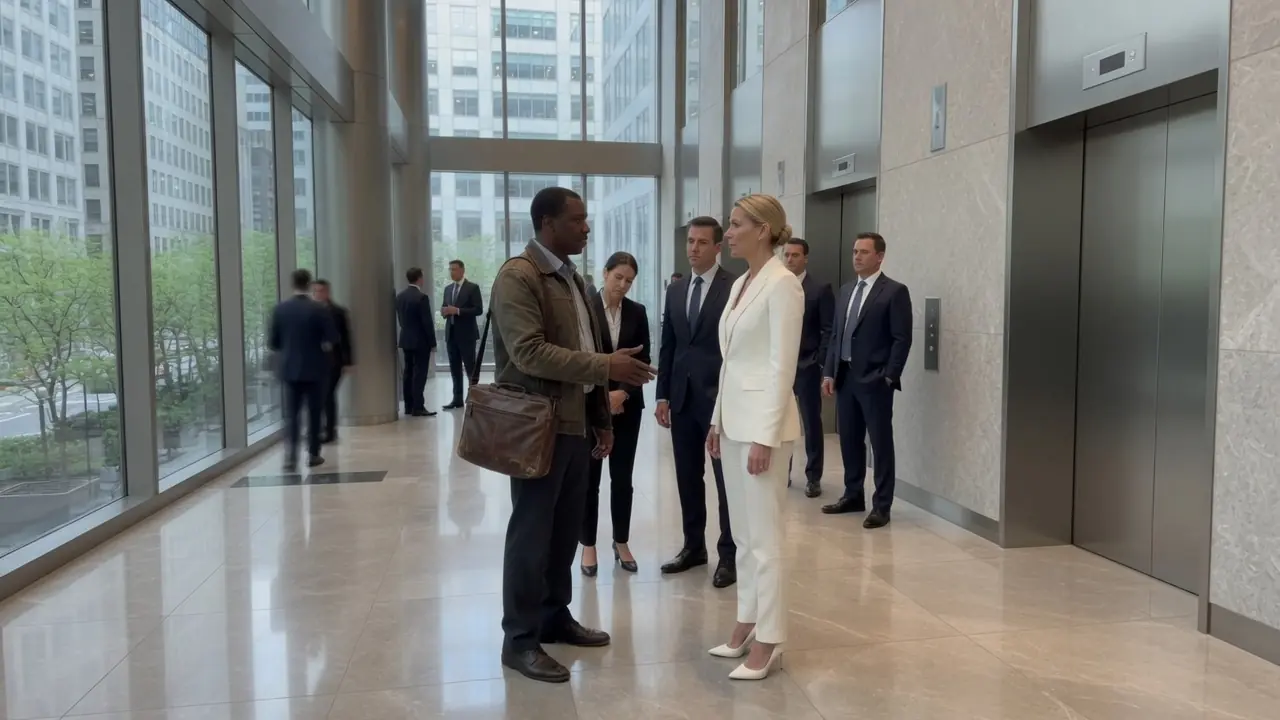
"The service entrance is around back," she said. Daniel gave a small smile and replied, "I am here for the executive partnership meeting." Her expression changed, not into respect, but into confusion. She checked the schedule twice, then reluctantly handed him a visitor badge. He thanked her and sat quietly in the waiting area.
While other executives entered in tailored suits and expensive watches, Daniel opened his laptop and reviewed his notes. Every few minutes, his phone lit up with messages. One was from his daughter and read, "Do not forget dinner tonight," followed by a red heart. He smiled and typed back, "Would not miss it." Years earlier, Daniel had imagined success would change everything.
After becoming a single father, however, his priorities had shifted. Fancy offices stopped mattering, and designer clothes stopped mattering. What mattered was getting home in time, keeping promises, and building something meaningful. The elevator doors opened, and conversation in the lobby softened. CEO Victoria entered surrounded by assistants and senior staff.
Her white suit looked flawless, her steps were confident and quick, and people straightened instantly as she passed. Daniel stood because he had learned long ago that respect should be offered first. With a calm smile, he stepped forward and extended his hand. "Good morning, Daniel Mills," he said. Victoria paused and let her eyes move over him for a second too long.
Daniel slowly lowered his hand, and nobody said anything. The moment lasted only seconds, but everyone nearby felt it. One assistant looked uncomfortable, while another avoided eye contact. Daniel stood still for a moment before quietly taking his seat at the conference table. There was no anger or embarrassment on his face, only the familiar silence earned from years of being underestimated.
He placed his laptop on the polished table, opened his presentation, and looked toward the empty chair where the CEO would soon sit. Then he whispered, "All right," and waited for the meeting to begin. The conference room was quiet in the way expensive places often are, with soft air conditioning, polished wood, and people who measured their words before speaking. Daniel took his seat at the far end of the table. No one introduced themselves, and no one offered him coffee.
Most of the executives still carried the impression they had formed in the lobby, seeing a man in ordinary clothes who probably did not belong there. A large screen lit up behind him. Victoria entered last, sat at the head of the table, and opened a folder without looking at him. "You have twenty minutes," she said. Daniel nodded once and replied, "That is enough."
He stood and connected his laptop. The first slide appeared without flashy graphics or dramatic slogans. It showed only numbers, growth charts, market projections, and operational models. For the first few minutes, people barely paid attention. A few checked emails, and someone tapped a pen.
Daniel kept speaking in a calm, measured voice without sales language or any attempt to impress them. He explained how their company had been losing efficiency across multiple divisions. He also showed how a restructuring model could recover millions within a year. One executive stopped typing, and another slowly looked up. Daniel moved to the next slide and then the next.
Data connected to data, and every problem was followed by a practical solution. Soon the room became completely still. Victoria finally closed her folder and kept her eyes on the screen. Daniel spoke about supply chains, customer retention, expansion opportunities, and risk reduction. Every answer seemed to come before the question was asked.
By the time he reached the final slide, nobody looked distracted anymore. He finished simply by saying, "That concludes my recommendation." Silence followed, but it was not awkward silence. It was thinking silence. One senior executive leaned forward and asked, "Who built this model?"
Daniel looked at him and answered, "I did." Another executive asked, "You personally?" Daniel nodded and said, "It started with spreadsheets at my kitchen table." Someone gave a short laugh, assuming it was a joke. Daniel did not smile, and the room slowly realized he was not joking.
Victoria folded her hands and, for the first time that day, actually looked at him. "This is impressive," she said. She turned a page in her briefing documents, then stopped. Her eyes moved back, she read the line again, and her posture changed. She looked directly at Daniel and said, "Wait."
The room became still as she looked from the document to him. "Daniel Mills," she said, and her voice lost some of its certainty. She turned another page and read, "Mills Holdings." Daniel gave a small nod. One assistant quickly opened her tablet while the executive beside her stared at the screen.
Numbers appeared, followed by ownership records and the corporate structure. Victoria looked back up, and her expression slowly changed. "You are the majority stakeholder," she said. Daniel closed his laptop carefully and replied, "I founded the parent company twelve years ago." Nobody moved.
Victoria's eyes narrowed slightly as she continued quietly, "And your ownership percentage?" Daniel answered without changing expression, "Sixty percent." The words landed heavily. Several people looked at each other, and someone sat back in their chair. Another executive suddenly remembered the ignored handshake and the dismissal in the lobby.
Victoria stayed silent, not because she did not understand, but because she understood perfectly. The man she had assumed was beneath her attention owned more of the company than anyone in the room. Daniel gathered his notes slowly without pride, revenge, satisfaction, or anything except calm. Then he looked at Victoria and said quietly, "I did not come here to prove who I am." His eyes moved across the room as he added, "I came to show what we could become."
For the first time that morning, nobody saw the worn shirt anymore. Nobody spoke after Daniel's words. The conference room, which had felt so certain only minutes earlier, suddenly seemed smaller. Victoria remained seated at the head of the table. Her eyes stayed on Daniel, no longer with authority, but with a quiet discomfort she was not used to feeling.
Around the room, executives shifted in their chairs. Some avoided eye contact, while others pretended to review documents that no longer mattered. Daniel calmly stacked his notes and placed them in his worn laptop bag. There was no dramatic exit and no speech, only someone preparing to leave after finishing his work. Victoria finally stood, and the movement pulled everyone's attention.
She took a breath and walked around the long conference table. People expected a corporate recovery, a joke, or a smooth explanation. Instead, she stopped in front of Daniel and simply looked at him for a moment. Then she said quietly, "Daniel, before this meeting ends, there is something I need to do." The room became completely silent.
Victoria extended her hand fully and steadily, not halfway and not casually. Her voice softened as she said, "When you greeted me earlier, I judged you." No one moved. She continued, "I saw your clothes and made assumptions about your importance." Her eyes lowered briefly as she added, "That was unprofessional, and it was wrong."
Daniel looked at her hand and then at her face. Years ago, he might have enjoyed this moment because proving people wrong had once felt satisfying. Life had changed him through long nights with a sick child, missed opportunities, and building a company while packing school lunches and paying bills. Those experiences taught him something success never could. People reveal themselves most clearly when they think someone has nothing to offer.
Daniel stood, looked around the room, and then looked back at Victoria. Daniel asked calmly, "Do you know what hurt?" "It was not the handshake," he continued, and nobody expected that answer. "It was how quickly everyone decided who I was." He gave a small smile and said, "I have been underestimated before, and it does not break me."
His eyes moved across the executives. "But somewhere in this building, there are people with good ideas who never speak because they think nobody sees them," he said. The room stayed still. Daniel looked back at Victoria. "You do not build great companies by listening only to people who look successful," he said.
Victoria slowly lowered her eyes, not from embarrassment, but from understanding. Daniel reached forward and shook her hand firmly, equally, and without hesitation. It was the same hand she had refused earlier. The difference now was not ownership or wealth. It was recognition.
The room quietly released the breath it had been holding. Victoria turned toward the leadership team, and her voice became clear again. "We are changing a few things," she said, and heads lifted. She announced anonymous proposal reviews, open strategy sessions, and no title-based access restrictions. Several executives exchanged surprised looks.
Victoria looked at Daniel and said, "I would like your help implementing it." Daniel gave a small laugh and asked, "You are asking the guy with the old laptop?" For the first time that day, Victoria smiled. "No," she said softly, "I am asking the person who remembered what the rest of us forgot." Daniel picked up his bag as his phone vibrated with another message.
The message from his daughter asked, "Dad, are you still coming for dinner?" He smiled and typed back, "Leaving now." Then he looked at the room one last time and said, "Build something worth being proud of." He walked out, not as the man who owned sixty percent. He left as the man who had never needed anyone to know.