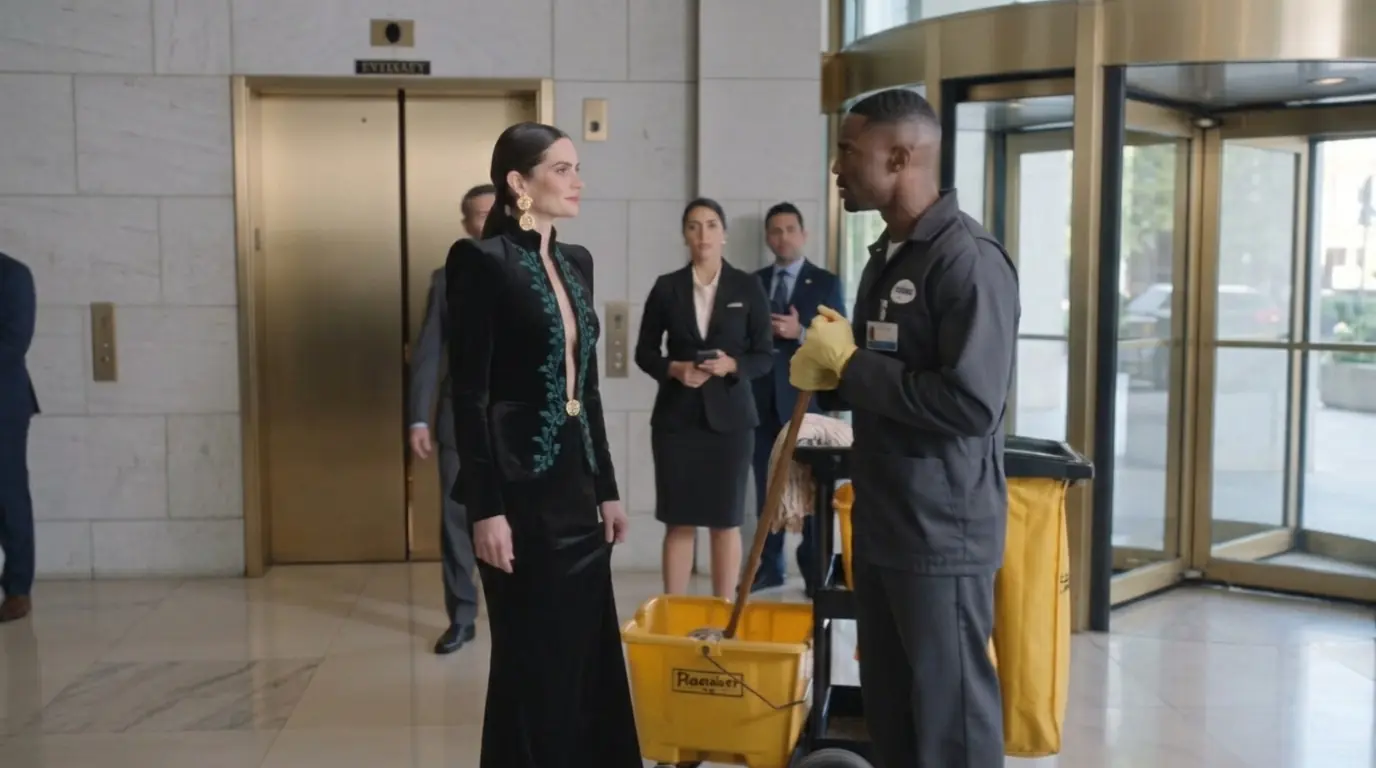
Malcolm Reed cleaned the forty-seventh floor every night, and most of the people who worked there never learned his name.
They knew the uniform. Gray shirt, black pants, rubber-soled shoes, key ring on his belt, and a janitorial cart with one wheel that squeaked no matter how many times he oiled it. They knew the sound of his mop bucket rolling past glass conference rooms after everyone important had gone home. They knew the floors looked spotless by sunrise, but they never wondered who made them that way.
Malcolm had stopped expecting them to wonder.
He was thirty-six years old, Black, widowed, and raising an eight-year-old boy in an apartment small enough that privacy had to be scheduled. His son, Noah, slept in the bedroom. Malcolm slept on the pullout sofa. Their neighbor, Mrs. Rivera, watched Noah during Malcolm’s night shifts, mostly for cash, partly because she had loved Malcolm’s late wife like a daughter.
Naomi Reed had died two years earlier, after a sickness that began with tiredness and ended with hospital rooms, insurance denials, and a little boy asking why heaven needed his mother more than he did.
Malcolm still heard that question sometimes.
Not out loud.
In the quiet.
That was why he did not have the luxury of pride at work. Pride did not pay rent. Pride did not keep Noah in school shoes. Pride did not sit beside a grieving child at 2:00 in the morning when he woke up from a dream and reached for a mother who was no longer there.
So Malcolm worked.
He mopped executive floors. He emptied designer trash cans. He wiped fingerprints from conference tables where people made decisions involving numbers larger than his entire lifetime earnings. He knew which executives drank too much after board meetings, which assistants cried quietly in bathrooms, which conference room smelled like cigars even though the building had strict rules against smoking.
He knew the company better than many people who owned shares in it.
Whitmore Global occupied twelve floors of the Sterling Tower in Manhattan, but the forty-seventh floor was different. It was quieter. Thicker carpet. Softer lighting. Private elevators. Art on the walls that looked accidental until you learned each piece cost more than a house.
At the center of it all was Catherine Whitmore.
Malcolm had seen her only a few times before the night everything changed. Usually from a distance. A tall white woman in her late thirties, always dressed in sharp black or gray suits, hair pinned back, eyes forward, moving through the building like hesitation was something other people practiced. She was the CEO, the face on magazine covers, the woman who had taken her father’s investment firm and turned it into a global machine.
People called her brilliant.
People also called her difficult.
Malcolm suspected both were true.
On the night of the anniversary gala, Whitmore Global was celebrating thirty years in business. The event filled the forty-fifth floor with violin music, silver trays, champagne, and the kind of laughter that always sounded slightly rehearsed. Malcolm could hear it through the ceiling vents while he worked above them.
He was supposed to start on forty-six, but the service elevator skipped too high, stopping on forty-seven with a tired groan.
Malcolm almost pressed the button back down.
Then he looked at his watch and decided to begin at the top.
That small decision later haunted him.
He was passing Conference Room E when his cart snagged on the corner molding. He bent to free it, annoyed by the delay, and that was how he heard voices inside. One belonged to Peter Lang, Whitmore’s chief operating officer. Malcolm recognized the polished impatience of it.
The other voice was older, lower, confident in a way that did not need volume.
“Catherine is distracted,” Peter said. “The board is ready. We just need the right moment.”
The older man answered, “Then give her one. A scandal works only if everyone can understand it quickly.”
Malcolm froze.
His hand stayed on the cart handle.
Peter said something about family votes, an ethics review, and Catherine’s uncle. The older man replied, “Keep her isolated. Keep her defensive. Once she looks unstable, we move.”
Malcolm pulled the cart free and kept walking.
He told himself it was none of his business.
People with offices had office problems. Men like Malcolm survived by knowing the difference between what they heard and what they could afford to know. He had a son, rent, and a supervisor who already warned him twice about taking too long on executive floors.
So he cleaned.
Downstairs, Catherine Whitmore stood beneath a row of glass chandeliers and delivered an eleven-minute speech no one would remember by morning.
She thanked investors. She thanked partners. She honored her father’s legacy. She smiled for photographers. She praised the company’s next chapter with the precision of someone who could do diplomacy in her sleep.
But behind the smile, she felt something breaking loose.
Her uncle, Lawrence Whitmore, had cornered her before the gala near the private bar. He had held a glass of Scotch and told her, in that smooth family voice she hated, that leadership required stability. He said the board worried about perception. He said investors liked certainty. He said a woman in her position needed a personal life that reassured people, not one that made them ask questions.
Catherine understood the translation.
Get married.
Become manageable.
Stop being the daughter who inherited power and started using it.
She smiled through the insult because that was what the Whitmore family had trained her to do. Feel nothing in public. Reveal nothing in rooms where men were waiting to write weakness into minutes. Save the knife for later.
But that night, she drank.
Not wildly.
Not sloppily.
Just enough.
Enough that three glasses of champagne softened the hard wall she kept between herself and the world. Enough that when the gala ended, the silence afterward felt unbearable. Enough that she told her assistant she did not need an escort to her private executive suite on forty-seven.
“I’m fine,” she said.
At 10:54 p.m., Catherine stepped off the private elevator and walked down the dim executive corridor.
She entered what she believed was her suite.
It was not.
Later, security records would show that the door to the adjacent hospitality room had been remotely released three minutes earlier from an administrative terminal. The suite had not been accidentally left open. It had been opened on purpose.
Malcolm was inside because he had returned for his secondary cleaning kit.
He had finished the room earlier, locked his closet, and gone halfway down the hall before realizing he had left the kit beneath the side counter. The kit was nothing special. Gloves, glass cleaner, extra cloths, disinfectant strips. But inventory mattered when your supervisor liked writing up people who could not afford write-ups.
He had just retrieved it when the door opened.
Catherine Whitmore walked in wearing a black evening gown and the kind of exhaustion no magazine cover would ever capture.
Malcolm stood too fast.
“Ma’am, I’m sorry. I was just leaving.”
She looked at him.
Not like a CEO looks at a janitor.
Like a woman seeing someone she had been expecting.
“You stayed,” she said.
Malcolm frowned.
“I think you have the wrong room.”
She took one step closer.
Then another.
Her eyes were bright but unfocused, not careless, not unconscious, but wounded in a way that made him stop thinking in categories. She said a name he did not know. A man’s name. Then she laughed softly, bitterly, as if even she did not believe the sound.
“I knew you’d still be here,” she whispered.
“Ms. Whitmore,” Malcolm said carefully, “you’re in the wrong suite. I can call your assistant.”
“No,” she said.
That word was not a command.
It was a plea.
Malcolm should have left.
He knew that then.
He knows it now.
But loneliness recognizes loneliness before reason can put a warning on it. He saw a woman who had spent her life being surrounded by people and still looked abandoned. She saw a man who had spent years being invisible and, for one strange moment, did not feel invisible to her.
The night that followed was not planned by either of them.
That did not make it simple.
By dawn, Malcolm left through the service corridor with his cleaning kit in one hand and a weight in his chest he could not name. He told himself it was over. A mistake. A strange, private accident between two exhausted people from different worlds who should never have shared the same room.
For three weeks, life returned to its familiar shape.
Malcolm worked.
Noah went to school.
Mrs. Rivera watched game shows from the armchair near Malcolm’s apartment door. The rent still came due. The laundry still piled up. The world did not change simply because one door had opened on the forty-seventh floor.
Then Catherine Whitmore walked into the lobby at 8:41 on a Tuesday morning.
Malcolm had just clocked in early for a day shift because another cleaner called out sick. He was tightening the lid on his mop bucket when the private elevator opened and Catherine crossed the marble floor toward him. She wore a charcoal suit, her hair pulled back, her face composed in the way people compose themselves when the truth has become unavoidable.
The lobby went still.
Receptionists stopped typing.
Security guards looked away too late.
An assistant dropped a stack of visitor badges and did not bend to pick them up.
Catherine stopped two feet in front of Malcolm.
“I need to speak with you.”
Malcolm’s hand tightened around the cart handle.
“All right.”
Her face did not change.
“I’m pregnant,” she said. “And I believe you are the father.”
She did not say it loudly.
She did not have to.
The words hit the lobby like a dropped chandelier.
Malcolm felt the floor move under him, though he knew it had not. He thought of Noah first, not himself. He thought of school pickup, groceries, a child support calculation he had no idea how to survive, and the expression on his son’s face if this became another reason adults whispered about his father.
Catherine looked at him as if she had rehearsed this moment ten times and hated every version.
“I don’t want to discuss it here.”
Malcolm glanced around the lobby.
“You already did.”
Her eyes flickered.
For the first time since he had seen her in the wrong suite, Catherine Whitmore looked ashamed.
The story spread faster than any official statement could catch.
By noon, every floor of Whitmore Global had its own version.
The janitor trapped the CEO.
The CEO had a breakdown in the lobby.
The janitor had been stalking her.
She had paid him off.
He refused.
He planned the whole thing.
None of it was true.
None of it needed to be true to become useful.
Malcolm finished his shift because what else was he supposed to do? Poor people rarely get to collapse dramatically in lobbies. They clock out, pick up children, buy milk, answer homework questions, and wait until everyone else is asleep before sitting at the kitchen table with the disaster.
Noah came out of school that afternoon talking about a drawing contest.
He had drawn a dragon, but his teacher said it looked more like a lizard with emotional problems. Noah found this offensive. Malcolm listened, laughed where he was supposed to, and told him dragons were often misunderstood by people with limited imaginations.
Noah accepted this.
That night, after his son fell asleep under the old dinosaur blanket Naomi had bought him, Malcolm sat alone with cold coffee and stared at nothing.
Two days later, Catherine’s assistant called.
The meeting was at a law office on Park Avenue.
Neutral ground.
That told Malcolm enough before he even arrived.
He wore his best shirt, a pale blue button-down with a collar that never quite sat right. Catherine sat across from him with a lawyer named Audrey Vale. The room smelled like leather, printer ink, and expensive quiet.
Catherine confirmed the pregnancy.
Eight weeks.
The timeline fit.
Audrey slid a document across the table.
It stated that Malcolm would be listed as the father pending medical confirmation. He would receive legal protection, financial support, continued employment, and a housing stipend if the child proved to be his. In return, he would sign a confidentiality agreement and agree not to speak publicly about the matter.
Malcolm read the line about Noah twice.
The agreement promised no challenge to Malcolm’s custody, no background report, no referral to family services, no action tied to “reputational concerns.”
He looked up.
“Why is my son in this?”
Catherine held his gaze.
“Because other people may try to use him.”
“Other people meaning your family?”
Her silence answered.
Malcolm set the document down.
“What happens if I don’t sign?”
Audrey began to speak.
Catherine stopped her with one small movement.
“If you don’t sign, I can’t control what the board or my family does with the story already forming.”
“That sounds like a threat.”
“It is not meant as one.”
“But it functions like one.”
Catherine looked down for the first time.
“Yes.”
Malcolm hated her for that honesty less than he wanted to.
He signed because Noah was not a risk he could gamble with.
He signed because men without money often have to choose the least dangerous chain.
He signed because power had already entered the room long before he sat down.
That evening, Lawrence Whitmore called Catherine from his private estate in Connecticut.
He did not ask how she felt.
He did not ask whether she was frightened.
He said the board was concerned.
He said investors would not tolerate instability.
He said a child connected to a night-shift employee with no background, no assets, and no proper standing would create a narrative the company might not survive.
He did not use the word Black.
He did not have to.
People like Lawrence knew how to speak in polished rooms. They used words like optics, foundation, suitability, and legacy. The old ugliness did not disappear when it learned grammar. It simply put on a better suit.
Catherine stood at her office window and listened.
For the first time in her life, she heard her uncle clearly.
Not as family.
Not as strategist.
As a man who believed people could be arranged by value.
When he finished, she said, “I’ll take that under advisement.”
Lawrence exhaled.
“You’re making an emotional mistake.”
“No,” Catherine said. “I think I made one already by confusing your concern with wisdom.”
Then she hung up.
The contract protected Malcolm on paper.
It did not protect him in hallways.
The whispers changed shape.
At first, they had been scandal.
Then they became accusation.
He planned it.
He waited for her.
He knew what he was doing.
A man like that sees a rich woman and calculates.
A man like that.
No one said the rest.
They didn’t need to.
Malcolm heard enough through office doors, supply closets, and break rooms. The people who ignored him for three years suddenly had theories about his character. Executives who could not have picked him out of a lineup two months earlier now spoke of him as if he had been a threat lurking near the elevator the entire time.
He kept working.
That was the part they did not understand.
Humiliation did not cancel bills.
One evening, a man in a dark wool coat approached Malcolm in the parking garage.
He introduced himself as a representative for the Whitmore family’s private interests. He was polite, clean-shaven, and emotionless in the way people become when money has trained them to deliver cruelty with good posture.
He placed an envelope on the hood of Malcolm’s car.
Inside was a check.
The number made Malcolm read it twice.
Enough to move.
Enough to pay off debt.
Enough to put Noah through college if used carefully.
The man spoke gently.
“A child tied to the Whitmore name needs a certain kind of life. A certain kind of foundation. A man in your position would have difficulty providing that. The family prefers a private arrangement.”
Malcolm looked at the check.
Then at the man.
“You mean disappear.”
“I mean reduce unnecessary conflict.”
“You mean disappear.”
The man’s pleasant expression did not move.
“The alternative will be difficult.”
Malcolm tore the check in half.
Then in quarters.
Then placed the pieces back in the envelope.
“Tell Lawrence Whitmore I’ll see him wherever he wants to take this. Court, boardroom, street corner. I’m not selling my child.”
The man picked up the envelope.
“Think carefully, Mr. Reed.”
“I did.”
The next attack came through Noah.
A week later, the school called Malcolm into the office.
An anonymous complaint had been made regarding the stability of Noah’s home environment. The words were careful. Financial insecurity. Emotional volatility. Questionable judgment. Potential exposure to adult scandal.
Malcolm sat in the principal’s office while a woman who had never seen him miss a parent conference explained that procedure required documentation.
“Who made the complaint?”
“We cannot disclose that.”
“Was there evidence?”
“We are required to follow up.”
He walked out of the school with rage burning so hot it left him cold.
That evening, he called Catherine from the lobby.
She came down herself.
He told her everything.
This time, he did not soften anything.
“Whatever war your family wants with me, fine,” Malcolm said. “But my son is not one of your board pieces. If they touch him again, I will stop being polite.”
Catherine looked at him.
Not as CEO.
Not as the woman who had placed a legal document between them.
As a person finally understanding the price someone else was being forced to pay for her world.
“You’re right,” she said.
Malcolm almost laughed.
“That doesn’t fix anything.”
“No,” she said. “But it changes what I do next.”
Before either of them could act, the floor dropped.
Two weeks later, Malcolm was called into Human Resources.
A report had been filed accusing him of stealing cleaning supplies over several months. The report was specific enough to sound real and vague enough to be nearly impossible to disprove without access to internal inventory records. Combined with “concerns about professional boundaries involving executive leadership,” the recommendation was immediate termination.
His ID badge stopped working before he left the building.
That same afternoon, Whitmore Global’s board issued a statement.
Catherine Whitmore was stepping back from operational duties pending review of decisions that had raised concerns about governance, ethics, and company stability.
She had been removed.
Cleanly.
Quietly.
Exactly the way people remove powerful women when they want the knife to look like paperwork.
By 5:00 p.m., Malcolm had lost his job.
Catherine had lost her company.
Noah still needed to be picked up at 5:30.
That was how life worked.
Even when your world collapsed, school dismissal did not reschedule itself.
Malcolm spent that night at his kitchen table after Noah fell asleep, laying every piece out in his mind.
The conversation outside Conference Room E.
The older voice telling Peter to keep Catherine isolated.
The wrong suite opening too easily.
The legal agreement that seemed prepared for a disaster before the disaster had time to become public.
The parking garage check.
The school complaint.
The false HR report.
Catherine’s removal from power on the same day he was fired.
Separate events were easier to survive.
Connected events were harder to ignore.
At 2:17 a.m., Malcolm stopped trying to explain them separately.
The shape became clear.
Someone had not merely used the scandal.
Someone had built a trap around it.
The wrong door had been unlocked.
The wrong people had been placed in the same room.
Catherine had been isolated. Malcolm had been chosen because he seemed disposable. If he accepted money, he vanished. If he resisted, he became evidence against her. If she defended him, she looked reckless. If she abandoned him, she proved her family right.
It was elegant.
Cruel.
And incomplete.
Because the people who built it forgot one thing about invisible workers.
They hear everything.
Malcolm called Catherine.
She answered on the second ring.
“I think the room was unlocked on purpose,” he said.
There was no pause.
“I know.”
That surprised him.
“You know?”
“I found something. Not enough. But something.”
By nine the next morning, Malcolm was sitting at Catherine’s apartment dining table.
The apartment was not what he expected. Beautiful, yes, but strangely unlived-in. Too clean. Too quiet. Like a hotel room owned by someone who never took off their armor long enough to leave a mark.
Catherine wore a plain white shirt and no makeup.
That somehow made her look younger and more tired.
She opened her laptop and turned it toward him.
“Security logs.”
The screen showed door access records from the night of the gala.
At 10:51 p.m., the hospitality suite adjacent to Catherine’s private suite had been remotely released from an administrative terminal. Not left open. Not malfunctioning. Released.
Malcolm stared at the timestamp.
“I was in that room because I left my cleaning kit.”
“I was sent there because my key card was redirected.”
“By who?”
Catherine clicked another file.
The terminal login belonged to building operations, but the access request had been routed through an executive override. Peter Lang’s office. Authorized through a secondary credential tied to Lawrence Whitmore’s private counsel.
Malcolm leaned back.
“They built it.”
Catherine’s face was pale.
“They built enough of it.”
He looked at her.
“Did you know?”
“No.”
The answer came quickly.
Too quickly to be calculated.
Malcolm believed it, and that bothered him because believing her meant the fight had become larger than blame.
Catherine looked at him for a long moment.
“I owe you an apology.”
“You owe me several.”
“Yes.”
“You owe my son more.”
Her face changed.
“Yes.”
Malcolm nodded once.
“Then let’s start there.”
They worked for four hours.
Catherine pulled calendar records she had saved to a personal device after years of distrust taught her never to leave all evidence inside a building her uncle could access. Lawrence had met privately with four board members in the six weeks before the gala. Peter had scheduled undocumented calls with the same members under project codes that did not exist.
Malcolm wrote down everything he remembered.
The two hallway conversations.
The man in the parking garage.
The HR meeting.
The exact phrases used in the school complaint.
Catherine found another connection. The anonymous email to Noah’s school had originated through a shell address linked to a former Whitmore contractor. That contractor had billed Lawrence’s private office three times that month.
The trap began losing its elegance.
By the end of the day, Catherine contacted Whitmore Global’s external counsel, not the internal legal team Lawrence had quietly filled with loyalists. She sent security logs, calendar discrepancies, executive override records, Malcolm’s signed statement, and a formal request to investigate board misconduct, retaliation, and unlawful manipulation of employee records.
Malcolm expected silence.
Instead, eleven days of controlled chaos began.
On day three, the external counsel requested preservation of all security footage, HR records, access logs, and communications involving Lawrence, Peter, and the board’s governance committee.
On day five, Peter Lang was placed on administrative leave.
On day six, Noah’s school closed the complaint after the source email was tied to an outside actor with no direct knowledge of Malcolm’s home.
On day seven, the false inventory report against Malcolm collapsed when warehouse records showed the alleged missing supplies were still in sealed storage.
On day nine, a board member resigned.
On day eleven, Lawrence Whitmore lost the vote he had spent more than a year building.
Catherine told Malcolm over the phone.
“It was quiet,” she said.
“What was?”
“My uncle leaving the boardroom. I always thought it would feel bigger.”
“Did it?”
“No.”
“What did it feel like?”
“Like someone closed a window that had been letting in cold air for years.”
Whitmore Global issued a new statement the next morning.
Catherine Whitmore would return as CEO following an independent review that found serious misconduct by former executives and directors. Peter Lang had been terminated for cause. Lawrence Whitmore had resigned from the board and would face civil claims related to governance violations, retaliation, and misuse of corporate access systems.
Malcolm’s termination was reversed.
He was offered reinstatement, back pay, and an apology from the head of HR, who looked like she would rather chew glass than say the words out loud.
Malcolm listened.
Then declined the job.
“I cleaned your floors for three years,” he said. “I’m not coming back as a symbol.”
Catherine did not argue.
Instead, she asked him what he wanted.
That question almost made him laugh.
People with money ask that question casually, as if wanting is not something poverty teaches a person to lock away.
“I want my name cleared,” he said. “I want the school complaint erased from every file. I want the people who used my son exposed. I want my back pay. I want references for work somewhere else. And I want every night-shift worker in that building to have access to legal support if management tries to bury them.”
Catherine wrote it all down.
Then she did something Malcolm did not expect.
She made it company policy.
The settlement included back pay, damages, removal of all disciplinary records, tuition support for Noah, and the creation of an employee advocacy fund for low-wage staff. The security staff who ignored prior complaints about executive floor misconduct were retrained or removed. Building access logs became auditable by an outside firm.
It did not undo what happened.
Nothing does.
But it forced the damage to leave a record.
Three months later, Catherine came to Malcolm’s apartment for dinner.
Not in a limo.
Not with security.
Alone, holding a grocery store pie in both hands like she was afraid she might be graded on it.
Noah opened the door before Malcolm could.
He looked her up and down with the seriousness of a judge.
“Do you like dinosaurs?”
Catherine blinked.
“I don’t know much about them.”
Noah narrowed his eyes.
“That’s not a no.”
“No,” she said carefully. “It is not.”
He stepped aside.
“I can teach you.”
“I would appreciate that.”
Malcolm watched from the kitchen doorway, something in his chest shifting before he could stop it.
Dinner was spaghetti because it was Tuesday and Tuesdays had become spaghetti by family law. Catherine sat at the small kitchen table, listened as Noah explained the difference between a pterodactyl and a dinosaur, and asked questions that were not fake. That mattered to Noah. It mattered to Malcolm more than he wanted it to.
After Noah fell asleep on the couch under his old blue blanket, Catherine stood in the kitchen holding a mug of coffee with both hands.
“I don’t know how to do this,” she said.
“Do what?”
She looked toward the living room.
“Any of it. Family. Trust. Showing up without turning it into strategy.”
Malcolm leaned against the counter.
“You start by showing up.”
“That sounds too simple.”
“It isn’t.”
She nodded slowly.
“I’m sorry for the contract.”
“You should be.”
“I’m sorry I treated you like a problem to manage before I treated you like a person.”
“That one matters more.”
She looked at him.
“I know.”
They did not become a family overnight.
Real life does not work that cleanly.
There were doctor’s appointments and legal confirmations, awkward conversations, bad days, trust built unevenly, and moments where Malcolm wondered whether he was being foolish to let Catherine anywhere near the fragile life he had fought so hard to protect. There were days when Catherine retreated into coldness without meaning to, because control had been her first language longer than tenderness had been an option.
But she kept showing up.
She showed up at Noah’s school science fair in a navy blazer and stood seriously in front of a cardboard volcano as Noah explained lava flow with the authority of a tenured professor.
She showed up for the ultrasound and cried before she realized she was crying.
She showed up when Malcolm found a new job as facilities coordinator at a nonprofit hospital, a position with benefits, daytime hours, and a supervisor who called him Mr. Reed from the beginning.
She showed up on Naomi’s birthday with flowers, and did not try to compete with a dead woman’s memory.
That was when Malcolm began to trust her.
Not fully.
Enough.
The baby was born in June.
A girl.
They named her Lena.
Noah decided she looked like “a potato with opinions,” which Catherine wrote down because she found it oddly accurate.
When Malcolm held Lena for the first time, he felt the old fear rise.
The fear that love was just another thing life could take if he held it too tightly.
Then Noah climbed into the chair beside him and touched his sister’s tiny hand.
“She’s loud,” he whispered.
“She’s new,” Malcolm said.
“I was new once.”
“You were.”
“Was I this loud?”
“Louder.”
Noah looked satisfied.
Catherine stood in the doorway watching them.
For once, she did not look like a CEO.
She looked like a woman trying to understand how a life she did not plan had become the only one that felt real.
A year later, Whitmore Global held another anniversary event.
This time, Catherine kept the speech shorter.
She thanked the employees by name, not only the executives. She announced permanent wage increases for night staff, childcare subsidies, and a whistleblower system monitored outside the company. Some board members looked uncomfortable. Catherine seemed to enjoy that part.
Malcolm was not there as staff.
He attended as family.
Noah wore a small suit and complained about the collar. Lena slept against Catherine’s shoulder through most of the event. People stared, of course. People always stare when the story they told themselves refuses to behave.
Lawrence Whitmore was gone.
Peter Lang was under indictment for corporate misconduct tied to access manipulation, retaliation, and falsified internal documents. Two former board members settled civil claims quietly. The man who offered Malcolm the check in the parking garage lost his license after evidence showed he helped coordinate the intimidation campaign.
The room had changed.
Not because wealth became noble.
Because power had been forced to answer for itself.
Late that night, after the event ended, Malcolm found himself on the forty-seventh floor again.
Not cleaning.
Just standing.
The corridor looked the same: soft lighting, expensive carpet, glass walls, polished silence. Conference Room E still sat where it always had. The hospitality suite door had been replaced, but Malcolm knew the frame.
Catherine stood beside him.
“That door changed everything,” she said.
“No,” Malcolm said. “The people who opened it did.”
She looked at him.
“And us?”
“We decided what to do after.”
They stood there for a moment without speaking.
Then Lena fussed softly in Catherine’s arms, and Noah announced from down the hall that rich people had boring snacks.
Malcolm laughed.
Catherine did too.
That sound in that hallway felt like a kind of victory no board vote could measure.
Years later, people told the story in simpler ways.
They said a janitor had a child with a billionaire CEO.
They said a powerful family tried to erase him.
They said he uncovered the trap, saved her company, protected his son, and became part of a life no one expected.
All of that was true.
But it missed the heart of it.
The truth was that Malcolm Reed had been invisible for years inside a building that depended on his labor while pretending he was not there. He had been chosen as a weapon because powerful men believed invisible people were easy to move, easy to blame, easy to discard.
They were wrong.
Invisible people listen.
Invisible people remember.
Invisible people know which doors close properly and which ones open too easily.
That was what Lawrence Whitmore never understood.
He thought power meant controlling the room.
Malcolm knew survival meant noticing everything inside it.
And Catherine learned, slowly and painfully, that control was not the same as strength. Strength was admitting harm. Strength was standing beside someone when it would be easier to hide behind lawyers. Strength was showing up again the next morning, and the next, and the next, until a thing too broken to name became something living.
No one planned their family.
It did not arrive clean.
It came through scandal, grief, fear, class, race, power, shame, evidence, apology, and stubborn daily effort.
But one evening, years after the gala, Malcolm came home from work and found Catherine at the kitchen table with Noah, Lena, and a pile of construction paper dinosaurs. The apartment had become a house by then. The refrigerator was still covered in drawings. The old Ohio magnet from Naomi’s road trip still held the corner of a school calendar.
Catherine looked up.
Lena shouted, “Daddy!”
Noah said, “We need you to judge whether this is a dragon or a scientifically inaccurate pterosaur.”
Malcolm set down his keys.
For a second, he simply stood there.
Not invisible.
Not managed.
Not bought.
Not erased.
Seen.
And that, he realized, was the thing all the money in Whitmore Tower had never been able to purchase.
A life where someone looked up when he walked in and knew his name.