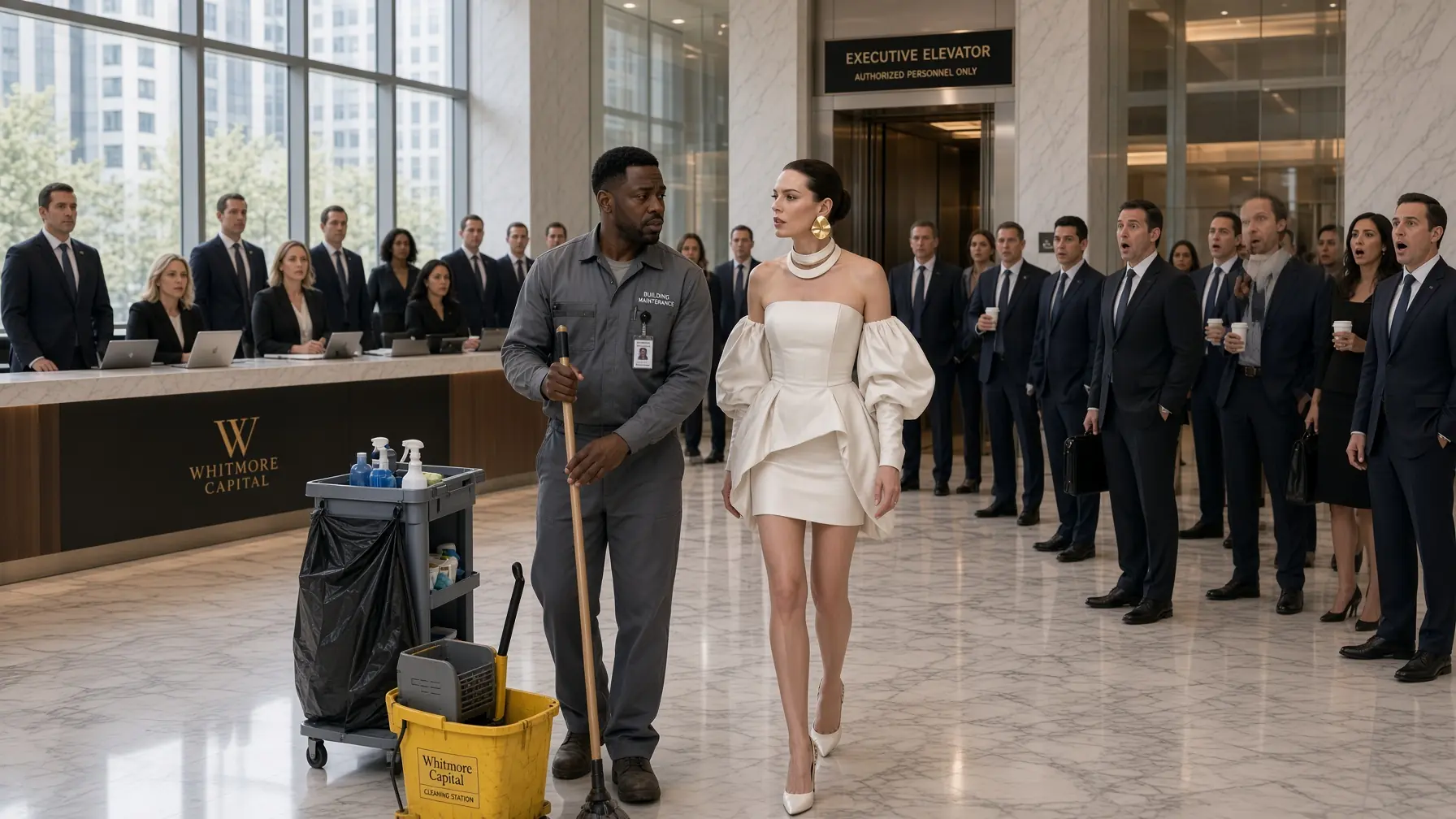
Every night, Nathan Cole cleaned the floors of people who did not know his name.
They knew the gray uniform.
They knew the mop bucket.
They knew the janitorial cart with the broken right wheel that squeaked whenever he turned too quickly near the executive elevators.
But Nathan himself was mostly invisible inside Whitmore Capital, and after three years on the night shift, he had learned that invisibility could be useful.
It kept people from asking questions.
It kept managers from inventing problems.
It kept him employed.
And employment mattered more than pride when a seven-year-old boy was waiting at home with homework half-finished, sneakers too small, and a dinosaur blanket he refused to give up because his mother had bought it before she got sick.
Nathan’s son was named Eli.
Eli loved pancakes, space rockets, and correcting adults who called a brontosaurus the wrong thing. He slept in the small bedroom at the end of the hall while Mrs. Alvarez from downstairs sat on the couch with the television low until Nathan came home after dawn. Nathan paid her when he could, apologized when he could not, and she always waved him off like the debt was less important than the boy.
She had known Nathan’s wife, Rosa.
That changed everything.
Rosa had died two years earlier after a sickness that emptied their savings before it took her body. Since then, Nathan had lived by a simple rule. Keep working. Keep quiet. Keep Eli safe. Anything beyond that was a luxury he could not afford.
Whitmore Capital occupied forty-three floors of a glass tower in downtown Boston.
The lower floors smelled like printer paper, coffee, and stress.
The upper floors smelled like leather chairs, polished wood, and expensive decisions.
Nathan knew the whole building better than most executives did. He knew which conference room thermostat lied by four degrees. He knew which managing director smoked in the private bathroom after 9:30 p.m. He knew which office kept a framed family photo turned backward whenever its owner was having an affair.
People told buildings the truth in ways they never told each other.
Nathan noticed those truths and carried them nowhere.
That was part of the job.
On the night everything changed, Whitmore Capital was celebrating its thirtieth anniversary with a private gala on the thirty-ninth floor. Nathan could hear the music through the ceiling as he worked on forty, something soft and expensive played by people in black suits for people in better black suits. The guests were beginning to leave by the time he reached the executive hallway, their laughter floating up through service corridors like smoke from a fire already dying.
He was not supposed to be on the forty-second floor until later.
But the service elevator skipped his stop, opened two floors too high, and Nathan decided to start there and work down. He had made that decision a hundred times before. It meant nothing. It should have meant nothing.
Near the east wing, his cart caught against the metal frame of a half-open conference room door.
He bent to free the wheel.
That was when he heard voices inside.
One belonged to Phillip Dane, the chief operations officer. Nathan knew him because Dane was the kind of executive who never said thank you to staff, not even by accident. The other voice was older, smoother, more controlled.
Nathan did not know the man’s name yet.
He heard only pieces.
“She’s distracted.”
“The board is nearly ready.”
“Give it a few more weeks.”
Then the older voice said, “Good. Keep her isolated. When the moment comes, she won’t know which direction the strike came from.”
Nathan pulled the cart loose.
He stood there for half a second longer than he should have.
Then he moved on.
He had no reason to care about executive politics. Men in expensive suits had been plotting against one another long before Nathan entered the building, and they would keep doing it after he emptied their trash. Whatever he had heard belonged to a world far above his pay grade.
At least, that was what he told himself.
The gala had been for Laura Bennett Whitmore.
She was thirty-nine years old, chief executive officer, and the public face of Whitmore Capital. Under her leadership, the company had gone from a respected regional investment firm to one of the strongest private capital groups on the East Coast. She was known for discipline, precision, and the rare ability to make men twice her age explain themselves without ever raising her voice.
Her employees respected her.
Her competitors feared her.
Her family waited.
Her uncle, Victor Whitmore, had been waiting for years.
Victor was her father’s younger brother, and he had never forgiven the board for choosing Laura over him. He smiled in public, toasted her success, and called her brilliant in interviews. But in private, he had been building influence, gathering board votes, placing loyal people in legal, operations, and security, and waiting for one mistake large enough to make him look less like an opportunist and more like a savior.
That night, at the gala, he had made one comment too many.
He told three board members that Whitmore Capital needed “a steadier family structure at the top.”
Everyone understood what he meant.
A woman CEO without a husband was too independent.
A woman without children was too cold.
A woman with power and no visible domestic anchor was, in Victor’s mind, a temporary problem waiting for correction.
Laura smiled when he said it.
She even laughed lightly, because power sometimes requires pretending the insult amused you.
But the sentence stayed with her.
She did not drink often. She disliked anything that loosened control. But the evening had been long, Victor had been everywhere, and the board members had kept raising glasses to her success as if each toast were a small test of how graciously she could endure being watched.
One drink became two.
Two became three.
By the time the gala ended, Laura was not loud or careless. She was worse. She was quiet, polished, and deeply unmoored beneath the surface. The kind of drunk that happens when someone who never lets herself need anything suddenly has no strength left to keep every wall upright.
She told her assistant she was going to her private suite on forty-two.
Her assistant asked if she needed someone to walk with her.
Laura said no.
Laura always said no.
What she did not know was that her suite was not the room she entered.
The door she opened had been released remotely at 10:57 p.m. from a building administration terminal. It was not an accident. It was not a faulty lock. Someone had unlocked the room after the gala ended and after Laura’s assistant had been told she would be going upstairs alone.
Nathan had cleaned that suite earlier.
He had left it shut.
He returned only because he realized he had left his secondary supply kit in the small storage closet near the bathroom. It was a small mistake, barely worth correcting, but Nathan was particular about inventory. Losing supplies meant answering questions. Answering questions meant being noticed.
He retrieved the kit and was about to leave when the door opened.
Laura Whitmore stepped inside in a black evening gown, one hand against the wall for balance, hair still perfect, eyes tired in a way that makeup could not hide. Nathan rose quickly from where he had crouched near the closet.
“Excuse me, ma’am. I’m just leaving.”
She looked straight at him.
Then she smiled faintly.
“I knew you’d wait.”
Nathan froze.
“Ma’am, I think you have the wrong room.”
She took a slow step toward him.
The city lights behind her turned the room silver.
“No,” she said softly. “Just tonight. Nobody has to know.”
He should have left.
He knew that then.
He knew it even more later.
But in that moment, Laura Whitmore did not look like the woman on magazine covers or company videos. She looked like a person who had spent so many years being untouchable that she had forgotten how lonely it was. Nathan, who spent every night being unseen, understood loneliness better than he wanted to.
He stayed.
That was the truth.
No pretty explanation made it cleaner.
No later conspiracy erased the fact that he made a choice in that room.
The night became something neither of them had planned and neither of them could undo. When dawn thinned the windows with gray light, Nathan gathered his kit, stepped into the hallway, and took the service elevator down without looking back.
For three weeks, he told himself it was over.
He worked.
He made Eli breakfast.
He fixed a loose cabinet door.
He helped with spelling words.
He listened to his son explain why pterosaurs were not dinosaurs, technically, which Eli considered an important distinction for any serious person.
At night, he pushed his cart through Whitmore Capital and avoided the forty-second floor whenever possible.
Then, on a Monday morning at 8:32, Nathan was mopping the lobby when the executive elevator opened.
Laura Whitmore stepped out.
The lobby shifted before she said a word.
Receptionists straightened.
An analyst near the coffee bar stopped mid-sentence.
A security guard took one step forward, then stopped because Laura’s eyes were fixed on Nathan.
She crossed the polished floor in a gray suit, her face composed but pale. Nathan stood with the mop handle in his hand, one sleeve rolled up, his name badge slightly crooked. He had never looked more like what the building believed he was.
She stopped in front of him.
“Nathan Cole?”
It was the first time he had heard her say his real name.
“Yes, ma’am.”
Her voice remained low, but the room was silent enough to carry it.
“I need to speak with you. I think I’m pregnant, and I believe you’re the father.”
The mop water settled in the bucket.
No one moved.
For one strange second, Nathan became aware of every detail at once: the smell of floor cleaner, the shine of the marble, the receptionist’s hand frozen over the phone, the way Laura’s eyes did not move away from his face.
He understood then that the door he had walked out of three weeks earlier had not closed behind him.
It had been waiting.
By noon, every floor above thirty had a version of the story.
Some said Laura had exposed an affair.
Some said Nathan had been stalking her.
Some said he had trapped her.
Some said the pregnancy was invented.
Some said worse.
The truth did not matter much inside a corporate tower. People preferred the version that made their own assumptions feel intelligent. Nathan heard enough whispers to understand how quickly he had become a shape others could fill with whatever they already believed.
He finished his shift.
He did not answer the looks.
He did not answer the comment one accountant made near the service corridor, something about “moving up in the world,” muttered low enough to deny if confronted.
Nathan had learned long ago that the insult was not always what cost you.
Sometimes the response did.
At 4:15, he picked Eli up from school.
Eli came running out with a crumpled drawing in one hand and immediate outrage in his voice.
“Dad, Mr. Larsen said my triceratops looks like a cow.”
Nathan unlocked the car.
“Was it a cow?”
“It had horns.”
“Cows can have horns.”
“It had three horns.”
“Then Mr. Larsen owes that triceratops an apology.”
Eli considered that.
“Yes. A written apology.”
Nathan laughed because his son expected him to, and because for those few seconds, the lobby, Laura Whitmore, and the frozen faces of everyone watching felt far away.
That night, after Eli fell asleep under the dinosaur blanket, Nathan sat at the kitchen table with coffee gone cold and tried to think like a man who had options.
He had very few.
Two days later, Laura’s assistant called and scheduled a meeting at a law office on Boylston Street.
Neutral ground.
That told Nathan a great deal before he arrived.
He wore his best shirt, a white one with a small stain near the cuff that he covered with his jacket sleeve. Laura was already there when he entered, seated beside a lawyer named Naomi Pierce. She looked rested, controlled, and impossible to read.
The pregnancy was confirmed.
Eight weeks.
Laura delivered the information directly, without softness, watching his face the way someone watches a market reaction after a risky announcement. The lawyer slid papers across the table. Nathan read the first page slowly, then the second.
He understood enough.
Laura did not need a husband.
She did not want a romance.
She needed a legal father on record before her uncle, the board, or the press could build a story around the absence of one.
In exchange, Nathan would receive job protection, financial support, housing assistance, and a written guarantee that his custody of Eli would not be challenged by anyone associated with the Whitmore family or company. The language was clean. The terms were generous. The power imbalance was obvious.
Nathan looked up.
“What happens if I don’t sign?”
Laura did not flinch.
“I cannot control the narrative forming around you if you refuse to be part of the legal structure protecting you.”
“That sounds like a threat.”
“It is a warning.”
“Those can sound alike when one person has lawyers.”
For the first time, something like shame flickered across her face.
Then it vanished.
“I am trying to prevent this from destroying both of us.”
Nathan looked at the pen.
He thought of Eli.
Custody was the only word on the page that mattered.
Nathan signed.
On the drive home, he felt no relief.
Just the heavy awareness that he had entered a room where every exit came with someone else’s hand on the lock.
Victor Whitmore called Laura the next morning.
He did not ask if she was all right.
He did not ask whether the pregnancy was safe, or wanted, or frightening, or complicated. He spoke as if the child were a business risk, and Nathan were a category of contamination that needed managing before investors smelled weakness.
“A janitor, Laura,” he said.
His voice was calm, nearly affectionate.
That made it worse.
“You understand what this does to confidence.”
Laura stood at her office window and looked down at the city.
“What confidence?”
“The confidence that leadership is stable.”
“My private life does not alter my ability to lead.”
“Everything about a CEO alters perception.”
“Say what you mean.”
Victor sighed.
“I am trying to be kind.”
“No. You are trying to be careful.”
A pause.
Then he said it differently, but not better.
“This is not a man who belongs in the Whitmore family story. He has no standing, no assets, no background that supports the reputation your father built.”
There it was.
Background.
A polite word carrying many impolite meanings.
Nathan was Black.
Nathan was poor.
Nathan was staff.
Nathan was widowed, overworked, underpaid, and outside every room Victor believed mattered.
Laura heard all of that without hearing any direct slur. Men like Victor had spent whole lives learning how to make prejudice sound like stewardship. That was part of what made them dangerous.
“I’ll take your concerns under advisement,” she said.
Victor knew that sentence.
It meant she had already decided not to obey.
“You’re making an emotional mistake.”
Laura looked at her reflection in the glass.
“No,” she said. “I think the emotional mistake was believing you were only worried about the company.”
She hung up.
For a long time, she stood there.
Then, for the first time since the law office, she thought about Nathan not as a problem to be managed, but as a man who had signed because the paper protected his son. A man who had spent three years inside her building doing honest work while people like Victor treated him as scenery. A man now being dragged through her family’s judgment because of a night neither of them fully understood.
That thought unsettled her more than the pregnancy.
The contract did not protect Nathan from the building.
It protected him from official actions, maybe.
It did not protect him from the whispers.
The whispers changed shape over the next week. At first, they sounded like curiosity. Then suspicion. Then contempt. People spoke with their mouths half-covered, as if that made cruelty more sophisticated.
He had planned it.
He had taken advantage.
He had waited for a rich woman to slip.
Men like him were always looking for a way in.
That last part was never said directly where Nathan could answer.
It did not have to be.
He heard it in pauses, in glances, in the way people stopped talking when he entered the break room. One afternoon, he stood inside the supply closet and heard two junior executives laughing on the other side of the cracked door.
“Honestly, it’s almost impressive,” one said.
“From mop bucket to family trust,” the other answered.
Nathan stood there with his hand on a stack of paper towels.
He waited until they left.
Then he waited a little longer because he needed to put his face back together before stepping into the hall.
That evening, on the drive home from school, Eli reached forward from the back seat and placed his small hand on Nathan’s shoulder.
He did not ask what was wrong.
He was seven, but children who grow up near quiet grief become fluent in silence.
Nathan covered the boy’s hand with his own.
That kept him from turning the car around and making a decision he could not repair.
A week later, a man approached Nathan in the parking garage.
He wore a dark coat, leather gloves, and the kind of pleasant expression people use when delivering something indecent on behalf of wealth. He introduced himself as Arthur Bell, representing the Whitmore family’s private legal interests.
Nathan did not invite him to speak.
Arthur did anyway.
He placed a check on the hood of Nathan’s car.
The number was so large Nathan had to look twice.
Arthur spoke gently, almost kindly.
He said the family understood Nathan had obligations. He said a child connected to the Whitmore name would require the correct environment. He said optics mattered. He said Nathan could avoid embarrassment, expense, and legal complexity if he accepted this generous settlement and agreed to step away from future claims.
Then he said, “A man of your background should consider what kind of fight he can realistically afford.”
Nathan looked at him.
There it was again.
Background.
Nathan picked up the check.
Arthur’s smile deepened.
Nathan tore it in half.
Then in quarters.
He placed the pieces back on the hood.
“Tell Victor Whitmore I’ll see him in court.”
Arthur’s smile did not disappear.
But it froze.
Nathan got into his car and sat for ten minutes before starting the engine because his hands were shaking too hard to drive.
The next piece came from Phillip Dane by accident.
Nathan was outside conference room C, the same door where he had heard the first conversation on gala night. He was replacing trash liners when Phillip stepped into the hallway with his phone pressed to his ear. He did not look toward the cleaning cart.
People rarely do when they believe the person beside it does not count.
Phillip spoke quietly.
“She’s distracted exactly like he wanted. The pregnancy changed everything. The board will move once Victor gives the word.”
Nathan stopped breathing for a second.
Phillip continued, “No, the janitor won’t be a problem. Men like that fold when custody is mentioned.”
Then he went back inside.
The door clicked shut.
Nathan stood in the hallway with a trash liner in one hand and felt the old fragments connect.
Keep her isolated.
The board is nearly ready.
The pregnancy changed everything.
Men like that fold.
He had believed the night on forty-two had become useful to Victor after the fact.
Now he wondered if useful had come first.
The call from Eli’s school came on a Thursday.
Not from his teacher.
From the administrative office.
A concern had been raised by an anonymous source about the stability of Eli’s home environment. The woman on the phone used phrases like financial stress, possible emotional volatility, and inconsistent supervision. Nathan gripped the phone until his knuckles hurt.
“Who made the report?”
“I’m not permitted to disclose that.”
“My son is safe.”
“I understand, Mr. Cole, but we are required to document concerns.”
That night, Nathan drove to Whitmore Capital and called Laura from the lobby.
She came down herself.
No assistant.
No lawyer.
No distance.
He told her about the school call. He told her about Arthur Bell in the garage. He told her what Phillip had said outside conference room C. He said it all plainly, not yelling, not pleading.
Then he said, “Whatever game your uncle is playing, my son is not part of the board.”
Laura looked at him.
Really looked.
For the first time, Nathan felt that she was seeing not the man from the suite, not the legal complication, not the janitor dragged into a scandal, but the father standing in front of her with nothing left to negotiate.
“You’re right,” she said.
“That doesn’t help me.”
“No,” she said. “But I will.”
Two weeks later, Nathan was called into HR.
The report accused him of removing cleaning supplies from the building over several months. The items were small, specific, and credible enough to look real: paper towels, disinfectant cartridges, trash liners, gloves. The kind of theft poor workers were expected to commit if someone needed a poor worker discredited.
Combined with what HR called “concerns regarding professional conduct,” the recommendation was immediate termination.
His badge was deactivated before he reached the lobby.
That same afternoon, Whitmore Capital’s board announced that Laura Bennett Whitmore would be stepping back from operational duties pending an internal review of recent decisions and leadership distractions.
The phrase leadership distractions appeared in every email.
By five o’clock, Nathan had no job, a threatened custody concern hanging over his son’s school file, and a legal arrangement with a woman who had just been stripped of power by the people who wanted him gone.
Laura had no company authority, no board access, and no easy way to fight from inside the institution her family had built.
They had both hit the ground on the same day.
Neither had seen the final shove coming fast enough.
That night, Nathan made spaghetti.
He helped Eli read two chapters of a school book about planets.
He listened to an argument about whether Pluto had been treated unfairly by scientists.
He tucked the dinosaur blanket around his son and waited until the apartment was quiet before allowing himself to sit at the kitchen table with the full shape of what had happened.
He laid the pieces out in his mind.
The door unlocked remotely.
The conversation about keeping Laura distracted.
The pregnancy becoming a board weapon.
The family lawyer offering money.
The anonymous school report.
Phillip Dane saying custody would make him fold.
The fake theft report.
For weeks, he had been treating each event like a separate storm.
Now he saw the weather system.
Someone had not merely exploited that night.
Someone had arranged it.
Nathan remembered shutting the suite door after cleaning. He remembered the latch catching. He remembered how easily it opened when Laura entered, like it had been waiting for her. Someone with access had released it at the right time, after she said she was going upstairs alone, after the gala had loosened her defenses, after Nathan had returned for the forgotten kit.
He had not been random.
He had been chosen.
A Black night cleaner with a dead wife, a child, no savings, and no protection.
The perfect disposable variable.
Nathan sat with that knowledge until the coffee went cold.
Then he called Laura.
She answered on the second ring.
“You’re awake,” he said.
“So are you.”
“I know what happened.”
He told her everything, not as a theory but as a sequence.
Laura listened without interrupting.
When he finished, she said, “Phillip does not move unless Victor authorizes it.”
“I know.”
“I need to see the security logs.”
“You still have access?”
“Not through the company.”
“Then where?”
“My father taught me to keep copies of doors people assumed I would never need.”
Nathan almost smiled.
Almost.
The next morning, after dropping Eli at school, he drove to Laura’s townhouse in Beacon Hill.
She opened the door herself wearing dark slacks, a white shirt, and no jewelry. The house was beautiful in a controlled way, but the dining table was covered in papers, printed emails, a laptop, and two coffee cups. It looked less like a home than a command center built by someone who had no intention of staying defeated.
Nathan sat across from her.
They built the timeline together.
Laura pulled up calendar records from a private backup showing Victor meeting unofficially with three board members in the six weeks before the gala. Meetings not logged in the company system. She found emails between Phillip and a building security administrator, vague enough to deny, suspicious enough to matter.
Then she opened the security file from the gala night.
There it was.
10:57 p.m.
Room 42-E door release overridden remotely.
Administrative terminal: Facilities Control B.
User credentials: K. Mallory.
Laura went very still.
“Kenneth Mallory,” she said. “Building systems director. Victor recommended him two years ago.”
Nathan stared at the screen.
“They unlocked it.”
“Yes.”
“After you went upstairs.”
“Yes.”
“After I was already in there.”
Laura closed her eyes for one second.
When she opened them, the distance between them had changed.
“They didn’t just use what happened,” Nathan said.
Laura nodded.
“They built the room around it.”
The sentence sat there.
Awful.
Clean.
True.
Laura looked at him then, and for the first time there was no CEO mask, no legal strategy, no controlled corporate chill.
“I owe you an apology.”
Nathan leaned back.
“You owe me several.”
“Yes.”
“We can settle that later.”
“Fair.”
“What do we do now?”
Laura turned the laptop toward him.
“Now we make sure Victor learns what happens when the person he calls disposable remembers everything.”
What they had was not enough to win in public immediately.
It was enough to start the right private war.
Laura contacted outside counsel, a woman named Miriam Shaw, who had represented her father years earlier and owed nothing to Victor. Miriam reviewed the security log, calendar discrepancies, and Nathan’s written account of both overheard conversations. She also requested a forensic trace of the anonymous complaint sent to Eli’s school and the inventory report used to fire Nathan.
The next eleven days moved slowly.
Nathan counted each one.
He took Eli to school.
He answered calls from Miriam.
He wrote and rewrote his statement until every date, time, and sentence was as exact as memory could make it. He refused to exaggerate because exaggeration was what powerful people expected from desperate people, and he would not give them the satisfaction.
Mrs. Alvarez brought soup on the fourth day and told him not to ask what was in it because the answer was “love and whatever was on sale.”
Eli drew a pterodactyl on the seventh day.
This one had wings spread wide and an expression of serious authority.
Nathan put it on the refrigerator next to an old photo of Rosa holding Eli as a baby, both of them laughing at something outside the frame.
On the eleventh day, Phillip Dane was placed on administrative leave.
On the twelfth, Kenneth Mallory resigned.
On the fourteenth, the anonymous school report was traced to an email account connected to a former Whitmore Capital contractor who had done private consulting work for Victor’s personal office. The school removed the concern from Eli’s file and issued a formal apology.
Nathan sat in his car outside the school holding the letter for several minutes.
When Eli climbed in, he announced that his pterodactyl drawing had been displayed on the classroom wall.
Nathan laughed so hard Eli looked offended.
“What?”
“Nothing,” Nathan said. “I’m proud of you.”
“You should be. It has shading.”
“Yes. That is advanced.”
The board meeting came three days later.
Nathan was not in the room.
Laura told him afterward it had been quiet, which surprised him until he understood. Powerful people rarely collapse loudly when the walls close in around them. They straighten their jackets, deny what can be denied, and look for exits that preserve whatever dignity remains.
Miriam presented the timeline.
The unauthorized door release.
The hidden board meetings.
Phillip’s communications.
The forged inventory report used against Nathan.
The school complaint traced through Victor’s network.
Arthur Bell’s parking garage offer, which Nathan had described in writing and which building cameras confirmed.
By the time Miriam finished, Victor Whitmore had run out of elegance.
His removal from the board was described publicly as a resignation amid governance concerns.
That was the language institutions used when they wanted scandal to wear a suit.
Laura knew what it meant.
Victor was gone.
Phillip would follow.
Kenneth Mallory would never work in corporate building systems again if Miriam had anything to say about it, and Miriam usually did.
Nathan’s termination was reversed.
Back pay was issued.
An apology letter arrived from HR, carefully worded and emotionally useless.
Nathan read it once, then put it in a drawer.
A week later, Laura came to Nathan’s apartment for the first time.
She stood in the doorway with a stillness that did not belong to the building, the boardroom, or the law office. It belonged to someone entering a life she did not know how to touch without breaking something. She looked at the small kitchen, the clean but worn table, the dinosaur drawings on the refrigerator, the blue blanket folded over the sofa.
Eli looked up from the floor where he was building something complicated out of plastic blocks.
“Do you like dinosaurs?” he asked.
Laura blinked.
Nathan watched her make the same calculation she made in boardrooms, then realize none of those tools applied here.
“I don’t know very much about them,” she said.
Eli sat up straighter.
“I can teach you.”
Laura looked at Nathan.
He shrugged.
“That’s a serious offer.”
“I would like that,” Laura said.
Eli nodded, satisfied.
“Good. First, pterosaurs are not dinosaurs. A lot of people get that wrong.”
Laura sat on the floor in a designer coat that probably cost more than Nathan’s rent and listened to a seven-year-old explain prehistoric classification with total seriousness. Nathan stood in the kitchen doorway and felt something inside him loosen carefully, like a fist opening one finger at a time.
They did not talk about the future that night.
Not really.
Laura stayed for dinner because Eli insisted and because, for once, Laura did not have a good reason ready for leaving. Nathan made chicken, rice, and green beans. Eli complained about the green beans. Laura asked if the complaint had supporting evidence.
Eli said yes, taste.
Laura considered that a weak argument.
Eli found this hilarious.
Later, after Eli fell asleep on the sofa under the dinosaur blanket, Nathan and Laura stood in the kitchen with two mugs of coffee. The apartment was quiet except for the hum of the refrigerator and the faint traffic from the street below.
Laura looked toward the living room.
“I don’t know how to do this.”
Nathan leaned against the counter.
“Do what?”
She gestured slightly.
“This. Family. Ordinary rooms. Not making every feeling into a strategy.”
Nathan looked at her.
“You don’t have to know all of it tonight.”
“I like knowing things before entering them.”
“I noticed.”
She almost smiled.
Then the smile faded.
“I used you at first.”
“Yes.”
“I told myself I was protecting both of us.”
“You were protecting yourself.”
“Yes.”
The honesty mattered.
Not enough to fix everything.
Enough to begin.
Nathan looked toward Eli sleeping under the blanket.
“You show up,” he said. “Then you show up again. That’s most of it.”
Laura held the mug with both hands.
“And if I fail?”
“You will.”
She looked at him sharply.
“Everyone does.”
That answer seemed to surprise her.
Then, slowly, she nodded.
Laura returned the next morning.
And the one after that.
Not dramatically.
Not as a grand romantic apology.
Just in the small accumulating way that real life builds itself when people stop performing and start staying. She came to Eli’s school science night and learned that baking soda volcanoes are apparently still an essential part of civilization. She attended a doctor’s appointment. She sat through one of Eli’s long explanations about why movies get dinosaur sizes wrong.
Nathan returned to work, but not as a night cleaner at Whitmore Capital.
Laura offered him a facilities oversight role with real pay and real authority. He did not accept immediately. He made her wait three days because he needed to know the offer was not guilt wearing a salary. In the end, he took a different position with a property management company that valued his experience without requiring him to walk through the same hallways where people had whispered about him.
Laura respected that.
The baby grew.
Eli adjusted to the idea with the flexible seriousness of a child who had already survived more than people knew. He asked whether the baby would like dinosaurs. Laura said they would encourage many interests. Eli said that was fine, but dinosaurs should be introduced early.
Nathan and Laura never became simple.
Their beginning was too complicated for that.
There were apologies that took time.
Trust that had to be built honestly.
Conversations that did not end neatly.
But families are not built from perfect beginnings. They are built from who keeps showing up after the truth becomes inconvenient.
Months later, Laura stood again in the Whitmore Capital boardroom, this time as CEO restored with a restructured board and Victor’s influence cut away. She announced governance reforms, building security audits, and protections for staff against retaliation from executives. She did not mention Nathan by name.
She did not have to.
Everyone who had participated in the machine knew what had happened.
Everyone who had ignored it knew too.
On the forty-second floor, the suite still existed.
The door still locked.
The windows still looked over the city.
But the room no longer belonged to the lie that had been built there.
One year later, Eli’s little sister was born.
Laura named her Rosa, after Nathan’s wife, but only after asking him with a nervousness he had never seen in her before. Nathan said yes, then had to leave the room for a minute because grief and gratitude sometimes arrive together, and a man needs space to stand under both.
Eli met the baby wearing a shirt with a T. rex on it.
He looked down at her tiny face.
“She doesn’t look like a dinosaur.”
“No,” Nathan said.
“She looks like a potato.”
Laura closed her eyes.
Nathan laughed.
For the first time in a long time, the room did not feel like a place where life had taken something.
It felt like a place where life had returned with both hands full.
Years later, when people tried to tell the story, they usually told it wrong.
They told it like a scandal.
A CEO and a janitor.
A pregnancy.
A boardroom coup.
A rich family brought down by its own arrogance.
Those things were part of it, but they were not the heart.
The heart of the story was a man everyone thought was invisible remembering what powerful people forgot they had said in front of him. It was a woman raised to believe control was survival learning that control could also become a cage. It was a child whose life became the line no one was allowed to cross.
And it was a door on the forty-second floor, unlocked by people who believed they were arranging someone else’s ruin.
They were wrong.
They had opened the room where the truth began.
Nathan Cole had cleaned those floors for three years while executives stepped around him without learning his name. They mistook his silence for emptiness. They mistook his uniform for weakness. They mistook his poverty for a price.
But silence is not always ignorance.
Work is not the same as worth.
And a man who spends years being unseen may know more about the room than everyone standing in the center of it.
In the end, Victor Whitmore lost because he believed the easiest person to sacrifice would be the least dangerous.
He never understood that the man with the mop had heard everything.
Remembered everything.
And when the time came, stood beside the woman he was meant to destroy, not because their story began cleanly, but because the truth had finally put them on the same side.
Sometimes a door opens by design.
Sometimes it opens by accident.
And sometimes, no matter who turns the lock, what walks through it is something no one planned but everyone has to answer for.