Victoria Wexler threw Caleb Rowan's phone to the floor and crushed it under her heel in front of the entire executive board. To her, the quiet man in the worn jacket was nothing more than an unemployed technician trying to disrupt the unveiling of a $300 million jet. Caleb did not fight back. He simply looked past her at the Crownstar X9 gleaming behind her shoulder and said, "Do not let it leave the ground today." A second later, the cockpit lit itself awake.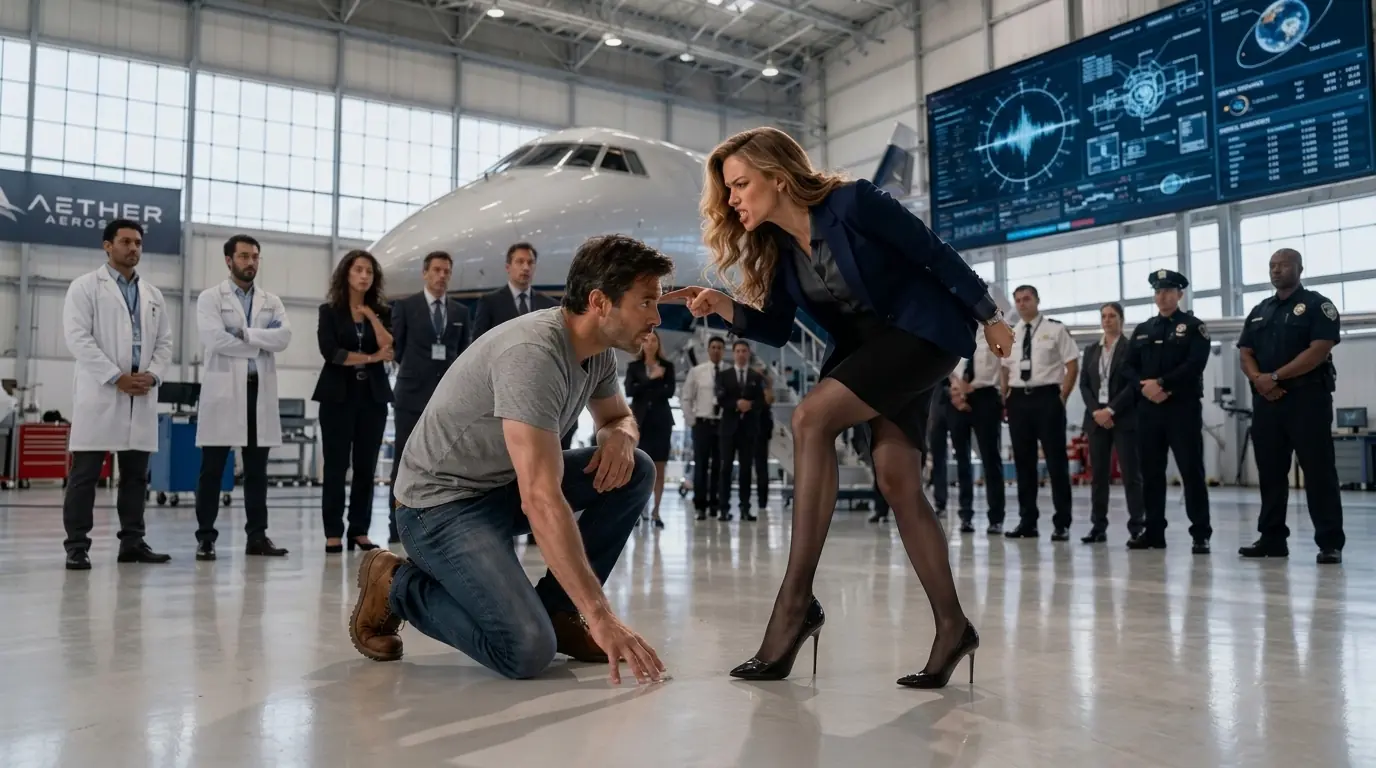
A calm mechanical voice rolled through the hangar: “Welcome back, founding architect Rowan. Root safety authority restored.” The morning of the unveiling had been built for spectacle. Wexler Aeronautics had rented out its private hangar for dozens of investors, board members, and aviation journalists, all gathered beneath banners bearing the company crest. Waiters moved quietly through the crowd with trays of coffee while a string quartet warmed up near the far wall, filling the vast space with a sound that felt entirely out of place beside the sharp smell of jet fuel.
Screens mounted above the aircraft displayed rotating statistics about range, speed, and cabin luxury, each one designed to draw a gasp from potential buyers watching from folding chairs arranged in neat rows. Victoria arrived in a black tailored suit, moving through the crowd with the kind of precision that made people forget she had inherited the company rather than built it herself. The flight itself would last only 40 minutes, but it carried the weight of a $5.2 billion merger that would define the rest of her career. Every camera in the room was pointed at her, and she intended to give them nothing but confidence. Victoria had spent years preparing for a morning exactly like this one.
Ever since she had taken over the company her late father built from a single hangar decades earlier, every board member in that room remembered Conrad Wexler. And every one of them had quietly wondered whether his daughter possessed the same instinct for aviation or had simply inherited his name. She refused to let that question linger any longer than necessary, and the Crownstar X9 was meant to answer it once and for all. Nothing about the morning was allowed to go wrong. Not the lighting, not the seating arrangement, not a single word spoken from the podium.
Caleb arrived in an old sedan, carrying a canvas tool bag and a folded warning letter from an independent safety monitoring firm. His name did not appear anywhere on the guest list, and the security staff assumed he was a maintenance contractor who had shown up on the wrong day. Everett Sloan spotted him near the perimeter fence and recognized him instantly, though he pretended otherwise, greeting him with a stranger's polite nod. Caleb explained that he had received an automated alert from the aircraft's onboard system at 3:12 that morning, flagging an unusual power fluctuation in the auxiliary converter. Everett dismissed the claim outright, reminding him coldly that he no longer worked for the company and had no standing to interfere with anything inside that hangar.
Caleb had heard variations of that sentence before in different rooms spoken by different men who mistook silence for weakness. He never raised his voice when he was dismissed because raising his voice had never once changed the outcome, only the way people remembered him afterward. What mattered to him was the sound coming from deep inside the aircraft, a sound none of the well-dressed guests around him seemed able to hear at all. Victoria overheard the exchange from a few paces away and assumed the stranger was simply another attention seeker, hoping to embarrass her in front of the press. When Caleb asked for a 30-second delay so someone could listen to the auxiliary power unit, she cut him off without hesitation.
She told him plainly that he had no name on her list, no title in her company, and no right to ask for anything inside that building. Caleb did not argue further or reveal who he was. He only stood there a moment longer, listening to a faint, high-pitched whine coming from deep within the aircraft's frame, and understood the danger was worse than the data he had already received. Caleb pulled out his phone and opened an acoustic analysis application, angling it toward the aircraft to record the abnormal frequency bleeding from its fuselage. A few steps away, Victoria was deep in conversation with board chairman Harlon Whitmore about the final terms of the merger.
Without another word, she snatched the phone from Caleb's hand, hurled it against the concrete floor, and drove her heel through the shattered screen while dozens of witnesses watched in silence. The device was ruined instantly. And though Caleb was unharmed, the humiliation was total and very public. Among the fractured glass sat the fading image of a missed call from his daughter, and still he did not raise his voice. Somewhere near the back of the crowd, Mara Quinn watched the entire exchange with a knot forming in her stomach, though she could not yet explain why the stranger's calm unsettled her more than Victoria's fury.
She had spent three years around the Crownstar program and had never once seen a nervous outsider stand his ground so completely while a phone was ground into pieces beneath a chief executive's shoe. Something about the way he watched the wreckage, more concerned with the missing data than with his own humiliation, struck her as deeply out of place among the polished suits filling the hangar. She filed the memory away without knowing yet that it would matter within the hour. He looked down at the wreckage and then back at Victoria, asking quietly whether she always destroyed things she did not understand. She ordered her security team to escort him off the property.
And as they closed in, Everett grabbed the canvas bag from his shoulder before he could react. Caleb managed only to pocket the memory card from the ruined phone before he was walked toward the gate. As he was led away, he said once more calmly and without anger, that the aircraft could not be allowed to fly. Victoria told him the jet belonged to her and that she alone would decide when it left the ground. And at that exact moment, the Crownstar X9 emitted a soft mechanical chime, as if answering him directly.
Harrison had flown for the company longer than almost anyone else in the hangar, and he had already asked twice that week whether the launch date could be pushed back, both times receiving the same firm refusal from Everett's office. He trusted his own instincts more than he trusted schedules. But a captain without evidence had little power against an operations chief determined to keep a deal on track. Inside the cockpit, Captain Harrison Vale had already begun the pre-flight sequence, and the display panels came alive one after another in practiced order. As the auxiliary power unit climbed toward operating speed, Caleb heard the same dangerous oscillation grow louder from across the hangar floor.
Still restrained by security, he turned toward the aircraft and called out clearly, “Sentinel, abort the startup cycle. Initiate level-four power inspection.” Every light in the hangar flickered at once, and the massive doors along the far wall shuddered as the building systems rerouted power in response to his voice. The engines fell silent mid-startup. The cabin doors sealed themselves into an emergency lockdown position, and every screen in the building, from the pilot's console to the command center monitors, displayed the same message in glowing white letters.
Voiceprint verified. Caleb Rowan, founding system architect. Root safety authority restored. The mechanical voice that followed carried through the entire hangar with unmistakable clarity, welcoming back the founding architect by name. Every head in the building turned toward the man security had just been dragging toward the exit.
Investors who moments earlier had been checking their watches now stood frozen, phones raised, capturing an image none of them fully understood yet. Harlon Whitmore set down the coffee he had been holding since dawn and stared at the message glowing above the cockpit windows as though it might rearrange itself into something less inconvenient. Security released Caleb's arms without being told to, unsure whose authority now outranked whose inside the hangar. For a long moment, nobody spoke at all, and the only sound was the faint hum of the aircraft settling into its locked, watchful state. Victoria ordered the technical staff to override the command immediately, insisting the jet belonged to her company, and no outside voice had the right to interrupt her unveiling.
The system refused, explaining that executive authority could not override a founding architect's safety lock while an active hardware risk remained unresolved. Mara Quinn, the young avionics engineer responsible for the Crownstar program, searched the current employee database for the name Rowan and found nothing at all. Confused, she dug into an older archived server and discovered thousands of lines of source code bearing his original signature dated years before she had ever joined the company. Victoria accused Caleb of planting a hidden back door to seize control of an asset that belonged entirely to her. Caleb only gestured toward the shattered phone still lying on the concrete, asking her which device she imagined he had used to hack anything.
As the argument escalated, the aircraft system issued another alert across every visible screen, flagging an unauthorized modification inside the thermal control software. The man everyone had assumed was an intruder now held more authority over the aircraft than the entire executive board combined. And no one in that hangar yet understood why. Buried in the alert was a small detail that would matter far more than anyone realized. The unauthorized update had been approved from an account inside the office of the chief operating officer.
Mara stared at that line for a long moment before saying anything, running the timestamp back against the maintenance calendar to make certain she had not misread it. Everett stood close enough to see the same screen, and his expression shifted just slightly, a flicker no one else in the room seemed to notice yet. Victoria pulled Caleb, Mara, Everett, and Harlon into a private conference room tucked behind the hangar floor, away from the cameras and the restless crowd outside. She demanded that Caleb unlock the aircraft immediately, reminding him that reporters were waiting and that any delay could send her company's stock sliding before the market even opened. Caleb calmly explained that he had not personally locked the jet at all.
The Sentinel Core system had triggered the shutdown on its own based on the simultaneous presence of three specific conditions. It had recognized the voice of its founding architect, received a valid inspection command, and detected genuine evidence of a hardware threat still unresolved somewhere inside the aircraft's frame. He reminded her that if the aircraft were truly safe, his voice alone would never have been able to trigger an emergency lockdown in the first place. Victoria offered him $5 million on the spot to sign a temporary clearance and let the unveiling continue as planned. Caleb refused without a moment's hesitation, and Everett immediately threatened to sue him for commercial damages caused by the delay.
Caleb asked instead for the final transfer documentation that should have accompanied the Sentinel Core system when ownership passed to Wexler Aeronautics years earlier, but the legal team searched their files and could not produce it. Victoria insisted her company had paid nearly $300 million for the Crownstar X9 and everything inside it. Caleb replied that the payment had covered the airframe, the engines, and the interior along with a license to operate the system, but never the final certification required to legally fly it. Harlon began to grow uneasy, recalling that Everett had personally assured him months earlier that every piece of legal paperwork had already been finalized. Mara pulled up the most recent software update and discovered that it had not fixed any sensor issue at all.
It had simply suppressed the heat warnings from appearing on the pilot's display. Everett tried to explain it away, claiming he had only wanted to prevent a faulty sensor from derailing the unveiling in front of investors. Caleb asked him plainly why a simple sensor error would need to be hidden from the very pilot flying the aircraft. The room fell quiet as the weight of that question settled over everyone present, and Victoria's confidence in her longtime operations chief began to visibly crack. Buried deep in the maintenance log was a detail no one had mentioned yet.
The suppressed warnings had not started that morning at all. They had been quietly hidden for six full weeks. Mara pulled records from eight years earlier and found the origin story none of the current staff had ever heard: a small rented warehouse where Caleb had founded Rowan Flight Systems from almost nothing. He and a handful of engineers had built the Sentinel Core after losing a close friend, a pilot who died because a critical warning had been buried by his own airline's management. Caleb designed the system around one unbreakable principle that no executive, no owner, and no shareholder could ever force an aircraft to ignore a genuine safety threat.
The rule was written directly into the architecture itself, immune to pressure, immune to deadlines, and immune to profit margins. Caleb had built that promise into every version of the system since, refusing to sell early prototypes to buyers who wanted the override function included as a convenience for executives in a hurry. Investors had walked away from him more than once over that single refusal, calling it stubborn, even reckless for a small company trying to survive its first difficult years. He never regretted it. Not once, not even when the refusal cost him contracts that would have made him wealthy far sooner than the eventual sale ever did.
The friend he had lost was never far from his thinking whenever someone asked him to soften that rule, and he had learned long ago that grief made a far better architect than ambition ever could. Mara sat with that history for a long moment, turning it over against everything she thought she knew about the man now standing quietly at the edge of the conference room. She had read fragments of his old code for years without ever picturing the person who wrote it, assuming the initials belonged to someone long retired or long gone from the industry altogether. Now she understood why certain safety functions in the Sentinel Core felt different from everything written after his departure: sturdier, less willing to bend, and built by someone who had personally felt the cost of a warning ignored. It reframed everything she thought she knew about her own workplace and about the man Everett had spent years quietly erasing from its history.
Wexler Aeronautics had purchased Rowan Flight Systems years later after the technology drew attention across the aviation industry and Victoria's late father, Conrad Wexler, had personally signed the acquisition agreement with Caleb. Under that original contract, Caleb had retained a permanent safety veto, ongoing access to the technical logs, partial intellectual property rights, and sole certification authority over the very first commercial version of the aircraft. After his wife passed away, Caleb had stepped back from daily operations to raise his young daughter alone, handing routine management over to Everett, who was overseeing the merger process at the time. Everett slowly erased his name from press materials, internal briefings, and public-facing documents, later telling Victoria that the founding engineer had been an unstable presence who abandoned the project halfway through development. Victoria had never once verified that story herself, trusting Everett completely while she focused all her energy on proving she deserved her position at the top of the company.
Caleb had sent seven separate warning letters over the previous three months. Each one quietly rerouted into a secondary mailbox that never reached her desk. She began to understand she had not simply insulted a random technician that morning. She had personally destroyed the phone belonging to the man who built the very brain of her most important aircraft. Still, pride kept her from apologizing outright, afraid that any admission of fault in front of her own staff would make her look weak at the worst possible moment.
Buried inside the escrow records, the legal team found something even more consequential. $38 million from the original agreement remained untouched, and only Caleb held the authority to release it. The company's attorney explained that the Crownstar X9 had never been fully transferred to Wexler Aeronautics in the first place. The company held the right to test and display the aircraft, but not to operate a single commercial flight until the founding architect signed final certification. Everett's unauthorized software changes had violated that original agreement outright, and the consequences were far broader than anyone in the room had expected. Caleb now held the power to revoke the entire operating license, order the Sentinel Core physically removed from the airframe, freeze the remaining payment, and formally report the breach to both the insurance carrier and federal regulators.
The attorney read the relevant clauses aloud twice as if repetition might somehow soften what they meant for the company's balance sheet and its pending merger. Harlon asked whether the escrow condition had ever been disclosed to the acquiring partners during due diligence, and the silence that followed answered the question more clearly than words could have. If the omission surfaced during the merger review, the deal itself could collapse, regardless of anything that happened with the aircraft that morning. Victoria understood, perhaps for the first time, that the danger in that hangar had never truly been about one jet at all. It was about the foundation her entire company had been quietly standing on for years.
If Caleb chose to exercise all of that authority at once, the Crownstar X9 would become a $300 million sculpture permanently forbidden from ever leaving the ground. Victoria's tone shifted for the first time that day, and for the first time, she asked him what he actually needed rather than telling him what she expected. Caleb laid out three immediate conditions: cancel the unveiling flight entirely, inspect every component that had been altered without authorization, and freeze Everett's system access for the duration of the investigation. Everett objected furiously, warning that any delay would destroy Victoria's credibility and give the board every reason to remove her from her own company. He reminded her of every quarter she had fought to prove herself against board members who still whispered that she had only inherited her title rather than earned it.
He knew exactly which fear to press, and for a moment it worked, her jaw tightening as she weighed the cost of looking indecisive in front of the very people she needed to trust her most. Caleb said nothing during that exchange, letting her sit with the pressure rather than rescuing her from it, aware that the decision meant more if she reached it herself. The threat landed exactly where Everett intended, striking at the deepest fear Victoria carried into every decision she made. For several long seconds, she stood suspended between two choices, protecting the position she had spent her whole career earning or trusting the man she had just humiliated in front of a room full of witnesses. In the end, she ordered the flight postponed, but stopped short of suspending Everett entirely, a half measure that revealed just how tightly his influence still gripped her judgment.
While the argument continued around the table, Everett quietly opened a hidden terminal and began deleting the technical logs before anyone noticed what he was doing. Mara noticed data vanishing from the central server in real time and immediately severed the network connection. Though nearly a third of the logs had already been erased by then, Everett tried to shift the blame onto Caleb, insisting his old access credentials were somehow corrupting the entire system from the inside. Victoria wavered, terrified that the evidence she needed most was disappearing before her eyes, especially with the one phone that might have backed it up already lying in pieces on the hangar floor. Caleb then revealed something Everett clearly had not anticipated: a separate audit memory built directly into the aircraft's frame, completely isolated from any network connection in the executive offices.
Opening that vault required three separate confirmations: the system architect, a representative of the flight crew, and the individual currently recognized as the aircraft's legal owner. Caleb and Harrison were ready immediately. But Victoria had to place her own hand on the scanner and accept that whatever decision she had made that morning would now be permanently recorded. Everett tried to stop her, warning that opening the vault might expose unrelated trade secrets that had nothing to do with the current crisis. Victoria began to realize his panic had nothing to do with protecting the company and everything to do with protecting himself.
Mara stood beside the terminal, watching the recovery progress bar crawl forward, painfully aware that every second of delay gave Everett another chance to find some new way to interfere. She had joined the Crownstar program because she believed in precise, honest engineering, not boardroom politics, and the last few hours had forced her to see how thin the line between those two things could actually be inside a company under pressure. When the vault finally unlocked, she felt less triumph than exhaustion, the particular fatigue of someone who had spent months sensing something was wrong without ever having the authority to prove it. The recovered data revealed that six weeks earlier, a power distribution cluster had reached a dangerous temperature threshold during routine testing. Mara had filed a report demanding immediate component replacement, but Everett rejected it outright, knowing the repair would delay the launch schedule by at least two months.
Instead, he ordered a software patch that delayed the warning display by 14 minutes, just long enough for the Crownstar X9 to clear the runway before any pilot noticed a problem. His personal stock package would only vest if the flight was completed before the merger deadline, a detail that suddenly explained every reckless decision he had made. If everything succeeded, Everett stood to collect nearly $90 million once the deal closed. If something went wrong after takeoff, he had already prepared to blame the component supplier rather than admit any fault of his own. Victoria finally understood that the man she had trusted for over 20 years had quietly turned her into a shield for his own private scheme.
Everett insisted there was no recording, no direct order, and no proof that he personally demanded the warnings be hidden from anyone. Caleb explained that every high-level administrative command inside the Sentinel Core was automatically preserved as an encrypted audio record. He had built the function specifically to protect engineers from being pressured into dangerous decisions by executives who might later deny giving the order. Everett had once demanded that feature be removed entirely, but Caleb had quietly hidden a duplicate copy inside the isolated audit memory years before he ever stepped away from the company. Once Victoria, Caleb, and Harrison completed their joint authorization, the Crownstar X9 played the recording back for the entire room to hear.
Everett's voice came through with unmistakable clarity: “Delay every warning until the aircraft clears 10,000 feet. The flight has to happen before the shareholder meeting.” Mara's own voice followed immediately after, objecting to the order and warning of the exact danger they now faced, only to be threatened with the termination of her entire engineering team if she kept pushing back. Everett insisted the recording had been altered or spliced together to frame him. Caleb asked the system to display the underlying verification data, the device signature, the precise timestamp, the biometric voice print, the account identifier, and the complete edit history, and every single marker matched Everett exactly.
He tried to leave the conference room, but Victoria ordered security to block the exit, making clear she would not allow anyone to physically harm him, only to hold him for the investigation that now had to follow. Cornered, Everett turned on her directly, threatening to expose her own outburst with the phone if he was arrested for anything at all. Victoria answered without flinching that she would expose it herself before he ever got the chance. It was the first time all day she had chosen to accept responsibility instead of protecting her own image at any cost. Everett tried one final approach, softening his tone and reminding Victoria of every quiet favor he had done for her over the years, the schedules he had rearranged, the difficult board members he had managed on her behalf, the long nights he had spent protecting her father's legacy after his passing.
For a fraction of a second, something in her expression wavered, the old habit of loyalty pulling against everything the recording had just proven. Then she thought of the 14 minutes he had shaved off a warning window meant to protect a flight crew, and the hesitation disappeared entirely. She told him plainly that loyalty built on a lie was never loyalty at all, only patience waiting for the right moment to collect its price. Security walked him out through a side corridor away from the cameras still gathered outside the main entrance and Victoria did not watch him go. Moments later, a new alert appeared on every screen in the room.
Sentinel Core reported that the corrupted software had been isolated successfully, but the power cluster Everett had tampered with was now heating rapidly and threatened to disable the entire system before it could be stabilized. A countdown appeared showing 19 minutes remaining before the protective fuses would automatically shut everything down. There was no risk of a dramatic explosion. But if the system failed while overheated, the Sentinel Core and its surrounding electrical architecture, worth tens of millions of dollars on its own, could be destroyed beyond repair. Caleb insisted the remaining guests be evacuated from the hangar immediately to guarantee everyone's safety.
Victoria canceled the live broadcast without hesitation and ordered every journalist escorted outside, the first time all morning she had placed genuine safety ahead of public image. Rather than trying to solve the crisis alone, Caleb put Mara in charge of the technical response and guided her toward the section of wiring that had been improperly rerouted. Together they discovered that Everett had approved a cheaper power distribution component from a new supplier, one built for ordinary conditions, but never rated for the Crownstar's peak electrical load. Harrison shut down every non-essential subsystem, while Mara manually opened the emergency heat vent by hand. Caleb used his own voice authority to isolate the Sentinel Core from the primary power line before the surge could reach it.
The hangar had emptied of reporters and investors by then, leaving only the sound of the countdown timer and the low mechanical groan of a system straining against its own limits. Harrison called out temperatures from the cockpit every 30 seconds, his voice tight but steady, the voice of a pilot who had trained for exactly this kind of pressure, even if never quite this way. Mara's hands moved fast along the access panel, tracing the rerouted wiring back to the exact junction where the cheaper component had been spliced into a system never designed to hold it. Caleb stayed close beside her, not taking over, only offering the occasional correction, trusting her enough to let her solve the problem herself, while the clock kept falling. With just over 3 minutes left on the countdown, the heat vent jammed halfway open, and for a moment, it seemed the entire system might fail.
Victoria stripped off her suit jacket and physically helped the technical crew move equipment into position, no longer directing from behind a wall of glass or barking orders from a distance. Slowly, the temperature began to fall. Sentinel Core confirmed the aircraft had returned to a stable condition but refused to permit any restart until the faulty component was fully replaced with an approved part. Victoria turned to Caleb and quietly admitted that he had just saved the very aircraft she had insisted belonged entirely to her. Caleb answered simply that he had saved the people she had been prepared to put inside it.
Even with the danger resolved, he still refused to sign the final certification the company needed to fly. Harlon called an emergency session of the board within hours of the incident. Several members wanted Victoria removed immediately, citing her destruction of evidence, her failure to investigate a legitimate warning, her blind trust in Everett, and her willingness to prioritize a merger deadline over basic safety. A number of board members suggested installing Caleb as interim chief executive instead, believing the founder's reputation alone could rescue the company's collapsing valuation. One member argued that the market would respond well to a founder's return and that headlines about a hidden genius stepping back into his own company practically wrote themselves.
Another pointed out that Caleb had walked away once already, and nothing in his conduct that morning suggested he had any appetite for boardrooms, quarterly targets, or the endless demands of running a public company. Harlon listened to both sides without committing to either, waiting instead for the one voice in the room who had not yet said what he actually wanted. Caleb refused the offer outright, making clear he had not returned to take Victoria's chair and had no interest in leading thousands of employees or becoming the public face of any corporation. What he wanted instead was to fix the culture that had forced his engineers into silence in the first place. He laid out a set of conditions required before he would sign any certification at all.
Everett would be removed from his position and referred for an independent investigation. Every component supplier used on the Crownstar program would undergo a full audit. Mara's engineering team would receive formal protection against retaliation of any kind. An independent safety board would be established with permanent authority over the program. No future chief executive would ever again be allowed to override a verified technical warning.
The names of the original founders and engineers would be restored across every official record, and Victoria herself would be required to publicly acknowledge exactly what had happened that morning. He delivered the list without theatrics, the same even tone he had used all day, as though he were reading off a maintenance checklist rather than dictating terms that would reshape an entire corporation. Several board members exchanged uneasy glances, unaccustomed to negotiating with someone who wanted neither money nor a title in return for saving their most valuable asset. One younger member asked quietly whether Caleb was certain he did not want a permanent seat on the board itself, given everything he had just uncovered. Caleb answered that seats on boards tended to fill with people chasing the next deadline, and he had already spent one lifetime watching deadlines outrank the truth.
Harlon asked whether Caleb wanted equity, a bonus, or any form of ownership stake in exchange for his cooperation. Caleb asked only for the royalty payments already guaranteed under his original agreement along with leadership of the new safety board for a period of two years. Victoria realized in that moment that a man who could have easily destroyed her entire company had deliberately chosen not to. He had not forgiven her yet, but he had given her a real chance to prove she could actually change. Victoria walked back into the hangar where employees and reporters were still waiting for an explanation.
She did not shift the blame entirely onto Everett, even though he had orchestrated the deception from beginning to end. Instead, she admitted that she herself had built an environment where a single frightened executive could manipulate every major decision simply by threatening failure. She told the room plainly that Caleb's warning had been legitimate from the very first moment, that she had judged him solely on his clothing and apparent status, that she had personally destroyed a phone containing critical evidence, and that she had placed a commercial deadline above the basic principle of safety. She confirmed publicly that Everett had been removed from his position and that the entire Crownstar program would now undergo an independent review. Somewhere near the front of the crowd, Mara felt a tension in her chest ease for the first time in months, the quiet relief of hearing a leader finally say out loud what her engineering team had been afraid to say for themselves.
A few employees exchanged glances, uncertain whether to trust the moment, while others simply stood in silence, absorbing an apology they had never expected to hear from anyone above them. Harrison watched from near the aircraft, arms crossed, offering the smallest nod of approval a career pilot ever allows himself in public. It was not a triumphant scene, and Victoria did not try to make it one. She simply stood there and let the words land exactly as heavy as they deserved to. Some in the crowd applauded softly, uncertain whether it was appropriate, while others simply nodded, recognizing an honesty they had not expected to witness that morning.
Afterward, she handed Caleb a small box, and inside was not an expensive replacement device, but his own original phone, carefully repaired by a data recovery team she had quietly hired. The final message from his daughter was still intact on the screen: three words asking when he would be home, sent hours before the phone had ever hit the concrete floor. Caleb read it twice before slipping the phone into his pocket, saying nothing about it, though something in his posture eased for the first time since he had arrived at the hangar that morning. Away from the cameras, Victoria apologized to him directly and without an audience. Caleb told her that an apology could not undo what had already happened, but that her choices from that day forward would decide whether it ever happened again.
Harlon announced that the board would allow Victoria to remain as chief executive, now operating under the direct oversight of the new independent safety board. Caleb signed a conditional repair certification, though he still withheld final approval for any actual flight. Weeks later, during the next scheduled startup sequence, the Crownstar X9 recognized Victoria's voice immediately, but still required Caleb's separate confirmation before granting her full operating authority. Six weeks after the failed unveiling, every faulty component on the Crownstar X9 had been replaced, and the aircraft passed every remaining inspection without a single flag. The second flight carried no elaborate staging and no crowd of investors, only the flight crew, the engineering team, a certified inspector, and members of the new safety board.
Caleb continued living quietly, spending most of his time with his daughter, and accepted the chairmanship of the safety board without ever returning to daily operations. Mara was promoted to lead engineer of the entire Crownstar program, a role she had earned long before anyone acknowledged it. Victoria rewrote the company's internal procedures so that any engineer could halt a test the moment they identified credible evidence of risk without fear of losing their position. She sat through every safety board meeting personally rather than sending a representative in her place, listening more than she spoke, a habit that would have seemed unthinkable to her only two months earlier. Employees noticed the shift long before any press release announced it, the small signals of a leader who had stopped treating caution as an obstacle to progress.
Even Harlon admitted quietly and only once that the company felt sturdier now than it had at any point since Conrad Wexler's passing. Before boarding, she stepped aside and let Caleb walk ahead of her, and he in turn insisted Mara and the technical crew board first instead. Inside the cockpit, the Sentinel Core requested confirmation of operating authority just as it always had. Victoria spoke first: “Sentinel, begin inspection sequence. Safety comes before schedule.”
The system recognized her voice instantly, but still waited for one final approval before releasing full control. Caleb spoke the words that closed the loop, confirming Victoria Wexler as the authorized operator of record. The system answered clearly: “Operating authority approved. Welcome back, founding architect Rowan. Welcome, Chief Executive Wexler.”
The aircraft eased slowly out of the hangar and into the open light beyond the doors. Victoria finally understood that $300 million could buy her an aircraft, but it could never buy the trust of the people responsible for keeping it in the air. Caleb, for his part, had never needed to seize power to win. He only needed to make sure the people who already held it were finally forced to answer for it. Somewhere below, the hangar doors closed behind an empty runway, and the crowd that had once gathered for spectacle had long since gone home.
There would be no headline calling Victoria a hero and no headline painting Caleb as anything other than a quiet man who fixed what was broken and then stepped away again. That suited him fine. His daughter was waiting for him that evening, unaware of anything that had happened inside a hangar three states away, and that more than any boardroom victory was the only outcome he had ever truly cared about. High above the runway, the Crownstar X9 leveled off into open sky, carrying two names in its memory now instead of one, and answering to both, exactly as its architect had always intended it.