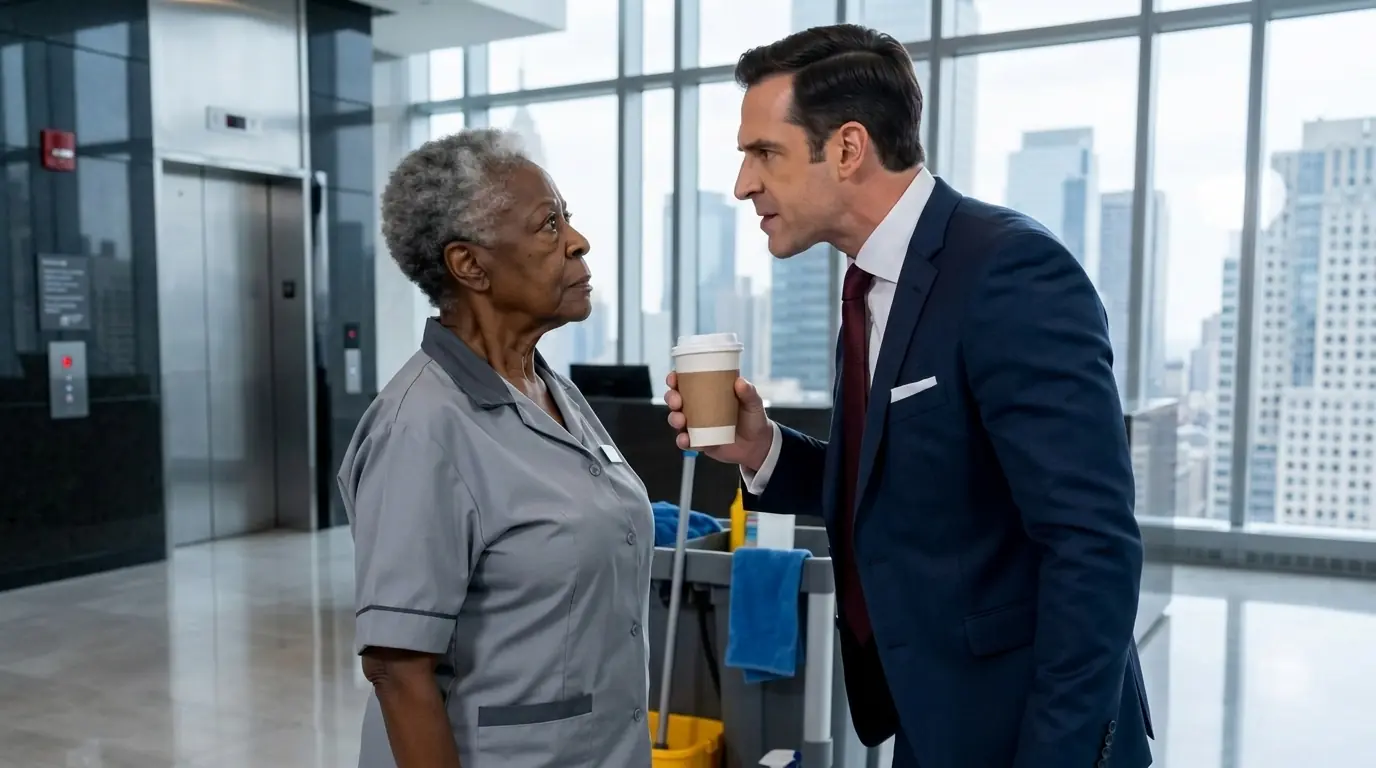
“Move faster. I don’t pay people to stand around.”
Gavin Rourke’s voice cracked across the forty-first floor of Rourke Dynamics just before seven on a Tuesday morning. The porcelain coffee cup left his hand a second later, missed seventy-year-old Dr. Lorraine Hayes by less than a foot, and exploded against a marble column behind her. Hot coffee splashed across the front of her gray custodial uniform while nearly thirty executives stopped moving in the hallway.
Lorraine did not scream. She did not step backward or reach for the burn spreading across her stomach. Instead, she switched off the floor buffer, set the handle upright, and walked three slow steps toward one of the richest men in California. Gavin expected an apology.
Lorraine leaned toward his ear. Her voice never rose above a whisper. “I’m Julian Hayes’s mother, and I have the December memorandum.”
Seven seconds later, Gavin Rourke’s knees nearly gave out beneath him. His hand shot toward the edge of a conference table, missed, and found the marble column instead. The man whose face had appeared on magazine covers, keynote stages, university billboards, and shareholder reports suddenly looked as if somebody had turned off the electricity inside him.
To understand why eight quiet words could break a billionaire in front of his own executives, you have to go back six years. You have to go back to the morning Lorraine Hayes first walked into Rourke Tower wearing a janitorial uniform and carrying a vacuum cleaner she understood mechanically better than the man who trained her. You have to go back even further, to the kitchen table in Oakland where her son once drew the first architecture diagrams for a company that was never supposed to carry Gavin Rourke’s name.
Lorraine was sixty-four when she took the custodial job. She had a doctorate in computer engineering from Stanford, spent twenty-seven years working on secure aerospace systems, and held four patents related to cryptographic authentication. None of that appeared on the application she submitted to Pacific Building Services, the contractor responsible for cleaning Rourke Dynamics after hours.
Her résumé showed only the things necessary to get hired. Reliable transportation. Night availability.
Previous facilities experience. References. She left everything else out.
Lorraine did not need recognition. She needed access.
The first time she entered the tower lobby, she stopped beneath a forty-foot sculpture suspended above imported Italian marble. Employees hurried past her with badges swinging from designer belts while two security guards discussed weekend football at the desk. Above the elevators, polished brass letters read ROURKE DYNAMICS — BUILDING THE TRUST LAYER OF TOMORROW.
Lorraine stared at the words longer than she should have. Her son Julian Hayes had written almost the same phrase on a legal pad fifteen years earlier. He had been twenty-seven then, barefoot at Lorraine’s kitchen table, explaining why the future of digital security required an encryption architecture that could authenticate behavior without revealing identity.
He called it Sentinel Mesh. He believed it could protect hospitals, financial systems, government networks, and eventually anything connected to the internet. He had built the first working version in his apartment while living on takeout noodles and sleeping four hours a night.
Julian was brilliant, but he was not especially interested in becoming famous. He liked designing systems more than pitching them. That was why, in 2011, he brought in Gavin Rourke, a twenty-five-year-old Yale dropout with wealthy parents, relentless confidence, and an ability to walk into rooms Julian found exhausting.
At first, the partnership worked. Julian built. Gavin sold.
Julian handled architecture and patents. Gavin handled investors, press, and early corporate relationships. The company operated from a converted warehouse in San Jose under the original name Hayes Secure Systems.
Lorraine remembered those years well. Julian sometimes came home on Sundays with circuit diagrams spread across the passenger seat and excitement in his voice. “Mom, if we get the next version stable, this thing changes everything.”
Lorraine had believed him. She also warned him repeatedly about Gavin. “That young man enjoys being believed more than he enjoys being correct.”
Julian laughed. “That’s why he sells.”
Lorraine did not laugh. “That’s why you watch him.”
Julian watched too late. During the fall of 2012, he discovered that several provisional patents had been refiled through shell entities listing Gavin as sole inventor. Investors had also been shown ownership agreements Julian had never signed.
The confrontation happened on December third. Julian called Lorraine afterward. His voice sounded furious and frightened in equal measure.
“He stole the filings.” Julian paced while they spoke. “He says it’s business.”
Lorraine told him to come home. Julian said he could not. He had documents to secure.
Three nights later, Julian Hayes was found dead at the bottom of a concrete stairwell inside a parking garage in downtown San Jose. Police concluded he had fallen after leaving a late meeting. There was no weapon, no witness willing to say they saw anything, and the security camera covering the landing had been offline for maintenance.
Gavin Rourke attended the funeral. Lorraine remembered the expensive black suit, the perfectly tied necktie, and the hand he placed on her shoulder. “Julian was like a brother to me.”
Lorraine had looked directly into his eyes. Something inside her rejected the sentence before she could explain why. Gavin cried for cameras but not when nobody was watching.
Within eight days, Gavin assumed full control of Hayes Secure Systems. Within three months, new incorporation documents renamed the company Rourke Technologies. Within a year, Julian’s name had nearly disappeared from investor materials.
The official story became simple. Gavin Rourke, visionary founder, had built revolutionary digital-security technology after dropping out of Yale. Journalists repeated the biography because it was easy to understand.
Forbes called him a generational entrepreneur. Business schools turned him into a case study. Gavin gave talks about risk, meritocracy, and trusting unconventional talent.
Nobody mentioned Julian Hayes. When Lorraine wrote letters asking why her son’s patents no longer appeared under his name, corporate attorneys replied that historical ownership issues had been legally resolved. She was advised not to make public accusations without evidence.
Then the bills came. Julian’s emergency hospitalization before he died had generated charges. So had legal consultations, private investigators, and years of trying unsuccessfully to challenge the patent history.
Lorraine’s pension shrank. Savings disappeared. Her daughter-in-law Monica eventually moved with Lorraine’s grandson Ethan to Atlanta to rebuild her life.
Ethan later earned a scholarship to Howard University. Tuition was largely covered. Books, housing gaps, travel, and everything else were not.
Lorraine quietly used what remained of her patent royalties to help him. When even that became thin, she needed income. At sixty-four, she found herself looking at a job posting for overnight custodial work inside the company that had once belonged to her son.
She applied the same day. Nobody at Pacific Building Services knew who she was. Nobody at Rourke Dynamics checked whether the name Hayes meant anything.
That was useful. Lorraine’s first assignment included floors thirty-nine through forty-two. Gavin Rourke occupied the corner office on forty-two.
Her shift began at six in the evening. Gavin usually remained until at least ten. Lorraine learned to clean around him without becoming noticeable.
He never asked her name. Not once.
If she entered with the trash cart, he lifted his feet without looking away from his laptop. If she wiped fingerprints from the glass conference wall, he continued shouting at employees in Singapore. If she replaced water beside his desk, he sometimes snapped his fingers toward the empty bottle.
“Another.” Lorraine brought another.
She did not correct him. Not yet.
The office itself hurt to enter. Julian had helped design the original furniture layout when the company still occupied the San Jose warehouse. Several pieces moved with Gavin when headquarters expanded.
The large walnut desk was one of them. Lorraine recognized the unusual curved edge immediately because Julian had sketched it on butcher paper at her kitchen table. “If I ever run a company, I don’t want one of those giant dictator desks.”
Gavin now sat behind it like a throne. Somebody had refinished the wood darker. The shape remained.
Lorraine noticed the bottom-left drawer during her second week. It used an old mechanical lock, unusual in a company where almost every other cabinet required biometric access. Gavin opened it only when alone.
Lorraine never stared. She noticed reflections in windows. She noticed sounds.
The lock clicked differently from the other drawers. Gavin always looked toward the office door before opening it. His executive assistant, Marissa Cole, was never permitted near it.
That made Lorraine curious. Curiosity, however, was not evidence. She had spent her professional career understanding the difference.
For nearly four years, Lorraine did nothing except work. She polished floors. Emptied trash.
Changed liners. Cleaned executive bathrooms. Restocked conference rooms.
At the same time, she learned the building. Which doors remained unlocked after midnight. Which security guards followed procedures.
Which guards spent too long watching basketball on their phones. Which elevators logged badge access. Which corridors had overlapping cameras.
She became friendly with people because she was naturally friendly, not because she wanted to manipulate them. Denise Walker in Human Resources always asked about Lorraine’s knees. Kevin Wu in IT sometimes repaired her phone and tried explaining simple computer concepts to her.
Lorraine let him. Kevin once spent ten minutes explaining encryption keys to a woman who had published on key-exchange protocols before he finished middle school. She thanked him afterward and brought him a muffin the next evening.
Rachel Stein in corporate legal liked staying late. She complained whenever Gavin created another emergency requiring weekend work. Over time, Rachel mentioned something Lorraine never forgot.
“There are original founding documents he refuses to let legal digitize.” Rachel rolled her eyes. “He keeps some of them physically locked in that antique desk.”
Lorraine did not react. “Why?”
“Gavin says originals are sensitive.” Rachel shrugged. “He gets weird whenever anyone asks about the early years.”
Lorraine remembered every word. She never asked again.
During her fifth year inside the building, cracks began appearing around Gavin’s perfect public image. A security startup in Boston challenged several old Rourke patents. An independent researcher noticed suspicious similarities between early Sentinel Mesh code and archived work attributed to Julian Hayes.
Then a Wired reporter named Nathan Holloway started calling. Nathan had found an old engineering conference where Julian presented concepts almost identical to technology Gavin later claimed to have invented. The presentation had been recorded on a university server nobody bothered deleting.
Rourke’s legal team dismissed the connection as historical collaboration. Nathan kept digging. Former employees began receiving calls.
Gavin changed too. He started drinking at work. Not enough for most people to notice.
Lorraine noticed. Tuesday nights, the bourbon smell appeared around nine. By ten, he became louder.
He began shredding certain documents personally instead of leaving them in locked disposal bins. He demanded security logs from old offices. Twice, Lorraine found him asleep at his desk near midnight.
One night, the bottom-left drawer remained open. A thick manila folder lay across the keyboard. Lorraine stood in the doorway with a vacuum cleaner.
She could see only the label. 2012.
She did not touch it. Every instinct told her to. Training told her not yet.
A stolen glance would satisfy curiosity. A careless move could destroy six years of patience. Lorraine emptied the trash and left.
The following week, she asked Pacific Building Services for overnight coverage. Her supervisor seemed surprised. “You already work late.”
“I sleep badly anyway.” Lorraine smiled. “Might as well get paid.”
The new schedule let her remain inside Rourke Tower after most executives had gone home. She became almost invisible. Security stopped noticing her movements because she was always present.
Gavin made his mistake on a rainy Tuesday in March. He had an early flight to Switzerland the next morning for an investor conference. Around six that evening, he stormed from his office carrying two phones and arguing with somebody about the Wired article.
Lorraine passed him near the elevators. Bourbon was obvious on his breath. His tie hung loose.
The elevator doors closed. Lorraine continued cleaning. She did not immediately enter the office.
Forty minutes later, she passed again. The door was open. Gavin’s desk chair sat crooked.
Lorraine walked inside with her trash cart. The bottom-left drawer had been left partially open. The key was still in the lock.
She stood completely still. Six years had trained her for this exact moment. It also taught her not to rush.
Lorraine closed the office door. She checked the hallway reflection through the glass. Nobody.
She walked to the desk. Pulled the drawer open.
Inside were several folders bound with elastic. One contained early patent filings. Lorraine recognized Julian’s handwriting immediately.
Dates. Diagrams. Signatures.
She felt the room narrow around her. Beneath the patent documents sat a transfer agreement dated December third, 2012—the same day Julian called her.
His signature appeared at the bottom. Lorraine knew her son’s handwriting better than her own. The signature was real.
The surrounding initials were not. Somebody had altered pages after he signed. Entire ownership provisions differed from drafts preserved in Lorraine’s old files.
Then she found a memorandum. One paragraph. Gavin’s former attorney had written it the day after Julian died.
Hayes issue resolved. Proceed with restructuring before family intervenes.
Lorraine had to sit down. Her knees no longer mattered.
Her hands shook. She read the sentence again. Then a third time.
There was more. A sealed envelope lay beneath the memorandum. No label.