The first thing Officer Grant Harlow noticed was not the license plate.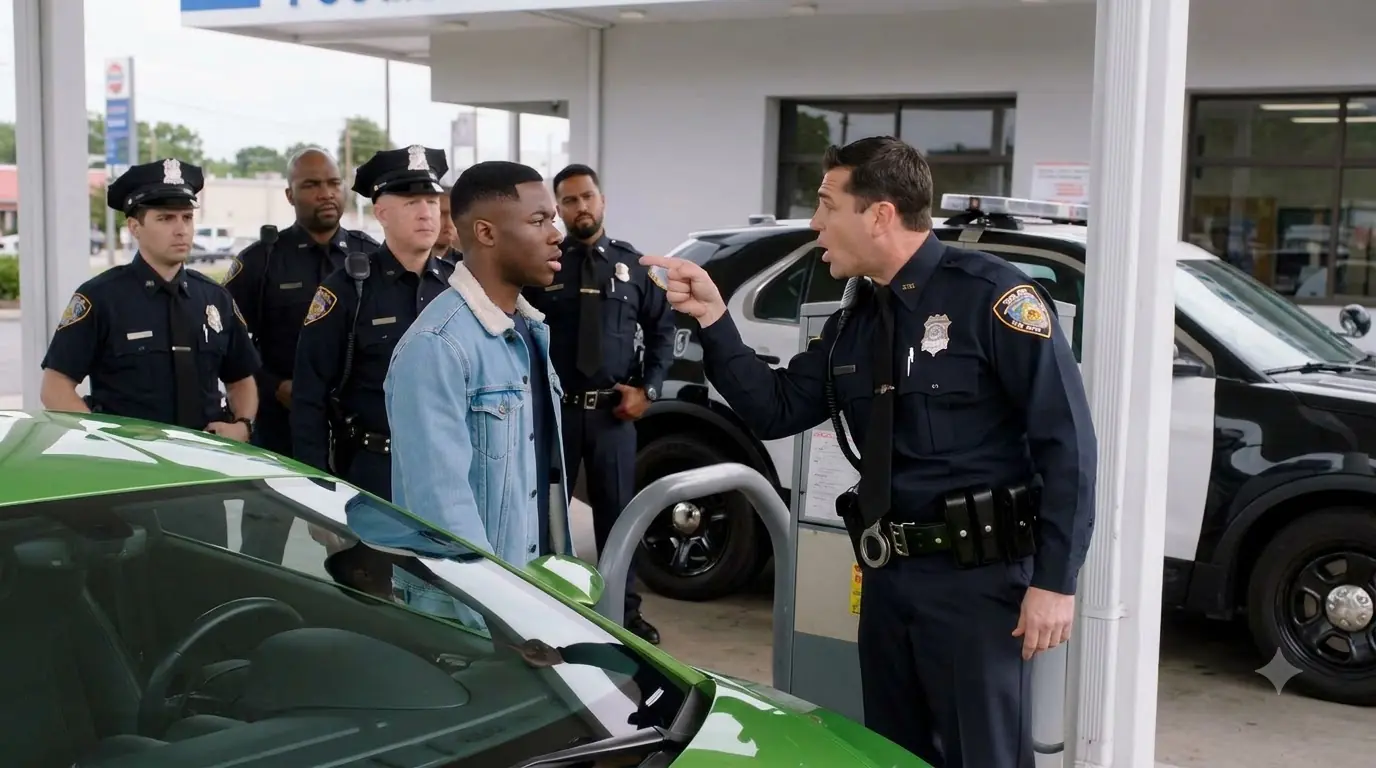
It was the driver.
The Lamborghini sat at pump number six like a lightning strike, low, sharp, and painted a deep electric orange that made every other car in the gas station look unfinished. Its engine had already gone quiet, but people still stared as if the sound remained in the air. A father filling his minivan had stopped mid-squeeze on the pump handle, and two teenagers near the snack shop window were already recording on their phones.
Then they saw Malik Bennett step out.
He was nineteen, Black, lean, and dressed in a plain gray hoodie under a dark denim jacket. No gold chain. No designer sunglasses. No entourage, no camera crew, no performance. He looked younger than he was, which had been inconvenient his whole life because people often mistook youth for weakness and Black youth for guilt.
Malik slid his card into the pump and tried to ignore the stares.
He had learned that skill before he owned a supercar.
When he was twelve, people stared at him in stores as if his pockets had already confessed. When he was sixteen, security guards followed him through malls while white kids his age pocketed lip balm and laughed at nobody noticing. When he was eighteen and his software company closed its first million-dollar contract, a hotel clerk still asked whether he was checking in with a guest.
The Lamborghini made the stares louder.
That was all.
He bought the car after three years of building Bennett Trace, a vehicle-authentication company that detected title fraud, VIN cloning, stolen-car laundering, and database tampering. His software had started as a school project in his grandmother’s kitchen. By nineteen, it had contracts with insurance companies, repossession auditors, and two state agencies that wanted to clean up their vehicle records.
The Lamborghini was not just a reward.
It was a test unit.
Hidden inside the dashboard was a prototype authentication module that recorded every digital touch connected to the car: plate queries, VIN scans, title checks, insurance requests, remote database lookups, and suspicious attempts to alter its status. Malik had installed it because he wanted to prove the product worked in real life, not because he expected the car itself to become evidence.
That afternoon, he was on his way to the largest meeting of his life.
A state transportation investment board wanted to review Bennett Trace for a six-million-dollar anti-fraud contract. If the deal closed, Malik’s company would move from promising startup to statewide infrastructure partner. His board was nervous, his investors were excited, and his grandmother had ironed his shirt that morning even though he told her he could do it himself.
He stopped for gas because the car was at half a tank.
A simple stop.
Five minutes.
That was all it should have been.
A woman in a business suit drifted closer to the Lamborghini, phone in one hand, curiosity pretending to be politeness.
“Is that yours?” she asked.
Malik looked at her.
“Yes, ma’am.”
She smiled, but the smile carried doubt in its teeth.
“You look awfully young for something like that.”
Malik put the nozzle back into the pump.
“I worked for it.”
Before she could answer, a police cruiser rolled into the station.
Its lights were off, but the effect was the same. The small crowd shifted, widened, and then tightened again. People who had only been staring now looked ready to witness something, as if the arrival of a badge had confirmed the suspicion already growing in their heads.
Two officers stepped out.
Officer Grant Harlow came first.
He was white, mid-thirties, thick through the neck, with close-cropped hair and a hard mouth that looked more accustomed to commands than questions. He walked toward Malik with one hand resting near his belt, not on the weapon, but close enough for the message to be clear.
Behind him came Sergeant Dean Calder.
Calder was older, quieter, and more careful. His uniform looked clean enough for a ceremony, and his face carried the calm of a man who knew how to make a bad decision look official after the fact. He did not speak first. He did not need to.
Harlow stopped beside pump number six and looked at the Lamborghini.
Then he looked at Malik.
“You really expect me to believe a kid like you bought this?”
The crowd reacted before Malik did.
A few laughs.
A few whispers.
A few phones rising higher.
Malik kept his hands visible.
“The registration, title, and insurance are all in my name, Officer. I can show you.”
Harlow held out his hand.
Malik reached slowly into his jacket, moving carefully, because careful movement was something Black boys learned before they learned taxes. He handed over his license, registration, and insurance card. Harlow took the papers, glanced at them for maybe two seconds, and then smirked toward the crowd like the joke had written itself.
“This paperwork means nothing if the story sounds fake.”
“It’s not fake.”
Harlow flicked the registration with two fingers.
“Title says Malik Bennett.”
“That’s me.”
“You own a Lamborghini at nineteen.”
“Yes.”
“What do you do, sell shoes online?”
“I own a technology company.”
Harlow laughed.
It was not a big laugh.
It was worse.
It was the laugh of a man who had already decided truth was entertainment when spoken by the wrong person.
Calder walked around the car and radioed in the plate. Malik watched him, listening for any change in tone. The car was clean. The title was clean. The VIN, the insurance, the registration, the payment record, everything would match.
At least, it should have.
Calder returned with his radio in one hand.
His face had sharpened.
“Vehicle comes back flagged as stolen.”
Malik’s chest went cold.
“That’s impossible.”
Harlow stepped closer.
“There it is.”
“No. Run it again. Check the title. Check the insurance. There has to be an error.”
Calder’s voice stayed smooth.
“The system says stolen property.”
“Show me the report.”
Harlow leaned in.
“You don’t get to demand reports while standing next to a stolen car.”
“It is not stolen.”
“Young men like you always say that until the cuffs come out.”
Malik heard someone near the pumps mutter, “Knew it.”
He did not look at them.
The crowd was no longer just watching. It was participating. Their suspicion had been given a uniform, and now they felt safe letting it breathe.
“I want a supervisor,” Malik said.
“You have one.”
“You are not listening.”
Harlow’s eyes hardened.
“Don’t tell us how to do our job, boy.”
The word landed across the gas station.
Not loudly.
Not even with force.
But everyone heard it.
A mother near pump three pulled her child closer. A man by the ice machine lowered his eyes, then slowly raised his phone again. An older gas station employee named Samuel Ortiz stood near the side door, pretending to wipe the glass while recording from waist level.
Malik forced himself to breathe.
“My company builds vehicle fraud detection software,” he said. “If your system is showing stolen, somebody entered bad data. The car has clear title.”
Harlow grabbed Malik by the arm.
“Nice speech.”
“Officer, do not touch me without cause.”
That made Harlow smile.
“Without cause?”
Then he shoved Malik against the hood.
The impact sent a metallic thud through the station lot.
Pain shot through Malik’s ribs.
People gasped.
Phones lifted higher.
The Lamborghini’s hood reflected Malik’s face back at him, distorted in the orange paint, younger-looking than he felt and calmer than he was. Harlow pulled one wrist behind him, then the other. The handcuffs clicked shut too tight.
“Turn around slowly,” Harlow ordered, though Malik was already pinned.
“I am not resisting.”
“Keep talking and I’ll add it anyway.”
Malik went silent.
That silence saved him.
He knew that even as anger burned behind his eyes.
Calder walked to the Lamborghini with yellow police tape and wrapped it around the mirror and door handle. Harlow announced to the crowd that the vehicle was being impounded pending investigation. Someone laughed. Someone else said, “That car was too much for him anyway.”
Samuel kept recording.
His hand shook.
But he kept recording.
At the police station, Malik sat in a cold holding room with red marks around his wrists.
Everything that proved who he was sat in a plastic evidence bag outside the door: wallet, phone, keys, watch, and the slim black card that opened the Bennett Trace office downtown. Without those things, he looked exactly how Harlow wanted him to look. Just another young Black man in a gray hoodie sitting under fluorescent lights, waiting for someone else’s story to become paperwork.
Through the glass, he watched Harlow type slowly.
Too slowly.
Carefully.
A report was being built.
Not written.
Built.
The door buzzed open.
A woman in a navy suit entered carrying a leather briefcase and a folder thick with tabs. She was in her early forties, South Asian, with sharp eyes and the kind of composure that made rooms organize themselves around her. Malik had met her twice, both times at board meetings where investors stopped joking the second she began asking questions.
“Malik Bennett?” she said.
“Yes.”
“I’m Priya Lawson. Your grandmother called me.”
Malik exhaled.
“Grandma got you?”
“She called me, your board chair, your CFO, and someone named Aunt Della who apparently threatens people in alphabetical order.”
Despite everything, Malik almost smiled.
Priya opened her folder and laid documents across the metal table.
Clear title.
Insurance.
Bank transfer.
Manufacturer purchase verification.
State registration.
Corporate ownership disclosures.
Venture funding letters.
Everything neat.
Everything real.
“You own the Lamborghini outright,” Priya said. “No lien, no lease, no financing issue, no reported theft, no fraud flag before today.”
“Before today?”
She looked at him.
“That is where this becomes interesting.”
The door opened again.
Calder entered first.
Harlow followed, arms crossed, still carrying himself as if the room belonged to him.
Priya did not stand.
“Gentlemen,” she said, “my client is being unlawfully detained.”
Calder’s mouth tightened.
“We are verifying documentation.”
“No, you are trying to repair a mistake before it becomes liability.”
Harlow scoffed.
“Lady, nineteen-year-olds don’t just own Lamborghinis.”
Priya looked at him.
“That sentence is going to age badly in a deposition.”
Calder stepped to the table and examined the documents.
His confidence weakened by degrees.
“This is a lot of paperwork.”
“It is the amount of paperwork required when people refuse to believe the obvious.”
Harlow picked up the state investor letter.
“What is this?”
“Proof that your arrest caused my client to miss a meeting with the state transportation investment board. Six-million-dollar contract. Morality clause. Public reputation factor.”
Malik felt his stomach twist.
The meeting.
His phone was still sealed outside.
He had no idea how many calls he had missed.
Calder looked at Harlow.
Then back at the paperwork.
“Release him.”
Harlow turned.
“Sergeant—”
“Now.”
Harlow unlocked the cuffs without apology.
The metal came away from Malik’s wrists, leaving raw circles in the skin.
Calder cleared his throat.
“We apologize for the inconvenience.”
Priya stacked the papers slowly.
“Inconvenience is a delayed coffee order. This was a public arrest, property seizure, reputational harm, and possible civil rights violation.”
Calder said nothing.
Malik rubbed his wrists, then noticed a printout on the edge of the table.
The stolen vehicle alert.
He looked at the timestamp.
2:11 p.m.
His arrest report listed the stop at 2:48 p.m.
“Priya,” he said quietly.
She leaned closer.
He pointed.
“The alert was created thirty-seven minutes before they arrested me.”
Priya picked up the sheet.
Her eyes narrowed.
Calder reached for it.
She pulled it back.
“This is now part of our record.”
Harlow’s face changed.
Just slightly.
Enough.
Malik saw it.
Priya saw it too.
Outside the station, Malik turned on his phone and watched his life catch fire.
Fifty-three missed calls.
Hundreds of texts.
Investor alerts.
Board messages.
News clips.
The first local headline had already spread across social media.
Young Man Arrested In Luxury Vehicle Theft Case.
The footage showed him in cuffs beside the Lamborghini. It did not show Harlow refusing to read the paperwork. It did not show Malik explaining the clear title. It did not show the timestamp. It did not show the trap being built.
His lead investor called while he was standing on the steps.
“Malik,” said Judith Kane, voice cold with fear disguised as professionalism, “tell me this is not what it looks like.”
“It’s not what it looks like.”
“The board saw the footage.”
“The car is mine. The police released me.”
“The transportation meeting has been postponed.”
Malik closed his eyes.
“For how long?”
“Indefinitely. They are reviewing exposure.”
“Judith, this was a setup.”
“Then prove it fast. Because right now, the market believes what it saw.”
The call ended.
His board chair called next.
Then two reporters.
Then a number he did not recognize.
Finally, his grandmother called.
“Malik,” Lorraine Bennett whispered.
Her voice nearly broke him.
“I’m okay.”
“No, baby. I saw them put you on that car.”
“I’m okay.”
“They did this to your father too.”
The words entered him like ice.
His father, Darnell Bennett, had owned a repair shop on East Mercy Avenue when Malik was seven. Police raided it after an anonymous tip claimed stolen vehicles were being chopped behind the garage. Twelve customer cars were seized. Papers were ignored. Neighbors stared. News trucks came. The shop collapsed before Darnell could prove the truth.
He died three years later with his name still stained.
People called it stress.
Lorraine called it a slow killing.
Malik had built Bennett Trace because of his father.
Because paperwork should not vanish when powerful people lie.
Because a clean title should mean something.
Because no honest mechanic should lose his shop to a story somebody invented and sold cheap at auction.
Priya watched Malik’s face.
“What are you thinking?”
“There’s a dealership owner named Conrad Bellamy,” Malik said. “Bellamy Crown Motors. He tried to buy my company six months ago.”
“And?”
“I refused after Bennett Trace found suspicious title patterns in his dealership network. VIN gaps. Auction transfers. Insurance claims. Cars that disappeared through shell companies and reappeared clean.”
“Did he threaten you?”
Malik looked at the police station behind him.
“He said reputation is fragile when you are young and people already doubt you.”
Priya’s expression hardened.
“Then we start there.”
The next morning, Malik and Priya went to the impound yard.
Rows of seized vehicles sat behind chain-link fences and cracked asphalt, baking in the sun like a graveyard for other people’s mistakes. The Lamborghini was impossible to miss. Even under police tape and dust, it looked alive, orange paint glowing between damaged sedans and abandoned pickup trucks.
Malik stopped when he saw the hood.
The dent from his body was still there.
For a second, he felt the push again.
Harlow’s hand.
The metal under his ribs.
The crowd watching.
Priya touched his arm once, lightly.
“Stay with the facts.”
He nodded.
They approached the office.
Before they reached the door, Harlow and Calder stepped out from a patrol car.
Harlow smiled.
“Well, look who came back for his stolen toy.”
Malik took out his phone and began recording.
Harlow’s smile faded.
“What are you doing?”
“Documenting public officials conducting public business.”
Calder held up a folder.
“The vehicle remains evidence in an ongoing investigation.”
Priya stepped forward.
“The charges were dropped.”
“New concerns,” Calder said smoothly. “After further review.”
He opened the folder and began reading.
“Subject displayed agitation during lawful detention, refused to provide satisfactory explanation of vehicle ownership, and demonstrated suspicious familiarity with police procedure.”
Priya laughed once.
Not because it was funny.
Because it was bold.
“My client remained calm on video. He offered complete documentation. Your officer refused to read it.”
Harlow stepped toward Malik.
“Turn that phone off.”
“No.”
Calder’s eyes sharpened.
“You do not want to make this worse.”
“It already is worse,” Malik said. “You just don’t know for whom yet.”
An older clerk stepped out of the impound office.
His coveralls were stained with grease, his hair was white, and his name tag read Samuel Ortiz.
Malik recognized him.
The gas station employee.
Samuel did not look directly at him.
“Evidence holds take time,” Samuel said, voice careful. “Sometimes cars sit too long. Sometimes paperwork shifts. Sometimes auction transfer starts before an owner can stop it.”
Harlow turned on him.
“Get back inside.”
Samuel lowered his eyes.
“Yes, sir.”
But the warning had already landed.
Malik photographed the windshield receipt.
Tow company: Metroline Recovery.
He froze.
That name was in his grandmother’s old files.
The same towing company had taken the vehicles from his father’s repair shop twelve years earlier.
Priya saw his face.
“What?”
“Metroline Recovery,” Malik said. “They towed my father’s customers’ cars.”
Calder closed the folder.
“The car stays.”
Priya looked at him.
“We will be back with a court order.”
Harlow smirked.
“Move fast.”
As they walked toward the gate, Samuel appeared beside a row of vehicles, pretending to check tire tags.
“You’ve got maybe forty-eight hours,” he whispered. “Transfer papers already started.”
“Why are you helping me?” Malik asked.
Samuel’s eyes flicked toward the patrol car.
“Your father fixed my truck once when I had no money. Told me to pay when I could. Men like him should not die with people thinking they were thieves.”
Then he walked away.
Lorraine had the documents waiting when Malik arrived.
She lived in a small brick house with a rosebush by the porch and three locks on the front door. On the kitchen table sat a cardboard box with worn corners, bound together with old packing tape. Malik had seen that box many times as a child but never understood why his grandmother kept it like a body that had not yet been buried.
Now he knew.
She poured coffee for him and Priya.
Then she opened the box.
“These are your father’s papers,” Lorraine said. “I kept every notice, every letter, every receipt, every lie they sent us.”
The first folder contained seizure forms.
Bennett Auto Works.
Twelve vehicles.
All listed as suspected stolen property.
At the bottom of the warrant was a familiar name.
Dean Calder.
Then a patrol officer.
Not yet a sergeant.
Malik stared at the signature.
“He was there.”
Lorraine nodded.
“He stood in the garage while your father begged them to check the work orders. He told Darnell if the cars were legitimate, the courts would figure it out.”
Priya turned a page.
“What happened to the cars?”
“Sold at auction before the case was resolved.”
“To whom?”
Lorraine slid another paper across the table.
A shell company named Crown Asset Holdings.
Registered manager: C. Bellamy.
Malik sat back.
“Conrad Bellamy bought them.”
“Bought them cheap,” Lorraine said. “Then resold them through Bellamy Crown Motors.”
She pulled out a handwritten letter.
Darnell’s handwriting filled the page, steady at first, then pressed harder near the end.
Chief Mercer, I am asking you to review the evidence again. These cars belong to customers. I have signed work orders, titles, repair invoices, and payment records. My name is all I have in this business. Please do not let one false report destroy everything I built.
Malik read it twice.
Then a third time.
His father had written seventeen letters.
Police chief.
Mayor.
City attorney.
Newspaper.
Nobody answered with anything useful.
The case never proved Darnell guilty, but it did not need to. The accusation had done enough. Customers stopped coming, insurance companies backed away, the bank called the loan, and the land beneath the shop was sold after foreclosure.
Priya searched the property record.
Her face changed.
“Malik.”
He looked up.
“The land from your father’s shop was purchased by Bellamy Development Group.”
Lorraine closed her eyes.
“That’s where his flagship showroom sits now.”
The silence in the kitchen became unbearable.
Bellamy had not only profited from the seized cars.
He had built his luxury dealership empire on the bones of Darnell Bennett’s shop.
Then Priya’s phone rang.
She listened for ten seconds.
Her face tightened.
“That was Samuel. Your Lamborghini has been transferred to Metroline Recovery. Auction paperwork is scheduled for tomorrow morning.”
Lorraine gripped the edge of the table.
“They are doing it again.”
Malik stood.
“No,” he said. “This time they picked the wrong car.”
That afternoon, Priya took Malik to the basement archive room of the downtown library.
A woman named Helen Park was waiting near a table covered with files, laptops, and two cups of coffee gone cold. Helen had spent thirty years investigating vehicle title fraud for the DMV before retiring early under circumstances everyone politely called complicated. She had gray hair, wire-rim glasses, and the kind of gaze that made lies feel nervous.
Priya introduced them quickly.
Helen opened the stolen vehicle alert.
“This is not a normal theft report,” she said.
“What is it?” Malik asked.
“A priority recovery flag. Dealership-linked access. It allows a certified partner to report a suspected title event and push it through law enforcement channels.”
“Who can create that?”
“Detectives, certain DMV fraud units, and certified dealership fraud partners.”
“Like Bellamy Crown Motors.”
Helen nodded.
“Exactly like Bellamy Crown Motors.”
Malik opened his laptop and logged into Bennett Trace.
His fingers moved quickly now.
Not frantic.
Focused.
He searched his Lamborghini’s history first. Clean ownership. Clean payment. Clean registration. Then, at 2:11 p.m., a stolen vehicle alert appeared from a dealership terminal. The terminal ID matched Bellamy Crown Motors.
At 2:19 p.m., Calder’s patrol system accessed the record.
At 2:30 p.m., the status changed from suspected to confirmed.
At 2:48 p.m., Harlow approached Malik at the gas station.
Priya leaned over his shoulder.
“They created the reason before they made the stop.”
Helen’s face had gone still.
“Search more vehicles.”
Malik expanded the query.
Fifteen.
Then twenty-nine.
Then forty-two.
Luxury cars flagged through dealership-linked reports, seized by local police, transferred to Metroline Recovery, sold at auction, purchased by shell companies, and retitled through Bellamy affiliates. Porsche, Mercedes, Ferrari, Bentley, Tesla, Range Rover, all moving through the same crooked pipeline.
Then Malik searched one old VIN from his grandmother’s file.
A 1997 Mercedes that belonged to one of his father’s customers.
The pattern appeared immediately.
Seized from Bennett Auto Works.
Sold at police auction to Crown Asset Holdings.
Transferred twice.
Resold by Bellamy Crown Motors for nine times the auction price.
Helen removed her glasses.
“This is not fraud by one dealership. This is a racketeering system.”
Priya’s phone buzzed.
It was Samuel Ortiz.
He wanted to meet in person.
They met behind a closed diner after sunset.
Samuel arrived in an old pickup, carrying a small hard drive wrapped in a paper towel. He looked scared, but there was something stubborn in his fear, something that made him keep walking even though every instinct told him to turn around.
“I copied the gas station cameras,” he said. “The owner told me the system failed, but I maintain that system. It did not fail.”
Priya took the drive.
“Did anyone ask you to delete footage?”
Samuel nodded.
“A detective came by. Said the case was sensitive. Told me to wipe the local backup.”
“Name?”
“Calder.”
Malik felt the world narrow.
Samuel opened a laptop on the tailgate and played the footage.
There it was.
Multiple angles.
Malik offering documents.
Harlow barely looking.
Calder speaking into his radio before the supposed confirmation.
Harlow shoving Malik into the hood.
The handcuffs.
The police tape.
Then the audio caught Calder leaning near Harlow.
“Make it look clean. Don’t get stuck on the paperwork.”
Priya’s expression became ice.
“That will hold in court.”
Malik copied the footage to three encrypted locations.
One to Priya.
One to Helen.
One to his company’s secure servers.
Then he created a release trigger: if his account went inactive for more than twelve hours, everything would go to federal investigators and the press.
Helen saw the screen.
“Insurance?”
Malik looked at her.
“Experience.”
Two hours later, Samuel was arrested at his apartment for evidence tampering.
By morning, the news turned ugly.
Sergeant Calder stood at a podium outside police headquarters, uniform perfect, voice steady.
“Further investigation has raised serious concerns regarding Malik Bennett’s financial activity and vehicle records,” he said. “We are examining potential fraud, obstruction, and links to a broader luxury vehicle theft operation.”
Then Conrad Bellamy stepped forward.
He wore a navy suit, a concerned expression, and the kind of expensive sadness men use when they are lying for cameras.
“As a legitimate dealership owner,” Bellamy said, “I have sympathy for every victim of luxury vehicle theft. Fraud hurts honest businesses, honest investors, and young entrepreneurs who do things the right way.”
Malik watched from Priya’s office.
His board suspended him pending review by noon.
The state transportation contract froze by one.
Two investors withdrew support by three.
By four, Lorraine called.
“They broke into my house.”
Malik and Priya raced there.
The front door had been forced open.
Drawers pulled out.
Couch cushions sliced.
Closet boxes emptied across the floor.
Lorraine stood in the kitchen, shaking but upright.
“They didn’t take my purse,” she said. “They didn’t take cash. They didn’t take jewelry.”
Malik already knew.
The box was gone.
His father’s original documents.
The letters.
The seizure papers.
The auction notices.
The proof.
Priya looked around the room.
“They knew exactly what to take.”
Malik helped Lorraine into a chair.
Then he sat across from her, his anger so deep it had become quiet.
“They’re not just trying to steal my car,” he said. “They’re trying to bury Dad again.”
Lorraine’s eyes filled.
“Then don’t let them.”
That night, Malik unlocked the private testing bay beneath Bennett Trace headquarters.
The Lamborghini sat under bright white lights, rescued from Metroline Recovery by an emergency injunction Priya had secured minutes before the auction transfer. The hood was still dented from where Harlow had shoved him. Police tape residue clung to one mirror.
Malik walked to the driver’s side and opened a hidden panel beneath the dash.
Inside was the authentication module.
He connected it to his laptop.
Data filled the screen.
Priya stood beside him.
Helen sat nearby with a notebook.
“This module recorded every digital interaction connected to the car,” Malik said. “If Bellamy created the flag, if Calder modified it, if Harlow scanned it before pretending he found it by chance, it’s all here.”
The logs appeared in perfect order.
2:11 p.m.
Bellamy Crown Motors terminal created stolen vehicle alert.
2:19 p.m.
Sergeant Dean Calder patrol system accessed vehicle record.
2:30 p.m.
Record modified from suspected theft to confirmed theft.
2:40 p.m.
Officer Grant Harlow handheld scanner accessed VIN remotely.
2:48 p.m.
Police contact at gas station.
Priya whispered, “They were hunting you before you even parked.”
Malik pulled up more logs.
Forty-two vehicles.
Same pattern.
Same dealership access.
Same police confirmation.
Same towing company.
Same shell buyers.
Then he added the old Mercedes from his father’s case.
Same pattern.
Twelve years earlier, without the digital clarity.
But still visible.
Helen leaned back.
“You turned your car into a witness.”
Malik looked at the dented hood.
“No. I turned it into a memory that corrupt men couldn’t rewrite.”
Priya called the FBI Public Corruption Unit.
By sunrise, federal agents had the files.
The emergency hearing took place two days later.
The courtroom was packed.
Reporters filled the back rows. Car owners who had lost vehicles sat together with stiff faces and folded hands. Samuel’s daughter sat near the aisle, eyes swollen from crying after her father spent the night in custody for trying to protect the truth.
Lorraine sat behind Malik in a dark green dress, silver hair pinned carefully, shoulders straight.
At the opposite table sat Calder, Harlow, and Conrad Bellamy.
They looked confident.
That was almost impressive.
Some men can stand in a burning house and still believe the smoke belongs to someone else.
Judge Naomi Whitaker entered and took the bench.
She was Black, in her fifties, with calm eyes and a reputation for making lawyers regret wasting syllables.
“This is an emergency proceeding regarding the impounded property of Malik Bennett and allegations of misconduct connected to a stolen vehicle report,” she said. “Counsel, proceed.”
Priya stood.
“Your Honor, we will show that Mr. Bennett was not the suspect in a theft scheme. He was the target of one.”
Calder testified first.
He said the alert came through properly.
He said Malik became agitated.
He said the documents seemed questionable.
Harlow testified next.
“The kid kept trying to talk over us,” he said. “He had fake papers, knew too much about police procedure, and acted like the car made him untouchable.”
Priya asked, “Did you read the registration?”
“I inspected it.”
“For how long?”
“Long enough.”
“Three seconds?”
“I don’t know.”
“Did you run the VIN before putting hands on him?”
“I relied on the stolen vehicle alert.”
“Did you call for a supervisor?”
“Sergeant Calder was present.”
“Did Mr. Bennett threaten you?”
Harlow’s jaw moved.
“No.”
“Did he resist?”
“He was argumentative.”
“Argumentative means he disagreed with you?”
Harlow glared.
Priya smiled faintly.
“I withdraw the question.”
Bellamy testified last.
He was polished and patient, a man used to selling expensive cars and cleaner versions of himself.
“I have never targeted Mr. Bennett,” he said. “Any access to his vehicle record would have been routine fraud-prevention work. My company cooperates with law enforcement to protect legitimate owners.”
Priya asked, “Did you attempt to purchase Bennett Trace six months ago?”
“Yes.”
“Did Mr. Bennett reject your offer?”
“Yes.”
“Did his software later detect irregular transfers connected to your dealership network?”
Bellamy’s mouth tightened.
“I am not aware of that.”
Priya let the lie sit.
Then she called Helen Park.
Helen explained the title system, the priority recovery flags, the dealership-linked access, and the difference between a legitimate report and a manipulated one. She spoke in plain language, not because the subject was simple, but because truth often becomes powerful when stripped of decoration.
Then Priya showed the access logs.
Bellamy Crown Motors created the alert.
Calder upgraded it.
Harlow scanned the car before approaching.
The courtroom began whispering.
Judge Whitaker lifted one hand.
Silence returned.
Priya then played the gas station footage.
Malik appeared on screen calm, hands visible, documents extended. Harlow waved the paperwork away. Calder moved in the background. Then came the shove, the hood, the cuffs.
Finally, the audio.
“Make it look clean. Don’t get stuck on the paperwork.”
Calder’s face went pale.
Harlow looked down.
Bellamy leaned toward his lawyer.
Priya turned off the video.
“Your Honor, that is not a misunderstanding. That is coordination.”
Bellamy’s attorney stood.
“We request a recess.”
Judge Whitaker looked at him.
“Denied.”
Priya called Malik.
He walked to the stand with measured steps.
He wore a dark suit, but the red marks on his wrists were still faintly visible. When he sat, he did not look at Harlow. He looked at the judge, then at his grandmother, then back at Priya.
“Mr. Bennett,” Priya said, “what does your company do?”
“We build tools that prove whether vehicle records are real.”
“And what did your Lamborghini prove?”
Malik connected his tablet to the courtroom display.
“It proved that my car was not reported stolen until someone at Bellamy Crown Motors created a false alert. It proved Sergeant Calder changed that alert to make it look confirmed. It proved Officer Harlow scanned the vehicle before pretending he discovered something suspicious at the pump.”
He clicked to the next screen.
“It also proved this was not the first time.”
The display filled with vehicle records.
Forty-two modern cases.
Then twelve older ones from Bennett Auto Works.
Lorraine covered her mouth.
Malik’s voice stayed steady.
“My father’s repair shop was destroyed by the same pattern. False reports. Police seizure. Metroline tow. Auction transfer. Shell company purchase. Bellamy resale.”
The courtroom was silent now.
Not quiet.
Silent.
Judge Whitaker leaned forward.
“Mr. Bennett, are these records preserved?”
“Yes, Your Honor. They are stored in multiple encrypted repositories with audit logs. They cannot be altered without detection.”
For the first time, Conrad Bellamy looked afraid.
The courtroom doors opened before the hearing ended.
Three federal agents entered.
The lead agent, Nadia Brooks, approached the bench and handed a sealed folder to the clerk. Judge Whitaker opened it, read for nearly a minute, and then looked over the courtroom with an expression that made everyone sit straighter.
“I am ordering immediate preservation of all police department, towing company, dealership, and auction records connected to this matter,” she said. “No vehicle is to be transferred, sold, retitled, or moved without court authorization.”
She looked at Calder.
“Sergeant Calder, Officer Harlow, Mr. Bellamy, you will remain available to federal investigators.”
Harlow’s lawyer rose.
“Your Honor—”
“No,” Judge Whitaker said.
One word.
Enough.
In the hallway, federal agents separated the three men.
Harlow was the first to be cuffed.
The smirk he had worn at the gas station was gone.
“Grant Harlow,” Agent Brooks said, “you are under arrest for falsifying police reports, civil rights violations under color of law, and conspiracy to commit fraud.”
Calder tried to unlock his phone.
An agent took it before he could finish.
“Dean Calder, you are under arrest for evidence tampering, conspiracy, and civil rights violations.”
Bellamy stood frozen until two agents approached him.
“This is absurd,” he said.
Agent Brooks did not blink.
“Conrad Bellamy, you are under arrest for racketeering, fraud, conspiracy, and interstate vehicle title laundering.”
Reporters pushed toward the courthouse exit.
Cameras flashed.
Questions flew.
Malik stood beside Lorraine and watched the men who had tried to turn him into a headline become defendants in their own.
Lorraine held his hand.
“Your father should have lived to see this.”
Malik squeezed gently.
“He will be in every word of it.”
The investigation tore through the city faster than anyone expected.
Federal agents raided Bellamy Crown Motors before sunset. Customers on the showroom floor watched as agents tagged vehicles, seized computers, boxed records, and placed evidence tape across the glass offices where Bellamy had once shaken hands and smiled beside charity plaques.
Metroline Recovery was next.
Auction records disappeared from one office, but not from the cloud backups Malik’s team had already preserved. Shell companies began collapsing under subpoenas. Bank transfers connected officers, dealership executives, towing managers, and auction brokers into one ugly chain.
Samuel Ortiz was released with all charges dropped.
He stood outside the courthouse wearing an old brown jacket and blinking against the cameras.
“I just kept the video,” he said. “That’s all.”
Malik saw the clip later and smiled.
Sometimes “that’s all” is enough to save a life.
The same news stations that called him a suspect now called him an entrepreneur, inventor, and one of the youngest self-made tech founders in the state. Malik hated how easily the words changed. Criminal yesterday. Genius today. Same face. Same facts. Different permission.
He refused every interview for a week.
Then he agreed to one.
Not because he wanted the attention.
Because his father’s name had to be said out loud.
He sat beside Lorraine in a small studio with soft lights and a careful anchor who spoke as if every question had to pass through glass.
“What do you want people to understand?” the anchor asked.
Malik looked into the camera.
“My father was not a criminal. Darnell Bennett ran an honest repair shop. His vehicles were seized through the same type of scheme that targeted me. He died believing the world remembered him wrong.”
Lorraine’s hand tightened around his.
Malik continued.
“I had software. Lawyers. Investors. Cameras. A witness. My grandmother’s records. My car recorded the digital trail. My father had truth, and that was not enough because nobody wanted to look at it.”
The studio fell quiet.
“So what happens now?” the anchor asked.
“Now we look.”
The settlements came later.
So did the guilty pleas.
Harlow took a deal and admitted he had made stops based on dealership tips without independent verification. Calder fought longer, then lost when deleted messages were recovered from a backup server. Bellamy’s trial lasted nine weeks and ended with convictions for racketeering, fraud, conspiracy, and title laundering.
Darnell Bennett’s name was formally cleared.
The city issued an apology.
Lorraine attended the ceremony in the same green dress she had worn to court. She listened while officials said words like regret, systemic failure, and corrective action. Her face did not move much.
When they handed her the framed exoneration certificate, she looked at it for a long time.
Then she said, “He needed this while he was alive.”
No one knew what to say.
Good.
Some silences are earned.
Malik used the settlement money and part of his new state contract to buy back the land where Bennett Auto Works once stood.
Bellamy’s flagship showroom came down piece by piece.
Glass first.
Then marble.
Then the false luxury that had been built over stolen ground.
In its place, Malik opened the Bennett Justice Garage.
It was not just a repair shop.
It was a training center, legal clinic, software lab, and community workshop. Teenagers learned diagnostics in one bay and coding in another. Drivers who believed their cars had been wrongfully seized could bring paperwork to Priya’s team twice a week. Helen Park ran title-fraud classes so plain and sharp that even high school students understood how a corrupt system dressed theft in official language.
On the front wall hung a photograph of Darnell Bennett.
He stood outside his old shop in a grease-stained shirt, smiling beside a customer’s pickup.
Under the photo were his words from the letter.
My name is all I have in this business.
Malik read that line every morning.
A month after the convictions, he drove the Lamborghini back to the same gas station.
Pump number six was open.
Lorraine sat in the passenger seat wearing sunglasses too large for her face, pretending she had not asked three times whether the car always sat this low to the ground.
Malik pulled in slowly.
The station went quiet.
Then the whispers started again.
But they were different now.
“That’s him.”
“The young man who exposed the car theft ring.”
“The one whose software caught the corrupt cops.”
Samuel Ortiz stepped out from the station office, smiling.
“Pump six saved for you,” he said.
Malik laughed.
“You reserve pumps now?”
“For history, yes.”
He filled the tank while Lorraine watched the lot.
Near the door, a little boy broke away from his mother and approached the Lamborghini with wide eyes. He wore a red superhero shirt and held a small toy car in one hand.
“Mister,” the boy asked, “is this really yours?”
Malik crouched to meet his eyes.
“It is.”
The boy looked at the car again.
“People didn’t believe you?”
“No.”
“What did you do?”
Malik thought about the handcuffs.
The news headline.
His grandmother’s box.
Samuel’s footage.
His father’s letters.
Then he smiled gently.
“I kept the truth where they couldn’t erase it.”
The boy nodded as if he understood more than he should have.
“Can I have a car like this one day?”
“Something better,” Malik said. “Something you build yourself.”
The boy grinned and ran back to his mother.
Lorraine wiped her eyes behind the sunglasses.
“I saw that.”
“You saw nothing.”
“I saw everything.”
Malik placed the nozzle back in the pump.
For a moment, he looked at the hood, repaired now, polished clean, no sign of the dent where Harlow had shoved him. The body shop had asked whether he wanted every trace gone. He said yes for the car, but no for the memory.
The damaged hood panel sat inside the Bennett Justice Garage now, mounted beneath glass.
Not as a trophy.
As evidence.
Years later, people still told the story like a twist.
A cop accused a young Black man of stealing a Lamborghini.
The young man turned out to be a tech millionaire.
Then the car itself exposed the corrupt police, the dealership, the towing company, and the old scheme that destroyed his father.
That version was true.
It was also too small.
The real story was not that Harlow arrested the wrong teenager.
There is no right teenager to humiliate at a gas pump.
The real story was that corrupt men built a system on assumptions they knew the public would accept: expensive car, young Black driver, fake paperwork, stolen property, open-and-shut. They counted on the crowd believing the cuffs before the documents. They counted on investors panicking before the facts arrived. They counted on the past staying buried because Darnell Bennett had died before anyone listened.
They did not count on Malik.
They did not count on Lorraine keeping every paper.
They did not count on Samuel recording from the ice machine.
They did not count on a lawyer who moved faster than their paperwork.
And they certainly did not count on the Lamborghini remembering every digital fingerprint they left on the lie.
Malik did not keep the car because it proved he was rich.
He kept it because it proved something else.
Truth can be delayed.
Dragged through police reports.
Mocked by crowds.
Twisted by headlines.
Buried under old files.
But if someone protects the record, if one witness keeps recording, if one grandmother refuses to throw away the papers, if one son refuses to let his father’s name be stolen twice, truth can still come back with headlights on.
On the first anniversary of the gas station arrest, Malik stood inside the Bennett Justice Garage while teenagers worked under lifted cars and typed code into donated laptops.
A girl named Tiana was debugging a VIN-check module.
A boy named Luis was learning how to read title transfers.
Samuel was teaching a group how to preserve video files without breaking chain of custody.
Lorraine sat near the office window with coffee, watching it all like a woman who had lived long enough to see grief become architecture.
Priya walked in with a fresh stack of case referrals.
Helen was already complaining about missing metadata.
Malik looked at the room and thought of his father.
Not the broken man the city had left behind.
The mechanic in the photograph.
The man with grease on his hands and pride in his work.
The man who had taught Malik that records mattered because good people needed truth to survive bad stories.
Outside, the repaired Lamborghini sat in the sun.
Inside, the old damaged hood panel hung beneath glass.
Between those two pieces of metal lived the whole lesson.
Some people see a young Black man and imagine guilt.
Some people see a beautiful car and imagine theft.
Some people see paperwork and imagine they can rewrite it.
But truth leaves marks.
In cameras.
In timestamps.
In old letters.
In court records.
In the memory of people who refuse to let lies become history.
Malik Bennett learned that dignity could be handcuffed for a moment.
His father taught him it could be stolen for years.
But the men who tried to steal it from both of them forgot one thing.
A lie is only powerful when no one can prove where it began.
And Malik had built his whole life around finding the beginning.