At 6:03 in the morning, Caleb Freeman unlocked the back door of Freeman’s Market the same way he had done for twenty-two years.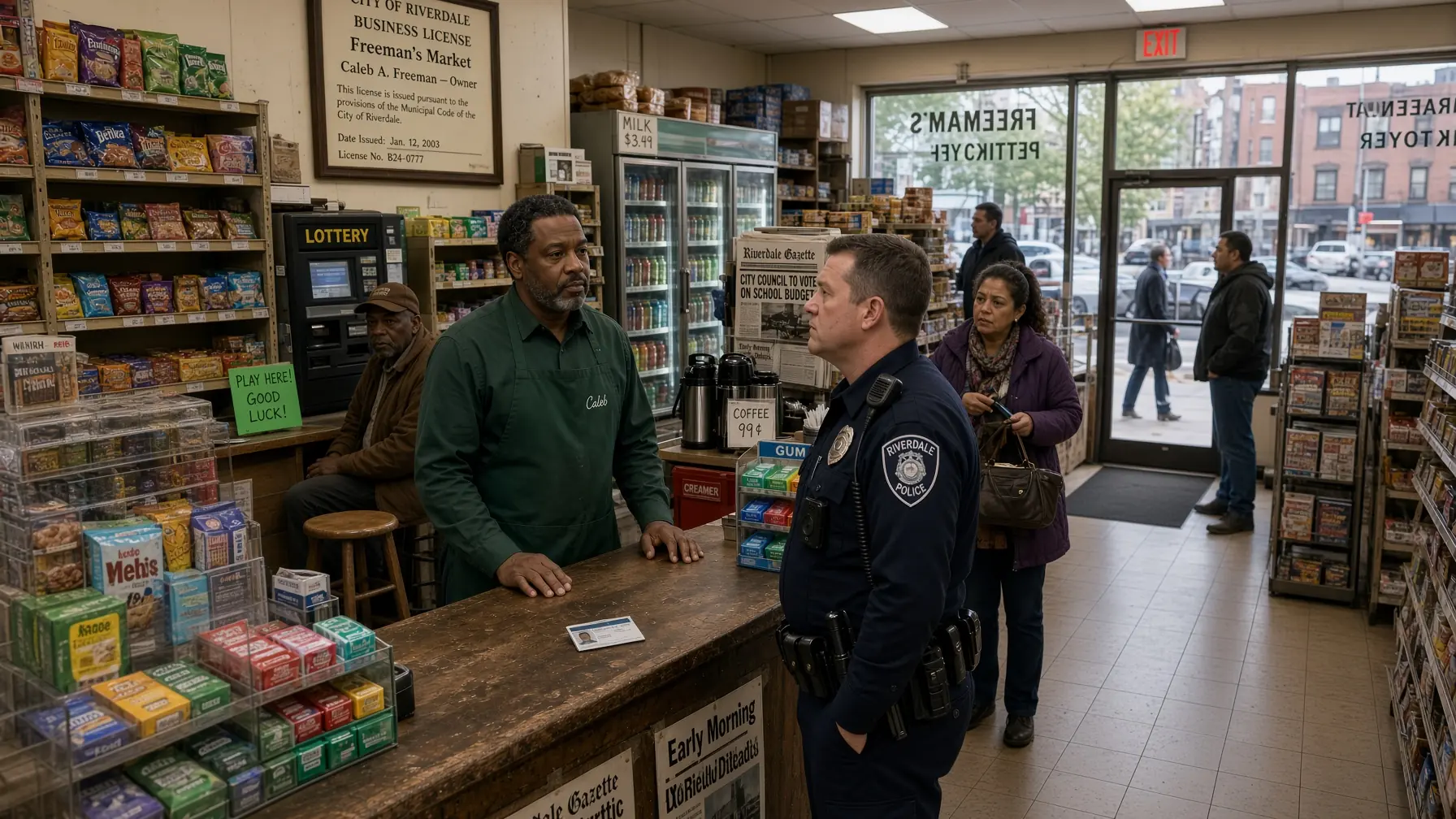
The alley was still blue with early light. Rain from the night before sat in shallow puddles near the loading steps, reflecting the dull orange glow from the streetlamp behind the building. Somewhere down the block, a bakery fan started humming, and the smell of warm dough drifted through the narrow service lane.
Caleb stood there for a moment with the key still in his hand.
He did that most mornings.
Not because he needed the pause.
Because after all these years, he still liked reminding himself that the door opened for him.
The market sat on the corner of Halston and Mercer, two blocks from the elevated train and one block from a row of apartments that had been renovated until half the old residents could no longer afford them. It was a small neighborhood bodega, nothing fancy, but it had survived three recessions, two rent wars, one fire in the building next door, and more city inspectors than Caleb cared to remember.
Inside, the coolers hummed like old machinery with a memory.
The floor tiles were worn near the entrance.
The counter had a shallow dip in the middle where elbows, change, coffee cups, and grocery bags had slowly shaped the wood over decades.
Caleb knew every inch of it.
He knew which shelf leaned slightly left.
He knew which cooler door needed a lift before it closed properly.
He knew the front window had a hairline crack hidden behind the lottery poster, and he knew the coffee machine had to be tapped once on the side if the timer failed to start before 6:15.
He moved through the store without turning on every light.
That was how familiar the place was.
His hands found switches, drawers, and locks by habit. He checked the back room, counted the bread delivery, slid yesterday’s invoices into a folder, and looked briefly at the framed business license hanging beside the coffee station. The frame had faded at the edges, but the name was still clear.
Caleb A. Freeman.
Owner.
His mother had cried when she saw it the first time.
Not loudly.
She simply stood in the store on the day he bought it, pressed her fingers against the glass, and said, “Your grandfather cleaned floors in places like this. Now your name is on the wall.”
Caleb thought of that sentence more often than he admitted.
By 6:20, the coffee was brewing, the newspaper rack was unlocked, and the front sign had been flipped from CLOSED to OPEN.
The first regular was Arthur Bell, a retired bus mechanic who bought black coffee, one banana, and a newspaper every weekday. Arthur came in wearing the same brown cap he had worn for years, even in summer. He did not like change, except when prices went down, which, as he often said, never happened anymore.
“Morning, Caleb,” he said.
“Morning, Arthur. Coffee’s fresh.”
“It better be. Last week tasted like the machine had a personal grudge.”
Caleb smiled and set a cup on the counter.
Arthur paid with coins stacked in neat little piles, as he always did. Then he carried his coffee to the one stool near the lottery machine, the stool Caleb never officially reserved but somehow nobody else used before Arthur arrived. The store had many arrangements like that, quiet rules built out of years rather than signs.
At 6:38, Mrs. Elena Cruz came in for bottled water and peppermint gum.
At 6:44, a construction worker named Dev bought two egg sandwiches and asked Caleb to put extra hot sauce in the bag.
At 6:57, a young nurse from the clinic up the street came in still wearing overnight-shift exhaustion on her face, bought coffee, and stood near the door for thirty seconds before leaving, as if the smell of the market gave her one last piece of strength before the train ride home.
It was an ordinary morning.
That was what made it cruel later.
Ordinary mornings do not warn people before becoming proof.
The patrol car turned onto Halston at 7:06.
Caleb saw it through the front glass before the cruiser stopped.
He had learned to notice police cars the way some people notice clouds. Not panic. Not guilt. Just attention. A quiet awareness that something powerful had entered the weather.
The cruiser rolled to the curb outside the market and idled there.
Arthur glanced up from his phone.
Elena, still comparing two packs of gum like the choice mattered more than it did, turned her head slightly toward the window.
The officer stepped out slowly.
His name, Caleb would learn again because he already knew it once from neighborhood talk, was Officer Ryan Keene.
Keene was white, late thirties, heavy through the shoulders, with sleeves rolled high and a jaw set in permanent challenge. He had the posture of a man who did not enter rooms to understand them. He entered to decide what needed correcting. The badge on his chest was clean enough to catch the morning light when he turned toward the glass.
He looked at the storefront for a long moment.
Then he came inside.
The bell above the door rang.
Keene did not look at the bell.
He did not say good morning.
He stood just inside the entrance and scanned the market like he had expected a crime scene and was disappointed to find potato chips, canned soup, coffee, and an old man reading headlines on a stool.
His eyes moved past Caleb first.
That was always telling.
People who truly want help look at the person behind the counter. People who already have a story look everywhere else, searching for details that fit it. Keene checked the aisles, the coolers, the coffee station, the back doorway, and finally Caleb himself.
Caleb stood behind the register in a dark green apron.
His name was stitched on the left side in white thread, a birthday gift from his daughter. His hands rested lightly on the counter, visible and still. He had not made that choice consciously, which bothered him a little, because the body remembers lessons the mind would rather outgrow.
“Morning, Officer,” Caleb said.
Keene gave him a flat look.
“You work here?”
Not silent.
Quiet.
The cooler still hummed. The coffee machine still clicked. A delivery truck still rumbled past outside. But inside the market, people stopped moving in the way people stop when a question says more than its words.
Caleb looked at Keene.
“I own it.”
Keene’s expression shifted just slightly.
It was not surprise exactly.
More like irritation that the answer did not fit the room he had already built in his head.
“You own this place?”
“Yes.”
Keene walked toward the counter, slow enough to make the movement feel official.
“I’m going to need some identification.”
Caleb nodded.
“I have ID.”
He did not reach for it yet.
Keene noticed.
Men like him always noticed when motion did not immediately follow command.
“Then show it.”
Caleb opened the drawer beneath the register and removed his wallet slowly. He placed his driver’s license on the counter, face up. Then he looked back at Keene, waiting.
Keene did not pick it up right away.
He glanced toward the business license on the wall, then toward Arthur, then back at Caleb.
“We got a call about suspicious activity at this location.”
Arthur lowered his newspaper.
Elena’s hand paused over the gum rack.
Caleb’s face stayed calm.
“What kind of suspicious activity?”
Keene’s eyes narrowed.
“I ask the questions.”
“That is a question that matters if you’re standing in my store.”
The answer landed softly but firmly.
Keene stepped closer.
“I’m conducting a check. You’re going to step out from behind the counter and wait outside while I do that.”
For a moment, Caleb truly thought he had misheard him.
Not because he was naïve.
Because the command was so far outside the facts of the room that it seemed to arrive from a different building.
He had opened this store before sunrise. He had paid the mortgage, taxes, inspection fees, payroll, supplier invoices, repair bills, city fees, and insurance premiums for over twenty years. His name was on the license by the coffee machine. His name was on the deed locked in a fireproof box under the back office desk.
And this man, who had not even looked properly at the wall, was telling him to leave.
“Officer,” Caleb said, “I am not stepping outside my own store.”
Keene’s jaw tightened.
“Do not make this harder than it needs to be.”
“I’m not making anything hard.”
“You’re refusing a lawful order.”
“I’m asking what law gives you the right to remove me from my own property.”
Arthur stood up from the stool.
He did it slowly, without drama.
He was sixty-six and had a bad knee, so standing took him a second. But once he stood, he stayed standing. That small act changed the room more than shouting would have.
Keene glanced at him.
“Sir, sit down.”
Arthur did not sit.
“I’ve been coming here sixteen years,” he said. “That man owns this store.”
Keene looked at him the way some officers look at witnesses they have not yet decided whether to intimidate.
“I didn’t ask you.”
“No,” Arthur said. “That’s part of the problem.”
Elena pulled her phone from her purse.
She did not raise it at first.
She simply held it.
The nurse from earlier had forgotten her receipt and returned just in time to step into the doorway. Her name was Jasmine Reed, though Caleb only knew her as “medium coffee, no sugar” until that morning. She read the room, saw Keene, saw Caleb, saw Arthur standing, and stayed just inside the door.
Keene raised his voice slightly.
“Everyone who is not making a purchase needs to clear the store.”
Nobody moved.
That was when Caleb reached beneath the counter.
Slowly.
Very slowly.
His fingers found the manila envelope he kept taped beneath the register shelf. It had been there for years. He had always felt foolish for keeping copies of his ownership documents within reach, until mornings like this reminded him that some people were required to carry proof of belonging in places other people entered empty-handed.
He set the envelope on the counter.
Keene watched it like it might insult him.
Caleb opened it and removed three documents.
Driver’s license.
Current business license.
Certified copy of the property deed.
He laid them out carefully, one beside the other. The deed was folded in thirds, and when he opened it, the paper made a soft crackling sound that seemed louder than it should have. The county recorder’s stamp sat at the top. The notary seal caught the fluorescent light.
Caleb A. Freeman appeared on the document in black print.
Keene looked at the deed.
Then at Caleb.
Then back at the deed.
He did not touch it.
“This doesn’t prove anything.”
Jasmine raised her phone and started recording.
Arthur let out one dry laugh.
“It proves more than your attitude does.”
Keene shot him a look.
Caleb kept his voice steady.
“The county recorder number is on the bottom. The business license is current. The address matches. My ID matches both.”
Keene leaned in.
“You don’t tell me how to do my job.”
“No,” Caleb said. “But those papers tell you what this building is, and who owns it.”
The store held its breath.
Keene was in trouble now, though he did not fully know it yet. Not because anyone had overpowered him. Not because Caleb had raised his voice. Because the facts had arrived, and Keene had chosen to treat them like inconvenience.
That is the moment when authority begins to reveal whether it serves law or ego.
Keene unclipped his radio.
“Unit Twelve requesting backup at Freeman’s Market, Halston and Mercer. Possible obstruction during premises check.”
Caleb looked at him.
“Obstruction?”
Keene did not answer.
He turned slightly away, speaking louder than necessary into the radio, as if volume could improve the story. He repeated the address. He said the subject was refusing to comply. He said the situation was tense.
He did not say the subject had produced a deed.
He did not say the subject had owned the store for twenty-two years.
He did not say the tension had begun when he ordered a man out of his own building.
Jasmine kept recording.
The red light on her phone reflected faintly in the glass of the cooler door.
Keene saw it.
“Ma’am, put the phone down.”
Jasmine’s face was tired, but her voice held.
“I’m recording from a public area.”
“This is a police matter.”
“And now it is being recorded.”
Elena lifted her phone too.
She had been quiet until then, but the quiet had changed in her body. She looked less frightened now, more resolved. She owned the small alterations shop next to the laundromat and had spent years watching people pretend they did not see things.
That morning, she decided she had seen enough.
Keene looked around the room.
Phones.
Witnesses.
Documents.
A man behind the counter who refused to become small.
He was losing the shape of the situation, and instead of stepping back, he reached for more pressure.
“I’m going to say this one more time,” Keene said to Caleb. “Step away from the counter and exit the premises.”
Caleb folded his hands in front of him.
“No.”
Arthur’s eyes moved toward Keene.
Jasmine’s phone stayed steady.
Elena stopped breathing for a second.
Keene took one step closer.
“You want to be arrested?”
“For standing in my store?”
“For interfering with an investigation.”
“What investigation?”
Keene’s mouth opened.
Nothing clean came out.
That was the problem with invented authority. When pressed for specifics, it often had to repeat itself louder because it had nothing else.
Outside, another cruiser pulled up.
A younger officer entered moments later.
He was Black, early thirties, lean, and watchful. His name tag read Mason Ford. He came in with one hand near his belt but not resting on it, eyes moving from the recording phones to Keene, then to Caleb, then to the documents on the counter.
“What’s going on?” Ford asked.
Keene answered first.
“Owner identification not verified. Subject refused to clear the premises during a check. I’ve got him obstructing.”
Ford looked at Caleb.
Then at the deed.
“May I see those documents?”
Caleb slid them forward.
Ford picked up the business license first. He read it, not quickly, not for show, but properly. Then he picked up the deed. His eyes moved across the county recorder stamp, the property address, the legal description, and Caleb’s name.
He looked back at Caleb.
“You’re Mr. Freeman?”
“Yes.”
“You own this building?”
“I do.”
Keene shifted behind him.
“We haven’t verified that.”
Ford already had his radio lifted.
“Dispatch, this is Unit Thirty-One. Need property confirmation for Freeman’s Market, address 214 Halston Avenue. Owner name Caleb Aaron Freeman. Cross-check business license number 7714-A.”
Caleb watched Ford do in one minute what Keene had refused to do for twenty.
He did not feel grateful exactly.
A man should not feel grateful for someone checking facts that were already laid in front of him.
Still, he respected the difference.
The store waited.
The radio crackled after less than a minute.
“Unit Thirty-One, property record confirms Caleb A. Freeman as registered owner. Business license active, no violations flagged. Property tax current. No active warrants or code enforcement holds attached to location.”
Ford lowered the radio.
The words had entered the room.
They could not be put back.
Arthur’s shoulders dropped slightly.
Elena closed her eyes for one second.
Jasmine kept filming, though her arm had begun to tremble from holding the phone too long.
Keene stared at the counter as if the documents had betrayed him.
Ford turned toward him.
“Records confirm ownership.”
Keene’s face tightened.
“I was responding to a complaint.”
“What complaint?” Caleb asked.
Keene looked at him.
“Anonymous tip.”
The words were small.
They sounded even smaller after everything else.
Arthur shook his head.
“Anonymous tip,” he repeated. “That’s all it took?”
Keene turned on him.
“Sir, stay out of this.”
Caleb spoke before Arthur could.
“No. He’s in it because you brought this into my store in front of him.”
That stopped Keene.
Not for long, but long enough.
Ford took one step toward him and lowered his voice. Caleb could not hear everything, but he heard enough.
“Ryan. We need to clear this correctly.”
Keene’s jaw set.
Ford continued, still low.
“The record is confirmed. Phones are recording. Body cam is running. We don’t have grounds to remove him.”
Keene glanced toward the body camera on his own chest.
It had been on the entire time.
That realization changed his face more than the deed had.
For the first time since he entered, Officer Ryan Keene looked like a man no longer standing above the room, but inside it.
The difference mattered.
He turned back to Caleb.
“Mr. Freeman,” he said.
Caleb waited.
“The records confirm you own the property.”
“Yes.”
Keene swallowed slightly.
“We were acting on a complaint regarding suspected unlawful activity at this location. The matter appears to be resolved. No further action is required.”
The words were careful.
Empty.
Not an apology.
Not even close.
They were a hallway built for him to walk out of with his pride bruised but still covered.
Caleb looked at him for a long moment.
Then he said, “Your inspection is over.”
Keene’s face reddened.
But he nodded once.
Ford returned the documents to the counter, placing the deed carefully beside the business license. That small gesture did not undo the morning. It did not repair the insult. But Caleb noticed it, because respect often announces itself in small, practical ways.
Keene turned and walked out.
The bell above the door rang.
This time, it sounded different.
Not happier.
Just final.
Ford stayed near the entrance.
“I’ll file a report,” he said to Caleb. “The body camera footage will be preserved. You have the right to file a formal complaint.”
Caleb looked at him.
“I will.”
Ford nodded.
“Understood.”
There was more he wanted to say.
Caleb saw it.
Maybe sorry.
Maybe I know what that was.
Maybe I wish I had arrived sooner.
But Ford did not say any of those things. Maybe he could not. Maybe the uniform made some truths harder to speak while still wearing it.
He gave Caleb one small nod and left.
The store exhaled only after both cruisers pulled away.
Elena lowered her phone.
Jasmine stopped recording.
Arthur sat back down, then stood again immediately, as if sitting felt wrong after what had happened.
For a while, nobody spoke.
That silence did more than words could have.
It held the shape of what had just occurred. A man had nearly been ordered out of his own business because an officer walked through the door believing an anonymous tip more readily than a Black owner standing beneath his own license.
The silence let that truth sit there.
Then Arthur picked up his cold coffee.
“You want me to make a fresh pot?” Caleb asked.
Arthur looked at him, then at the coffee, then back at him.
“No,” he said. “I think this one earned the right to be cold.”
Caleb laughed.
It was brief, but real.
Jasmine set a folded receipt on the counter.
“My number is on the back,” she said. “I have the whole thing. Audio too. If you need it, call me.”
Elena added, “Mine too. I started recording after he told you to leave.”
Caleb accepted both numbers.
“Thank you.”
Jasmine shook her head.
“No. Thank you for staying calm.”
Caleb looked down at the deed on the counter.
“Calm is expensive.”
She understood that.
People who have had to buy it often do.
By 9:30, the block had heard.
Neighborhoods carry news through doors, texts, sidewalks, registers, and people who say they are not gossiping while absolutely gossiping. Customers came in with unusual reasons to buy ordinary things. A bottle of water. One apple. A lighter. A candy bar. Coffee they did not need.
They wanted to see Caleb.
Not stare at him.
Just see him still there.
That mattered.
Mrs. Porter from the laundromat came in with a foil-covered plate of chicken and rice.
“Eat,” she said, placing it on the counter.
“I’m working.”
“You can chew between customers.”
Mr. Singh from the pharmacy brought over a copy of the exterior camera footage from his storefront without being asked.
“It caught the patrol car arriving,” he said. “Also the officer entering. The angle through the window is not perfect, but it shows enough.”
Dev the construction worker returned during his lunch break and stood at the counter for ten minutes pretending to compare lottery tickets.
Finally, he said, “My uncle lost a shop in Queens because the city kept hitting him with inspections after someone wanted the building.”
Caleb looked at him.
“I remember you telling me that.”
“Just saying. Paperwork matters.”
“Yes,” Caleb said. “It does.”
His daughter called at 10:12.
Her name was Maya.
She was a school counselor in New Jersey, thirty-four, sharp as her grandmother and twice as impatient with injustice. Caleb told her the story plainly. He gave her the facts in order: officer arrived, demanded ID, ordered him out, refused to accept the deed, called backup, backup confirmed ownership, no apology.
Maya was quiet for a long time.
Then she said, “Dad, are you okay?”
“I’m at the store.”
“That is not what I asked.”
He looked toward the front window.
Outside, two teenagers walked past eating chips from bags they had bought there yesterday. An old woman paused to adjust her shopping cart near the curb. A bus sighed at the corner.
“I will be,” Caleb said.
That was the honest answer.
Maya heard the difference.
“File the complaint today.”
“I am.”
“Send me copies of everything.”
“I will.”
“And don’t tell me you don’t want trouble.”
Caleb almost smiled.
“I wasn’t going to.”
“You were thinking it.”
“I raised a difficult child.”
“You raised a prepared one.”
After the call, Caleb placed the deed back into the manila envelope.
Then he stopped.
For years, the deed had lived under the counter like an emergency tool. That morning, it had done its work. But putting it away immediately felt too much like letting the morning disappear into a drawer.
So he left it on the counter.
Not open for spectacle.
Just visible.
A legal document in plain sight, carrying the weight of twenty-two years.
By noon, a police supervisor called.
Lieutenant Marissa Cole introduced herself professionally and said an internal review had been opened. She had seen the body camera footage. She asked if Caleb would provide a formal statement. Her voice was careful, and Caleb could hear the department trying to manage the size of the incident before the public did.
“I’ll provide a statement,” he said.
“Thank you, Mr. Freeman.”
“I also have civilian videos from three witnesses, exterior camera footage from the pharmacy, and the names of everyone present.”
There was a pause.
“Please include those.”
“I intend to.”
Another pause.
Then she said, “Mr. Freeman, I understand this morning was unacceptable.”
Caleb waited.
“I appreciate you saying that.”
“It is not enough,” she said.
That surprised him.
He looked at the phone.
“No,” he said. “It isn’t.”
The formal complaint took three hours to write.
Caleb wrote it at the back office desk, the same desk where invoices accumulated and where the fireproof lock box had sat for years. He wrote carefully. Not emotionally. Not because emotion was wrong, but because he knew what systems did to emotional people when they wanted to avoid facts.
They called them angry.
Confused.
Uncooperative.
Difficult.
He gave dates, times, names, exact words, document numbers, witness names, and camera sources. Maya reviewed it over video call, correcting two sentences that sounded too soft. Caleb grumbled, then admitted she was right.
Arthur stayed at the counter while Caleb wrote.
He did not know how to run the register, but he knew enough to tell customers, “He’ll be right out, and if you’re in a hurry, come back with patience.”
Some did.
Most stayed.
When Caleb finished, he printed the complaint and signed it with the same pen he used for supplier checks. His signature looked normal. That pleased him more than it should have.
The days after the incident unfolded in layers.
First came the internal review.
Then the local news, after Jasmine’s video spread online.
Then the city council member, who called not because she had suddenly discovered concern for small business owners, but because public attention had arrived before she did.
Then came other stories.
A barber who said Officer Keene had once ordered him to prove he worked in his own shop after closing late.
A Black woman who owned a daycare and had been questioned outside her building because someone reported “a stranger near children.”
A Puerto Rican mechanic who said Keene had threatened to tow cars from his lot until he produced five different permits.
A delivery driver who had been forced to empty his bag on the sidewalk because an anonymous caller said packages were being stolen.
Patterns do not appear all at once.
They collect.
They wait.
Then one recorded moment gives them a place to gather.
Officer Keene was placed on administrative leave within a week.
The department did not announce that first.
Someone leaked it.
Then the department confirmed it.
His union representative called the incident a misunderstanding, a routine response to a complaint, and an unfortunate escalation made worse by social media. Caleb read the statement from behind his counter and shook his head.
Misunderstanding.
People loved that word when the person being misunderstood looked like him.
A misunderstanding suggested equal confusion.
That was not what happened.
Keene understood exactly what he was doing until the deed proved he had chosen wrong.
At the public review hearing, Caleb wore a navy suit Maya had insisted on buying him years earlier for her graduation. He did not like suits. They made him feel like he was borrowing somebody else’s shape. But Maya said the city liked costumes, and if they were going to pretend formality meant credibility, he might as well use it against them.
She sat beside him.
Arthur sat behind him.
Jasmine, Elena, Mr. Singh, Mrs. Porter, Dev, and half the block filled two rows in the hearing room.
Keene sat across from them with his attorney.
He looked smaller without the store around him.
That surprised Caleb.
Authority had filled him out that morning. The badge, the belt, the cruiser, the confidence of being believed first. In the hearing room, stripped down to testimony and footage, he looked like a man realizing that confidence was not the same as truth.
The video played.
Everyone watched him enter the market.
Everyone heard him ask, “You work here?”
Everyone heard Caleb answer, “I own it.”
Everyone heard the order to leave.
Everyone saw the deed laid flat on the counter.
Everyone watched Keene refuse to accept what was in front of him until another officer verified it.
The room was quiet when the video ended.
Then Caleb gave his statement.
He did not embellish.
He did not call Keene names.
He did not describe feelings first.
He described facts.
The store opened at 6:00.
Keene arrived at 7:06.
The deed was produced.
Ownership was verified.
No apology was given.
Then he looked at the review panel and said the only sentence he had written by hand at the bottom of the typed page.
“A man should not have to prove he belongs in the building he owns because an officer walked in already believing otherwise.”
That sentence traveled farther than anything else.
It appeared in articles.
It appeared in posts.
It appeared on a handwritten sign someone taped inside Freeman’s Market the next day.
Caleb took the sign down after two hours because he did not want the store turning into a shrine. Then he put it in the back office drawer because he did not want to throw it away either.
Keene received a suspension first.
Then, after the review uncovered three prior incidents with similar patterns, the city ordered retraining, public discipline, and removal from solo patrol pending further evaluation. Some people wanted him fired. Some wanted charges. Some said discipline did not go far enough.
Caleb did not build his peace around Keene’s punishment.
He had learned long ago that the fall of one man rarely fixes the stairs.
What mattered more was the policy that followed.
Anonymous complaints involving businesses now required verification before premises action unless there was immediate danger. Officers had to document the specific legal basis for ordering an owner or employee off property. Body camera footage from business checks became automatically reviewable if property rights were disputed. Small business owners received a city hotline for law enforcement disputes.
It was not enough.
But it was something with teeth.
Freeman’s Market changed too, though not in the way Caleb first feared.
For two weeks, strangers came in just to say they supported him.
Some bought nothing and made speeches.
Caleb disliked speeches in aisles, especially when customers blocked the soup. He appreciated the sentiment, but he had a store to run. Eventually, the attention settled, and the old rhythms returned.
Arthur on the stool.
Elena comparing gum.
Dev asking for hot sauce.
Jasmine buying coffee after night shifts.
Mrs. Porter bringing food Caleb did not ask for and absolutely ate.
The deed went back into the fireproof box under the desk.
But Caleb made two certified copies and placed one behind the counter and one in the manila envelope taped underneath the register shelf. Maya suggested scanning everything into cloud storage. Caleb pretended to dislike the idea, then asked her to do it before dinner.
Six months later, Officer Mason Ford came into the store off duty.
He wore jeans, a gray jacket, and the slightly awkward expression of a man unsure whether his presence would be welcome. Caleb looked up from the register and waited.
Ford placed a bottle of water on the counter.
“Just this.”
Caleb rang it up.
Ford paid.
Neither spoke for a moment.
Then Ford said, “I should have said more that morning.”
Caleb looked at him.
“You verified the record.”
“I did.”
“That mattered.”
“I know. But I still should have said more.”
Caleb handed him the receipt.
“Then say more next time.”
Ford nodded slowly.
“Yes, sir.”
He left the store without making the moment bigger than it needed to be.
Caleb respected that.
One year after the incident, Maya convinced Caleb to let the block hold a small anniversary breakfast outside the market.
He argued against it for three weeks.
She ignored him for three weeks and planned it anyway.
Tables appeared on the sidewalk. The bakery donated pastries. Mrs. Porter made enough rice and beans to feed a church basement. Arthur complained the coffee was not as good as Caleb’s, then drank three cups.
Someone asked Caleb to speak.
He refused.
Then Maya stood with a paper cup in her hand and said, “My father has been speaking for twenty-two years every time he opens that door before sunrise.”
The block applauded.
Caleb hated that part.
He also remembered it later when the store was quiet.
That evening, after the crowd left and the sidewalk was swept, Caleb stood behind the counter alone. The light outside had softened into early dusk. The coolers hummed. The coffee machine clicked into its final cycle. The framed license by the coffee station caught a small reflection from the front window.
He opened the back office drawer and took out the folded sign someone had made after the hearing.
A man should not have to prove he belongs in the building he owns.
He read it again.
Then he placed it inside the fireproof lock box, on top of the deed.
Not because he needed reminding of what was his.
Because the city did.
Years later, people still told the story as a simple twist.
A cop walked into a bodega and ordered a Black man out.
The man turned out to own the building.
He put the deed on the counter, the backup officer verified it, and the cop had to walk out in front of recording customers.
That version was satisfying.
It was also too small.
The real story was not that Officer Keene picked the wrong man to challenge.
There is no right man to treat that way.
The real story was that Caleb Freeman had spent twenty-two years doing everything right and still knew he might one day need paper to prove what his labor had already built. He knew the deed might need to speak because his presence would not be enough for someone determined not to see him.
That knowledge was not paranoia.
It was preparation.
It was the quiet wisdom of people who have learned that dignity should be automatic, but proof should still be close enough to reach.
Caleb kept running the store.
He opened before dawn.
He brewed coffee.
He paid taxes.
He replaced the cooler door that had been bothering him for years.
He fixed the crack behind the lottery poster.
He raised the price of Arthur’s coffee by ten cents and listened to three full days of theatrical complaints.
Life went on.
But something had shifted on Halston and Mercer.
People watched differently now.
Not with fear.
With responsibility.
When a patrol car slowed outside, heads turned. Phones did not always come out, but hands knew where they were. Witnesses had learned that witnessing was not passive. It was a choice made in the first seconds before a bad story writes itself clean.
Caleb never called himself brave.
Bravery sounded too grand for what he had done.
He had stood behind his own counter.
Laid out his own papers.
Kept his voice level while an officer tried to make his ownership feel conditional.
Sometimes that is what courage looks like in America.
Not running into fire.
Not shouting in the street.
Just staying still long enough for the truth to catch up.
One morning, years later, a young man came into the market wearing a delivery vest and looking uncertain.
He held a package in both hands and glanced from the counter to the back door.
“Is Mr. Freeman here?” he asked.
Caleb looked up.
“That’s me.”
The young man blinked.
“Oh. Sorry. I thought maybe you were just working here.”
The store went quiet for half a second.
Then the young man’s face changed as he realized what he had said.
“I didn’t mean it like that.”
Caleb studied him.
Maybe twenty-two.
Nervous.
Trying.
Caleb let the moment breathe.
Then he said, “A lot of people start there. The important thing is where they go next.”
The young man swallowed.
“Yes, sir. Package for you.”
Caleb signed for it.
After the young man left, Arthur looked up from his stool.
“You let him off easy.”
Caleb poured coffee into a paper cup.
“No,” he said. “I gave him a door.”
Arthur considered that.
Then nodded.
The market bell rang again.
Another customer entered.
The day continued.
That was the thing about buildings like Freeman’s Market. They held more than inventory. They held correction, memory, argument, forgiveness, exhaustion, proof, and the small daily rituals that made a neighborhood something more than a collection of addresses.
Caleb’s name remained on the deed.
His license remained on the wall.
The counter remained scarred, dipped, and solid.
And beneath it, taped where his hand could find it without looking, stayed the envelope with the copies.
Not because Caleb expected the world to be fair.
Because he had learned that fairness often needed witnesses, paperwork, and one person calm enough to place the truth on the counter.
Officer Keene had walked in believing authority meant the room belonged to him.
He walked out corrected by a deed, a camera, a backup officer willing to check the record, and a store full of people who decided not to disappear.
That was the lesson.
Power can enter loudly.
Truth does not have to.
Sometimes it is folded in thirds, stamped by the county, kept under a counter for years, waiting for the morning someone mistakes patience for weakness and learns, too late, that the quiet man behind the register has already done the work.