The first person to call Maya Calloway a liar that morning did it quietly.
He was an older man sitting two rows behind the defense table in Courtroom 4B of the Fulton County Justice Center.
Maya never learned his name.
She only heard the whisper.
“She’s lying.”
Three syllables.
Soft enough that the bailiff could pretend not to hear.
Loud enough that Maya knew they were intended for her.
She did not turn around.
Her hands remained flat on the polished wooden table.
A thick beige evidence folder rested beneath her right palm.
Across the courtroom, Lieutenant Mark Keller watched her.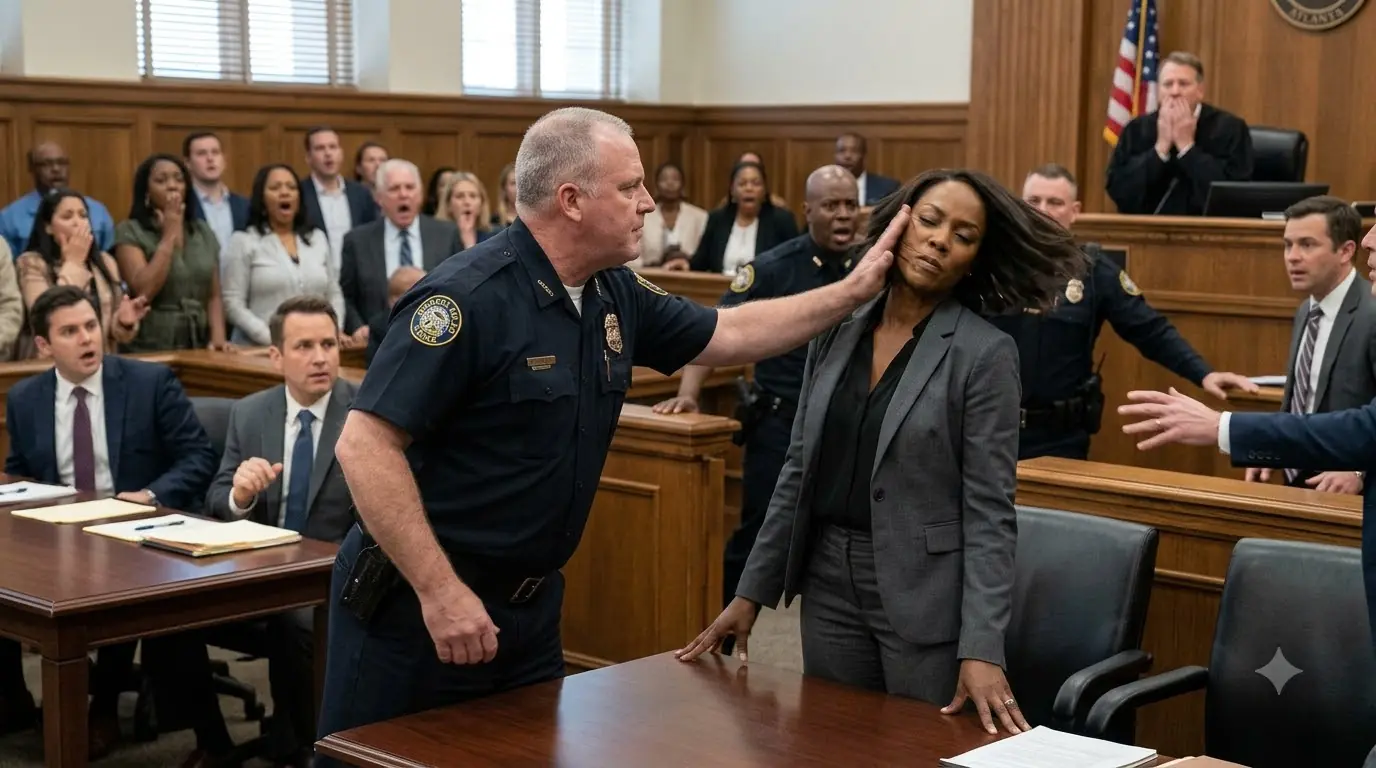
He was fifty-one years old, stocky, broad through the chest, and still wore his dark-navy Atlanta police uniform as though the fabric itself were a character witness.
Twenty-six years on the job.
Four commendations.
Two medals for valor.
Former president of the local police association.
Guest speaker at civic breakfasts.
A photograph of Keller shaking hands with a mayor had once appeared on the front page of the newspaper.
He knew exactly what people saw when they looked at him.
Experience.
Authority.
Certainty.
Maya knew too.
That was why he was smiling.
The case before Superior Court Judge Raymond Ellis was officially titled State of Georgia v. Devon Price.
To everyone outside the courthouse, it was known as the Edgewood arrest case.
Devon Price was twenty-one.
Black.
A community-college student.
No prior criminal record.
Eleven months earlier, he had been arrested outside a convenience store after an argument involving two officers and a broken storefront window.
The police report stated that Devon had been intoxicated, aggressive, and armed with a folding knife.
It stated he had threatened Lieutenant Keller.
It stated he resisted arrest.
It stated Keller used necessary force only after Devon attempted to attack him.
The report contained seven paragraphs describing a violent encounter.
Maya had watched the whole thing happen.
And almost none of it was true.
That was why Keller hated her.
Maya had been driving home from a late client meeting when she stopped at the Edgewood Market for coffee.
She had parked near the side entrance.
She was standing beside her car when Devon came out carrying a plastic bag containing milk, cereal, and cold medicine.
A patrol cruiser entered the lot too quickly.
It nearly hit him.
Devon slapped one palm against the hood.
The officer driving shouted.
Words followed.
Then Keller's unmarked SUV arrived.
Maya did not know why he was there.
Later she learned he had been supervising a nearby traffic operation.
What she remembered clearly was Devon stepping backward with both hands visible.
What she remembered even more clearly was Keller saying:
“Put him down.”
Devon had not touched anyone.
He had not displayed a weapon.
He had not run.
But within seconds, he was on the pavement.
One officer pinned his legs.
Another twisted his arm.
Keller stood over him shouting commands that contradicted one another.
“Stop resisting.”
“Give me your hands.”
“Quit moving.”
Devon's hands were already trapped beneath his chest.
Maya had shouted from twelve feet away.
“He can't give you his hands. You're lying on them.”
Keller looked at her.
That was their first encounter.
His expression told her everything about how he understood the situation.
He was not surprised that someone had spoken.
He was offended.
“Ma'am, back up.”
“I am backed up.”
“Leave.”
“I witnessed what happened.”
Keller stepped toward her.
“Then you'll give a statement.”
“I will.”
He hesitated.
That had not been the answer he expected.
Maya had spent seventeen years as an attorney.
She had served six years as an assistant district attorney before moving into corporate investigations and professional ethics work.
She knew what happened when frightened witnesses left scenes without securing their own records.
So she took photographs.
Not secretly.
Openly.
Keller noticed.
“What are you doing?”
“Documenting.”
“You interfering with an active arrest?”
“No.”
“Put your phone away.”
“No.”
The word changed his face.
Maya remembered that.
Not anger exactly.
Recognition.
Keller had realized she might become inconvenient.
Twenty minutes later, Devon was in an ambulance.
The folding knife supposedly recovered from his pocket had not appeared while Maya stood there.
She saw it for the first time two days later in a photograph attached to the police report.
That was when she contacted Devon's family.
That was also when the trouble began.
At first, Maya assumed the case would correct itself.
Body-camera footage would exist.
Store surveillance would exist.
Dispatch logs would clarify which officers arrived when.
Witnesses would be interviewed.
Instead, the store camera had allegedly malfunctioned.
Two officers claimed their body cameras activated late because of “equipment delay.”
Keller's body camera had no footage at all.
The department's internal review concluded that evidence supported the officers.
Devon was charged with aggravated assault on an officer, obstruction, carrying a concealed weapon, and criminal damage.
Maya gave a statement.
Then another.
Her statements were consistent.
That should have mattered.
Instead, Keller began attacking her credibility.
First indirectly.
An investigator asked whether Maya had “previous negative experiences with law enforcement.”
Then another asked whether she had been drinking that evening.
She had not.
A third questioned whether poor parking-lot lighting could have affected her perception.
The lot was brightly illuminated.
Then came the rumor.
Maya supposedly knew Devon.
She did not.
Then another.
She was allegedly connected to an activist organization trying to embarrass police.
False.
Then one local website published a piece stating that Maya had once represented a client in a lawsuit against the city.
True.
Nine years earlier.
Completely unrelated.
The implication was obvious.
She had an agenda.
For months, Maya answered every question the same way.
“I saw what I saw.”
Keller answered with one sentence.
“She’s lying.”
By the morning of the pretrial evidentiary hearing, those words had become his shield.
Maya stood at the counsel table beside Assistant District Attorney Nathan Cole, though she was not part of the prosecution team.
She was a subpoenaed witness.
Cole had asked her to wait until called.
Keller sat behind his attorney.
The courtroom was full because the case had become local news.
Reporters occupied the rear bench.
Police officers sat behind Keller.
Devon's family sat across the aisle.
Devon himself remained silent at the defense table, charged with crimes Maya increasingly believed had been manufactured.
The unusual posture of the hearing came from newly disclosed evidence.
Three weeks earlier, the prosecution received a digital file from an anonymous source.
Nobody publicly knew what it contained.
Keller's attorney demanded exclusion.
The judge ordered a hearing.
Maya had received a subpoena the following day.
Now she stood waiting.
Keller stared.
Then one of the reporters whispered something.
Another looked at Maya's folder.
Keller saw that too.
He leaned toward his attorney.
“What does she have?”
The attorney murmured something.
Keller's jaw tightened.
Judge Ellis entered.
Everyone rose.
The judge was sixty-one, patient in the way only people accustomed to other people's bad decisions could be patient.
“Be seated.”
The hearing began.
For forty minutes, lawyers argued about authenticity, chain of custody, and disclosure.
Maya listened.
The mysterious file remained sealed.
Then Keller's attorney, Gregory Marsh, stood.
“Your Honor, before the state attempts to introduce material through Ms. Calloway, we need to address her reliability.”
Maya's eyebrows rose slightly.
The prosecutor objected.
Judge Ellis allowed limited argument.
Marsh turned.
“Maya Calloway has repeatedly accused Lieutenant Keller of misconduct.”
Maya said nothing.
“She has given public interviews.”
Two.
Only after Keller's supporters publicly accused her of fabricating testimony.
“She has a history of adversarial litigation against the city.”
One case.
Nine years ago.
“She has positioned herself as an advocate rather than a neutral observer.”
Maya felt Keller watching her.
Marsh continued.
“This alleged evidence arrived anonymously, and we expect testimony will establish that Ms. Calloway had both motive and technical access sufficient to manipulate digital material.”
That was new.
Maya looked toward Cole.
The prosecutor looked equally surprised.
Judge Ellis frowned.
“Counsel, are you alleging evidence fabrication?”
“We are raising the possibility.”
Keller suddenly spoke from his seat.
“She made it.”
Marsh turned.
“Lieutenant.”
Keller stood anyway.
“She made the whole damn thing.”
Judge Ellis's expression hardened.
“Lieutenant Keller, sit down.”
Keller pointed toward Maya.
“She’s lying.”
The courtroom shifted.
Maya did not.
Judge Ellis struck the gavel once.
“That is enough.”
Keller's attorney reached for his arm.
Keller jerked away.
“You don't understand what she's doing.”
Judge Ellis stood slightly.
“I understand that you are disrupting my courtroom.”
Maya felt every eye turn toward her.
Keller moved into the aisle.
“She's been coming after me for eleven months.”
The prosecutor rose.
“Your Honor—”
“She doesn't know Devon Price.”
Keller pointed again.
“She claims she was just standing there.”