The first thing Judge Naomi Ellison wanted that morning was silence.
Not courtroom silence, the kind that sat heavy under fluorescent lights while lawyers shuffled papers and jurors watched every breath. Not the tense silence before a verdict, when everyone pretended not to hope too loudly. She wanted the ordinary kind, the small peaceful silence of water moving through a garden hose, birds arguing in the maple trees, and sunlight touching the roses before the city remembered its own noise.
It was 7:18 on a Thursday morning in Portland, Oregon, and Laurelhurst looked like a neighborhood arranged for a postcard.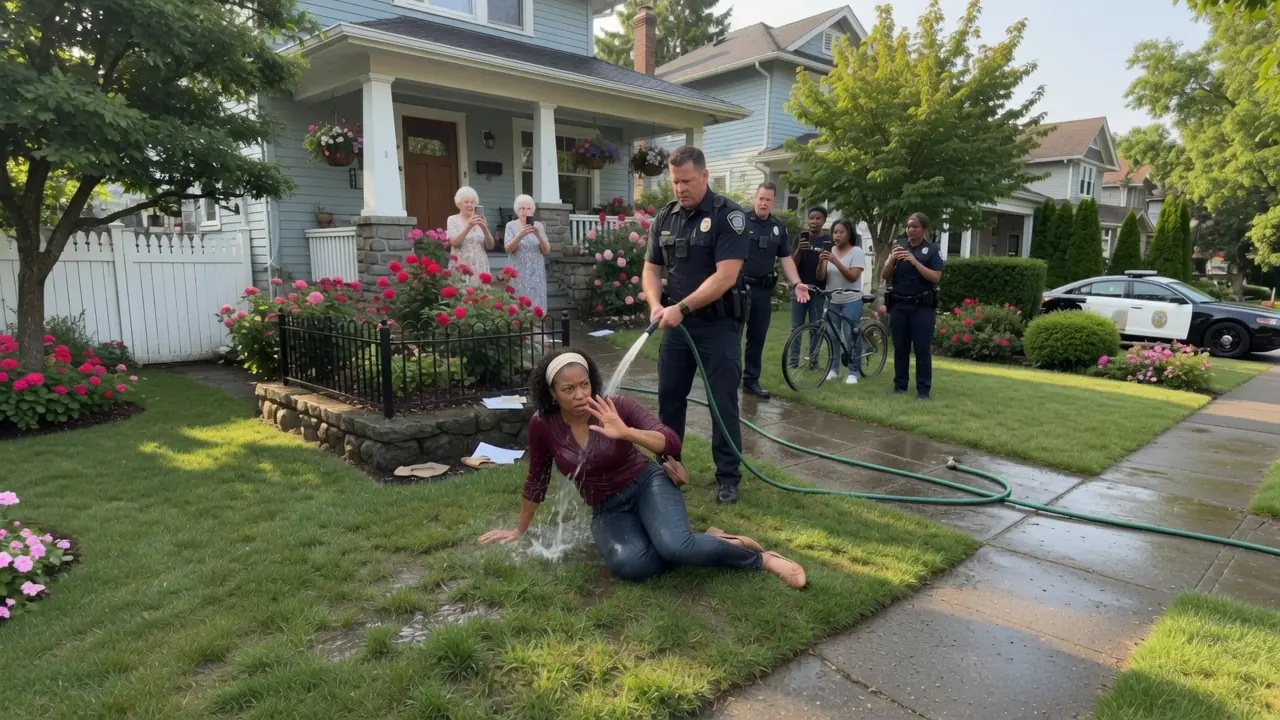
Old Craftsman houses stood behind trimmed hedges and stone paths. Porches wrapped around painted columns. Hydrangeas leaned over fences, and the sidewalks were clean enough to make the whole street feel less like a public road and more like a private promise. Naomi had lived there for six years, long enough to know which neighbors overwatered their lawns and which dogs barked at delivery trucks but not mail carriers.
Her house sat near the corner of Alder View Lane, pale blue with white trim, a wide porch, and a rose bed her late mother would have called “too pretty to trust.”
Naomi loved it anyway.
She stepped outside barefoot in old jeans and a soft gray sweater, her curls tied back with a green scarf. She had federal court at one in the afternoon and a stack of draft opinions waiting on her kitchen table, but for the next twenty minutes, she belonged to the garden. Her husband, Dr. Adrian Ellison, had already left for surgery rounds at the hospital, kissing her on the forehead while she pretended to still be asleep.
Now the house was quiet.
The coffee was strong.
And the roses needed water.
Naomi turned on the spigot, adjusted the nozzle to a soft fan, and watched the soil darken beneath the first bush. The morning air smelled like wet leaves, lavender soap from her kitchen window, and the faint sweetness of the bakery three blocks away. It was the kind of morning that made a person believe the world might behave itself for once.
“Morning, Judge,” called Mrs. Lillian Price from next door.
Naomi looked up and smiled. Lillian was eighty-one, sharp as a tack, with silver hair pinned into a bun and a garden hat far too wide for practical use. She had known Naomi long before most of the neighborhood stopped treating her like a visitor who had overstayed her welcome.
“Morning, Lillian. Your lilies are showing off again.”
“They know company is coming Sunday.”
“Tea?”
“And lemon cake, if you don’t pretend you’re too busy.”
Naomi laughed and moved to the next rosebush.
Neither woman noticed the patrol car at first.
It rolled slowly down Alder View Lane, tires whispering against the clean pavement. Officer Blake Rourke drove with one hand on the wheel and the other resting near his radio, his eyes moving over the houses with the hard impatience of a man looking for something wrong. He had fifteen years with Portland Police and a reputation that depended on who you asked.
To his friends, he was old-school.
To his supervisors, he was aggressive but productive.
To the people who had filed complaints against him, he was a nightmare in a blue uniform.
His partner, Officer Evan Cole, sat in the passenger seat with a coffee cooling between his knees. Evan was twenty-six, only a year out of the academy, still young enough to believe procedures existed for a reason. He followed Rourke’s gaze across the street and saw Naomi watering roses in her own yard.
“What are we slowing for?” Evan asked.
Rourke nodded toward her. “That.”
Evan looked again. “A woman watering flowers?”
“A woman who doesn’t fit the house.”
Evan’s stomach tightened. “Blake.”
Rourke parked at the curb. “Don’t start.”
“We don’t have a call here.”
“We have suspicious presence in a high-value residential area.”
“That’s not a call. That’s you deciding something.”
Rourke opened his door. “That’s experience.”
Evan watched him step out and felt that familiar trapped feeling of being new, junior, and right in a way that could still cost him. Rourke had already crossed the street, boots striking the pavement too loudly for a morning this quiet. His hand sat near his belt, close enough to the gun and cuffs to turn conversation into warning.
She turned off the hose spray and looked over her shoulder. “Good morning, officer. Can I help you?”
Rourke stepped over the low decorative fence without asking. That was the first line he crossed. Naomi saw it clearly, not only as a homeowner, but as a federal judge who had spent years listening to officers explain where lines became blurry only after they had already stepped past them.
“What are you doing here?” Rourke asked.
Naomi looked down at the hose in her hand, then back at him. “Watering my roses.”
“Your roses?”
“Yes.”
“This your property?”
Naomi’s face stayed composed. “It is.”
Rourke’s eyes moved over her old jeans, bare feet, gray sweater, and head scarf. He looked past her to the house, then at the garden, then back at her with the smug confidence of a man who believed property could only belong to certain faces.
“I’m going to need ID.”
Naomi breathed in slowly. “Officer, I am standing in my own yard. What is the basis for your request?”
His jaw shifted. “The basis is I asked.”
“That is not a legal basis.”
Rourke gave a short laugh. “Oh, we got a lawyer now?”
Lillian Price stepped closer to her fence. “Officer, Naomi lives there. Everyone on this block knows her.”
Rourke turned his head. “Ma’am, stay out of this.”
“I won’t stay out of it when you’re harassing my neighbor.”
“One more interruption and I’ll cite you for interfering.”
Lillian stared at him for one second, then reached into the pocket of her robe and pulled out her phone.
Rourke saw it.
His expression hardened.
Naomi did too, and she felt the day begin to tilt. This was no longer a foolish question from a careless officer. This was becoming something hungrier, something that needed to prove itself in front of witnesses.
“Officer, may I have your name and badge number?” Naomi asked.
Rourke tapped his nameplate with two fingers. “Rourke. Badge 5126. Write it on your little complaint form.”
“I will.”
“You threatening me?”
“I’m documenting you.”
His eyes narrowed. “Big difference in your mind, I’m sure.”
Across the street, a man walking a golden retriever slowed down. A woman in running clothes stopped near the corner. Two teenagers on bikes rolled to the curb and lifted their phones without speaking. The street was waking up around the confrontation, and with every new witness, Rourke seemed to grow more determined to win.
“Show me proof you live here,” he said.
“My identification is inside.”
“Then go get it.”
“You want me to allow you into my home?”
“I didn’t say that.”
“You implied it.”
He stepped closer. “Lady, stop trying to out-talk me.”
Naomi held the hose loosely at her side. “I’m not trying to out-talk you. I’m asking why a police officer stepped onto my property and demanded identification because I was watering flowers.”
“Because you don’t belong here.”
The words came out too fast.
Even Rourke seemed to know it.
For one breath, the street went still.
Naomi’s voice lowered. “What did you say?”
“I said something doesn’t look right.”
“No, officer. You said I don’t belong here.”
Rourke’s face flushed. “Don’t twist my words.”
“I don’t have to. They’re on camera.”
The taller of the two teenagers, a Black boy in a red hoodie, spoke from the sidewalk. “Yeah, they are.”
Rourke spun toward him. “Put that phone away.”
“No, sir. I’m recording from a public sidewalk.”
“I’ll take that phone.”
“No, you won’t.”
Evan finally got out of the patrol car.
“Blake,” he called, trying to sound calm. “Let’s just verify the address and move on.”
Rourke pointed at him without looking away from Naomi. “Get back in the car.”
“Blake, we don’t have probable cause.”
Rourke’s neck reddened. “I said get back in the car.”
Evan stopped, but he did not return to the cruiser.
That small act of hesitation mattered more than he knew.
Naomi watched him from the corner of her eye. He was scared. Not of her. Of his partner. She had seen that kind of fear in courtrooms too, in young officers who knew the truth but had been trained to fear the blue wall more than the law.
Rourke turned back to her. “Last chance. ID.”
Naomi moved carefully. “I’m going to retrieve my identification from my back pocket.”
“Keep your hands where I can see them.”
“My ID is in my pocket. You cannot demand it and prevent me from reaching it.”
He stared at her.
The logic irritated him because it was correct.
“Slow,” he said.
Naomi shifted her weight. Her heel caught the garden hose lying in the wet grass. The nozzle jerked, and a thin spray of water arced up, catching Rourke across one pant leg.
It was barely anything.
A splash.
A mistake.
But Rourke looked down as if she had struck him with a weapon.
Then he looked at her.
His face changed.
“Did you just assault me?”
Naomi froze. “No. I tripped on the hose.”
“You sprayed a police officer.”
“Officer Rourke, it was accidental.”
“You think this is funny?”
“No.”
“You think because you live in this fancy house, you can disrespect me?”
“I did not disrespect you.”
“You people always know exactly how to play innocent.”
Lillian gasped.
Evan stepped forward. “Blake, stop.”
But Rourke had already grabbed the hose.
He twisted the nozzle hard. The soft fan became a tight, high-pressure jet. Naomi saw his hand tighten, saw the rage in his eyes, and for one terrible second, she understood what he intended before her body could move.
“Don’t,” she said.
He pulled the trigger.
The water hit her full in the face.
Cold force slammed into her eyes, mouth, nose, and chest. Naomi stumbled backward, hands flying up, but the pressure kept coming. Her foot slid on the wet grass, and she fell hard beside the rose bed, one elbow striking the earth, the breath knocked out of her.
Rourke followed her with the stream.
“You wanted to act smart,” he shouted. “Let’s cool you off.”
Naomi turned her head, trying to breathe, but water filled her mouth. She choked, rolled onto one hip, and covered her face with both arms. The spray pounded against her shoulders, her hair, her sweater, soaking her through in seconds.
“Stop!” Lillian screamed. “She can’t breathe!”
The teenagers shouted from the sidewalk.
The man with the dog cursed loudly.
Evan grabbed Rourke’s arm. “Blake, stop it!”
Rourke shoved him away with his shoulder and kept spraying.
Ten seconds.
Twenty.
Thirty.
The world narrowed to water, grass, and the sound of people screaming her name.
Then finally, the stream cut off.
Naomi sat on the lawn, coughing hard, water running from her hair and down her face. Her sweater clung to her skin. Her legal briefs had fallen from the folder she dropped near the porch, pages soaking in puddles across the walkway. Her morning, her dignity, her sanctuary, all lay ruined in front of neighbors who had watched a police officer turn her own garden hose into a punishment.
Rourke stood over her, breathing hard.
His face held the ugly satisfaction of a man who believed he had restored order.
“Maybe next time you’ll learn to cooperate,” he said.
Naomi pressed one hand into the grass and pushed herself up.
Slowly.
Not because she wanted drama.
Because her body was shaking.
Water dripped from her chin. Her scarf hung loose, curls plastered against her temples. She wiped her eyes with the back of her wrist and looked at him with a calm so cold it made Evan step back.
“Officer Rourke,” she said, voice rough from coughing, “you have just made the worst mistake of your life.”
He laughed once, though it came out weaker than before. “Still threatening me?”
“No.”
She reached into her back pocket and pulled out a soaked leather badge case.
The gold seal caught the morning light.
She opened it.
The United States Courts emblem gleamed against the wet leather. Her photograph sat beside her full name and title.
Hon. Dr. Naomi Ellison.
United States District Judge.
District of Oregon.
Rourke stopped breathing.
For the first time since he stepped onto her lawn, he looked unsure of where his feet were.
Naomi held the badge case higher so every camera could see. “I am Judge Naomi Ellison of the United States District Court. You just unlawfully detained, threatened, and assaulted a federal judge on her own property.”
The street went silent.
Then the teenager in the red hoodie whispered, loud enough for his livestream to catch, “He’s done.”
Evan pulled out his phone with shaking hands and searched her name. The official court page loaded almost instantly. Naomi’s portrait filled the screen, black robe, composed expression, American flag behind her.
“Blake,” Evan said, voice breaking. “It’s real. She’s real.”
Rourke stared at the phone, then at Naomi, then back at the gold seal.
His mouth opened.
No words came.
Lillian stepped onto the lawn with a towel wrapped in both hands. “I told you she lived here. I told you.”
Rourke looked at her like a drowning man looking at shore.
Then he said the worst possible thing.
“I didn’t know she was a judge.”
Naomi’s eyes sharpened. “So if I were not a judge, this would be acceptable?”
“No, that’s not what I meant.”
“That is exactly what you meant.”
He swallowed.
The teenager’s livestream count had climbed past eight thousand. Comments flew across the screen faster than he could read them. Neighbors stood on porches, sidewalks, and front steps, all holding phones. There were too many witnesses to control, too many angles to deny, too much truth already outside his reach.
Naomi took Lillian’s towel and wrapped it around her shoulders.
Then she called Police Chief Meredith Sloan directly.
The chief answered on the second ring. “Judge Ellison?”
“Chief Sloan, I need you at my home immediately. Alder View Lane in Laurelhurst.”
There was a shift in the chief’s voice. “Are you safe?”
“No. One of your officers just assaulted me with my garden hose after accusing me of trespassing at my own house.”
Silence.
“What officer?”
“Blake Rourke. Badge 5126.”
Another silence, colder this time.
“Is he still there?”
“Yes.”
“I’m on my way with internal affairs. Do not let him leave.”
Naomi looked directly at Rourke. “He will stay.”
She extended the phone toward him. “Chief Sloan wants to speak with you.”
Rourke took it with trembling fingers. He turned away, but the street had gone so quiet that half the call still carried.
“Chief, it was a misunderstanding.”
The chief’s voice cut through the air, sharp enough to make people flinch.
“You assaulted a federal judge?”
“I didn’t know—”
“I don’t care what you didn’t know. Badge and weapon, now. You are suspended immediately pending termination and criminal review.”
Rourke’s knees bent slightly.
He caught himself before he fell.
Evan removed Rourke’s duty belt under the chief’s order. His hands shook so badly that Naomi saw it from the porch. Rourke let him do it, suddenly hollow, suddenly smaller without the tools that had made him bold.
The first news van arrived twelve minutes later.
By then, Naomi’s front yard had become a live crime scene. FBI agents were on their way. Internal affairs was rolling in. Neighbors were saving videos, giving statements, and helping collect the ruined legal papers from the wet grass.
Rourke sat on the curb, no badge, no gun, no authority left to hide behind.
When Chief Sloan arrived, she did not ask him what happened first.
She walked straight to Naomi.
“Your Honor,” she said, face pale and tight, “I am deeply sorry.”
Naomi’s voice was steady. “I do not need apology language right now. I need action.”
“You’ll have it.”
“I want every complaint ever filed against him preserved. Every body-camera file. Every stop record. Every internal review.”
Sloan nodded. “Done.”
“No quiet resignation. No pension deal. No ‘bad day’ explanation.”
“Understood.”
Naomi looked past her toward Rourke. “And I want every supervisor who kept him on the street reviewed.”
Chief Sloan looked as if she had expected that and feared it anyway.
“Yes, Your Honor.”
A local reporter named Grace Han approached with a microphone. She was careful, almost gentle, but her camera operator was already filming. Naomi knew she looked destroyed. Her hair wet, sweater soaked, makeup smeared, towel wrapped around her like a rescue blanket.
For one moment, shame rose hot in her throat.
Then she remembered all the people who had never had a badge case to open.
She stepped toward the camera.
“My name is Judge Naomi Ellison,” she said. “This morning, I was watering roses in front of my own home when Officer Blake Rourke decided I did not belong here.”
The camera held on her face.
“He asked if I was the help. He suggested I was trespassing. He demanded proof that I lived in a house he assumed I could not own. When I asserted my rights, he escalated. When water accidentally splashed his uniform, he grabbed my hose and sprayed me at full pressure while I was on the ground and unable to breathe.”
Grace Han’s eyes flickered with shock, but she kept the microphone steady.
Naomi continued. “This happened to me, a federal judge, in broad daylight, in front of witnesses. Imagine what happens to people without my title, without neighbors recording, without the legal knowledge to name what is being done to them.”
Behind her, Rourke lowered his head into his hands.
Naomi did not look at him.
“This is not only about one officer,” she said. “It is about the system that taught him he could do this and survive it.”
By noon, the video had gone national.
By evening, the hashtag #JudgeInTheGarden was trending across the country.
By Friday morning, Blake Rourke had been fired.
That was only the beginning.
The federal investigation opened within forty-eight hours. Special Agent Keira Park from the FBI Civil Rights Division took the lead, and she arrived with the expression of someone who had seen enough patterns to stop believing in isolated incidents. Her team subpoenaed years of records from Portland Police.
What they found was worse than even Naomi expected.
Rourke had fourteen excessive-force complaints. Nine racial-profiling complaints. Four civil settlements. Two internal warnings that had gone nowhere. His patrol data showed a pattern so obvious it looked like a map drawn in anger.
In wealthy neighborhoods, he stopped Black and Latino drivers at nearly six times the rate of white drivers.
In three cases, body-camera footage had gone missing.
In five, supervisors accepted his version over witnesses who had phone video but lacked lawyers.
The name that appeared most often in the cover-up files was Captain Harold Madsen.
Madsen had signed off on nearly every complaint dismissal. He called witnesses “unreliable,” labeled victims “argumentative,” and wrote the same phrase again and again: Officer acted within policy. When investigators searched his emails, they found messages warning Rourke to “keep stops clean on paper” and “stop creating headaches in rich neighborhoods.”
Naomi read the affidavit in her kitchen with Adrian beside her.
Her roses had begun blooming again outside the window.
She had not watered them herself since that morning.
Adrian touched her shoulder. “You don’t have to read all of it tonight.”
“Yes,” she said. “I do.”
Her voice was tired, but not weak.
“Every person in these files had a life. A job. A family. A morning that went wrong because he decided they didn’t belong. If I stop reading when it gets painful, I become one more person who looked away.”
Adrian said nothing after that.
He only sat beside her while she turned the pages.
Rourke was indicted in state court first.
Assault. Official misconduct. Coercion. Bias-motivated intimidation.
Then the federal indictment followed.
Deprivation of rights under color of law.
Captain Madsen was indicted separately for obstruction, falsification of records, and conspiracy to conceal civil-rights violations. Three other officers were placed on leave. Two retired suddenly, which did not save them from subpoenas.
The trial began six months later.
The courthouse steps were packed every morning. Reporters stood behind metal barriers. Protesters held signs with Naomi’s wet badge case printed across them. One sign read, If it took a judge to be believed, what happens to everyone else?
Inside, Rourke looked different in a suit.
Smaller.
No belt. No badge. No radio. No gun. Just a man facing the law he had once believed belonged to him.
Naomi testified on the third day.
She wore a navy suit and no jewelry except her wedding ring. The courtroom went completely quiet as she stepped onto the witness stand. She gave her testimony the way she wrote opinions: precise, controlled, devastating in its refusal to exaggerate.
The prosecutor asked, “What did Officer Rourke say when he approached you?”
Naomi answered, “He asked what I was doing there. When I told him I lived there, he did not believe me. He asked whether I was the help.”
“And how did you interpret that?”
“As racial profiling.”
The defense attorney stood for cross-examination with the awkward stiffness of a man holding a bad hand. “Judge Ellison, isn’t it true you were argumentative?”
Naomi looked at him. “No. I was lawful.”
“Is it possible Officer Rourke perceived your refusal to provide ID as noncompliance?”
“People often perceive rights as defiance when they are accustomed to obedience.”
A few people in the gallery shifted.
The judge warned the room to remain silent.
The prosecutor played the hose video last.
The jury watched Rourke spray Naomi for fifty-one seconds.
No one spoke.
One juror wiped tears from her face. Another stared at Rourke with open disgust. Evan Cole, who had testified earlier against his former partner, lowered his head and did not look up until the video ended.
Rourke took the stand against his attorney’s advice.
He tried to sound remorseful.
“I lost control,” he said. “I was under stress. I made a terrible mistake.”
The prosecutor opened a folder.
“Officer Rourke, one hour before this incident, you sent a text to Captain Madsen. Please read it aloud.”
Rourke stared at the page.
His face went gray.
“Read it,” the prosecutor said.
Rourke swallowed. “‘Patrolling Laurelhurst. Let’s see who’s pretending to belong.’”
The words sat in the courtroom like smoke.
The prosecutor stepped closer. “Who did you mean by who?”
Rourke did not answer.
“Black people?”
His lawyer objected.
Overruled.
Rourke stared at his hands. “Yes.”
The trial was over in that moment, even though procedure carried it for another week.
The jury convicted him on every count.
At sentencing, Naomi addressed the court. She did not cry. She did not shout. She stood at the podium and held the room with a voice that had survived humiliation and learned how to turn it into law.
“Blake Rourke did not simply assault me,” she said. “He acted on a belief that some citizens must prove they belong before they are allowed to exist peacefully. That belief is older than him, wider than one police department, and dangerous wherever it hides behind authority.”
She paused.
“I ask this court for accountability, not revenge. A badge should make a person more responsible, not less.”
Rourke received twelve years combined between state and federal sentences.
Captain Madsen received four years for obstruction and conspiracy.
Rourke’s police certification was revoked permanently. His pension was frozen pending civil judgments. His name became a warning in police ethics trainings, a case study in how bias, ego, and institutional protection can turn an ordinary morning into a constitutional crisis.
But Naomi cared less about the man than the machinery that had protected him.
Her civil lawsuit against the city resulted in a sweeping consent decree. Portland created a civilian oversight board with subpoena power. Body cameras became mandatory, with automatic upload and termination for intentional deactivation. Patrol data would be reviewed quarterly for racial disparities, and officers with repeated complaints would be removed from street duty pending investigation.
The settlement included money.
Naomi donated almost all of it.
She founded the Ellison Justice Project, a legal and community defense fund for people profiled in neighborhoods, stores, parks, apartment buildings, and traffic stops. The teenager in the red hoodie, whose name was Malik Turner, became the project’s first youth media fellow. Lillian Price joined the advisory board and became famous for telling city council members, “At my age, I have no time left for polite nonsense.”
Evan Cole left patrol for a year and returned as part of the department’s intervention-training unit.
He told new officers the truth every time.
“I stood there too long,” he would say. “A bad officer acts. A silent officer permits. Never confuse loyalty with cowardice.”
One year after the incident, Naomi stood again in her front yard.
The roses had grown back.
Adrian had installed a gentle irrigation system so she would not have to hold the hose unless she wanted to. For months, she did not touch it. Then one morning, after the trials were over and the consent decree had been signed, she stepped onto the lawn and picked it up herself.
Her hand shook at first.
Then steadied.
Water arced softly over the rose bed.
Lillian watched from next door. “You all right, Naomi?”
Naomi smiled without looking away from the flowers. “Getting there.”
Across the street, Malik rode by on his bike, older now, taller, a camera bag slung over his shoulder. He waved and called, “Morning, Judge.”
“Morning, Mr. Turner,” she called back.
He grinned at the formality and kept riding.
The neighborhood looked peaceful again, but Naomi no longer mistook peace for proof that harm had ended. Peace could be real. It could also be silence wearing a clean shirt. She had learned that accountability was not a single verdict or a fired officer or a headline that faded after a week.
Accountability was maintenance.
Like a garden.
Like law.
Like justice.
You had to water it, inspect it, pull what was rotting at the roots, and refuse to be fooled by beauty on the surface.
Blake Rourke had looked at a Black woman with a garden hose and decided she did not belong.
He was wrong about the house.
Wrong about the woman.
Wrong about the world still being willing to protect men like him in silence.
And on that Thursday morning in Laurelhurst, when Naomi Ellison stood soaked, shaking, and surrounded by cameras, she did not just show him her badge.
She showed him that dignity does not disappear because someone tries to drown it.
Sometimes it rises.
Dripping wet.
Furious.
And impossible to ignore.