“Hands where I can see them. Now.”
Marcus Avery froze with the garden hose still running in his hand.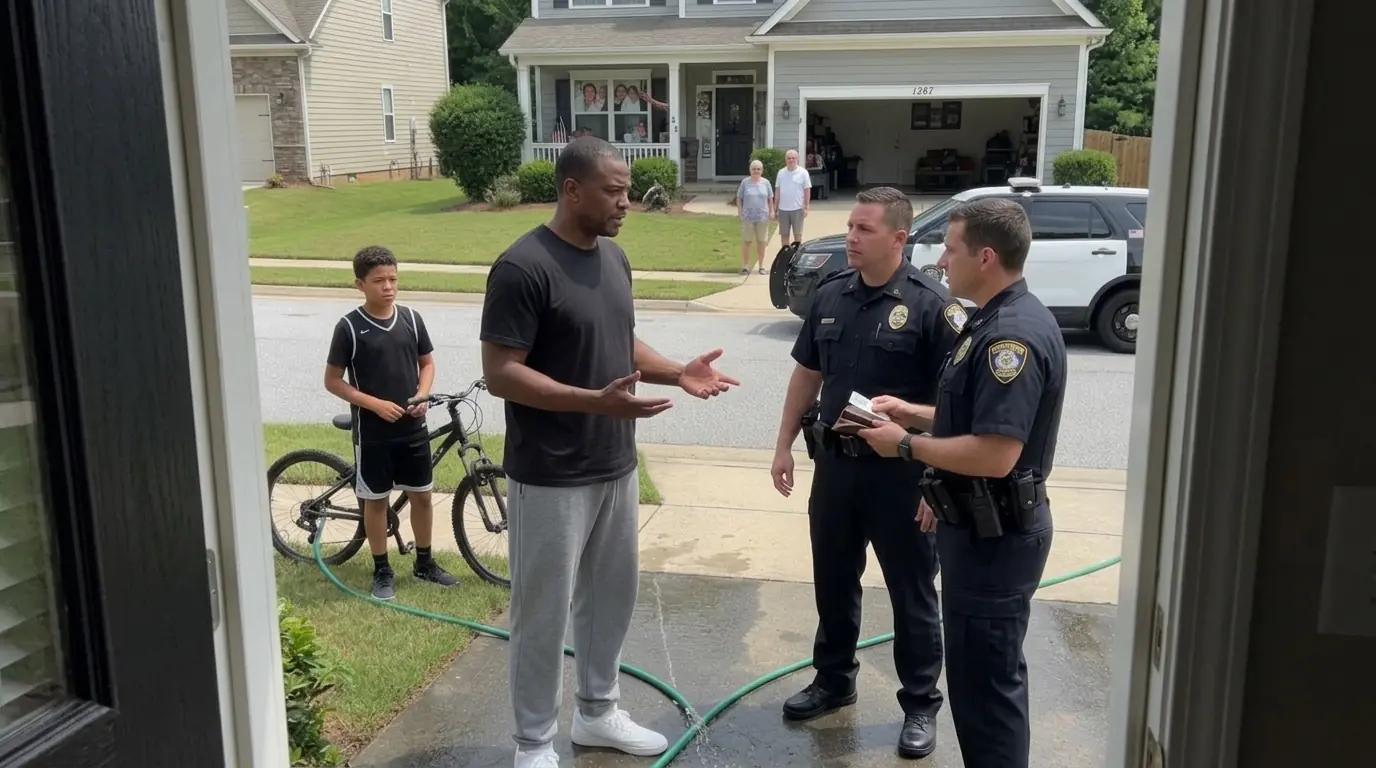
Water spilled across the edge of his driveway, darkening the concrete beneath his sneakers. He turned slowly, sunlight hitting his face, and saw two police officers moving toward him like he had just crawled through somebody’s window instead of standing on his own front lawn. One officer had his hand close to his taser. The other had already squared his shoulders, ready for a fight he had invented before asking a single question.
“My hands are up,” Marcus said, raising both palms carefully. “This is my house. What’s going on?”
The taller officer kept coming. His nameplate read Wilkes. His eyes did not move to the house number, the mailbox, the open garage, or the family photos visible through the front window. They stayed fixed on Marcus like the explanation had already been rejected before it was offered.
“We got a call about a suspicious man in the neighborhood,” Officer Travis Wilkes said. “You match the description.”
Marcus looked down at his wet black T-shirt, gray sweatpants, and white running shoes. Then he looked at the hose curling through the grass by his feet. “A suspicious man watering his lawn?”
“Don’t get smart.”
“I’m not getting smart. I’m asking what I did.”
The second officer, younger and less certain, stepped around toward the driveway. His name was Caleb Reed, and even from where Marcus stood, he could see the hesitation in the man’s face. Reed looked at the house, then at Marcus, then at the patrol SUV parked crookedly at the curb with its lights flashing over the quiet subdivision.
Marcus knew that look.
It was the look of someone realizing the situation was wrong but not yet brave enough to stop it.
The neighborhood was called Willow Creek Estates, a quiet upper-middle-class stretch outside Savannah, Georgia, where lawns were trimmed like carpets and front porches looked friendly until you noticed how many blinds moved when Marcus walked past. He had lived there almost four years. Long enough to know who jogged at sunrise, whose dog barked at mail trucks, and which neighbors waved only when other people were watching.
At forty-one, Marcus had spent nearly half his life in uniform.
He enlisted at nineteen, served two combat deployments, trained younger soldiers who still called him when life got heavy, and carried medals in a drawer because he did not like turning pain into decoration. He was still active duty, stationed forty minutes away, and the house on Briar Hollow Lane was the first thing he had ever bought that felt like peace.
It had a two-car garage, a small backyard, and a bedroom upstairs for his thirteen-year-old son, Caleb, who stayed with him on weekends and during school breaks.
The irony had not been lost on Marcus. He had named his son Caleb years before ever meeting Officer Caleb Reed. Now one Caleb was standing beside a police SUV with uncertainty in his eyes, while the other was due back from basketball practice in less than ten minutes.
That thought made Marcus’s stomach tighten.
He kept his voice calm. “Officer, my wallet is inside on the kitchen counter. My military ID is in it. My name is Marcus Avery, and I own this property.”
Wilkes gave a humorless laugh. “Everybody owns the house once the police show up.”
Marcus felt heat rise under his skin. “You can check the mailbox. You can check county records. You can ask any neighbor who actually knows me.”
“Oh, we asked a neighbor,” Wilkes said.
A curtain moved three houses down.
Marcus knew before he looked.
Linda Harrow.
She lived in the pale green house with the white shutters and the hanging flower baskets she watered twice a day. In four years, she had never once said more than a clipped hello to Marcus. But he had seen her watching from behind blinds, from behind hedges, from the far side of her porch like he was a weather event she expected to become dangerous.
“Was it Mrs. Harrow?” Marcus asked.
Wilkes’s eyes narrowed. “You don’t ask the questions.”
Marcus exhaled slowly.
Discipline had saved his life in worse places than a Georgia subdivision. He knew how to keep his hands visible, how to keep his tone measured, how to survive a man with authority who needed him to seem threatening. But discipline did not erase humiliation. It only kept it from spilling out where other people could punish it.
“Turn around,” Wilkes ordered.
Marcus blinked. “For what?”
“Investigation.”
“Into me watering my lawn?”
“Turn around.”
Officer Reed shifted his weight. “Travis, maybe we should verify first.”
Wilkes did not look at him. “I said turn around.”
Neighbors had begun drifting onto porches now. Not rushing. Not alarmed. Just appearing, one by one, as if the blue lights had opened the curtains for them. A man across the street stood near his mailbox with his phone at chest level. A woman in tennis clothes held her little dog and whispered to another woman beside her.
“I always wondered about him.”
It hit harder than Wilkes’s command.
Because that was the truth of it. They had been wondering. Watching. Waiting. His lawn was neat, his truck was clean, his mortgage was paid, his flag hung properly on Memorial Day, and still some of them had been waiting for proof that he was what they already suspected.
Marcus turned around.
The moment the cuffs touched his wrists, something inside him went cold.
Not afraid.
Cold.
Wilkes pulled his hands behind him too roughly and snapped the cuffs tight enough to bite. The metal cut into skin already slick with sweat and hose water. Marcus’s jaw flexed, but he did not pull away.
“Too tight,” he said.
Wilkes leaned closer. “Good.”
Officer Reed looked up sharply. “Travis.”
“What?”
“Don’t do that.”
Wilkes ignored him and pushed Marcus toward the patrol SUV. The flashing lights washed red and blue over his driveway, over the trimmed hedges, over the American flag folded in a shadow box visible through the front window. Marcus stood beside the cruiser while water from the unattended hose ran into the gutter.
Reed walked toward the porch. “I’ll check his ID.”
“You do that,” Wilkes said. “And check the house while you’re at it.”
Marcus turned his head. “You do not have permission to search my house.”
Wilkes smiled. “You want us to believe you live there, don’t you?”
“That doesn’t give you the right to go through my home.”
“Then stop making this harder.”
Reed paused at the front door. He looked back at Marcus, then at Wilkes. “We need consent or a warrant.”
Wilkes’s face tightened. “Door’s open. He said his ID is inside.”
Marcus’s garage door was open. The front door was not.
Reed saw that. Everyone saw that. But Wilkes had said it with enough force that the younger officer hesitated at the edge of the porch, torn between policy and hierarchy.
Marcus spoke clearly. “Officer Reed, I am not giving consent to search. My wallet is on the kitchen counter. You may retrieve it if you leave the door open and go nowhere else.”
Reed nodded once. “Understood.”
Wilkes muttered, “Unbelievable.”
Reed entered the house carefully.
Inside, the air smelled faintly of lemon cleaner and coffee. Reed’s body camera recorded the kitchen, the framed photos on the wall, the military challenge coins on a shelf, and the folded laundry sitting in a basket near the stairs. On the counter lay a wallet beside a stack of mail addressed to Marcus Avery at that exact address.
The truth was sitting there in plain view.
It had been plain outside too.
Reed picked up the wallet and opened it. Driver’s license. Military ID. Active duty credentials. Same name. Same address. Same face currently standing handcuffed in the driveway.
He looked toward the living room and saw a framed photograph on the mantel.
Marcus in dress uniform.
A younger boy beside him, missing two front teeth, both of them laughing in front of an old fishing pier.
Reed swallowed.
Outside, Wilkes was still talking.
“So how long have you been here?”
“Almost four years.”
“Where’d you get the money?”
Marcus turned slowly. “Excuse me?”
“House like this isn’t cheap.”
“I earned it.”
“Doing what?”
“I told you. I’m active duty military.”
Wilkes glanced toward the house. “That supposed to impress me?”
“No. It’s supposed to help you stop embarrassing yourself.”
The words were out before Marcus could pull them back.
Wilkes stepped close, almost chest to chest. “You better watch how you talk to me.”
Marcus met his eyes. “You better watch what you do while cameras are recording.”
That was when Wilkes noticed just how many phones were up.
The man by the mailbox was filming openly now. A teenage girl sat on the curb with her phone pointed toward the scene. Leonard Pike, a retired firefighter who lived next door, had stepped onto his porch with both arms crossed and a look of disgust tightening his face.
Linda Harrow finally came outside.
She wore gardening gloves and sunglasses, though the sun was behind her. Her mouth was pressed into a thin line, and she held herself like someone who had done a civic duty and expected gratitude for it.
Wilkes turned toward her. “Ma’am, are you the caller?”
Linda nodded. “I am.”
Marcus stared at her. “You called the police on me?”
She did not meet his eyes. “I saw someone walking around the house for a long time.”
“I was watering my yard.”
“You were moving strangely.”
“Moving strangely?”
“You kept looking up and down the street.”
Marcus laughed once, dry and bitter. “Because I was watching for my son.”
Linda’s lips tightened. “I couldn’t know that.”
“You could have asked.”
“I didn’t feel safe.”
The sentence landed exactly the way she intended it to. Soft enough to sound reasonable. Sharp enough to cut.
Marcus looked at her, then at the others watching from driveways and porches. “You’ve seen me here for four years.”
Linda looked away. “People change.”
“No,” Marcus said. “People reveal what they always thought.”
Wilkes stepped between them. “That’s enough.”
“No, it isn’t,” Marcus said. “She called because she saw a Black man outside a nice house and decided the house couldn’t be his.”
Linda’s face flushed. “That is not true.”
“Then say what was suspicious.”
“I already told you.”
“Say it without saying Black.”
The street went silent.
Reed came out of the house holding the wallet and military ID. His face had changed. Not completely, but enough.
“Everything checks out,” he said. “He lives here. Active duty. Address matches.”
The situation should have ended there.
Wilkes should have unlocked the cuffs, apologized, documented the false call, and left. Instead, pride rose in him like a second uniform. He took the wallet from Reed, glanced at the ID, and then looked Marcus up and down again.
“You got weapons in the house?”
Marcus’s eyes hardened. “I have legally registered firearms locked in a safe.”
Linda gasped softly.
Wilkes turned toward Reed as if he had uncovered something. “There we go.”
Marcus’s voice cut through the air. “I am trained, licensed, and legal.”
“You military guys bring bad habits home sometimes.”
Reed looked startled. “Travis, come on.”
Marcus stared at Wilkes. “Did you just suggest my service makes me a gang threat?”
Wilkes spread his hands. “I’m asking questions.”
“No,” Marcus said. “You’re searching for a reason to justify what you already did.”
Before Wilkes could answer, the sound of a bicycle skidding against the curb snapped everyone’s attention toward the corner.
A boy in a blue basketball jersey had dropped his bike onto the grass and was running toward the driveway.
“Dad!”
Marcus’s whole body changed. “Caleb, stop right there.”
His son froze near the mailbox, chest heaving, backpack hanging from one shoulder. He looked at the officers, the flashing lights, the cuffs on his father, and the neighbors watching like this was entertainment.
“What did they do to you?” Caleb shouted.
“I’m okay,” Marcus said quickly. “Stay back for me.”
Wilkes stepped toward the boy. “You need to move to the sidewalk.”
“This is my dad’s house!”
“We already know that.”
“Then why is he in handcuffs?”
No one answered.
That silence did more damage than any answer could have.
Caleb looked at Linda Harrow. “Did you call them?”
Linda’s expression shifted. For the first time, shame almost reached her face. Almost.
“I thought something was wrong.”
“You see him every weekend,” Caleb said. “You see me here. You know this is his house.”
“I was concerned.”
“You lied.”
Wilkes snapped, “Watch your mouth.”
Marcus’s voice dropped. “Do not talk to my son like that.”
Wilkes turned back toward him. “Then control him.”
“He’s thirteen and he just found his father handcuffed in his own driveway because a neighbor couldn’t mind her racism.”
Linda stiffened. “How dare you.”
Leonard Pike stepped off his porch. “No, how dare you, Linda.”
Everyone turned.
Leonard was in his late sixties, white-haired, broad-shouldered, and still built like the firefighter he had been before retirement. He walked across the lawn with slow, deliberate steps, pointing at Marcus as he spoke.
“That man helped me board my windows before the last hurricane. He fixed my generator when my wife was on oxygen. He watches my place when I visit my daughter. You knew damn well he lived here.”
Linda’s mouth opened, but nothing came out.
Wilkes lifted a hand. “Sir, step back.”
Leonard ignored him. “I watched this whole thing. You came in hot. You never asked the right questions because you didn’t want the right answers.”
“You want to be detained too?” Wilkes asked.
Leonard stepped closer. “For telling the truth?”
Reed moved between them quickly. “Everybody, let’s take a breath.”
Then dispatch crackled over Wilkes’s radio.
“Unit 14, update from caller. Caller now states subject was seen holding possible tool or hose near front yard. No weapon confirmed.”
A hose.
Caleb looked at the green coil still lying across the driveway. “They thought the hose was a weapon?”
Linda whispered, “From my window, I couldn’t tell.”
Marcus looked at her with a sadness that finally cracked through his anger. “You could tell enough to call the police. You just couldn’t tell enough to see me.”
Reed stepped to Wilkes’s side. “Unlock him.”
Wilkes hesitated.
“Now,” Reed said.
Something in the younger officer’s voice had changed. Not loud. Not dramatic. But firm enough that Wilkes looked at him like he was seeing a new problem form.
Wilkes yanked out the cuff key.
When the metal opened, blood rushed painfully back into Marcus’s hands. Red marks circled his wrists. Caleb ran to him the second he was free and wrapped both arms around his waist. Marcus held him with one hand and rubbed his wrist with the other, trying not to let his son feel how badly he was shaking.
Wilkes leaned in as he stepped back. “You should be more careful around here.”
Marcus looked at him. “Careful doing what?”
Wilkes’s eyes moved to the neighbors, the phones, his partner, and the boy clinging to his father.
“Being misunderstood,” he said.
Marcus almost laughed. “That’s what you’re calling it?”
Reed lowered his eyes.
Caleb looked up at Wilkes, his face wet with tears he was trying hard to hide. “If my dad wasn’t in the Army, would you have hurt him?”
The question stopped everything.
Even the sprinklers seemed quiet.
Wilkes did not answer.
Caleb continued, voice shaking. “If he didn’t have that ID, if he was just my dad in his yard, what would you have done?”
Linda looked down at her gardening gloves.
Leonard closed his eyes.
The man across the street lowered his phone just a little, not because he stopped recording, but because the weight of the moment had reached him too.
Marcus placed his hand gently on the back of his son’s head. He wanted to protect him from the answer. But the answer was already there, in Wilkes’s silence, in the red marks around Marcus’s wrists, in the way the whole neighborhood suddenly had nothing to say.
Reed stepped forward.
“I’m sorry,” he said.
Marcus looked at him.
Reed swallowed. “That’s not enough. I know it’s not. But I am sorry.”
Wilkes shot him a hard look. “Caleb—”
“No,” Reed said.
Wilkes froze.
Reed turned fully toward Marcus. “Mr. Avery, I’m requesting my supervisor to the scene. I’m preserving my body-camera footage and documenting that your identity and residence were confirmed before Officer Wilkes continued questioning and threatening you.”
Wilkes’s face turned pale. “You better think carefully about what you’re doing.”
“I am,” Reed said. “For the first time since we pulled up.”
The street heard every word.
That was the second crack in the day.
The first had been Caleb’s question.
The supervisor arrived fifteen minutes later, and by then the story had already begun moving beyond Briar Hollow Lane. The teenage girl’s video was online. Leonard had emailed his footage to the local news. Someone had posted a still image of Marcus in handcuffs with his son crying beside him.
The caption was simple.
Black soldier handcuffed for watering his own lawn in Savannah suburb.
It spread fast.
By sunset, the police department issued the kind of careful statement people write when the truth is already visible and they are trying not to admit how bad it looks. They said they were reviewing the incident. They said officers responded to a citizen complaint. They said all parties were safe.
Marcus read the statement at his kitchen table while Caleb sat upstairs, refusing to talk.
All parties were safe.
He looked at his wrists, still swollen where the cuffs had cut in.
Safe was a thin word, and it did not cover humiliation. It did not cover the way neighbors had watched. It did not cover his son’s face when he saw his father treated like a threat on the property Marcus had worked half his life to buy.
At nine that night, Caleb came downstairs.
He stood in the doorway wearing pajama pants and the old Army T-shirt Marcus had given him years ago. His eyes were red.
“Dad?”
Marcus closed the laptop. “Yeah, buddy.”
“Did I make it worse?”
Marcus felt his chest tighten. “No.”
“I yelled.”
“You were scared.”
“I wanted to fight him.”
Marcus stood and crossed the room slowly. “I know.”
“I hate that I couldn’t do anything.”
Marcus knelt so they were closer to eye level, though Caleb was getting tall enough now that kneeling was beginning to feel symbolic more than practical. “You did something.”
“What?”
“You asked the question everybody else was too afraid to ask.”
Caleb’s mouth trembled. “Would he have hurt you?”
Marcus could have lied.
He wanted to.
But children remember the shape of lies, even when they accept the words.
“I don’t know,” Marcus said softly. “But I know he was willing to go too far.”
Caleb sat beside him at the table. “I don’t like this neighborhood anymore.”
Marcus looked toward the front window, where the streetlights glowed over quiet lawns and closed curtains. “I don’t know if I do either.”
The next morning, Leonard knocked on the door with a flash drive in one hand and a casserole in the other.
“My wife cooked,” he said. “I brought the video.”
Marcus almost smiled. “That is the most Southern sentence I’ve ever heard.”
Leonard’s face softened, but the guilt remained. “I should have walked over sooner.”
“You walked over.”
“Not soon enough.”
Marcus looked at him for a long moment. “Maybe that’s what everybody has to sit with.”
Leonard nodded.
By Monday, the video had reached local news. By Tuesday, national outlets picked it up. By Wednesday, the military base issued a statement confirming that Staff Sergeant Marcus Avery was an active-duty service member in good standing and that the command was monitoring the investigation closely.
That changed the tone quickly.
People who had ignored the humiliation began praising his service. Commentators called him a decorated soldier. Strangers thanked him online. Politicians who had never met him posted statements about respecting veterans.
Marcus hated how fast the world found a version of him it could respect.
Not father.
Not homeowner.
Not neighbor.
Soldier.
That was the version they could understand.
At the press conference, he refused to stand behind that alone.
He wore a plain blue button-down, not his uniform. Caleb stood beside him, wearing a tie he clearly hated. Leonard stood behind them. Officer Reed stood farther back, off to the side, after giving a formal statement against his partner.
Marcus faced the cameras.
“My military service should not be the reason I was treated like a human being,” he said. “My house deed should not be the reason. My job, my medals, my mortgage, my son standing beside me—none of that should be required for a police officer to see me as a person.”
The reporters went quiet.
“I was watering my lawn. That is all. A neighbor called the police because she decided I didn’t belong. Officers arrived prepared to believe her fear before my facts.”
Caleb looked down at his shoes.
Marcus placed one hand gently on his shoulder.
“My son asked Officer Wilkes a question that no adult on that street could answer. If I hadn’t been military, would you have treated me worse? That question is bigger than our family. It belongs to every person who has ever had to prove they belong in a place they already earned.”
The clip aired everywhere.
Officer Travis Wilkes was suspended that same afternoon.
Two weeks later, the department released body-camera footage under public pressure. It showed the first command, the handcuffs, the search, the comments, the final threat. It also showed Officer Reed repeatedly warning Wilkes to stop and eventually requesting a supervisor.
The footage made the department’s careful statement collapse.
An internal investigation found that Wilkes had violated procedures, escalated without cause, prolonged a detention after identification had been verified, and made biased statements inconsistent with department policy. Three prior complaints against him resurfaced, all from Black men stopped in wealthy neighborhoods after suspicious-person calls.
One involved a college professor jogging.
One involved a delivery driver.
One involved a retired pastor sitting in his parked car outside his daughter’s house.
All had been dismissed.
Until Marcus’s video made dismissal impossible.
Linda Harrow tried to apologize in a handwritten note.
Marcus found it tucked under his welcome mat.
She wrote that she had been frightened. That the world was dangerous. That she had never meant for things to go so far. That she hoped he understood she was only trying to protect the neighborhood.
He read it twice.
Then he put it in a drawer.
Not because he forgave her.
Because he did not want to throw away proof of how some people confuse apology with explanation.
A month later, the Willow Creek homeowners’ association held an emergency meeting.
Marcus did not want to go, but Caleb asked if they could. Not because the boy wanted confrontation. Because he wanted to see whether adults could say out loud what they had done.
The meeting room at the clubhouse was packed.
Linda sat in the front row, pale and stiff, her hands folded around a tissue. Neighbors avoided Marcus’s eyes when he entered. Leonard pulled out two chairs and nodded for him and Caleb to sit beside him.
The HOA president, a man named Stuart Langley, cleared his throat and spoke about “unfortunate events” and “community healing.”
Marcus stood before he could finish.
“Don’t call it unfortunate,” he said.
Stuart froze.
Marcus looked around the room. “Unfortunate is a tree falling on a fence. What happened to me was predictable. It happened because some of you watched me for years and still treated me like a question mark.”
Nobody moved.
“I kept my lawn perfect because I knew you were watching. I waved first because I knew you were watching. I kept my garage tidy, my music low, my son respectful, my trash bins pulled in early because I knew you were watching.”
His voice stayed calm, which made the words heavier.
“And it still wasn’t enough.”
Linda began crying quietly.
Marcus did not look at her yet.
“My son watched me get handcuffed in my own driveway. He watched adults stare, record, whisper, and wait for someone else to decide whether his father deserved dignity.”
Caleb stared at the table.
Leonard placed a hand on his shoulder.
Marcus turned to Linda then. “You said you were protecting the neighborhood. From what?”
Linda’s lips trembled. “I was wrong.”
“That is not an answer.”
She looked at him, tears spilling now. “From what I imagined.”
The room went silent.
It was the first honest thing she had said.
Marcus nodded once. “That imagination put cuffs on my wrists.”
Linda covered her face.
Nobody rescued her from the discomfort.
That mattered.
Three months later, Officer Wilkes was fired.
Six months later, after pressure from the community and evidence from the prior complaints, he surrendered his law-enforcement certification. He was not sentenced to prison, which disappointed many people and surprised Marcus not at all. Systems rarely punish themselves as harshly as they punish the people they suspect.
But the civil settlement forced changes.
The county adopted new rules for suspicious-person calls. Dispatchers had to ask specific behavior-based questions instead of accepting fear as fact. Officers responding to “doesn’t belong” calls were required to verify residence before detaining anyone when no crime had been reported. Body cameras had to remain active through every interaction, and supervisors had to review any call involving a homeowner accused of trespassing on their own property.
Officer Reed testified during the county hearing.
“I was afraid to challenge my senior officer,” he said. “That fear made me late. And being late almost made me complicit.”
Caleb watched the testimony from the second row.
Afterward, he walked up to Reed and said, “Thanks for telling the truth.”
Reed looked down, emotion flickering across his face. “I should have told it sooner.”
Caleb nodded. “Yeah. You should have.”
Then he shook the officer’s hand anyway.
A year after the incident, Marcus still lived in the house on Briar Hollow Lane.
People asked why he stayed.
Some expected him to move. Some hoped he would. Maybe his presence made them uncomfortable now, no longer because he seemed suspicious, but because he reminded them of who they had been when the lights flashed in his driveway.
Marcus stayed because leaving would have felt too much like letting the story end where they wanted it to.
He planted two oak trees in the front yard with Caleb that spring.
The first was for patience.
The second was for witness.
Leonard helped dig the holes, complaining about his knees the entire time. Mrs. Harrow watched from her porch for a long time before crossing the street with a pitcher of lemonade. She stopped at the edge of the driveway like a person approaching a border she no longer had permission to cross.
“I made this,” she said softly. “For you and Caleb.”
Marcus looked at the pitcher.
Then at her.
“Thank you,” he said.
She nodded, eyes wet. “I know it doesn’t fix anything.”
“No,” Marcus said. “It doesn’t.”
“I’m trying to be different.”
“Then keep trying when nobody praises you for it.”
She absorbed that.
Then she set the pitcher on the porch step and walked back home.
Caleb came outside a moment later. “You gonna drink that?”
Marcus glanced at the lemonade. “Not today.”
Caleb smiled a little. “Fair.”
They finished planting the trees near sunset. Dirt covered their hands, shoes, and knees. The grass was uneven where they had worked, and the hose lay nearby, harmless and green in the fading light.
Caleb picked it up and sprayed water gently around the roots.
For a second, Marcus felt the old memory return: cuffs, lights, Wilkes’s voice, neighbors staring, his son running toward him in panic.
Then Caleb looked over.
“You okay?”
Marcus breathed in.
The air smelled like soil and cut grass.
“Yeah,” he said. “I’m okay.”
Caleb watered the second tree, careful and serious. “Dad?”
“Yeah?”
“I still think about what I asked him.”
Marcus leaned on the shovel. “Me too.”
“He never answered.”
Marcus looked down the street. People were walking dogs. Kids were riding bikes. Lights glowed behind windows that once hid watching eyes.
“No,” he said. “But everybody heard the silence.”
Caleb nodded like that made sense.
Maybe it did.
Some answers are loud.
Others are the absence of one.
And sometimes, the truth arrives in the voice of a thirteen-year-old boy standing in a driveway, asking why his father had to be a soldier before anyone remembered he was a man.