The first thing Maya Ellison heard after the crash was not the horn.
It was laughter.
A short, arrogant laugh coming from the driver of the black pickup truck that had just slammed into the passenger side of her old Toyota Corolla and sent it spinning halfway across the intersection. Glass glittered across the dashboard. The air smelled like burned rubber, hot metal, and the bitter chemical dust from the airbags.
Maya sat frozen behind the wheel, both hands still locked at ten and two.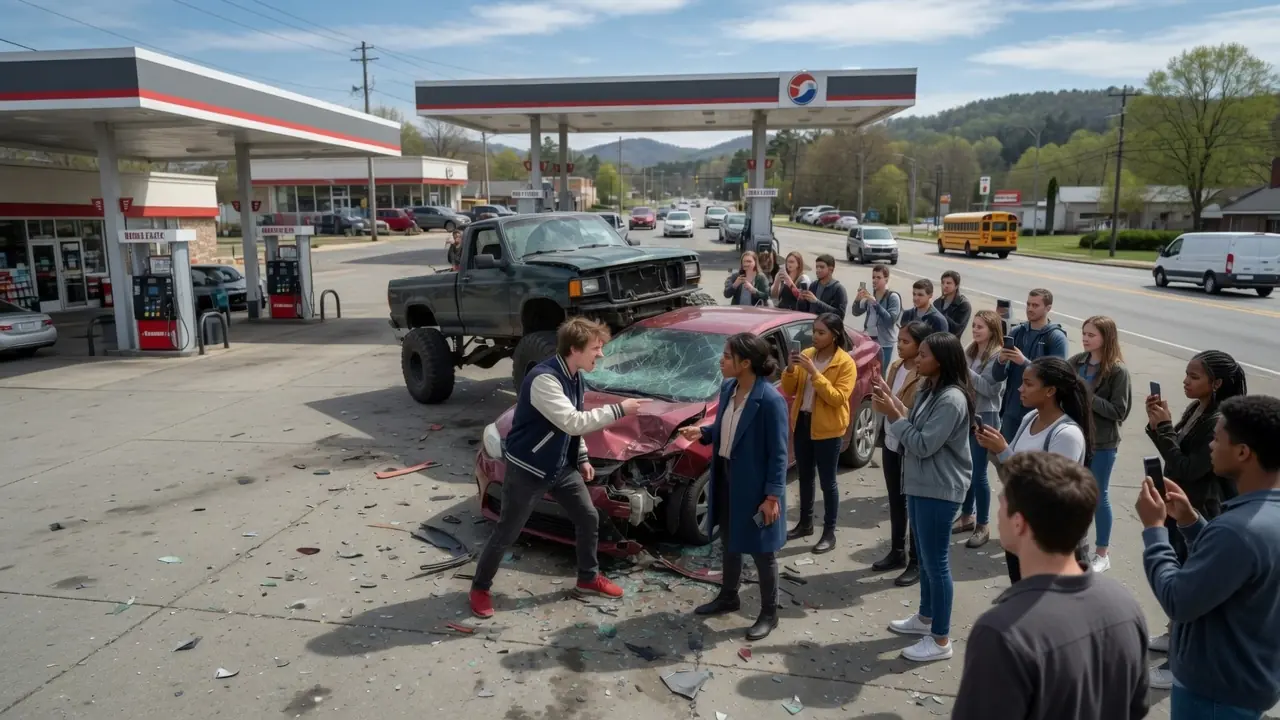
Her best friend, Tasha Reed, was in the passenger seat, breathing hard and holding her shoulder where the seat belt had caught her. The whole world seemed too bright for a second, too sharp at the edges, like the impact had broken more than the car. Then Maya forced herself to move.
“Tasha,” she said, voice rough. “Are you hurt?”
“I don’t know,” Tasha whispered. “I think I’m okay. My shoulder hurts.”
Maya looked through the cracked windshield.
The pickup truck sat twenty feet away, lifted high on oversized tires, its black paint almost untouched except for a bent corner near the bumper. The man stepping out of it did not look worried. He looked annoyed.
His name was Chase Langford.
Maya did not know that yet.
All she saw was a white man in his early twenties wearing a college baseball cap, expensive sneakers, and the kind of confidence that only comes from never having consequences arrive on time. He walked to the front of his truck first, not to her car. He crouched, checked his bumper, then stood up and glared at her like she had personally insulted him by surviving.
“What the hell is wrong with you?” he yelled.
Maya opened her door carefully.
Pain ran up her neck when she stepped onto the pavement. A thin line of blood moved down her wrist where glass had cut her skin. She was twenty-two years old, a senior at Redmont University, and she had spent enough of her life staying calm in unfair situations to know that anger would be used against her faster than truth would be heard.
“You ran the red light,” she said.
Chase laughed again.
“No, sweetheart. You pulled out in front of me.”
“I had the green.”
“You had a junk car and bad timing.”
Tasha pushed the passenger door open and climbed out slowly. Her face had gone pale, but her eyes were alert. She looked at Chase, then at the traffic light, then at the dashcam mounted behind Maya’s windshield.
“Maya,” she said softly. “The camera got it.”
Chase heard her.
His eyes flicked toward the windshield.
For the first time, something uncertain passed across his face.
Then it disappeared under a smirk.
“You think that little camera matters?”
“It recorded the whole crash,” Maya said.
Chase stepped closer.
He smelled like energy drink and stale cologne.
“My dad’s a cop,” he said. “Not some mall security guy. A real cop. Sergeant Langford. You understand what that means?”
Maya did not answer.
Chase smiled wider, enjoying the silence.
“It means by the time this is done, the report is going to say you ran the light, you hit me, and you got aggressive at the scene. You’ll be lucky if you don’t leave in handcuffs.”
Tasha lifted her phone quietly.
She did not hold it up like a challenge.
She just pressed record.
Maya saw the red dot appear on the screen and kept her face still.
“Let’s exchange insurance,” Maya said. “Then we can wait for the responding officer.”
“You don’t give orders here.”
“I’m following procedure.”
“No,” Chase said, looking her up and down. “People like you love procedure when you think it can get you paid.”
The words landed exactly the way he meant them to.
A man pumping gas across the street paused with the nozzle in his hand. A woman coming out of the pharmacy slowed and looked over. Two teenagers near the bus stop raised their phones.
Nobody spoke.
That was the way these moments often worked.
Everybody saw enough.
Almost nobody wanted to become part of it.
Maya felt heat rise behind her eyes, but she refused to give it to him. Her father had taught her years ago that a steady voice could be a shield when the world wanted to turn you into a scene. She stood beside her damaged car with blood on her wrist, glass in her hair, and her shoulders squared.
Chase misread her composure.
He thought it was fear.
That was his first mistake.
The story had begun long before that intersection.
Maya Ellison was the daughter of Marcus Ellison, the newly appointed commissioner of the North Carolina State Highway Patrol. Marcus had spent thirty years in law enforcement, starting as a trooper on night patrol before rising through investigations, internal affairs, and command.
Six months earlier, he had become the first Black commissioner in the agency’s history.
The appointment made news in Raleigh.
It made speeches.
It made headlines.
But in the college town of Briar Falls, most people did not know his face. They knew their local officers, their county deputies, their favorite sergeants, the sons who got warnings instead of tickets and the families whose names made problems softer.
Maya never told people who her father was.
She drove a twelve-year-old Corolla with a cracked rear taillight cover. She worked part-time at the campus law library. She bought most of her jackets secondhand and kept a weekly grocery budget taped inside a kitchen cabinet.
Nothing about her looked connected to power.
She liked it that way.
She wanted law school on her own record, not her father’s name. She wanted professors to remember her because she came prepared, not because she had a commissioner in the family. She wanted to move through the world as herself, even if the world often made that harder than it should have been.
That Saturday morning, she had been driving Tasha to a constitutional law study group.
They had stopped for coffee, argued over music, and joked about a professor who used the phrase “reasonable person” as if reasonable people actually agreed on anything. Maya drove carefully through town because careful had become habit. She signaled early. Checked twice. Stayed under the speed limit.
Not because she was timid.
Because she knew mistakes were not weighed evenly for everyone.
Across town, Chase Langford had slept until eleven in his father’s guest room after a night out with friends. Empty beer cans sat beside the bed. His phone was still open to a group chat full of insults, memes, and bad decisions.
He had been protected from consequences his whole life.
His father, Sergeant Ron Langford, had worked for Briar Falls Police Department for twenty-two years. He was popular inside the precinct, the kind of man who brought barbecue to retirement parties and remembered everyone’s kids’ birthdays. He also had a habit of fixing problems when his son created them.
A speeding ticket vanished.
A road rage complaint became “unfounded.”
A fight outside a bar turned into “mutual confusion.”
A crash in a grocery store parking lot was handled privately after Ron made two phone calls and visited the other driver in uniform.
Chase had learned the wrong lesson perfectly.
To him, a badge was not a promise to serve.
It was a family discount on accountability.
So when he ran the red light at Briar and Seventh while looking down at his phone, he did not think about the damage, the people inside the Corolla, or the fact that the light had been red for three full seconds.
He thought about his truck.
Then he thought about his father.
Then he smiled.
Chase made the call before Maya finished speaking to dispatch.
“Dad,” he said loudly, looking straight at her. “Some girl hit my truck at Briar and Seventh. Yeah, says I ran the light.”
He paused, listening.
Then his mouth curved.
“You know how this goes.”
That phrase did more damage than he realized.
Tasha’s phone caught it clearly.
Maya’s dashcam caught the crash.
And Chase’s arrogance caught the rest.
Within seven minutes, Sergeant Ron Langford arrived in an unmarked gray sedan.
He was off duty, wearing jeans, boots, and a navy polo shirt, but his badge was clipped to his belt where everyone could see it. He stepped out slowly, like a man entering a room he already owned.
He did not ask whether Maya or Tasha were injured.
He went to Chase first.
He checked the truck, touched his son’s shoulder, and spoke to him in a low voice. Chase nodded toward Maya with the easy confidence of someone handing over a problem to the person trained to make it disappear.
Then Ron turned.
His eyes landed on Maya.
The decision had already been made.
“License and registration,” he ordered.
Maya looked at his badge.
“Are you the responding officer?”
“I asked for your license and registration.”
“You’re off duty.”
His face hardened.
“I am a police sergeant standing at the scene of a collision. Do not make this harder than it needs to be.”
Maya reached into her car slowly.
Very slowly.
She knew better than to make a sudden movement around an agitated officer, even one in jeans. She retrieved her documents and handed them over.
Ron studied her license.
“Maya Ellison,” he read.
His voice carried the faint tone of a man who expected the name to explain everything and was irritated when it did not.
“Where were you headed?”
“A study group.”
“What kind?”
“Law.”
He looked at her then.
Something almost amused moved across his face.
“Law.”
“Yes.”
“Pre-law kids love arguing with police.”
“I’m not arguing. I’m giving you the facts.”
“The fact is my son says you ran the red light.”
“My dashcam says he did.”
Ron’s jaw tightened.
Behind him, Chase shifted against the truck.
A marked patrol car pulled into the gas station lot. A young officer stepped out, maybe twenty-five, with clean boots and a nervous face. His name tag read Mercer.
Officer Ben Mercer took in the scene quickly: damaged Corolla, lifted truck, off-duty sergeant, sergeant’s son, two young Black women beside the smaller car, and half a dozen bystanders pretending not to film while filming.
He looked uncomfortable before anyone said a word.
Ron walked over to him and spoke low.
Maya could not hear everything.
She heard enough.
“My son’s truck was struck. She’s claiming the light. Keep it simple.”
Ben glanced toward Maya.
Then toward the dashcam.
Then down at his clipboard.
“Yes, sir.”
Maya felt Tasha move closer.
“Did he just tell him what to write?” Tasha whispered.
“Yes.”
“And he’s doing it?”
“For now.”
Ben approached with the accident form already angled toward a conclusion.
He asked Maya for her statement, but his pen moved before she finished talking. He wrote “failure to yield” and then paused when she said the words “dashcam footage.”
“I need the report to show that I have video evidence,” Maya said.
Ben looked toward Ron.
Ron shook his head once.
Small.
Almost invisible.
But visible enough.
Ben did not write it down.
Tasha’s phone caught that too.
Ron moved toward Maya’s car and leaned close to the rear window.
“I need to check the inside.”
“No,” Maya said.
Ron looked over his shoulder.
“Excuse me?”
“I do not consent to a search of my vehicle.”
“I’m not searching. I’m checking for safety.”
“The collision was on the passenger side. You have no cause to open my rear door.”
Ron stepped closer.
“You hiding something?”
“No.”
“Then you won’t mind.”
“I said no.”
The gas station seemed to go still.
Even Chase stopped smiling for a second.
Ron was not used to being told no by people he considered powerless.
He reached for the door handle anyway.
Maya stepped between him and the car.
She did not touch him.
Did not raise a hand.
Did not shout.
She simply stood there, calm and direct, blocking the door with her own body.
“You do not have my consent,” she said clearly. “You do not have a warrant. You do not have probable cause. And you are off duty at a collision involving your own son.”
Ron’s eyes narrowed.
“You think you’re smart.”
“I think I’m right.”
Ben stopped writing.
Chase laughed under his breath.
Ron turned toward Tasha.
“Put that phone away.”
Tasha held it steady.
“I’m recording in public.”
“For officer safety.”
“You’re not the responding officer,” Maya said.
That was when Ron’s face changed.
Not into rage.
Something colder.
A man deciding that he would teach a lesson.
He unclipped his radio and requested another unit.
“We have an uncooperative driver at Briar and Seventh,” he said. “Possible obstruction. Send backup.”
Uncooperative.
Maya knew that word.
It was the word people used when a person refused to be pushed into fear.
It could bend a report.
It could justify force.
It could turn a victim into a suspect before the first supervisor arrived.
Maya took one breath.
Then another.
Then she pulled out her phone.
Chase watched her and grinned.
“Calling your boyfriend?”
Maya ignored him.
She tapped one contact.
The line picked up on the first ring.
“Hey, baby girl.”
“Dad,” Maya said, voice steady. “I was in a crash. I’m okay. Tasha is okay.”
Silence.
Then Marcus Ellison’s voice changed.
“Where are you?”
“Briar and Seventh. Shell station. The other driver ran a red light and hit us. His father is Sergeant Ron Langford from Briar Falls PD. He arrived off duty, attempted to search my car without consent, and is pressuring the responding officer to write a false report.”
Another silence.
This one was heavier.
“Is anyone recording?”
“Yes.”
“Dashcam?”
“Yes.”
“Do not argue. Do not move away from witnesses. I’m coming.”
Maya ended the call.
Chase clapped slowly.
“Oh, wow. Daddy’s coming.”
He laughed.
“What’s he gonna do? Yell at a sergeant?”
Ron did not laugh.
Something in Maya’s words had reached him, even if he did not know why. The way she had said his full name. His department. The legal facts. The phrase “false report.”
For the first time that morning, uncertainty touched his face.
Then he pushed it away.
He had been protected by habit for too long to believe it could fail in a gas station parking lot.
Nine minutes later, three black SUVs turned onto Briar Street.
No sirens.
No flashing lights.
Just dark windows, government plates, and the quiet precision of vehicles driven by people who did not need drama to announce authority.
They entered the lot and stopped in a line.
The doors opened.
Two men and one woman stepped out first, plainclothes, alert, scanning the scene. One moved toward the damaged Corolla. One toward the patrol car. One stayed beside the middle SUV.
Then the rear door opened.
Marcus Ellison stepped out.
He wore a dark jacket and no tie.
His badge was clipped to his belt.
It was not a city badge.
It carried the rank of the North Carolina State Highway Patrol commissioner.
The highest law enforcement authority Chase Langford had ever been close enough to misunderstand.
Officer Ben Mercer recognized him first.
His face went pale so quickly that Tasha later said it looked like someone had pulled a plug.
Ron recognized him second.
The arrogance drained from his body in visible stages.
Shoulders.
Jaw.
Hands.
Eyes.
Chase recognized only that his father looked afraid.
That was enough.
Marcus walked directly to Maya.
He did not look at Ron.
He did not look at Chase.
He took Maya gently by both shoulders, checked her eyes, her cut wrist, the way she held her neck.
“You hurt?”
“Whiplash, maybe. Cut is small.”
“Tasha?”
“My shoulder hurts, Mr. Ellison, but I’m okay.”
Marcus nodded once.
Then he turned around.
The lot went silent.
Even the phones recording seemed to hold still.
“Sergeant Langford.”
Ron straightened automatically.
Old training trying to survive new terror.
“Commissioner.”
That single word changed the entire scene.
Chase’s head snapped toward Maya.
“Commissioner?”
Tasha whispered, “Oh, he is cooked.”
Marcus’s face did not move.
“You responded off duty to a collision involving your son.”
“Yes, sir, I—”
“You questioned the other driver before the assigned officer completed his assessment.”
Ron swallowed.
“You attempted to open her vehicle after she refused consent.”
“Sir, I was checking—”
“You instructed the responding officer not to document dashcam evidence.”
The words landed cleanly.
No shouting.
No theatrics.
Just fact after fact, each one heavier than the last.
Marcus looked toward Ben.
“Officer Mercer, did Sergeant Langford influence the content of your initial report?”
Ben froze.
Ron looked at him.
So did everyone else.
Ben’s hand tightened on the clipboard.
For a second, Maya thought he would fold.
Then he exhaled.
“Yes, sir.”
Ron’s face collapsed.
Ben continued, voice shaking.
“He told me his son was struck and told me to keep the report simple. He indicated I should not include the dashcam.”
Marcus nodded.
“Thank you for telling the truth now. We will discuss why it took this long later.”
Ben looked down.
“Yes, sir.”
Marcus turned back to Ron.
“You are relieved of any police authority at this scene. Your badge and weapon will be secured pending an internal investigation.”
Ron’s mouth opened.
“Commissioner, please. I have twenty-two years—”
“And in twenty-two years, you never learned that a badge cannot be used as a family shield.”
Ron’s jaw trembled.
“My son called me. I was trying to help him.”
“No,” Marcus said. “You were trying to protect him from the law by placing someone else under it.”
That sentence ended every excuse Ron had prepared.
One of the plainclothes officers stepped forward and held out a hand.
Ron stared at the badge on his belt.
For a moment, he looked like a man realizing it was smaller than he had always believed.
Then he unclipped it and placed it in the officer’s palm.
Chase stepped forward.
“Dad?”
Ron did not answer.
He could not save him now.
That was the second collapse.
The first was Ron losing his power.
The second was Chase realizing he had never had power of his own.
He had only been borrowing his father’s.
Marcus looked at Chase.
“Mr. Langford, you will remain on scene. The collision investigation will proceed according to evidence, not family relationship.”
Chase’s face flushed.
“This is ridiculous. She hit me.”
Maya turned slowly and pointed to the windshield.
“The camera recorded everything.”
For once, Chase had no easy answer.
The dashcam footage was reviewed at the scene.
The light facing Maya was green.
The light facing Chase was red.
His truck entered the intersection at speed.
His phone was visible in his hand.
The impact was clear.
There was no gray area left to hide in.
Officer Mercer rewrote the report from the beginning while a supervisor from the state patrol observed. Chase received citations for running a red light, reckless driving, distracted driving, and failure to render aid after a collision.
His truck was towed.
Maya’s Corolla was declared undrivable.
Emergency medical technicians treated Maya and Tasha at the scene. Tasha had a deep bruise across her shoulder. Maya had mild whiplash and a small cut that needed cleaning. Neither injury was life-threatening, but both were real.
Marcus stayed near his daughter the entire time.
Not hovering.
Present.
There is a difference.
When the paramedic finished wrapping Maya’s wrist, Marcus stepped closer.
“You handled yourself well.”
Maya looked toward Ron, now seated in the back of one of the SUVs.
“I shouldn’t have had to.”
Marcus nodded.
“No. You shouldn’t.”
That was the line people repeated later.
Not because it sounded powerful.
Because it was true.
The video spread by nightfall.
Tasha posted it after blurring Maya’s personal information and confirming with her that she was ready. The first clip showed Chase threatening her with his father’s badge. The second showed Ron attempting to open the car door while Maya said clearly that she did not consent. The third showed Marcus arriving and Ron’s face changing when he realized exactly whose daughter he had tried to intimidate.
By midnight, half the state had seen it.
By morning, national outlets had picked it up.
The headline was everywhere.
“Police Sergeant Tried To Blame Young Black Woman After His Son Ran Red Light. He Didn’t Know Her Father Was The State Patrol Commissioner.”
People argued online, as people always do.
Some defended Ron.
Some said Maya should have just cooperated.
Some asked why she had to bring her father into it.
But beneath all that noise, something larger began happening.
Hundreds of people shared stories.
A Latino father whose son’s complaint disappeared after a crash with an officer’s nephew.
A Black nurse stopped for “suspicious driving” on her way home from a night shift.
A college student whose dashcam saved him from a false failure-to-yield citation.
A woman who said she wished she had known she could say, “I do not consent.”
The video became more than a viral moment.
It became evidence of something people had been trying to describe for years.
Marcus held a press conference four days later.
He stood at a podium in Raleigh with the state seal behind him and reporters filling the room. He did not mention Maya’s name until a reporter asked directly whether the young woman in the video was his daughter.
“She is,” Marcus said.
Then he paused.
“And that is not the point.”
The room quieted.
“My daughter had a dashcam. She knew the law. She had a witness recording. She had the ability to call someone who could intervene. Every person in this state should be protected before they need all of that.”
No one interrupted.
Marcus continued.
“What happened at that intersection was not merely a traffic collision. It was an abuse of authority. It was also a reminder that corruption often begins as a favor, then becomes a habit, and eventually turns into a system.”
Sergeant Ron Langford was suspended immediately.
The investigation uncovered five previous incidents involving Chase that had been softened, buried, or redirected through his father’s influence. One involved a hit-and-run complaint that was never properly pursued. Another involved a bar fight where the other young man had been charged while Chase walked away. A third involved a reckless driving report from a delivery driver who said he was discouraged from filing because “the family was connected.”
The records were not clean.
They had only been cleaned.
That was different.
Officer Ben Mercer was placed on administrative leave during review. He cooperated fully and admitted that he had followed Ron’s lead because he feared retaliation. He kept his job, but only after retraining, probation, and a public acknowledgement that obedience to a senior officer did not excuse dishonesty.
Ron Langford was charged with obstruction, abuse of office, attempted evidence suppression, and witness intimidation.
He lost his badge before trial.
He lost his pension after conviction.
He received a prison sentence that was shorter than some people wanted and longer than he ever imagined possible.
Chase lost his license, his truck, and the protection that had shaped his entire personality. He was ordered to pay restitution for Maya’s vehicle, medical bills, and Tasha’s treatment. He received probation, community service, and a permanent criminal record.
Whether he became better was unclear.
Some people do.
Some only become quieter.
Maya did not build her life around wondering which kind he became.
Six months later, she sat at the same kitchen table where she had studied for the LSAT before the crash. Her new mug said Future Civil Rights Lawyer, a gift from Tasha, who said it was ugly enough to be inspirational.
Maya had been accepted to three law schools.
She chose the one with the strongest civil rights clinic.
Her new car had a dashcam mounted behind the windshield.
So did Tasha’s.
So did half the people they knew.
Marcus still sent her morning texts.
Most were embarrassingly corny.
One showed a cartoon coffee cup flexing under the words, Rise and grind, legal legend.
Maya sent back a heart.
Then she checked her tire pressure because he would absolutely ask.
People often wanted the story to be about the moment her father arrived.
They liked the black SUVs.
The commissioner badge.
The instant collapse of Ron Langford’s confidence.
That part was satisfying in the way public reversals always are.
But Maya understood the real story had started earlier.
It started when Chase assumed she could be bullied because she was young, Black, and driving an old car.
It started when his father arrived and saw not a citizen, not a crash victim, not an injured student, but someone whose truth he believed he could overwrite.
It started when a rookie officer knew something was wrong and almost let fear turn his pen into a weapon.
And it changed when Maya stood beside her crushed Corolla, with glass in her hair and blood on her wrist, and refused to surrender the facts.
That was what stayed with her.
Not the cameras.
Not the headlines.
Not the applause from strangers who would forget her name by the next news cycle.
The thing she remembered was the sound of her own voice staying steady when everything in her body wanted to shake.
“I do not consent.”
“The dashcam recorded everything.”
“I want that in the report.”
Those were small sentences.
But small sentences can hold a line when spoken at the right moment.
A year later, Maya spoke at a first-year law seminar about evidence, power, and credibility.
She did not tell the story like a hero’s tale.
She told it like a warning.
“Documentation matters,” she said. “Knowing your rights matters. Recording matters. But none of those things should be the only reason someone is treated fairly.”
The room was quiet.
Maya looked at the students in front of her.
Some leaned forward.
Some took notes.
Some had the look of people recognizing a truth they had lived but never heard said clearly.
She continued.
“The law is supposed to protect people before they prove they are connected to power.”
That sentence became the one students quoted later.
After the talk, a young woman waited near the door.
She was holding a notebook against her chest.
“My brother had something like that happen,” she said softly. “No dashcam. No commissioner father. Nobody believed him.”
Maya felt the familiar ache behind her ribs.
“I’m sorry.”
The young woman nodded.
“Me too.”
Then she looked up.
“That’s why I’m here.”
Maya smiled.
“Then stay.”
Outside, the campus air smelled like rain.
Maya walked to her car, unlocked it, and sat behind the wheel for a moment before starting the engine. The dashcam blinked on. The little red recording light reflected faintly in the windshield.
She thought about that intersection.
Briar and Seventh.
The broken glass.
The red light.
The truck.
The badge.
The moment the whole story could have been taken from her if she had not been ready to protect it.
Then she thought about every person who never got that chance.
That was why she was going to law school.
Not because her father wore the highest badge.
Because too many people had been hurt by smaller ones.
Maya started the car.
She checked the mirror.
Signaled.
Waited for the light.
When it turned green, she drove forward carefully, both hands steady on the wheel.
Not afraid.
Not reckless.
Just aware.
And somewhere in the quiet confidence of that movement was the lesson Chase Langford and his father had learned too late.
A badge can bend a story for a while.
Privilege can hide a pattern for years.
But the truth has a way of waiting at the intersection.
And sometimes it records everything.