200 stolen horses can make a poor cowboy rich. But Elias Mercer knew they could also get an innocent man buried beneath a lie. He found them just after sunrise in a narrow basin 12 mi north of Red Mesa, where the desert opened between walls of rustcoled stone, and the morning wind smelled of sage, horse sweat, and coming heat. 200 horses, maybe more, bays, paints, chestnuts, a few gray mars, all crowded around a shrinking water hole while dust hung above them like smoke. Elias sat motionless in the saddle.
He had spent 14 years working cattle and horses across Arizona territory, and no herd that size wandered loose by accident. Then he saw the brands. Some had been burned over, others had been cut into strange new shapes. Crude attempts to hide older markings beneath them. Elias removed his hat and wiped his forehead with his sleeve.
"Lord," he murmured. "Somebody went to trouble for you. " His geling shifted beneath him. 50 yards away lay an abandoned camp. Cold ashes, three empty grain sacks, a broken coffee cup, and a saddle tossed beside a msquet bush. No voices, no writers, just wind dragging sand across boot tracks.
Elias dismounted and walked carefully through the camp. He found rope, branding tools, and a folded sheet of paper beneath a saddle blanket. The paper listed numbers instead of names. 200 horses. Delivery at Dry Creek.
Payment after brands changed. Elias read it twice. At the bottom was a single initial s. He folded the paper and slipped it inside his coat. Then he noticed the man near the far edge of camp.
Elias approached slowly and stopped several feet away. The stranger was motionless, apparently taken by some accident before Elias arrived. No weapon lay nearby. No sign of a struggle remained. Elias looked toward the herd.
Whatever had happened here, the horses were still alive, still thirsty, and still stolen. That was enough. He spent the next hour checking brands, and recognition came slowly. Years earlier, while driving cattle near Apache country, Elias had seen those markings from a respectful distance. These horses belonged south of the ridge.
Returning them would bring no reward he could count on. Keeping even 20 could buy him fresh cattle, repair his roof, maybe save the little ranch the bank had been circling for months. Nobody had seen him find them. Nobody would know. Elias stared at the nearest mayor, then gave a tired smile.
That's usually when a man finds out who he is. He mounted and began gathering the herd. By midm morning, nearly 200 horses were moving south beneath a rising cloud of dust. Then one mayor fell behind. She limped badly, favoring her left for leg, and when Elias approached, he saw a raw scrape near the fetlock.
He had no clean bandage, only the faded red neckerchief his father had given him years before. Elias held it for a moment. Then he tore the cloth, wrapped the mayor's leg, and tied it carefully. Don't make me regret ruining the only decent thing I own. The mayor breathed against his shoulder.
Somewhere high above the basin, a figure stood among the rocks, watching. Elias never looked up. He never saw the Apache woman named Nielli lower her hand from the shade of her eyes. And he could not know that before the next sunrise, 20 women would stand outside his door carrying that same red cloth. And words he would misunderstand completely.
By noon, the desert had swallowed every sign of the abandoned camp except the dust rising behind Elias Mercer and the restless thunder of nearly 200 horses moving south. Keeping them together was harder than he expected. The herd stretched almost a/4 mile from front to back, drifting whenever the wind changed or a jack rabbit broke from the brush. Elias rode the edges, whistling low, turning strays with patient pressure instead of panic. The injured mayor stayed near the rear.
Every few miles, he checked the faded red cloth around her leg, tightening the knot when it loosened. The sun climbed white and hard above the maces. His canteen grew lighter. His shirt gathered dust until its original color disappeared beneath Arizona Brown. Still, he kept south.
Near 3:00, Elias reached a ridge overlooking a broad valley of cottonwoods and dry grass. He stopped there. Beyond the valley lay country he knew enough to respect and not enough to enter carelessly. Apache tracks crossed the sandy wash below. Fresh once.
Elias studied them, then looked at the herd. This is where you go home. He rode down slowly and guided the horses toward the wash. At first they hesitated. Then an old paint stallion lifted its head towards something carried on the wind.
The animal gave a low call. Another horse answered from somewhere beyond the cottonwoods. The herd changed at once. Ears rose. Bodies turned.
200 horses began moving forward as though an invisible rope had pulled them home. Elias stayed behind. He did not cross the wash. He did not call for anyone. He did not wait for thanks.
The injured mayor paused beside him, the red cloth bright against her dusty leg. Elias reached down and touched her neck. "Go on," she followed the others. Within minutes, the valley filled with moving backs and drifting dust, then slowly emptied again. Elias watched until the final horse disappeared among the cottonwoods.
Only then did he turn north. High above him, hidden between sunbaked rocks, Nielli had watched the entire thing. She had followed from the basin since morning, expecting the white cowboy to turn west toward the trading roads. He never did. She had expected him to keep the strongest horses.
He kept none. She had expected him to ride into a patchy country demanding payment. Instead, he stopped at the boundary and sent the herd home alone. Naelli descended after Elias disappeared beyond the ridge. Near the wash, she found tracks from his geling and the deep prince of the injured mare.
Something small rested in the dust. A strip of faded red cloth. The mayor had lost part of the bandage while crossing the stones. Nellie picked it up. It smelled faintly of horse, dust, and sweat.
She looked north toward the empty ridge. Behind her came voices as families discovered the returning herd. Relief traveled through the valley faster than any rider. Nielli closed her fingers around the cloth. She had seen men return stolen property when a sheriff was watching.
She had seen traitors perform kindness while calculating payment. This had been different. Elias Mercer believed nobody had witnessed what he chose to do. By sunset, Nielli knew his name. By moonrise, 20 Apache women knew it, too.
And before dawn, they were already riding north. The first thing Elias noticed when he reached his ranch that evening was the silence. Usually his geling relaxed at the sight of the weathered barn and crooked windmill, but tonight the horse kept its ears turned south. Elias felt it too. Something had followed him home, though there was nothing on the road but moonlight and dust.
He unsaddled carried his nearly empty canteen inside and placed the folded paper from the thieves camp on his kitchen table. 200 horses dry creek payment after brands changed. One letter at the bottom, S. Elias stared at that letter while coffee warmed on the stove. There were plenty of names beginning with S and Red Mesa, but only one man Elias knew who could move that many horses without attracting questions.
Silus Crow. Silas owned the largest livestock yard within 50 mi. He loaned money to struggling ranchers, bought cattle cheap from desperate families, and somehow always knew when valuable stock was coming through town. Elias had borrowed from him once. That mistake still sat inside a desk drawer in the form of three unpaid notices.
He folded the paper again, accusing Silas without proof would be foolish. Taking the paper to the sheriff might be worse. Elias needed evidence, not suspicion. Outside, the windmill turned once with a dry metallic groan. His geling answered from the barn.
Elias stepped onto the porch. Nothing moved beneath the moon. Still, he had the strange feeling that the desert was holding its breath. He slept poorly. Before sunrise, he woke to a sound so faint he thought it belonged to a dream.
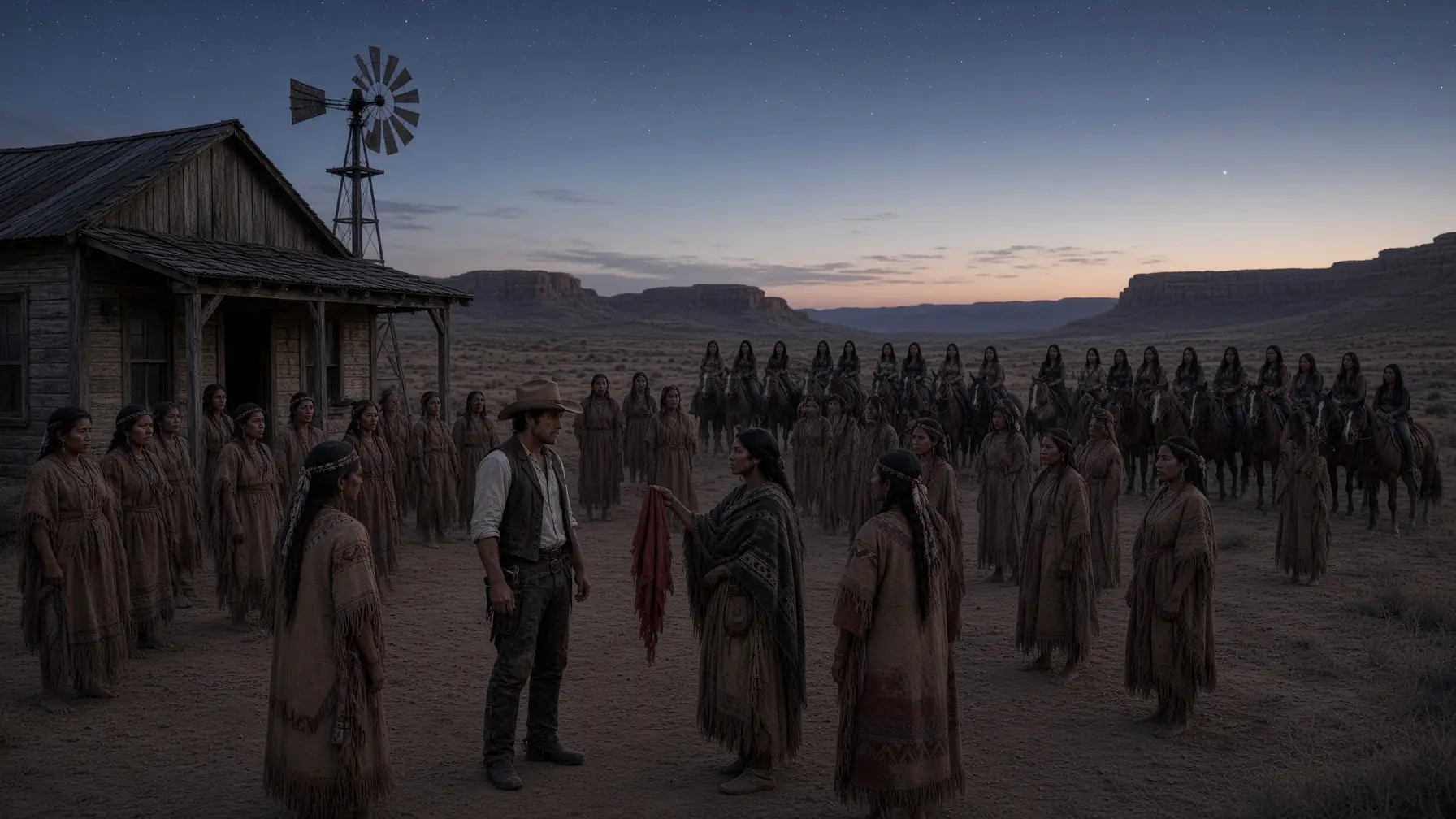
Hooves, not cattle, horses, many of them. Elias pulled on his boots and opened the front door. The eastern horizon was only beginning to turn gray. 20 riders stood beyond his fence. Every rider was a woman, Apache women.
They sat quietly beneath the fading stars, wrapped against the cool morning air, their horses arranged in a patient line across the road. No one approached the house. No one shouted. Elias counted twice. 20.
His eyes settled on the woman at the center. Nielli dismounted first. She wore a dark woven blanket over her shoulders, and in one hand, she carried something red. Elias recognized the cloth before he recognized anything else. His father's neckerchief or what remained of it.
Nielli walked to the gate and stopped. Elias stepped from the porch but kept several yards between them. Morning, he said. Nielli studied him for a moment. Her English when she spoke was careful and quiet.