Jonah Mercer’s horse stopped so suddenly that the dust rolled past them like smoke.
The animal’s name was Flint, and Flint did not scare easy.
He had crossed bad country with Jonah for nearly five years, through dry washes, rattlesnake flats, bandit trails, winter crossings, and nights so cold the stars looked sharp enough to cut skin. He had never once planted his hooves without cause. So when he stopped in the middle of the Arizona desert and refused another step, Jonah listened.
That was the first rule his grandfather had taught him.
A good horse sees trouble before a proud man admits it.
Jonah loosened the reins and leaned forward, running one hand along Flint’s neck. The horse’s ears stood stiff toward the southern rocks. His nostrils flared. The desert around them was too still, too empty, too clean of ordinary sound.
No insects.
No hawk cry.
No lizard skittering beneath the brush.
Just heat rising off red stone and a wind so dry it seemed to carry bone dust.
Jonah slid down from the saddle and kept his hand near his rifle, not on it. He had learned caution without making a religion of fear. Out here, danger came in many shapes: a rattler under a ledge, a wounded outlaw behind a boulder, a dead mule in the trail warning that men with guns had passed before you.
Then he heard it.
A groan.
Faint.
Almost swallowed by the wind.
He climbed a low ridge of sunburned rock, pressing one hand against the hot stone for balance. From the top, he looked across the open sand and felt the heat leave his body in spite of the noon sun.
People were moving below.
Not walking.
Staggering.
Forty of them, maybe more, stretched across the flats like a broken shadow. Some leaned on sticks. Some dragged others by the arms. Mothers carried children too weak to cry. Older men and women moved with empty eyes, their mouths cracked from thirst, their feet barely lifting before the sand took them again.
Jonah knew who they were.
The Silver Creek people.
He had seen their riders at a distance over the years, sometimes near the old wash, sometimes in the high country after rain. They kept to themselves. Ranchers in town spoke of them with fear, lies, or ignorance, depending on how much whiskey had loosened their tongues.
Jonah had never seen them like this.
Broken.
Starving.
Moving toward death in broad daylight.
For a moment, the sensible choice stood before him as clear as the trail to Miller’s cattle camp.
He could turn away.
He could mount Flint, ride north, collect his pay, and tell himself the desert had already chosen their fate before he saw them. Men survived out here by knowing which trouble was theirs and which trouble belonged to the wind.
But Jonah’s grandfather had also taught him something else.
A man who rides away from dying children does not get to call himself hard. He only gets to call himself empty.
Jonah went down the ridge.
Up close, the suffering had faces.
A boy with dust caked around his lips.
A woman holding a baby whose head rested too heavily against her shoulder.
A gray-haired elder with one hand on another man’s sleeve, walking only because someone else refused to let him fall.
The group stopped when they saw Jonah.
Not with relief.
With caution.
A tall man stepped forward from among them. He was broad through the chest, though hunger had drawn the strength tight across his bones. His dark hair was braided with a strip of blue cloth, and a scar ran from his left temple down toward his jaw. His eyes were sharp, steady, and alive in a way the rest of him barely was.
A leader.
He did not beg.
He watched.
Jonah slowly took his canteen from the saddle and held it out with both hands.
No sudden movement.
No reaching for a weapon.
No smile too wide to be trusted.
The leader accepted the canteen, but he did not drink first. He turned and carried it to an old woman whose knees were bending under her. She took one sip. Then he gave it to a child. Then another. Then the woman with the baby.
Only after several others drank did he lift the canteen to his own mouth.
One small swallow.
That told Jonah more about him than any introduction could have.
The leader touched his chest.
“Mahko,” he said, voice rough but firm.
Jonah touched his own.
“Jonah.”
The rest came slowly through gestures, broken English, and the few words Jonah had picked up from old traders.
Soldiers.
Forced relocation.
A dead guide.
A wrong turn into country no one knew.
Water gone two days.
Food nearly gone.
The weak already falling.
Jonah looked across the group and counted the truth without wanting to.
His canteen might keep a few alive until evening.
Not all.
Not even close.
The desert would take the children first. Then the elders. Then the strong ones who had carried too much too far. By morning, this place would be bones, buzzards, and a story someone in a town saloon would lie about later.
Unless his grandfather had been telling the truth.
A memory struck him so sharply that he almost turned toward the north rocks before thinking.
Silas Mercer, known as Red Fox to men who had trapped with him and Old Liar to women who loved him enough to tell the truth, had spent forty years crossing this desert. He claimed there was a hidden spring near a formation shaped like a kneeling horse, found only when the high sun cast its shadow east.
Jonah had been twelve when he first heard it.
“When the stone horse bows,” Silas had told him beside a fire, “count sixty steps from the nose of its shadow. Dig where the black rock sweats. Water waits under stone for men patient enough to believe.”
Jonah had thought it was one of the old man’s stories.
A pretty lie for keeping children quiet at night.
Now it was all he had.
He turned slowly, scanning the horizon.
Red formations stood everywhere, twisted by wind and time into shapes men gave names to so the emptiness felt less endless. Then he saw it, far off beyond the broken flats: a massive formation rising from the sand, its upper curve shaped like the bowed head and neck of a horse.
From just the right angle, it looked alive.
Jonah pointed.
“Water,” he said clearly.
Mahko’s eyes moved toward the rocks.
“Water?”
“Yes.” Jonah mimed drinking. “There. Maybe.”
That last word cost him.
Maybe was not hope.
Maybe was a knife with two edges.
Mahko understood enough. He turned toward his people, but before he could speak, a younger man stepped between them.
The young warrior was lean, hard, and furious, no more than twenty-five, with eyes so dark they seemed to hold all the shade the desert had refused them. His hair was tied back with red cord. A knife rested at his hip. His whole body looked like a bowstring pulled too tight.
His name, Jonah would learn, was Taren.
Mahko’s nephew.
Taren spoke fast in his own language, sharp and burning. Jonah did not need translation to understand.
White men lie.
White men lead people into traps.
White men offer water with one hand and death with the other.
Three other warriors moved closer beside him.
Their hands hovered near knives.
Jonah stood still.
He kept his palms open and away from his gun.
One wrong twitch, one wrong word, and every life in front of him might fall into blood before the sun finished them.
Mahko raised his hand.
His voice cut through Taren’s anger, low but commanding. Taren answered fiercely, pointing first at Jonah, then at the open desert, then at the children lying in the dust. Mahko pointed to the elders, the mothers, the baby whose lips had gone pale.
Fear against hope.
Memory against need.
Both men were right.
That was the worst part.
Taren had every reason not to trust Jonah. Mahko had every reason to gamble anyway. The desert did not care which argument was more honorable. It only waited.
Finally, Mahko spoke one sentence that silenced the younger man.
Taren’s jaw tightened.
For a moment, it looked like he might refuse even his chief.
Then he stepped aside.
But his eyes stayed fixed on Jonah.
Mahko turned back.
“Taren,” he said, touching his nephew’s shoulder. “He does not trust.”
Jonah nodded.
“I know.”
Mahko touched his own chest.
“I choose.”
Jonah understood.
The trust was not earned.
It was borrowed from desperation.
And if he failed, it would be taken back in blood.
He mounted Flint and turned toward the Stone Horse.
Behind him, forty lives followed.
The heat grew savage as they crossed the flats.
Every step raised dust that stuck to sweat and turned skin the color of clay. Jonah rode slowly enough not to leave the weakest behind, fast enough to keep death from catching up too easily. It was the worst kind of pace, too fast for mercy and too slow for hope.
A woman stumbled.
Taren reached her before anyone else and lifted her across his shoulders.
He carried her without complaint.
Jonah saw the tremor in his legs.
Even the angry ones were nearly finished.
Mahko walked beside Flint for part of the journey.
“How far?”
Jonah looked toward the rocks.
“Not far enough to be easy.”
Mahko gave one dry breath that might have been a laugh in another world.
“Easy is not on this road.”
They reached the base of the Stone Horse when the sun was almost overhead.
The formation towered above them, red and gold against a merciless blue sky. From below, the illusion was perfect: the head lowered, the stone mane rippling back, the body half-buried in earth as though the creature had knelt there centuries ago and never risen.
Jonah slid down from the saddle and searched the ground.
His grandfather’s words came back in pieces.
High sun.
Shadow east.
Sixty steps.
Black rock sweating.
But the shadow had not fully turned yet.
“We wait,” Jonah said.
The word hit the group badly.
A murmur of fear moved through them.
Taren strode forward, fury returning full force. He pointed at the children, at the sun, then at Jonah’s face.
Mahko translated, though he did not need to.
“He says waiting is death.”
Jonah looked at Taren.
“If we move wrong, that is death too.”
Mahko spoke the words in his own language.
Taren spat into the sand near Jonah’s boot.
Jonah did not blame him.
Minutes dragged.
The shadow crept slowly across the ground while the people sat wherever they could find narrow shade. The children had stopped crying, and that silence was worse than their cries had been. A mother hummed over her baby in a trembling voice. An elder whispered something that sounded like prayer.
Then a sharp cry broke the air.
The baby in the young mother’s arms began to seize.
Her name was Luma.
She fell to her knees, clutching the child while Mahko rushed to her side.
Taren turned on Jonah.
“Now!” he shouted in English.
The word was raw.
The shadow was close.
Not there.
Close.
Jonah looked at the ground.
Then at the baby.
Then he pulled his canteen from Flint’s saddle.
There were maybe three swallows left.
He handed it to Mahko.
“For the child.”
Mahko stared at him.
So did Taren.
Jonah nodded once.
“Now.”
Mahko tilted a few drops onto the baby’s lips.
For a terrible second, nothing happened.
Then the child coughed.
A weak cry followed.
Thin.
Angry.
Alive.
The mother began sobbing.
Taren looked at Jonah, and for the first time the hatred in his eyes cracked open enough for something else to show through.
Not trust.
Not yet.
But recognition.
Mahko turned suddenly.
“The shadow.”
Jonah looked.
The Stone Horse’s shadow stretched east, long and sharp like an arrow drawn across the sand.
This was the moment.
Jonah walked to the tip of the shadow and began counting.
Ten.
Twenty.
Thirty.
His boots sank into hot sand.
Forty.
Fifty.
Sixty.
He stopped.
Nothing.
Only sand, stone chips, and a patch of dark rock half-buried near a low red wall.
A bitter sound came from Taren.
Several others murmured.
Jonah dropped to his knees and dug.
His fingers scraped through sand, then struck stone.
Not natural stone.
Set stone.
Worked stone.
Built by hands.
“Help me,” he said.
Mahko understood first. He knelt beside him and began digging. Then two elders. Then Taren, though his face still said he expected betrayal. They cleared sand from a ring of flat stones packed together with clay and desert roots.
It took six men to shift the largest slab.
For a moment, nothing happened.
Then came a sound from below.
A faint bubbling.
Then stronger.
Water rose between the stones.
Clear.
Cold.
Living.
It filled the hollow slowly at first, then with steady force, pooling beneath the sun like a miracle that had been waiting patiently for someone to remember where to knock.
No one moved.
Then the camp broke.
People fell to their knees, hands plunging into the water. Mothers held it to their children’s lips. Elders wept openly. Warriors cupped it in both hands and drank like men returning from the edge of the grave.
Jonah stepped back.
He did not drink.
Not yet.
He sat on a rock while his legs shook from the weight leaving him all at once.
Mahko came to him with water dripping from his beard and placed one hand firmly on his shoulder.
No words.
None needed.
Taren stood near the spring, watching Jonah differently now.
The blade was still there in his eyes.
But it was no longer aimed quite the same way.
The Silver Creek people made camp around the spring.
Three days later, the dead desert had become a living place.
Women stretched hides between rocks for shade. Children who had been too weak to lift their heads now chased one another around the water. Elders sat beneath the Stone Horse and told stories in low voices while the young listened with the seriousness of people who had nearly lost the right to hear them.
Jonah planned to leave on the second morning.
Then the third.
Each time, something held him.
Maybe it was the way the children followed Flint around, laughing whenever the horse snorted at them. Maybe it was the way Mahko’s people looked at the spring like it was not merely water, but a second chance given physical shape. Maybe it was that Jonah, who had spent years drifting from ranch to ranch, suddenly felt less alone beside people who had nearly vanished and chosen to rebuild before the sand even dried.
On the third afternoon, while Jonah tightened Flint’s cinch, a boy came running.
“Mahko calls,” the boy said in careful English. “Important.”
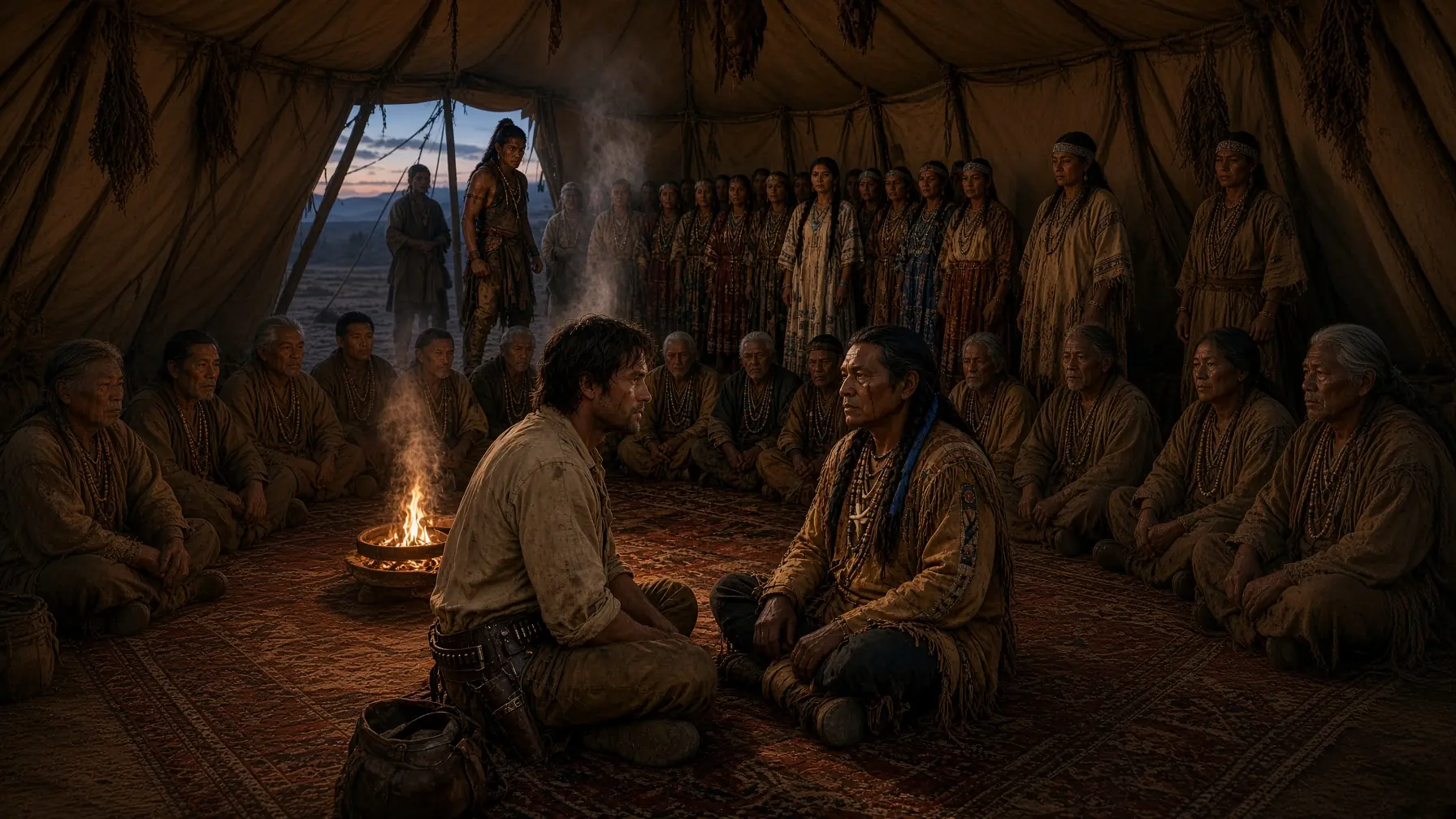
Jonah followed him to the largest lodge in the new camp. It stood near the spring, made quickly but with care, marked with painted symbols Jonah did not understand. Two warriors stood at the entrance. Their faces were serious, not hostile.
Inside, the air smelled of burning sage and warm leather.
Mahko sat among the elders.
Taren stood to one side, silent and watchful.
“Sit, Jonah,” Mahko said.
Jonah sat cross-legged before them, feeling the room settle around him.
Mahko studied him for a long time.
“You found water when death was walking beside us,” he said. “Our children live. Our mothers live. Our elders live. My people breathe because you did not ride away.”
Jonah shifted uncomfortably.
“Your grandfather’s spring saved you. I just remembered the story.”
An elder spoke from Mahko’s left.
“Many men remember stories. Few use them for others.”
Mahko nodded.
“You gave your last water to a child.”
Jonah said nothing.
“There is a debt between us now,” Mahko continued. “A sacred debt cannot remain empty.”
The lodge grew still.
At Mahko’s gesture, the entrance curtain opened.
Young women entered one by one, dressed in their finest woven garments, turquoise, beads, bright cloth, and polished shell. Some stood proudly. Some lowered their eyes. Some looked at Jonah with curiosity, others with uncertainty.
Jonah counted because his mind needed something to hold.
Twenty.
His heartbeat changed.
Mahko’s voice carried solemn weight.
“These are unmarried women of the Silver Creek people. Daughters, nieces, blood of our camp. Each family gives honor through them. They will be your wives. They will build your home. They will bear children strong enough to remember both your blood and ours.”
Silence struck the lodge.
Jonah looked at the women and felt the floor vanish beneath him.
He knew the offer was meant as honor.
That made it harder.
How does a man refuse gratitude from people he has saved without cutting them? How does he accept without becoming the kind of man who takes human lives as payment for doing what decency demanded?
Then he saw her.
One young woman stood near the end of the line, taller than most, with dark hair braided over one shoulder and a turquoise pendant resting against her throat. Her face was calm, but her eyes were not calm at all. They were sharp, intelligent, and deeply afraid of showing fear.
Mahko noticed his gaze.
“My daughter,” he said. “Naya. She is the brightest of my house. She is offered too, if you choose.”
Jonah looked away because something in that offer felt too heavy to meet directly.
Then he saw Taren.
The young warrior’s fists were clenched at his sides. His jaw was tight enough to tremble. But he was not looking at Jonah.
He was looking at Naya.
And the look on his face told the whole story.
Love.
Not sudden.
Not shallow.
Not the kind that begins when trouble arrives.
Old love.
Rooted love.
The kind two people carry quietly while waiting for the world to permit it.
Jonah understood then.
This gift would break more than his own conscience.
It would break them.
Mahko leaned forward.
“You are silent.”
Jonah took a breath.
“This honor you offer me is greater than I know how to answer.”
The elders nodded, expecting acceptance.
“But where I come from, a wife is not a debt paid to a man.”
A ripple moved through the lodge.
One elder frowned.
“You refuse our daughters?”
“No,” Jonah said quickly. “I dishonor none of them. Any man would be honored by their strength. But I cannot take women because gratitude demands it. Marriage should be chosen by the two hearts that must live inside it.”
Naya’s eyes lifted to him.
Taren stared.
Mahko’s expression became harder to read.
“Our debt must be answered.”
“I know.”
“Then what do you offer?”
Jonah searched for the right words and found none large enough.
So he chose honesty.
“I need time.”
The elders murmured among themselves.
Mahko watched him.
“You have until sunrise. If you refuse our gift, you must offer another path that carries equal honor.”
The women were dismissed.
Naya was last to leave.
At the entrance, she turned just enough for Jonah to see her mouth form silent words.
Please do not take what is not freely given.
Then she was gone.
Jonah stepped out into the cool desert night with the weight of twenty lives pressing on his chest.
Before he reached Flint, Taren seized his arm.
“If you take Naya,” he whispered in English, voice low and lethal, “I will kill you before the moon dies.”
Jonah looked at his hand.
Then at him.
“I’m not taking her.”
Taren froze.
“I mean that,” Jonah said. “But I need your help.”
The young warrior’s eyes narrowed.
“With what?”
“Finding a way out that does not shame your uncle.”
They walked to the edge of camp, where the firelight weakened and the desert opened beneath a sky thick with stars.
For a while, neither spoke.
Then Jonah said, “You learned English from traders?”
Taren gave a bitter half-smile.
“Mission school first. Traders later. They taught their language because they thought it would make us forget our own.”
“Did it?”
“No.”
The answer was sharp as a knife.
They sat on separate rocks, close enough to speak and far enough to remain honest about the danger between them.
“Naya and I were promised as children,” Taren said. “I was twelve. She was nine. Our families agreed. We grew up knowing where our path would lead.”
His voice softened despite himself.
“She loves you?”
Taren looked at him.
“With every breath she has.”
“And you love her.”
Taren looked toward camp.
“I have loved her long enough that I no longer remember myself before it.”
That sentence quieted Jonah.
“But Mahko is your chief.”
“He is my uncle. My chief. The father of the woman I love. If he gives her to you as honor, I cannot strike him down with shame in front of the people.”
“So you would lose her?”
Taren’s face hardened.
“I would obey. Then I would become something worse than dead.”
Jonah sat with that.
The desert wind moved softly through brush.
“There must be another custom,” he said. “Something that lets me refuse the gift without insulting the families.”
Taren studied him.
“There is an old right. Not used often.”
“What kind?”
“If a man refuses a gift of sacred debt, he may face trials. Skill. Wisdom. Endurance. If he passes, he earns the right to answer the debt in his own way.”
“And if he fails?”
Taren did not answer.
Jonah nodded.
“Of course.”
“You could die.”
“I could die walking back to my horse if your uncle wakes up insulted.”
Taren almost smiled.
Almost.
“Why would you do this?” he asked.
Jonah looked toward the spring.
“Because saving your people and breaking your heart in the same week seems like poor manners.”
This time, Taren did smile.
Only slightly.
But it changed his whole face.
He offered his hand.
Jonah took it.
At sunrise, Jonah stood before the council.
Mahko sat with the elders in a wide circle. The women sat behind them. Naya kept her head lowered, but Jonah saw her hands clasped tightly in her lap. Taren stood to the side, expression unreadable.
Jonah stepped forward.
“I cannot accept your daughters as wives,” he said.
Murmurs rose instantly.
He lifted one hand.
“Not because they are unworthy. Because they are worthy of more than being used to settle a debt owed to me.”
The murmurs changed.
Some offense.
Some curiosity.
Some discomfort.
“I ask for the old right,” Jonah continued. “Let me face the trials. If I pass, I will offer another payment of honor.”
Mahko’s eyes moved to Taren.
Taren gave one small nod.
Mahko’s gaze returned to Jonah.
“You know our ways?”
“I know little. Enough to ask with respect.”
An elder leaned forward.
“Three trials.”
Jonah nodded.
Mahko raised his hand.
“First, a ride to Twin Sisters Rock and back. Second, find the white hart of the canyon and mark it without harm. Third, endurance against our strongest warrior.”
Jonah looked at Taren.
Taren stepped forward.
“I stand for the third.”
Of course he did.
Jonah nodded.
“I accept.”
The first trial began at noon.
The whole camp gathered near the flat stretch beyond the spring. Twin Sisters Rock stood far out on the horizon, two stone columns rising side by side from the shimmering heat. The path there crossed sand, gravel, cactus beds, and a field of broken stone that could lame a careless horse in a heartbeat.
Taren rode a powerful paint horse named Smoke.
Young.
Fast.
Restless.
Jonah rode Flint, older and less flashy, with a chest built for distance and eyes that had seen enough country to distrust pretty ground.
Mahko raised his hand.
“When my arm falls, ride.”
Taren looked over.
“Do not fall behind to be kind.”
Jonah adjusted his reins.
“Do not outrun your horse to impress me.”
Mahko’s arm dropped.
Both horses exploded forward.
Smoke surged ahead at once, hooves tearing up sand. Taren rode low, perfect balance, moving with the animal like one body. Jonah let him go. Flint did not win races with pride. He won by still breathing when other horses remembered they had bones.
The first mile belonged to Taren.
The broken stone changed things.
Smoke had speed, but Flint had judgment. He picked his way through the rough ground without panic, cutting angles where Taren had to slow. By the time they circled Twin Sisters Rock, they were almost even.
Then Smoke stumbled.
Not badly.
Enough.
Taren felt it and shifted weight immediately.
Jonah saw the slight hitch in the horse’s gait.
He could win right there.
Push Flint hard, pull ahead, leave Taren nursing the horse through the return. That would complete the trial. It would also prove only that Jonah knew how to use another creature’s pain to make himself look worthy.
He eased back.
Taren looked over, angry and confused.
“What are you doing?”
“Your horse is hurt.”
“Then win.”
Jonah shook his head.
“That is not the kind of win I came for.”
They rode back side by side.
The camp watched in confusion as both horses crossed the line together.
A tie.
The elders stirred.
One began to speak, but Taren dismounted and checked Smoke’s leg. He stood, placed one hand on the horse’s neck, and faced the council.
“Jonah won,” he said.
Mahko’s eyes narrowed.
“He crossed with you.”
“He saw Smoke favoring his foot and chose not to take advantage. Speed is not the only measure. Honor is greater than haste.”
The camp quieted.
Mahko looked at Jonah for a long moment.
“The first trial is complete.”
That night, Naya came to Jonah’s sleeping place near the edge of camp.
She carried a bowl of stew made from dried meat and desert herbs. She moved quietly, but not timidly. Her presence made the darkness feel more aware.
“You will need strength tomorrow,” she said.
Her English was careful but clear.
“Thank you.”
She sat a few feet away.
For a while, they watched the firelight flicker against the rocks.
“Taren taught you?” Jonah asked.
“My mother first. Taren helped after.”
“He told me you were promised.”
Naya looked down.
“Many things are promised before children know what promises cost.”
“You love him?”
“With every year of my life.”
Jonah nodded.
“Then I’ll do what I can.”
“Why?”
The question was soft, but not simple.
Jonah looked toward the spring.
“Because a man does not save people from thirst and then drink up their freedom.”
Naya’s eyes shone.
“My father is not cruel.”
“I know.”
“He believes honor must have weight.”
“Then we’ll give him something heavy enough to hold.”
She looked at him.
“What?”
Jonah gave a faint smile.
“You’ll hear it when I earn the right to say it.”
Dawn painted the desert gold and violet.
The second trial began alone.
Jonah rode into the canyon country with only a canteen, a coil of rope, and a strip of red cloth he was meant to tie to the white hart’s antler as proof. The rule was clear: find the animal, mark it, do not harm it.
Taren had explained what he could.
“The hart is not hunted like meat,” he said the night before. “It is watched like weather. Men chase it for days and see only dust. You must understand where it wants to be before it gets there.”
Jonah searched for hours.
Tracks led into rock, then vanished.
Grazing marks appeared near one wash, but the trail doubled back. Droppings near a patch of bitter grass were too old. Twice, he thought he saw white movement and found only pale stone catching sun.
By midday, sweat had soaked his shirt.
Then his grandfather’s voice came back.
Animals live by need, not mystery. Water at dawn. Shade at noon. Food when light softens.
Jonah stopped chasing tracks and looked for comfort.
A narrow canyon cut through the red wall ahead, shaded even at high sun. At its base, a thread of water ran through the rock, too small for men to camp beside, just enough for an animal that knew how to survive.
Jonah tied Flint back and entered on foot.
He waited in the shade for nearly two hours.
Then the white hart appeared.
It moved soundlessly between the rocks, pale as moonlight, antlers high and smooth, dark eyes alert to everything. It lowered its head to drink, then froze.
It knew he was there.
Jonah did not move.
He spoke softly.
Not words that mattered.
Tone.
Low.
Steady.
No threat.
The hart watched him.
Jonah slowly lifted the red cloth and let it stir in the faint canyon breeze. The color flickered bright against the stone. The animal’s ears moved forward.
He took one step.
Then stopped.
Another.
Then stopped.
The hart could have vanished in a flash, and part of Jonah expected it to. Instead, it lowered its head slightly, drawn by curiosity or patience or some wild mercy Jonah would never name properly.
When he stood close enough, he held out the cloth.
The hart sniffed it.
Jonah’s hands trembled.
Not from fear.
From knowing the moment would punish greed.
He moved slowly, tied the red cloth around the left antler, and stepped back.
The hart held still for one heartbeat.
Then it sprang away, white body flashing once between red rocks before disappearing into the canyon.
Jonah released a breath he had been holding for what felt like half his life.
By afternoon, he returned to camp.
The elders were doubtful until two scouts came running from the canyon rim. They had seen the white hart, red cloth bright on its antler, moving untouched through the shade.
That night, Mahko announced the second trial complete.
The third came with sunrise.
The whole camp formed a circle in the sand near the spring. No weapons. No knives. No stopping until one man yielded or could not stand.
Taren stepped into the circle without his shirt, lean muscle marked by old scars and sun. Jonah entered opposite him, bruised from the ride, tired from the hunt, and aware that every eye in camp had become part of the weight on his shoulders.
Taren leaned close before Mahko gave the signal.
“Do not make it easy.”
“I was about to tell you the same.”
Mahko’s hand dropped.
Taren moved first.
Fast.
He struck Jonah in the ribs hard enough to steal his breath, then drove low to take him down. Jonah caught his shoulder, twisted, and both men hit the sand together. They rolled apart and rose at the same time.
The fight became something larger than anger.
Taren attacked with speed and precision. Jonah answered with patience and weight. Sand clung to sweat. Blood appeared at the corner of Jonah’s mouth. Taren’s cheekbone swelled beneath one eye. The sun climbed higher. The circle stayed silent.
Minutes stretched into an hour.
Then longer.
Neither man wanted to injure the other.
Neither could afford to look false.
This was not theater.
It was proof.
At last, both dropped to one knee at the same moment, exhausted beyond pride. Taren looked at Jonah through sweat and dust, then extended his hand.
Jonah took it.
They pulled each other upright.
Mahko stood.
“Draw.”
The word moved through the camp with surprise.
Then he looked at Jonah.
“You have faced skill, wisdom, and endurance. You have proven worth. Speak your answer to the debt.”
Jonah turned toward him.
“I do not want wives.”
The camp stirred.
“I want a trading post built here by the spring,” Jonah said. “A place where your people choose what to trade, when to trade, and with whom. Food, horses, tools, blankets, medicine, craftwork, knowledge. A place that brings strength without taking your home from you.”
Mahko listened.
Jonah continued.
“I will bring lumber, iron, seed, and men who can work under your rules. I will use my grandfather’s old route to connect this spring with town, but no one enters without your permission.”
He looked toward Naya and Taren.
“And I ask that your daughter be free to marry the man she chooses, not the man chosen by debt.”
The camp went quiet.
Mahko turned slowly toward Naya.
She stood with her head lowered, but her hand was in Taren’s.
No one could miss it now.
Mahko looked at them for a long time.
Then he closed his eyes.
When he opened them again, he looked older.
And kinder.
“A father can mistake control for protection,” he said.
Naya’s eyes filled.
Mahko turned back to Jonah.
“The debt is answered.”
Taren’s hand tightened around Naya’s.
Mahko raised his voice.
“The trading post will be built. My daughter will choose.”
A sound moved through the camp.
Not cheering at first.
Relief.
Then joy.
Naya crossed the circle and embraced her father. Taren stood still until Mahko extended one hand toward him. The young warrior stepped forward, and Mahko placed that hand over Naya’s.
Jonah turned away before the moment became too private for him to stand inside.
But Mahko stopped him.
“Jonah Mercer.”
Jonah faced him.
“You found water. You refused power. You carried honor without trying to own what honor brought you.”
Mahko touched his chest.
“You are brother to Silver Creek now.”
Jonah bowed his head.
The trading post took four months to build.
It began with cut timber hauled by mule wagon and ended with a long, low structure near the Stone Horse spring, shaded by canvas awnings and marked with Silver Creek symbols painted above the doorway. Jonah kept his promise. No trader entered without permission. No whiskey crossed the line. No man bought what had not been freely offered.
The first season was rough.
White traders tried to cheat the weights.
Taren threw one into a cactus patch.
Jonah stopped the second with a ledger and a pistol resting visibly beside it.
Mahko laughed when he heard about both incidents and said wisdom had many languages.
The post grew.
Silver Creek women traded woven goods for tools and seed. Men traded horses, hides, and carved work for iron, coffee, flour, and medicine. A school table was set beneath the awning twice a week, where children learned English words without being asked to surrender their own.
Naya taught there.
Taren repaired tack and watched her from across the yard like a man still amazed that the future had not been taken from him.
They married at the first winter moon.
Not as payment.
Not as duty.
By choice.
The ceremony lasted deep into the night, full of song, firelight, and laughter that rose against the cold desert stars. Jonah stood at the edge of the gathering, trying not to feel out of place.
Naya found him anyway.
“You look ready to run,” she said.
“I usually am.”
She smiled.
“You stayed.”
Jonah looked toward the spring.
“Seemed like the desert finally gave me work worth doing.”
Taren approached and handed him a cup.
“Drink, brother.”
Jonah sniffed it.
“No whiskey?”
Taren grinned.
“Not today.”
“That sounds suspicious.”
“It is medicine.”
“It smells like horse regret.”
Naya laughed.
So did Taren.
Jonah drank it anyway and coughed so hard several children pointed at him.
Years passed.
The Stone Horse trading post became a place people spoke of carefully.
Some called it impossible.
Some called it dangerous.
Some called it the only honest crossing in the territory.
Jonah did not care much what towns called it. Towns had a way of naming things after they were already done. The people who mattered called it useful. Called it fair. Called it theirs.
Mahko lived long enough to see three springs after the camp was saved.
Before he died, he sat beside the water with Jonah and watched children filling clay jars.
“I almost gave my daughter away to pay a debt,” he said.
Jonah sat beside him.
“You were trying to honor what saved your people.”
“I was trying to hold the old ways while the world broke around us.”
“That is not shameful.”
Mahko looked at him.
“No. But pain can hide inside honor if a man stops listening.”
Jonah said nothing.
Mahko touched the ground beside the spring.
“You made another path.”
“No,” Jonah said. “Your people did. I only got thirsty in the right place.”
Mahko laughed softly.
Two weeks later, he was gone.
Taren became chief.
Not because he was the strongest warrior, though he was.
Because he had learned that strength without listening becomes another kind of hunger.
Under him, the Silver Creek people remained near the spring, moving with seasons, trading when they chose, refusing when they chose, building a future without pretending the past had not been wounded.
Jonah never married.
People asked sometimes.
Usually rude people.
He always said he had been offered twenty wives once and figured a man should not press his luck.
But the truth was quieter.
He had found family without taking what did not belong to him.
He had found purpose without owning the people he helped.
He had found a place where Flint could graze near water, where children called him Uncle Jonah, where an old story from his grandfather had become a living settlement under a stone horse’s shadow.
That was enough.
Years later, when he was an old man himself, Jonah sat outside the trading post and watched Taren’s oldest son lead a group of riders toward the canyon.
The boy was teaching them how to track the white hart.
Not to catch it.
To understand it.
Naya sat beside Jonah, her hair streaked with gray, her eyes still sharp.
“You know they still tell the story wrong,” she said.
“Which part?”
“All of it.”
Jonah smiled.
“They say I saved a tribe.”
“You found water.”
“That sounds smaller.”
“It is truer.”
He nodded.
“They say I refused twenty brides because I was noble.”
Naya looked amused.
“Were you not?”
“I was terrified.”
“That also is truer.”
They sat in comfortable silence.
The spring bubbled softly near the stone ring. The trading post doors stood open. Children ran beneath the awning, kicking dust into gold light. Taren stood near the horse rail, older now, but still straight-backed, still watching over the place with the same fierce eyes he once aimed at Jonah like a blade.
Naya followed Jonah’s gaze.
“He would have killed you that night.”
“I know.”
“He liked you after.”
“I noticed it took him several years to admit that.”
“He is a stubborn man.”
“You chose him.”
“I am also stubborn.”
Jonah laughed.
The sound moved easily through the warm air.
People later made the story into something grander than it had been.
A cowboy found a dying tribe.
A hidden spring rose from the desert.
A chief offered him twenty brides.
He passed three trials, freed the chief’s daughter to marry her warrior, and built a trading post where enemies became neighbors.
That version was close enough for fireside telling.
But Jonah knew the real story was made of smaller choices.
A horse refusing to walk.
A canteen handed over before questions.
A child receiving the last drops of water.
A young warrior loving a woman enough to risk shame.
A woman brave enough to ask a stranger not to accept what tradition demanded.
A chief strong enough, in the end, to change his mind.
And a man who understood, just in time, that saving people did not give him the right to own their gratitude.
The Stone Horse watched over all of it.
Its shadow still stretched east at high noon.
The spring still filled the stone hollow.
Travelers still came carefully, because the rules of the place were known far beyond the desert.
Trade fair.
Enter respectfully.
Bring no whiskey.
Take no person’s freedom as payment for your help.
Jonah liked that last rule best.
It had never been written above the door.
It did not need to be.
Everyone knew whose story had put it there.
And sometimes, when the sun stood high and the stone horse’s shadow pointed east, Jonah would think of his grandfather’s voice by the fire.
Water waits under stone for men patient enough to believe.
The old man had been right.
But he had left out the greater truth.
Sometimes water is not the only thing buried under stone.
Sometimes there is a future there too.
And if a man is lucky, he does not discover it by taking what is offered.
He discovers it by refusing what was never his to take.