The crystal slipper slid onto Lady Lucienne's foot so easily that the entire drawing room seemed to stop breathing. A royal herald leaned forward. Her mother pressed a lace handkerchief against her lips, hiding a smile that looked nothing like surprise. Beside the fireplace, a young maid stood with a tray of untouched tea, watching a thin ribbon of blue light pass through the transparent heel. She knew, before anyone applauded, that the slipper was a lie.
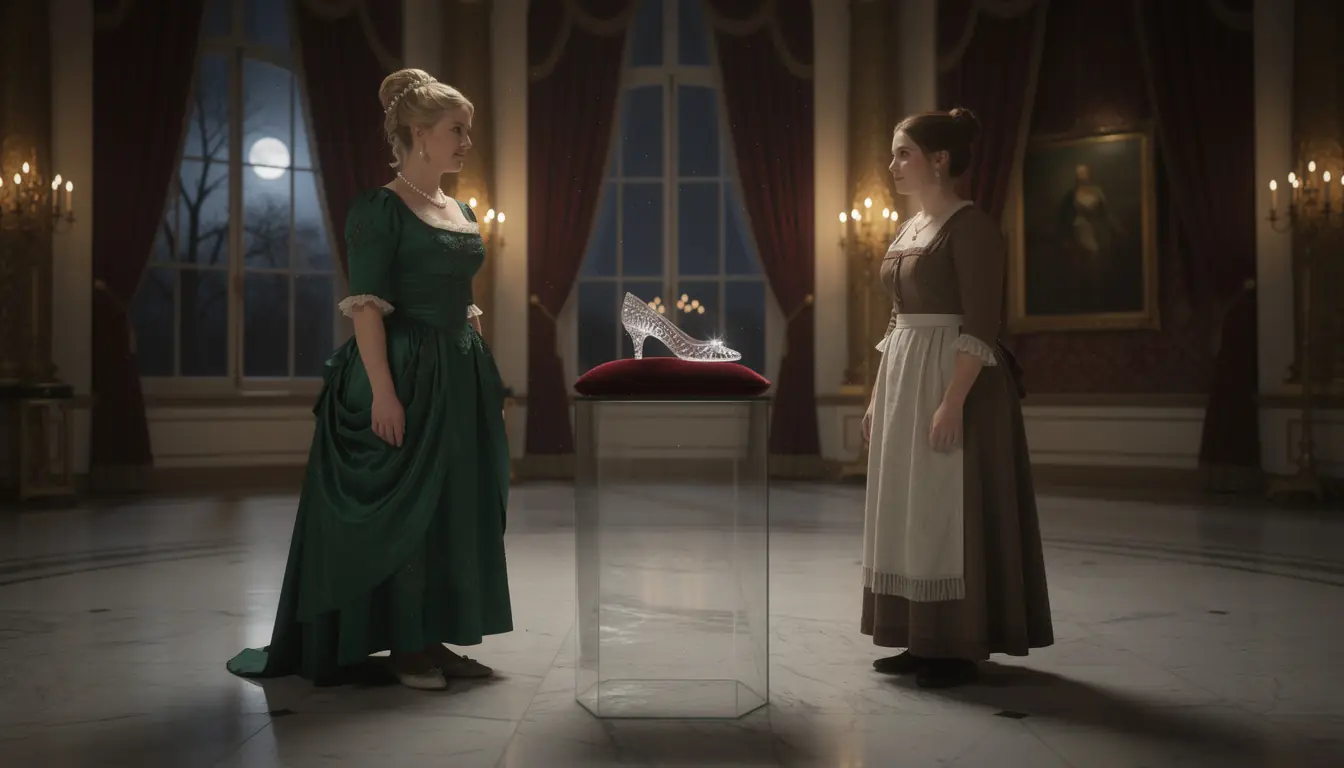
"There," Lucienne announced, stretching her toes beneath the glittering glass. "As I told you, I was the woman who danced with His Highness." She lifted her chin toward the herald and smiled as though he had arrived with a crown instead of a shoe. Her younger sister, Isolde, clapped twice before noticing that their mother's hands remained still. "You see?" Lucienne continued. "The prince has found me at last."
The herald, Sir Alden, consulted a document bearing the palace seal. The decree had been announced in every village of the kingdom: the prince was searching for the unknown guest who had left a crystal slipper on the palace steps during the winter masquerade. Any claimant would be asked to try it on before a royal witness. A fitting was evidence, not a marriage contract, but Lucienne was already behaving as though wedding bells had begun to ring.
The maid lowered her eyes before Lucienne could notice her expression. Her name was Elara, and for six years she had washed that family's floors, repaired their gowns, and endured their favorite joke: that a girl born to fine people could become a servant if she failed to protect her place. She knew the genuine slipper intimately. She had worn it while dancing with the prince, and the authentic crystal held a small silver star within its left heel, not the thin blue ribbon glinting through the counterfeit now on Lucienne's foot.
Only two people had seen the exchange in the drawing room. One was Lady Verena, Lucienne's mother, who had distracted Sir Alden with a sealed letter. The other was Elara, who had been kneeling behind the sofa to retrieve a dropped spoon when Lucienne's hand moved beneath the velvet cushion and replaced the palace shoe with a copy. Nobody had bothered to look at the maid. Nobody ever did.
"Shall I send word to the palace?" Sir Alden asked. Lady Verena's smile broadened. "Naturally. My daughter has waited long enough for her proper future." Elara set down the tray with remarkable care. She understood that what happened next would decide far more than who stood beside the prince at a wedding. If the wrong woman entered the palace under a stolen identity, an entire valley might never learn where its missing winter grain had gone.
Three months earlier, Elara had known almost nothing about royal slippers or masquerades. Her world was the kitchen at Valecrest Manor, a stone house above the River Merrow, where the windows glittered in summer and leaked cold air in winter. Every morning she rose before the servants, carried coal upstairs, and laid fires for a family that called her lazy whenever the rooms were not warm enough. At night she slept in a narrow attic where snow sometimes found its way beneath the roof tiles.
She had not always lived there as a maid. Her father, a mill owner with a gift for numbers and a weakness for giving people second chances, had married Lady Verena when Elara was thirteen. Verena arrived with two daughters, Lucienne and Isolde, and a promise to make the household whole again after the death of Elara's mother. For a short while she was affectionate. Then Elara's father fell ill, and the affection disappeared as quickly as a candle blown out.