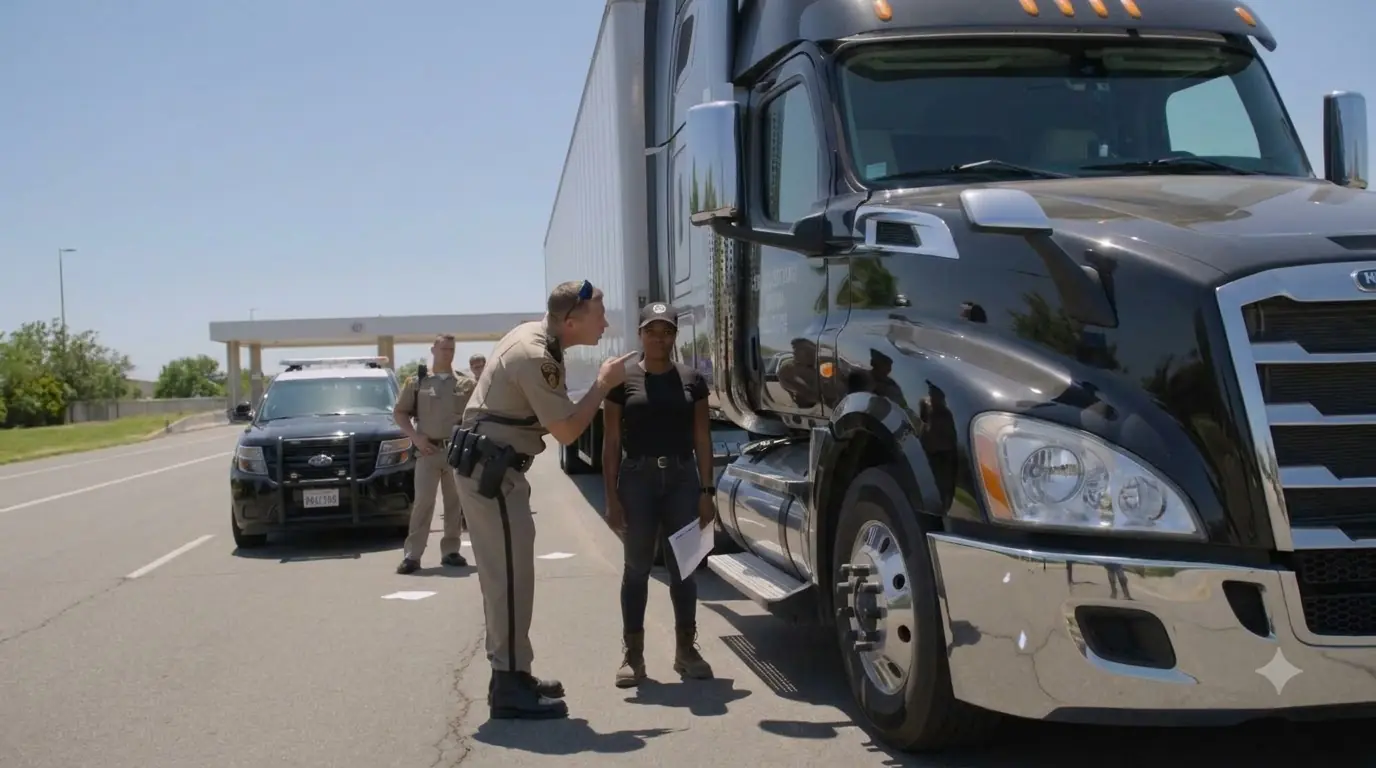
“Hands where I can see them, freight trash.”
Deputy Boyd Keller’s voice cut across the truck stop lot like a blade dragged over concrete.
He stood beside pump seven with one hand on his belt and the other holding Mariah Reed’s commercial license between two fingers, as if the plastic itself had offended him. Then he flicked it onto the asphalt. The card bounced once, landed faceup, and sat there under the late-afternoon sun with her alias printed across it.
Tessa Boone.
Independent hauler.
Clean record.
Valid CDL.
Keller stepped on it anyway.
Slowly.
His boot ground over the license like he was trying to scrape the name off the world.
A small crowd had already formed near the rest stop pumps. Truckers paused with diesel hoses in their hands. A mother stood frozen beside an SUV, one hand covering her child’s eyes without fully knowing why. A teenage boy near the vending machines lifted his phone and started recording.
Keller saw the phone.
He smiled.
“Look at her,” he called to the crowd. “Big rig, big mouth, no respect.”
Beside him, Deputy Trent Shaw laughed and yanked Mariah’s arms behind her back. The cuffs bit fast and hard, locking her shoulders at an angle that sent pain down both arms. Her cheek struck the hot black metal of her semi’s door, and the sun-baked surface burned against her skin.
Mariah did not scream.
She did not curse.
She did not fight.
That was training.
Pain belonged to the body. Fear belonged to the mission. Neither one got permission to take command.
A hidden comm unit inside her ear clicked once.
Then a calm voice came through.
“Reed, hold position. Do not engage.”
Mariah breathed in through her nose and kept her eyes empty.
Deputy Keller leaned close, satisfied enough to smell like coffee, tobacco, and cheap power. He thought he had stopped a random Black female trucker. He thought she was alone. He thought the badge on his chest made him the most dangerous person in the lot.
He was wrong about all three.
Three weeks earlier, Special Agent Mariah Reed had driven the same stretch of Interstate 19 under a different name.
Tessa Boone had been built carefully.
A freight hauler from Memphis.
No family nearby.
No obvious federal ties.
A used black Peterbilt with a scratched trailer, a clean inspection history, and enough road dust to look like it belonged anywhere diesel fumes gathered.
That was the point.
For eight months, girls had been disappearing along the interstate corridor.
Not from wealthy neighborhoods.
Not from places that made national news immediately.
From bus stops, cheap motels, rest stop bathrooms, roadside diners, and truck lanes where tired people came and went too quickly to notice who did not leave. Some were runaways. Some were foster kids. Some were traveling with relatives and stepped away for five minutes.
Then they were gone.
The reports crossed county lines and died there.
One sheriff’s office blamed another.
One highway patrol unit said cameras failed.
One local department claimed the missing girl had probably run off willingly.
Too many files ended with the same dead words.
No further leads.
Mariah’s task force found the lead everyone else had missed.
A matte-black transport truck with no visible company markings, temporary plates that changed every few weeks, and a custom exhaust stack angled behind the cab. It appeared near three disappearance sites within forty-eight hours of each case. Every time federal agents got close, a local law enforcement stop or road closure conveniently forced surveillance away from the route.
That was why Mariah went undercover.
Because the pattern had protection.
The Briar County rest stop looked ordinary that day.
Heat shimmered above the asphalt. A kid cried because the snack machine ate his dollar. Two long-haul drivers argued about a fuel receipt near the pumps. A pair of local cruisers sat under the thin shade of a half-dead sycamore tree like they had every right to watch everyone who came through.
Mariah pulled her semi into position at 2:12 p.m.
Right on schedule.
She cut the engine, stepped down from the cab, and pretended to check a cargo manifest clipped to a metal board. Her eyes moved once toward the highway entrance, where the black transport truck was due to appear within the hour.
Then she heard boots behind her.
“Well, well,” Deputy Shaw called. “Don’t see many lady drivers in a rig like this.”
Mariah did not turn too fast.
“Afternoon, Deputy. Just running my safety check.”
Shaw was tall, red-faced, and thick through the middle, with the kind of grin that got uglier the longer it stayed on his face. He looked her over the way men sometimes did when they had already decided a woman was either entertainment or trouble. Behind him, Boyd Keller approached more slowly.
Keller was different.
Colder.
He had pale eyes, a square jaw, and a habit of standing still while other people wasted movement. His uniform was clean, his boots polished, his badge bright. Nothing about him looked careless, which made him worse.
“This is a rest area,” Keller said. “Not a depot. How long you planning on sitting here?”
Mariah held out her paperwork.
“Ten minutes. Maybe less. Everything’s current if you need to verify.”
Keller did not take the clipboard first.
He grabbed her wrist.
Hard.
“Funny thing about paperwork,” he said. “It only matters when the person holding it looks honest.”
Mariah’s body knew seven ways out of that grip.
Break the thumb.
Shift inside.
Drive an elbow into the ribs.
Hook the knee.
Take him down before Shaw could clear his holster.
Her body knew all of it.
Her mission told her no.
She pressed her thumb against the tiny transmitter under her sleeve.
Two quick taps.
Escalation signal.
“Deputy, you’re hurting my wrist,” she said loudly, making sure the crowd heard. “I have provided my license and freight documents. There is no reason for you to touch me.”
Shaw stepped closer.
“You hear that, Boyd? She knows words.”
Keller twisted her arm behind her back.
“Resisting.”
The word came out like he had been waiting all day to use it.
Mariah’s cheek hit the truck door.
The metal burned.
The crowd gasped.
The hidden comm in her ear crackled again, and this time the voice was not calm.
“Reed, abort. Abort now. Target is moving. We are compromised.”
For the first time that afternoon, real cold moved through her blood.
Through the corner of her eye, Mariah saw the black transport truck roll out from behind the rest stop building. It moved slowly at first, then turned toward the eastbound ramp. Its dark windows reflected the sun, giving nothing back.
The truck they had hunted for weeks.
The truck that might be carrying missing girls.
The truck that was now leaving because Keller had forced the scene early.
Shaw shoved her toward the cruiser.
“Not so tough now, huh?”
Mariah said nothing.
Her mind was already working.
Primary comm still active.
Backup tracker at ankle.
Small ceramic blade hidden in belt seam.
Two deputies.
One cruiser.
Crowd cameras.
Target lost, but not gone.
If she could activate the ankle tracker, the team might still triangulate her and trace the deputies’ movement. She shifted her cuffed hands slowly, using the uneven steps toward the cruiser as cover.
Keller caught it.
His eyes met hers in the side mirror of the patrol car.
“I wouldn’t.”
The cruiser pulled away from the pump, then stopped hard near the gravel shoulder. Keller opened the back door, grabbed her ankle, found the backup device, and crushed it beneath his boot.
He leaned in close.
“You’re smarter than the usual ones,” he whispered. “That makes you dangerous.”
Mariah stared at him.
He smiled.
“But not dangerous enough.”
At the Briar County station, they brought her through the side entrance.
Not booking.
Not the front lobby.
Side door.
Old camera above the hall.
No civilian desk view.
No witnesses.
Mariah noticed every detail because noticing details was how people survived rooms built for forgetting.
The station smelled of dust, floor cleaner, and old coffee. A wall clock ticked too loudly above a bulletin board full of faded safety posters. Somewhere down the hall, a printer jammed and kept trying anyway.
At intake, she gave the alias.
“Tessa Boone.”
Keller studied her face.
“You don’t look like a Tessa.”
“That’s what my mother named me.”
Shaw shoved her toward a holding cell.
“Cute.”
The door slammed shut.
Twenty miles away, in a surveillance van hidden behind a closed feed store, Senior Agent Victor Hale watched Mariah’s primary signal vanish from his screen.
Then the backup died.
Then the transport truck’s tracker disappeared near the east junction.
Hale stood so fast his chair rolled backward into a metal cabinet.
“Status.”
A junior analyst looked up, pale.
“Primary dead. Backup dead. Truck signal lost.”
“Pull highway cameras.”
“Already trying.”
Another agent rushed in with a tablet.
“You need to see this.”
The screen showed shaky phone footage from the rest stop. Mariah pressed against her truck. Keller stepping on the license. Shaw forcing cuffs onto her wrists. Keller’s voice clear enough for court.
Hands where I can see them, freight trash.
The video caption read:
Cops abusing Black woman trucker at Briar County rest stop. Share before they delete it.
Hale stared at the video.
Then at the dead signals.
“This isn’t random,” he said.
At the station, Keller searched Mariah’s belongings himself.
He moved carefully.
Too carefully.
He took the burner phone, wallet, freight documents, keys, and cash. Then he checked seams, socks, boot soles, jacket lining, even the underwire of her bra with a female deputy watching from the doorway and pretending discomfort was the same as objection.
Inside her left sock, Keller found the secondary encrypted phone.
He turned it on.
The screen lit up.
Satellite uplink active.
A faint FBI seal appeared for half a second before the lock screen changed.
Keller’s expression went flat.
No surprise.
Recognition.
That told Mariah more than any confession could have.
He walked out of the room without a word.
Then he locked the front doors of the station.
No one in.
No one out.
They dragged Mariah into the evidence room and cuffed her to a metal chair bolted to the floor. The air was hotter there, stale and close, with shelves of boxed files and seized property stacked along the walls. Keller placed the encrypted phone on the table in front of her.
“You know,” he said softly, “I had a feeling about you.”
Mariah said nothing.
Shaw stood by the door.
“She a fed?”
Keller ignored him and leaned closer to Mariah.
“That what you are? FBI? Homeland? Some special little task force sticking its nose into county business?”
Mariah kept her face blank.
Keller stepped into the hallway and made a call.
His voice lowered, but the room was quiet enough for pieces to carry.
“Yeah. It’s me. We got a problem. She had federal gear.”
A pause.
“No. Nobody outside knows she’s here.”
Another pause.
“What do you want done?”
Mariah watched his expression change as he listened.
That was enough.
Officer Luis Navarro stood in the dispatch room pretending to enter old traffic warnings into the system.
He was twenty-six, new enough to still believe policy meant something, old enough to know Briar County did not reward belief. He had seen Keller rough up drivers before. He had watched Shaw turn traffic stops into shakedowns. He had heard rumors about the sheriff’s department protecting certain routes and pretending not to recognize certain trucks.
He had told himself he needed proof.
Then proof sat cuffed in the evidence room with a split lip and an FBI phone on the table.
Navarro watched through the glass as Keller returned, shut off the overhead light, and turned the thermostat higher.
“You know what happens to people who make trouble out here?” Keller asked Mariah. “They get lost. Deep woods. Empty roads. Bad luck.”
Mariah’s wrists burned inside the cuffs.
Her side ached from the truck door.
Her mouth tasted like blood.
But her mind stayed clear.
Four steps to Keller.
Two to Shaw if he entered.
Vent above left shelf.
Loose screws.
Old utility door beyond evidence lockers.
Possible basement access.
She could move.
But not yet.
In the hallway, Shaw sat at a department computer and began deleting security footage. His hands moved too comfortably. Not the hands of a man committing his first crime. The hands of a man doing maintenance.
The station phone rang.
Navarro answered.
A voice came through the line.
“This is Senior Agent Victor Hale with the Federal Bureau of Investigation. I need to speak with your commanding officer immediately.”
Navarro looked toward Keller.
Keller’s head turned.
Slowly.
Navarro’s throat tightened.
Keller walked over and took the phone.
“Briar County Sheriff’s substation. Deputy Keller speaking.”
He listened.
His smile returned.
“No federal detainee here, Agent. But if somebody’s using this office for false reports, you might want to check your own people.”
Then he hung up.
He turned toward Navarro.
“You heard nothing.”
Navarro nodded.
But his conscience had already stopped obeying.
Later that night, the station went quiet.
Shaw left to “check a perimeter alert.” Keller disappeared into the back office with two men in civilian clothes who had arrived through the rear lot. The desk sergeant watched television with the volume low and a hand resting near his gun.
Navarro moved.
He copied what remained of the station footage to a USB drive, then pulled dispatch logs, visitor entries, and the side-door camera cache before Shaw could wipe the backup server. His hands shook so badly that he dropped the first drive and had to crawl under the desk to find it.
Then he filled a paper cup with water, tucked a small first-aid kit into his jacket, and unlocked the evidence room.
Mariah’s eyes opened before the door finished moving.
“Don’t make noise,” Navarro whispered.
She studied him for one second.
Then she took the water.
“I know you’re not a trucker,” he said. “I know Keller is into something. I don’t know how deep.”
Mariah’s voice came rough.
“There was a black transport truck leaving the rest stop. Girls may be inside. If you don’t get help fast, they disappear.”
Navarro’s face went pale.
“Girls?”
“Call Victor Hale. Use this phrase: Orchard Red. Tell him Reed is alive, Briar station compromised, Keller directly involved.”
Navarro repeated it under his breath.
“Orchard Red.”
Outside, car doors shut behind the building.
Navarro moved to the small window.
Keller stood near the tree line in a dark jacket, handing a thick envelope to three masked men beside an unmarked SUV. The men did not look like deputies. They looked like work done after paperwork failed.
A fragment of Keller’s voice drifted in.
“Federal problem. No body. No trace.”
Navarro stepped back, face gray.
Mariah saw it.
“They’re moving me tonight?”
He did not answer.
He did not need to.
“I’ll call Hale now,” Navarro said.
“No,” Mariah said. “If you call from this building, they’ll know.”
“What do I do?”
“Get out first. Send the files. Then call.”
“What about you?”
Mariah looked at the loose vent above the shelves.
“I have plans.”
The moment Navarro left, Mariah went to work.
The thin metal rim from the water cup became a tool. The vent screws were old, painted over, and stubborn, but not impossible. Her fingers were numb from the cuffs, and blood kept slipping down one wrist, but she turned each screw slowly.
Above her, Keller’s voice echoed through the hall.
“Get the van ready.”
Mariah freed the vent cover at 11:43 p.m.
By 11:51, she had climbed onto the shelf, twisted one shoulder painfully through the opening, and pulled herself into the ductwork. The metal scraped her ribs. Dust filled her mouth. Somewhere behind her, the evidence room door opened.
Shaw cursed.
“She’s gone!”
The station exploded with movement.
Mariah crawled through the duct until it dropped into the basement archives. She hit the floor hard between two rusted filing cabinets, rolled to protect her shoulder, and came up barefoot, bruised, bleeding, and moving.
Assess.
Adapt.
Survive.
The basement was a maze of old boxes, seized property records, and forgotten equipment. Emergency lights cast everything in a dirty red glow. Somewhere above, men shouted her alias like they could still control the name she wore.
She found the utility panel behind a stack of broken chairs.
The lock was simple.
The wiring was not.
She rerouted power to wake the basement monitors and pulled up the remaining external feeds. Three cameras flickered alive. Grainy. Time-stamped. Enough.
There.
The black transport truck leaving the rest stop.
Camera two caught the rear angle.
Camera five caught the highway turn.
Camera nine caught the exit.
It had gone east on Route 22 toward the abandoned Merritt Cold Storage plant, a meat-processing facility shut down eight years earlier after contamination lawsuits. Remote. Thick walls. Freezer rooms. Loading bays large enough for trucks.
Perfect.
Mariah whispered, “Found you.”
Keller’s voice came from the stairwell.
“She’s in the basement. Lock every exit.”
Mariah moved through a storage hall and found an old armory locker.
Mostly empty.
Mostly.
Behind dusty riot shields sat an outdated taser, a cracked baton, and a box of zip ties. She took all three. Then she found the emergency exit, a rusted metal door with a keypad.
Four digits.
The station’s founding year was painted on a plaque upstairs.
She entered it.
The lock clicked.
Shaw rounded the corner.
“You little—”
Mariah slammed her shoulder into the door.
It burst open with a scream of metal.
The alarm shrieked.
Cold night air hit her face.
She ran.
Bare feet on gravel.
Blood on concrete.
Woods ahead.
Shouting behind her.
A hundred yards between capture and survival.
By dawn, Mariah was deep in the pine country beyond Briar station.
Her feet were cut. Her ribs burned. Blood had dried stiff along her side. She smeared mud across her arms and face to break up her outline, then moved along a creek bed to hide her tracks.
Keller’s men had dogs.
She heard them twice.
Both times, she went into water.
Both times, she thought of the missing girls and kept moving.
Ranger school had taught her that pain was information, not instruction. Her body was reporting damage. Her mission was telling her what to do with it.
Five miles east of the station, she reached an emergency cache buried beneath an old hunting blind.
The steel container was hidden under boards, leaves, and a rusted deer feeder. Inside were clean clothes, medical supplies, a compact sidearm, ammunition, a burner phone, a drone folded into a black case, maps, cash, and a laminated photograph.
Lily Moreno.
Fourteen when she vanished from a bus transfer station near Interstate 19.
Braces.
Round cheeks.
Bright eyes.
Holding a blue ribbon from a county science fair.
Lily would be sixteen now if she was still alive.
Her case had brought Mariah into Briar County.
Mariah placed the photo on the tailgate of the abandoned farm truck beside the cache and stitched the cut along her ribs without anesthesia. Her hands stayed steady until the third stitch. Then they shook. She paused, breathed through it, and finished.
By noon, she was close enough to Merritt Cold Storage to see the smokestack through the trees.
The plant sat behind a sagging fence at the end of a broken service road. Weeds grew through the asphalt. Old warning signs hung crooked on the gate. From a distance, it looked dead.
But power lines hummed.
A side door had fresh scratches around the lock.
Tire tracks cut through mud behind the loading dock.
Mariah launched the drone.
From above, the building came alive.
Black SUV at the rear entrance.
Two armed guards near the loading bay.
Heat signatures inside.
Small ones.
Too small.
Her jaw tightened.
Then another vehicle arrived.
Keller stepped out wearing civilian clothes but still moving like a man used to being obeyed. He carried a briefcase in one hand. Two men met him at the door, and the three disappeared inside.
Mariah recorded everything.
Vehicles.
Faces.
License plates.
Entry points.
Guard positions.
Then she tried the secure FBI line.
“This is Special Agent Mariah Reed. Authentication code Delta 662. I need immediate tactical response at—”
Static cracked.
A distorted voice came through.
“Agent Reed. Still alive? That’s inconvenient.”
Shaw.
Mariah’s stomach tightened.
The line went dead.
If Shaw could break into that channel, someone beyond Briar County had fed them federal access. The leak was not only local. The task force was compromised.
Mariah sat in the cab of her semi, half a mile from the plant, and made a decision she knew would end her career whether she survived or not.
She went public.
She mounted the burner phone to the dashboard, started a satellite uplink, and looked directly into the camera. Her face was bruised, her lip split, her shirt dark with dried blood, but her voice was steady.
“My name is Special Agent Mariah Reed, Federal Bureau of Investigation, undercover operations. What I am about to release documents a human-trafficking operation protected by Deputy Boyd Keller and members of the Briar County Sheriff’s Office.”
She uploaded everything.
Drone footage.
Rest stop video.
Station footage Navarro had sent.
Vehicle routes.
Missing-person timelines.
Financial records.
Call logs.
Names.
Dates.
Locations.
Then she looked back into the camera.
“To Deputy Keller and everyone protecting him: no more darkness. No more missing girls. No more locked doors. Tonight, the whole country sees you.”
She hit send.
Files went to federal oversight offices, major news outlets, state police leadership, trusted prosecutors, and every public platform her team had set up for a worst-case scenario.
No one could bury it now.
Then Mariah started the truck.
The semi roared down the service road like thunder with a driver’s license.
The reinforced bumper hit the front gate and tore it from its hinges.
Steel screamed.
Guards scattered.
Smoke canisters flew from the cab before the truck stopped.
White clouds swallowed the loading dock.
Gunfire cracked through the smoke.
Mariah moved into it anyway.
Inside, Merritt Cold Storage smelled like rust, old blood, and frozen concrete. Machinery sat dead along the walls. Water dripped from pipes overhead. Emergency lights flickered in long corridors that seemed built to hide screams.
A guard came through the smoke with a rifle.
Mariah took him from the side, drove him into a support beam, and dropped him before he could fire twice. Another swung at her from behind. She ducked, slammed the baton into his knee, then used a zip tie on his wrists before he hit the floor fully.
She moved toward the heat signatures.
Toward the small ones.
Toward the sound she had been listening for.
A cry.
Not loud.
Not dramatic.
Worse.
Weak.
In the old processing room, a masked guard held a teenage girl in front of him with a pistol at her temple.
“One more step,” he shouted, “and she dies.”
Mariah raised her hands.
“Let her go.”
“Drop the weapon.”
Mariah placed her Glock on the floor.
The girl’s eyes met hers.
Terrified.
Still thinking.
Good.
Mariah shifted one finger toward the smoke canister at her boot.
The girl saw it.
One pull.
One roll.
White smoke exploded between them.
The girl dropped.
Mariah moved.
She hit the guard low, drove him into a steel table, trapped his wrist, broke his grip, and slammed his head hard enough to end the fight. The girl crawled backward, sobbing without sound.
Mariah crouched beside her.
“What’s your name?”
“Jade.”
“Jade, are there others?”
The girl nodded quickly.
“Freezer room. Back hall. Please.”
Mariah ran.
The freezer door was locked with a heavy chain and padlock. She fired once. The lock jumped and fell. Cold air poured out in a white rush.
Inside, twelve girls huddled together on the frozen floor.
Some were barefoot.
Some wrapped in plastic sheeting.
Some stared without blinking, as if hope had become too dangerous to recognize.
The youngest looked ten.
Mariah lifted her badge.
“I’m FBI,” she said softly. “I’m getting you out.”
No one moved at first.
Then one girl began to cry.
The others followed.
Mariah wrapped them in emergency blankets from her truck and guided them through smoke, down a side corridor, and into the trailer. It had water, food, first-aid kits, and a reinforced internal lock.
“Stay together,” she told them. “Lock this from the inside. I knock three times, pause, then twice. You open for nobody else.”
Jade grabbed her sleeve.
“Don’t go back.”
Mariah looked toward the burning plant.
“Keller is still inside.”
Jade understood.
She let go.
Mariah went back in.
The plant was chaos now.
Sirens wailed in the distance, but distant did not help the people still trapped in front of her. Four armed men moved through the central corridor, shouting over one another. Mariah used the smoke, the old machinery, and the flickering lights to take them one by one.
A rifle stock caught her shoulder.
A bullet grazed her thigh.
A punch split her lip again.
She kept moving.
Pain was information.
Not instruction.
She reached the upper office level as flames began licking along the far wall. Keller waited behind a metal desk with a knife against a young girl’s throat. His face was pale with rage, but his eyes were still calculating.
“Well,” he said. “The trucker found her badge.”
Mariah kept her gun trained on him.
“It’s over.”
Keller laughed.
“You people always say that before you understand the room. I own deputies. I own dispatch. I own judges who fish on my land. I own people in your Bureau who tell me when you’re coming.”
“Let the girl go.”
“You know what happened to your Senior Agent Hale?”
Mariah’s finger tightened slightly on the trigger.
Keller smiled.
“Bad road. Sharp curve. Tragic.”
“You’re lying.”
“Am I?”
The girl’s eyes were squeezed shut.
Mariah saw the metal coffee mug on the desk near Keller’s elbow.
She shifted aim and fired.
The mug exploded, spraying hot coffee and metal fragments across Keller’s face.
He jerked back.
The girl twisted free.
“Run!” Mariah shouted.
The girl ran.
Mariah’s second shot hit Keller in the shoulder, but he lunged over the desk and tackled her before she could reset. They hit the floor hard. Her gun skittered under a file cabinet.
Keller’s fist slammed into her wounded ribs.
Agony turned the room white.
Then his hands closed around her throat.
“You should have stayed on the ground at the rest stop,” he growled.
Black spots filled her vision.
Mariah clawed at his face, found the edge of a broken chair leg, and swung it against his temple. His grip loosened. She drove her knee into his ribs, rolled, and trapped his arm.
He was strong.
Brutal.
Used to winning through weight and cruelty.
Mariah was hurt.
Bleeding.
Barely breathing.
But she was better trained.
When he lunged again, she used his momentum, clipped one cuff around his wrist, and snapped the other around an exposed furnace pipe. Keller jerked hard, but the pipe held.
He spat blood.
“You think this ends with me?”
Mariah grabbed his hair and lifted his face toward the body camera clipped to her vest. The red light blinked live.
“No,” she said. “It starts with you.”
Outside, sirens flooded the plant.
Federal tactical units, state police, and emergency medical teams converged through smoke and flashing lights. The public upload had forced every honest agency in three counties to respond before the corrupt ones could stop them.
Mariah dragged Keller out through the side door.
“Federal agent!” she shouted. “Twelve victims secured in my trailer. They need medical now.”
Paramedics rushed past her.
One by one, the girls emerged wrapped in silver blankets.
Some cried.
Some stared.
Some clung to each other so tightly that medics had to move with them as a group.
Then Luis Navarro stumbled into the light with a bruised cheek, torn uniform, and a USB drive clenched in one hand.
“I got out,” he said. “I sent Hale the files before they cut my line.”
Mariah’s heart caught.
“Hale?”
Navarro swallowed.
“He’s alive. They hit his vehicle, but he survived. He’s in surgery.”
For the first time since the rest stop, Mariah nearly folded.
Not from pain.
From relief.
Keller lunged against the cuffs, snarling.
Federal marshals seized him, cut him loose from the pipe, and slammed him against an armored transport van.
Mariah looked at him one last time.
At the man who had stepped on her license.
At the man who thought he could erase her name.
At the man who used a badge to make children disappear.
“You hear those girls crying?” she said.
His eyes burned with hatred.
“That’s the sound of your world ending.”
Then the adrenaline vanished.
Mariah’s knees buckled.
The last thing she saw before the ambulance doors closed was Keller being shoved into the van, his face slack with the dawning knowledge that power had left him.
When Mariah woke, a hospital television was playing low in the corner.
Breaking news moved across the screen.
FBI and state authorities dismantle trafficking ring linked to corrupt sheriff’s deputies.
Deputy Boyd Keller and several Briar County officers charged in federal conspiracy.
Twelve missing girls recovered alive.
Mariah blinked slowly.
Her throat hurt.
Her ribs hurt.
Her leg hurt.
Everything hurt.
That meant she had survived.
Assistant Director Dana Whitmore sat beside the bed with a folder on her lap and dark circles beneath her eyes.
“How are you feeling, Agent Reed?”
“Like somebody parked a truck on me.”
“Close enough.”
“Hale?”
“Alive. Critical, but alive. He woke up long enough to ask whether you were still causing problems.”
Mariah closed her eyes.
“Good.”
Whitmore leaned forward.
“We found the leak.”
“In the Bureau?”
“Contract analyst attached to the trafficking task force. Keller had been paying him for route updates and operation windows. Navarro’s files and your upload gave us enough to arrest him before he could run.”
Mariah stared at the ceiling.
“And the girls?”
“All twelve alive. Five hospitalized. Seven with family services. We’re still identifying victims from prior routes.”
The room went quiet.
Prior routes.
That phrase carried weight.
Not everyone came home.
A woman entered the room then, escorted by a nurse.
Her face was swollen from crying, and she held a folded photograph in both hands.
“My name is Carmen Moreno,” she said. “Lily is my daughter.”
Mariah tried to sit up.
Whitmore gently pushed her back.
Carmen stepped closer.
“She’s alive,” the woman whispered. “She’s alive because of you.”
Mariah’s throat tightened.
“How is she?”
“Sleeping. She asked if the lady from the smoke was real.”
For the first time, Mariah’s eyes filled.
“Tell her yes.”
More families came over the next two days.
Mothers.
Fathers.
Grandparents.
Siblings.
People carrying months of grief in their bodies and now learning how to hold relief without dropping it.
Mariah accepted their thanks quietly, but her mind kept returning to the girls they had not found, the files still open, the names that would never sit up in hospital beds and ask if the smoke was real.
Guilt is stubborn.
Even when it has no legal standing.
Three weeks later, Mariah testified in federal court.
Keller sat at the defense table in a suit that did not make him look less like a criminal. Shaw sat beside him, smaller than he had been at the rest stop. Two other deputies and three trafficking operators filled the row with lawyers around them like sandbags.
The prosecution played the rest stop video.
Keller stepping on her license.
Shaw forcing cuffs onto her wrists.
The crowd watching.
Then they played the station footage Navarro saved.
The evidence room.
The phone call.
The erased files.
The envelope in the woods.
Then the plant footage.
The girls.
The freezer.
Keller in chains.
Mariah answered every question clearly.
When Keller’s attorney implied she had escalated the operation recklessly, she looked at the jury and said, “The girls were locked in a freezer. Waiting would have been the reckless choice.”
The jury took less than four hours.
Guilty.
Conspiracy.
Human trafficking.
Kidnapping.
Civil rights violations.
Evidence tampering.
Attempted murder of a federal agent.
Keller stared forward as the verdicts landed one after another.
Shaw cried.
Keller did not.
At sentencing, Judge Alana Mercer looked down from the bench with cold precision.
“You used law enforcement authority to hunt the vulnerable and shield predators,” she said. “You treated human beings as cargo and your badge as a key to locked doors. This court cannot restore what your victims lost, but it can ensure you never again stand between help and those who need it.”
Keller received life without parole.
Shaw received thirty years after cooperating.
Others followed.
The analyst inside the Bureau received twenty-two.
Briar County Sheriff’s Office was placed under federal oversight, then partially dissolved and rebuilt under state control. Navarro testified, resigned, and later joined a victims’ recovery unit. Hale survived, though he would walk with a cane and complain about it with the bitter dignity of a man determined to be annoying forever.
The FBI held a private ceremony two months later.
No press.
No cameras.
Just agents, families, and a row of empty chairs for the victims they could not bring home.
Mariah accepted the Director’s Medal for Valor with one arm still in a sling. Applause filled the room, but her eyes went to Lily Moreno, sitting beside her mother, alive, thin, and smiling carefully like someone relearning how.
That mattered more than the medal.
Later that week, Mariah placed her resignation letter on Whitmore’s desk.
The Assistant Director read the first line and sighed.
“No.”
Mariah almost smiled.
“That is not how resignation works.”
“You are one of the best agents I have.”
“I know.”
“Modest too.”
“I learned from Hale.”
Whitmore leaned back.
“Why?”
Mariah looked toward the window.
“Because the Bureau saved those girls. But it almost moved too slowly. It almost lost the operation to leaks, chain of command, jurisdictional hesitation, and people protecting walls instead of children.”
“That is why we need people like you inside.”
“Yes,” Mariah said. “And I was inside. Now I need to be where the waiting happens.”
Whitmore read the letter.
Mariah had written it simply.
The Bureau gave me tools, discipline, and purpose. I will always honor that. But my work now belongs closer to the roads, terminals, motels, truck stops, and forgotten places where victims vanish before paperwork catches up.
I am not leaving the fight.
I am changing vehicles.
Six months later, a black semi pulled into a truck stop off Interstate 40.
The trailer carried a new logo in white and blue:
North Star Recovery Response
Rescue. Documentation. Return.
Below it:
Licensed Security Contractor
Federal Victim Services Partner
Mariah stepped down from the cab wearing black cargo pants, boots, and a fitted jacket with no federal seal on it. Her badge was different now. Her mission was not.
Luis Navarro checked communications gear near the trailer doors. A former prosecutor named Hannah Price reviewed warrants on a tablet. Two combat medics stocked trauma bags. A retired dispatcher monitored live feeds from rest stops across three states.
“Morning brief in five,” Mariah called.
Her phone buzzed with a news alert.
Keller’s appeal denied.
Life sentence upheld.
She read it once and put the phone away.
The work did not pause for satisfaction.
A school bus pulled into the far side of the lot.
A teenage girl stepped down with a backpack covered in bright pins. Lily Moreno, now seventeen, taller than the photo Mariah had carried, spotted her and raised one hand.
Mariah waved back.
“You coming to group next week?” Lily called.
“Wouldn’t miss it.”
“I’m presenting my science project.”
“I expect fireworks.”
“No explosives this time.”
“This time?”
Lily grinned and climbed back onto the bus.
Mariah watched it pull away.
That was the work.
Not medals.
Not viral videos.
Not seeing Keller dragged into court.
That.
A girl getting on a school bus with homework in her backpack and a future no one had managed to steal.
Inside the trailer, the team finished preparations for a new operation. Warrants clean. Local agencies notified. Backup confirmed. Medical support ready. Cameras running. Evidence chain protected.
No shortcuts.
No cowboy nonsense.
Mariah had learned the hard way that justice worked best when it could survive cross-examination.
She climbed into the driver’s seat and adjusted the mirrors.
The truck rumbled to life.
Sunlight stretched across the highway ahead.
Somewhere down that road, a scared person believed no one was coming.
Somewhere, someone with power believed that darkness, paperwork, and distance would protect them.
They were about to be disappointed.
Years later, people still told the story the simple way.
A racist deputy humiliated a Black woman trucker at a rest stop.
Then he learned she was an undercover FBI agent.
Then she escaped, exposed his trafficking ring, rescued twelve girls, and ended his empire.
That version was true.
It was also too small.
The real story was about every place where people disappear because the world has been trained not to look. It was about a badge used as camouflage for evil, and another badge carried by a woman who understood that authority meant nothing if it did not reach the forgotten. It was about one young officer brave enough to copy the footage, one senior agent who refused to stop searching, and one wounded woman who climbed back into the fire because children were waiting in the cold.
Deputy Boyd Keller thought Mariah Reed was alone.
A woman in a truck.
A body he could cuff.
A name he could grind into asphalt under his boot.
But she was a witness.
A soldier.
A storm under control.
And when he stepped on her license, he did not erase her.
He marked the exact place where his downfall began.
Because some people carry power loudly.
Others carry it in steady breathing, hidden cameras, preserved files, controlled rage, and the decision to keep moving when fear begs them to stop.
Keller used his badge to make people vanish.
Mariah gave hers up so she could keep finding them.
And long after his name became a warning whispered in training rooms, Mariah Reed kept driving.
Black truck.
Open road.
Sun at her back.
Eyes on every forgotten stop along the highway.
Always ready to pull over.
Always ready to fight.
Always ready to bring someone home.