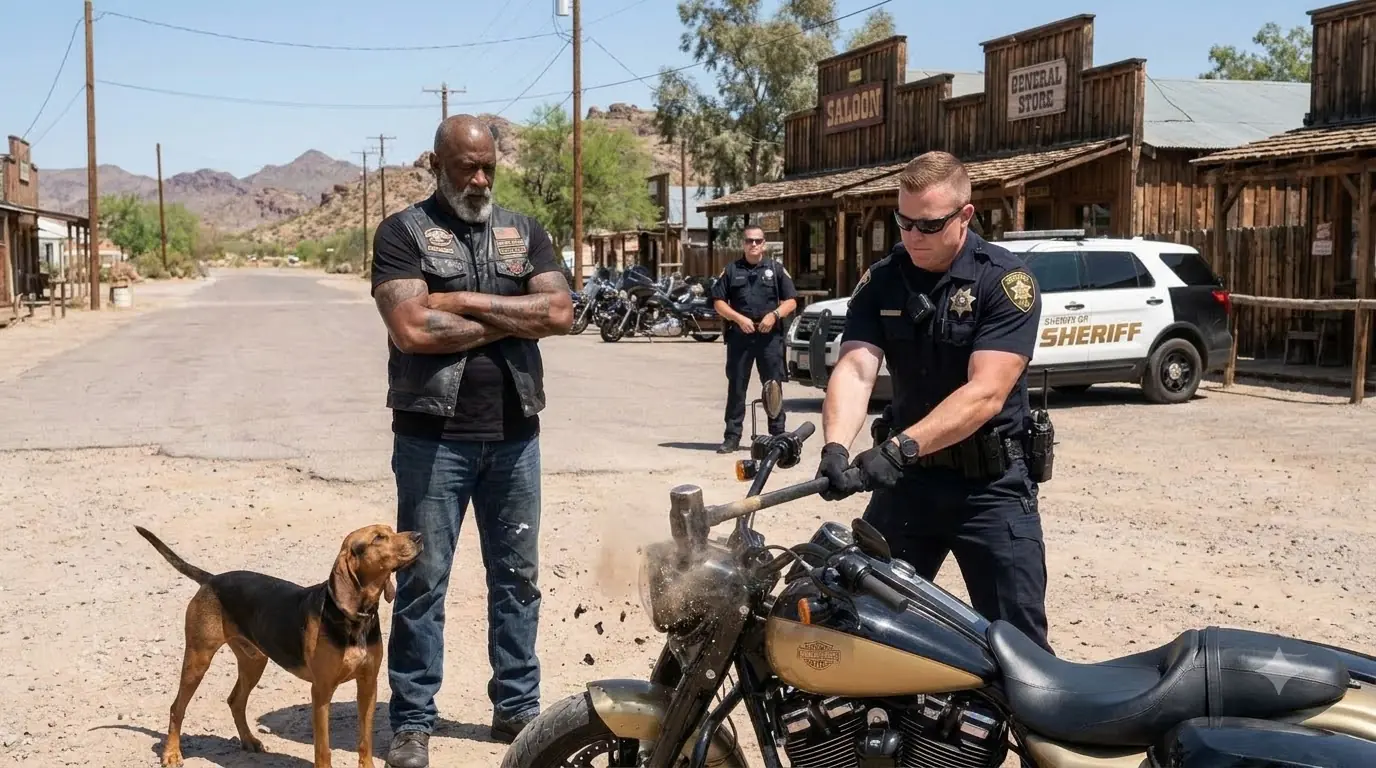
The first blow hit the gas tank like a church bell falling from the sky.
Metal caved inward. Black paint split open across a stripe of hand-laid gold. The second blow shattered the headlamp and sprayed glass across the gravel, bright pieces skittering under the impound fence like broken ice.
Deputy Travis Rourke laughed as he lifted the sledgehammer again.
The old Black man standing outside the fence did not move.
His name was Vernon Cross, sixty-four years old, gray beard trimmed close, shoulders still broad beneath a faded leather vest. One hand rested on the head of his old hound, Rufus, who was barking from the sidecar with the sharp, frightened sound of an animal who knew something precious was being hurt.
Vernon did not shout.
He did not lunge at the fence.
He did not beg the deputy to stop.
He simply watched.
That was what made the scene strange to the men enjoying it. A younger man might have swung on the first deputy close enough to reach. A proud man might have cursed until they found a reason to put him on the ground. A frightened man might have pleaded for mercy from men who had none to spend.
Vernon gave them none of that.
Deputy Rourke brought the hammer down again.
The custom front fender folded.
The left mirror snapped off and bounced across the gravel.
Deputy Nolan Pike leaned against the chain-link fence, arms crossed, grinning as if the whole thing had been arranged for his entertainment.
“You still feeling fancy now, old man?” Rourke called.
Vernon looked at him.
There were many things he could have said.
He could have given his full name. He could have mentioned the office he once held, the oath he had sworn, the federal cases that still made crooked men sleep badly. He could have said that the deputy with the hammer had just made the most expensive mistake of his life.
Instead, Vernon said nothing.
Because Vernon Cross had spent forty-two years learning that men like Travis Rourke always revealed more when they believed consequence was not in the room.
To anyone passing through the little desert town of Arroyo Bend, Vernon looked like just another old biker.
A Black man in sun-faded jeans, cracked road boots, and a leather vest that had seen more states than most people saw counties. His patches were worn nearly soft. His gloves were dusty. The scarf around his neck had been washed so many times it had faded from red to rust.
But the motorcycle was impossible to ignore.
It was a custom-built touring machine worth close to eight hundred thousand dollars.
Not gaudy.
Not childish.
Beautiful.
Deep black frame, gold leaf brushed into the fuel tank by hand, polished engine, leather saddle, custom sidecar fitted for Rufus, every piece shaped by a master builder in Nevada who still believed motorcycles should look like they had souls.
Vernon had waited most of his adult life to own it.
He had not bought it to impress strangers at gas stations.
He bought it because after decades of carrying other people’s secrets, after burying his wife, after watching friends retire into silence or graves, he wanted one thing that belonged to him, Rufus, and the open road.
That morning was supposed to be a birthday ride.
The Iron Shepherds Motorcycle Club was waiting at a roadside diner north of town with bad coffee, blueberry pie, and the kind of loud jokes old men use when they want to hide affection. Rufus, fifteen years old and gray around the muzzle, rode in the sidecar with a padded harness, goggles, and a small collar camera Vernon had installed years earlier just because it made his late wife laugh.
Rufus loved the road.
Some dogs chase cars.
Rufus preferred to be escorted by one.
The trouble began outside a gas station on the edge of Arroyo Bend, where two sheriff’s deputies sat in the shade like men hoping the day would bring someone they could bother.
Deputy Travis Rourke noticed Vernon first.
Rourke was thirty-two, white, thick-necked, and broad through the chest, with mirrored sunglasses and a badge polished brighter than his manners. He carried himself like a man who had confused a uniform with a personality. People in Arroyo Bend knew him by the way they lowered their voices when his cruiser rolled by.
His partner, Nolan Pike, was quieter.
That did not make him better.
Pike rarely started anything. He stood nearby, nodded at the right time, wrote what needed writing, and later swore he had only followed procedure. In a corrupt county, that kind of man was not a bystander. He was the padding around the fist.
Rourke looked at the motorcycle, then at Vernon, then at Rufus sitting proud in the sidecar.
A slow smile spread across his face.
Vernon knew that smile.
He had seen versions of it in sheriff’s offices, courthouse basements, interrogation rooms, border checkpoints, internal affairs files, and town councils where people spoke gently while hiding ugly habits. It was the smile of a man who believed prejudice became law the moment he said it with confidence.
Rourke walked over with his thumbs hooked in his belt.
“That your bike?”
Vernon shut off the engine.
“It is.”
Rourke circled the motorcycle slowly, dragging one boot through the gravel.
“Expensive machine.”
Vernon said nothing.
Rourke tilted his sunglasses down.
“Real expensive for somebody passing through.”
“Everything is registered,” Vernon said. “Papers are in the saddlebag.”
Pike stepped closer, his hand drifting near his holster.
“Don’t reach.”
Vernon turned both palms outward.
“I was not reaching.”
“What about the dog? That thing secured? Looks like a safety problem to me.”
Rufus wagged his tail once, then tried to sniff the deputy’s sleeve.
Rourke jerked back.
“Keep that mutt away from me.”
For half a second, Vernon’s eyes changed.
Only half a second.
Then his face settled again.
“His harness is bolted to the frame,” Vernon said. “He rides safer than most people drive.”
Pike chuckled.
Rourke did not.
The deputy tapped the gold stripe on the fuel tank with two fingers.
“Custom parts. High-value build. Could be stolen. Could be drug money. Could be some rich man’s bike with your hands on it.”
Vernon looked at his badge number.
“Or it could be mine.”
Rourke’s smile disappeared.
“You people always think paperwork changes what common sense already knows.”
The words hung there.
A woman pumping gas glanced over, then looked away quickly.
The cashier inside the station suddenly found something important beneath the counter.
Pike watched Vernon’s face, waiting for anger.
Vernon gave him none.
That disappointed both deputies.
“Step off the bike,” Rourke ordered.
“On what charge?”
“Suspicion of transporting stolen property.”
“What is your basis?”
Rourke stepped closer.
“My eyes.”
Vernon looked at him.
“And what do your eyes see, Deputy?”
Rourke leaned in slightly.
“A man who doesn’t fit the machine.”
There it was.
Plain enough.
The kind of sentence men later called misunderstood when the recording got played.
Vernon stepped off the motorcycle slowly and unclipped Rufus’s harness. The old hound climbed down stiffly, his claws clicking against the sidecar step before his paws hit the ground. Vernon kept one hand on the dog’s collar while Pike moved closer.
“Where are you taking it?” Vernon asked.
“County impound,” Pike said. “Across the street. Convenient, huh?”
Rourke swung one leg over the motorcycle without permission.
He revved the engine too hard, jerked forward, and sent gravel spitting from the rear tire. The bike lurched across the road and into the fenced county lot like a prize horse handled by a drunk fool.
Across the street, men began stepping out of the diner.
The Iron Shepherds.
Twelve bikers gathered near the curb: mechanics, retired truckers, welders, one former judge, two old soldiers, and men with enough miles and scars to recognize trouble before it introduced itself. Vernon’s road name was Compass, because he had a way of getting people out of situations they were too angry to survive.
To them, he was just Vern.
A calm man.
A careful man.
A man who could settle a fight with one sentence if the room still had enough sense left to hear him.
Club president Hector Reyes took two steps toward the impound lot.
Vernon lifted one hand.
Stop.
No words.
Every man in the Iron Shepherds froze.
Because when Compass told you to hold, you held.
Inside the impound yard, Rourke parked the bike near a rusted county work truck. Then he opened the truck bed and pulled out a sledgehammer.
Pike laughed under his breath.
Vernon stepped toward the fence.
Pike moved in front of him.
“Stay back,” he said. “County property now.”
Vernon looked at the bike.
Then at Rufus.
The dog was barking harder, straining against the leash, his old body trembling with confusion.
Vernon crouched beside him as if calming him.
With one hand, he scratched behind Rufus’s ear.
With the other, hidden from the deputies’ view, he tapped the small camera clipped under the dog’s collar.
A tiny red light came on.
Rourke raised the hammer.
The first blow crushed the tank.
Vernon felt it in his ribs.
The second blow destroyed the headlamp.
The third cracked the gauge cluster.
Rourke swung with pleasure. That was what mattered. Not seizure. Not evidence preservation. Not policy. Pleasure. His shoulders shook when he laughed, and every few seconds he looked back at Vernon to see if the old man had finally given him the reaction he wanted.
Pike supplied commentary.
“Careful, Travis. That thing might have cost more than his whole neighborhood.”
Rourke laughed.
“Not anymore.”
He swung again.
“You want a rich man’s toy, old timer? Next time steal something less obvious.”
Vernon memorized everything.
Badge numbers.
Positions.
Words.
Tone.
Witnesses.
The angle of the hammer.
The way Pike stood between him and his property.
The way Rourke destroyed the bike not because he had legal authority, but because he believed no one in that town would stop him.
When it was over, the motorcycle lay twisted on the gravel.
Gold leaf peeled open.
Chrome cracked.
Sidecar frame bent.
Oil spreading dark beneath the engine.
Rourke dropped the hammer and wiped sweat from his forehead.
“File a complaint,” he said. “See where it gets you.”
Vernon looked at him.
Then he looked at the ruined motorcycle.
He said nothing.
He clipped Rufus’s leash shorter and turned away.
The Iron Shepherds waited outside the fence, anger burning off them so hot it seemed to bend the air. Hector’s hands were tight fists. The youngest rider, Eli Parker, looked ready to climb the fence and make the county famous for a different reason.
Hector stepped toward Vernon.
“Compass,” he said, voice shaking. “Give the word.”
Vernon shook his head.
“No.”
“They destroyed your bike.”
“I saw.”
“You can’t let that stand.”
Vernon looked back at the deputies.
“It won’t.”
Then he began walking.
Two miles under the Arizona sun.
An old Black biker and an old hound moving along the shoulder while cars passed and slowed and kept going. No one stopped. People rarely do when stopping might ask something of them.
Vernon walked with the same measured pace he had used in federal courtrooms, prison interviews, public corruption hearings, and rooms where powerful men learned too late that calm was not weakness.
By the time he reached his small house outside town, Rufus was tired.
Vernon filled the dog’s water bowl first.
Then he made coffee.
He sat at the kitchen table with his boots dusty, vest still on, and hands folded around the mug while late afternoon light slid across the floor. The house was plain, quiet, and clean. On the windowsill stood a photograph of his wife, Marlene, smiling beside the same motorcycle the day it was delivered.
He looked at the picture.
“I know,” he said softly. “I kept my temper.”
Rufus groaned and settled at his feet.
Vernon finished the coffee.
Rinsed the cup.
Set it in the rack.
Then he unclipped the camera from Rufus’s collar and placed it on the table.
Before he pressed play, the old landline rang.
Only a handful of people had that number.
He answered.
“Cross.”
It was Hector.
“You need to hear me out.”
“I am listening.”
“This wasn’t just you,” Hector said. “Rourke and Pike have been doing this for years. Black riders, Mexican riders, Native riders, rough-looking white boys with no family money, anyone they think won’t fight back. They stop them, claim registration problems, impound the bikes, and then half those bikes disappear.”
Vernon went still.
Hector kept talking.
“One guy from Tucson lost the Harley his brother left him. Another got arrested when he asked for a receipt. A Diné mechanic from up north had his bike sold at auction before his court date. Everybody says don’t complain because Sheriff Rourke is Travis’s uncle, and the complaint forms go straight into the trash.”
Vernon looked at the camera on the table.
His face changed.
The motorcycle had hurt.
This was different.
This was not one racist deputy with a hammer.
This was a pattern.
Patterns were what Vernon Cross had spent his life dismantling.
For forty-two years, Vernon had served inside the federal system. He had started as a young civil rights attorney, became a prosecutor, then moved into federal investigations. Later, he led the National Public Integrity Bureau, the office that took on corrupt sheriffs, bought judges, violent police units, prison contractors, county bosses, and people who believed a local badge made them untouchable.
He had briefed presidents.
He had testified before Congress.
He had sent men to prison who once thought they owned whole towns.
And now, in retirement, wearing a biker vest with desert dust on his boots, he had found a small county operation rotten enough to smell through the fence.
“Hector,” Vernon said, “get every rider who lost property in Red Mesa County. Names, dates, deputy names, paperwork, medical records, auction notices, repair bills, anything they kept.”
“They’re scared.”
“They should be.”
“Of the deputies?”
“No,” Vernon said. “Of believing the wrong system will protect them.”
There was a pause.
Then Hector asked the question he had never asked directly in thirty years.
“Vern, what exactly did you do before you retired?”
Vernon looked at Marlene’s photograph.
“Enough.”
He hung up and picked up his cell phone.
The contact was saved under L.B.
Lila Bishop answered on the third ring.
“This had better be an emergency. I’m in the middle of a birthday party with twelve children and a magician who may be wanted in two states.”
“Lila,” Vernon said. “It’s Vernon Cross.”
The line went quiet.
Then her voice changed completely.
“Director Cross?”
“Retired.”
“Yes, sir. What do you need?”
Lila Bishop was Special Agent in Charge of the Phoenix Federal Field Office. Vernon had recruited her years earlier, protected her when older men called her difficult, and promoted her because difficult was often what honest work looked like to dishonest people.
He told her everything.
Not emotionally.
Not dramatically.
The stop.
The remarks.
The false suspicion.
The impound.
The sledgehammer.
The pattern Hector had described.
The sheriff’s family connection.
Lila did not interrupt.
When he finished, she said, “Sir, that is deprivation of rights under color of law, extortion, conspiracy, destruction of property, falsification if records were created afterward, and possibly interstate trafficking if those bikes were moved across county or state lines.”
“That is my reading.”
“You have proof of today?”
Vernon looked at the collar camera.
“Four minutes and thirty-eight seconds. Video and audio. Faces, badge numbers, the hammer, the remarks, the destruction, and Deputy Rourke telling me to file a complaint and see where it gets me.”
Lila exhaled.
“That is not proof. That is Christmas morning.”
“There are other victims.”
“We will find them.”
“They do not trust local law enforcement.”
“They will not be speaking to local law enforcement.”
For the first time that day, relief moved through Vernon’s body.
It did not soften him.
It simply gave his patience somewhere to go.
“Make the calls,” he said.
That night, while Travis Rourke probably sat at a bar laughing about the old Black biker he had humbled, federal agents began pulling Red Mesa County impound records.
They found the first irregularity in twenty minutes.
Then another.
Then another.
Motorcycles seized disproportionately from Black, Latino, and Native riders.
Missing release forms.
Auction documents with incomplete dates.
Buyers connected to Sheriff Dale Rourke’s relatives.
Complaints marked unfounded without interviews.
Body camera footage listed as unavailable.
Repeat deputies.
Repeat excuses.
Repeat victims.
By midnight, Lila had five names.
By morning, she had nine.
By noon, she had fourteen.
One man, Rafael Ortega, had been stopped after leaving his mother’s funeral. His motorcycle was seized for “suspected stolen components,” though the VIN matched his title. When he returned with paperwork, the bike had already been “transferred pending auction review.”
A Diné mechanic named Joseph Manygoats had his custom chopper taken after Pike claimed the engine stamp looked altered. Joseph had built the engine himself. He brought receipts, photographs, and shop records. The county told him the case was closed.
A Black rider named Darius Bell had been shoved against a cruiser for asking why his registration was being ignored.
Different roads.
Same deputies.
Same language.
Same impound yard.
Same disappearing machines.
Vernon watched Rufus’s camera footage once on his laptop.
Only once.
He forced himself to see the tank cave, the headlight explode, the hammer rising and falling, Rourke laughing, Pike blocking the fence, Rufus barking in panic. He did not watch it to make himself angry. Anger had already come, done its job, and left.
He watched it to remember why not reacting had mattered.
Then he closed the laptop.
Because Vernon Cross knew a truth younger men often had to learn the hard way.
You do not move when your hands are shaking.
You move when the record is ready.
Three days passed.
During those three days, Rourke and Pike got arrogant.
That was predictable. Men like them mistake silence for surrender because most people they harm are too tired, poor, frightened, or isolated to push past the first locked door. They had watched victims shout, cry, threaten, plead, or disappear.
Vernon had done none of those things.
So they assumed he had folded.
On the fourth morning, Vernon drove into town in his old black pickup, Rufus sitting in the passenger seat like a retired judge. Behind him came the Iron Shepherds in a slow line, twelve motorcycles rolling down Main Street with no revving, no shouting, no theater.
Just presence.
Behind the motorcycles came four black SUVs.
Government plates.
Tinted windows.
Clean tires.
Deputy Nolan Pike saw them first from the sheriff’s office window.
He said something to Travis Rourke.
Rourke looked out.
Vernon watched confidence leave the deputy’s face one layer at a time.
Irritation.
Confusion.
Concern.
Then the beginning of fear.
Vernon parked in front of the sheriff’s office and stepped out.
Rufus climbed down beside him, leash loose, collar camera still clipped below his neck like a small private joke. The Iron Shepherds lined the street. The SUVs stopped behind them, and eight federal agents stepped out wearing navy jackets.
Lila Bishop led them.
Badge at her belt.
Warrant folder in her hand.
Vernon entered the sheriff’s office first.
The lobby smelled of burned coffee, old paper, floor cleaner, and institutional arrogance. A faded county flag stood in the corner. A bulletin board listed community safety notices no one had updated since spring.
Travis Rourke stood behind the counter, trying to rebuild his swagger before anyone noticed it had collapsed.
“Well, well,” he said. “You finally come to file that complaint, old timer?”
Vernon did not answer.
He looked past Rourke toward the rear office, where Sheriff Dale Rourke had stepped out in suspenders, a white shirt, and a face already turning red.
“What is this?” the sheriff demanded.
Lila stepped beside Vernon.
“Sheriff Dale Rourke?”
“That’s me.”
“Special Agent in Charge Lila Bishop, Federal Field Office, Phoenix. We have federal warrants for Deputy Travis Rourke and Deputy Nolan Pike.”
The room froze.
Lila opened the folder.
“Charges include deprivation of rights under color of law, conspiracy, extortion, falsification of official records, destruction of property, and participation in a stolen vehicle seizure scheme.”
Pike sat down before anyone told him to.
Travis stared at Lila.
The sheriff stepped forward.
“Now hold on. Nobody is arresting my deputies in my office.”
Lila removed a second sheet.
“We also have a warrant for you, Sheriff Rourke. Obstruction, conspiracy, evidence suppression, and falsification of complaint records. At least two years of buried complaints carry your signature.”
The sheriff’s mouth opened.
Nothing useful came out.
He looked at Vernon.
“This is because of that biker?”
Vernon finally spoke.
“Yes.”
The sheriff’s eyes narrowed.
“You think you can bring a bunch of leather boys and federal suits into my county and tell me how to run it?”
Vernon reached slowly into the inside pocket of his vest.
Every agent watched his hands.
So did every deputy.
He pulled out a laminated credential and placed it on the counter.
Then he slid it forward.
The sheriff picked it up.
His expression changed before he finished reading.
The card showed a younger Vernon Cross in a dark suit, clean-shaven, standing beside an American flag with the steady, unsmiling face of a man used to hard rooms.
Under his name were the words:
DIRECTOR
NATIONAL PUBLIC INTEGRITY BUREAU
RETIRED
The sheriff read it once.
Then again.
His fingers trembled.
“You’re Vernon Cross.”
“I am.”
“You ran federal public integrity.”
“For eleven years.”
Travis Rourke made a small sound behind the counter.
Not a word.
Something less than a word.
The sound of a man realizing the old Black biker he had tried to humiliate was not powerless, not alone, and not afraid.
Vernon turned toward him.
“You looked at me and saw a man you thought you could break for amusement.”
Rourke’s mouth opened.
Nothing came out.
“You saw gray hair, leather, a dog, and skin you did not respect. You decided the motorcycle had to be stolen because your prejudice could not imagine me owning something valuable.”
Vernon’s voice stayed low.
That made every word heavier.
“Then you used a badge and a hammer to show me what kind of man you were.”
Rourke swallowed.
Vernon looked toward Rufus.
“That dog you mocked filmed everything. Every swing. Every word. Including ‘file a complaint and see where it gets you.’”
A thin smile touched Vernon’s face.
“It got here.”
Lila nodded.
The agents moved.
They cuffed Travis Rourke first.
He did not resist.
He kept staring at the retired credential on the counter as if refusing to believe in it might somehow put the morning back together.
They cuffed Nolan Pike next.
He began talking immediately.
Saying he had only followed Travis.
Saying he had never wanted to hurt anyone.
Saying it was just how things were done in Red Mesa County.
Vernon looked at him and saw a familiar species: a coward who discovered moral discomfort only after the room changed sides.
Then they cuffed Sheriff Dale Rourke.
The whole department watched.
Some deputies stared at the floor.
Some looked afraid.
A few looked relieved.
That interested Vernon.
Corruption survives because bad men act and weak men learn to wait for somebody braver to arrive.
Outside, the Iron Shepherds stood in silence as the three men were walked out.
No one cheered at first.
The sight was too heavy.
Deputy Travis Rourke, who had treated road riders like targets for years, was placed into a federal SUV in handcuffs. Nolan Pike cried openly. Sheriff Dale Rourke looked stunned by the simple fact that consequence had found the front door of his own office.
Only after the doors closed did Hector Reyes lift one fist.
The Iron Shepherds fired their engines together.
Twelve motorcycles roared to life, the sound rolling through Main Street, rattling windows and pulling people out of stores. It was not a threat. It was testimony. For years, riders had crossed Red Mesa County carefully, knowing the wrong deputy could turn a road trip into a theft.
Now the road had answered.
Hector grabbed Vernon in a hug so hard Rufus barked at both of them.
“Compass,” Hector said, laughing with tears in his eyes, “you mean to tell me all these years I’ve been riding next to the man who took down half the corrupt sheriffs in America?”
Vernon shrugged.
“You never asked.”
“We asked what you did.”
“I said government.”
“That could mean the post office.”
“It could.”
Hector stared at him.
Then he laughed so hard he had to lean against a motorcycle.
That evening, the Iron Shepherds gathered at their fire pit outside town.
Vernon did not ride there.
His motorcycle was still ruined behind an evidence fence, tagged, photographed, and measured. So he came in the pickup with Rufus beside him, and nobody joked about it.
They built a fire beneath the Arizona sky, passed coffee and beer around, and told the story five different ways before the stars fully came out.
Some versions grew too large.
Hector had Vernon walking in with thirty agents instead of eight.
Another rider swore Rufus growled at Rourke before the arrest, though Rufus had mostly been sniffing a sandwich wrapper near the curb.
Vernon let them talk.
Then Eli Parker, the youngest rider in the club, asked what everyone else had been thinking.
“Compass,” Eli said, “does it hurt bad? The bike, I mean.”
The fire cracked.
The men went quiet.
Vernon looked down at Rufus, whose head rested on his boot.
“For about ten minutes,” Vernon said.
He looked into the flames.
“I wanted to put Travis Rourke through that fence.”
Nobody laughed.
They believed him.
“But anger is easy,” Vernon continued. “That hammer was easy. That is why he reached for it. The harder thing is standing still long enough for the truth to survive what happened.”
Eli listened carefully.
Vernon looked at him.
“That motorcycle was metal. Beautiful metal, but metal. What mattered was not letting him turn me into the man he needed for his report.”
He paused.
“He wanted rage. He wanted a fight. He wanted a clean charge he could write before dinner.”
Vernon touched Rufus’s collar.
“I gave him evidence.”
Four months later, the case broke wider than anyone expected.
Travis Rourke was convicted on federal civil rights and extortion charges and sentenced to ten years. Nolan Pike cooperated and received four. Sheriff Dale Rourke received seven years for obstruction, conspiracy, and falsifying records.
The county settled with fourteen riders.
Then more came forward.
The auction buyer, Sheriff Rourke’s cousin, turned over records that led investigators into two neighboring counties. Red Mesa had not been the whole operation. It had been one branch of a regional theft scheme targeting minority riders, poor riders, independent clubs, and anyone deputies believed could be isolated.
The sheriff’s department was placed under federal oversight.
Several deputies resigned.
Two were later charged.
A temporary sheriff named Teresa Valdez took over and began her first staff meeting by placing a printed copy of the Fourth Amendment on the table.
“Anyone here who finds this inconvenient,” she said, “should resign before lunch.”
Three did.
The story reached national news.
Retired Federal Director Exposes Motorcycle Seizure Ring.
Old Biker’s Dog Camera Brings Down Corrupt Sheriff.
Black Rider’s Destroyed Bike Opens Civil Rights Investigation.
Vernon disliked most of the headlines.
They made it sound like a trick.
As if the point was that Rourke had accidentally picked someone important.
That was not the point.
The point was that no one should have needed to be important. Rafael Ortega should not have had to lose his brother’s Harley. Joseph Manygoats should not have had to watch his own engine become evidence against him. Darius Bell should not have had to prove his dignity with paperwork while a deputy treated suspicion like ownership.
The point was not that Vernon Cross had once held power.
The point was that Travis Rourke had abused people who did not.
Still, the headlines did one useful thing.
They reached Nevada.
The old craftsman who built Vernon’s motorcycle called him personally.
His name was Amos Vale, seventy-five, machinist, retired racer, and a man whose voice sounded as if it had been dragged across gravel and then polished smooth.
“Mr. Cross,” Amos said, “I saw what they did to my machine.”
Vernon sat at his kitchen table, Rufus asleep beneath it.
“Your machine?”
“I built it. You bought permission to ride it.”
For the first time in weeks, Vernon laughed.
Amos continued.
“I’m building another.”
“No.”
“Yes.”
“Insurance and restitution will cover replacement costs.”
“I didn’t ask about insurance.”
Vernon sighed.
“I don’t take gifts easily.”
“Good,” Amos said. “At your age, learning something new will keep you young.”
Vernon looked toward Marlene’s photograph.
Amos’s voice softened.
“You spent your life making sure men like that learned the law still had teeth. You took a hammer you did not deserve and turned it into justice for people with no door to knock on. Let another old man put something decent back on the road.”
Vernon had no answer.
The new motorcycle arrived five months later.
A truck pulled into Vernon’s driveway just after sunrise. Hector and the Iron Shepherds were already there because none of them had successfully pretended they were waiting for Vernon to invite them. Amos came with the delivery, leaning on a cane, eyes bright beneath a faded cap.
When the ramp lowered, Vernon went still.
The motorcycle rolled down slowly.
It looked like the first one, but deeper.
Black frame.
Gold leaf worked into the tank like desert sunlight under glass.
A sidecar built lower and wider for Rufus, padded in brown leather.
Chrome polished so clean the morning sky seemed caught inside it.
Beneath the seat, where only Vernon would know to look, Amos had signed the frame.
Not all justice comes from courts.
Vernon ran his hand along the tank.
For a moment, he could not speak.
The Iron Shepherds were wise enough to stay quiet.
Rufus climbed into the sidecar the moment he was allowed, turned twice, and sat upright like the whole thing had been ordered in his honor.
Vernon clipped the harness.
Then he attached the same collar camera.
Amos noticed.
“You still using that?”
Vernon smiled faintly.
“Never know when an old dog may need to testify.”
The whole yard laughed.
Vernon swung one leg over the motorcycle.
The engine fired deep and clean, rolling across the yard and out into the desert. He looked once at Marlene’s photograph in the kitchen window, then at Rufus, then toward the highway.
Hector pulled up beside him.
“You ready, Compass?”
Vernon looked at the road.
“I was ready before the hammer.”
They rode out together.
A line of motorcycles beneath a wide Arizona sky.
Old men.
Young men.
Black, white, Mexican, Native.
Veterans, mechanics, fathers, widowers, sons, workers, and wanderers.
Men who had been followed in gas stations, dismissed in diners, judged by leather, stopped for existing too proudly on machines some deputy thought they should not own.
They rode through Red Mesa County not as a warning.
As proof.
The road belonged to them too.
Vernon Cross never raised his voice through the whole thing.
Not when Rourke insulted him.
Not when the hammer came down.
Not when the sheriff realized whose credential sat on the counter.
He did not need to.
The loudest sound in the story was not the sledgehammer.
It was not the motorcycles.
It was not even the engines roaring outside the sheriff’s office.
The loudest thing was an old Black man sitting at a kitchen table, drinking coffee slowly, letting the evidence settle, and deciding exactly when to pick up the phone.
Men like Travis Rourke always think power means forcing someone to react.
They never understand real power.
Patience.
Memory.
Evidence.
A dog collar camera blinking red while arrogance performs for itself.
And a man who has been underestimated one time too many.
Years later, people still told the story like instant justice.
A racist deputy smashed an old Black biker’s motorcycle.
Then he learned the biker used to run federal public integrity.
Then the dog’s camera brought down the sheriff.
That version made people lean forward.
It had the twist they liked.
But Vernon always told the longer version when young riders asked.
He told them about Rafael, Joseph, Darius, and the riders whose names never made the headline. He told them about Nolan Pike, because quiet men who help bad men are not innocent just because they hold the smaller hammer. He told them about the deputies who looked relieved during the arrests, because waiting for rescue while others suffer is still a choice.
And he told them about the hardest part.
The moment between the first hammer swing and the first phone call.
That was where most people lose the case.
Not because they are weak.
Because they are human.
Rage asks to be used immediately. Pain wants a witness. Humiliation wants to throw itself back across the fence. But if the person hurting you is counting on your reaction, restraint becomes more than dignity.
It becomes strategy.
Vernon kept one broken piece of the old motorcycle.
A strip of black metal from the tank with gold leaf still clinging to one edge.
Amos had cleaned it, mounted it on a small wooden block, and sent it back with a note.
For the record.
Vernon placed it on a shelf beside Marlene’s photograph.
Not as a shrine.
As a reminder.
Beautiful things can be damaged and still become evidence.
One afternoon, a teenage boy came to the house with his father.
The boy was Black, sixteen, nervous, and obsessed with motorcycles in the way only sixteen-year-old boys can be obsessed. His father had brought him because he wanted the boy to hear the story from Vernon, not from a clipped video online.
The boy looked at the new motorcycle in the driveway.
“Didn’t you want to fight him?” he asked.
Vernon leaned against the porch rail.
“Yes.”
The boy seemed surprised by the honesty.
“Why didn’t you?”
Vernon looked toward Rufus, now sleeping old and heavy in the shade.
“Because that was the only ending he knew how to win.”
The boy frowned.
Vernon continued.
“Sometimes they build a trap out of your own anger. You do not owe them the satisfaction of stepping into it.”
The father nodded slowly.
The boy looked at the motorcycle again.
“So what do you do?”
Vernon picked up the small broken piece of the old tank from the porch table.
“You remember everything. You find witnesses. You preserve proof. You call people who still know the difference between law and power.”
He handed the boy the metal.
“And when the time comes, you make the truth louder than the hammer.”
The boy held the broken piece carefully.
Like it mattered.
Because it did.
Vernon rode until his knees got too stiff to swing over the seat without help.
Even then, Rufus stayed with him for as long as the old hound had breath enough to enjoy the wind. When Rufus finally passed in his sleep one winter morning, Vernon buried him beneath the mesquite tree behind the house, collar and camera placed in a small box nearby.
The Iron Shepherds came.
Every one of them.
No engines revved that day.
They stood quietly while Vernon placed one hand on the dirt and said, “Good witness, old friend.”
Years later, the new riders in Red Mesa County still heard about Rufus before they heard about Vernon.
That suited Vernon fine.
The dog had done his part.
So had the road.
So had the ruined motorcycle.
So had every rider who finally came forward once one old man proved the complaint could go farther than the sheriff’s trash can.
And if anyone asked Vernon what the whole thing meant, he would usually give the short answer first.
“Do not mistake quiet for beaten.”
Then, if they stayed long enough, he gave the real one.
“The law is only as strong as the people willing to record what power does when it thinks nobody important is watching.”
He believed that until the end.
And somewhere on the highway outside Arroyo Bend, when the sun hits the desert just right, people still talk about the old Black biker with the hound in the sidecar.
The one the deputy thought he could humiliate.
The one who watched the hammer fall without moving.
The one who went home, poured coffee, checked the footage, and made a call that shook a county loose from its own corruption.
Because the quiet ones are not always powerless.
Sometimes they are counting.
Sometimes they are remembering.
And sometimes, by the time they finally speak, the whole system is already on its way.