“Leave the keys and start walking, old man.”
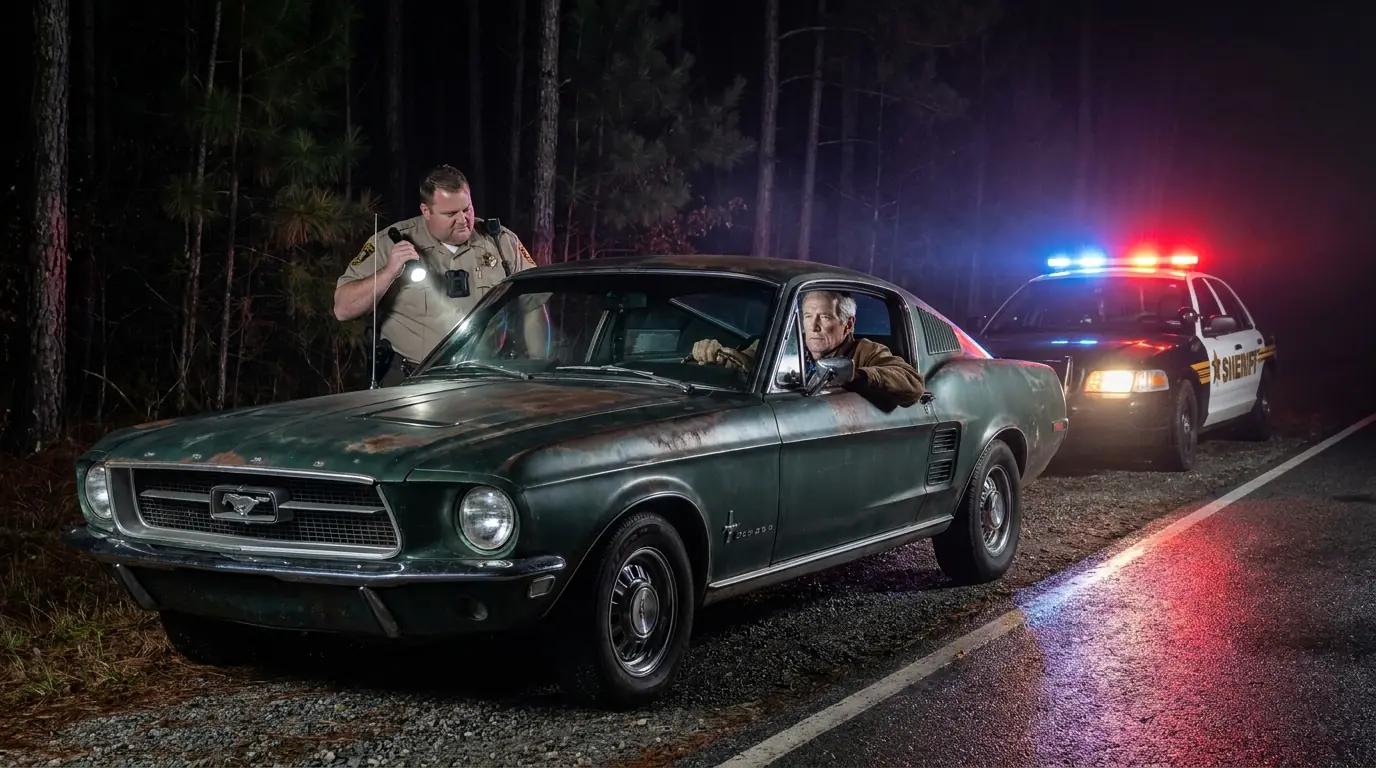
Deputy Vance said it like he was offering a routine instruction.
Like it belonged in a policy manual.
Like elderly men in weathered Mustangs regularly got ordered out onto county roads at two in the morning to abandon their cars and disappear into the cold.
I kept both hands on the wheel.
Ten and two.
That part mattered.
At my age, you learn that men who wear authority badly are always looking for one sudden movement to turn into a story.
The inside of my 1968 Ford Mustang smelled faintly of old leather, engine oil, and cedar from the lining in the compartment beneath the passenger seat. November cold pressed against the windows. Behind me, the sheriff’s cruiser flooded the shoulder with red and blue light, throwing color across the pines and making the road look like it was underwater.
Deputy Vance leaned through my open driver’s window with a flashlight in one hand and half a smile on his thick face. He was a heavy man, muscular through the neck and chest, with short dark hair and the sort of expression some officers wear when they mistake intimidation for command presence. His body camera sat clipped to his uniform, blinking, though whether it was truly recording was anybody’s guess.
On the passenger seat beside me rested a steel Hamilton field watch with a badly scratched case and an old brown leather strap. It lay on top of my folded jacket exactly where I had placed it.
Vance noticed it.
Of course he did.
That was the point.
“Put my watch back,” I said.
He hadn’t taken it yet, but we both knew he was about to.
The flashlight beam shifted from my face to the watch and back again. His grin sharpened.
“Consider it your fee for staying out of jail.”
Then he reached through my window, grabbed the watch off the seat, and slipped it into his pocket like he was picking up change from a diner counter.
I looked down briefly beneath the dashboard.
The small green indicator light was still steady.
Good.
That meant the transmitter was live.
Deputy Vance turned away from the Mustang and started back toward his cruiser with that same satisfied swagger I had seen in too many men over too many years—the walk of someone who believed there would be no witness he could not out-rank, no complaint he could not bury, no old man tired enough not to bother.
I moved one finger toward the transmit switch mounted near the steering column.
Then I said quietly, “Badge seven-four-two. Confirmed.”
Deputy Vance stopped walking.
For half a second, he didn’t turn around.
He just froze.
Then his cruiser scanner crackled behind him.
A woman’s voice came through loud and unmistakable.
“Attention all units—Deputy Vance, badge seven-four-two, remain exactly where you are. Do not return to your vehicle. State investigators are en route to your location now.”
The smile vanished from his face.
Forty-three minutes earlier, I had left a truck stop off Highway 61 with a paper cup of black coffee, a half tank of gas, and a county map folded beside me even though I knew the route by memory.
I’m Walter Hayes.
Seventy-one years old.
Retired twice, though neither retirement ever held the way people hoped it would.
The first retirement came after thirty-four years in public safety communications and state investigations. The second came after consulting for the attorney general’s office on rural sheriff department audits. My daughter, Claire, said the problem with men like me was that we never really retired—we just stopped wearing ties and started calling the next obsession “helping out.”
Maybe she was right.
The road I was driving that night cut through Ashcomb County, a stretch of dark two-lane blacktop bordered by pines and shallow ditches where fog liked to gather low in the colder months. It was quiet country. Sparse houses. Long gaps between lights. Exactly the kind of place where bad behavior can survive if it knows how to put on a badge.
For the last five months, the State Office of Professional Standards had been collecting complaints about traffic stops in this county.
Not dramatic complaints at first.
Uncomfortable ones.
A contractor from Missouri who said a deputy took six hundred dollars from his glove box and told him it was “temporary evidence,” then never logged it.
A divorced schoolteacher driving home from a late shift who claimed an officer threatened to tow her car unless she paid a “roadside release fee” in cash.
An older widower transporting his wife’s jewelry to his daughter after the funeral who reported that a deputy “confiscated” a watch and a ring but listed only the ring on the receipt.
One truck driver said the deputy made him leave his pickup on the shoulder and walk two miles to a gas station because he was “too tired to drive,” then somehow the expensive tool set in the cab never showed up when the truck was recovered.
Individually, every complaint looked messy.
Unprovable.
Easy to discredit.
Especially in a county where the sheriff publicly dismissed criticism as anti-law-enforcement theater and where body-camera upload failures had somehow become remarkably common whenever certain names showed up in a report.
But patterns tell stories people don’t want told.
And once the pattern became clear, one name kept surfacing.
Deputy Curtis Vance.
Badge 742.
Forty-four years old. Twelve years in uniform. Three years in Ashcomb County after resigning from a department two counties over. No major discipline on file. Too many civilian complaints dismissed as misunderstandings. Too many supervisors willing to accept the same phrases in his reports.
Subject became uncooperative.
Property retained for evidentiary review.
Motorist elected alternate transportation.
I’d seen language like that before.
Clean on paper.
Rotten underneath.
The state needed proof that would survive inside a courtroom, not just around a conference table. Real proof. Clear audio. Clear conduct. No argument about who said what. No opportunity for a supervisor to claim the complainant misunderstood procedure.
That was where I came in.
I hadn’t carried a badge in years, but I still knew radio systems better than most people half my age. I had spent decades building them, testing them, fixing them, and teaching departments how to use them correctly. When investigators needed a civilian volunteer who could stay calm, follow protocol, and understand how to trigger a live recording system from inside a vehicle, my name came up.