A duke does not carry wine trays. A duke does not bow his head to butlers, stand silent in a corner while lesser men give him orders, or wait by a servant's door for permission to enter a house he could buy twice over with the income from a single quarter. "Yes, my lord." And yet, on a cold evening in late autumn, Sebastian Ashford, Duke of Ashbourne, stood in the servants' hall of Hawthorne Manor wearing another man's livery, waiting to be told what to do like any other anonymous hire.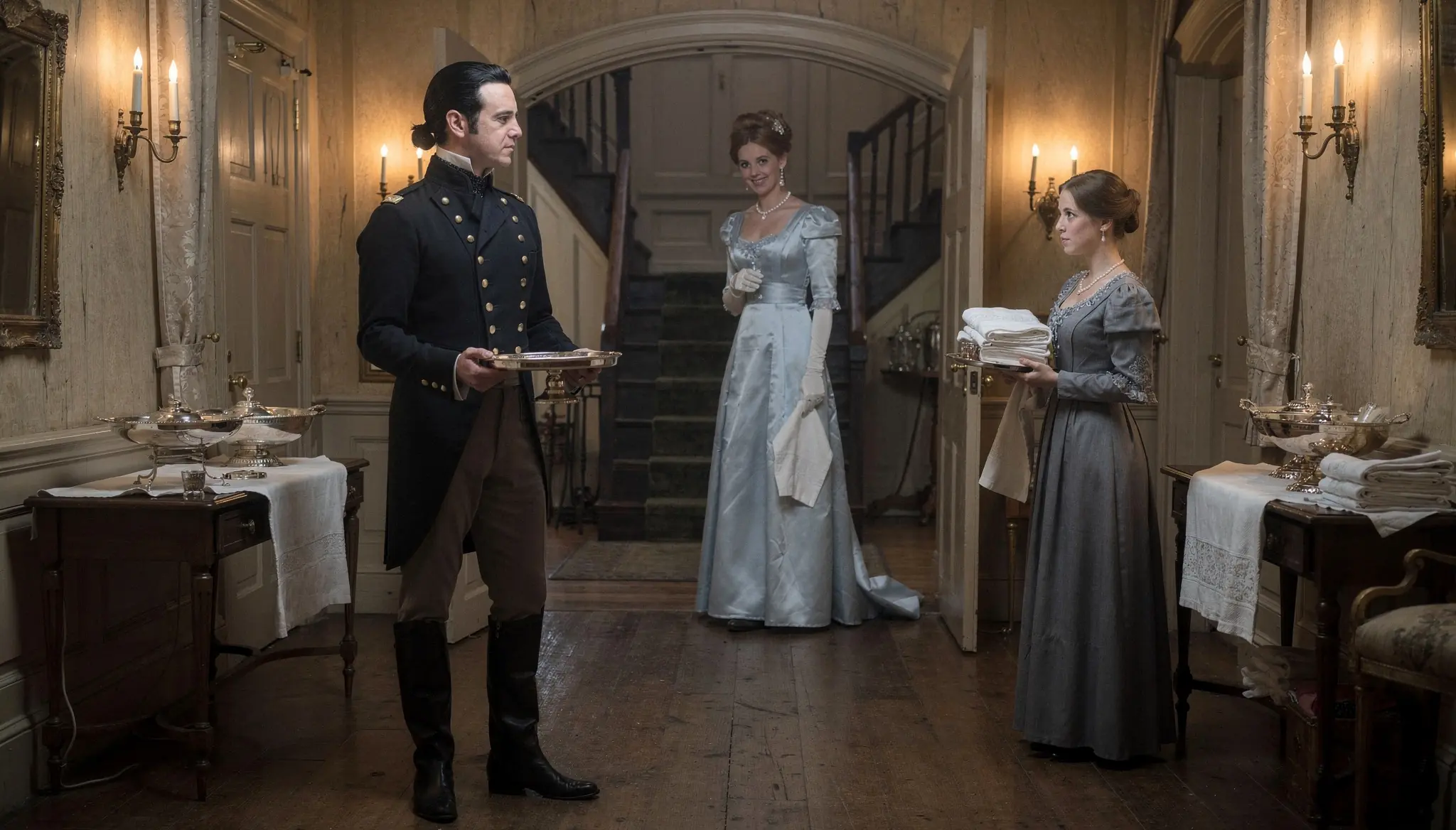
The coat did not fit him properly. The collar sat too tight against his throat, the sleeves pulled awkwardly at the shoulder, and the boots pinched hard at the heel with every step, but he had chosen this disguise deliberately, plain, unremarkable, the clothing of a man no one in a great house was ever trained to notice. He had arrived a full day before anyone expected him, folded quietly into his own traveling party under a false name given to the housekeeper without hesitation, while his actual coach, his actual title, and his actual name waited a day's ride behind him, ready to arrive tomorrow with all the appropriate ceremony, the appropriate bowing, the appropriate performance that came with being a duke. Tomorrow, he would walk through the front doors of Hawthorne Manor as himself, dressed in silk, greeted with curtsies and careful, calculated smiles designed to flatter a man whose good opinion mattered enormously to the people offering them.
Tonight, he intended to see the house and the woman inside it exactly as they were, long before anyone had reason to perform for him. Because something about this match had felt wrong from the very beginning, wrong in a way he could not yet name, and Sebastian Ashford had learned, painfully and at great personal cost, never to ignore that particular feeling in his chest. For three years, he had refused every introduction arranged carefully on his behalf, every dinner seated with calculated precision beside some hopeful young lady, every dance that ended with her mother's eyes already measuring the size of his estate before the music had even finished. He had buried a father deep in debt, a debt hidden for years behind a respectable name and an even more respectable smile, and he had spent the years since quietly, privately repairing what had nearly collapsed under decisions made before Sebastian was even old enough to understand what was happening to his own inheritance.
He had no patience left for flattery and even less for fortune hunters dressed carefully in the soft, convincing language of love and devotion. But patience, he had come to understand, was no longer fully his to keep. His allies in Parliament wanted him settled at last. A wife, they said, plainly and often, would soften the cold, unyielding reputation he had built over years of defending Ashbourne's name against men who would have gladly seen it fall.
His creditors wanted firm assurance that the dukedom would not crumble into public scandal the moment he was gone with no heir and no clear succession to steady it. And his distant relations circled, as they always had, like gulls over a dying ship, each one quietly, carefully wondering who might inherit everything if Sebastian never married at all, or worse, if he died before producing a son. Lady Arabella Whitmore had appeared in the center of all of it like the answer to a question Sebastian had never actually allowed himself to ask aloud. Beautiful, by every account he had received.
Accomplished in music and conversation and every small grace expected of a future duchess. Connected to a family whose name had never once touched scandal in living memory, a rare thing among the circles he moved in. Too perfect, perhaps, when he considered it honestly. And it was that single word, perfect, that had put him in a footman's plain coat instead of a gentleman's well-sprung carriage.
Hawthorne Manor, when he finally saw it properly from below stairs, did nothing to ease his suspicion at first glance, though it gave him little reason to sharpen it, either. The house ran with a discipline that impressed him despite every instinct telling him to remain wary of anything that appeared too well-managed. Servants moved quickly, quietly, efficiently, as though the entire household had been carefully trained to anticipate trouble before it ever had the chance to arrive at the door. Lady Arabella, when he caught his first real glimpse of her crossing the long hall in pale blue silk, seemed to glow with an effortless, practiced grace that no amount of coaching alone could fully explain.
She smiled warmly at a maid carrying an armful of linens and thanked her by name, a small courtesy that servants rarely received from women of her station and breeding. She lowered her voice respectfully when an elderly guest spoke too long and too dully about a subject no one else in the room seemed to care for in the slightest. She laughed softly at precisely the right moment during a conversation Sebastian wasn't even meant to overhear from his position near the wall, and the laugh sounded warm, unrehearsed, almost musical in the quiet of the room. For the better part of an hour, standing in the shadows of the grand hall with a tray balanced carefully against his hip, Sebastian allowed himself, cautiously and almost reluctantly, to wonder if he had simply spent too many years expecting the very worst from people who had never actually given him a real reason to.
She corrected a maid's small mistake before anyone else in the room even saw that a mistake had been made at all. She quietly refilled a tray that Arabella had emptied without ever once thinking to ask who would be the one to replace it for her. She was, Sebastian began to realize with a growing and uncomfortable certainty, the true reason the household ran as smoothly and as gracefully as it appeared to from the outside, while receiving none of the credit, none of the warmth, none of the easy attention given so freely and so constantly to her far more celebrated cousin. And she was watching him.
Not with open suspicion, not yet, but with a quiet, careful, practiced attention of someone whose safety and place in that house depended entirely on noticing things other people too easily overlooked. A footman who stood too straight for a man of his supposed station. A footman whose hands were far too clean for a servant's hands, unmarked by years of heavy labor. A footman who listened to conversations as though committing them carefully to memory, rather than simply letting the words pass by unheard and unremembered as any ordinary servant would.
She said nothing at all. She only watched him briefly and silently, and then returned to her work without comment, and Sebastian found himself oddly, deeply unsettled by how easily this overlooked, unpaid companion had seen exactly what an entire houseful of distracted, self-satisfied guests had completely failed to notice in him. The wine was ordered just after 9:00 that evening, and it was Sebastian who was sent to carry it down a corridor rarely used by guests of the house, narrow, dim, lined with old family portraits that no one ever paused to admire or even glance at, leading directly past the closed door of Lord Whitmore's private study. The door, he noticed as he approached, was not quite fully closed.
A good footman, a careful footman properly playing his assigned part for the evening, would have walked past that gap without a second glance and delivered the wine exactly where he had been instructed to take it. Instead, something in the low, deliberate sound of Arabella's voice drifting through that narrow opening, entirely unlike the warm, easy laughter he had heard ring so pleasantly through the hall only hours earlier, made him stop completely still in the corridor, every muscle suddenly tense. He expected vanity, if anything at all. He expected idle talk of jewels, of gowns being prepared for a wedding, of the quiet, satisfied pleasure of having successfully caught a duke where so many other ambitious women before her had failed entirely.
What he heard instead drained every last ounce of warmth from his chest in a single, terrible instant. "He is not strong," Arabella was saying, calm as a woman discussing nothing more troubling than the weather outside the window. "Weak chest, weak nerves. The physicians always say so quietly, as though it were some sort of kindness to warn us beforehand.
How long do you suppose before a man like that simply fails?" Sebastian stood frozen in that narrow, dimly lit corridor, the wine bottle trembling faintly in his gloved hand, and for the first time in years, through debt, through scandal, through every quiet threat his enemies had ever dared to make against him and his name, he felt something close to genuine fear settle deep into his chest, because whatever waited behind that half-open study door was far older, far colder, and infinitely more dangerous than he had ever once allowed himself to imagine. Sebastian did not move. He could not move, not yet, not while Arabella's voice continued drifting through that narrow gap in the study door, calm and unhurried, as though she were discussing nothing more serious than the seating arrangement for an ordinary dinner party.
Lord Whitmore answered her in the same even tone, the tone of a man comparing two business ventures, weighing the merits of one against the other for profit and convenience. "Mr. Vale lasted for months," he said, as though reading from a ledger rather than describing a man's death. "A weak heart," the physician declared, "and no one questioned it because no one ever questions Dr. Pell." Arabella made a small sound of satisfaction, almost pleased with herself.
"And Lord Cresswell, barely 3 months, though that was clumsier than I would have liked." The settlement had to be altered twice before his solicitor finally stopped asking questions about the wording. Sebastian stood frozen against the corridor wall, the wine bottle cold and slick in his gloved hand, listening to two people calmly dissect the deaths of two other men the way other families might discuss the weather, or the price of grain, or which guests to invite to a summer gathering. There was no grief in either voice.
There was no hesitation, no flicker of conscience, no pause that might suggest either of them understood, even faintly, that they were speaking of murder. Only calculation. Gifts received quietly before each man's death. Settlements altered afterward, redirected, adjusted in small, careful increments that no single document would ever reveal on its own.
Correspondence forged in handwriting close enough to pass inspection from solicitors too trusting or too easily paid to look twice. And grief performed so convincingly in black silk and lowered eyes that no one watching from the outside ever thought to ask a single uncomfortable question. "Grief is easy," Lord Whitmore said, almost fondly, "the way a craftsman speaks of a trade he has long since mastered, if the costume is good enough." Arabella laughed softly at that, the same musical, unhurried laugh Sebastian had heard from her in the hall only hours earlier, warm and effortless and utterly without weight.
And the sound of it now turned his stomach in a way he suspected he would remember for the rest of his life, however long that life turned out to be. It was in that moment, standing rigid in a dark corridor with wine he would never deliver, that Sebastian understood the true shape of what he had walked into. This was not a greedy bride hoping simply to marry well, to secure a title and a fortune through ordinary ambition. This was not a silly social climber chasing rank for vanity's sake, the kind of woman his aunts had warned him about a hundred times over tea.
This was something far older, far more deliberate, and infinitely more dangerous. It was a system, refined patiently over years, that used the institution of marriage itself as a legal road toward murder, inheritance, and influence, dressed up carefully in silk and impeccable manner so that no one watching from the outside would ever think to look twice at what was actually happening beneath the surface. Two men were already dead because of it. Two families had already buried sons or brothers, believing illness alone had taken them, never suspecting the calm, charming young woman who had wept so beautifully at each funeral.
Sebastian understood, with a coldness that settled deep into his chest, that he had very nearly become the third name on that quiet, terrible list, a duke no less, whose death would have been mourned publicly and investigated by no one because who would dare suspect Arabella Whitmore, darling of the county, devoted niece of a respected lord? And he understood something else as well, something that frightened him almost as much as the conversation itself had. He could not simply announce himself in this moment. He could not throw open that study door, declare himself Duke of Ashbourne, demand answers, and trust that justice would follow naturally from outrage alone.
If he exposed himself now, tonight, Arabella and her uncle would have a full day's warning before his official arrival tomorrow, more than enough time to burn whatever evidence still existed, to silence any servant who might confirm what he had heard, to vanish the truth entirely behind yet another flawless performance of confusion and apology. Sebastian needed proof, not outrage. And proof required him to remain exactly what he appeared to be tonight, invisible, unremarkable, beneath their notice entirely. A footman, nothing more, until he could afford to be anything else.
He retreated from the door as quietly as he had come, each step deliberate and measured despite the pounding of his own pulse in his ears, and made it only a short way down the corridor before a low voice stopped him completely still. "You heard something." It was not a question. Eleanor stood half in shadow near the turn of the passage, her expression difficult to read in the dim light, watching him with the same careful, unhurried attention she had given him earlier that evening in the hall.
Sebastian, recovering himself quickly out of long habit, straightened his posture and attempted the easy denial of a servant caught somewhere he had no business being. "I heard nothing at all, miss. I was only delivering the wine as I was told." Eleanor did not move.
She did not blink. She did not allow the lie even a single moment to settle comfortably between them before she dismantled it entirely. "You're standing in the wrong corridor," she said quietly, holding a full, undelivered bottle, "and you look as though you've just seen a ghost walk past you in the dark." She studied him a moment longer, her gaze steady and unflinching, then said, almost gently, as though offering him an opening rather than setting a trap, "Arabella's last fiance died after dining at Hawthorne."
"No one in this house is permitted to speak of it, not the servants, not the family, not even in whispers below stairs. I think you already know that now, whoever you really are." Sebastian said nothing in reply, but his silence, stretching a beat too long, told her everything his denial had failed to hide. Eleanor glanced once down the corridor toward the closed study door, listening for any sound of movement within, then drew him further back into the shadows of an adjoining alcove before she spoke again, her voice low and steady, stripped now entirely of pretense.
"I am not family here, not in any way that matters to the people who live in this house," she said. "My father died deeply in debt, and Lord Whitmore took me in as an act of charity he reminds me of often, usually when he wishes me to remember my place. I have no fortune of my own, no protector, no standing whatsoever to accuse anyone of anything, however much I might privately suspect them." She paused, and something tightened visibly in her expression, a flicker of old grief or old fear that she clearly worked hard to keep contained.
"But I have eyes, and I have spent nearly three years in this house watching things disappear that should never have disappeared at all. Letters vanished from desks before anyone could read them a second time. A maid dismissed without wages, sent away within a week, simply for asking aloud why Mr. Vale's correspondence had stopped so suddenly after his illness began. And I watched Arabella's mother burn papers herself with her own hands in the kitchen grate very late one night, only weeks after Lord Cresswell was buried in the county churchyard."
Her voice did not shake, though Sebastian could see plainly the effort it cost her to keep it steady and even. "I have suspected for a long time now that something terrible lies quietly inside the walls of this house, wearing very fine clothing and speaking very softly. I simply had no one to tell, and certainly no proof that anyone of consequence would ever believe coming from someone like me." Sebastian looked at her for a long moment in the dim light of the alcove, weighing everything at once.
He weighed the danger of remaining inside Hawthorne Manor a moment longer against the far greater danger of leaving with nothing but suspicion and no proof at all, as well as the strange, sudden, fragile trust forming between a disguised duke and an overlooked companion who had absolutely no reason to risk herself helping him. He understood now, with complete certainty, that walking away solved nothing whatsoever. If he quietly canceled the match tomorrow under some invented excuse, a sudden change of heart, a convenient illness of his own, anything plausible enough to satisfy society's curiosity, Arabella and her uncle would simply find another wealthy, unsuspecting man within the year, perhaps within months, and that man would never know what Sebastian now knew with terrible clarity. The pattern would continue exactly as it always had: gifts given, illness arranged, grief performed beautifully, and inheritance secured, until someone finally found the courage and the evidence to stop it permanently. "I am staying," he said quietly, and the words felt heavier in his mouth than he had expected them to. "Not as myself. Not yet. Not until I have something more than an overheard conversation no court would ever accept as proof. As exactly what you see standing in front of you right now." Eleanor's eyes searched his face carefully in the dim light as though trying to decide once and for all whether to trust a man she barely knew and had every reason to doubt before she finally nodded once slowly and deliberately. "Then we will need each other," she said, her voice quiet but resolute, "because I cannot do this alone. Not against Lord Whitmore, and certainly not against Arabella. And clearly, whoever you truly are, neither can you." It was not friendship yet and certainly not trust in its fullest and most complete sense, only two people standing together in a dark, narrow corridor late at night bound together by mistrust, by danger, and by the shared, terrible knowledge that the elegant, respectable house surrounding them might be exactly the trap it now so clearly appeared to be. The days that followed required a kind of discipline Sebastian had never once practiced in his life as a duke.
Below stairs, he learned to make himself useful and invisible in equal measure, polishing silver he didn't care about while listening with absolute attention to every word exchanged around him. The servants' hall, he discovered, was its own kind of court, full of gossip and grievances that no drawing room ever heard, and most of it meant nothing except for the fragments that mattered. He listened when Lord Whitmore's visitors arrived, noting their names, their professions, the particular way certain men were shown into the study with unusual privacy while others waited in the hall like ordinary guests. A physician came twice that week, a Dr. Pell, the very name Sebastian had heard spoken through that half-open door, and he stayed each time far longer than any social visit required.
A solicitor came as well, thin and nervous, carrying a leather case he guarded with both hands as though it held something more dangerous than paper. Meanwhile, Eleanor moved through the house with the quiet freedom her position allowed her, a companion's access without a companion's importance, the kind of presence everyone trusted precisely because no one thought to question it. She slipped into Arabella's rooms under the excuse of mending and tidying, and there, tucked behind gloves and forgotten ribbons, she found an old invitation book listing names Sebastian recognized instantly when she recited them to him in a hushed corner of the servants' passage that evening. Mr. Vale.
Lord Cresswell. And a third name neither of them had heard spoken aloud in the house before, a Mr. Edmund Hale, a gentleman of considerable fortune who had, according to the brief and hurried note beside his name, broken his engagement to Arabella abruptly and fled to the continent without explanation, never to return to England again. What troubled Sebastian most, as he and Eleanor pieced together what little they had gathered, was how far this went beyond simple poison slipped into a cup of tea. That would have been crude, traceable, the kind of thing even a careless physician might eventually question.
What Arabella and Lord Whitmore had built instead was something far more elaborate and far harder to prove, a slow, patient machinery of manipulation that left almost nothing behind to point a finger at. Letters forged in handwriting close enough to deceive even a man's own family. Wills altered not through outright theft, but through careful, gradual persuasion, a clause added here, a beneficiary adjusted there, until the document looked entirely natural by the time it was signed. Physicians like Dr. Pell, paid well enough and discreetly enough to declare whatever illness was most convenient, regardless of what they actually observed in their patients.
Debts uncovered and quietly exploited, men pressured through financial ruin into decisions they would never have made with a clear head. And illnesses, always illnesses, timed with a precision that no honest doctor could explain, beginning only after a man had signed the right papers and ending only once his fortune had nowhere left to go but toward Arabella and the family managing her marriage like a business venture. Arabella's role in all of it was deceptively simple. She charmed.
She smiled. She listened attentively. She made each man feel as though he alone had earned her affection through some quality unique to himself, while Lord Whitmore worked quietly behind every curtain, managing the legal architecture that turned charm into inheritance. It was, Sebastian realized with growing dread, a partnership refined through repetition.
Two dead men and one ruined man serving as proof that whatever they were attempting now with him had likely already been rehearsed to near perfection. The danger sharpened considerably on the fourth day when Arabella discovered that one of her sealed drawers had been disturbed. Sebastian heard of it secondhand through the frightened whispers of a housemaid who had been summoned and questioned sharply about who had entered the west passage that week. Arabella's questioning, though calm on the surface, carried an edge Sebastian recognized immediately from that night in the study, the same cold precision dressed in pleasant words.
She asked which servants had cause to pass through that corridor. She asked, with deceptive casualness, whether anyone had noticed the new footman lingering anywhere he oughtn't. And later that same afternoon, Sebastian felt her attention settle on him directly for the first time, a gaze lingering a moment too long as he carried a tray past the drawing room, assessing him the way a woman might assess a stranger she suspected of something she could not yet name. Every instinct trained into him as a duke screamed at him to meet the gaze directly, to stand taller, to demand what right she had to question him at all.
He forced himself instead to lower his eyes, to bow his head slightly, to become smaller and duller and entirely unremarkable, every motion calculated to convince her that nothing behind his expression was worth her continued interest. It cost him more than he expected, swallowing his own instincts so completely, and he understood now with painful clarity exactly what Eleanor had been doing for years simply to survive in this house. It was watching Eleanor closely during those tense days that taught Sebastian something he had not expected to learn at Hawthorne Manor at all. She was, he began to see clearly, far more than the quiet, overlooked cousin everyone assumed her to be.
When a young housemaid was nearly dismissed over a broken vase that wasn't her fault, Eleanor quietly took the blame upon herself before Lord Whitmore could hand down a punishment, absorbing the unfair consequence without complaint or visible resentment. When the household account showed a discrepancy that might have fallen on an innocent footman's wages, Eleanor corrected the figures herself late one evening, silently, never mentioning it to anyone, simply ensuring the right outcome occurred without seeking credit for it. And more than once, Sebastian watched her step gently between Arabella's sharp tongue and a servant too frightened to defend themselves, redirecting Arabella's irritation with a calm word or a timely distraction, protecting people who would never know how often she had shielded them. She believed herself ordinary, powerless, a woman with no fortune and no standing who simply did what she could within the narrow space allowed to her.
But Sebastian, watching her navigate that house with quiet, unrelenting moral steadiness, found himself developing something close to genuine respect, the kind he rarely extended to anyone, least of all so quickly. She had no title, no wealth, no power of any kind within these walls, and yet she had clearly been the only person inside Hawthorne Manor with the courage and the conscience to notice that something was deeply wrong long before a disguised duke ever arrived to confirm her suspicions. That respect, growing quietly each day, began to complicate things in ways Sebastian had not anticipated when he first chose this disguise. There were moments now, brief and unguarded, when he caught himself watching Eleanor not as an ally in a dangerous investigation, but simply as a woman, clever, steady, quietly courageous in a house that gave her no credit for any of it, and the realization unsettled him more than the danger itself did.
Eleanor, for her part, still believed him nothing more than a servant attached loosely to the duke's traveling party, a footman with an unusual education and an even more unusual habit of noticing things servants weren't meant to notice. She spoke to him with the careful equality of two people facing the same danger together, without the deference she would have shown a duke, and Sebastian found he valued that honesty more than he expected to, even as it sat increasingly uneasily alongside the lie he continued to let her believe. Guilt crept into him slowly, in small, unwelcome moments, when she trusted him with another fragment of evidence, when she spoke plainly of her own fears without performing courage she didn't feel, when she looked at him as an equal rather than a title to be impressed by. He told himself, repeatedly, that revealing himself now would destroy everything they had carefully built toward, that Arabella's suspicion was already too sharp to risk anything before the proof was complete.
It was the truth, and yet it did nothing to ease the discomfort of watching her trust a man who was not entirely who he claimed to be. That evening, as the household settled into its usual quiet, Arabella found Eleanor alone near the corridor outside the study and stopped her with a smile that did not reach her eyes. "You've been spending a great deal of time near the west passage lately," she said lightly, almost affectionately, the way one might speak to a favorite cousin. "I do hope you're being careful, Eleanor.
Servants who listen at doors in this house have a way of disappearing from respectable households entirely." She said it pleasantly, almost kindly, and that was precisely what made it terrifying. Word arrived at Hawthorne Manor on the fifth morning that the Duke of Ashbourne's official arrival had been confirmed for the following evening, and the news moved through the household like a current through still water, changing the temperature of every room it touched. Sebastian heard it first from the butler's clipped instructions to the staff, a list of preparations that grew longer by the hour.
Silver to be polished a second time, the best linens brought down from storage, extra hands hired from the village to manage a dinner now expanded into something grander than originally planned. Lord Whitmore, Sebastian gathered from the hurried conversations around him, had decided that a simple introduction would no longer suffice. He wanted a formal engagement dinner, a public declaration before the assembled county, something substantial enough that no rumor, no whisper, no inconvenient doubt could unravel it afterward. It was, Sebastian understood immediately, a calculated decision dressed up as enthusiasm.
The faster the match was sealed in front of witnesses, the harder it would be for anyone, including Sebastian himself, to quietly withdraw from it later without scandal. Lord Whitmore was not simply eager. He was protecting an investment the way a man protects a contract he has worked years to secure, and the formal dinner was his way of binding Sebastian to Arabella before the Duke had even properly met her as himself. Arabella, for her part, seemed to welcome the timeline with genuine pleasure, though Sebastian no longer mistook that pleasure for anything resembling affection.
She spent the day rehearsing, in her own quiet way, the performance she intended to give that evening and the one still to come, softening her voice when she spoke of the Duke to her mother, practicing a particular expression of modest hope whenever his name was mentioned in company, ensuring that every guest who arrived for the dinner would leave believing they had witnessed a young woman genuinely, innocently falling in love. Sebastian, moving silently through rooms being readied for a celebration built on a lie, found himself disturbed by how effortlessly she slipped into the role, how completely she had already convinced herself, perhaps, that the performance and the truth were close enough not to matter. It was Eleanor who found the proof that finally gave shape and weight to everything they had only suspected until now. She had grown bolder over the past days, emboldened by the urgency of the looming engagement dinner, and that boldness led her, late on the fifth evening, into a locked drawer in Lord Whitmore's study that she had watched him open and close a hundred times without ever daring to touch herself.
She used a hairpin, patiently, the way she had once seen a locksmith do years before, and when the lock finally gave way, she found inside a leather portfolio that had clearly been hidden rather than simply stored. Within it lay a packet of letters, each bearing the same elegant, practiced hand belonging to Dr. Pell, written not as ordinary medical correspondence, but as carefully worded instructions disguised as diagnosis, references to symptoms a man would not actually present, suggestions for how an illness might be described to satisfy a solicitor's questions. Even a note discussing payment for his continued discretion regarding Lord Cresswell's final months. Beneath the letters, Eleanor found something far more damning still, a draft marriage settlement, unsigned but fully drawn, naming Arabella as the principal beneficiary of Sebastian's estate in the event that he died without producing an heir, with clauses structured in language so deliberately vague that any death, by any cause, within the early years of the marriage would satisfy its terms.
The ink was fresh. The paper bore the watermark of the same solicitor Sebastian had watched arrive at the house days earlier, his leather case guarded so carefully. There was no ambiguity left in what Eleanor held in her trembling hands. Sebastian was not simply a wealthy man being courted carelessly.
He had already been measured, calculated, and prepared down to the exact legal language required to make his death profitable rather than merely unfortunate. Eleanor sat alone in the dim study for several long minutes after closing the portfolio, staring at nothing before she finally found the strength to slip it beneath her shawl and carry it away to find Sebastian, her hands cold despite the warmth of the room around her. She never had the chance to deliver it to him in private. Arabella found her first in the corridor just beyond the study, her expression shifting the moment she saw the faint outline of the portfolio Eleanor had not yet managed to hide completely.
"What are you carrying, Eleanor?" Arabella's voice remained light, almost playful, but something beneath it had gone hard and cold in an instant, the charm dropping away just enough for Sebastian, watching from a doorway down the passage, to see the real woman beneath it for the first time in full daylight rather than through a half-open door at night. Eleanor tried to explain herself, claiming mending, claiming nothing of consequence, but Arabella was already reaching for the shawl, already pulling at the edge of the leather case Eleanor instinctively clutched tighter against herself. "You've been in my uncle's study," Arabella said, quieter now, more dangerous for its quietness.
"You've taken something that isn't yours." Within minutes, Lord Whitmore had been summoned, and the accusation Arabella leveled against her cousin was swift and absolute. Theft, plain and simple, a desperate companion stealing from the family that had shown her nothing but charity for years. Lord Whitmore, his face arranged into convincing outrage, declared that Eleanor would be confined to her room until after the engagement dinner concluded, locked in like a child being punished, conveniently silenced for exactly as long as the household needed her silenced.
Sebastian, still in his footman's coat, felt every instinct he had spent days suppressing surge forward at once. He stepped from the doorway before he had fully decided to, his voice sharper and more commanding than any footman had a right to be, insisting there must be some misunderstanding, that he himself could vouch for Miss Whitmore's whereabouts that evening. It was reckless. It was exactly the kind of authority a duke wielded without thinking and a servant never dared, and Eleanor, even in the chaos of the moment, turned to look at him with new and dawning suspicion in her eyes, as though hearing, for the first time, the wrong note in a song she had been listening to for days without quite placing it.
Sebastian understood, watching that suspicion take root in Eleanor's expression, that he could not allow the lie to continue even one more day. He found a moment alone with her that night, after Lord Whitmore's temper had cooled into watchful silence and Eleanor had been left, for now, unguarded in the small sitting room near the kitchen, the confinement postponed rather than cancelled. He closed the door quietly behind him and told her the truth without preamble, without softening it, because he owed her at least that much honesty after everything else he had withheld. He was not a footman.
He had never been a footman. He was Sebastian Ashford, Duke of Ashbourne, the very man Arabella intended to marry, the man whose death she and her uncle had already begun preparing for in ink and forged signatures. Eleanor's reaction was not what he expected. There was no flicker of awe, no sudden deference, none of the softening he had seen in other women upon learning his rank.
There was only anger, immediate and unmistakable, color rising in her face as she stepped back from him as though his closeness itself had become unbearable. "You let me believe you were a servant," she said, her voice low and shaking with something far sharper than surprise. "You let me trust you, tell you things I have told no one in three years, take risks I would never have taken for a stranger, and the entire time you were exactly the man we were trying to protect, lying to my face about who you were." Sebastian did not attempt to excuse himself because he knew there was no excuse that would satisfy what he had done.
He admitted plainly that the deception had been wrong, that he should have found some way to tell her sooner, that her anger was entirely justified, and he would not ask her to set it aside simply because circumstances now required her help. What he asked instead, quietly and without expecting forgiveness, was whether she would still help him finish what they had started together, not for his sake, but for the sake of whoever might become Arabella's next victim if they failed now. Eleanor was silent for a long moment, her jaw tight, clearly fighting the urge to walk away from him entirely. When she finally spoke, her voice had cooled into something harder and more resolute than anger.
"I am not doing this for you," she said. "I am doing this because two men are already dead, and I will not let there be a third, duke or footman or whatever else you choose to call yourself tomorrow." It was not forgiveness. It was something more useful than forgiveness, and Sebastian accepted it without argument.
What remained of that night and the following day moved with the particular urgency of people who knew exactly how little time they had left. Sebastian, no longer trusting any message to the household's own messengers, found a stable boy willing to ride quietly into the village before dawn, carrying three letters sealed with wax pressed by a signet ring Sebastian had kept hidden in his coat throughout the entire deception, the one piece of his true identity he had never quite been willing to leave behind. One letter went to his solicitor in London, instructing him to come at once with whatever documentation existed regarding the Ashbourne estate and succession, prepared to verify and explain it before witnesses if required. A second went to a magistrate known personally to Sebastian's family, a man whose presence alone would lend the weight of law to whatever accusations were made that evening.
The third and most delicate letter went to a name Eleanor herself had supplied, a relative of Lord Cresswell still living within a day's ride, a man who had quietly suspected for years that his cousin's death had not been entirely natural, but who had lacked the proof or the standing to say so aloud until now. Eleanor, meanwhile, worked to secure the portfolio itself, transferring the letters and the draft settlement into a small case she could carry concealed beneath her cloak, refusing to let it leave her sight even for a moment, aware now more than ever that Arabella's earlier accusation of theft had not been entirely wrong, only wrongly aimed. By the time evening arrived, the manor had transformed entirely. Candles lit in every window, carriages already beginning to arrive along the drive, the entire county gathering beneath Hawthorne Manor's roof to witness what they believed would be a joyful announcement.
Sebastian stood once more before a mirror, this time in his own clothes, his own name restored to him along with the silk and the signet ring he had kept hidden for days, and he allowed himself one final moment to feel the full weight of what was about to happen before he walked as himself for the first time inside that house toward the sound of music and laughter drifting from the dining hall below. Arabella, catching sight of him from across the entrance hall as he was announced properly for the first time, smiled with warm, practiced delight, reaching out both hands toward the man she believed she was about to marry, entirely unaware that the footman she had questioned so sharply only days before, the one she had warned might disappear from a respectable household, was the very same duke now smiling politely back at her, waiting only for the right moment to end everything she had so carefully built.
The dining hall at Hawthorne Manor had never looked so magnificent, and Sebastian, seated now at the head of the table as himself for the first time since his arrival, understood that every candle, every flower, every carefully arranged place setting had been designed for precisely this purpose, to convince an entire county that they were witnessing something joyful and natural rather than something rehearsed down to the smallest gesture. The chandeliers had been polished until they threw light across the entire room in soft, golden waves, and the long table groaned beneath the weight of silver and crystal brought out specifically for occasions meant to be remembered. Arabella sat across from him in pale gold silk that caught the candlelight beautifully whenever she moved, performing exactly the version of herself she had perfected over years of careful practice, modest smiles offered to the older matrons who watched her with open approval, soft concern shown toward an elderly guest who complained of the evening chill, elegant manners extended graciously to every person at the table regardless of their importance.
Because she understood, better than almost anyone Sebastian had ever met, that an audience watching closely for flaws would find none if she simply gave them nothing at all to find. She laughed at the right moments. She lowered her eyes modestly when complimented. She reached once, briefly, to touch Sebastian's sleeve with the practiced affection of a woman already comfortable in her role as his intended bride, and the gesture drew a soft, approving murmur from the guests seated nearest them.
Lord Whitmore rose partway through the second course, his glass raised high enough to catch the candlelight, and announced to the assembled guests what everyone had already come expecting and hoping to hear, that his niece, Lady Arabella Whitmore, was to be united in marriage with His Grace, the Duke of Ashbourne, in a match that honored both families and promised, he added with practiced and convincing warmth, a long and happy future for them both. The room erupted immediately in polite applause, in murmured congratulations passed from guest to guest, in the particular warm and contented noise of a county eager to celebrate something it believed it understood completely and simply. Wine glasses were raised. A toast was offered by a cousin of Lord Whitmore's, brief and sentimental, praising the union of two such respected families.
Near the edge of the room, seated where companions and dependents were customarily placed, well away from the candlelight and the center of attention, Eleanor sat pale but composed, her hands folded carefully in her lap, her spine straight despite the tension Sebastian could see plainly in the set of her shoulders. The small leather case containing the portfolio rested hidden beneath the table near her feet, concealed by the long folds of her plain gray gown, and she had not once, in the entire course of the evening, allowed her eyes to drift toward it for longer than a heartbeat, as though afraid that looking too long might draw attention to exactly what she carried. Sebastian caught her eye only once across the crowded room, brief and deliberate, and in that single glance passed everything words could not yet say aloud, not yet, not until the performance had gone far enough one in that hall could later claim it had been interrupted too soon, before the family had fully and irrevocably committed themselves in front of witnesses to the union they intended to profit from in blood and forged ink.
It was near the height of the evening, as the dessert course arrived on delicate China and the conversation around the table turned warm and unguarded with wine, that Arabella offered the remark that would end everything she had built. She had been speaking to an older woman seated near her, a distant relation of the Whitmore family who had traveled some distance for the occasion, about the responsibilities awaiting her as a future duchess, the charitable work she intended to take up, the household she hoped to manage with grace and diligence. She said, with that same effortless, musical warmth Sebastian remembered clearly from the very first night he had stood disguised in the servants' hall listening to her laugh drift through the corridors, that she intended above all else to be a loyal wife to her husband, devoted, steadfast, the kind of duchess who would never once give him cause for concern or doubt.
The table murmured its approval, several guests nodding warmly, one older gentleman remarking that such sentiment spoke well of her character. Sebastian set down his glass slowly and deliberately, the small sound of crystal against linen somehow audible even over the gentle hum of conversation, and rose to his feet in the sudden quiet that followed, the simple gesture itself enough to draw every eye in the room toward him, curious at first, then increasingly uncertain as they registered something unusual in his expression. "Loyalty," he said, his voice calm but carrying easily and clearly across the now silent hall, each word deliberate, "is an interesting word to choose, Lady Arabella. I find myself genuinely curious whether you learned it before or after the deaths of Mr. Vale and Lord Cresswell."
The room did not simply grow quiet. It froze entirely and completely. Glasses halfway to lips, forks suspended motionless over plates, conversation dying mid-sentence as an entire county sat caught in the single terrible instant between confusion and dawning horror. Someone near the far end of the table let out a small, startled gasp.
Lord Whitmore was on his feet almost immediately, his face flushing dark red with something between outrage and barely concealed panic, demanding loudly that Sebastian explain himself at once, insisting the remark was an insult unworthy of a guest welcomed so generously into his house, his voice rising sharply enough to draw the attention of the butler standing near the doorway and several footmen positioned along the walls. "This is monstrous," Lord Whitmore declared, his hand striking the table hard enough to rattle the nearest glasses. "I will not have my niece slandered at her own engagement dinner, duke or no duke." But before he could finish, before the moment could be smoothed over with bluster and wounded indignation the way so many uncomfortable moments inside that house had apparently been smoothed over before, the heavy doors at the far end of the hall swung open without ceremony, and Sebastian's solicitor entered first, his expression grave, followed closely behind by the magistrate Sebastian had summoned in the dead of night through a stable boy's quiet ride into the village.
Both men moved with the unhurried, deliberate authority of those who had been told exactly what they would find inside that house and had come fully prepared for it. What followed unfolded with a precision Sebastian had spent the better part of two days preparing for. Each piece of evidence was laid carefully before the assembled county in an order designed to leave no room whatsoever for doubt, denial, or recovery. He spoke first of the letters from Dr. Pell, forged diagnoses dressed convincingly as legitimate medical opinion, describing illnesses that matched no natural disease known to any honest physician, but matched perfectly, instead, the timeline required to settle two men's fortunes neatly before their convenient deaths.
The magistrate confirmed aloud, in the flat and unembellished language of law, that such letters constituted clear evidence of fraud serious enough to warrant immediate formal investigation by the authorities. A ripple of horrified murmurs moved through the seated guests. Sebastian spoke next of the financial transfers his solicitor had painstakingly traced over the preceding day and night, gifts and settlements that had flowed steadily and repeatedly toward Arabella and her uncle in the weeks following each suitor's death, money that left an unmistakable trail, however carefully its true origins had been disguised behind layers of false correspondence. And then, reaching into his own coat, Sebastian produced the draft marriage settlement Eleanor had discovered locked away in Lord Whitmore's private study.
The document named Arabella sole beneficiary of the entire Ashbourne estate should Sebastian himself die without producing an heir, and its language was constructed with such careful, deliberate vagueness that any death occurring within the marriage's early years would satisfy its terms completely and legally. A gasp moved through the room like wind sweeping suddenly through dry grass, followed by a heavy, stunned silence broken only by the magistrate's quiet instruction that the document be examined formally. Eleanor rose then from her place at the edge of the hall, her hand steady despite the weight of every eye in the room suddenly turning toward her, and walked the length of the long table with measured, unhurried steps to set the leather portfolio itself down before the magistrate, the forged letters, the altered medical reports, every careful piece of proof she had risked her safety, her reputation, and her place within that household to retrieve and protect.
The guests watched her in stunned silence, many of them seeing her clearly, perhaps for the very first time in years, as something other than Arabella's quiet, unremarkable shadow. Arabella's composure, so carefully maintained and perfected over years of practiced performance, broke at last in front of the very audience she had spent her entire life performing for. Her face drained of color entirely, her hands trembling visibly against the white tablecloth, her charm collapsing into something raw, frightened, and finally, unmistakably guilty before every witness present. She opened her mouth as though to offer some explanation, some final desperate performance of innocence, but no words came, only a small, broken sound that satisfied no one in that silent room.
Lord Whitmore's protests grew louder and more desperate beside her, his voice cracking with something that no longer resembled outrage so much as raw panic, but no one in that hall was listening to him any longer with anything resembling sympathy. The respectable reputation he had spent decades carefully constructing, dinner by dinner, favor by favor, cracked apart entirely in the span of mere minutes, witnessed firsthand by the very county he had spent a lifetime cultivating to trust and admire him. What remained after the initial shock finally began to settle into something quieter, but no less consequential unfolded over the following hour with grim efficiency. The magistrate placed both Arabella and Lord Whitmore under formal questioning before the evening fully ended, summoning additional men from the village to ensure neither attempted to flee before proper arrangements could be made.
The engagement was dissolved publicly and irrevocably, declared null before witnesses who would carry the story to every corner of the county and well beyond it by morning, repeated at breakfast tables and in drawing rooms for months to come. Sebastian made certain before the gathering finally dispersed into the cold night air outside that the household's innocent servants and dependent relatives understood clearly that they bore no blame whatsoever for what had occurred within those walls. The maids who had simply followed orders without ever understanding their true purpose, and the distant cousins and elderly relations who had known nothing of the scheme orchestrated quietly above their heads, were all spared from the ruin that now belonged completely and justly to the two people responsible for it alone.
He spoke briefly with the housekeeper, assuring her that positions would be found for any servant who needed one, that no one faithful to that house deserved to suffer for crimes they had no part in. And then, with the same calm and unshakable authority he had used to expose the entire conspiracy, Sebastian turned to address the matter of Eleanor directly, ensuring that every person still remaining in that hall understood precisely and completely what she had done. "Miss Whitmore is not party to any of this," he said, his voice carrying clearly enough across the room that no one present could later claim confusion or doubt on the matter. "She is the reason any of it came to light at all tonight.
She risked her position in this household, her safety, and her reputation among people who never once valued her to uncover what her own family had hidden carefully for years. She did so with no expectation of reward, no hope of recognition, and certainly no obligation to anyone in this room." He watched, as he spoke these words deliberately and slowly, the way the room's attention shifted visibly toward Eleanor, the same county that had overlooked her for years and treated her as little more than a quiet shadow trailing dutifully behind her far more celebrated cousin, now seeing her clearly and properly for what felt like the very first time. Several of the older women who had barely acknowledged her presence in years now looked toward her with something like shame mixed into their open astonishment.
It was not justice, exactly, not in any complete or fully satisfying sense, but it was something close to it nonetheless, a small, necessary, long-overdue correction to years spent entirely unseen by the very people who should have noticed her worth far sooner. In the weeks that followed, as the scandal settled gradually into the kind of story told and retold at every dinner party across the county, growing slightly more dramatic with each retelling, Sebastian found himself returning again and again to the grounds surrounding Hawthorne Manor. Arabella and Lord Whitmore no longer resided there, their disgrace having stripped them swiftly of both fortune and welcome among the very society that had once celebrated them so warmly. Sebastian sought out Eleanor properly this time, without disguise, without deception, without the careful performance of servitude that had defined their first days together, and offered her the apology he had owed her since the very night he first lied about who he truly was.
"You saw clearly what I only suspected," he told her plainly, one quiet afternoon in the Manor's gardens, the autumn light softer and gentler now than it had been on the night he first arrived beneath its roof in another man's coat. "I came to this house prepared only to test a bride I did not trust. I never expected, not for a single moment, to find the truth through a woman everyone else around her had long since decided wasn't worth watching closely at all." Eleanor did not forgive him easily, nor quickly, and Sebastian, to his credit, did not ask her to rush toward forgiveness simply because the immediate danger had passed and the household had settled into uneasy peace.
Trust, once broken so deliberately, required rebuilding with the very same patience it had taken to dismantle it in the first place, and he gave her that necessary time freely, without pressing for more affection or warmth than she was genuinely ready to offer him. He courted her slowly and openly over the months that followed, visiting regularly, writing when he could not visit, never once treating her as a rescue to be grateful for or a convenient solution to a frightening ordeal now safely behind them both. He courted her instead as a woman he had come to genuinely and deeply respect for her intelligence, sharpened by years of careful observation, for her steadiness under pressure that would have broken lesser people, and for the quiet, unrelenting courage that had carried her faithfully through years of being entirely unseen by everyone around her who should have known better.
They walked together often in those months, through gardens and along quiet country lanes, talking not of dukedoms or scandals, but of small, ordinary things, books she loved, places she hoped one day to see, the modest dreams she had quietly set aside for years while caring for a household that never once thanked her for it. When Sebastian finally asked for her hand, kneeling in the same garden where he had first properly apologized to her, it was with full and complete knowledge of who she truly was, not a footman's secret ally from a dangerous and frightening ordeal, not a convenient companion elevated suddenly by circumstance, but a woman who had chosen, again and again and at great personal cost, to do what was right even when doing so threatened to cost her everything she had left in the world. They married that following spring in the small stone chapel at Ashbourne, beneath windows that scattered soft-colored light across the old stone floor, with none of the performance, the pretense, or the careful calculation that had filled the dining hall at Hawthorne Manor months earlier.
There were no county guests gathered merely to be impressed, no careful rehearsal of modest smiles and practiced charm. There was only the quiet, hard-won certainty of two people who had earned each other's trust the difficult way, through danger and deception and the slow, patient work of rebuilding something honest from the wreckage of a lie. Sebastian, standing at the altar in the soft chapel light and watching Eleanor walk toward him in a simple gown far plainer than anything Arabella had ever worn, found himself thinking back one final time to the night he had first arrived at Hawthorne Manor disguised as a footman, utterly certain that he was the one doing the watching, the testing, the careful and suspicious assessment of a stranger's hidden character. He understood now, with a clarity that humbled him completely and permanently, that he had been wrong about nearly everything that night except for one single thing.
Someone inside that house had truly been worth discovering all along. He simply hadn't known, not until it had very nearly cost him his life, that it was never the bride he had originally come to find at all. It was the overlooked cousin no one else in Hawthorne Manor had ever thought worth seeing.