You were told that a duke must know his duty before he knows his heart. You were told that a great house survives through careful marriages, polished manners, and daughters trained to smile before they speak. Arthur, Duke of Westley, had believed that for most of his life. He had come to the Danvers estate to choose the right sister, the perfect sister, the sister everyone had already placed beside him in the future.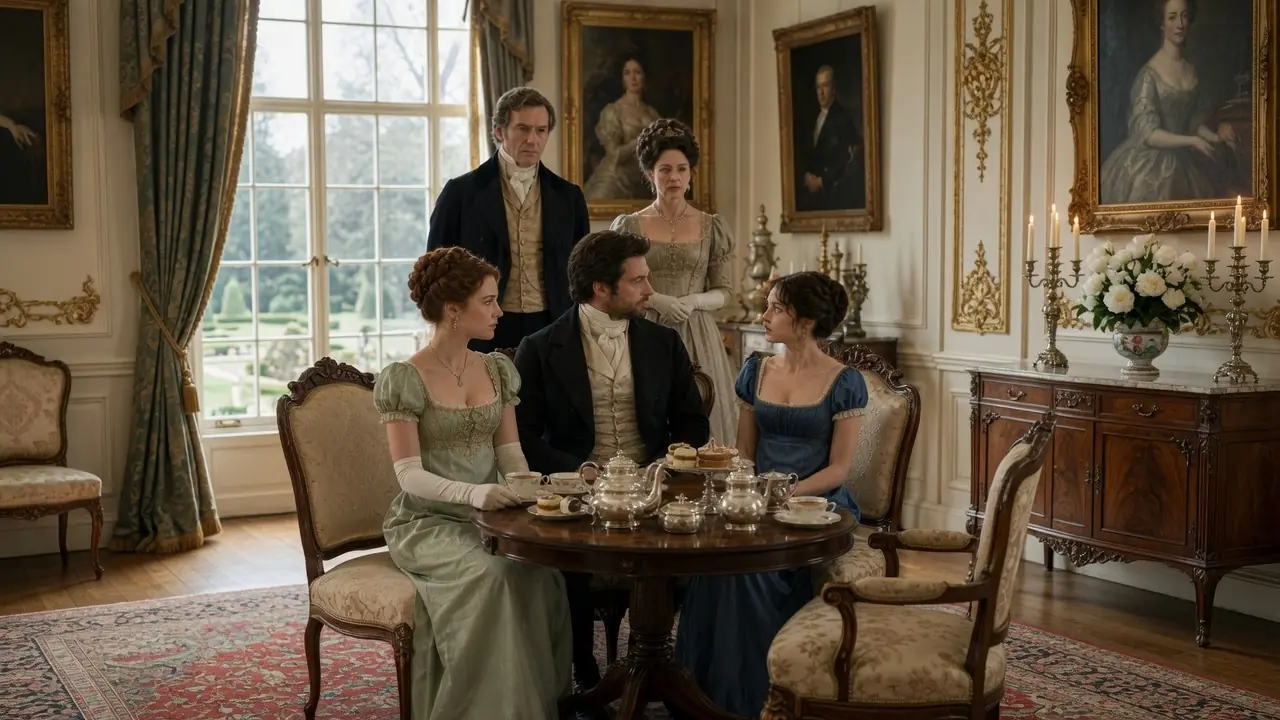
But before he could ask for her hand, he met the wrong sister in the dark, and she did not bow to the role he had brought with him. The Danvers ballroom glowed as if the house had swallowed the sun and turned it into chandeliers. Gold light spilled over polished floors, silk gowns, silver trays, and rows of watching faces that all seemed to know why Arthur had come before he had said a single word. He stood near the tall archway between the ballroom and the music room, one hand resting lightly around a glass he had no intention of drinking.
His cravat was tied with perfect severity, his coat fit without a wrinkle, and his face carried the calm expression that had served him since he inherited the dukedom at 26. It was the expression of a man who understood his place and never questioned the cost of standing in it. Across the room, Eleanor Danvers moved through the evening with faultless grace. She was the eldest daughter, and everything about her had been shaped for rooms exactly like this one.
She laughed at the right moments, lowered her eyes with the right degree of modesty, and spoke to older women with warmth that never slipped into familiarity. When she turned toward Arthur, her smile altered just enough to become something more careful, more promising. And everyone near her noticed. Lady Danvers noticed most of all.
She had arranged the seating at dinner so that Eleanor sat within easy conversation, close enough for intimacy, but not close enough to seem bold. She had chosen music Eleanor played well, guests Eleanor knew how to charm, and a menu that allowed Eleanor to praise the cook without looking overly domestic. Nothing in that house had been left to accident, and Arthur understood the mechanism because he had spent his whole life inside one just like it. He should have admired it.
A duke did not marry for surprise. He married for steadiness, reputation, and the long health of an estate that depended on him. Eleanor was suitable in every way that could be named in a family ledger. She was beautiful, trained, composed, and willing.
And still, as Arthur watched her smile at a joke he doubted she found amusing, a slow pressure gathered beneath his ribs. It was not dislike. That would have been easier. Eleanor had done nothing wrong.
She was kind in the formal way women of her station were taught to be kind, and she would probably become an excellent hostess, an obedient wife, and a duchess no one could criticize. Yet, the thought of sitting across from her for breakfast year after year while both of them performed a marriage instead of living one made Arthur's chest tighten until the room seemed short of air. Lord Danvers approached him with the pleased caution of a man who could already see an alliance forming. "Westley," he said, his voice low and satisfied.
"I hope you find the evening agreeable." "Very agreeable," Arthur replied, because that was the answer required. "Eleanor has been looking forward to your visit." "So I understand."
"She is fond of Westley Abbey, though she has only seen it once." "Your late mother spoke highly of her, I believe." Arthur inclined his head. "My mother spoke highly of many young ladies who sat straight and knew how to leave a room."
Lord Danvers laughed, not because the remark was very funny, but because a duke had made it. Arthur smiled in return, and the exchange passed for ease. The music changed. A waltz began, bright and polished, and Eleanor's eyes moved across the room to find him.
It was not an invitation, exactly. It was a reminder. The whole room turned with that reminder, gently but firmly, as if the entire house had become a hand at his back. Arthur felt the old training rise in him.
Step forward. Ask. Dance. Confirm what everyone already knows.
Do not make the household wonder. Do not embarrass the daughter. Do not disturb the order of things. Instead, he set his untouched glass on a passing tray.
"Excuse me," he said. Lord Danvers blinked. "Of course." Arthur crossed the edge of the ballroom without hurrying, because a duke did not flee.
He walked deeper into the conservatory, past potted orange trees and climbing vines trained along iron frames. The place was not entirely dark. A few lamps burned low near the far wall, enough to show the shapes of leaves, the gleam of wet glass, and the pale stone path beneath his shoes. He thought he was alone until a voice spoke from the shadows.
If you stand there much longer, Your Grace, my mother may send a search party, and then neither of us will have any peace. Arthur turned at once. A woman sat on a wrought iron bench beside a large fern, her posture relaxed and her hands folded around a glass of water. She wore a gown of deep gray-blue, simple enough to almost vanish in the low light, and her dark hair had loosened slightly near one temple.
She did not rise. She did not apologize. She only looked at him as if his arrival were interesting, but not alarming. "Lady Clara," he said after a moment.
She inclined her head. "Your Grace." He knew her, though only in the thin way one knows people through family conversation. Clara Danvers, the younger daughter, not presented with the urgency attached to Eleanor, not praised for brilliance at the pianoforte or skill in drawing a guest into conversation.
Usually mentioned after a pause, as if the speaker had remembered a chair in the corner of a room. "I did not mean to intrude," Arthur said. "No," Clara replied. "I imagine you meant to escape."
The word landed too precisely. Arthur reached for the polished answer that had saved him in hundreds of conversations. "The evening is lively, and I wished to admire the conservatory. Lady Danvers has created a remarkable space."
Clara studied him over the rim of her glass. "That is a very safe sentence." He stared at her. She did not smile in triumph.
She seemed almost sorry for having named it. "I only mean that you sounded as if you had selected it from a drawer." Arthur should have been offended. He had seen men bristle over less, especially when a young unmarried woman spoke with such plainness.
But there was no insult in Clara's voice, no hunger to impress him by being daring. She had simply observed a false note and pointed to it. A faint, unwilling breath of amusement left him. "And what would have been an unsafe sentence?"
"That you were tired," she said. The conservatory became very quiet around him. Rain whispered above them, steady and close. Arthur looked back toward the glowing doors of the ballroom.
Through the glass, figures moved in color and light, bowing and turning and smiling as if none of them had ever wanted to stop. "I suppose most people tire at some point during an evening," he said. "Most people do," Clara answered. "But you looked tired before dinner ended."
By the third course, you had begun nodding without listening. He turned back to her, sharper now. "You watched me through dinner?" "I watched everyone," she said.
"It is easier than speaking." There was no shyness in the admission, no apology. She lifted her glass and took a small drink, then rested it on her knee with both hands wrapped around it. Arthur noticed the motion because it was unpracticed.
Eleanor's hands moved like music over porcelain and silk, each gesture trained to show grace. Clara's hands moved because they had decided to. "Why are you not inside?" he asked.
"Because I prefer it here." "So you hide." She shook her head once. "No. Hiding suggests I want to be found and rescued. I came here because the rain is honest and the ballroom is not." Arthur looked at her longer than courtesy allowed. He expected her to soften the remark, perhaps laugh at herself, perhaps say she did not mean to sound severe.
She did none of those things. Her gaze remained steady, neither inviting nor rejecting him. "You dislike society?" he asked.
"I dislike pretending to enjoy what exhausts me." "That is a costly dislike for a young lady." "It can be," Clara said. "Though not as costly as marrying someone who rewards the pretense."
The words reached him with quiet force. Arthur shifted his weight, suddenly aware of his own posture, the rigid shoulders, the straight back, the cravat fastened close to his throat. Clara's eyes dropped briefly to that cravat, and when they returned to his face, he had the uncomfortable sense that she had understood more than he had offered. He moved to a stone ledge near the orange trees and rested one hand against it.
"You speak very plainly." "Only when people give me sentences from drawers." This time, he did laugh, softly enough that the ballroom could not hear him. The sound surprised him.
It had been days since laughter had come without effort. Clara's expression changed by the smallest degree. Not pleasure, exactly, and not victory, but recognition. "What were you reading before I interrupted?"
he asked, noticing a closed book beside her. "Essays," she said. "On what subject?" "Women's education."
He lifted a brow. "Dangerous material." "Not nearly as dangerous as an educated woman pretending not to be one." Arthur's smile faded, not because he disliked the line, but because it opened a door in him.
He had met clever women before. He had met women who sharpened wit into a weapon for drawing rooms. Clara's intelligence did not strike outward. It stood where it was and refused to move aside.
A burst of laughter rose from the ballroom, followed by applause. Eleanor had likely finished at the pianoforte. Arthur knew he should return. The evening had a rhythm, and he had stepped out of it for too long.
Clara seemed to understand. She looked past him toward the doors. "They will expect you." "Yes," he said.
"And you will go?" "Yes." But he did not move at once. For one suspended moment, they remained in the dim conservatory with the rain above them and the party held at a distance.
Arthur heard his own breathing slow. He noticed the thin line of light along Clara's cheek, the loosened strand of hair she made no attempt to fix, and the calm way she accepted silence without rushing to fill it. He had spent years surrounded by people who wanted something from him. Agreement, approval, marriage, advancement.
Clara wanted none of it. Or if she did, she had hidden it so well that it made no claim on the air between them. At last, he bowed. Not the deep public bow meant for a ballroom, but a smaller one, more private, and more sincere.
"Good evening, Lady Clara." "Good evening, Your Grace." Arthur returned to the ballroom, where Eleanor's smile found him almost immediately, and Lady Danvers watched with careful hope. He stepped back into the light, into music, into expectation, and resumed the role he had left behind.
But something in the mechanism had slipped. The next afternoon, Lady Danvers hosted tea in the east drawing room, a space designed to make conversation look effortless, while quietly controlling every movement inside it. The chairs had been placed in elegant half circles. The curtains were drawn back to let in soft daylight.
A silver tea service sat at the center of the room, and Eleanor stood beside it like the answer to a question everyone had agreed not to ask aloud. Arthur entered beside Lord Danvers, and felt the arrangement settle around him. Eleanor wore pale green muslin, embroidered with small white flowers. The color suited her.
Of course it did. Her mother would not have allowed anything else. She greeted Arthur with a curtsy that was neither too eager nor too distant, then poured his tea before anyone could offer to do it for her. "You take no sugar, I believe," she said.
"You remember correctly." "I try to remember what matters." It was well done. Gentle, modest, suggestive without impropriety.
Arthur accepted the cup, thanked her, and sat where Lady Danvers indicated. Eleanor took the chair angled nearest his, while Lord Danvers settled by the fire with a newspaper he did not read. Clara sat near the open doors to the terrace, partly inside, partly outside, as if she had refused to let the room claim her completely. A book rested closed in her lap.
She was not reading it. She watched a pair of sparrows land on the low garden wall, and paid no attention to the conversation until the conversation required her. Eleanor began with the London season. She spoke of which families had returned from the continent, which hostesses were planning musicals, and which marriages had already been whispered about in drawing rooms.
Her voice was pleasant, and her opinions were careful. She disliked nothing too strongly, approved of nothing too boldly, and turned every subject towards stability. Arthur answered as he should. He asked where she preferred to spend the season.
He allowed her to praise the balance between town and country. He listened while she described a new arrangement of the gardens at Townsend Hall, where old shrubs had been removed and the paths made more symmetrical. "It is vastly improved," Eleanor said, setting down the teapot. "There is something reassuring about order, do you not think? A garden should show the hand of the person responsible for it." Lady Danvers smiled. "Eleanor has always had a fine eye for household management." Arthur looked into his tea.
The surface trembled slightly where his fingers held the cup. "I suppose a garden can reveal a great deal about the person who governs it, he said. Eleanor brightened. Exactly. Without discipline, even beauty becomes untidy. It was the kind of statement he might once have admired. It matched the life expected of him. A great estate required discipline. Tenants, land, accounts, servants, family name, political obligations, all of it required a hand steady enough to keep disorder from spreading. Yet, as Eleanor spoke, Arthur found himself thinking of the conservatory, of rain on glass, and Clara saying that the ballroom was not honest. He turned his head toward the terrace. Clara was watching the sparrows. One had hopped closer to a crumb near the door. She looked entirely at ease in her chair, her shoulders loose, her attention unclaimed by the need to please him. Lady Clara, Arthur said. The room shifted. It was a small thing, using her name, but it cut across the careful design of the afternoon. Eleanor's smile remained, though her fingers stilled on the edge of her saucer. Lady Danvers looked up. Clara turned from the terrace. Yes, Your Grace? Do you agree with your sister? About Townsend Hall? About gardens, he said. Should beauty be disciplined before it is allowed to be admired? Eleanor gave a light laugh. Clara would let half the county disappear under weeds if she thought a bird might nest there. It was not cruel, not exactly. It was sisterly, polished, and dismissive enough to pass as affection. Clara did not react, but Arthur felt something tighten in him. I would still like to hear her answer, he said. Eleanor's laugh faded gently. Lady Danvers lowered her cup. Clara looked at Arthur for a moment, long enough to understand that he was not merely being polite. He had placed a question in her hands, and now the room was watching to see what she would do with it. She did not rush. "I think discipline has its place," she said. "A fruit tree may need pruning if the branches are diseased, and a path may need clearing if people are meant to walk safely. But there is a difference between tending a living thing and forcing it to prove obedience." Arthur leaned back slightly. "Obedience? When every hedge is cut into a shape it would never choose, and every flower is moved because it does not match the design, the garden may look impressive from a window," Clara said. "But I am not sure it is more beautiful. Sometimes it is only evidence that someone was afraid of what might grow without permission." No one spoke. The words were not loud, yet they seemed to settle into every upholstered chair in the room. Arthur felt their meaning before he allowed himself to name it. A garden. A daughter. A duke. A life cut into shape because permission had already been granted to the people holding the shears. Eleanor looked down and adjusted the fold of her gown. Lady Danvers set her cup down with a small sound. "That is a rather severe interpretation of gardening," she said. Clara inclined her head. "Perhaps." She did not defend herself further. That struck Arthur even more than the answer itself. Clara had spoken because she had been asked. Now that she had said what she believed, she did not chase approval. She did not soften the point to make the room comfortable. She let the thought stand on its own, and if others stepped around it, that was their business. Eleanor recovered first. "My sister has always preferred wild corners," she said, her tone warm enough to repair the room. "I prefer a house one can manage." "And a duke requires management?" Arthur asked before he could stop himself. Eleanor blinked. Then she smiled, cautious but skillful. "A duke requires support, surely. A great position must bring a great many burdens." "That it does.
And a wife can ease them by understanding what is expected." There it was. The entire promise laid out neatly between them. Eleanor would understand the expectations. She would support them, maintain them, polish them until no one could see the man wearing thin beneath them. Arthur looked at her and felt no anger. She was offering what she had been taught was valuable. In another life, perhaps he would have accepted it with gratitude. But Clara's words had opened a second window, and air had begun moving through the room. The conversation continued. Lady Danvers guided it toward music, charities, and the upcoming visit of an elderly aunt. Eleanor answered beautifully. Lord Danvers made approving remarks. Clara returned her attention to the garden, though Arthur noticed that she did not open her book. When tea ended, the household rose in small coordinated motions. Eleanor approached Arthur near the mantel. "I hope Clara did not seem too odd," she said quietly. "She has strong feelings about small things." Arthur looked toward the terrace where Clara had stepped outside and was standing beside a stone planter, looking up at the pale afternoon sky. "No," he said. "I would not call them small." Eleanor followed his gaze, and for the first time since he had arrived, something uncertain crossed her face. It was gone quickly, replaced by the composure she knew how to wear. "Of course," she said. Arthur bowed to her and took his leave, but the house seemed different as he crossed the hall. The portraits watched him from the walls. Men in powdered wigs and women in pearls stared down from generations of good marriages and careful alliances. He had grown up beneath faces like theirs. He had learned very early that a title was not a possession. It was a cage inherited with the keys already lost. At the foot of the staircase, he paused. Through the open doors behind him, he heard Clara's voice. She was speaking to a servant who had dropped a glove near the terrace. Her tone was low and kind, without the sweet performance some ladies used when servants could hear. It was the same voice she had used with him in the conservatory. "Consistent," he thought. That was the word that settled in him. Clara was not gentle in the dark and vain in the light. She was not clever only when no one important could object. She did not change shape to fit the person looking at her. The realization should have been simple. Instead, it disturbed him more than any flirtation could have done. That evening, Arthur walked the grounds with Lord Danvers after dinner. It was not formally announced as a conversation about marriage, but the direction was clear. They took the gravel path around the formal garden, where lanterns had been lit along the trimmed hedges, and Lord Danvers spoke of family histories, land boundaries, and the future with the careful confidence of a man approaching agreement. "My Eleanor has been raised with duty in mind," he said. "Not every young woman understands what a title demands." "No," Arthur said, "not every young woman does." "She is steady. That is worth more than romance in my view." Arthur walked beside him, hands clasped behind his back, cravat tight at his throat. "Romance is often used to excuse foolishness." "Precisely," Lord Danvers said, pleased. "The heart is a poor steward of property." Arthur almost agreed. The words were ready. They had lived in him for years, passed down from fathers, guardians, solicitors, uncles, and every elderly woman who believed a man's happiness was a decorative concern. But his mind produced an image of Clara standing near the terrace, unshaken by being dismissed, her shoulders easy because she had not abandoned herself. "A poor steward, perhaps," Arthur said. "But a man who refuses to consult it may mismanage something more important than land." Lord Danvers gave him a sidelong glance. "You are young enough to say so, and old enough to know what silence can cost." The conversation cooled after that. Lord Danvers did not press him, but Arthur felt the pressure thicken. It moved through the estate without needing words. A servant left brandy in his room. Lady Danvers mentioned that Lord Danvers would be free after luncheon the next day. Eleanor wore ivory at dinner, not white, but close enough to suggest innocence and promise without vulgarity. No one demanded anything. They did not have to. Arthur lay awake past midnight staring at the dark canopy above his bed. Rain had returned, harder now, striking the windows in uneven bursts. The house creaked around him. He turned onto his side, then onto his back again, and each position seemed to belong to a man already trapped. By 2:00 in the morning, he could no longer endure the room. He rose, dressed only enough to be decent, and tied his cravat loosely because habit reached for control even when he was too tired to complete it. The corridor outside his room was dim and cold. He should not have been walking through another man's house at that hour, but the need for air drove him past propriety. He went first toward the conservatory, then stopped when he saw a light beneath the library door. Arthur knew he should turn back. An unmarried woman alone in a library at night was not safe from gossip. An unmarried duke joining her there would be worse. A servant waking early, a footman passing with coal, a maid carrying linen, any one of them could see enough to damage Clara more than him. A man survived whispers. A woman carried them like stains. He stood with his hand near the door and listened. Inside, pages turned. He should have left. Instead, he opened the door. The library was warm from a fading fire lit by a single lamp set on a low table. Shelves rose into shadow along every wall. Rain beat softly against the tall windows. Clara sat in a leather chair near the hearth, a book open in her lap, though she was not reading when he entered. She looked up, and for the first time since he had met her, surprise moved clearly across her face. It vanished almost at once. "Your Grace," she said. "Lady Clara, this is unwise." "Yes," Arthur said. She closed the book. "Then why are you here?" He stepped inside and shut the door behind him, though not fully. He left it open by an inch, a small mercy to propriety that changed little and meant everything. "I could not sleep." "Nor could I." "That is not an answer." "It is the only one I have that is simple." He crossed to the mantel and stood with one arm resting against it. The room should have soothed him. Books had always been easier than people, and firelight was kinder than chandeliers. But with Clara watching him, he felt more exposed than he had in the ballroom. "You were right," he said. "About what?" "The garden. The shears. The fear of what might grow without permission." Her expression softened, though not with satisfaction. "I was speaking of hedges." "No, you were not." Clara looked down at the book in her lap. "Perhaps not entirely." Arthur let out a breath and reached for the smooth, bitter voice he used when feeling too much was dangerous. "It is charming in a young lady to speak of freedom when she has never had to keep a dukedom solvent, settle tenants' disputes, answer creditors, preserve a family name, and marry with a hundred dead ancestors leaning over her shoulder. One can afford sincerity when the cost is only being thought odd. The words came sharper than he meant them to.
He knew it as soon as Clara's fingers stilled on the book cover. She could have been wounded. She could have defended herself. She could have reminded him that she had not asked him to come.
Instead, she looked at him with an almost painful calm. "There he is," she said. Arthur frowned. "I beg your pardon?"
"The duke who enters the room when the man is frightened." The sentence struck him with such precision that he turned away from her. Clara stood, setting the book aside. "You need not perform for me, Arthur."
His Christian name, spoken so quietly in the small hours of the morning, went through him with more force than any accusation. "I am not performing," he said, but the denial had no strength. "You are," she said. "You are making yourself harder than you are, because hardness feels safer than fear. You speak of duty as if it were a wall, but tonight it sounds more like a locked door, and you are standing on the wrong side of it." Arthur's hand tightened on the mantel. "You make it sound simple." "No," Clara said.
"I make it sound honest." "Those are not the same thing." The fire shifted. A small piece of coal broke inward, sending sparks up the chimney.
Arthur looked at it because he could not look at her. For years he had believed control was dignity. His father had died with debts hidden beneath polished silver. His mother had smiled through illness because no duchess was allowed to become inconvenient.
Arthur had inherited Westley Abbey with tenants to protect, land to restore, sisters to settle, servants depending on his judgment, and a name that could not be allowed to bend. Every private feeling had been weighed against public consequence, and public consequence had always won. Now Clara stood a few feet from him in a dark library and spoke as if the man buried beneath all that duty still had the right to breathe. Arthur reached for his cravat.
The silk was already loose, but still he pulled at the knot until it came undone completely. The ends hung on either side of his open collar. It was a small action, almost foolish, yet he felt the relief of it through his whole body. "I am tired," he said.
Clara did not move. "I am tired of being measured before I am heard. I am tired of entering rooms where everyone has already decided what I must want. I am tired of conversations that are really negotiations. I am tired of being grateful when someone praises the cage because it is made of gold." His voice dropped, rougher now. "And tomorrow I am expected to ask your father for Eleanor's hand." Clara lowered her eyes, and for the first time he saw the cost land in her.
Not jealousy, not triumph, pain, controlled quickly because she had trained herself not to ask for what was not offered. "Yes," she said. "I thought I could do it." "You cannot."
Arthur looked at her then. "Not without disappearing." The room held the confession carefully. Clara's face changed.
The guarded steadiness remained, but something vulnerable opened behind it. "Then you must not do it. Your family expects it." "My family expects many things. Eleanor expects it." At that, Clara looked away toward the rain-dark window. "Eleanor expects what she has been taught to expect. That does not mean she deserves to be used by it."
"No," Arthur said. "She does not. And I will not be the reason she is humiliated." "You would not be."
"Would I not?" Clara asked, turning back to him. "A duke comes to court the eldest daughter and leaves with the younger. There are drawing rooms that would feast on that for a year."
Arthur had no answer. She was right. He could bear gossip. Clara would be made into a story.
Eleanor would be pitied in public and examined in private. Lady Danvers would rage behind doors. Lord Danvers would feel insult even if no insult had been intended. The cost stood in the room with them, no longer invisible.
Clara wrapped her arms loosely around herself, not from cold, but from the effort of staying still. "My independence is not bravery all the time," she said. "Sometimes it is simply the place I go when the world is too loud. I made a life inside myself because I could not trust the rooms outside it to be kind."
Arthur listened without moving. "I do not dislike love," she continued. "I dislike being asked to trade myself for the appearance of it. I would rather be alone than admired falsely, and I would rather be forgotten than chosen for a role I never wanted to play."
She looked at him then, fully. "If you are trying to escape your duty, do not run toward me. I will not become another door you use." The warning should have pushed him back.
Instead, it steadied him. She was not asking to be rescued. She was not asking to win. She was asking him to be clear, even if clarity took him away from her.
Admiration rose in him with such quiet force that it left no room for argument. "I would never ask you to be a hiding place," he said. "Then do not decide tonight." He stilled.
Clara's voice softened. "Fear can sound very much like truth when it is loud enough. If you break with my family, let it be because you know your own mind in daylight, not because the library is warm and I am the only person here who lets you breathe." Arthur looked at her for a long moment.
There were women who would have taken his confession and shaped it into a proposal before dawn. There were families that would have locked the door and called witnesses. Clara gave him the harder gift. She refused his confusion and demanded his integrity.
He bowed his head once. "You are the most difficult comfort I have ever known." A faint, sad smile touched her mouth. "Comfort should not make cowards of us."
"No," he said. "It should not." They stood without speaking while the rain pressed against the windows. Arthur wanted to cross the room.
He wanted to take her hand, not as a declaration, but as proof that someone in the world was solid. He did not. She had drawn the line clearly, and because he respected her, the line held. At last, he stepped back from the mantel.
"I will leave before the house wakes," he said. "That would be wise." He reached the door and paused. "Clara."
She looked at him. "Thank you for not letting me lie beautifully." Her eyes shone in the lamplight, though her voice remained steady. "Thank you for hearing me when I did not flatter you."
Arthur left the library with his cravat undone and his chest aching, but the ache had changed. It was no longer the pressure of a life closing over him. It was the pain of knowing that choice had to be made cleanly, without darkness, without escape, and without using anyone else as an excuse. By morning, the rain had passed, leaving the Danvers estate washed bright beneath a pale sun.
Arthur dressed with unusual care. His valet tied his cravat twice before Arthur approved the knot. The silk sat perfectly at his throat again, white and formal, the exact image of command, but it no longer felt like armor. At breakfast, Lady Danvers was cheerful in a controlled way.
Eleanor looked lovely in soft cream, a color that made her appear almost bridal. Clara was absent, and no one mentioned it. Arthur drank coffee, answered questions about Westley Abbey, and felt the clock move toward the hour everyone had set aside for his future. After breakfast, he walked alone to the small gallery overlooking the gardens.
He needed to look once more at the shape of the life he was refusing. Below him, Eleanor crossed the lawn with her mother. Lady Danvers leaned close, speaking quickly, and Eleanor listened with the attentive stillness of a daughter who had learned that obedience could look like grace. Arthur watched her and felt sorrow.
Eleanor had not deceived him. She had offered exactly what she believed he wanted. A polished wife, a managed house, a future that would please the county. If he had met no one else, he might have taken it.
He might have even been kind to her. They would have produced heirs, hosted dinners, and grown older in rooms where nothing essential was ever said. That was the danger. Not disaster, not cruelty.
A peaceful emptiness that no one would name because it looked so respectable from the outside. At half past 11:00, a footman found him. Lord Danvers is in his study, Your Grace. Arthur nodded.
Thank you. The study smelled of leather, tobacco, and old paper. Lord Danvers stood when Arthur entered, and for one hopeful second, the older man's face carried the satisfaction of a plan reaching its proper conclusion. Westley, he said, "Please."
Arthur did not sit. That was the first break in the expected pattern. Lord Danvers noticed, and the satisfaction faded slightly. "I owe you directness," Arthur said.
Lord Danvers became very still. Arthur kept his hands at his sides. He would not pace. He would not soften the matter with elaborate phrases that only delayed injury.
I hold your family in sincere respect. Lady Eleanor has been gracious in every particular, and nothing I say should be understood as a criticism of her character. Lord Danvers' jaw tightened. I see.
I came here believing that a match between us would be suitable. And now? Now I believe it would be unjust to her. The room cooled.
Lord Danvers walked slowly behind his desk, though he did not sit either. Unjust? Yes. She deserves a husband who sees her with certainty.
I cannot offer that. My daughter has been led to expect I know, Arthur said. And the fault is mine. That stopped him.
Arthur continued, his voice even. I allowed an expectation to grow because it was convenient to every family involved, including my own. I should have understood myself sooner. Since I did not, I will carry the responsibility for ending it.
Lord Danvers stared at him. Anger moved beneath his controlled face, but so did calculation. There will be questions. I will answer them in a manner that protects Lady Eleanor.
You understand what you are declining? Completely. A beautiful young woman of excellent upbringing with a respectable dowry and no stain upon her name. I understand.
And you would have me tell her what? Arthur's throat tightened, but he did not look away. Tell her that I am not the man who should ask for her life. Lord Danvers looked toward the window where the formal garden stretched beneath the morning light.
This is irregular. Yes. Embarrassing. Yes.
Deeply disappointing. I know. Silence followed. It was not peaceful, but it was clean.
Arthur could feel the cost of what he had done moving outward through the house already. There would be closed doors, private tears, angry letters, and careful explanations. The world would not end, but it would bruise. At last, Lord Danvers turned back.
Is there another attachment? Arthur had known the question would come. He answered with care. There is no understanding with anyone.
That is not what I asked. No, Arthur said. It is not. Lord Danvers studied him for a long time.
If you have compromised my younger daughter, I have not, Arthur said at once, and the first true steel entered his voice. Nor would I. The older man heard the warning and accepted it. Whatever else might be said, Arthur would not allow Clara's name to be dragged into that room as evidence.
Lord Danvers exhaled heavily. You may go. Arthur bowed. I am sorry for the pain this causes.
Pain is not the difficulty, Lord Danvers said coldly. Pain is private. Embarrassment must be managed. Arthur accepted the rebuke because it was partly deserved.
Then he left the study and stepped into the corridor. For a moment he stood still. He waited for panic. He waited for the old tightening in his chest, the punishment his body delivered whenever he stepped away from expectation.
It did not come. He felt sorrow, yes, and the hard awareness of consequence, but beneath it ran a steadier current. He had told the truth in daylight. A door opened somewhere down the hall.
Lady Danvers's voice called for a maid. Arthur turned away before anyone could summon him into explanations and crossed the house toward the side entrance. He found Clara where he thought he might. Not in the conservatory, not in the library.
She was beyond the formal gardens, past the clipped hedges, near the rougher edge of the estate where the land sloped toward a narrow stream. The place looked half neglected by design, with long grass, ferns, and trees that had been allowed to keep their natural shape. Clara stood near the water with a sketchbook under one arm, though she was not drawing. She was watching sunlight move across the current.
Arthur paused before stepping from the path. He wanted to remember this sight as it was before his words changed it. Clara in a dark blue morning dress, hair pinned simply, one hand resting on the bark of a low branch, not waiting to be chosen, not arranged for admiration, present in her own life. A twig broke beneath his shoe.
She turned. Her eyes moved first to his face, then to his cravat, perfectly tied. Her expression did not betray fear, but he saw the question form. "It is done," he said.
Clara's hand tightened slightly around the sketchbook. "Done?" "I spoke to your father. I will not ask for Eleanor's hand."
She closed her eyes for one brief moment. When she opened them, there was pain there and relief and caution holding both at a distance. Was he angry? Yes.
Was he cruel? No. Not beyond what disappointment permits. And Eleanor?
I have not spoken with her yet. Clara looked toward the house, though it was hidden behind trees. She will be hurt. Yes, Arthur said.
And I regret it. That mattered to her. He saw it. She needed him to understand that Eleanor was not merely an obstacle removed from his path.
She was a person who would have to wake tomorrow inside a changed story. Arthur took one step closer then stopped. I did not come here to ask you to celebrate her pain. Good.
And I did not come because last night frightened me into rebellion. Clara looked back at him. He breathed in slowly. The air smelled of wet grass and cold water.
I have spent the morning asking myself whether you were right. Whether I had mistaken relief for love. Whether I wanted you because you seemed like a door out of the life I feared. And?
And I found that when I imagined leaving here without you I did not feel trapped, he said. I felt false. Her face changed slightly but she did not interrupt. I do not want you because you free me from duty, Arthur continued.
I want you because you remind me that duty without honesty becomes a kind of cowardice. I do not want a wife who echoes me back to myself until neither of us can tell whether I am still alive. I want a companion who will disagree with me in gardens, stop me in libraries, and know when my finest sentences are hiding the worst parts of me. Clara's breath caught.
It was small, but he heard it. Arthur moved no closer. I cannot promise you a quiet life in every respect. Westley Abbey is not a cottage.
There will be duties, guests, tenants, dinners, and rooms full of people who speak too much. If you stand beside me, some will say I chose badly. Some will say worse of you than they dare say of me. I know.
But I can promise that I will not ask you to become Eleanor, or my mother, or any portrait on a wall. The title may shape our days, but it will not own your spirit if I have strength enough to prevent it. And when I do not, I trust you to tell me. Clara lowered her gaze to the stream.
For a long time, she said nothing. Arthur let the silence remain. It was hers to use. When she spoke, her voice was quieter.
I have made peace with being overlooked. It is not always pleasant, but it is simple. No one asks much of a woman they have decided not to notice. I would notice you.
That is what frightens me. He felt the answer in his chest. Why? Because to be seen truly is not always gentle, Clara said.
It means I cannot pretend to need nothing. It means the rooms I built inside myself may not be enough anymore. Arthur understood then that her calm had never been emptiness. It had been discipline of another kind.
She had survived by choosing what could touch her. Now he was asking to be allowed near. I will not force the door, he said. A faint smile, fragile and real, touched her mouth.
"No. You have better manners than that. Usually." The smile deepened for 1 second, then faded into seriousness.
She stepped toward him, closing some of the space he had left. If this is a choice, Arthur, it must remain one after the first difficulty. Not only today, while the air feels clean and brave. Later, when your aunt disapproves, when society laughs quietly, when I fail to say the graceful thing at dinner, when I prefer the library to a receiving line, you must not wake one morning and resent me for being the woman you asked me to remain.
"I will fail you in smaller ways," he said. "I know enough of myself to promise that. But I will not resent the truth I chose." She searched his face with the steady attention that had undone him from the beginning.
She looked for haste, for vanity, for the glow of a man pleased with his own defiance. Arthur stood still and let her examine him. Because love, if that was what this had become, could not begin with evasion. At last, Clara set her sketchbook on the grass.
"What are you asking me?" Arthur's voice lowered. "Not to save me. Not to hide me. Not to become proof that I was brave. I am asking whether you would consider sharing a life with me, as my equal in all the ways the law may fail to name, but I will not forget." Her eyes brightened. "I am asking," he said, "whether you will be Duchess of Westley on your own terms."
The stream moved over stones beside them. Somewhere beyond the trees the house held its disappointment and rearranged its future. Arthur saw the weight of the choice pass through Clara, saw her think of Eleanor, of her mother, of every room that would suddenly look at her differently. Then she lifted her hand.
He looked at it before he took it. Her fingers were bare, steady, and slightly cold from the morning air. He placed his hand beneath hers, not gripping at first, only receiving. She looked down at the contact as if it were both ordinary and enormous.
"Yes," Clara said. The word was not loud. It did not need to be. Arthur closed his fingers around hers.
The touch moved through him with a force no ballroom declaration could have carried. There was no kiss, no theatrical vow, no kneeling in damp grass as if love required an audience even in private. There was only her hand in his, warm now, certain now, and the deep, astonishing quiet of being chosen by someone who had no interest in pretending. He bowed his head over their joined hands, not as a duke, but as a man accepting the gravity of joy.
Clara stepped closer. "We should go back." "Yes," he said. "Together?"
Arthur looked toward the house. The path back would not be easy. Eleanor would have to be treated with dignity. Lady Danvers would not forgive quickly.
Lord Danvers would negotiate anger into form. The servants would know before sunset. And London would know in a week. There would be cost enough for everyone.
But Clara's hand remained in his. "Together," he said.
Three years later, autumn rain fell against the tall windows of the Westley Library, making the glass shimmer the way the conservatory roof had shimmered on the night Arthur first heard Clara speak from the shadows.
He sat at his desk with estate papers spread before him, his cravat loosened at the end of a long day. While Clara rested on the sofa with a book open on her lap and a large old hound asleep against her feet. They had not spoken in nearly an hour. And neither of them had felt abandoned by the silence.
Beyond the library doors, Westley Abbey continued to demand what great houses always demanded. Accounts needed attention. Tenants came with worries. Relations came with opinions.
Some people had never stopped calling Clara the surprising Duchess. Though the phrase had lost most of its teeth. Eleanor had married the following spring. Not to a duke, but to a kind baronet who laughed easily and looked at her as if she were more than well-trained.
That knowledge had become one of Clara's private mercies. Arthur looked up from his papers. Clara sensed it and lifted her eyes. Across the room, they shared a small smile that belonged to no one else.
It was not dramatic. It would not have satisfied a ballroom. But it held the whole story. The rain, the library, the garden, the hand taken freely, the rules broken without cruelty, and the life built afterward with care.
Their love had not conquered society by shouting over it. It had done something quieter and more difficult. It had taught two people raised among beautiful performances to become honest in the same room. And perhaps that was the greater revolution.
Not to be adored by the world, but to be known by one person and still be chosen.