The ballroom at Ashford House had never held so much silence. Duke Ashford stood at the center of it, surrounded by three foreign envoys in fine dark coats, their faces unreadable, their patience visibly thinning. Behind him, his fourth translator in as many days packed his satchel with trembling hands and refused to meet his eyes. "I cannot help you, Your Grace," the man muttered.
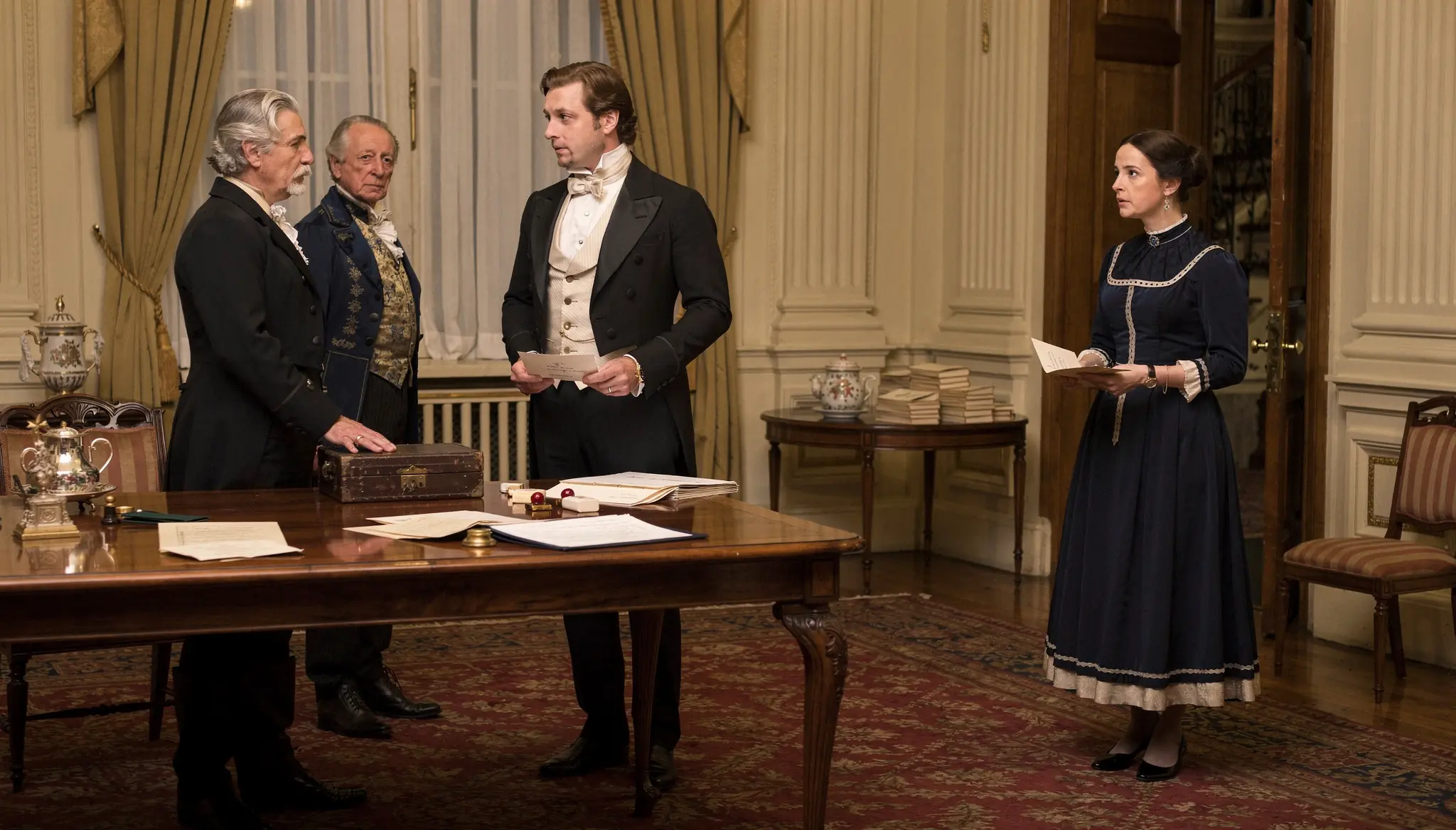
"The terms are beyond me. I must go." The door shut. The silence returned, heavier now.
Ashford's jaw tightened. Six months of negotiation, an entire fortune staked on this single trade agreement, and he could not so much as greet these men properly. The envoys exchanged a glance, the kind that meant they were already calculating how quickly they could leave Bristol and take their contracts elsewhere. "Perhaps," said the eldest envoy in halting English, "we return another season."
It was not a question. It was a door closing. Ashford felt the weight of every debt, every promise, every hope he'd built this deal upon collapsing in real time. He opened his mouth, uncertain what to say, when a voice, quiet, unhurried, entirely unexpected, spoke from the doorway.
It was not English. It was fluent, warm, effortless French, addressed directly to the envoys, apologizing for the delay and asking, with perfect courtesy, whether they might continue in comfort. Every head turned. There, half-forgotten in a corner where she'd been arranging correspondence no one thought to notice, stood Lady Whitmore, the librarian's daughter, the spinster society had long since stopped inviting to anything that mattered.
The envoys stared. Ashford stared. She did not blush. She did not falter.
She simply switched, without pause, into Italian. Nobody moved for a long moment. Then the eldest envoy laughed, a genuine, startled sound, and answered her in kind. Duke Ashford felt something shift in his chest that he could not immediately name.
Relief, certainly. But also something sharper, more uncomfortable. The recognition that he had walked past this woman in his own household for the better part of a fortnight and never once considered she might be of anything beyond cataloging books. "You speak Italian," he said, when the envoys had been settled with tea and the immediate crisis had passed.
It was not quite a question. "And French, Your Grace. Spanish and enough Portuguese to be useful, though I confess my accent wants practice." Lady Whitmore folded her hands before her, unbothered by his astonishment.
"My father was a translator himself before his death. He believed a mind left idle was a mind wasted, regardless of what society expected a woman to do with it." Ashford frowned. "And yet no one thought to mention this."
"No one asked." There was no bitterness in it, only fact, and somehow that was worse. Ashford had spent three days in a state of near panic, had nearly lost the single most important contract of his career, while the solution sat quietly in his own library, unremarked upon because she was unmarried, unfashionable, and past the age society considered a woman worth noticing. He said nothing further that evening, but he watched her work.
Watched the envoys warm to her, watched her navigate not merely the words, but the delicate diplomacy beneath them, softening a blunt phrase here, clarifying an insult that was never intended there. She was, he realized with something like shame, extraordinary. Word spread quickly through Bristol's drawing rooms as word always did. The overlooked Lady Whitmore, suddenly indispensable to the Duke's negotiations.
Some called it charming. Others called it unseemly. They objected to a woman conducting business among men and speaking languages no lady ought to need. Lord Pembroke, dining at his club that same week, heard the news with considerably less amusement than most.
"Four languages," he repeated to his companion, swirling his glass slowly. "How very inconvenient." He said nothing more on the matter that night. But the following morning, a letter went out under his seal, quiet, careful, addressed to no one Ashford would ever think to suspect, and the first small thread of sabotage began, unnoticed, to pull tight.
By the following week, Lady Whitmore had become a fixture at the negotiation table, and Duke Ashford had begun to notice things about her that had nothing to do with languages at all. The careful way she chose her words even in English, the quiet steadiness in her hands when the envoys grew tense, the small, private smile she wore when a difficult phrase finally landed correctly. "You're staring, Your Grace," she said one afternoon, not looking up from the letter she was translating. "I'm observing. There's a difference."
"Is there?" But she was smiling when she said it, and he found he did not mind being caught. Clara Hastings, watching from the library doorway with the particular satisfaction of a friend whose advice has finally been proven right, said little about it directly. She had spent two years urging Margaret Whitmore to stop hiding her gifts behind quiet cataloging and modest silence.
Now, watching her sit across from a duke as an equal in all but title, Clara allowed herself a small, knowing smile of her own. But not everyone in Bristol shared her satisfaction. The first sign of trouble came quietly. A shipment manifest, translated by Lady Whitmore days earlier, was suddenly disputed by the envoys.