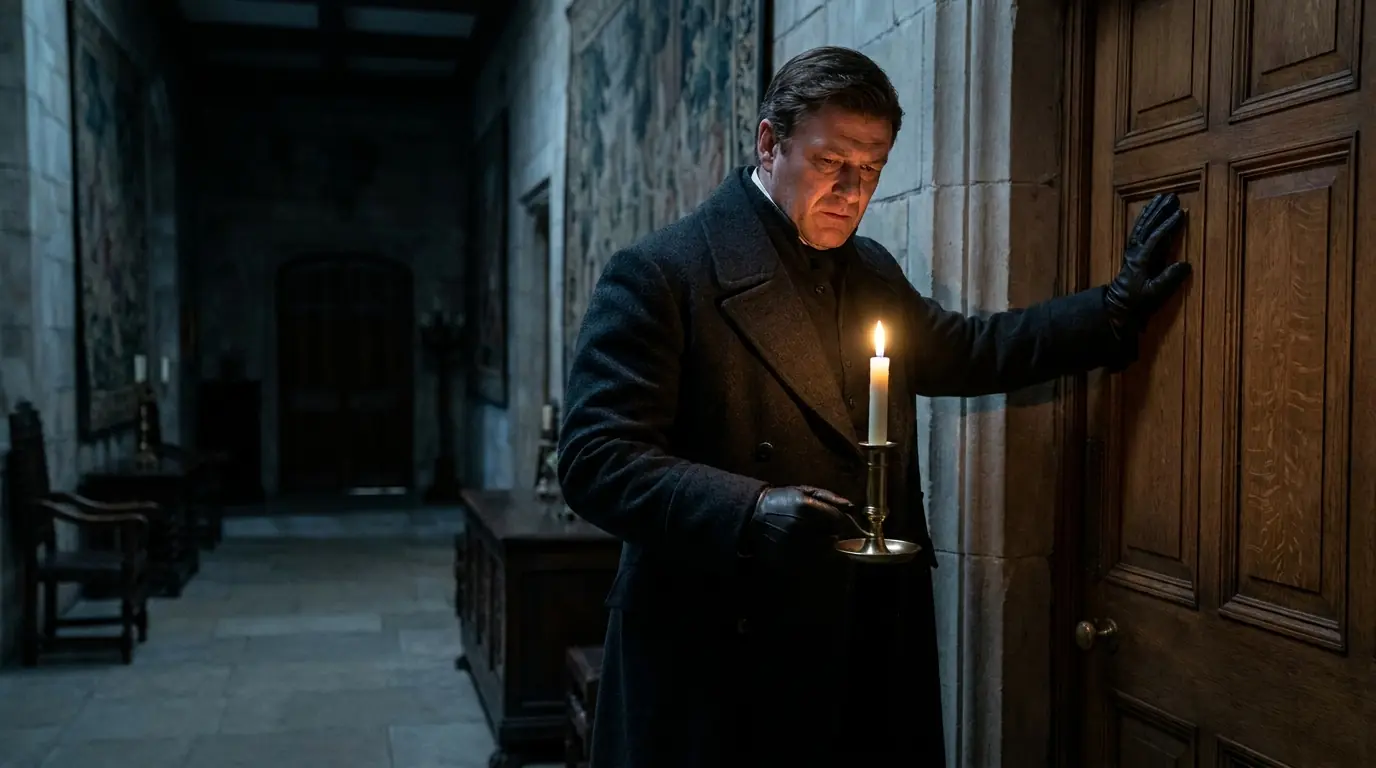
Edmund Cavendish, Duke of Hawkridge, was three steps past his wife’s chamber door when he heard her say his name. He stopped without meaning to. One gloved hand still rested on the corridor wall, while the other held a candle whose flame trembled in a draft from the long gallery. A year of marriage had taught him exactly two things about the woman behind that door. She required nothing from him, and she made no sound he could trace.
He had grown so accustomed to her silence that her voice, speaking his given name aloud alone at the edge of evening, sounded almost foreign. “Edmund.” She was not calling him. The door was closed. The room beyond it lay in that hush a house keeps just before the candles are lit. He should have walked on. He had walked on a hundred times before.
He was, in fact, the kind of husband who took pride in walking on. He did not walk on. Through the door, in a low, unhurried voice, his wife was praying. Not for herself. “And let his hands trouble him less tonight. He sat at the desk so long this morning. The cold goes into the old wound on the right one. The one he hides when anyone notices. Let it ease. Let him sleep without setting his teeth against it.”
Edmund’s gloved hand pressed flat against the wall. The candle in the other tilted. A bead of wax, soft and warm, slid over his knuckle. “Let his sister write to him before the season ends,” the voice continued, calm as someone tending a small fire. “She is afraid he will think her ungrateful. He is not ungrateful when he is afraid. She is not, either. They are the same in this, and have never told one another.”
A pause followed. The kind of pause a person who is unhurried can afford. He pictured her, though he had not looked at her properly in months, and could not, for an instant, summon her face. He summoned instead the slope of her shoulders at the dinner table, the way her hands folded in her lap when he did not speak to her, and the white edge of a sleeve neatly turned at the cuff.
“Let him be happy,” she said, simply, as if it were a fact she was placing in safekeeping. “Let it not matter from whose hand the happiness comes, only that it finds him. Amen.” There was no amen for herself. There was no petition for herself. There was, in the entire prayer, not one word concerning the woman who had spent twelve months in this hall as the man who married her looked through her at the wallpaper.
Edmund stood very still. His own breath had stopped somewhere between sentences, and he had not yet remembered to start it again. The corridor smelled of the beeswax candles his housekeeper preferred, of the spring damp that always rose into Hawkridge in May, and of something faint and impossible. A thread of lavender that was not, he was suddenly certain, the housekeeper’s choice. It was hers. It had been hers since the day she came. He had simply not noticed.
The door before him was made of oak and had been hung in the reign of his grandfather. He had passed through it twice in twelve months. Once on the night of the wedding to bow stiffly and depart, and once at the end of the bride’s first week to ask whether her quarters required any further comfort. She had said no. He had not asked again.
Behind it now, the woman who had asked him for nothing was asking nothing for herself. A footstep sounded on the stairs at the corridor’s far end. The candle in his hand recovered its flame. Edmund Cavendish, Duke of Hawkridge, who had crossed three continents in service of the Crown and held a regiment together at Salamanca with a bayonet wound in his right hand, found that he could not have moved from the spot if the house itself had begun to burn.
He took the candle in his other hand to free the gloved one. He spread its fingers against the paneled wall. He breathed in. He had been a fool. That, too, he understood without warning, the way men sometimes understand things on a winter battlefield when the fog suddenly opens and they see at last the shape of the ground they have been fighting on.
He had been a fool for one year. He had been a fool with great precision and consistency, with a calm that he had mistaken for dignity. He had given a young woman his name and his roof and the back of his head at every meal. And she had answered with this. With a prayer for the ease of a wound she had no business knowing about.
The footstep on the stairs reached the gallery and turned away. Edmund did not knock. He could not have spoken if he had. He took two steps backward, then a third. The third placed him in the shadow of the alcove opposite her door. And there, in the half dark of his own corridor, the Duke of Hawkridge bowed his head against the cold paneling and pressed the heel of his uninjured hand into his eyes. The candle guttered. He let it.
Behind the door, very quietly, his wife began to hum. It was not a hymn. It was a country song, a simple, stubborn, working tune, the kind a girl might sing while turning bread or untangling thread. He had heard it once at a haymaking in his boyhood. He had not heard it in twenty years.
He stayed in the alcove until the humming stopped and the candle in her room was lit. Through the keyhole’s faint glow, he saw the warm yellow widen and steady. He saw, in his mind’s eye, her bending to set the taper to the wick, her hand cupping the small flame, and her face turning toward the window where the spring darkness pressed against the glass.
Then he straightened. He did not knock. He had not earned a knock yet. And he was, before everything else, a man who understood the cost of things. He turned and walked back toward his own wing. And this time he did not stop. Because if he stopped, he was going to do something undignified and entirely earnest. And the Duke of Hawkridge had not been undignified or entirely earnest in front of any woman in his life.
It would, he discovered, be necessary to begin. The next morning he came down to breakfast at half past seven, an hour before his wife usually appeared. He had risen at five. He had paced the length of the library twice, then sat at the desk, then risen again. He had stared, finally, at the cold square of gray beyond the eastern window until the color bled into pink, and the pink into the first watery yellow of a Yorkshire spring.
Now he sat alone at the long mahogany table in the breakfast room, and he watched the door. A footman entered with the silver coffee service. Behind him came a maid with a covered dish. And behind her came Mrs. Penrose, the housekeeper, in her gray worsted, with the air of a woman whose schedule was being kept.
“Your Grace.”
“Mrs. Penrose. A question, my lord.”
Edmund placed both hands on the table. The right one, the one that troubled him in the cold, lay flat against the wood with the deliberate ease of a man who refused to favor it. “What is on that tray?”
“The brown bread, my lord. The sharp cheese, the plums in spirit, and the ham.”
“Why?”
The housekeeper paused. “It is your breakfast, my lord.”
“Mrs. Penrose, I have not asked for that breakfast in this house since I came home from Spain. I have eaten it because it has been put before me. I assumed it was cook’s notion of how a duke ought to begin a Tuesday.”
“Ah.” Mrs. Penrose gathered her hands at her waist. Her face composed itself into the careful neutrality of a senior servant who had been asked, at last, the question she had been waiting for. “The bread is the way your father preferred it, my lord. Cut thick. The plums in spirit are because you mentioned in your second week home from the peninsula that you had not had them in three years. The ham is from the home farm. The cheese is from Renton because you said once at dinner that Renton cheese was the only thing about Yorkshire you did not regret.”
“No, my lord. Her Grace does.”
Edmund closed his eyes for a single, audible breath. When he opened them, his voice had not changed, but the man behind it had. “Mrs. Penrose, how long has my wife been ordering my breakfast?”
“Since the third week of her residence, my lord.”
“And you did not think to mention this to me?”
“My lord,” said Mrs. Penrose with the perfect mildness of a woman who had been in service forty years and knew exactly when to be a piece of furniture and when to be a knife, “Her Grace did not wish it mentioned. And until this morning, my lord, you had not asked.”
There was a long silence. Edmund picked up the silver knife at his place. He set it down again. He laughed once, low in his chest, and it was not a kind laugh. It was directed entirely at himself. “Thank you, Mrs. Penrose.”
“My lord?”
“One further question. The lavender in the linen press. Whose taste is that?”
“Her Grace’s, my lord. From a stillroom receipt of her grandmother’s. She prepares the sachets herself in the stillroom on Wednesdays.”
“Of course she does.”
“My lord?”
“You may go.”
Mrs. Penrose curtsied with the same neutral composure with which she had entered. At the door she paused, half-turned, and added in a voice scrubbed perfectly free of any suggestion at all, “She takes her breakfast in the morning room these last six months, my lord, with the eastern window. Cook sends a tray at half past nine. If you were thinking of asking her something, my lord, she is generally there until ten.”
“Thank you, Mrs. Penrose,” he said again, and this time the words came out slightly hoarse. When she had gone, Edmund Cavendish sat very still and looked down at the slice of brown bread on his plate. He understood, for the first time in twelve months, that he had been fed every morning of his marriage by a woman he had refused to look at.
He did not eat the bread. He went, instead, to find her. The morning room at Hawkridge faced east across the kitchen garden and the ha-ha, and beyond them the meadow that ran down to the river. The window that gave it its purpose was tall, deep-set, and held an oak seat below the casement. On a fair Tuesday in May, with the light coming in pale and clean over the new leaves, anyone who sat in that window would see most of a county.
His wife sat in it. She had not, he saw at once, expected him. A book lay open in her lap. Her left hand held the place. Her right was stretched to the windowsill where a small white teacup balanced on a chipped saucer that he recognized, with a fresh and entirely deserved jolt of shame, as a saucer from the second-best service. She had been using the second-best service for her own breakfast. He had not asked her to. She had, evidently, decided that the first-best ought to be reserved for occasions involving him.
She looked up. His wife was twenty-five years old. He had married her at twenty-four, and he had spent twelve months arranging not to look at her. And now, in a clean Tuesday light, he looked at her properly for the first time. And the small, civilized injury he had been carrying since the previous evening became something larger and less manageable.
She had a long, quiet face. The kind of face that did not assert itself across a crowded room, and which, at three feet distance and in morning light, was startling. Dark hair drawn back in a soft chignon, a wide, level mouth, eyes the color of strong tea, and a carriage of the head that had been schooled by a country governess and not by London. Her gown was indigo blue, plain at the rest, and entirely too good for a Tuesday breakfast in a household that did not see her.
She closed the book. The closing was unhurried. It was the same unhurriedness with which she had said, the night before, “Let him be happy.”
“My lord.”
“Beatrice.”
It was the first time he had used her given name aloud since the afternoon of the wedding. She heard it. He could see her hear it. Something in the angle of her shoulders shifted very slightly, and then settled. “You are at breakfast early, my lord.”
“I am at your breakfast, Beatrice.”
“Forgive me. I should have asked before I came in.”
“It is your house.”
“It is our house.”
She did not answer that. She set the book aside on the window seat. Cooper, he saw. She folded her hands in her lap and waited with that disciplined patience he had taken for one entire year to be coldness. It had not been coldness. It had been the courtesy of a woman who had been raised to require nothing.
He came forward and stood at the corner of the window seat, not too close. He felt enormous in this small bright room, the plain riding coat across his shoulders, the boots, the bandaged grace of a man who at twenty-eight was still recently a soldier. He set the candle from the corridor down on the sill, although the room was full of morning light and no one needed it.
“The breakfast tray,” he said.
“My lord.”
“You ordered it every morning for ten months.”
A pause. Her tea-colored eyes moved across his face the way a careful reader’s eyes move across a difficult line. She did not deny it because she did not lie. And she did not embellish it because she did not require thanks. “I did, my lord.”
“Why?”
“Because you came home from Spain very thin,” she said with a small, perfectly polite smile. “And a man who has marched through Estremadura ought, in my opinion, to be given Renton cheese in his own house. It seemed an indignity not to.”
He laughed. It was not the laugh of the previous morning when he had laughed at his own foolishness. It was the laugh of a man who had been struck very lightly across the face by something he had been waiting for without knowing it. She watched him laugh. She did not laugh back. She watched him with the same careful level kindness she might have used on a child who had finally remembered how to spell his own name.
“My lord,” she said gently when he had stopped. “Was there something else?”
“Beatrice.”
“My lord.”
“I was a fool last night. I’ve been a fool for a year. I’m going to be a fool again in all probability this afternoon. I’m asking you to bear with me through one breakfast in this room on your second-best service until I have understood what kind of fool I have actually been.”
She regarded him for a long moment, the kind of moment that holds its breath. She did not move at all. Then, with the same unhurried courtesy she had used to fold her book, she lifted the chipped saucer from the windowsill and offered him her cup of tea. “Then sit down, my lord,” she said, “and have my tea. I will ring for a fresh one.”
He sat. The cup was warm in his hand. The chipped edge of the saucer rested against his palm and reminded him very specifically of the bayonet wound because the chip pressed exactly where the cold pressed in winter. He found for the first time that he did not mind it.
She rose, crossed to the bell pull, and rang it. Her step was light. The hem of her indigo gown brushed the door frame as she returned. She sat not in the window, but in the small armchair opposite, and folded her hands again. He watched her hands. They were clean, careful, neat as a clerk’s. Across the knuckle of her right thumb ran a faint white scar he had never noticed.
“How did that happen?” he said. She glanced down. “A garden knife, my lord. The pruning of the climbing rose by the south wall. Three years ago, before we were married. It is old.”
“The rose by the south wall is my mother’s.”
“Yes, my lord.”
“You have been pruning it.”
“It’s needed it, my lord. The under-gardener was unwilling. He said he had been told never to touch it. I asked him not to mention to your steward that I had taken over the work.”
Edmund set the cup very carefully on the small table at his elbow. He did not trust his hand to hold it. “You have been pruning my mother’s rose for a year.”
“Two years, my lord. I came in the summer before our wedding and saw the state of it. I have been managing it since.”
“My mother was lost to us at her writing desk on a Tuesday in October,” he said quietly. “And my father gave orders that the rose was not to be removed. He could not bring himself to give orders that it be tended.”
“I know, my lord. Mrs. Penrose told me.”
“Mrs. Penrose,” he said, “tells you a great deal.”
“Mrs. Penrose tells me what is required for the running of the house, my lord.”
“And the rose was required for the running of the house?”
A small, deliberate pause. Then, quietly, “The rose was required, my lord. By the man who lived in it.”
He looked at her. She held his gaze. He understood, suddenly and completely, that his wife had spent a year tending things she had judged to be necessary to him while asking him to know about exactly none of them. The breakfast. The lavender. The rose. The letters. There were, he was now certain, letters somewhere he had not been informed of. The list, he realized, was likely to grow at every meal for the next month.
“Beatrice.”
“My lord?”
“Will you go for a walk with me after breakfast?”
She blinked. It was the first uncalculated motion he had seen from her. “A walk, my lord?”
“In the kitchen garden, along the wall to the rose. I should very much like, if you would permit it, to be shown my own house.”
A second, longer pause. Then his wife smiled. It was not a brilliant smile, and it was not for the company of a duke. It was a small, real, tired smile. The kind a person offers when a long-born private joke is, at last, understood by the only other person in the room. “Yes, my lord,” said Beatrice Cavendish. “I will walk with you in the kitchen garden after breakfast.”
She rose to ring for fresh tea. Edmund Cavendish, who had marched fifteen miles a day across Spain, who had sat at councils with men who wrote the laws of England, who had inherited a dukedom at twenty-four and worn it like a coat that did not fit and refused to be altered, discovered that he had begun, twelve hours earlier, the only campaign of his life that he was going to fight properly.
He did not yet know how badly he was outmatched. He found out three days later. It began with a letter. Hawkridge received the post twice a week. The duke read his correspondence in the library at the great oak desk that had been his father’s, with his coffee at his elbow and the bay window throwing morning light across the green leather. He had been opening his own letters since boyhood. Nothing about the practice required revision.
Except that on this Friday in May, the letter on the top of the salver was not addressed to him. It was addressed to his wife. This was not in itself a startling event. She received correspondence like any lady of the house. The startling event was that the seal on it, a small careful red oval, bore the device of the Whitfield baronetcy. And the hand that had written “Her Grace the Duchess of Hawkridge” was a hand he recognized from the marriage settlements.
It was the hand of her father’s cousin, Sir Roderick Whitfield, currently of London, formerly of the Whitfield estate at Asham, and the man who had, twelve months ago, brokered Edmund’s marriage to a girl he had barely glanced at across a Worcestershire dining table.
Edmund did not open the letter. He had been a fool for a year, but he had not been a man who opened his wife’s correspondence, and he was not about to start. He did, however, observe it. He observed, in particular, that Roderick Whitfield’s hand had been on six other letters in the past two months. Judging by the corner of the salver where Heath, the butler, kept the records, he observed, when he asked, that Beatrice had answered every one of them.
He observed, when he asked further, that she had written checks against her quarterly allowance from him three times in six months. Sums that had gone, by Heath’s reckoning, through the Coutts office in London, which the Duke knew very well to be Roderick’s bank. His wife, who had asked him for nothing in twelve months, was sending money to her cousin.
Edmund rose from the desk. He walked to the bay window. He pressed both hands against the cold sill. “Heath.”
“Your Grace.”
“My wife’s allowance.”
“Your Grace.”
“What does she spend it on?”
Heath, who had been at Hawkridge longer than Edmund had been alive, and who was on three separate counts more loyal to the Duchess than he was to the Duke, paused for the precise length required to make his answer ceremonial. “Her Grace, Your Grace, does not spend it on herself.”
“That, Heath, I have begun to understand.”
“Her Grace, my lord, sends the larger portion of it to her mother’s establishment in Northumberland. Lady Whitfield resides at the Dower Cottage at Beckford, which is, I understand, in poor repair and unsuitable for a lady of her age. Her Grace’s quarterly contributions, Your Grace, have repaired the roof, paid the apothecary, and retained a girl from the village to keep house. She has done this without notice and without thanks.”
“And the remainder?”
A longer pause. Heath, who was a man of professional discretion, and also a man who had decided three days ago that the Duke had been allowed to be a fool for long enough, lifted his chin a careful quarter inch. “Sir Roderick Whitfield, Your Grace, has been advising Her Grace on what he describes as an obligation of the family name.”
“Has he?”
“He has reminded Her Grace, Your Grace, in several letters whose phrasing I do not quite admire, that the Whitfield line has standing to maintain in London, and that Her Grace’s elevation to a Duchess places certain expectations upon the household. Her Grace has, to her credit, Your Grace, and against my own counsel, paid three of the bills he forwarded.”
“How much?”
“Eighty-four guineas, Your Grace.”
“Heath.”
“Your Grace.”
“Have I given my wife eighty-four guineas of pin money in the past half year?”
“Your Grace has given Her Grace one hundred and twenty guineas a quarter, in accordance with the settlements. Of which, Your Grace, Her Grace has retained for herself in the last six months a sum I would estimate at not more than four pounds.”
Edmund laughed once, humorlessly, into his palm. “Four pounds.”
“Your Grace, the lavender for the linen press is from her own stillroom, and the gowns Your Grace will have observed at dinner are, with one exception, from her trousseau. The exception, Your Grace, is the indigo morning gown, which Her Grace had made up two summers ago from a length of silk that was a wedding gift from a distant aunt.”
“I see.”
“If Your Grace will forgive my saying so, Your Grace, Her Grace has been keeping a household within the household.”
“Heath.”
“Your Grace.”
“I forgive you saying so. I would have forgiven you saying so a year ago. You may, in fact, consider yourself encouraged to say a great deal more in any matter touching my wife at any hour of the day, beginning approximately this morning.”
“Yes, Your Grace.”
Edmund returned to the desk. He sat. He drew a sheet of paper toward himself, and a pen and ink. He wrote three lines. He folded the paper. He sealed it with the Hawkridge ring, which he had not used to seal a letter to a woman in his life. “Heath, take this to her, please, in the morning room. Do not wait for an answer.”
“Your Grace.”
The note read:
Beatrice,
There is a letter on the salver from Sir Roderick. It is yours to open. Do not pay it. If he writes again about household economies, I will reply to him myself. Forgive me for not understanding sooner.
H.
He signed it with the single letter she would, he knew, recognize as the way his sister addressed him. He did not see her open the note. He did not see when she opened it, the way her hand stilled and then settled with the same disciplined ease it had used on the windowsill three days before. Or the way she folded the paper twice and tucked it into the small pocket at her waist where she kept the keys to the stillroom and a sprig of last year’s lavender.
She did not that day send a reply. She simply, after luncheon, made her way to the south wall and the rose. And he, walking past the kitchen garden on his way to the stables, found her there with a small pair of pruning shears. And he did the only intelligent thing he had done in a year of his marriage. He sat down on the bench against the wall and watched her work.
She did not greet him. She did not stop. She held the long cane against the trellis, gauged where to cut, made the cut, and laid the cane in the basket by her boot. “You are angry,” he observed eventually.
“I am pruning a rose, my lord.”
“With unusual decision.”
“It is overdue.”
“Beatrice.”
“My lord.”
“I should have known about the eighty-four guineas. I should have known about Beckford. I should have known more particularly about the cousin whom I have disliked since I was eleven and who, let me be entirely plain, was permitted to be present at our marriage settlements only because I was not paying attention and your father was.”
She made another cut. A spray of dead wood fell onto the gravel. “My father is not an unkind man, my lord. He simply does not know what to do with the daughter when the dowry is settled.”
“And your cousin?”
“My cousin,” she said with the precise neutrality of a woman who had been raised to speak well even of relations she did not respect, “wrote me a letter four months into our marriage in which he reminded me that the Whitfield name had been declining since my grandfather’s time. That the marriage to Hawkridge represented an opportunity for the family and that it would be — those were his words, my lord — a poor sort of duchess who failed to advance the standing of her own people.”
“Beatrice.”
“He has a cleverness, my lord. He frames the request as duty. I was raised on duty. I did not at the time see any other way to read it.”
“Did you wish to?”
She paused with the shears in midair. Then she lowered them. She looked at him directly. “I wished, my lord, to spend that allowance on books and on a chestnut mare for the stables and on a small house for my mother. Of those three things, one is a frivolity, one is a luxury, and one is necessary. I have, with some patience, been doing one of them.”
“Your mother.”
“Yes, my lord.”
“What does your mother need?”
“My lord, Beatrice, I have been a fool for a year. I am in no position to be asked twice. What does your mother need?”
She set the shears in the basket. She drew off her gardening glove. The thumb of her right hand showed the white scar from the pruning knife. She wiped a small streak of dust from her cheek. She regarded him. “My mother needs to be moved out of Beckford before next winter. The cottage is sound enough now, but the road is not. She is sixty-two and has been alone for three years. She refuses to come to me at Hawkridge because she believes she will be a burden. She will not, however, refuse a dower house if one is offered on the grounds that the dower house exists already and her presence in it is a convenience to me. I have been working out, my lord, how to suggest such a thing to you in a letter that does not look like a request.”
He stared at her. “You have been composing the letter in your head. For three months, my lord.”
“Beatrice.”
“My lord.”
“Will you stop pruning that rose for thirty seconds and listen to me?”
She set her hands on her knees. He stood. He took two paces along the gravel. He took two paces back. He sat down again on the bench, closer this time. “There is a dower house at Hawkridge. It has not been used since my grandmother’s day. It needs new chimneys and new linen and a competent gardener. It will be ready by July if I write to my steward this afternoon. Your mother will be carried there in a chaise of mine with two outriders in the second week of June. She will not be a burden to you because she will be a delight to me on the grounds that she is your mother and I have been a fool. Roderick Whitfield will not receive another guinea of yours, mine, or hers in his lifetime. I’m writing to him this evening. Do you understand?”
“My lord.”
“Beatrice.”
“That is a great deal to do in four minutes, my lord.”
“It is twelve months overdue.”
She looked at him. He had thought for a year that her face was reserved. He had thought it, in his less generous hours, lacking. He saw in this moment by the spring sun on the south wall that her face was kept. She had been keeping it the way she had been keeping the rose against a season she had not been sure would come.
“My lord,” she said quietly. “If you do these things for me only because you overheard a prayer at a door, you will be tired of them by Michaelmas.”
He absorbed that with no movement at all. “That,” he said at last, “is a fair warning.”
“It is not a refusal, my lord.”
“I understand. I do not require that you love me, my lord. I’m not unintelligent. I do, however, require that whatever you do for me from this afternoon forward, you do because you have decided to be the kind of man who does it. And not, my lord, because for half an hour on a Thursday evening, you were briefly ashamed of yourself.”
He bowed his head. For a long moment, the only sound in the kitchen garden was a thrush in the hedge by the ha-ha and the small click of a dead cane being lifted and laid in a basket. “Beatrice,” he said at last, “may I help you with the rose?”
She did not answer at once. Then she handed him the second pair of shears she had brought, the small ones, the kind one used for the inner growth. “You may, my lord. The east side. I have not been tall enough.”
He took the shears. He worked beside his wife for an hour and a half on the south wall in the spring light. And in that hour and a half, he said almost nothing, because almost nothing was what was required. And at the end of it, the rose stood lighter, leaner, and more capable of bearing its own bloom.
On the way back to the house, she walked half a step ahead of him on the gravel, and her hand, swinging at her side, brushed his coat once. She did not apologize for it. He did not remark on it. They walked in.
That evening, for the first time in twelve months, the Duke and Duchess of Hawkridge dined at the same end of the table. He did not speak much. She did not, either, but when he reached for the salt cellar, she moved it half an inch toward him before he had asked. And when he set down his glass, she refilled her own, and he saw for the first time the small private comedy that had been running on the other side of the table for a year.
He smiled at her. She smiled back. It was the same small, real, tired smile she had given him in the morning room. It was, he understood, the smile he was going to spend the rest of his life earning.
The letter to Roderick was sent the next morning. It was brief, civil, and final. It informed Sir Roderick Whitfield that the Duchess of Hawkridge would no longer be available for consultation on the household economies of the Whitfield baronetcy. That any further correspondence of that nature should be directed to the Duke himself. And that the Duke would not be answering. It was sealed with the Hawkridge ring. Heath delivered it to the post in person.
Sir Roderick Whitfield, a tall, beautifully tailored man of thirty-two, who wore a russet velvet coat in London for the same reason that he kept a gray carriage horse with one white sock, received it on a Wednesday in his rooms in Brook Street. He read it once. He read it again. He laid it down on the marquetry side table beside his coffee. He smiled. “Edmund,” he said pleasantly to no one in particular. “Edmund. Edmund. Edmund.” Then he went to his desk, drew out a sheet of cream paper, and began to write to a friend in the Lord Chancellor’s office.
Sir Roderick Whitfield did not believe in losing the long game. He believed, rather, in adjusting the board.
The dower house at Hawkridge was reopened the second week of June. Lady Whitfield, sixty-two, narrow as a winter sparrow and twice as opinionated, was conveyed to it in a closed chaise with two outriders and a small hamper of plums in spirit. She had asked for none of these courtesies and accepted all of them with the suspicious grace of a woman who had not in three years been offered a single thing by a son-in-law she had begun to consider a permanent absence.
Edmund met her on the front steps in his second-best coat. He did not bow. He extended his right hand, the one that troubled him in the cold, and assisted her down from the chaise. His grip was firm. His face was grave. He addressed her as madam with the full attention of a man who had been raised to it.
“Lady Whitfield.”
“Hawkridge.”
“You will forgive the lateness of this welcome.”
She regarded him with the precise tea-colored eyes of her daughter. “I will consider it, sir,” she said in a voice that had been schooled by the same country governess. “Show me the dower house.”
He showed her the dower house. She approved the chimneys. She approved the kitchen. She approved with reservations the gardener. She informed him that the south parlor required a fresh paint, that the housekeeper she had been promised would do, that the plums in spirit were better than the ones at Beckford and equal to the ones at her father’s table in 1782, and that she would expect him to dine with her on Tuesdays at six for as long as she remained alive enough to demand it.
Edmund accepted all of this. He kissed her hand at the door. He walked back across the meadow toward the great house with the long stride of a man who had done one decent thing in a fortnight and intended, if it was permitted him, to do another.
Beatrice met him at the ha-ha. She did not say anything. She put her hand through his arm. He felt the small, careful pressure of her fingers through his sleeve. He did not look at her. He could not, just then, look at her without being undone in the open field.
“Beatrice.”
“My lord.”
“I am going to London on Thursday.”
She paused half a step on the gravel. “For Parliament, my lord.”
“For Parliament. And for one other thing. Roderick has not answered my letter. He has written instead to a friend at the Lord Chancellor’s office, who is, in turn, a friend of mine. The letter, as I understand it, is a piece of mischief about the Whitfield estate’s standing in London, and about a duchess who has been, in his phrasing, deficient in her family duties. He intends, I think, to make himself unpleasant at the season’s end.”
“Ah.”
“You will come with me.”
“My lord.”
“Beatrice. To London, my lord. I cannot face him there alone. I am, in any case, not minded to face him alone. He is your cousin, and he has been writing to you for a year. And he has been mistaken for a year. And the kindest thing I can do for him is to be mistaken at, in person, in a room of his choosing, in his presence, with his wife in attendance. It is a pleasure I prefer, on balance, not to deny him.”
She walked on with him for several paces in silence. “My lord,” she said at last, “are you proposing that we attend a London ball together?”
“I am proposing, my lord,” he answered, in a tone she had not heard from him before, “that we attend, together, the first London ball of our marriage. At which my wife will wear the most extraordinary gown she possesses, and her cousin will discover that the Whitfield baronetcy has indeed acquired a duchess. And that the duchess in question is a woman who prunes her own roses.”
She laughed. It was a sudden, unguarded laugh, the first he had heard from her. And it rang clean across the meadow like a thrown silver coin. “My lord, I do not own an extraordinary gown.”
“That is fortunate,” said the duke. “Mrs. Allard of Bond Street happens to be a friend of my late mother’s. We shall procure one between Thursday and Saturday. It will, in my opinion, be ruby red. Roderick dislikes red. He thinks it provincial.”
“My lord.”
“Yes.”
“My lord, the gown will cost a great deal of money.”
“Beatrice, I have one hundred and sixteen guineas of yours owing to me from this past half year. I am paying it back with interest in Bond Street silk. Do not, I beg you, attempt to economize.”
She looked up at him. He looked down at her. For a moment, in the broad sunlight of the meadow, with the rooks going about their business in the elms and the river running silver beyond the ha-ha, the Duke and Duchess of Hawkridge stood as still as people in a portrait. And Edmund discovered that he had, in three weeks, fallen entirely and quietly in love with the woman whose name he had spoken aloud for the first time over a cup of tea.
He did not say it. It was not earned yet. He had a battle to fight in London first, beside her, and he intended to fight it well. He put his hand over hers in the crook of his arm, and they walked into Hawkridge together. And Heath, who had been waiting in the doorway with the post, decided not to mention to either of them that another letter had arrived from Sir Roderick Whitfield in Brook Street. The post would keep until the morning.
The morning brought it back. The morning also brought another matter, smaller in scale and considerably larger in importance: a note from Lady Margaret Cavendish, the Duke’s younger sister, on her own paper, sealed in green wax, addressed to the Duchess of Hawkridge, with my dearest love, Edmund.
Opening his own correspondence at the desk, he observed the seal without comment. He had not received a letter from his sister in eight months. He had assumed, on grounds of a quarrel he could no longer entirely remember the details of, that he was not going to receive one before Michaelmas, and possibly not before next year.
His sister was, in his memory, a slender, fierce, brown-haired girl of nineteen, whose engagement had been broken three weeks before her wedding by a young man who had subsequently married a banker’s daughter from York. She had refused, since that Michaelmas, to attend any London ball, to receive any London visitor, and to write to her brother on the grounds that her brother had, in her opinion, expressed himself with unusual stupidity at the time.
Edmund had not, at the time, thought himself stupid. He had thought himself practical. He had told her that the young man was a coward, and that her grief was not, in the long run, a tragedy. He had been correct, he believed, in every particular, and he had been a fool in delivery. And the difference between correctness and grace had been, until a Tuesday in May, lost on him.
He understood it now. He took the letter to the morning room. He gave it to his wife without opening it.
“Beatrice.”
“My lord.”
“This is from Margaret. Will you tell me what is in it?”
She considered him. She did not ask why he had not opened it himself. She broke the green seal with a small ivory paper knife and read the single page. She read it twice. She folded it again. “My lord?”
“Yes.”
“Margaret writes that she has been thinking in her solitude this past spring of the things you said to her at Michaelmas. She writes that some of them were on consideration true. She writes that she will be in London for the second week of the season at her aunt’s and that she would like, if you would permit it, to call upon us.”
“Beatrice.”
“My lord?”
“How long have you been writing to my sister?”
“Since the third month of our marriage, my lord.”
“For ten months?”
“Yes, my lord.”
“What about?”
His wife’s tea-colored eyes held his. There was no triumph in them and no pity and no apology. There was only the steady level kindness of a woman who had been doing one thing at a time slowly for the man who had not been paying attention. “About you, my lord,” she said. “And about the things you might have meant by what you said to her at Michaelmas. And about the things she might have meant by what she said to you. I told her, my lord, that you were a man who had been a soldier and that soldiers spoke quickly under pressure and that if she could permit herself to read what you had said as a man who was afraid for her rather than as a man who was disappointed in her, she might find that the two of you had in fact been in the same room together at the same time. It has taken her ten months. She is a careful reader. She has reached this morning the conclusion that she would like to come and meet me. She does not yet know, my lord, that it is also you she is coming to meet.”
He did not speak for a long moment. When he did, his voice was rough. “Beatrice.”
“My lord?”
“Why?”
“Because Margaret was lonely, my lord. And because I could write a letter. And because my mother had taught me that one wrote letters in households that were standing on the wrong foot. There is no greater reason than that.”
“You have been the wife I did not know I had,” he said. “And the sister my sister did not know she had. And the daughter your mother did not know she still had. For an entire year. While I read the newspaper at breakfast.”
“My lord.”
“Beatrice.”
“My lord.”
“I’m going to do better. Beginning in London.”
“My lord, you are already doing better. The dower house is opened. The rose is pruned. My cousin has been written to in your hand. I am being taken to my first London ball in a ruby red gown. I do not require, my lord, that you do better. I require only that you do not stop.”
“I will not stop.”
“My lord.”
“Beatrice.”
“I will not stop.”
She looked at him. She nodded once, with the same disciplined ease with which she had folded her book in the window seat three weeks before. “Then we will go to London,” she said. “And we will receive Margaret. And we will face Roderick. And afterwards, my lord, we will come home to Hawkridge. And the rose will be in bloom. And that, I think, will be enough.”
“Yes,” said Edmund Cavendish. “That will be enough.”
He did not know yet that it would not quite be enough. He did not know yet what Roderick Whitfield had been arranging in London. He did not know that the second letter, lying in Heath’s salver, contained an accusation he was not going to be permitted to ignore. He did know, in that moment, that he was not going to face any of it without his wife. That alone was new. It would, by the end of the season, be everything.
The Hawkridge townhouse in Grosvenor Square had not been opened for a duchess in twenty years. Edmund’s mother had been the last to use its long upstairs drawing room. The dust covers had come off it for the first time on the morning of the second Thursday in June.
Beatrice walked through it in her traveling gown. She did not exclaim. She did not, as her cousin’s wife would have done, comment on the cornice. She walked the length of the drawing room, paused at each window, glanced into the small library, returned to the staircase, and informed the housekeeper, quietly, that the green damask in the second-best bedchamber had been hung incorrectly, and that it could be remedied that afternoon if a man with a hammer were available.
Edmund, watching from the door, heard the housekeeper say, “Yes, Your Grace,” in a tone that suggested she would have hung the curtains herself, with her teeth, if the duchess had asked. He understood, by the end of the first afternoon in Grosvenor Square, that his wife had been a duchess in private at Hawkridge for twelve months, and that London was now going to find out.
He also understood, by the second day, that London was already hostile. Sir Roderick Whitfield had been at work. The first sign came at the Marlborough soirée on the Friday, a small gathering, no more than thirty people. Edmund and Beatrice were announced. The conversations in the room did not quite pause, but a particular set of conversations rearranged themselves, the way a flock of starlings rearranges in a field when a hawk passes overhead.
A baronet, whose wife had been a friend of Edmund’s mother, bowed too long over Beatrice’s hand. A dowager fixed her with the polite, level stare of a woman composing in real time the gossip she would deliver at the next morning’s calls. A young man at the windows said something to his neighbor and laughed. Edmund, who had crossed Spain, recognized the rhythm of a flank that was being probed. He did not show that he recognized it.
He set his hand at the small of Beatrice’s back, kept her at his elbow, made one circuit of the room with her, met every eye that could be made to meet his, and left after exactly forty minutes. In the carriage back to Grosvenor Square, he said, very quietly, “Beatrice.”
“My lord.”
“Roderick is in town. He has been speaking. I do not yet know precisely what he is saying. By tomorrow afternoon, I will.”
“My lord, you will not, please, hear it from anyone but me. My lord, the dowager Lady Marlborough was kind enough to inform me, while you were occupied with the Lord Chancellor, that there is a story circulating that I — that I bought my way into your affections with a forged letter purporting to be from your late mother in order to elevate the Whitfield baronetcy. She informed me that she did not believe a word of it. She also informed me that there were five other women in the room who would believe whichever version was repeated to them last.”
Edmund went very still. “Forged letter?”
“Yes, my lord.”
“From my mother?”
“Yes, my lord.”
“To you?”
“Apparently, my lord, the letter is said to read that your mother begged me, on her deathbed, to consent to the marriage on the grounds that you required, in her phrase, a sensible girl from a serviceable family who would manage the rose garden. The letter is supposed to have been written six months before her decline, sealed by a clerk, and delivered to my father in 1820. That, my lord, would have been three years before our betrothal. And four years before my mother set foot in London.”
“Quite so, my lord. The letter does not exist. It has, however, been described in great detail by a man who has, my lord, an eye for the kind of detail that makes a thing sound true.”
Edmund closed his eyes. In the carriage, by lantern light, he looked older than he had looked all spring. “Roderick,” he said softly. “Roderick. Roderick. Roderick.”
“My lord.”
“Beatrice.”
“Yes.”
“You should not have heard that from a dowager. You should have heard it from me. Or from no one at all. I’m sorry.”
“You did not know, my lord.”
“I should have known.”
“My lord, you have been in London for forty-eight hours. Even Wellington required a fortnight in Lisbon.”
He laughed, despite himself, in the dim of the carriage. He took her gloved hand in his, the first time he realized he had taken it deliberately rather than offered her his arm, and turned it over, and looked at the small white scar on the thumb, faintly visible through the fine kid.
“I’m going to tell you what I’m going to do,” he said. “And then I’m going to ask you whether you agree.”
“My lord.”
“On Saturday at the Carrington ball, Roderick will be there with his wife. He has accepted on the strength of his having a story to tell. I’m going to allow him to tell it. I’m going to allow him to begin it, in any case, in front of as many people as he can gather. And then, Beatrice, I’m going to walk into the middle of the room with you on my arm, and I’m going to tell the actual story. I’m going to tell it loudly enough to be heard and slowly enough to be remembered. I’m going to tell it badly. Roderick is the polished one, not me. But I’m going to tell it true. And after I’ve told it, you, Beatrice, are going to do what you do best, which is to stand exactly where you stand and require nothing, and let the room watch you require nothing until the room understands. My lord, will that suit?”
She considered him for a long moment. “My lord,” she said, “I have one alteration.”
“Tell me.”
“You will not, my lord, walk into the middle of the room with me. You will walk in behind me by half a step. I’ve been a duchess for twelve months without the room knowing it. It is, my lord, my room to walk into.”
He stared at her. Then he laughed, a short, surprised, fully approving laugh, and inclined his head. “It is your room to walk into, Beatrice.”
“Thank you, my lord.”
“And the gown?”
“The gown, my lord, will be ruby red.”
“Good.”
The Carrington ball began at ten. The Cavendishes arrived at half past. The room into which they walked was perhaps the largest private ballroom in London, with a triple-tier chandelier of a thousand candles and a long mirrored gallery at the south end, and an orchestra of fourteen on a small dais beside the staircase. There were, by the major-domo’s count, 342 persons in the room when they were announced. So, Roderick Whitfield was one of them, in russet velvet, by the south fireplace, with his wife at his elbow and a glass of champagne in his hand.
Edmund did not look at Roderick. He looked at the doorway, at the announcer, at the long mirrored sweep of the gallery, and then at his wife. Beatrice, in ruby red. She wore the gown Mrs. Allard had cut for her in two days. It was the color of a deep summer rose at evening, with a heavy silk skirt that took the candlelight in long, slow pulses, and a low square neckline over a fine silver chain, and a single silk rose pinned at the waist. Her hair was up. The Hawkridge sapphires, which had not been worn since his mother, hung at her ears and at her throat. Her gloves were white. Her chin was level. She was, beyond any argument, the most striking woman in the room. She was also, in carriage and in stillness, the most underestimated.
She entered first. He entered half a step behind. The major-domo, who was a man of considerable training, modulated his announcement so that the duke’s name fell after the duchess’s by a measurable interval. Heads turned. Roderick Whitfield smiled. He moved smoothly through the crowd toward them, his wife in pale blue at his side. His russet velvets caught the light. His face, beautifully boned and beautifully kept, wore the small, rehearsed smile of a man who had been preparing his line for forty-eight hours.
“Cousin,” he said pleasantly to Beatrice, when he was close enough to be heard by the half-circle of guests who had drifted, with the inevitability of starlings, into the path of the conversation. “You wear the family jewels well. They suit you better than I expected.”
“Cousin,” said Beatrice, with the same level politeness with which she had folded her book in the window seat, “it is delightful to see you in town.”
“Hawkridge has, I gather, agreed to bring you out at last.”
“Hawkridge,” said Beatrice, “did not bring me out, cousin. He invited me. The distinction is small. It is, however, real.”
A small ripple passed through the half-circle. Roderick’s smile did not move. His eyes did. They flicked briefly over her shoulder to her husband, and then back. “There has been a story going about you, cousin. I have been correcting it where I could.”
“How obliging of you. Which version have you been correcting?”
“That you bought your way into my cousin’s affections with a forged letter from his late mother. I have, of course, been refuting it.”
Beatrice tilted her head a quarter of an inch. “Cousin, have you been refuting it? Or have you been describing it?”
The half-circle stilled. Roderick’s polish caught, for the first time, on the inside of his collar. “I beg your pardon, cousin.”
“It is a curious thing,” said Beatrice, in a voice that carried clearly in the small, charged silence around them, “that no one in London had heard this story ten days ago, and everyone in London has heard it now. And the only person in London with a mother of the precise temperament required to invent it is, by my count, you.”
Edmund, half a step behind her, allowed himself a single, small, audible exhalation. He did not interrupt. Beatrice continued. “I will spare us, cousin, the labor of producing the letter. There is no letter. My husband’s mother was lost to us at Hawkridge in October of 1822, three years before my betrothal. The roses she planted on the south wall have been in my keeping since the summer before our wedding. The receipts for the dower house at Beckford, where my mother resided in genteel poverty for three years, are in Mr. Heath’s office at Hawkridge and may be examined by anyone present this evening who can read. Eighty-four guineas of my quarterly allowance from my husband, cousin, were paid to you between October and April in response to letters from you suggesting that the dignity of the Whitfield baronetcy required them. They did not. I should not have paid them. My husband has been good enough to assume the responsibility for that error on my behalf. He is, I’m informed, planning to send you the bill.”
Roderick’s wife, in pale blue, set her champagne glass down on a passing tray with a small, soft sound of a person whose evening had, in the previous thirty seconds, ended.
“Beatrice,” said Roderick.
“Cousin,” said Beatrice. “I am not finished.”
Edmund did not smile. He was about to begin. “Sir Roderick Whitfield,” said Edmund Cavendish, Duke of Hawkridge, and his voice, the trained voice of a regimental officer, carried the length of the gallery without ever rising in pitch, “has been a relation of my wife’s for the entirety of her life and a relation of mine for one year.”
He paused. Three hundred and forty faces had turned toward the south fireplace. He intended to use every one of them. “In the past forty-eight hours, Sir Roderick has circulated through approximately fourteen drawing rooms of my acquaintance an entirely fabricated letter from my late mother. He has done this, I’m told, with great elegance. He is a man of considerable elegance. He has done it because he understood twelve months ago that he had brokered a marriage from which he expected to draw an indefinite line of credit. And he discovered three weeks ago that the line had been closed.”
Roderick’s wife, in pale blue, took two further steps toward the cloakroom.
“He has done it in revenge. I am, on the whole, sorry for him. I will not, however, be paying his debts. Nor will my wife. Nor will any member of this household, in this generation or the next, for any amount, on any pretext, in any season, in any room, in this country or in any other, for as long as he continues to sign his name in red ink. I trust I have been clear.”
There was a silence. It was the kind of silence that London’s ballrooms produced approximately twice a season. Then, a dowager, the very dowager who had, two evenings before, informed Beatrice that there were five women in the Mayfair drawing room who would believe whichever version was repeated to them last, turned her back on Sir Roderick Whitfield with audible deliberation. Within twenty seconds, half the room had done the same.
Roderick stood in his russet velvet, in a small clearing of polished floor, with his wife already several paces toward the cloakroom, and a champagne glass on a footman’s tray that no one had thought to refresh. His smile attempted, briefly, one last maneuver. It found nowhere to land. He bowed, stiffly, to his cousin. “Cousin,” he said.
“Cousin,” said Beatrice, with the level, unhurried politeness of a woman who had been raised to speak well, even for relations she did not respect.
He left. The orchestra, which had paused in the middle of a quadrille without anyone giving it the order, resumed. Edmund, half a step behind his wife, set his hand at the small of her back. He felt her breathing, even, steady, controlled. He felt the small tremor that was beneath the control, exactly as human as he had known it would be.
“Beatrice.”
“My lord.”
“That was your room.”
“Yes, my lord.”
“Will you dance with me?”
“My lord, I have not danced since my wedding.”
“Then dance with me, Beatrice. Badly, if you like. I shall be the worst partner.”
She laughed. It was the second time he had heard her laugh, and it was, this time, not a thrown silver coin, but a warm, small, private sound that went only as far as his ear. She put her gloved hand in his, and the Duke and Duchess of Hawkridge danced their first dance together at the Carrington Ball in a great mirrored gallery with a triple-tiered chandelier, with the entire ton watching as if they had been sold tickets.
And Edmund, who had spent twelve months not looking at his wife, discovered that he was now incapable of looking anywhere else.
Margaret Cavendish came to call on the Tuesday that followed. She was, as Edmund remembered her, a slender, fierce, brown-haired girl with the same sapphire-gray eyes that ran through the Cavendish line. She had grown thinner in eight months. She had not grown less fierce.
She walked into the Grosvenor Square drawing room behind the butler with the carriage of a soldier reporting for orders she had not been certain she would accept. Beatrice rose to meet her. Margaret stopped in the middle of the carpet. She had, Edmund discovered watching from the door, been preparing a sentence. She had, on the evidence, prepared several. None of them survived contact with a ruby-red dowager duchess in a midnight-blue afternoon gown who came forward, took both her hands, and said, simply, “Margaret, come and sit by the window. The light is better here. Edmund will ring for tea. He may even pour it without spilling if you smile at him a little. He has been on his best behavior for three weeks now, and is, in my opinion, ready for an examination.”
Margaret looked, for the first time in her life, at her brother. He stood at the door in his second-best coat, his hands folded in front of him, with the careful stillness of a man who had been preparing for his sister’s gaze for eight months, and was, on the whole, not certain he was ready.
“Edmund.”
“Margaret. You have not changed.”
“On the contrary,” said her brother quietly, “I have changed entirely. I’m simply still standing in the door because my wife has not yet given me permission to sit down.”
A small, startled laugh escaped Margaret. It was, Edmund saw with a depth of relief he did not expect, the same laugh she had had at thirteen. Beatrice looked at him over her shoulder with the small, private comedy in her eyes that had become his favorite thing in the world.
“My lord,” she said gravely, “you may sit down.”
“Thank you, Beatrice.”
He sat. His sister sat. His wife sat between them. For two hours in the Grosvenor Square drawing room, while the late afternoon light moved across the carpet from gold to amber to rose, the three Cavendishes drank tea and rebuilt, slowly, inexpensively, in small careful sentences, what Edmund had broken at Michaelmas with one too-correct speech.
It was Beatrice who held the conversation. She held it the way she had held the rose against the trellis, with the patient certainty of a person who had decided in advance that the work was worth doing. She translated her husband to her sister-in-law and her sister-in-law to her husband, and once or twice she translated each of them to themselves. She did this without performance. She did it the way she had ordered the breakfast and tended the rose and written the letters while looking at no one in particular and asking nothing for herself.
By the time the lamps were lit, Margaret had agreed to dine with them on Sunday. By the time Margaret was handed into her carriage, she had agreed to come down to Hawkridge in August.
By the time the carriage had cleared Grosvenor Square, Edmund had retrieved his wife into the small library off the drawing room and shut the door. He did not speak. He stood in front of her with his hands at his sides and he looked at her. And his face was, for the first time in a year, entirely unguarded.
“Beatrice.”
“My lord.”
“I love you.”
There. It was said. He had not planned to say it in a small library in Grosvenor Square, in a midnight-blue afternoon coat, with the lamps just lit. He had imagined, in his more orderly hours, saying it at Hawkridge by the rose in early autumn. He had imagined a phrasing. The phrasing had abandoned him at the door of his own drawing room. The truth had not.
She did not move. She had, Edmund realized, been waiting for it. Not demanding it, not engineering it, but waiting for it with the patient certainty with which she did everything because she had decided it was worth doing.
“My lord.”
“Beatrice, I have loved you, I think, since the morning of the breakfast tray. I have certainly loved you since the rose. I am not asking you for anything. I am not, in particular, asking you to love me back. I am informing you because I believe I have owed you the truth for a year, and because I have been told recently by a person I have great respect for that one says true things into silences where other people say nothing.”
She rose from the small chair. She crossed the carpet. She placed both her gloved hands on his chest. Light. Certain. Careful. “My lord, I have one condition.”
“Anything.”
“My lord, listen to it before you say anything.”
“Tell me.”
“I will not, my lord, stay married to you out of duty. I have been married to you for one year out of duty. It has been adequate. I am not, my lord, willing to be adequate for the rest of my life. If you wish me to remain your wife, my lord, you will have to choose me. Not on the night of a ball, not after a prayer at a door, but every morning from this morning forward, for as long as we are both above ground, you must choose me, my lord, every day, knowing that I will require nothing of you, and choose me anyway, because choosing me is what you wish to do. If you cannot do that, my lord, I would rather know now.”
He looked down at her. He took her gloved hands in his and he held them and he said quietly, with the precision of a man who had trained himself for one year in the wrong things and intended for the rest of his life in the right ones, “I choose you, Beatrice. My lord, this morning, tomorrow, next Tuesday, the first frost, Michaelmas, Christmas, the Tuesday after Christmas, Easter, every morning my eyes open in a house we share, I choose you. I will keep choosing you. If I forget, and I will sometimes, because I am the kind of fool who reads the newspaper at breakfast, you will tell me and I will choose again. That, Beatrice, is what I am offering. It is not, on the whole, very romantic. It is, however, true.”
Her tea-colored eyes filled. She did not weep. She did, for the first time in his memory, lean her forehead against his chest. “My lord. Edmund.”
“Edmund.”
“Beatrice.”
“My lord. Edmund, you may, if you wish, kiss me.”
He did. It was, on the whole, not a London kiss, but it was a Yorkshire one. It tasted of tea and of one year of patience and of every breakfast tray she had ordered for him without his knowing. It lasted a long time. The lamps in the small library burned steadily. Beyond the windows, Grosvenor Square went on with its evening, the rumble of carriages, the cry of a flower girl, the distant bell of a chapel striking seven. None of it reached them.
They remained for some time exactly where they were. When at last Beatrice drew back, she looked up at her husband with the small, real, tired smile he intended to spend the rest of his life earning. And she said, in a tone of perfect Yorkshire practicality, “My lord, come home, please. The rose will be in bloom by the time we reach Hawkridge.”
“Yes,” said Edmund Cavendish. “Let us go home.”
They went home. It was the eleventh of October at Hawkridge, six months later, when Beatrice Cavendish, coming up the great staircase in the early dusk with a sheaf of letters from her mother and a small white teacup balanced on a chipped saucer, paused outside the door of her husband’s study without meaning to.
The corridor smelled of beeswax candles, of the autumn damp that always rose into Hawkridge in October, and of a thread of lavender from the linen press at the gallery’s far end. She had gone three steps past the door when she heard him say her name. She stopped without meaning to. One hand on the paneled wall, the other holding the chipped saucer with the small white cup that she had, six months ago, offered him in a window seat in May.
“Beatrice.” He was not calling her. The door was closed. The room beyond it was lit. She should have walked on. She had walked on before, only once. She did not walk on now.
Through the door, in a low, unhurried voice, her husband was praying. Not for himself. “And let her not tire herself with the dower house this week. Her mother is willful. The weather is bad. The roof of the south chapel will keep. And it does not matter whose hand mends it. Let it ease. Let her sleep without setting her teeth against it. Let Margaret write to her before Michaelmas. She’s afraid Beatrice will think her ungrateful. Beatrice does not think anyone ungrateful when she is afraid. Margaret is not, either. They are the same in this and have, to my great fortune, told one another. Let her be happy.”
A pause. The kind of pause an unhurried man can afford. “Let it not matter, particularly, from whose hand the happiness comes. Only that it finds her.” A longer pause. “And, if it would not be too much trouble, let it, occasionally, find her from mine. Amen.”
There was no amen for himself. There was no petition for himself. There was, in the entire prayer, not one word concerning the man who had, for one year, looked through her at the wallpaper.
Beatrice Cavendish stood very still. The chipped saucer was warm in her hand. The cup was warm in the saucer. The corridor smelled of beeswax and of October and of lavender. And the house was as quiet as any house in Yorkshire is quiet at the edge of evening.
She did not knock. She bent her head against the cold paneling for a moment. She allowed herself one breath that was not perfectly disciplined. Then she straightened, balanced the cup, and, on the same disciplined feet that had carried her up the staircase, walked the three steps back to the study door.
She knocked. A pause. A chair pushed back. A footstep. The door opened. Edmund Cavendish, Duke of Hawkridge, in a riding coat the color of midnight, with his right hand, the one that had troubled him in the cold, at the latch, looked at his wife.
She held out the cup. “My lord,” she said, with the small private comedy in her tea-colored eyes that had become his favorite thing in the world. “I have brought you my tea. Will you have it? I will ring for a fresh one.”
He looked at her. He saw, for the first time without surprise, that she had heard him. He took the cup. He took the saucer. He took her by the wrist, very gently, with the gloved fingers of his uninjured hand, and drew her into the study, and shut the door behind them.
He did not speak. He did not have to. The candle on his desk burned steadily. Beyond the long window, beyond the kitchen garden and the ha-ha, and the meadow that ran down to the river, the late autumn light was lying on the south wall of Hawkridge, and on the roses his mother had planted, and on the climbing canes Beatrice had pruned in May with him beside her on the bench against the wall.
The rose, in October, had finished blooming. It would, in May, bloom again. Beatrice Cavendish set her hand on her husband’s chest, where it had rested six months before in a small library off Grosvenor Square. She felt the steady knock of his heart through the midnight wool. She felt the warmth of the chipped saucer between them. She felt, for the first time in her life, something arriving from a hand she had not had to ask.
It was enough. It would, by Michaelmas, be everything.