The year 1825 had been unkind to Fenbridge. It had been unkind for 10 years in truth. But this particular autumn, the decay seemed to settle with a final weary sigh into the very bones of the house. The rain, a persistent gray shroud over the Northumberland fells, found new paths through the leadwork of the East Wing roof. Damp bloomed like ghostly flora on the silk wallpaper of the lesser drawing rooms.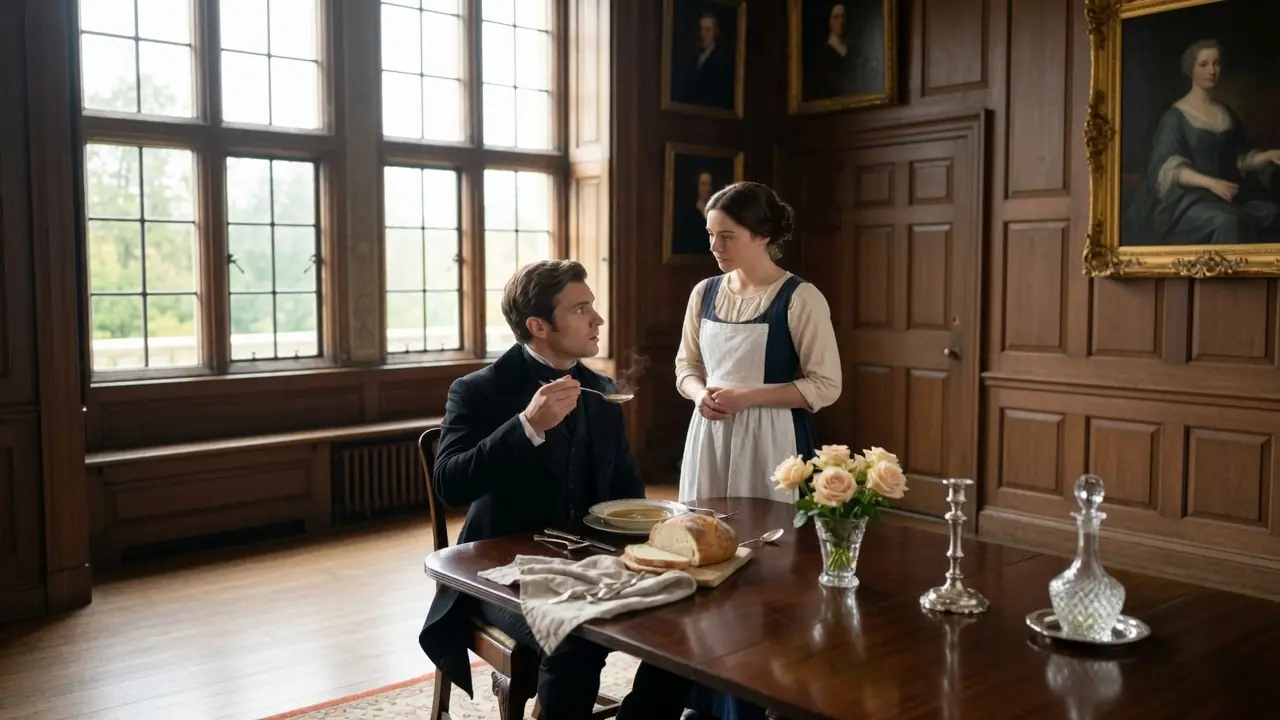
A profound and settled chill had taken up residence in the stone. A chill that had little to do with the season. It was the cold of a house that had lost its purpose. Fenbridge was a great house. It had grown from the land itself.
Its sandstone quarried from the surrounding hills. Its timbers hewn from an oak wood older than the ducal title it served. But now it was a great hollow thing, breathing a shallow and infrequent breath. The Duke of Whitchurch was in residence. He was always in residence.
And yet the house felt empty. It was into this carefully curated emptiness that Miss Vivian Whitmire arrived, seated on the hard bench of a carrier's cart, with one small scuffed trunk, and a mind full of numbers. She was 26 years old, the recently orphaned daughter of a clergyman, and possessed a quiet, resolute stillness that life had taught her was a form of armor. She did not look like a savior. In her plain gray traveling dress, with her dark hair pinned in a severe but practical knot, she looked like what she was, a woman of good breeding and no prospects, entirely dependent on the kindness of a relative.
The relative in question was Mrs. Croft, her mother's elder sister, and the housekeeper at Fenbridge for 40 years. It was Mrs. Croft who met her in the cavernous, cold kitchen, her face a road map of worry. "Vivian, my dear child," she whispered, her hands fluttering as she took in Vivian's rain-spattered cloak. "You are here. Thank the good Lord.
You are here." Vivian allowed herself to be enfolded in a brief, wiry embrace that smelled of lavender and beeswax. "Aunt Hortense, I came as quickly as I could. The journey was not too terrible. The roads were poor, but the driver was kind," Vivian answered, her gaze already taking in the vast, understaffed kitchen. A single scullery maid scrubbed pots in a corner, her movements slow and listless.
The great range, large enough to roast an ox, was mostly cold. Only a small section was lit, a kettle steaming morosely upon it. Mrs. Croft followed her gaze. "It is not as it was," she said, a tremor in her voice. "Nothing is as it was." Vivian knew the story, or the parts of it her aunt had dared to commit to paper.
The Duke, Richard, had returned from the final battle against Napoleon in 1815, a decorated hero and a broken man. He had seen his younger brother, his closest friends, and half the men from his own estates fall at Waterloo. He had come home to Fenbridge, dismissed the majority of the staff, closed up most of the house, and retreated into a silence as vast and impenetrable as the surrounding moors. For 10 years, he had spoken to almost no one. For 10 years, he had dined alone, a single place setting at the end of a vast, polished table, eating whatever was placed before him without comment or complaint.
He was a ghost in his own life. "His Grace is... well?" Vivian asked delicately. Mrs. Croft wrung her hands in her apron. He is as he always is. He will take his ride at dawn, regardless of the weather.
He will spend the day in his rooms. He will come down for dinner at precisely 7:00. He will not speak. He will not see us. She took a deep breath.
But the estate, Vivian, the estate is failing. The tenants are leaving. The suppliers are demanding cash, and there is no cash. The agent in Newcastle sends papers I cannot make head nor tail of. I am an old woman.
I know how to keep a house, but I do not know how to keep it from ruin. This was the real reason Vivian was here. Not just for shelter, but because she had inherited her father's methodical mind. While other girls had been taught watercolor and piano, Vivian had been taught how to balance parish accounts, and how to make a single shilling do the work of two. "Let me see the books, Aunt," Vivian said, her voice calm and steady.
It was a tone that had soothed her father through his final illness. A tone that promised not miracles, but order. "Let me see the papers. I will put them right." Mrs. Croft led her not to a comfortable guest room, but to a small, clean chamber in the housekeeper's wing. It was cold, but the linens were fresh.
"His Grace does not know you are here," Not precisely. I have said my niece is coming to assist me. He did not object. Her aunt's expression was clear. He had not objected because he had not truly heard.
"Stay out of his sight, child. He does not like surprises." Vivian understood. She was to be as much of a ghost as the duke himself. A quiet, unseen force working in the shadows to hold the crumbling walls together. She unpacked her few belongings.
Two more dresses, one black, and one a dark, serviceable blue. A book of sermons by her father, and a worn, leather-bound ledger, its pages filled with her own neat, precise script. It was all she had left of her old life. That evening, as the clock in the great hall struck seven, Vivian stood in the shadows of the upper gallery. She watched as the Duke of Whitchurch descended the grand staircase.
He was tall, broader in the shoulder than she had expected, and moved with a strange, contained grace, like a great hunting animal confined to a cage. His chestnut hair caught the dim light of the single candle sconce that was lit. He did not look at the portraits of his ancestors that lined the walls. He did not look at the dust motes dancing in the gloom. His gaze was fixed on the floor ahead of him.
Vivian did not pity him. She had learned early that pity was a useless emotion. Instead, a different feeling took root. A quiet, stubborn determination. She looked from the retreating figure of the duke to the peeling paint on the wall, to the tapestry that was fraying in its corner.
It was all one and the same problem: a great house and a great name falling into ruin. And she, for reasons she could not yet fathom, was the only one who seemed to have noticed. She retreated to her room. The image of his clenched fists burned into her mind. The house was not empty, she realized.
It was full of a grief so large it had displaced everything else. The next morning, Mrs. Croft led Vivian to the estate office. It was a small, cold room behind the butler's pantry, smelling of dust and decay. Piles of paper lay everywhere. Bills, receipts, letters, and ledgers coated in a fine gray powder.
They were not filed. They were not ordered. They were simply abandoned. The last agent left 5 years ago, Mrs. Croft said, her voice hushed, as if the papers themselves might object. His Grace would not appoint another.
He said to send everything to his man of business in Newcastle, but I don't think Mr. Henderson has ever set foot in this house. Vivian ran a finger over a stack of invoices, leaving a clean line in the dust. He has been paying them, I assume. A draft is sent from the bank in London every quarter, but is it enough? Is it too much?
Who is to say? The butcher complains the price of beef has risen. The chandler says the cost of wax is twice what it was. I have no authority to agree or disagree. I just... I try to make do.
Vivian picked up the top invoice. It was from the local blacksmith for the shoeing of four horses, dated 6 months prior. It was marked unpaid. Beneath it was another and another. A mountain of small, forgotten debts.
"This is not a muddle, Aunt," Vivian said softly, after an hour of silent assessment. "This is a catastrophe waiting to happen." For the next week, Vivian worked in the small, cold office from dawn until dusk. She moved like a shadow through the house, never venturing into the main wings during the hours the Duke might be about. She learned the rhythms of his ghostly existence. The sound of his boots on the gravel at sunrise as he left for his solitary ride, the faint echo of his footsteps in the hall as he descended for dinner, the utter silence from his wing of the house at all other times.
He was a fixed point of stillness in a world she was determined to set in motion. She began by imposing order. She sorted the papers into piles, invoices, receipts, letters from tenants, legal documents. She sharpened quills, mixed fresh ink, and opened a new ledger. Her handwriting, clear and elegant, began to fill the empty pages.
A quiet rebellion against the chaos. She found discrepancies everywhere. Suppliers who were overcharging, tenants who had not paid rent in years, bills for services that had long since been discontinued. She started with the kitchen accounts. She discovered they were paying for 20 pounds of butter a week, though Mrs. Croft confirmed they used less than half of that.
They were being charged for game from the market when the estate's own gamekeeper could provide more than enough. Small things, insignificant things, perhaps, in the grand scheme of a dukedom. But Vivian knew that a great house did not fall in a single crash of thunder. It crumbled away in tiny, unnoticed increments. She began to make changes.
She sent polite, firm notes to the suppliers questioning their invoices. She calculated the exact amount of food needed each week and had Mrs. Croft order only that. She discovered a cache of fine French brandy in the cellars, untouched for a decade, and arranged for a wine merchant from Newcastle to purchase it, providing a much-needed injection of cash. The house began, almost imperceptibly, to change. There was a little more food in the larder.
The scullery maid received her back pay and started to smile. Mrs. Croft seemed to stand a little straighter. The chill in the stone corridors did not disappear, but it seemed to retreat a little, pushed back by the small, persistent warmth of Vivian's purpose. Vivian felt a satisfaction in it that was sharp and clean. This was a puzzle she could solve.
The numbers on the page added up, balanced, and made sense in a way that life often did not. She was not just helping her aunt. She was rebuilding a world. One afternoon, seeking a specific deed from 1780, Mrs. Croft suggested the main library. "His Grace never goes in there," she assured Vivian.
"Not since his father passed. The old duke spent all his days in there. I think the memory is too strong." The library was on the ground floor of the west wing, a magnificent room with a soaring, vaulted ceiling, and shelves that reached two stories high. But it, too, had succumbed to the general air of neglect. A thick layer of dust covered everything, and the air was stale and close.
The grand fireplace was dark and empty, the curtains drawn to protect the books, plunging the room into a perpetual twilight. But it was a sanctuary. Vivian felt it the moment she stepped inside. The silence in here was different from the silence in the rest of the house. It was not an empty, grieving silence.
It was a full silence, pregnant with the thoughts and stories of a thousand books. She found the deed she was looking for in a matter of minutes. Her logical mind navigating the old filing system with ease. But, she did not leave. She ran a hand along a row of leather-bound spines, reading the gilt titles.
Homer, Virgil, Shakespeare. A world of knowledge sitting here, forgotten. On an impulse, she went to the heavy velvet curtains and pulled one open a few inches. A spear of pale afternoon sunlight cut through the gloom, illuminating a constellation of dancing dust motes. It fell across a large globe standing in the corner, tracing the faded lines of continents and oceans.
It felt like a sacrilege and a liberation. She began to spend her afternoons in the library. She told herself it was for work, that the large table was better for spreading out the vast estate maps. But, it was more than that. She would open the curtains a little wider each day, letting more light into the room.
She began to dust the books carefully, one shelf at a time. She found a copy of Virgil's Georgics, a poem about the cultivation of the land, and began to read it in the evenings. Its ancient, practical wisdom a strange comfort. The house was her patient, and slowly, slowly, it was responding to her care. The Duke remained a ghost, a rumor of footsteps in a distant hall.
Vivian felt his presence as a constant low pressure. The unmoving center around which she orbited. She knew the color of his favorite horse. The exact duration of his morning ride. The fact that he never touched the wine poured for him at dinner.
She cataloged these small particulars as she cataloged the estate's debts. They were facts. Data points in the complex equation of the man and his house. She did not think about him as a man. To do so would be a dangerous folly.
He was a problem to be managed. The largest and most intractable variable in her new life. She was the unseen custodian of his world. And that was how it must remain. She was content in the shadows.
The shadows, after all, were safe. One evening in late November, a crisis erupted in the kitchen. Cook, a stout woman prone to dramatics and the consumption of cooking sherry, had declared herself too ill to perform her duties. She had taken to her bed with a fit of the vapors, leaving the preparation of the Duke's dinner in jeopardy. Mrs. Croft was beside herself.
What are we to do? What are we to do? She fretted, pacing the flagstones. It is half past six. His Grace dines at seven.
He must have his dinner at seven. The routine was sacrosanct. To break it was unthinkable. What was Cook preparing? Vivian asked calmly, tying on a spare apron.
A cold collation. Some sliced game pie, a bit of cheese, bread. The usual. Mrs. Croft's voice was thin with anxiety. He will not complain if it is not there.
That is the horror of it. He will simply sit in an empty room. The image was more than Vivian could bear. A man starving in his own house, not from a lack of food, but from a lack of care. "That will not do," she said, her decision made in an instant.
On a night this cold, a man needs a hot supper. Before her aunt could protest, Vivian was in motion. She stoked the fire in the range, her movements quick and efficient. She surveyed the larder with a practiced eye. There was leftover roasted mutton from the staff's midday meal, potatoes, an onion, some carrots.
It was humble fare, but it could be made into something nourishing. "Aunt, please find me the rosemary from the herb garden," she instructed. "And is there any of that good cheddar left?" For the next 30 minutes, the kitchen was a hive of quiet, focused activity. Vivian worked with a speed and confidence that surprised even her aunt. She had learned to cook from her mother, not for pleasure, but for sustenance, learning how to turn simple ingredients into something warm and comforting.
She chopped the vegetables, diced the mutton, and set a pot of water to boil for the potatoes. The air filled with the savory scent of frying onions, a smell the kitchen had not known in years. She made a shepherd's pie, the mashed potato topping ridged with a fork and dotted with butter. She found a tin of chicken broth and turned it into a simple, hearty soup. At precisely 5 minutes to 7:00, she ladled the soup into a bowl and placed the pie, golden brown and bubbling, onto a tray.
"There," she said, wiping her hands on her apron. "A proper meal." Mrs. Croft stared at the tray. It was simple, rustic. It was not the kind of food a duke was typically served, but it was hot. It was real.
It was an offering. "Who will take it up?" the scullery maid asked, her eyes wide. There was a moment of hesitation. It was the footman's job, but the one remaining footman was a doddering man of 70. "I will," Vivian said, before she could think better of it.
She took off the apron and smoothed down her dark blue dress. She trusted no one else to carry it without incident. And more than that, she wanted to see this small act of rebellion through to its conclusion. She carried the heavy silver tray up the back stairs and along the service corridor that ran behind the main gallery. She paused at the door to the dining room, her heart beating a little faster than usual.
She could hear the silence from within. She placed the tray on the dumbwaiter, gave the rope a firm pull, and waited. A moment later, the dumbwaiter returned empty. She had done it. She had sent a small, warm signal into the heart of the frozen palace.
She did not know if it would be received, but she had sent it all the same. She returned to the kitchen, her face betraying nothing of the turmoil within. An hour later, the footman came down to clear. He carried the empty dumbwaiter tray. The soup bowl was empty.
The dish that had held the shepherd's pie was scraped clean. Mrs. Croft looked at Vivian, her eyes shining with unshed tears. "He ate it." she breathed. "He ate it all." Vivian felt a strange fierce joy. It was a small victory, a single meal, but in a house that had been starved of warmth for a decade, it felt like a revolution.
From his solitary post in the vast echoing dining room, Richard, Duke of Whitchurch, noticed the change. He noticed everything. His self-imposed exile had honed his senses, made him preternaturally aware of the small shifts in his environment. He noticed the way the draft from under the door seemed less persistent. He noticed the beeswax polish on the table held a deeper luster.
He noticed the bread, for the first time in memory, was fresh. They were insignificant details, motes of dust in the great still cathedral of his grief. He had built this life for himself, a fortress of routine and silence. It was his penance for surviving when better men had not, for carrying a title he felt he had not earned, a life he did not want. The cold tasteless meals, the echoing halls, the profound loneliness, they were the hair shirt he wore, a constant private atonement.
Then, one night, the routine was broken. He had come down to dinner at his appointed hour, expecting the usual cold pie, the dry cheese. Instead, a scent had met him on the stairs. A warm, savory, unfamiliar scent. It was the smell of a home, a smell he had not encountered since he was a boy in his mother's nursery.
It was so out of place in the sterile world of Fenbridge that for a moment he thought he had imagined it. But when he sat at the table and the dumbwaiter ascended, the scent became a reality. A bowl of steaming soup, a dish of shepherd's pie, its potato crust golden and inviting. It was not ducal fare. It was the food of the fields, of the kitchens, of the common man.
It was the food his men had dreamed of in the cold mud of Belgium. He stared at it for a full minute. One second. Two seconds. Three.
It was a disruption, a message. He did not know what it meant. His first instinct was to reject it, to send it back untouched, to reinforce the walls of his isolation. But he was hungry. Not just for food, but for the warmth that emanated from the simple, honest meal.
He picked up his spoon. The soup was chicken and vegetable, perfectly seasoned. He ate it all. He moved on to the pie. The mutton was tender, the gravy rich.
It tasted of care, of effort. When he was finished, he sat back in his chair, a strange feeling settling in his chest. It was not contentment. He had forgotten what that felt like. It was something else.
A disquiet. The meal was an intrusion, a question asked of a man who had forbidden all questions. He did not sleep well that night. The ghosts were more restless than usual. He saw their faces in the dark, young men from his village, men he had led to their deaths.
He had promised their mothers he would bring them home. He had failed. The warmth of the meal felt like a betrayal of their memory, a comfort he had not earned. The next morning, he broke another of his own rules.
After his ride, instead of retreating to his rooms, he went in search of Mrs. Croft. He found her in the linen room counting sheets. She started when she saw him, curtsying so low she nearly fell over. Your Grace. It had been years since he had sought her out. He felt a flicker of something that might have been guilt at the fear in her eyes.
"The dinner," he said, his voice rough from disuse. "Last night." "Yes, Your Grace." I hope it was acceptable. He ignored the question. Cook was ill? "Yes, Your Grace." A sudden indisposition.
He waited. He was a master of waiting. He could outwait generals, politicians, and frightened housekeepers. Mrs. Croft's composure began to crumble. It was my niece, your grace, Vivian.
She's come to help me. I'm not as young as I was. She she meant no disrespect. Cook was unwell, and she did not wish for your grace to go without a hot meal. A niece.
A new person in the house. An unknown variable. He did not like it. I was not informed. No, your grace.
It was my oversight. She's very quiet. She keeps to my rooms. You will not even know she is here. But he did know.
He had known for weeks. Though he had not known what it was he knew. The subtle shifts. The quiet improvements. It was her.
This Vivian. He gave a curt nod and turned to leave. He had the information he needed. But as he reached the door, he stopped. He did not turn around.
The soup. He said to the doorframe. "It required more salt." And then he was gone. Leaving Mrs. Croft staring after him. Her hand pressed to her heart.
It was the first opinion he had offered on his food in 10 years. Richard told himself he was angry. The intrusion was unforgivable. His house, his sanctuary of silence, had been breached. He resolved to put a stop to it.
He would tell Mrs. Croft her niece must leave. The thought gave him a grim sort of satisfaction. But he did not do it. Instead, he found himself watching. Listening.
He started to notice things. A flicker of movement in the gallery when he came down for dinner. The faint scent of lemon oil in the air. The discovery of a book left on a table in the hall. A marker in its pages.
He picked it up. Virgil. He found her in the library. He had not entered the room since his father's funeral. It was his father's heart.
The place where the old duke had reigned. Surrounded by his books and maps. For Richard, it was the room where he had received the news of his commission, where he had last seen his father's proud, hopeful face. The memories were too sharp, the ghosts too numerous. He had been drawn there by an unfamiliar sound, the soft rustle of paper.
He pushed the door open silently. The room was transformed. The heavy curtains were drawn back, and the gray light of a winter afternoon streamed in, illuminating the space. The air was clean. The dust was gone.
And in the center of the room, at the great library table, sat a woman. She was bent over a large, sprawling map of the estate, her dark hair catching the light. A ledger was open beside her, and she was making neat, precise notes with a quill. Her brow furrowed in concentration. She was wearing a simple, dark blue dress.
She looked as if she belonged there, as if the room had been waiting for her. She was the niece, Vivian. He watched her for a long moment, unseen in the doorway. She was not beautiful in the fashionable sense. Her features were too serious, her expression too intent.
But there was a harmony to her face, a quiet intelligence in her clear, focused eyes. She was a figure of profound stillness, of absolute purpose. She was everything he was not. He stepped into the room. "You are trespassing." She did not startle or cry out.
She simply lifted her head, her expression unreadable. Her eyes were a cool, clear gray, the color of the winter sea. She looked at him directly, without fear or supplication. "No, Your Grace," she said, her voice low and even. "I am working." He walked towards the table, his boots echoing on the polished floor.
He looked down at the map. It was covered in her notes. Red ink for debts, black ink for assets, green ink for potential. She was dissecting his home, or his history, laying it bare on the table. "This is my library," he said, the words sounding childish, even to his own ears.
"It has been neglected," she replied, not unkindly. "Like the rest of the house." The sheer audacity of it left him speechless. No one had spoken to him with such plain, unvarnished truth in a decade. "My aunt is old and tired," she continued, as if sensing his confusion. "The accounts were in chaos.
The estate is bleeding money. Someone had to put them in order. You did not, so I did." He stared at her, a whirlwind of emotions swirling within him. Anger, indignation, and something else, something he could not name. A grudging respect.
"You think you can save this place with your little book of numbers?" he sneered, the cruelty a reflex, a shield. Her gaze did not waver. "No, Your Grace. I think I can show you how it can be saved, but only you can save it." She gestured to the map. "The north fields are lying fallow, but the soil is good. They could be leased for barley.
The west woods are full of mature oak that could be sold for timber, with enough left for the next 100 years. Your tenants have not had their cottages repaired since the war. They cannot pay rent if their roofs leak and their fields flood." She spoke with a passion that was as quiet and intense as she was. She was not talking about numbers.
She was talking about a living, breathing entity. About the land. About his duty. He felt a sudden, suffocating pressure in his chest. He turned and walked to the window staring out at the bleak winter landscape.
"You know nothing of my duty."
"I know that a title is not a privilege but a responsibility," she said softly from behind him. "My father taught me that, and he was only a vicar."
Silence fell between them. It was a different kind of silence than the one he was used to. It was not empty. It was filled with her words. With the challenge she had laid at his feet.
He should have thrown her out. He should have been furious. But all he felt was a profound weariness and a flicker of something he had long thought extinguished. A spark of interest. "Continue your work," he said without turning.
"But do not presume to know what is best for this house or for me." He left the library. The scent of old books and lemon oil and the memory of her clear, steady gaze following him down the hall. The fortress of his solitude had been breached not by a frontal assault but by a quiet woman with a ledger and a pot of ink. And he found, to his own astonishment, that he was not entirely displeased. The winter deepened, locking Fenbridge in its icy grip.
But inside the great house, a slow thaw had begun. The encounters between the Duke and the bookkeeper's niece became a strange, unspoken ritual. Richard found himself drawn to the library, the one place he had avoided for so long. Now the only place in the house that felt alive. He would enter without a word and take a book from the shelves, settling in one of the large wingback chairs by the fireplace, which Vivian now kept lit.
He would pretend to read, but he would watch her over the top of his book. He watched her work, her concentration absolute. He watched the way she bit her lip when a column of numbers refused to balance. He watched the small, satisfied smile that touched her mouth when she finally brought order to a page of chaos. Vivian, for her part, was acutely aware of his presence.
At first it was unnerving. He was a brooding, silent giant in the corner of her new-found sanctuary. But she learned to work around him. She treated him as she treated the ancient globe or the bust of Cicero, as another piece of the room's furniture. A particularly large, dark, and unpredictable piece of furniture, but a fixture nonetheless.
They rarely spoke. Sometimes a full afternoon would pass with only the whisper of a turning page or the scratch of her quill to break the silence. But the silence was changing. It was no longer the hostile, grieving emptiness of the house. It was becoming a shared silence, a space of quiet companionship.
One afternoon, she was struggling to reach a book on a high shelf. She was perched precariously on the library steps when his shadow fell over her. "Allow me," he said. His voice was low, close to her ear. She froze, her hand still outstretched.
He reached past her, his arm brushing her shoulder. The brief contact sent a jolt through her, a startling warmth in the cold room. He easily retrieved the book, a treatise on crop rotation, and handed it to her. Their fingers brushed. His hands were large, strong, the knuckles scarred, the hands of a soldier.
She looked up at him, and for the first time, their eyes met and held for more than a fleeting second. His were the color of a coming storm, and she saw something in their depths beyond the cold indifference, a flicker of pain, of exhaustion. "Thank you, Your Grace," she whispered, her voice barely audible. He simply nodded and retreated to his chair, the brief moment of connection broken. But it left an afterimage, a change in the very air between them.
He was not a statue. He was a man, a man who was suffering. Richard returned to his chair, his heart hammering in his chest. The simple act of handing her a book had felt monumental. Her scent, a clean, fresh smell of soap and paper, filled his senses.
The brief touch of her skin was like a spark on dry tinder. He had spent 10 years avoiding all human contact, and in a single moment, this quiet, serious woman had breached his defenses without even trying. He was terrified and intrigued. He began to ask her questions. Not personal questions.
Never those. But questions about her work. "What is this?" he asked one day, pointing to a diagram she had drawn. "A plan for a new drainage system for the lower pastures, Your Grace," she explained, her tone business-like. "The current one is blocked.
That is why the fields flood every spring. If we clear it and extend it, we could reclaim 20 acres of grazing land." He listened as she explained the costs, the labor required, the projected increase in revenue from leasing the new pasture. Her understanding was not just theoretical. It was practical, grounded, sensible. She had walked the land.
She had talked to the tenants. She had done the work. He began to walk the land with her. Their walks were as silent as their afternoons in the library. He would follow a few paces behind as she strode through the muddy fields, her cloak pulled tight against the wind, pointing out a broken fence, a leaking roof, a field choked with weeds.
She did not offer solutions. She simply showed him the problems. She made him see his own neglect. He began to see the estate not as a burden, but as a patient, wounded and bleeding, that he had abandoned. And he began to see Vivian Whitmire not as an intruder, but as the only person who had been brave enough to staunch the bleeding.
One blustery March afternoon, they took shelter from a sudden squall in an old shepherd's hut on a high ridge overlooking the estate. The rain lashed against the small window. Inside, it was dark and smelled of earth and old wool. "My father and I used to walk for miles," Vivian said, her voice soft, her gaze distant. "He said you could not care for a parish if you did not know its boundaries, its pathways, its people." It was the first time she had ever volunteered a piece of personal information.
Richard held his breath, afraid to break the spell. "He loved this land," she continued. "He believed that God was in the turning of the seasons, in the strength of the oak, in the resilience of the grass." She turned her gaze from the window to him. "He would have loved Fenbridge." In her eyes, he did not see pity. He saw understanding.
She was not just talking about the land. She was talking about him. About the resilience he had forgotten he possessed. He had the sudden, overwhelming urge to tell her everything: the war, the dead, and the guilt he carried. But the words would not come.
Vivian told herself it was gratitude. He was grateful for her help in saving his estate. That was all. She was an employee. A useful tool.
To imagine anything else was a dangerous fantasy. A path that led only to heartbreak for a woman in her position. She focused on her ledgers. On the neat columns of numbers that made sense. That did not have storm gray eyes that could see right through her carefully constructed defenses.
Richard felt it, too. He felt it as a constant low ache in his chest. This quiet, capable woman had not only brought his house back to life. She had woken something in him. A feeling he had thought long dead and buried in the fields of Flanders.
It was more than gratitude. It was a deep, soul-shaking recognition. He saw in her a strength and integrity that humbled him. He wanted to close the distance between their chairs, to take her hand. To tell her What?
He did not have the words. One evening, he made a change to his own rigid routine. Instead of taking his solitary meal in the great dining hall, he instructed a bewildered footman to set a table for one in the small, intimate breakfast room that overlooked the newly repaired gardens. The room was warm and filled with the scent of spring flowers from a vase Vivian had placed on the mantelpiece. Eating there, alone, felt less like a punishment and more like a quiet moment of peace.
It was into this fragile new-found peace that Lady Camilla Ainsworth arrived. She came on a bright afternoon in May in a gleaming carriage drawn by four perfectly matched gray horses, a whirlwind of silk, perfume, and breathless exclamations. Lady Camilla had been Richard's fiance before the war. She was the daughter of a neighboring earl, a celebrated beauty, and the woman everyone had expected him to marry. Theirs was to have been the match of the decade.
Then came Waterloo. Richard had returned a changed man and broken the engagement with a cold, brief letter. Camilla, by all accounts, had been devastated. She had never married. Now, 10 years later, she had apparently decided that enough was enough.
Hearing rumors that the Duke of Whitchurch was finally emerging from his shell, she had come to reclaim her prize. Vivian was in the front hall discussing the delivery of new seed potatoes with the head gardener when the carriage swept into view. She watched as Lady Camilla alighted, a vision in rose-pink muslin, her face framed by a bonnet festooned with ribbons and silk flowers. She looked around at the scaffolding, the wagons of stone, the general air of productive chaos, and her perfectly shaped lips thinned in disapproval. "Good heavens," she said to no one in particular.
It looks like a building site. What on earth has Richard been thinking? She swept into the hall, her gaze falling on Vivian. She looked her up and down, taking in the plain brown dress, the ink stain on her finger, and dismissed her with a single cool glance. You there, she said, her voice light and musical, but with an edge of steel.
Inform his grace that Lady Camilla Ainsworth has arrived. And then have someone bring me tea. I have had a most dreadful journey. At that moment, Richard himself appeared at the top of the stairs, drawn by the commotion. He had just come in from the fields.
His boots were muddy. His hair was wind-tousled. And he had a smudge of dirt on his cheek. He stopped dead when he saw her. Camilla, he said.
The name was flat, devoid of all emotion. Richard, darling, she cried, her face breaking into a radiant smile. She glided to the bottom of the staircase and looked up at him. Her head tilted. I heard you were finally rejoining the world, and I thought it was high time I came to see for myself.
You have been a hermit for far too long. The next few days were excruciating for everyone. Camilla installed herself in the finest guest suite and set about trying to turn back the clock. She acted as if the last 10 years had been a brief, unpleasant interruption, and that she was now ready to take up her rightful place as Duchess of Whitchurch. Her presence was a loud, jarring note in the quiet harmony Vivian and Richard had established.
She was everything Vivian was not. Bright, frivolous, demanding, and utterly self-absorbed. She filled the silent house with chatter, with plans for balls and house parties, with complaints about the lack of fashionable society. "We simply must reopen the London house, Richard." she announced at dinner on her first night. She had insisted on dining in the great hall, the two of them looking like tiny, lost figures at either end of the vast table.
"And this house needs a complete redecoration. It is so dreadfully brown." Richard responded in monosyllables, his face carved from stone, the old, cold mask firmly back in place. He retreated from her, and in doing so, he retreated from Vivian as well. The walks stopped. The library sessions ceased.
He was once again a ghost in his own house, but this time he was haunted by a new ghost, a ghost from his past, dressed in rose-pink muslin. Camilla treated Vivian with a kind of pleasant, dismissive cruelty. She never learned her name, referring to her simply as the little brown bird or Mrs. Croft's useful niece. She saw Vivian in the library, surrounded by the estate ledgers, and laughed. "Oh, Richard, you don't actually let her meddle with the accounts, do you?" she trilled.
"How quaint. You must hire a proper agent, darling. A man. These things are not for a woman's delicate sensibilities." Vivian said nothing. She simply endured.
She did her work, her face a calm, placid mask. But inside, a storm was raging. It was not jealousy. It was a fierce, protective anger. Camilla did not see the real Fenbridge, the living, breathing entity that was slowly healing.
She saw only a backdrop for her own social ambitions. She did not see the real Richard, the man scarred by war and grief, who was fighting his way back to the light. She saw only a duke, a title, a prize to be won. The situation came to a head a week after her arrival. Camilla, determined to force Richard into the role she had chosen for him, decided to host a dinner party.
She invited her father, the Earl, and a handful of other local gentry who were still on speaking terms with the reclusive duke. "It will be a new beginning, Richard," she declared, ignoring his stony silence. "A relaunch. We will show the world that the Duke of Whitchurch is back." The preparations threw the household into chaos. Mrs. Croft and Vivian worked tirelessly, trying to produce a grand dinner from a kitchen that was accustomed to simple, rustic fare.
Camilla swept through, criticizing everything, changing menus, demanding flowers that were not in season, and generally making everyone's life a misery. She was not a monster. She was simply a woman who had been raised to believe the world would bend to her will, and who could not comprehend that it would not. Her frustration made her cruel. Vivian watched her, and for the first time she felt a sliver of understanding.
Camilla had also been a victim of the war in her own way. She had been left waiting for a man who had never come home. Not really. Her life had been put on hold and now she was trying to force it back into motion using the only tools she had. Charm, beauty, and a will of iron.
It was sad as well as infuriating. The night of the dinner party arrived. Vivian, her work in the kitchen done, retreated to the library. She could not bear to be a witness to the charade. She tried to lose herself in her ledgers but the sounds of the party the murmur of conversation the clink of glasses, the forced laughter drifted down the hall.
Each sound a small torment. She knew this was the end of her time at Fenbridge. When not if Richard married Camilla there would be no place for her here. She would be the dowdy, overreaching niece of the housekeeper. A reminder of a time they would all want to forget.
The thought was a cold, hard knot in her stomach. She had come to love this house this land. She had come to care for its broken master. It was a foolish, hopeless affection and it was going to break her heart. The library door opened.
Richard stood there, dressed in formal evening attire. He looked pale and utterly exhausted. A prisoner in his own fine clothes. "It is loud," he said, his voice strained. "Yes, Your Grace." He walked into the room and closed the door, shutting out the noise.
He came to the table and looked down at her work. At the familiar comfort of her neat columns of figures. "She wants me to be someone I am not," he said. His voice barely a whisper. Someone I have not been for a very long time.
"I know," Vivian said softly. He looked at her then, a desperate hunted look in his eyes. "What do I do, Vivian?" It was the first time he had used her given name. It hung in the air between them. A fragile, beautiful thing.
Her heart ached for him. "You tell her the truth," she said. The dinner party was a disaster. The local gentry, who had come out of a mixture of loyalty and morbid curiosity, were met with a host who was as silent and forbidding as the moors in winter. Richard sat at the head of his table like a grim specter, answering direct questions with monosyllables, and offering nothing to the conversation.
Camilla, seated at his right, tried her best to compensate. She was brilliant, witty, and charming. She told amusing anecdotes about London society, flattered the stuffy old earl, and tried to draw Richard into the conversation. All to no avail. Her smile grew more brittle as the evening wore on.
Her laughter a little too loud. She was like a desperate actress playing to an empty theater. Vivian, hiding in the library, could feel the tension from a hundred feet away. It was a palpable thing. A tightening in the very atmosphere of the house.
After the ladies had withdrawn, leaving the men to their port, the Earl, Camilla's father, made a clumsy attempt to corner Richard. "Good to see you back in the world, my boy," he blustered. "Time to put all that unpleasantness behind you. Camilla's been waiting a long time. A man needs a wife.
A duke needs an heir." Richard said nothing. He simply rose from the table and walked out of the room, leaving the Earl sputtering into his glass. The evening ended early. The guests, sensing the deep chill that had nothing to do with the night air, made their excuses and fled. Vivian was in a small alcove off the library, searching for a book on estate law, when she heard voices from the main room.
Richard had returned to his sanctuary, and Camilla had followed him. "What was that, Richard?" Camilla's voice was sharp, stripped of its earlier gaiety. "You humiliated me. You humiliated my father." "I did not ask you to come here, Camilla." Richard's voice was flat, weary. "I did not ask for this performance." "Performance?
I am trying to give you back your life. A life you have let crumble into dust. Look at this place. It's a ruin. And look at you, hiding in the dark with your books and your grief.
The war was 10 years ago. It is time to be the Duke of Whitchurch again." There was a long, heavy silence. Vivian held her breath, trapped in the alcove, an unwilling witness. When Richard finally spoke, his voice was quiet, but it cut through the room like a shard of glass. It was a voice she had never heard before, stripped of all its defenses, raw and terribly calm.
"The Duke of Whitchurch died in Belgium," he said. Camilla gave a short, incredulous laugh. "Don't be so dramatic, Richard." "I am not being dramatic." The quietness of his tone was more devastating than any shout. "I held my brother in my arms as he died. I wrote the letters to the mothers and wives of the men from this estate who were never coming home.
I watched boys of 18 charge a line of cannons because I ordered them to. And then I came home to this." He gestured around the grand, silent room. "To a title, to a party. The man you were engaged to, the man who thought that was a life worth living, he did not survive. He is buried in a field near a small village called Waterloo, along with everyone else I ever cared about." He was not looking at Camilla.
He was staring into the empty fireplace, his eyes focused on something a decade in the past. "I am what is left," he said. "This ghost, this ruin. This is all there is." The silence that followed was absolute. Vivian could hear her own heart beating.
She risked a glance from the alcove. Camilla was staring at Richard, her face pale, her beautiful mouth slightly open. For the first time, she was seeing him. Not the Duke, not her former fiance, but the stranger he had become. The truth, in all its brutal simplicity, had finally reached her.
All the fight went out of her. Her shoulders slumped. The brilliant, vivacious Lady Camilla seemed to shrink, becoming just a woman who had lost something she could not even name. "I see." She whispered. The words were barely audible.
"I am sorry, Richard. I truly am." She turned and walked out of the library and out of his life. She did not weep. She did not rage. Her defeat was quiet, dignified, and profoundly sad.
Her dream was over, and she finally knew it. Richard did not move. He stood staring into the fireplace, his body rigid, as if the confession had turned him to stone. He knew Vivian was there. He had known it the whole time.
Perhaps he had even counted on it, needing a witness to the unburdening of his soul. Slowly, Vivian stepped out of the alcove. The book she had been seeking was still in her hand. She did not know what to say. The silence stretched between them, no longer comfortable, but charged with the weight of his confession.
He finally turned to look at her. His face was a wreck. His eyes hollowed out by the ghosts he had finally named. The mask was gone. All that was left was the man, raw and wounded, and terribly vulnerable.
He did not need to apologize for her overhearing. He did not need to explain. In that shared, terrible moment, a new understanding was forged. He simply stood there, visible for the first time. And she simply stood and saw him.
She walked toward him and, without a word, took the empty glass from his unresisting hand and placed it on the mantelpiece. Then she took his hand. It was cold as ice. She held it in both of her own, trying to chafe some warmth back into it. He looked down at their joined hands, at her small, capable hands holding his large, scarred one.
A single shuddering breath escaped him. "Stay," he said. The word was a plea. "Don't leave." She looked up at him into his storm-gray eyes and saw not a duke, but a man asking for a lifeline. "I will not leave," she said.
And in the quiet promise, in the simple, steady pressure of her hands, the house and the man finally began to heal. One year later, summer had come to Fenbridge: a deep, verdant, glorious summer. The gardens, once choked with weeds, were a riot of color and scent. Roses climbed the newly repaired walls and the lawns, thick and green, swept down to a lake that sparkled in the sun. The sound of hammers had been replaced by the drone of bees and the laughter of children—the sons and daughters of the tenants—who were celebrating the harvest from fields that were for the first time in a decade fertile and productive.
The house itself seemed to breathe the summer air. The windows were thrown open and a warm breeze stirred the curtains. The rooms were filled with light. The ghost of grief had not been banished but it had retreated to the shadows. Its power diminished.
In the library, which was now the heart of the house, Vivian, now the Duchess of Whitchurch, sat at the great table, a ledger open before her. But she was not looking at the numbers. She was looking out the window at her husband. Richard was standing by the lake, talking to the head gardener. He was dressed not in the fine clothes of a duke, but in the simple, practical attire of a landowner.
His sleeves rolled up, his face browned by the sun. He was smiling. It was not a wide, easy smile. It was a quiet, tentative thing, something he was still learning how to do. But it was real.
A small boy, the gardener's son, ran up to him, holding out a fistful of wild flowers. Richard crouched down to the boy's level, taking the crumpled offering with a solemn gravity, and then said something that made the boy laugh, a bright, carefree sound that carried across the lawn. Vivian's heart swelled. Their marriage, a quiet ceremony in the village church, 3 months after Camilla's departure, had scandalized the county. A duke marrying his housekeeper's niece, a woman with no name, no fortune, no connections.
They had whispered behind their hands. But Vivian and Richard had not cared. They had built their world here at Fenbridge, a world of quiet work, of mutual respect, and of a love that was as steady and deep as the ancient stones of the house. He was not cured. The war had left scars that would never fade.
There were still nights when he woke up, his voice choked with a silent scream, the ghosts of his past crowding in on him. On those nights, Vivian would simply hold him. A steady presence, a silent anchor in the dark, until the storm passed. There were still days when a profound melancholy would settle over him, when he would retreat into a silence that was a faint echo of his old prison. But he was no longer alone in the dark.
She did not try to fix him. She did not try to erase his past. She had simply given him a space to be seen, a place where his wounds were not a source of shame, but a part of the man she had come to love. Love, she had learned, was not a transaction, but a chosen act. It was the patient work of building a life together, brick by brick, day by day.
He looked up from his conversation and saw her watching him from the library window. His quiet smile deepened. He said a final word to the gardener and began to walk towards the house, towards her. Vivian closed her ledger. The accounts were balanced.
The estate was thriving, but her greatest accomplishment was not in the numbers. It was in the steady sound of her husband's footsteps on the gravel path, coming home. She rose to meet him. He entered the library, bringing the scent of sun and earth with him. He came to her and took her hands, lifting them to his lips.
"The accounts can wait, my love," he said. His voice was a low murmur that still sent a shiver down her spine. "Everything is in order, Your Grace," she replied, a teasing light in her eyes. "Richard," he corrected her softly. "My name is Richard." "I know," she said, her smile matching his.
He was not the man he had been. He was not the man he was supposed to be. He was simply the man who was here, now, his hand in hers, his eyes full of a love that was both a quiet harbor and a new beginning. He no longer dined alone. And in the great breathing house of Fenbridge, that had made all the difference.