Snow swallowed the courtyard of Ashborne Court beneath a white restless veil. Inside the long gallery beyond the banquet hall, servants waited between courses while musicians quietly tuned their instruments. Guards stood beneath gilded arches and noble attendants whispered beside tall windows darkened by the winter night.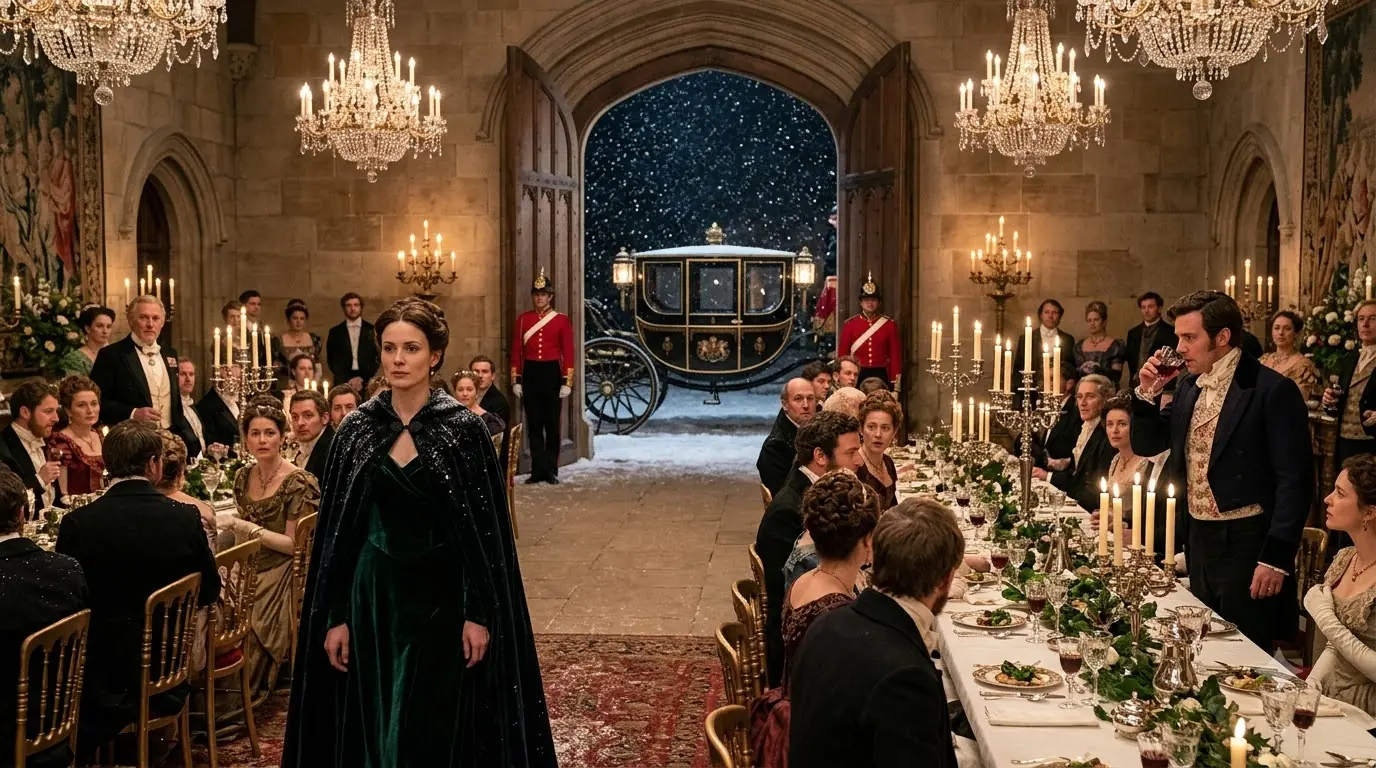
Then an equerry came running. "Open the courtyard doors."
Every conversation stopped. Beyond the windows came the unmistakable thunder of approaching horses. Hooves struck stone. Wheels rolled beneath the archway. Guards outside suddenly called the royal salute.
Inside the banquet hall, heads turned. Duke Charles Valehurst lowered his wine glass. A late ambassador whispered to the nobleman beside him. Charles barely listened. Across the hall, King Uldren II had already turned toward the doors. Strangely, the king did not look surprised.
The doors opened. A magnificent black carriage trimmed in gold stood beneath the falling snow. Charles recognized the crest immediately. It was not merely a palace carriage. It belonged personally to the king.
A footman opened its door. Duchess Freya veiled her step down. She wore a deep emerald gown beneath a dark velvet cloak dusted with snow. Her expression held neither triumph nor anger. She looked composed, almost solemn, as she crossed the gallery and entered the banquet hall.
Charles stopped breathing. Every noble turned. Then King Uldren rose. That shocked them more than the carriage.
Freya halted and bowed. "Your Majesty."
"Duchess Freya," Uldren said, his voice carrying across the silent hall. "Forgive the delay. My carriage should have reached you sooner."
Charles stared at his wife. Only then did he understand. The king had personally sent for the woman Charles had deliberately left behind.
Several hours earlier, Freya had believed she was unwanted there. For 6 years, Charles and Freya had been married. There had been affection once, real affection. Before becoming Duke of Veilhurst, Charles had laughed easily. He had sought Freya's opinion and admired the practical intelligence behind her quiet manner.
Then his father died. At 29, Charles inherited enormous estates, political influence, military patronage, and regular access to the crown. Power did not transform him overnight. It changed him gradually. Soon Charles became less concerned with whether decisions were wise than whether they appeared authoritative.
Freya noticed. When she asked about grain reserves, Charles heard criticism. When she questioned an estate report, he heard defiance. When she suggested another approach, he increasingly heard something worse: Competition.
That winter exposed the fracture completely. The first reports of fever arrived from Veilhurst's northern villages in December. Charles dismissed them as seasonal illness. Then more letters came. Dr. Elias Marin, physician for the Northern District, reported rising infections. Laborers were becoming too sick to work. Families were exhausting their coal reserves. Mills slowed. Elderly tenants and widows increasingly depended upon parish assistance.
Charles's steward assured him the situation remained manageable. Charles accepted that answer. Freya did not. She discovered the seriousness accidentally when several reports were placed among papers delivered to her sitting room.
That evening she found Charles in his study. "How many northern villages are affected?"
Charles looked up impatiently. "The steward is handling it."
"Dr. Marin says 14 villages reported cases last week."
Charles frowned. "You have been reading estate correspondence."
"It was brought to me accidentally."
"Then it should have been returned."
Freya placed the papers before him. "Families are running out of fuel. Winter is difficult every year. This is different."
Charles leaned backward. "And what exactly would you have me do? Petition the crown for emergency supplies?" His expression hardened. "I will not embarrass Veilhurst by begging the crown every time villagers become ill."
Freya stared at him. "Preventing deaths is not begging."
Charles remembered that sentence long afterward, not because it persuaded him, because he resented her for saying it.
Freya began working quietly. She wrote directly to Dr. Marin and asked what he needed. She used money from her personal household allowance to purchase blankets, medicines, food, and fuel. She convinced neighboring land owners to contribute coal. Most importantly, Freya created a reporting system. Every village reeve would send weekly numbers listing infections, deaths, grain reserves, available fuel, and households requiring immediate assistance. For the first time, someone could see the crisis clearly.
Freya sent Charles copies. He barely read them.
One summary eventually reached Lord Cedric Halver, the king's minister for domestic affairs. Cedric had been struggling with contradictory information from rural districts throughout the realm. Freya's reports were different. Simple, consistent, useful. Cedric wrote asking whether the crown might adapt her system elsewhere. Freya agreed immediately. Within weeks, modified versions were being used across three counties. King Uldren began seeing her name attached to official relief papers.
Charles knew almost nothing about it. Then the invitation arrived. The sovereign's harvest dinner was the most politically significant dinner of the winter season. Appointments were announced there. Service was honored. Families watched seating arrangements as carefully as speeches because proximity to the king often revealed royal favor. The invitation named both Duke Charles Vealehurst and Duchess Freya Veilhurst.
Charles noticed something else. Lord Cedric had handwritten a request that Freya be seated near officials responsible for domestic relief.
"Why would Cedric Halver request you?"
Freya looked up. "He has been using the Northern reporting system."
Charles stared at her. "What reporting system?"
She explained. His face darkened. "You corresponded with a royal minister without telling me."
"I sent you copies of everything."
"That is not the point."
"What is the point?"
"You have inserted yourself into government affairs."
"I was trying to keep people alive."
"You have made me look negligent."
Freya's expression changed. "If the truth makes you look negligent, perhaps your quarrel is not with me."
Charles said nothing. But in that moment, he decided she would not attend.
On the afternoon of the dinner, servants prepared them both. Freya had nearly finished dressing when Charles entered her chamber. Her emerald gown had been chosen weeks earlier. Charles looked at her for several seconds.
"Take it off."
Freya thought she had misunderstood. "What?"
"You are not attending tonight."
She turned fully toward him. "Why?"
"I have informed the palace that you are unwell."
Freya's disbelief sharpened. "You did what? The harvest dinner is not a charitable committee meeting."
"I will not spend the evening watching my wife parade herself before ministers as though she possesses some office independent of mine."
"I have never paraded myself before anyone."
"You have become unhelpful."
"Unhelpful to whom?"
"To me."
Silence followed. Freya understood. Then this was not about etiquette. Charles was afraid. Still, one possibility mattered more.
"Did his majesty request that I remain behind?"
Charles hesitated. The honest answer was no, but honesty would expose everything. "Yes."
Freya studied his face. She believed him, that mattered. Her shoulders lowered slightly. "Very well."
Charles left alone. Freya changed into a simple evening dress and returned to Dr. Marin's latest report.
At Ashborne Court, dinner began without her. King Uldren noticed the empty place.
"Where is Duchess Freya?"
Lord Cedric looked toward Charles. "I was informed she would not attend, Your Majesty."
"Why?"
Cedric discreetly approached Charles between courses. "His majesty understood the Duchess would be here."
"My wife is indisposed," Charles answered.