What drives a lady of the aristocracy to the most dangerous alleys of London? Pure, blinding desperation.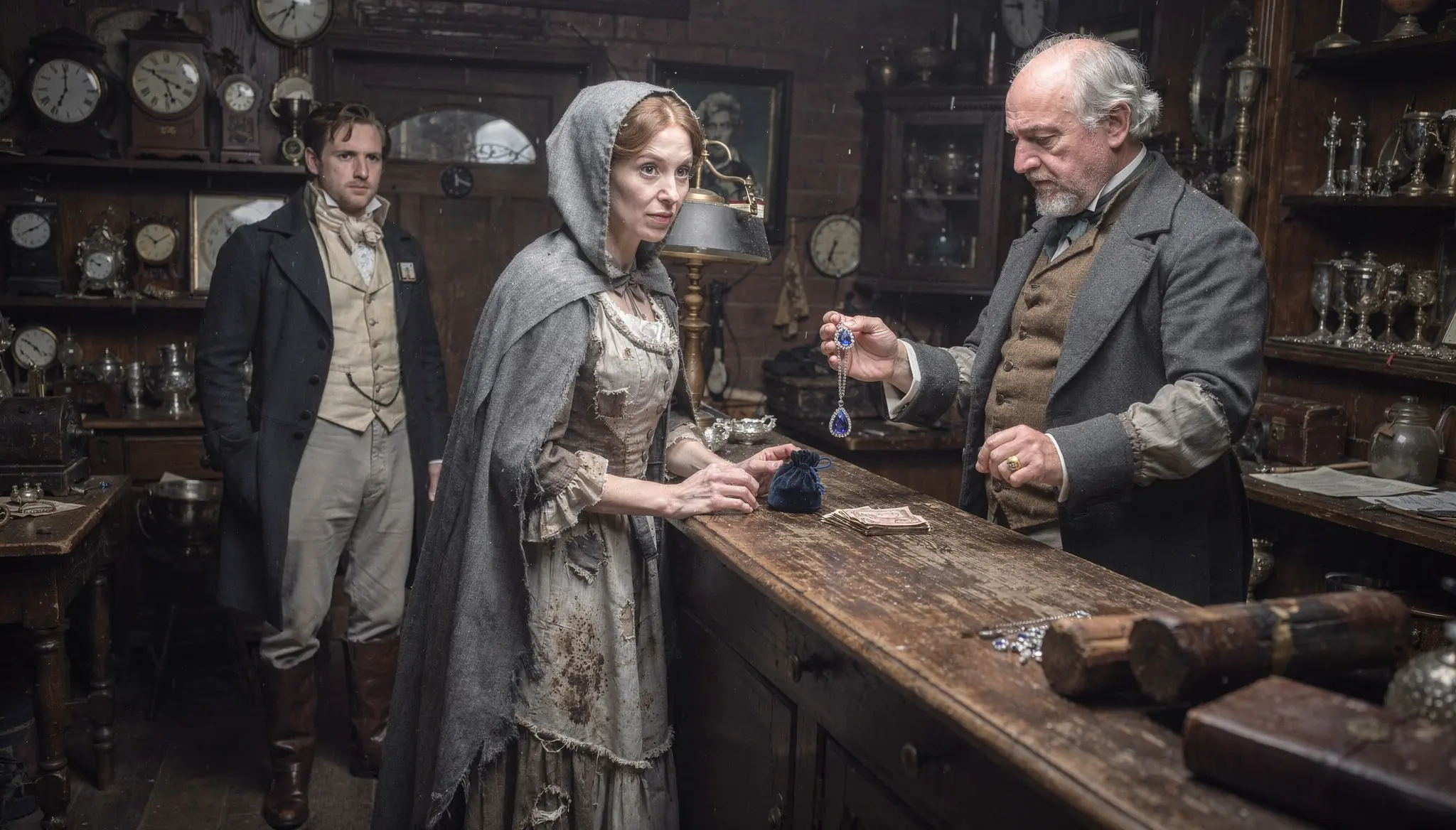
When the Duke of Westmoreland stepped into a squalid Cheapside pawn shop to escape the freezing rain, he never expected to find the only woman he had ever loved trading her grandmother's sapphire merely to survive. The winter of 1814 was recorded in the annals of London as one of the most brutally unforgiving in a century. The Thames had frozen solid, and a biting frost clung to the cobblestones of Cheapside like a shroud.
It was not a place for a gentleman, and it was certainly no place for Adrian Cole, the eighth Duke of Westmoreland. Yet Adrian was a man who occasionally sought the anonymity of the city's darker veins, looking for rare antiquities that often washed up in its poorest pawn shops. Standing in the dim corner of Mr. Cobb's establishment, wrapped in a heavy wool greatcoat that concealed his aristocratic tailoring, Adrian was merely waiting for the rain to break.
The shop smelled of damp wool, rusted iron, and the sour tang of despair. Then the bell above the door chimed, admitting a violent gust of wind and a solitary figure. She was wrapped in a threadbare gray cloak, the hood pulled low over her face to shield her from the sleet. She moved with a stiff, unnatural grace, shivering violently as she approached the scarred wooden counter.
Mr. Cobb, a man with a face like a squashed cabbage and a heart just as tough, barely looked up from his ledger.
"We're closing," Cobb grunted.
"Please," a voice whispered.
Adrian's breath caught in his throat. It was a single word, spoken scarcely louder than the rattling windowpanes, but it struck him with the force of a physical blow. He knew that voice. He had heard it in the grand ballrooms of Mayfair, ringing with laughter in the rose gardens of Hyde Park, and in his own dreams for the past five years.
Catherine. Lady Catherine Ashdown, born Lady Catherine Harrington, the woman who had captured Adrian's heart during her debut season of 1809, only to marry the charming, devastatingly handsome Lord Percival Ashdown before Adrian could summon the courage to declare his own intentions.
Adrian shrank farther into the shadows, his pulse hammering against his ribs. It could not be her. Lord Ashdown had died unexpectedly of a fever six months earlier, leaving Catherine a widow, but surely not destitute. The Harringtons were a respectable family, and Ashdown had boasted of a vast estate in Cornwall.
Yet as the woman lowered her hood with trembling, gloveless fingers, the flickering candlelight illuminated her face. It was Catherine. But the vibrant, porcelain-skinned beauty Adrian remembered was gone. Her cheeks were hollow, her skin a pallid, translucent white, and her brilliant hazel eyes were shadowed with profound exhaustion. The proud posture that had once captivated London high society was bowed beneath an invisible, crushing weight.
"I need to sell this," Catherine said, her voice shaking as she reached beneath her cloak.
She placed a small velvet pouch on the counter and opened it. Even in the gloom of the shop, the necklace caught the meager light and burned with a deep, oceanic fire. It was a heavy silver chain holding a pendant centered with a massive teardrop-shaped sapphire surrounded by a halo of crushed diamonds.
Adrian recognized it instantly. It was the Harrington family sapphire. Catherine had worn it on the night of the Duchess of Richmond's ball, the very night Adrian had resolved to propose, only to find her on the terrace in Percival Ashdown's arms.
Cobb picked up the necklace, his greasy thumb smudging the pristine stone. He pulled a jeweler's loupe from his pocket and jammed it into his eye, grunting as he tapped the silver casing with a dirty fingernail.
"The silver is cheap," Cobb lied smoothly, recognizing a desperate woman when he saw one. "The stone is fair, but it has inclusions. I can give you twenty pounds for it."
Adrian's hands curled into fists inside his pockets. Twenty pounds was a criminal insult. The necklace was worth a thousand, perhaps more.
Catherine gasped, a heartbreaking sound of defeated panic. "Twenty? Sir, that is my grandmother's sapphire. It was appraised at fifteen hundred pounds. Please, I only need two hundred to satisfy my landlord and buy coal for the week."
"Twenty," Cobb repeated, tossing the necklace back onto the counter with feigned indifference. "Take it or leave it, miss. I'm doing you a favor. Nobody buys jewels in this weather."
Tears welled in Catherine's eyes, but she blinked them back with the last remnants of her aristocratic pride. She looked at the necklace, a symbol of a life that had completely turned to ash, and then slowly nodded.
"Twenty, then. Please, hurry."
Cobb smirked, counted out twenty soiled, crumpled pound notes, and slid them across the scratched wood. Catherine snatched them up as if they were a lifeline, pulled her hood over her head, and fled the shop into the freezing tempest without another word.
Adrian remained frozen in the shadows for a long moment, the silence broken only by the ticking of a grandfather clock. The shock slowly ebbed away, replaced by a cold, dark fury. He stepped forward into the candlelight, his greatcoat falling open to reveal an impeccable silk cravat and the gold signet ring of a duke.
Cobb looked up, his smirk vanishing instantly as he recognized the sudden, terrifying shift in power within his own domain. Adrian's face was a mask of cold stone.
"I will take the sapphire," Adrian said, his voice a low, dangerous rumble.
"Oh, well, sir, it is a fine piece," Cobb stammered, his eyes darting to Adrian's wealth. "I would have to ask two hundred pounds."
Adrian withdrew a leather purse from his coat, retrieved ten fifty-pound notes, and dropped them onto the counter.
"Five hundred," Adrian said. "For the remaining three hundred, you will tell me exactly how often that woman comes here, what she has sold you over the last six months, and which direction she walks when she leaves."
By noon the following day, Adrian sat in the private study of his Mayfair townhouse, staring at the sapphire necklace resting on his mahogany desk. The fire crackled in the hearth, throwing warm, dancing light across the room, a stark contrast to the icy truth his solicitor had just delivered.
Josiah Crawford, a meticulous man with silver hair and wire-rimmed spectacles, sat opposite the duke, looking profoundly uncomfortable.
"It is worse than we could have imagined, Your Grace," Crawford said, consulting a thick ledger in his lap. "When you commanded me to investigate the late Lord Percival Ashdown's estate last night, I assumed we would find poor investments or a few gambling debts. The reality is catastrophic."
Adrian leaned back in his leather chair, steepling his fingers. "Explain it to me, Crawford. How does a baron with an estate in Cornwall leave his widow starving in Cheapside?"
"Because the estate in Cornwall has not belonged to the Ashdown family for three years, Your Grace," Crawford explained gravely. "Lord Ashdown was not merely a gambler. He was a degenerate addict of the highest order. He kept his vices hidden from polite society by borrowing against everything he owned. He mortgaged the country estate, sold the London townhouse from under Lady Catherine without her knowledge, and borrowed heavily from unsavory moneylenders."
Adrian's jaw tightened. He remembered Percival Ashdown, charming and quick to laugh, always wearing the finest waistcoats and flashing a brilliant smile. A complete illusion. A monster in a silk cravat who had driven the woman Adrian loved into absolute ruin.
"How much debt did he leave her with?" Adrian asked, his voice deceptively calm.
"That is the most troubling part," Crawford sighed, removing his spectacles to polish them. "The majority of Lord Ashdown's promissory notes, totaling an astronomical forty thousand pounds, were quietly bought up a month before his death by one man."
"Who?"
"Lord Reginald Croft."
Adrian went perfectly still. Lord Reginald Croft was a wealthy, ruthless viscount known for his cruel temperament and voracious appetite for young, vulnerable women. Croft moved in the highest circles but operated with the morals of a back-alley footpad.
"Croft holds the debt," Adrian murmured, the pieces of a sickening puzzle falling into place. "And since the marriage laws transfer a husband's debts to his widow if the estate cannot pay?"
"Precisely, Your Grace," Crawford said grimly. "Legally, Lady Catherine owes Lord Croft forty thousand pounds. My inquiries this morning revealed that Croft's solicitors evicted her from her home four months ago. She is currently residing in a dilapidated boarding house in Spitalfields—a slum, frankly. She has survived by selling her personal jewelry piece by piece. The sapphire was the last of it."
"Why has she not gone to her family? The Harringtons would surely take her in."
"Her father, the Earl, passed away two years ago, and her elder brother, the new Earl, had a vicious falling-out with Lord Ashdown. He formally disowned Lady Catherine when she refused to leave her husband. She has no one, Your Grace. She is completely isolated."
Adrian stood, unable to contain the violent surge of protective rage coursing through his veins. He paced the length of the study, his boots echoing sharply against the hardwood floor.
"Catherine—proud, brilliant Catherine—living in a Spitalfields slum."
"There is one more thing, Your Grace," Crawford added softly, hesitant to continue. "My informant in Lord Croft's household overheard something deeply disturbing. Lord Croft has no expectation that Lady Catherine can pay the forty thousand pounds. He is deliberately starving her out. He has visited her boarding house twice and offered to forgive the debt entirely if she agrees to become his mistress."
The mahogany desk groaned as Adrian's hands slammed down upon it. The inkwell rattled, and the air in the room seemed to drop ten degrees. Adrian's eyes, usually a calm, composed gray, burned with terrifying, icy ferocity.
"He is hunting her," Adrian said softly, his voice vibrating with lethal intent. "He engineered Ashdown's final ruin to trap her."
"It appears so, Your Grace."
"We will pay the debt," Adrian commanded instantly. "Draw up the papers. Transfer forty thousand pounds to Croft's solicitors anonymously. I want her free of him by nightfall."
"I strongly advise against that, Your Grace," Crawford protested, standing. "If you pay the debt anonymously, Croft will simply find another way to corner her. He is a predator. Furthermore, Lady Catherine is a woman of immense pride. If she discovers a mysterious benefactor has paid a fortune on her behalf, she will suspect she is merely trading one master for another. She will run."
Adrian closed his eyes and exhaled a ragged breath. Crawford was right. Catherine had always been fiercely independent to a fault. When Adrian first met her, she had argued politics and philosophy with men, refusing merely to sit and embroider.
If Adrian descended like a wealthy savior tossing gold at her feet, she would feel patronized, humiliated, and compromised. She did not need a savior to pity her. She needed a shield she did not know she was holding.
"Then we do not pay the debt directly," Adrian said, a dangerous, brilliant strategy forming in his mind. "We dismantle Lord Reginald Croft entirely. We strip him of his power, his wealth, and his reputation, so that his promissory notes against Catherine become worthless paper."
He looked down at the blue fire of the sapphire necklace. "But first, I must secure Catherine. I must get her out of that slum before the winter kills her, and I must do it without her realizing it is charity."
"How do you propose we do that, Your Grace?"
"We are going to forge a miracle, Crawford. Get your coat. We are going to Spitalfields."
Number 14, Cobblers Lane, was a rotting three-story brick structure that leaned dangerously to one side, looking as though a strong gust of wind would send it tumbling into the soot-stained snow. The stench of open sewers and boiled cabbage hung heavy in the air.
Adrian stood across the street, concealed in the shadow of a hired, unmarked carriage. Beside him, Crawford clutched a leather satchel, looking pale and nervous.
"Remember the instructions, Crawford," Adrian said, his voice low and commanding. "You are an independent solicitor representing a defunct mining company. You have never heard of the Duke of Westmoreland. You are here solely to discharge a legal obligation. Be polite, be professional, and do not let her refuse you."
"Yes, Your Grace."
Crawford swallowed hard and stepped out of the carriage into the slush. Adrian watched from behind the velvet curtain as his solicitor knocked on the peeling green door. A harsh-faced landlady answered, and after a brief exchange and the flash of a coin, Crawford was allowed inside.
For twenty agonizing minutes, Adrian sat in the carriage, his imagination tormenting him with images of the squalor Catherine was enduring. He wanted to kick down the door, scoop her into his arms, and carry her away to his country estate. He wanted to wrap her in furs and feed her hot broth until the color returned to her cheeks, but he had to be patient. He had to play the long game.
Finally, the door opened. Crawford emerged, but he was not alone. Catherine stepped out onto the stoop.
In daylight, her poverty was even more heartbreakingly obvious. Her dress, though immaculately clean, was mended in a dozen places. Yet as she looked at Crawford, there was a spark of her old fire in her eyes—a defensive, suspicious glare.
Adrian cracked the carriage window just enough to hear.
"I find this incredibly difficult to believe, Mr. Crawford," Catherine was saying. Her voice was crisp and sharp despite her shivering. "My husband told me nothing of an investment in a Welsh copper mine."
"Lord Ashdown was a man of many discreet ventures, Lady Catherine," Crawford lied smoothly, playing his part to perfection. "He purchased the shares five years ago. For years, the mine yielded nothing, but three months ago they struck a new vein. The dividends have finally been distributed. As his widow, the funds legally belong to you."
"How much?" Catherine asked, her arms wrapped tightly around herself.
"The initial dividend is three thousand pounds, my lady, with a modest quarterly stipend to follow."
Adrian saw Catherine's knees buckle slightly. She grabbed the doorframe to steady herself, her face going perfectly blank with shock. Three thousand pounds was not a fortune by aristocratic standards, but to a woman starving in a slum, it was life itself. It was heat. It was food. It was safety from Croft.
"I—I do not understand," she whispered, a tear finally escaping and tracing a clean line down her soot-smudged cheek. "Are you certain there is no mistake?"
"No mistake, my lady," Crawford said gently, handing her a heavy canvas bank bag containing five hundred pounds in gold and notes, along with a forged legal document. "This is an advance. However, the mining company's charter requires beneficiaries to reside at a verifiable, respectable address for future correspondence. You cannot stay here."
"I have nowhere else to go," she admitted, vulnerability breaking through her armor.
"As part of my firm's services, we have taken the liberty of securing a modest furnished townhouse in Bloomsbury," Crawford said, pressing a brass key into her hand. "The rent is deducted from your dividends. A carriage will arrive in one hour to transport you and your belongings."
Catherine stared at the gold in her hand, then at the key, and finally covered her mouth as a sob racked her thin frame.
"Thank you," she wept softly. "God bless you, Mr. Crawford."
"Think nothing of it, my lady. Good day."
Crawford bowed and walked briskly back to the unmarked carriage. He climbed inside, shutting the door quickly as the driver urged the horses forward.
"It is done, Your Grace," Crawford breathed, wiping sweat from his brow despite the freezing cold. "She took the money. She is moving to the Bloomsbury house."
Adrian leaned back against the squabs, a profound sense of relief washing over him. She was safe. For now, she was warm, fed, and hidden in a respectable part of the city.
"Excellent work, Josiah," Adrian murmured. "But this was only the opening move."
"And the next move, Your Grace?"
Adrian's eyes turned cold as he stared out at the passing streets of London. "Now that the queen is safe on the board, we hunt the opposing king. Tell my secretary to send a message to Lord Reginald Croft. Invite him to my box at the opera tomorrow evening. It is time he and I had a conversation about debt."
The following evening, the Royal Opera House was a glittering sea of diamonds, silk, and societal hypocrisy. Adrian sat in his private box, his face half-shadowed by heavy crimson curtains, watching the stage with feigned indifference.
The door opened, and Lord Reginald Croft stepped inside. Croft was a man in his late forties, heavily built, with a florid face, thinning hair, and the arrogant swagger of someone who believed wealth made him a god. He wore a waistcoat of ostentatious gold brocade and reeked of cheap brandy and expensive cigars.
"Westmoreland," Croft boomed, clapping his hands together as he took the velvet chair beside Adrian. "A surprise to receive your invitation. We do not run in the same circles. You are usually too busy being disgustingly noble, and I am entirely too busy having fun."
Adrian did not smile. He did not even look at Croft, keeping his eyes fixed on the soprano below.
"I invited you here, Croft, because I have a business proposition."
"Business?" Croft laughed, pouring himself a glass of Adrian's private wine without asking. "I was not aware dukes bothered with trade."
"I am interested in acquiring some of your paper," Adrian said softly. "Specifically, the promissory notes you hold."
Croft paused, his glass halfway to his lips. His small eyes narrowed with sudden cunning.
"My paper? I hold debt all over London, Westmoreland. Which poor fool are you trying to bail out?"
"I am not bailing anyone out," Adrian lied smoothly, his voice laced with boredom. "I am consolidating power. I have heard you hold paper on several estates in Cornwall and Devon. I wish to purchase those debts from you at a twenty-percent premium."
Croft scoffed, relaxing back into his chair. "Ah, land. Several notes on a young viscount in Devon, and, well, I have the late Lord Ashdown's debts. Forty thousand pounds' worth. His Cornwall estate is gone, but the debt remains."
"Ashdown," Adrian mused, pretending barely to recognize the name. "Yes. I will take the Ashdown notes."
A nasty, knowing smile spread across Croft's face. He swirled the wine in his glass and leaned closer.
"I think not, Your Grace. The Devon notes you can have, but the Ashdown debt is special to me."
"Why?" Adrian asked, his tone perfectly flat, though every muscle in his body was coiled like a striking viper.
"Because the debt did not die with Ashdown. It passed to his lovely, stubborn widow, Lady Catherine." Croft grinned, his teeth stained purple from the wine. "And I do not want the money, Westmoreland. I want her. She is currently rotting in a slum, starving to death."
"In another week or two, her pride will break. She will come crawling to my door, begging me to clear the debt, and I will have one of the finest, most arrogant beauties in London warming my bed as my absolute slave."
The silence in the box was deafening. The music from the stage seemed to fade into nothingness. Adrian slowly turned his head to look at Croft. The duke's face was utterly devoid of emotion, but his eyes were so dark and terrifyingly hollow that Croft's smirk faltered.
"I see," Adrian whispered softly. "You intend to ruin a woman out of pure spite."
"It is not spite. It is conquest," Croft chuckled uneasily, unnerved by the duke's stare. "Come now, man to man, you understand the thrill of breaking a wild mare."
Adrian stood smoothly, adjusting the cuffs of his coat. He looked down at the vile creature sitting in his box.
"I will not buy the debt from you, Croft," Adrian said quietly.
"No?" Croft sneered, recovering his bravado. "Pity. It is a guaranteed return on investment for me."
"Enjoy the opera, Lord Croft," Adrian said, turning toward the door, "because by this time next month, you will not be able to afford a seat in the stalls."
Croft laughed aloud. "Is that a threat, Westmoreland? You are a duke, but my wealth is untouchable. You cannot hurt me."
Adrian paused with his hand on the brass doorknob. He looked over his shoulder, a predatory, chilling smile finally touching the corners of his mouth.
"I am not going to hurt you, Croft," Adrian promised softly. "I am going to erase you."
As Adrian walked out of the opera house into the crisp night air, the game had officially begun. He had saved Catherine's life, but now he had to secure her future by tearing a powerful man down to the bedrock of London society. The Duke of Westmoreland never lost a war.
The destruction of Lord Reginald Croft did not happen with a pistol at dawn or a blade in a dark alley. It happened in the quiet, mahogany-paneled boardrooms of the City of London, executed with the cold, surgical precision of a duke who commanded wealth rivaling that of small nations.
Adrian did not merely want Croft bankrupted. He wanted him humiliated, stripped of the very arrogance he used as a weapon against the defenseless. Within forty-eight hours of their conversation at the Royal Opera House, Adrian unleashed his financial hounds.
He began with the prestigious banking house of Barings Brothers. Adrian, whose family had been principal investors in Barings since its inception, requested a private breakfast with Alexander Baring himself. A few whispered words about the instability of Lord Croft's Jamaican sugar plantations—rumors Adrian had carefully fabricated and seeded—were all it took. By noon, Barings had called in Croft's extensive lines of credit.
Panic was a contagion in the financial district. When Barings withdrew, the smaller banks followed within days.
Next, Adrian targeted Croft's shipping fleet. Through his vast political connections in the House of Lords and a quiet dinner with Prime Minister Lord Liverpool, Adrian arranged sudden and rigorous customs inspections on every vessel bearing the Croft flag arriving from East India trade routes.
Cargoes of tea, silk, and spices sat rotting in the Thames Estuary for weeks, denied entry while port authorities scoured them for contraband that did not exist. Croft's buyers canceled their contracts, and his investors fled.
To complete the snare, Adrian systematically bought the mortgages on Croft's properties through anonymous companies created by the brilliant Josiah Crawford. By the third week of February, the arrogant viscount was bleeding from a thousand unseen financial cuts.
Desperate for liquid capital to save his crumbling empire, Croft attempted to call in the promissory notes he held on lesser members of the nobility. That was when he sent his men to the Spitalfields slum to collect Lady Catherine.
When Croft's thugs broke down the door of the rotting boarding house on Cobblers Lane, they found an empty room. Catherine had vanished like smoke. Enraged and frantic, Croft hired Bow Street Runners to scour London for her, but Crawford had done his work too well. Catherine was safely ensconced in Bloomsbury under a fictitious name, her rent paid directly by the phantom Welsh mining company.
The final blow came on a Tuesday evening at White's, the most exclusive gentlemen's club in London. The famous bow window was packed with the elite of society, murmuring over brandy and cigars.
The room fell into a deathly silence when Lord Reginald Croft burst through the doors. He was a ruin of a man. His gold brocade waistcoat was unbuttoned, his cravat was askew, and his florid face was pale with sickly, desperate sweat.
He marched directly toward the corner where the Duke of Westmoreland sat calmly reading The Times, a glass of port resting on the table beside him.
"You did this," Croft hissed, his voice shaking with a terrifying mixture of rage and fear.
He slammed his fist onto Adrian's table, rattling the crystal glass. "You poisoned Barings against me. You blockaded my ships. My own home in Mayfair was seized this morning by the bank. You have ruined me, Westmoreland."
Adrian slowly lowered his newspaper, his expression one of mild aristocratic boredom.
"You are causing a scene, Croft, and you are interrupting my reading."
"I am ruined!" Croft roared, spittle flying from his lips.
Several lords nearby stood in alarm, but Adrian merely raised a single silencing hand.
"You ruined yourself through poor investments and poorer character," Adrian replied, his chillingly calm voice carrying across the silent room. "However, I am a charitable man. I hear you are desperate for coin. I am still willing to purchase that portfolio of debt you hold."
Croft's eyes bulged. He reached into his coat with trembling hands and produced a thick stack of vellum—the promissory notes, including the forty thousand pounds owed by the late Lord Ashdown. It was the only asset he had left in the world.
"You offered a twenty-percent premium at the opera," Croft panted, practically shoving the papers at Adrian. "Take them, pay me, and call off your dogs."
Adrian did not touch the papers. He took a slow sip of his port.
"That offer expired the moment you threatened the widow of a peer. Croft, the market has changed. I will buy those notes from you, but not for a premium. I will give you exactly one hundred pounds for the entire stack—enough to buy a coach ticket to the Continent and cheap lodgings when you arrive in exile."
"One hundred pounds?" Croft choked, stumbling backward. "The Ashdown debt alone is forty thousand. This is robbery."
"This is execution," Adrian corrected softly, leaning forward, predatory authority flashing in his gray eyes. "Sell them to me now for one hundred pounds, or walk out of those doors and face debtors' prison by sunrise. I am told Newgate is remarkably drafty in February."
Croft stared at the duke, his chest heaving as the horrific reality of his absolute defeat settled over him. He was broken. With a hollow, guttural sob, he dropped the stack of vellum onto the table.
Adrian snapped his fingers. Crawford, who had been sitting quietly in the shadows two tables away, stepped forward, placed a single one-hundred-pound note on the table, and swept the promissory notes into his satchel.
"Get out of London, Reginald," Adrian commanded, picking up his newspaper once more. "If I ever see your face in this city again, I will ensure you do not leave it breathing."
Croft turned and fled into the rainy night, a ghost of a man.
Adrian looked at Crawford, a genuine smile touching his lips for the first time in weeks. "Take the Ashdown notes to the fireplace, Josiah. Burn them. The lady is finally free."
For a month, Lady Catherine lived in a state of surreal, fragile peace in the Bloomsbury townhouse. There was coal in the hearth, fresh bread in the pantry, and heavy wool blankets on her bed. The nightmares of the Spitalfields slum and the looming terror of Lord Croft slowly began to fade.
Yet Catherine was a woman of sharp intellect, and she could not shake a gnawing suspicion. The dividends from the Welsh copper mine arrived too perfectly, delivered by couriers who avoided her questions. When she attempted to write a letter of gratitude to the mine's board of directors, her letters were returned as undeliverable.
Her husband, Percival, had been a deceitful fool. He would never have possessed the foresight to invest in anything that yielded an actual profit.
Determined to unravel the mystery, Catherine followed the young courier who delivered her weekly stipend. She tracked him through the winding streets of London, pulling her cloak tightly against the chill, until he entered the imposing, brass-plated doors of a prestigious legal firm in Mayfair.
Waiting across the street, she finally saw a familiar face emerge. It was not a miner or a company director. It was Mr. Josiah Crawford, the very solicitor who had pulled her from the slums.
But it was the man who exited the building beside him who made Catherine's heart stop in her chest. Tall and imperious, wrapped in a dark greatcoat, the Duke of Westmoreland spoke quietly to Crawford and patted the solicitor on the shoulder before stepping into a waiting carriage bearing the ducal crest.
The truth struck Catherine with the force of a falling anvil. There was no copper mine. There were no dividends. The townhouse, the food, the coal—it was all Adrian.
The man she had once foolishly rejected for a charming monster had found her broken and destitute, and he had orchestrated an elaborate lie to keep her alive.
Two hours later, Adrian was sitting in his study, staring at the embers in the fireplace, when his butler opened the doors with a flustered expression.
"Your Grace, I apologize, but Lady Catherine Ashdown is here. She refused to wait in the drawing room."
Catherine pushed past the butler and stepped into the study. She looked markedly different from the starving creature in the Cheapside pawn shop. Though still slender, color had returned to her cheeks, and the fierce, proud fire had returned to her hazel eyes.
Adrian stood immediately, his heart hammering against his ribs. He nodded to the butler, who quickly closed the doors, leaving them alone.
Catherine reached into her reticule, pulled out a heavy canvas bag of coins, and slammed it onto Adrian's mahogany desk. The gold clattered loudly.
"A Welsh copper mine, Adrian?" she demanded, her voice trembling with a mixture of furious pride and overwhelming emotion. "Did you truly think me so dull-witted that I would never investigate?"
Adrian did not flinch. "I knew you would discover it eventually, Catherine. I merely hoped to buy you enough time to heal before you did."
"Buy me?" she echoed, her voice cracking as tears sprang into her eyes. "Is that what you did? Did you pity the ruined widow so much that you had to invent a fantasy to toss her your charity? I survived my husband's debts, Adrian. I survived the freezing boarding houses, but I will not survive being the pathetic charity case of the Duke of Westmoreland."
"You were never a charity case," Adrian fired back, his composure finally cracking.
He stepped around the desk, closing the distance between them. "And you do not have any husband's debts. Percival Ashdown's debts were held by Lord Croft. I destroyed Croft. I took the notes, and I burned them."
"You owe no one, Catherine. You are completely, legally free."
Catherine froze, the breath rushing from her lungs. "You? You destroyed Lord Croft for me?"
"I would have burned all of London to the ground if it meant keeping you safe," Adrian confessed, his voice dropping to a rough, desperate whisper.
He reached into his desk drawer and pulled out the small velvet pouch. Opening it, he poured the heavy silver chain and brilliant teardrop-shaped sapphire into his palm.
Catherine gasped, covering her mouth with trembling hands. "My grandmother's necklace. The pawn shop. You were there."
"I was there," Adrian said, his eyes locking onto hers, burning with the intensity of five years of suppressed longing. "I watched you sell the last piece of your soul for twenty pounds, and it nearly tore me apart. I did not create the mining company out of pity, Catherine. I created it because I knew your pride would never let you accept my help if you knew it came from me. I wanted to protect you from Croft, from the cold, and from the world."
He stepped closer and carefully placed the sapphire necklace into her trembling hands. His fingers brushed against hers, warm and solid.
"I did not buy your debts to own you," Adrian said softly, laying his heart completely bare. "I bought them to set you free, so that if you ever chose to look my way again, it would be because you wanted to, not because you had to. I loved you five years ago in the rose gardens of Hyde Park, Catherine, and God help me, seeing you in that freezing pawn shop only proved that I love you even more today."
Catherine stared down at the sapphire, the physical proof of a man who had moved heaven, earth, and the financial markets of London merely to shield her from the shadows. She looked back at Adrian and saw the vulnerability beneath the powerful duke's composure.
For years, her pride had been her only armor against a cruel world. Standing before Adrian, she realized she no longer needed armor.
With a choked sob, Catherine let the necklace slip from her fingers onto the desk. She stepped forward, threw her arms around Adrian's neck, and buried her face against his chest.
Adrian's breath hitched as he wrapped his strong arms around her and pulled her fiercely against him. He buried his face in her hair, inhaling the scent of lavender and rain, holding her as if he would never let her go.
"You stubborn, wonderful fool," Catherine wept against his coat, her hands clutching his lapels. "I was so blinded by youthful charm five years ago. I did not see the giant standing directly in front of me."
She pulled back slightly, her tear-streaked face looking up into his. "I do not want the Bloomsbury house, Adrian, and I do not want the copper mine."
Adrian brushed a tear from her cheek with his thumb, his heart soaring. "What do you want, Catherine?"
A radiant, beautiful smile broke through her tears, the very smile that had captivated him seasons ago.
"I want the Duke," she whispered.
Adrian did not hesitate. He leaned down and captured her lips with a passion that had waited five agonizing years to be released. It was a kiss of absolute salvation, melting away the winter frost, the debts, and the pain of the past.
Six months later, London's society papers erupted with the news of the season. The Duke of Westmoreland had married, taking as his duchess a woman of stunning beauty and fierce spirit who wore a magnificent teardrop sapphire at her throat.
Lord Croft was never heard from again, disappearing into the forgotten corners of the Continent. Lady Catherine had walked into the darkest alleys of London expecting to lose her last treasure, but instead she found a love that could move mountains and bankrupt monsters.